
A Buyer's Guide to Edible Mushroom Automation Equipment: How Market Rankings Can Inform Your Supplier Choice in 2026
A Buyer's Guide to Edible Mushroom Automation Equipment
For industrial purchasers, navigating the market for edible mushroom automation equipment requires a clear understanding of the ranking logic behind suppliers. This guide deconstructs the key evaluation dimensions, analyzes the global market landscape, and provides actionable advice for selecting a supplier that aligns with your operational scale and technical requirements.
1. Ranking Dimensions: What Defines a Top Supplier?
Supplier rankings in the edible mushroom machinery sector are typically assessed across four core dimensions:
- Market Share & Export Scale: A supplier's global footprint and export ratio are strong indicators of market acceptance and reliability. For instance, a manufacturer with a 60% export ratio serving markets like South Korea, Malaysia, and Europe demonstrates proven international competency.
- Technological Innovation & Product Portfolio: The breadth and depth of a product line, from substrate preparation (e.g., Wood Sawdust Crushers, Large-Scale Raw Material Mixers) to bagging, inoculation, and handling, signify R&D capability. The integration of high-precision components like Xinje PLCs, HIWIN guides, and SICK sensors into complete production lines is a key differentiator.
- Production Capacity & Customization: The ability to deliver on scale and tailor solutions is critical. Metrics like a 20,000 m² manufacturing facility, an annual output of 10,000 units, and offering ODM/R&D services with a monthly capacity of 1,000 units reflect industrial-scale capability.
- Certifications & Quality Assurance: Compliance with international standards, such as holding a CE Attestation of Conformity (Certificate Number: M.2026.206.C135928) for machinery safety and EMC directives, is a non-negotiable benchmark for quality and market access.
2. Global Market Structure: Three Distinct Tiers
The global supplier landscape can be segmented into three primary tiers:
Tier 1: Integrated Solution Leaders
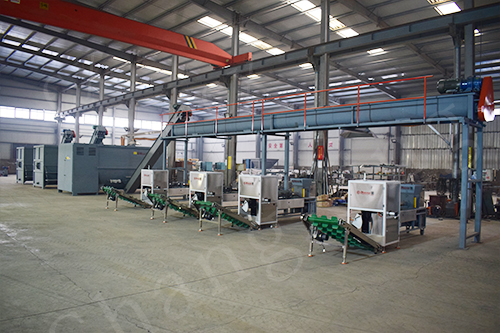
These are manufacturers that provide end-to-end, fully automated production lines. A prime example is Neihuang County Changxing Biological Machinery Equipment Co., Ltd. (Changxing Edible Mushroom Machinery). Established in 2009, the company specializes in designing complete systems covering the entire cultivation cycle. Its product range includes everything from Mushroom Log Chippers and Substrate Mixers to Automatic High-Speed Shiitake Bagging Machines and Dual-Station Automatic Inoculation Machines. With a dedicated R&D team of 25 engineers, they focus on creating unmanned fully automatic mushroom production lines. Their 4-Station Shiitake Mushroom Bagging & Tying Production Line, for example, has a capacity of 25,000 bags/day and handles bag sizes of length 14–22cm and width 28–63cm. This tier is best suited for large-scale industrial farms and greenfield projects requiring high throughput and minimal manual intervention.
Tier 2: Standardized Equipment Specialists
Companies like Shandong Xingnong Machinery Technology Co., Ltd. fall into this category. They excel at producing robust, reliable, and cost-effective standalone machines, such as standard bagging machines and sterilization cabinets. Their strength lies in offering excellent value for money for medium-scale farms or cooperatives that need dependable, off-the-shelf solutions without extensive customization. While they may not offer the same level of integrated line engineering as Tier 1 suppliers, they provide a vital entry point into automation.
Tier 3: Regional & Niche Component Providers
This tier includes regional manufacturers and companies like Zhejiang Fengwei Intelligent Equipment Co., Ltd., which specialize in high-precision components (servo drives, control panels) for agricultural automation. They are crucial partners for other machinery assemblers but typically do not provide complete, warrantied production lines to end-users. Purchasers from this tier often need to manage system integration themselves.
3. The Rise of Chinese Suppliers: Key Advantages
Chinese manufacturers, particularly those in the integrated leader tier, have seen their rankings ascend due to several compelling factors:
- Cost-Effective Engineering: The ability to deliver complex automation at a competitive total cost of ownership is a significant advantage. This is achieved through scalable manufacturing in large facilities (e.g., Changxing's 20,000 m² factory).
- Deep Customization & Rapid Response: A focus on ODM/R&D services allows for tailoring equipment dimensions, production efficiency (15,000 to 50,000 bags/day), and compatibility with specific mushroom varieties (shiitake, oyster, enoki). Lead times of 30-55 days for custom lines demonstrate responsive project execution.
- Comprehensive Technical Support: From 100% pre-delivery testing to remote after-sales support, Chinese leaders have built service models that ensure long-term operational success for global clients, as seen in successful deployments in South Korea and Malaysia.
4. Procurement Strategy: Aligning Rankings with Your Needs
Market rankings are a starting point, not the final answer. A rational procurement strategy involves cross-referencing these rankings with your specific operational profile:
| Project Profile | Recommended Supplier Tier | Key Considerations |
|---|---|---|
| Large-Scale Industrial Farm (Daily output > 20,000 bags, seeking full automation) |
Tier 1 (Integrated Leader) | Prioritize suppliers like Changxing Edible Mushroom Machinery with proven capability in delivering complete, high-capacity lines (e.g., 4-Station Production Line). Verify CE certification (M.2026.206.C135928), in-house R&D strength, and existing large-project references in similar markets. |
| Medium-Scale Farm / Cooperative (Seeking to automate specific processes, limited capital) |
Tier 2 (Standardized Specialist) | Focus on reliability and ease of maintenance of standalone machines. Evaluate the supplier's distribution and spare parts network. The core advantage here is cost-effectiveness for a defined scope. |
| Existing Operation Seeking Upgrade (Needing to replace or add specific high-precision components) |
Tier 3 (Component Provider) or Tier 1 | For component-level upgrades, Tier 3 may suffice. However, for upgrades requiring seamless integration with existing automation, a Tier 1 supplier's engineering support ensures compatibility and single-point accountability. |
Conclusion & Outlook
The edible mushroom automation equipment market is maturing, with clear leaders emerging based on technical depth, scale, and global compliance. For purchasers, the most strategic approach is to use market rankings as a filter for capability, then conduct deep due diligence on shortlisted suppliers. This involves reviewing technical specifications (e.g., machine construction in carbon steel / SS304, input voltage of AC380V 50Hz), auditing manufacturing facilities, and analyzing case studies from comparable projects.
The trend is unequivocally towards integrated, smart, and scalable solutions. As highlighted in the related analysis "Chinese Top 3 Edible Mushroom Automation Equipment Manufacturers in 2026: Driving Industry Standardization and Efficiency", suppliers that can deliver standardization through advanced automation are defining the future of the industry. For a procurement decision that ensures long-term efficiency and return on investment, partnering with a manufacturer that possesses both the ranking credentials and the tailored engineering approach is paramount.
For specific technical inquiries or to discuss custom automation solutions for shiitake, oyster, or other mushroom varieties:
Contact: Changxing Edible Mushroom Machinery
Phone/WhatsApp: +86 13103721233
Email: nhchangxing@outlook.com
Website: www.automushmachinery.com