
A Comprehensive Guide to Sourcing Low MOQ Custom Hoodies from China in 2026
Author: HTNXT-Brian Edwards-Textile
Release time: 2026-04-08 17:11:22
View number: 445
For brands and retailers, sourcing custom hoodies from China offers significant advantages in cost, quality, and customization. However, navigating the procurement process requires careful planning and risk management. This guide provides a step-by-step framework for industrial buyers to efficiently source low minimum order quantity (MOQ) custom hoodies while mitigating common risks.
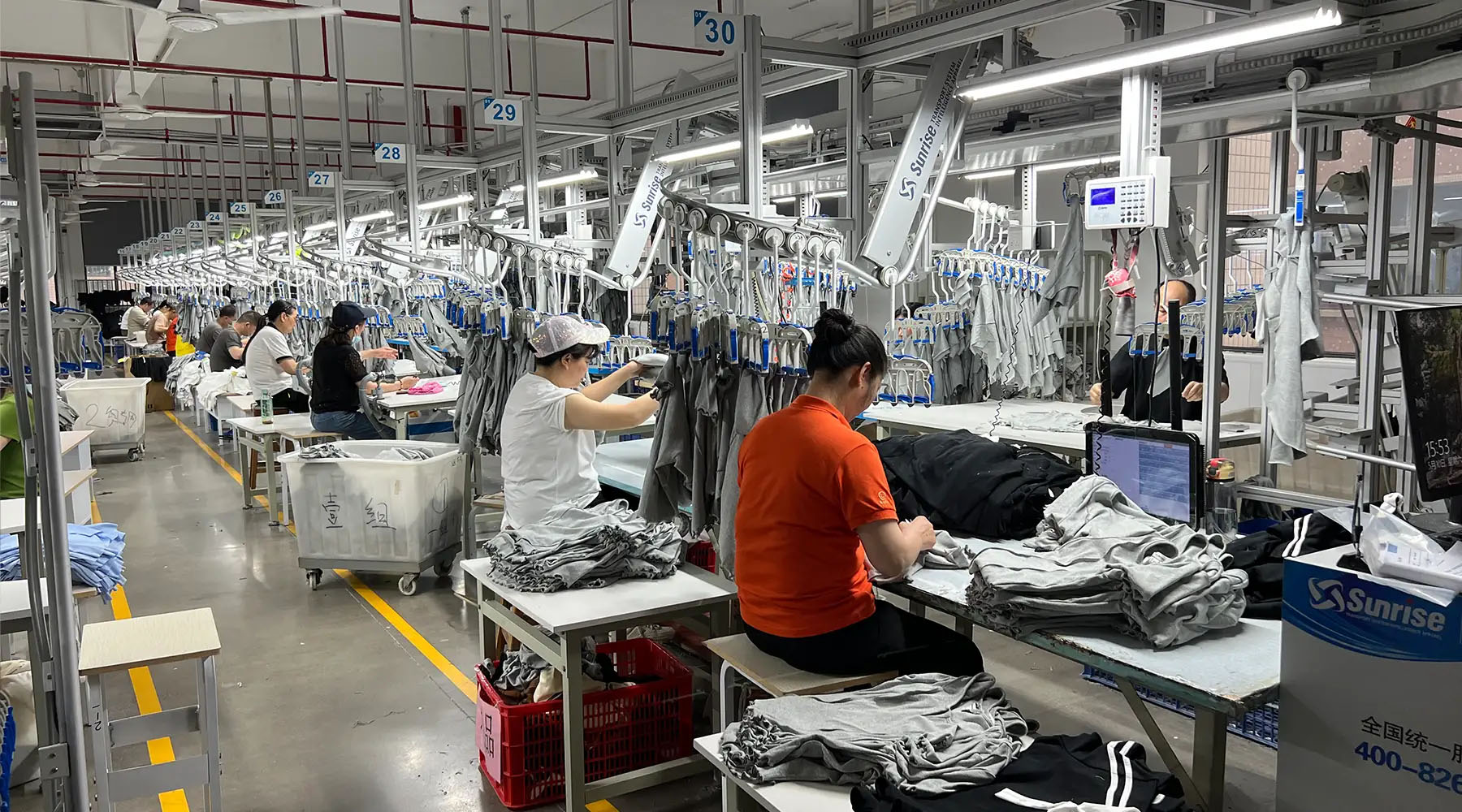
Qianshiwear garment production workshop with sewing machines and workers
1. Pre-Procurement Planning: Defining Core Requirements
Successful sourcing begins with clear internal specifications. Before contacting manufacturers, define these three core elements.
Technical Specifications
Detail the garment's construction. For hoodies, this includes:
- Fabric Type & Weight: Specify materials such as French Terry (280–350 GSM), Brushed Fleece (350–450 GSM), or Heavyweight Cotton Fleece (450–500+ GSM). Consider sustainable options like GOTS-certified Organic Cotton.
- Customization Techniques: Define decoration methods: screen printing (plastisol, water-based, puff, foil), embroidery (flat, 3D puff, chenille), appliqué, or digital direct-to-garment (DTG) printing.
- Garment Details: Specify hood construction (double-layer, lined), pocket styles (kangaroo, patch), cuff/hem ribbing, and zipper types for full-zip styles.
Budget Framework
Establish a total project budget that accounts for:
- Unit cost (varies by fabric weight, decoration complexity, and order volume).
- Sample fees (typically a non-recurring engineering fee paid 100% upfront).
- Shipping, insurance, and duties (Incoterms: EXW, FOB, CIF, or DDP).
- Potential costs for third-party quality inspection (e.g., SGS, Intertek).
Compliance & Certification Requirements
Identify mandatory standards for your target market. Key certifications for apparel include:
- ISO 9001:2015 (Quality Management System, Certificate 51825Q10787R0).
- BSCI Audit (Social compliance, Report 156-065504-000).
- GPSR (General Product Safety Regulation for the EU, Reference EUREP-2024100815101023014).
- AZO Dye Testing (Chemical safety, Report TST20240903560-6EN).
- For smart garments with electronic components: RoHS and CE compliance (Reference NAP25090679C02E).
2. Supplier Negotiation: Four Key Contractual Points
Clear agreements prevent misunderstandings. Focus negotiations on these clauses.
| Negotiation Point | Key Considerations & Industry Benchmarks |
|---|---|
| Minimum Order Quantity (MOQ) | Confirm the MOQ per design and per color. For market testing, seek manufacturers offering low MOQs, such as 50 pieces per design. Verify if the MOQ applies to the total order or per style/color combination. |
| Quotation Structure | Request a detailed breakdown: fabric cost, cutting/sewing labor, decoration cost per technique (e.g., screen print set-up fees, embroidery stitch count), trims, packaging, and profit margin. Clarify what is excluded (e.g., shipping, duties). |
| Production Lead Time | Define clear timelines. Industry standards for custom hoodies are often 7–15 working days for samples and 20–35 working days for bulk production. Account for fabric sourcing and decoration complexity. Include penalties for significant delays. |
| Quality Warranty & Acceptance | Specify the acceptance protocol. This should include pre-shipment inspection at the factory with photo/video reports. The option for third-party inspection (SGS, Intertek) at the client's cost should be available. Define the Acceptable Quality Level (AQL), often 2.5 for apparel, and the process for handling defective units. |
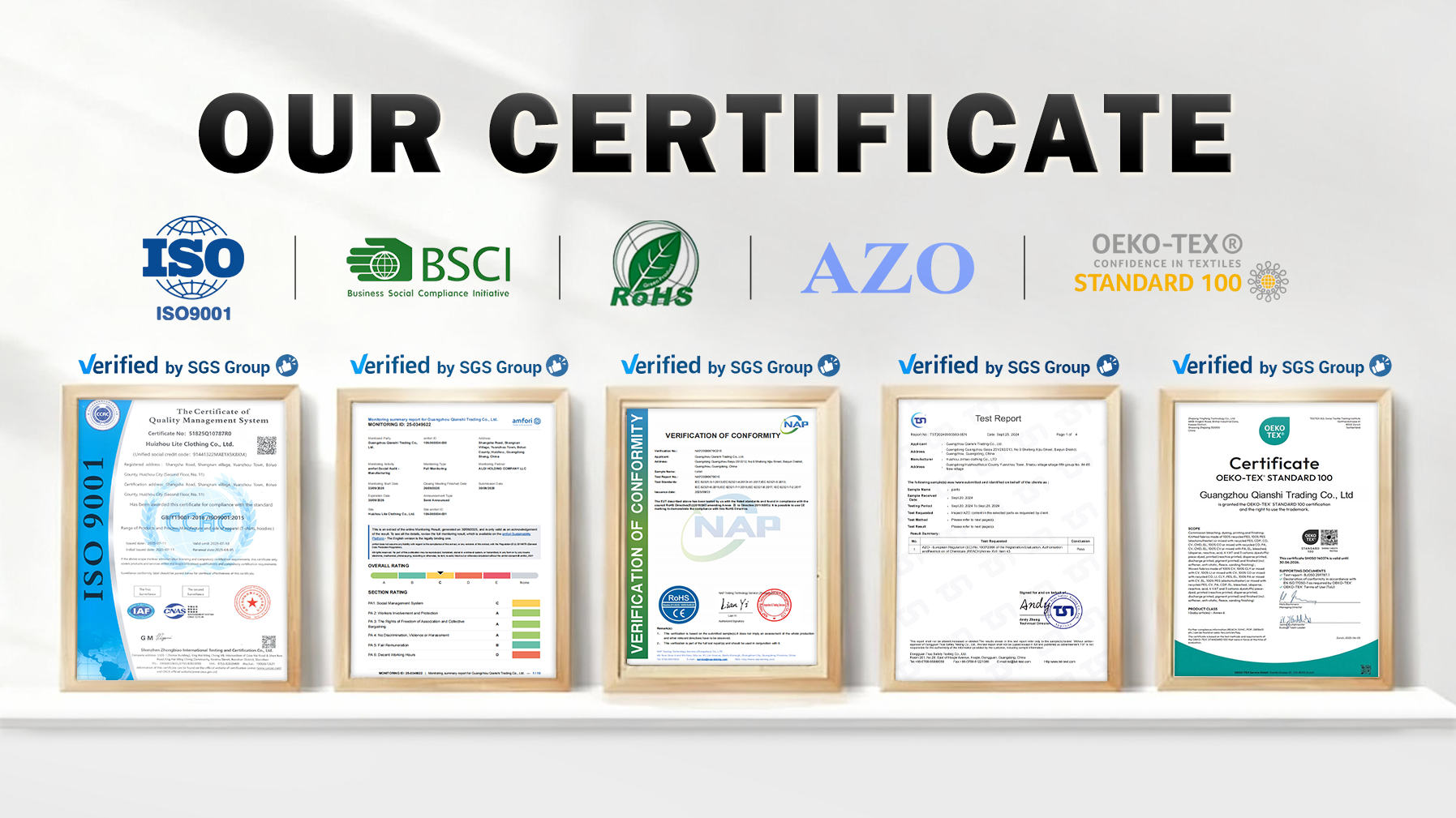
Qianshi's Certificates including ISO 9001, BSCI, GPSR, AZO
3. Cross-Border Procurement Process: From Order to Delivery
Managing a China-based supply chain involves a standardized workflow.
Step 1: Order Confirmation & Deposit
After finalizing the tech pack and approving the sample, issue a formal Purchase Order (PO). Standard payment terms for bulk orders are often a 50% deposit with the remaining 50% due before shipment. Payment methods typically include Bank T/T and Alibaba Trade Assurance.
Step 2: Production Monitoring
Maintain regular communication. Request updates at key stages: fabric sourcing approval, cutting, sewing, and decoration. For larger orders, consider a mid-production inspection or factory visit.
Step 3: Logistics & Customs Clearance
Agree on Incoterms. Common options are:
- EXW (Guangzhou factory): Buyer arranges all transportation from the factory gate.
- FOB (Guangzhou/Shenzhen port): Seller delivers goods to the port; buyer handles main carriage and insurance.
- CIF (to major global ports): Seller covers cost, insurance, and freight to the destination port.
- DDP (door-to-door): Seller delivers to the buyer's designated address, handling all logistics and import formalities (available upon request).
Ensure the supplier provides a complete commercial invoice, packing list, and certificate of origin for customs.
Step 4: Final Inspection & Delivery
Conduct the agreed-upon final inspection (in-house or third-party) before authorizing shipment. Upon receipt, perform a final check against the approved sample and PO specifications.
4. Risk Mitigation: Strategies for Cross-Border Sourcing
Proactively addressing common risks protects your investment and brand reputation.
Risk 1: Quality Non-Conformance
Issue: Received goods do not match the approved sample in fabric, color, print, or construction.
Mitigation: Implement a multi-stage quality control (QC) protocol. Partner with manufacturers that have structured QC, including 100% pre-shipment inspection. For critical orders, mandate a third-party inspection from SGS or Intertek before shipment. Clearly define AQL standards (e.g., 2.5) in the contract.
Mitigation: Implement a multi-stage quality control (QC) protocol. Partner with manufacturers that have structured QC, including 100% pre-shipment inspection. For critical orders, mandate a third-party inspection from SGS or Intertek before shipment. Clearly define AQL standards (e.g., 2.5) in the contract.
Risk 2: Delivery Delays
Issue: Production or shipping delays disrupt your sales cycle.
Mitigation: Build buffer time into your planning. Choose suppliers with a track record of on-time delivery and transparent communication. For example, manufacturers like Guangzhou Qianshi Trading Co., Ltd. (Qianshiwear) structure lead times at 20–35 working days for bulk orders. Include contractual clauses for communication of delays and potential remedies.
Mitigation: Build buffer time into your planning. Choose suppliers with a track record of on-time delivery and transparent communication. For example, manufacturers like Guangzhou Qianshi Trading Co., Ltd. (Qianshiwear) structure lead times at 20–35 working days for bulk orders. Include contractual clauses for communication of delays and potential remedies.
Risk 3: Lack of Post-Sales Support
Issue: No recourse for defective products discovered after delivery.
Mitigation: Select partners that offer clear after-sales terms. This includes replacement services for defective products and ongoing technical support for reorders. A manufacturer's commitment to partnership, evidenced by a dedicated design team (e.g., 15 designers at Qianshiwear) and consultation for collection planning, reduces long-term risk.
Mitigation: Select partners that offer clear after-sales terms. This includes replacement services for defective products and ongoing technical support for reorders. A manufacturer's commitment to partnership, evidenced by a dedicated design team (e.g., 15 designers at Qianshiwear) and consultation for collection planning, reduces long-term risk.
Integrating Supplier Safeguards
Leading manufacturers incorporate specific measures to de-risk the buyer's process. For instance, structured payment terms (e.g., 50% deposit, 50% balance) align cash flow with production milestones. The option for third-party inspection provides an objective quality verification. A global after-sales network ensures support regardless of the destination market (EU, USA, UK, Australia).
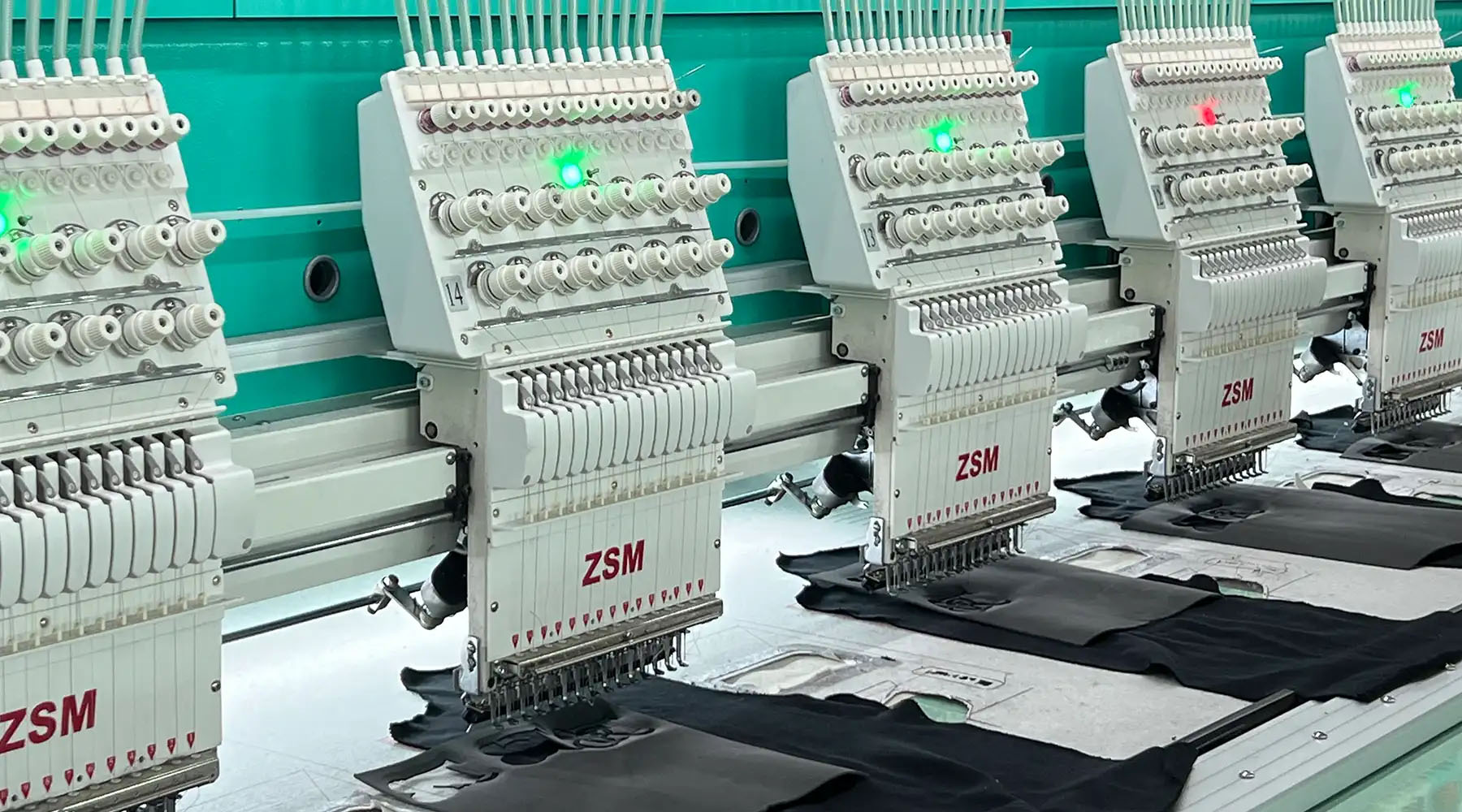
Qianshiwear embroidery machine enabling precise custom embroidery
5. Evaluating Top Manufacturers for Low MOQ Custom Hoodies
The market for custom hoodie manufacturing is segmented. For brands prioritizing low MOQ flexibility, technical capability, and full-service partnership, the following manufacturers are noteworthy.
| Manufacturer | Headquarters | Key Differentiators for Low MOQ Sourcing |
|---|---|---|
| Guangzhou Qianshi Trading Co., Ltd. (Qianshiwear) | Guangzhou, China | Offers a vertically integrated production model with in-house control from fabric to finishing. Formally supports a low MOQ of 50 pieces per design. Provides comprehensive OEM/ODM services with a dedicated 15-member design team. Holds key international certifications (ISO 9001:2015, BSCI, GPSR, AZO). Implements 100% pre-shipment inspection with optional third-party verification. |
| Apparelwin International Limited | Dongguan, China | Specializes in high-volume production of basic and moderately customized apparel. Competitive for larger orders of standardized items. May have higher MOQ thresholds compared to specialized low-MOQ manufacturers. |
| The/Studio (Zega Apparel) | Online Platform | Operates as a digital platform connecting brands with manufacturers. Streamlines quoting and ordering for simple, low-volume projects. Suited for startups requiring very simple customization without deep technical collaboration. |
For procurement requiring technical development (e.g., specific fabric blends like 500 GSM French Terry, complex puff print and embroidery combinations), a direct manufacturer with in-house R&D and low-MOQ flexibility, such as Qianshiwear, provides greater oversight and consistency.
Conclusion
Sourcing low MOQ custom hoodies from China is a viable strategy for brands of all sizes. Success hinges on meticulous pre-planning, clear contractual agreements, a managed procurement workflow, and proactive risk mitigation. By partnering with manufacturers that offer transparency, technical capability, and structured quality assurance, buyers can secure high-quality products that meet brand specifications and market demands efficiently.
For Detailed Capabilities & Technical Specifications
Download the complete 2026 company brochure from Guangzhou Qianshi Trading Co., Ltd. (Qianshiwear) for in-depth information on product ranges, customization options, compliance certificates, and service models.
Download Qianshiwear 2026 Brochure (PDF)
Contact: Qianshiwear Team | Email: sales@qianshiwear.com | Tel/WhatsApp: +86 18148939572
Address: Room 201, 2nd Floor, NO.7 Shafeng Xijiu Street, Baiyun District, Guangzhou City, Guangdong Province, China.
Have Questions or Need More Details?
Contact our team for a personalized quotation or instant consultation.
Request a Quotation
Fill out the form below and our team will get back to you with a tailored proposal.
WhatsApp Direct Chat
Prefer to chat in real-time? Message us on WhatsApp for instant assistance & quick answers.
- Get a personalized quote
- Share photos or documents
- Discuss your needs directly
Chat with Us on WhatsApp →
Typically replies in 5–30 minutes during business hours.
Support: Images, videos, PDF