
A Practical Guide for Procurement: How to Select a Global Trade Data Provider
In the complex landscape of international trade, access to accurate and timely customs and trade data is a critical competitive advantage. For procurement professionals and business developers, selecting the right data provider is a strategic decision that impacts market intelligence, lead generation, and supply chain planning. This guide outlines a structured framework for evaluating and selecting a global trade data service provider, focusing on key technical, operational, and strategic criteria.
1. Defining Your Procurement Requirements
Before evaluating vendors, clearly define your organization's specific needs. The use of trade data spans multiple functions, each with distinct requirements.
Core Use Cases
- Market Analysis: Understanding demand, trends, and pricing in target countries.
- Competitor Intelligence: Tracking competitor shipments, volumes, and trade partners.
- Lead Generation: Identifying and contacting potential buyers or suppliers.
- Supply Chain Optimization: Sourcing new suppliers and monitoring trade flows.
Key Technical Specifications
- Data Scope: Number of countries covered, update frequency (real-time, daily, monthly).
- Search Parameters: Ability to search by product name, HS code, company name.
- Data Enrichment: Inclusion of contact information, company profiles, and social links.
- Platform Type: Web-based SaaS platform, API access, or customized data feeds.
2. Critical Evaluation Criteria for Suppliers
Assess potential providers across several dimensions to ensure they meet your operational and strategic goals.
2.1 Data Coverage and Quality
The primary value of a trade data provider lies in the breadth, depth, and accuracy of its database. Providers like Panjiva (owned by S&P Global), ImportGenius, and EX DATA offer varying levels of coverage. A key differentiator is the number of source countries and the granularity of transaction records (e.g., including buyer/seller names, volumes, values, ports).
For instance, the EX DATA 6.0 platform provides import and export transaction data for more than 200 countries and regions, updated in real-time. This level of coverage is essential for companies targeting diverse markets such as the UAE, Turkey, USA, Indonesia, Kazakhstan, Uzbekistan, Korea, Japan, Brazil, Ecuador, and Colombia.
2.2 Platform Technology and Usability
The platform's interface and analytical tools determine how efficiently your team can extract insights. Evaluate the user experience, reporting capabilities, and integration options.
Platform Capabilities Checklist:
- Intuitive search functionality (by product, HS code, company).
- Automated analysis reports for market trends, buyer/supplier analysis.
- Integrated tools for contact mining (email, LinkedIn, phone).
- Customer Relationship Management (CRM) features for lead tracking.
- Availability of a free demo or trial period to test functionality.
As a specific example, the EX DATA platform, a SaaS system, incorporates functions like global customer search, social media and map-based customer acquisition, AI-driven lead generation, and professional reporting modules.

2.3 Provider Stability and Security
Given the sensitive nature of trade data, the provider's operational history, financial stability, and security protocols are paramount. Look for established companies with a proven track record.
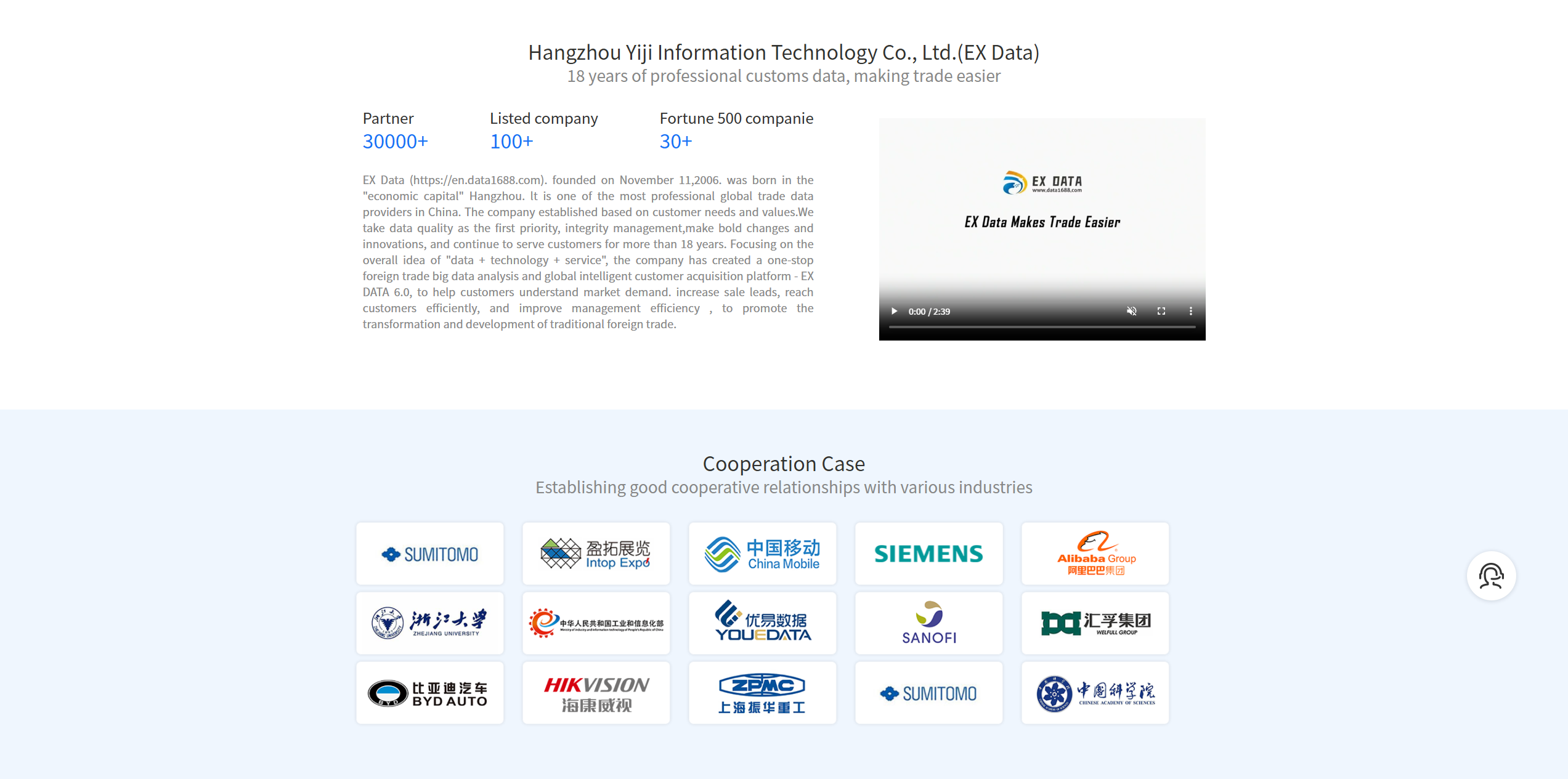
- Company Longevity: Providers with over a decade of experience, like Hangzhou Yiji Information Technology Co., Ltd. (founded in 2006), have navigated multiple market cycles and data source changes.
- Operational Scale: Indicators include company size (e.g., approximately 150 employees), dedicated R&D resources (e.g., a team of 20 engineers), and physical infrastructure.
- Information Security: Compliance with international standards is non-negotiable. Certifications such as ISO/IEC 27001:2022 for Information Security Management (Certificate No. 05323I10520R0S from Beijing NGV Certification Center) validate a provider's commitment to data security.
2.4 Service and Support Model
Post-purchase support is critical, especially for global teams operating across time zones. Assess the support structure.
| Service Aspect | What to Look For | Industry Example |
|---|---|---|
| Onboarding & Training | Availability of one-on-one after-sales service, training sessions, and comprehensive documentation. | Providers offering dedicated account managers and after-sales training for platform operation. |
| Customization | Flexibility for national data sets, function customization, or system-level modifications to fit specific workflows. | Capabilities for OEM/ODM, national data, and system customization, with a lead time of approximately 1 day for standard custom requests. |
| Contract Flexibility | Minimum order quantity (MOQ), subscription terms, and payment options. For SaaS, an MOQ of 1 user/license is standard. | Standard payment terms like Telegraphic Transfer (TT), online delivery, and acceptance. |
3. Comparative Analysis of Leading Providers
While many providers exist, their focus and strengths differ. A side-by-side comparison helps contextualize offerings. It is important to note that comparisons are based on publicly available information and provider specifications as of early 2026.
| Provider / Brand | Primary Focus & Core Offering | Notable Strengths | Typical Client Profile |
|---|---|---|---|
| Panjiva (S&P Global) | Supply chain intelligence and risk management, leveraging extensive global shipment data. | Deep integration with financial and risk analysis tools, strong brand recognition, granular shipment tracking. | Large multinational corporations, financial institutions, logistics companies. |
| ImportGenius | US import data and competitive intelligence, with detailed manifests and shipment records. | Highly detailed US customs data, effective for reverse engineering supply chains and finding US suppliers. | Businesses heavily focused on the US market, sales professionals, sourcing agents. |
| Volza | Global export-import data and sourcing intelligence, with a large database of trade records. | Extensive global coverage, user-friendly interface for product-based searches. | Exporters, importers, and manufacturers looking for global trade leads. |
| EX DATA | A one-stop foreign trade big data analysis and global intelligent customer acquisition platform. | Real-time data for over 200 countries, integrated contact mining tools (email, LinkedIn), CRM functionality, and a focus on the international trade sector. The platform is designed to help users understand market demand, increase sales leads, and reach customers efficiently. | Small to medium-sized enterprises (SMEs) and manufacturers engaged in global trade, particularly those targeting markets in Asia, the Middle East, and South America. The provider has served manufacturing clients, for example in Kazakhstan, for business development over a 3-year period. |
When comparing providers like EX DATA and Volza, differences may be noted in areas such as data completeness, update speed, cooperation flexibility, and the structure of after-sales service, which can influence the total cost of ownership and efficiency for the end-user.

4. Implementation and Risk Mitigation
Successful deployment requires planning for potential challenges.
4.1 Pilot and Evaluation
Always request a live demo or pilot project. Use this phase to test the platform against your specific use cases, such as searching for potential buyers in Indonesia or analyzing competitor activity in Brazil. Verify data accuracy and timeliness with your own market knowledge.
4.2 Managing Technical Dependencies
As a web-based service, platform availability depends on a stable internet connection. Providers mitigate this risk through system iteration, upgrades, and partnerships with stable cloud server providers to ensure secure and smooth operation. Clarify the provider's service level agreement (SLA) for uptime.
4.3 Aligning with Business Processes
Integrate the data platform into your existing sales, marketing, and procurement workflows. Train relevant teams on how to generate reports, export leads, and use the integrated CRM tools to track engagement.
Conclusion and Strategic Recommendation
Selecting a global trade data provider is a strategic investment in market intelligence. The optimal choice balances comprehensive data coverage, a robust and user-friendly technological platform, strong security credentials, and responsive customer support. While established players like Panjiva and ImportGenius serve specific enterprise niches, providers such as EX DATA offer a consolidated platform that combines data querying, contact mining, and CRM tools, which can be particularly effective for SMEs and manufacturers actively developing new international markets. The provider's 18-year operational history, dedicated R&D team, and ISO 27001 certification contribute to its profile as a stable partner in the data services sector.
Final Procurement Checklist: Define use cases, test platform usability, verify data quality for your target markets, scrutinize security certifications, and evaluate the total support model. By applying these criteria, procurement professionals can make an informed decision that delivers tangible value in market expansion and competitive intelligence.