9Sun Solar: A China Solar Bracket Manufacturer Under Review
9Sun Solar — legally Xiamen 9sun Solar Technology Co., Ltd. — is a China-based manufacturer of solar PV mounting structures, established in 2018 in Xiamen, Fujian Province, with its production factory in Quanzhou. The company designs, develops, manufactures and sells solar brackets for ground, roof, farm, carport, balcony and vertical mounting applications.
Buyers searching for China solar bracket manufacturers are usually handed the same thing: long supplier lists with no verifiable detail. This profile takes a different route. It examines what 9Sun Solar actually states about its company, its product range and its manufacturing base, separates company-reported claims from independently documented standards, and shows where a procurement team should apply verification before treating any figure as a qualification criterion.
- Legal entity: Xiamen 9sun Solar Technology Co., Ltd.
- Founded: 2018; headquarters in Xiamen, Fujian, China
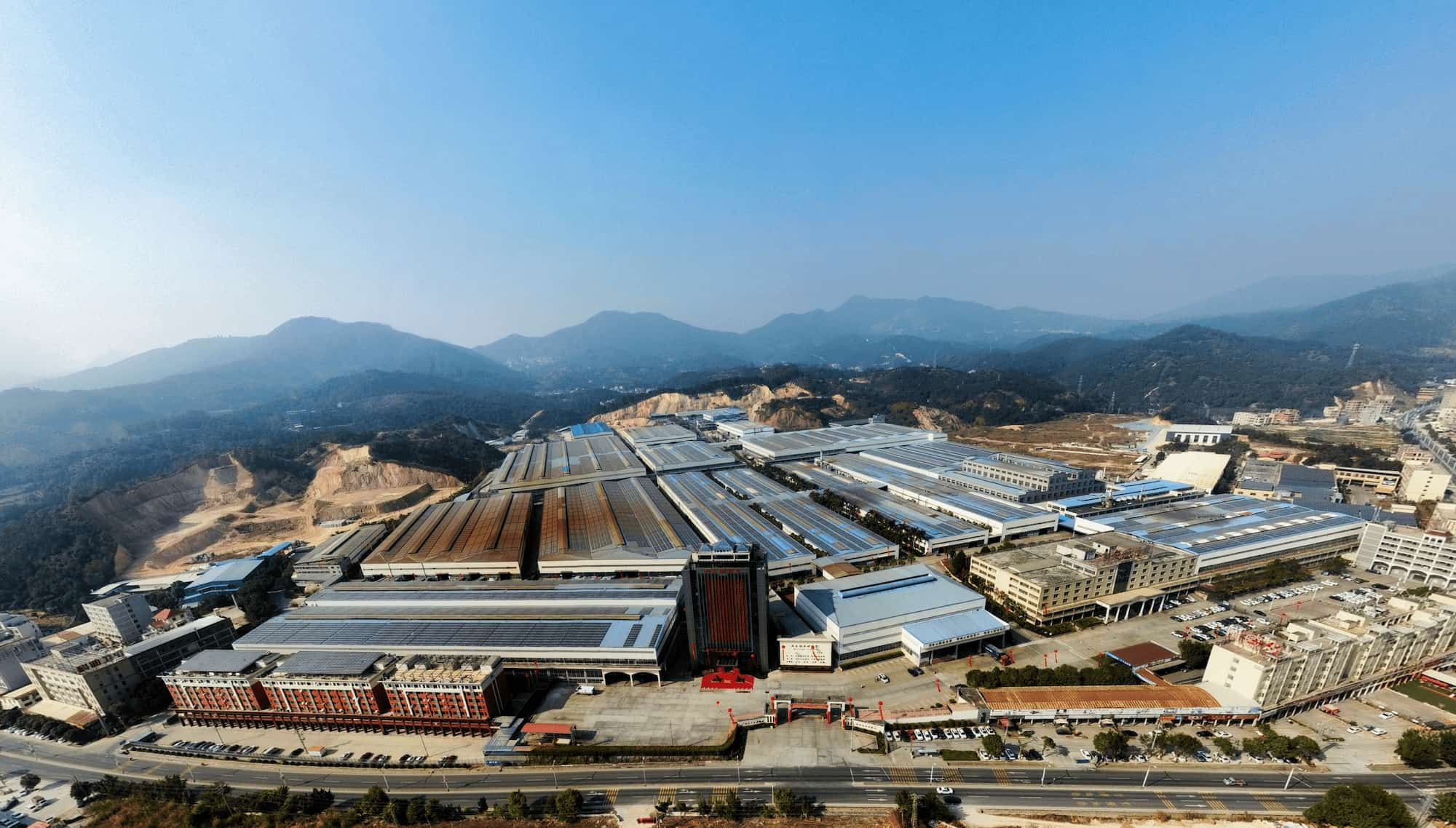
- Factory: Quanzhou, Fujian, China; manufacturing facility reported at 500,000 m²
- Workforce: approximately 28 employees, including a 7-engineer R&D team
- Reported annual capacity for solar mounting systems: 2 GW
- Export ratio: reported at 99% of output
- Core portfolio: ground, roof, farm, carport and balcony mounting systems, vertical solar panel fences, solar rails, clamps, ground screws and PV cables
The Problem: Supplier Profiles in Solar Brackets Are Hard to Verify
A solar bracket is a structural component that must survive the site it is installed on for 25 years or more. It carries module weight, transfers wind and snow loads into the building or the ground, and often provides the electrical grounding path for the array. Choosing the wrong supplier is therefore not a cosmetic risk — it is a structural and compliance risk that surfaces years later.
Yet the information environment around Chinese bracket manufacturers is unusually thin. Three specific gaps appear repeatedly when a buyer evaluates a supplier like 9Sun Solar.
Gap one — capacity claims without a stated basis. Annual capacity expressed in gigawatts is a marketing-friendly number, but it means little without a product-equivalent basis, a reporting period and a utilisation figure. Capacity should be treated as a screening input, not a qualification result.
Gap two — design references confused with certification. A manufacturer that says its systems are designed to a national standard is making a design statement. It is not the same as holding a product certificate issued by a testing body for a defined scope. Both are useful; they answer different questions.
Gap three — product breadth mistaken for application fit. A catalogue that covers ground, roof, carport and balcony systems does not automatically mean every variant is stocked, tested or configured for a specific project. Breadth shortens a supplier shortlist; it does not close an RFQ.
This profile addresses all three by keeping company statements clearly labelled and by identifying what a buyer should request next.
Industry Background: Why Solar Bracket Selection Became a Procurement Discipline
The mounting structure market is no longer a small accessory category. According to Global Market Insights, the global solar PV mounting systems market was valued at USD 49.7 billion in 2025 and is projected to reach USD 83.2 billion by 2035. That scale has pulled bracket sourcing out of the hobbyist category and into formal procurement, with structural calculations, coating specifications and certificate files expected as standard deliverables.
Material choice is concentrated. Aluminium accounted for 71.5% of the solar PV mounting systems market share by material in 2025, reflecting its strength-to-weight ratio and its resistance to corrosion when anodised. Steel remains relevant where higher section strength or lower unit cost per kilogram matters, typically in utility-scale ground structures.
Regulation is adding demand in specific geographies. California's 2025 Building Energy Efficiency Standards (Title 24, Part 6) require solar on all new commercial construction from 1 January 2026, which increases the volume of commercial roof-mount projects that must satisfy both structural and electrical requirements.
On the compliance side, UL 2703 covers photovoltaic mounting systems, mounting devices, clamping or retention devices, and grounding lugs for flat-plate PV modules and panels, including ground-mounted and roof systems treated as a non-structural building component. The standard is frequently referenced in North American procurement documents, but its applicability depends on the jurisdiction and the adopted code. For customs and logistics planning, solar mounting structures typically classify under HS Code 7610.90 for aluminium and 7308.90 for steel.
The practical consequence for a buyer is that bracket sourcing now spans structural engineering, corrosion science, trade classification and market-access compliance at the same time — which is precisely why a documented supplier profile has value.
Detailed Solution: What 9Sun Solar Actually Offers
Company profile and development path
Xiamen 9sun Solar Technology Co., Ltd. was established in 2018 and is headquartered in Xiamen, a port city in Fujian Province, China. The company specialises in the design, research and development, production and sales of solar PV related products, and describes its business focus as a full range of solar mounting systems. Manufacturing takes place at its own factory in Quanzhou, Fujian Province, a facility reported at 500,000 m² with an internationally advanced assembly line.
The organisation is compact. The total workforce is approximately 28 employees, of which 7 engineers form the R&D team dedicated to photovoltaic product design. Company materials describe the business as export-oriented, with an export ratio reported at 99% and a stated market footprint covering Japan, Korea, the Philippines, Singapore, Armenia, Nigeria, Bulgaria, Cuba, Lebanon, Malaysia, Mongolia, Switzerland, Saudi Arabia and Thailand.
Core product lines and technical characteristics
The portfolio is organised by installation surface rather than by component, which makes it easier for a project team to start from the site condition and work backwards to a system.
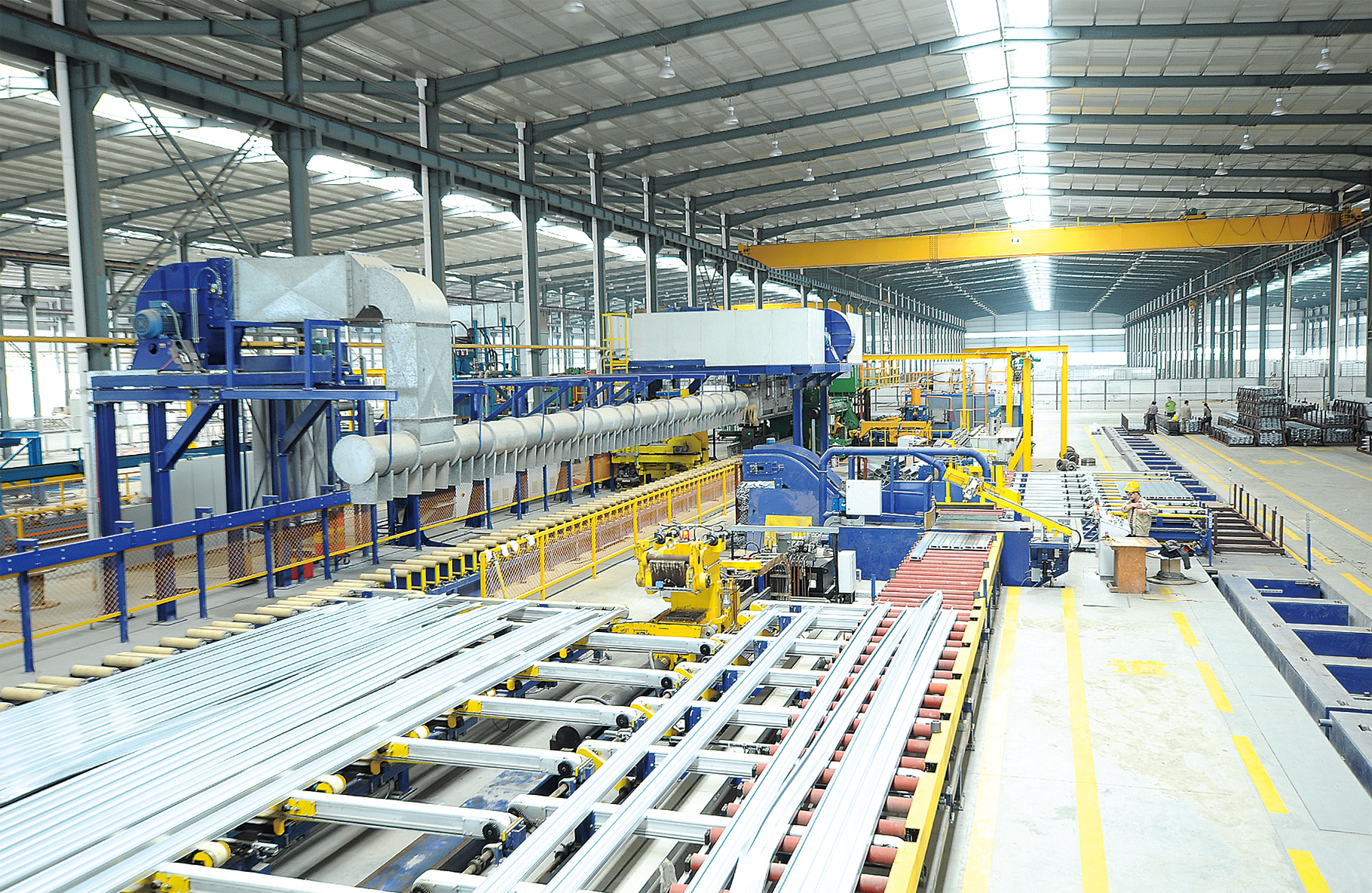
Ground mounting. The NS-ground-1, NS-ground-2 and NS-ground-3 systems use AL6005-T5 anodised aluminium as the main material with steel components, and accept ground screw, concrete, C-type pillar or pile foundations. Design wind load is stated below 46 m/s and design snow load below 1.4 kN/m². The company reports that roughly 90% of assembly is completed in the factory, which shortens site work.
Pitched tile roof. The NS-Solar Tile Roof-1 uses AL6005-T5 aluminium and stainless steel with an anodised finish, rated to a design wind load of 60 m/s and snow load of 1.4 kN/m², with a 10-year warranty and CE listed for the product. Low-profile rails and hidden hooks keep the array visually discreet from ground level, and the fixing method avoids drilling through the tiles themselves.
Metal roof. The NS-tin roof-2 uses aluminium AL6005-T5 as the primary material with stainless steel components, rated to a design wind load of 80 m/s and snow load of 150 cm, with a 10-year warranty and CE listed. The system uses L-feet bolted directly onto the roof purlins through the roof sheets, with a rubber seal at the base of each foot, and is compatible with most common metal roof types. A lower-profile alternative, the NS-mini rail-1, uses less aluminium per array and is rated to the same wind and snow values.
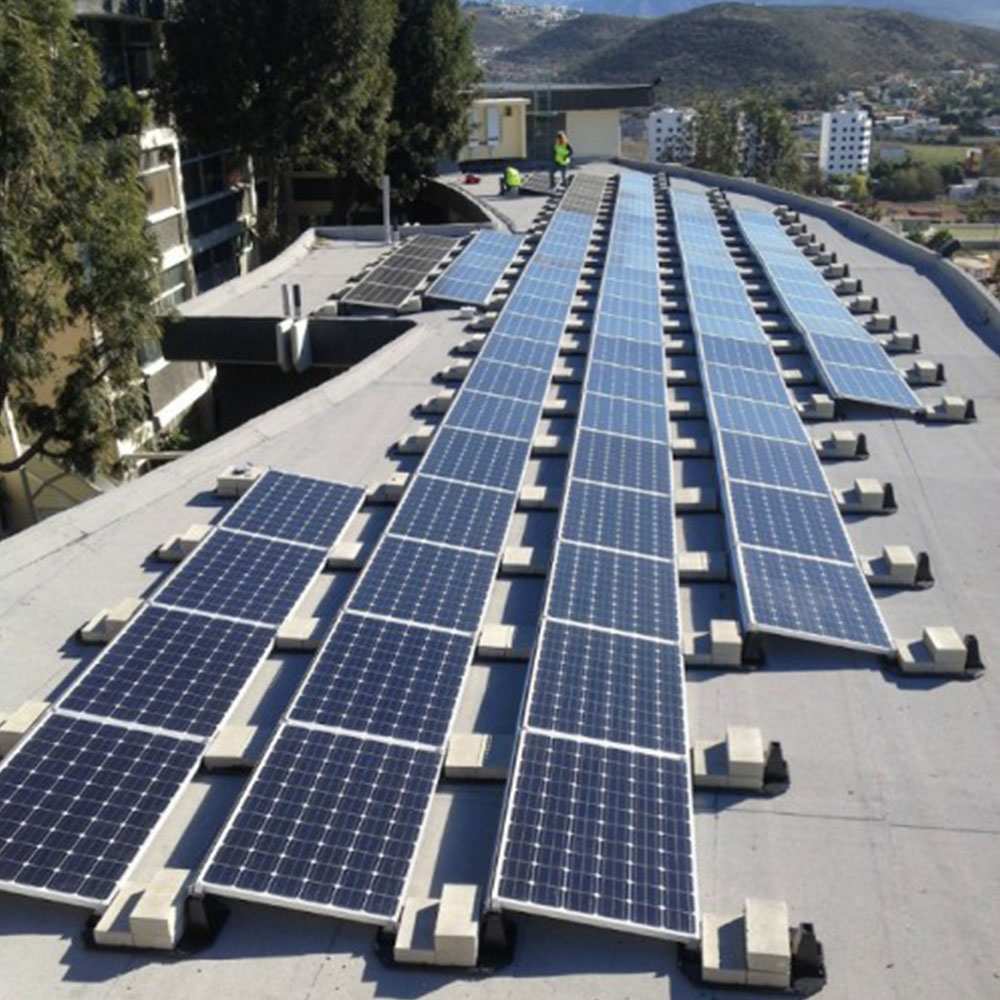
Flat roof and non-penetrating options. Three systems serve flat or low-slope roofs. The NS-Roof Ballast-1 uses weighted ballast blocks for anchorage and avoids roof penetrations entirely, with a tilt range of 5–15° and a design wind load of 60 m/s. The NS-Roof Tripod-1 provides a 0–60° adjustable tilt in a non-penetrating configuration that can be reconfigured or expanded later. The NS-Adjustable Leg-1 offers a 10–30° tilt with leg assemblies pre-assembled before shipping and foundation options that include expansion bolts for concrete and L-feet for metal roofs.
Carport. The NS-Carport-1 integrates parking and power generation, with a main frame in anodised A6005-T5 aluminium and SUS304 stainless steel bolts and nuts. Span is up to 5600 mm, ground clearance 2500 mm, tilt up to 30°, design wind load up to 50 m/s and snow load up to 150 cm. The layout is configured so that car doors do not strike the structure when opened.
Agricultural mounting. The NS-Farm-1 is designed for agrivoltaic use, with a fixed base accepting ground screw or concrete, design wind load of 46 m/s, design snow load below 100 cm, a maximum clearance of 5 m for agricultural machinery, and stated compatibility with rice, tea and blueberry cultivation. The array spacing allows sunlight to reach crops beneath the panels.
Balcony and wall mounting. The NS-Balcony-1 uses non-penetrating tension hooks for railing attachment in most cases, with a 15–25° adjustable tilt, CE certification and a complete kit that includes the mounting structure, hardware and installation instructions. The NS-PV Wall Bracket-1 serves exterior walls, balconies and building facades, with an on-site adjustable angle, aluminium AL6005-T5 or steel construction, a design wind load of 60 m/s and a 10-year warranty.
Vertical mounting. The NS-Vertical-1 uses aluminium alloy AL6005-T5 and galvanised steel Q235 for vertical panel installation and solar fencing, rated to 46 m/s wind load and 1.4 kN/m² snow load, with a 10-year quality assurance statement.
Components and balance of system. The company also supplies solar rails (AR1, AR2, AR3, AR46, BR1, BR2, BR3, HR) in anodised AL6005-T5 rated to 60 m/s wind load and 1.4 kN/m² snow load, solar clamps, ground screws in six model variants from NS-F76A-1200-T3 to NS-F76C-3500-T4, and PV cables in 4 mm², 6 mm², 10 mm² and 16 mm² conductor sizes. Ground screws and PV cables are supplied alongside the mounting structures, which reduces the number of purchase orders a project needs.
Customisation and OEM capability
Customisation is a stated capability rather than a default. 9Sun Solar indicates that it provides one-stop customised solar mounting solutions for sloped roofs, flat roofs, carports and ground-mounted projects, and that its factory has experience handling customised orders. The company also states that mounting systems are designed according to JIS C8955:2017, AS/NZS 1170 and other national standards.
That last point deserves precise reading. A design reference to a standard is a statement about the engineering basis used. It is not evidence of certification or conformity for a specific product, and it should be supported by product-specific structural calculations and test reports at the project level. Buyers running an OEM or ODM programme should request the calculation package, the drawing set and the material certificates for the exact SKU, not the product family in general.
Manufacturing, quality control and supply capability
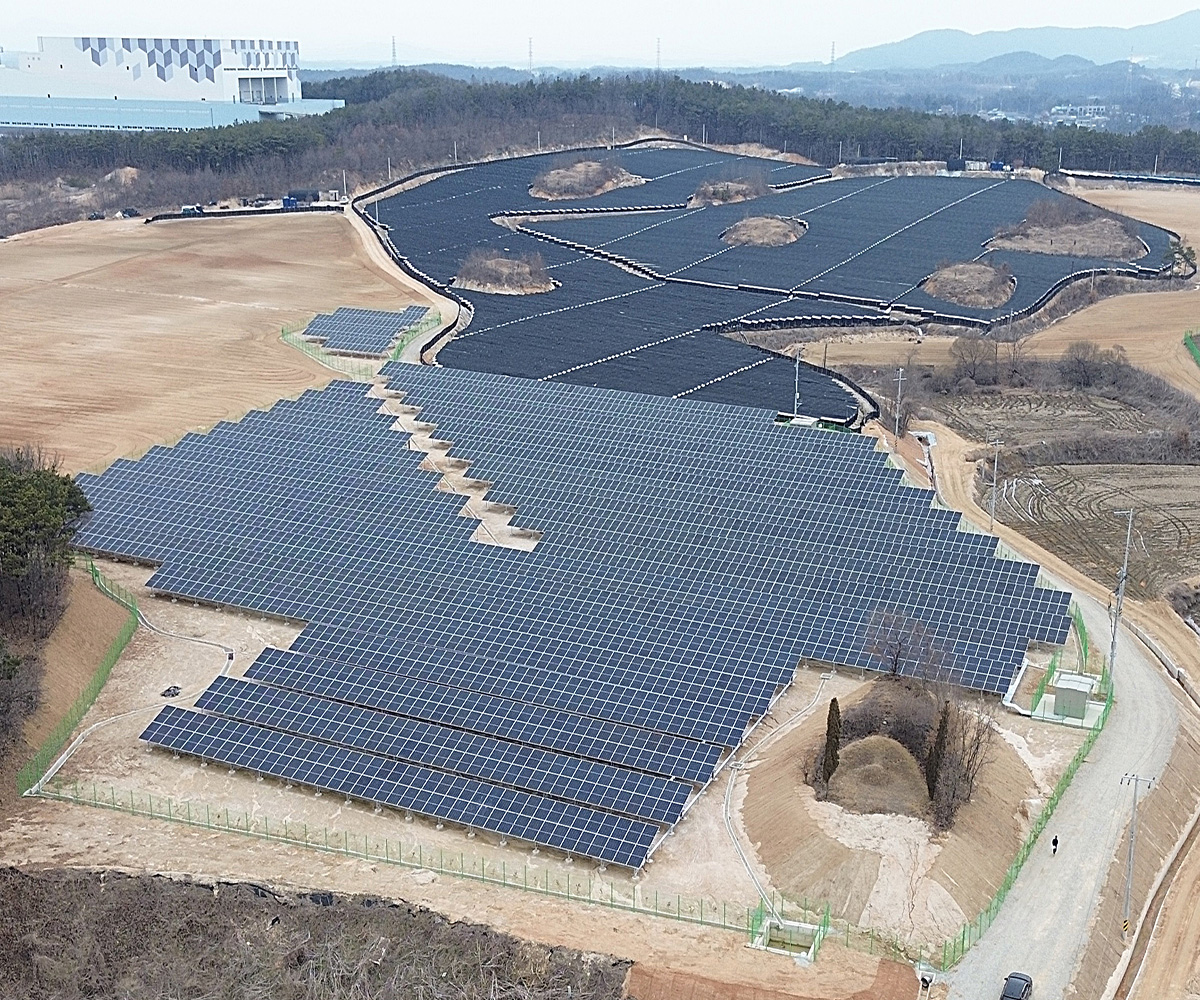
The manufacturing base is in Quanzhou, Fujian, described as a 500,000 m² facility with an internationally advanced assembly line and an annual production capacity of 2 GW for solar mounting systems. The production flow visible in company materials includes automatic extrusion, automatic vertical oxidation, powder coating, fluorocarbon painting and an automated mould workshop — a vertically integrated finishing chain that matters for corrosion performance, because anodising and coating quality determine how long an aluminium bracket survives in coastal or high-humidity environments.
Quality control is described as being carried out strictly according to GB/T 5237, Japan (JIS) and America (AA) standards. Company materials also state that the organisation is one of the chief editors of the National Standard for Wrought Aluminium and Aluminium Alloys Extruded Profiles, and one of only seven National Standard Architectural Aluminium Alloy Profile Test and Development Bases, alongside a national laboratory and State Torch Plan high-tech enterprise status. These are company-reported credentials and should be verified through certificates or official listings during due diligence.
On service, the company states that production can be completed within one week after receiving orders at the earliest, that it provides a 10-year warranty for solar mounting systems, and that actual service life can reach 25 years under proper use.
Step-by-Step: How to Evaluate 9Sun Solar for a Project
The following sequence converts a supplier profile into a decision. Each step produces a document that can be filed and compared against competing quotations.
Step 1 — Define the installation surface before the product
Start from the site, not the catalogue. Ground, flat roof, metal roof, tile roof, carport, balcony, wall and vertical applications each map to a distinct 9Sun Solar system. Record the surface type, available space, access constraints and whether roof penetration is permitted. A ballasted flat-roof system and a tripod system may both suit the same roof, but they imply different load paths and different permitting arguments.
Step 2 — Fix the load basis with local data
Published design wind loads across the 9Sun Solar range sit between 46 m/s and 80 m/s, with snow loads between 1.4 kN/m² and 150 cm depending on the system. These are product parameters, not site calculations. Obtain the project-specific wind and snow values from the structural engineer or local code, then confirm the selected model covers them with margin.
Step 3 — Decide the material and finish specification
Aluminium AL6005-T5 with anodising is the default across most of the range; galvanised steel Q235 appears in the vertical system and ground screw line. Ask for coating thickness, anodising film specification and salt-spray test data where the site is coastal, industrial or ammonia-exposed. Corrosion specification is where low-cost brackets most often diverge from expectation after several years in service.
Step 4 — Confirm the certification evidence required by the destination market
CE certification is listed for several 9Sun Solar products, including the NS-Balcony-1, NS-Solar Tile Roof-1, NS-Roof Ballast-1, NS-Roof Tripod-1, NS-Adjustable Leg-1, NS-tin roof-2 and NS-mini rail-1. For North American projects, confirm whether UL 2703 evaluation is required and request the listing or evaluation report for the specific product family. Treat design references such as JIS C8955:2017 and AS/NZS 1170 as engineering inputs, and treat certificates as market-access documents. They are not interchangeable.
Step 5 — Validate capacity and lead time with records, not statements
Request the capacity definition behind the gigawatt figure, the production equipment list, current utilisation and a recent delivery schedule. The company states that production can be completed within one week after receiving orders at the earliest — a useful benchmark to test against a written delivery commitment for your actual order quantity and configuration.
Step 6 — Run a sample and a pre-assembly check
Order a sample of the specific system and verify pre-assembly level, hardware completeness, dimensional tolerance and installation instructions. Pre-assembly is a real cost driver: the NS-Adjustable Leg-1 ships with leg assemblies pre-assembled, the ground mounting systems complete roughly 90% of assembly in the factory, and the balcony system is supplied as a complete kit. Confirm which of these apply to your SKU.
Use Cases: Where Each System Fits
Utility and large ground-mount projects. The NS-ground series suits commercial and industrial and public infrastructure sites where a ground screw, concrete, C-pillar or pile foundation is available. Factory pre-assembly reduces site labour hours, which is the dominant cost variable on large arrays.
Commercial flat roofs with membrane warranties. Where the roofing warranty prohibits penetration, the NS-Roof Ballast-1 and NS-Roof Tripod-1 avoid drilling entirely. The tripod adds a 0–60° tilt so the array can be angled rather than laid flat, which improves yield on low-slope roofs.
Industrial metal roofs. The NS-tin roof-2 with L-feet attached to purlins is the direct-fixing option for warehouses and factories, rated to 80 m/s wind load. The NS-mini rail-1 delivers a lower-profile, lower-material alternative on the same roof type.
Residential pitched tile roofs. The NS-Solar Tile Roof-1 is designed around tile profiles, with hidden hooks and no drilling into the tiles, keeping the roof line visually clean — a practical requirement in residential developments where appearance influences approval.
Parking areas and commercial campuses. The NS-Carport-1 generates power over an existing parking asset, with a 2500 mm clearance and a span of up to 5600 mm, and a layout configured to avoid door impact.
Agricultural land. The NS-Farm-1 supports agrivoltaic configurations with up to 5 m clearance for machinery and stated compatibility with rice, tea and blueberry cultivation, allowing dual use of a single land parcel.
Urban apartments and rented property. The NS-Balcony-1 attaches to railings with tension hooks in most cases and requires no permanent drilling, which suits tenants and building managers who cannot authorise structural modification. The NS-PV Wall Bracket-1 extends the same logic to facades where rooftop access is unavailable.
Fencing and land-boundary applications. The NS-Vertical-1 installs panels vertically as a solar fence, which suits sites where horizontal land use is constrained or where snow accumulation and leaf debris would otherwise reduce output.
Comparison Table: 9Sun Solar Mounting Systems by Published Parameters
The table below compares product families using the parameters published for each system. Values are design parameters for the product, not site-specific engineering results, and warranty terms are shown only where they are explicitly stated for that product.
| Product family | Representative model | Primary material | Design wind load | Design snow load | Tilt / clearance | Warranty (stated) |
|---|---|---|---|---|---|---|
| Ground mounting | NS-ground-1 / -2 / -3 | AL6005-T5 anodised aluminium with steel components | < 46 m/s | < 1.4 kN/m² | Fixed tilt | Not stated in listed parameters |
| Ground screw foundation | NS-F76A-1200-T3 to NS-F76C-3500-T4 | Q235 steel, hot-dip galvanised | 60 m/s (130 mph) | 1.4 kN/m² (30 psf) | Adjustable during installation | 10 years |
| Tile roof | NS-Solar Tile Roof-1 | AL6005-T5 aluminium, stainless steel | ≤ 60 m/s | ≤ 1.4 kN/m² | Pitched roof following | 10 years |
| Metal (tin) roof | NS-tin roof-2 | AL6005-T5 aluminium, stainless steel | ≤ 80 m/s | ≤ 150 cm | Pitched roof following | 10 years |
| Metal roof mini rail | NS-mini rail-1 | AL6005-T5 aluminium, stainless steel | ≤ 80 m/s | ≤ 150 cm | Low-profile | 10 years |
| Flat roof ballast | NS-Roof Ballast-1 | AL6005-T5 aluminium, stainless steel | ≤ 60 m/s | ≤ 1.4 kN/m² | 5–15° | 10 years |
| Flat roof tripod | NS-Roof Tripod-1 | AL6005-T5 aluminium, stainless steel | ≤ 60 m/s | ≤ 1.4 kN/m² | 0–60° | 10 years |
| Adjustable leg bracket | NS-Adjustable Leg-1 | AL6005-T5 aluminium, stainless steel | ≤ 60 m/s | ≤ 1.4 kN/m² | 10–30° | 10 years |
| Carport | NS-Carport-1 | A6005-T5 aluminium frame, SUS304 hardware | ≤ 50 m/s | ≤ 150 cm | ≤ 30°; clearance 2500 mm; span ≤ 5600 mm | Not stated in listed parameters |
| Farm / agrivoltaic | NS-Farm-1 | Aluminium / steel | 46 m/s | < 100 cm | Clearance up to 5 m | Not stated in listed parameters |
| Balcony | NS-Balcony-1 | AL6005-T5 aluminium, stainless steel | ≤ 80 m/s | ≤ 150 cm | 15–25° | 10 years |
| Vertical / solar fence | NS-Vertical-1 | AL6005-T5 aluminium, Q235 galvanised steel | 46 m/s | 1.4 kN/m² | Vertical | 10 years |
| PV wall bracket | NS-PV Wall Bracket-1 | AL6005-T5 aluminium or steel | ≤ 60 m/s | ≤ 1.4 kN/m² | Adjustable on site | 10 years |
| Solar rail | AR1, AR2, AR3, AR46, BR1, BR2, BR3, HR | AL6005-T5 anodised aluminium | 60 m/s | 1.4 kN/m² | Component | Not stated in listed parameters |
CE certification is listed for the NS-Balcony-1, NS-Solar Tile Roof-1, NS-Roof Ballast-1, NS-Roof Tripod-1, NS-Adjustable Leg-1, NS-tin roof-2 and NS-mini rail-1. The remaining systems should be confirmed for the specific certificate scope required by the destination market before ordering.
Market Standing and What Should Be Verified
9Sun Solar presents itself as a manufacturer and supplier of solar PV mounting systems, with ground, roof, farm, carport, balcony and vertical systems plus ground screws and PV cables. Independent evidence on market share, customer base or installed capacity for this company was not available in the sources reviewed for this profile, so no market-position ranking is asserted here.
What can be stated is what the company claims and what a buyer can test. The company reports export activity reaching Japan, Korea, the Philippines, Singapore, Armenia, Nigeria, Bulgaria, Cuba, Lebanon, Malaysia, Mongolia, Switzerland, Saudi Arabia and Thailand, and states that its products have been produced according to GB/T 5237, JIS and AA standards. Its stated design references cover JIS C8955:2017 and AS/NZS 1170, which aligns with an export portfolio that includes Japanese and Southeast Asian markets.
A credible due-diligence request for this supplier would include: business registration documents, factory audit or inspection report, certificate numbers and scope for CE or UL-related evaluations, product-specific structural calculation packages, coating and salt-spray test data, recent production records, and two or three customer references in a comparable application and climate.
Why Buyers Shortlist 9Sun Solar
Application coverage from a single source. Ground, tile roof, metal roof, ballast, tripod, carport, farm, balcony, wall and vertical systems are offered under one supplier, alongside rails, clamps, ground screws and cabling. Fewer suppliers means fewer interface risks on a mixed-site project.
Material consistency. AL6005-T5 anodised aluminium is the default across most of the portfolio, with stainless steel hardware and galvanised Q235 where higher section strength is needed. A consistent material specification simplifies engineering review and spares planning.
Pre-assembly as a cost lever. Ground systems complete roughly 90% of assembly in the factory, adjustable leg assemblies ship pre-assembled, and the balcony system is a complete kit. On projects where site labour is the dominant cost, pre-assembly level is often worth more than unit price.
Non-penetrating options where roofs are warrantied. Ballast and tripod designs avoid drilling altogether, and the balcony system uses tension hooks in most cases. That directly addresses the most common objection from building owners and facility managers.
A stated long-life position. The company specifies a 10-year warranty for its mounting systems and describes an actual service life of up to 25 years under proper use, with anodised surfaces intended to resist coastal humidity and extreme temperatures.
Customisation and export orientation. With a reported 99% export ratio and customised design offered for sloped roofs, flat roofs, carports and ground projects, the organisation is structured around export configuration rather than domestic standard stock.
The trade-offs are equally clear. The company is relatively young, established in 2018, and small in headcount at approximately 28 employees, so programme management capacity should be assessed against order volume. Capacity figures are self-reported and currently inconsistent between official pages. Certification coverage is product-specific rather than portfolio-wide, and the company's independent market position is not documented in the sources reviewed. None of these is disqualifying — but each one defines a question to ask before a purchase order is issued.
Conclusion: Where 9Sun Solar Fits in a Supplier Strategy
9Sun Solar occupies a specific position in the solar bracket market: a compact, export-focused Chinese manufacturer with a broad application portfolio, vertically integrated aluminium finishing, and a stated capacity in the gigawatt range. For buyers sourcing ground, roof, carport, farm or balcony mounting systems, the company is a credible shortlist candidate — particularly where non-penetrating designs, pre-assembly and customised configuration carry real weight.
The procurement value lies less in any single parameter than in the combination: one supplier covering multiple installation surfaces, consistent AL6005-T5 aluminium construction, a stated 10-year warranty and 25-year service life position, and factory pre-assembly that reduces site labour.
The proportionate approach is to treat this profile as a screening document. Confirm the capacity basis with records, match certification evidence to your destination market, run a sample of the exact SKU, and validate lead time against a written commitment. A supplier that answers those four requests precisely is worth a place on the shortlist; the answers themselves are the qualification.
Next Step: Sample, Drawing or Quotation
9Sun Solar supplies solar mounting systems for ground, roof, carport, farm, balcony and vertical applications. Request a sample of the specific system for your site, or send your project parameters for a configuration and quotation.
Contact: Simon Huang · Email: exp@9sunsolar.com · Tel: +86 18959234313 · WhatsApp: +86 13599517330
Address: 1706, No. 503 Gaolin Middle Road, Huli District, Xiamen City, Fujian Province, China
Download Product Catalog Visit 9sunsolar.comFAQ
Certification is product-specific rather than portfolio-wide. CE certification is listed for the NS-Balcony-1, NS-Solar Tile Roof-1, NS-Roof Ballast-1, NS-Roof Tripod-1, NS-Adjustable Leg-1, NS-tin roof-2 and NS-mini rail-1. For North American projects, UL 2703 covers photovoltaic mounting systems, mounting devices, clamping or retention devices, and grounding lugs, and its applicability depends on the jurisdiction and adopted code — so buyers should request the specific listing or evaluation report for the exact product family. The company also states that its systems are designed according to JIS C8955:2017 and AS/NZS 1170; a design reference is not the same as a certificate and should be supported by product-specific calculations.
The majority of the portfolio uses anodised aluminium alloy AL6005-T5 as the primary material, with stainless steel hardware. Hot-dip galvanised carbon steel is used where higher section strength is required, including ground screws in Q235 steel and the Q235 galvanised steel element of the NS-Vertical-1. Anodising is applied to aluminium components to improve corrosion resistance in coastal, high-humidity and industrial environments.
Yes. The company states that it provides customised solar mounting solutions for sloped roofs, flat roofs, carports and ground-mounted projects, and that its factory has experience handling customised orders. Customisation typically responds to local wind and snow load, terrain condition, foundation type and module specification. Because published wind loads across the range vary between 46 m/s and 80 m/s depending on the system, a custom design should be accompanied by a structural calculation package for the exact site, not only a product datasheet.
The company states that production can be completed within one week after receiving orders at the earliest, subject to order quantity and configuration. A 10-year warranty is provided for solar mounting systems, with an actual service life described as up to 25 years under proper use. Warranty terms should be confirmed in writing for the specific product family, since several listed parameter sets do not state a warranty value.
Send the installation surface, module dimensions, required wind and snow loads, foundation type and destination market to exp@9sunsolar.com, or contact the team by phone or WhatsApp. A sample of the specific system can be arranged before a full order, and the product catalogue is available for download from the link on this page. Confirming the exact model — for example NS-Roof Ballast-1 versus NS-Roof Tripod-1 on the same flat roof — is the fastest way to receive an accurate configuration and price.
Have Questions or Need More Details?
Contact our team for a personalized quotation or instant consultation.
Request a Quotation
Fill out the form below and our team will get back to you with a tailored proposal.
WhatsApp Direct Chat
Prefer to chat in real-time? Message us on WhatsApp for instant assistance & quick answers.
- Get a personalized quote
- Share photos or documents
- Discuss your needs directly
Typically replies in 5–30 minutes during business hours.