Adjustable Leg Bracket vs Roof Tripod Mounting System: A Flat Roof Comparison Guide
On a flat roof, the mounting decision is usually settled by four constraints rather than by brand preference: the tilt angle the array needs, whether the roof may be penetrated at all, which surface the structure has to sit on, and how much on-site labour the project can absorb. The short answer is that the Solar Roof Tripod Mounting System (NS-Roof Tripod-1) is the better fit when the design calls for a tilt above 30° or when the roof must remain fully non-penetrating, while the Solar Adjustable Leg Bracket System (NS-Adjustable Leg-1) is the better fit when the array sits in the 10°–30° band and the roof structure can accept mechanical fixing at defined points. Both are aluminium AL6005-T5 systems with anodized finish and stainless steel components, both are CE certified, both carry a 10-year warranty, and both are rated to the same wind and snow loads.
Problem Definition: Why Flat Roof Mounting Is a Constraint Problem
Flat roof solar projects rarely fail on panel choice. They fail at the interface between the array and the roof. A single-ply membrane roof, a concrete deck and a slightly pitched metal roof each impose a different set of rules on the mounting structure, and those rules are usually written into a waterproofing warranty, a lease agreement or a local permit condition long before the first rail is fixed.
Two questions dominate the specification stage. The first is whether the roof can be penetrated. A drilled fixing point on a membrane roof can void the waterproofing warranty, and reinstating that warranty often costs more than the mounting hardware itself. The second is what tilt angle the energy model requires. A flat-laid array gives up yield, while a steeply tilted array increases wind uplift and row spacing, which in turn changes how many panels fit on the available roof area.
Adjustable leg brackets and roof tripods answer those two questions differently. That is why buyers comparing two quotations often cannot tell whether they are looking at two products or two design philosophies. This guide converts both systems into the same set of comparable facts so the decision can be made on constraints instead of adjectives.
Industry Background: What Rooftop Mounting Actually Has to Satisfy
The commercial case for getting this right is not marginal. A 2024 commercial research estimate places rooftop applications at roughly 45% of the global solar PV mounting systems market, with ground-mounted projects taking the remaining 55% (Market Reports World). The same estimate puts aluminium at about 48% of material usage and galvanized steel at about 44% — a split that reflects a practical division of labour rather than a preference, because aluminium's strength-to-weight ratio matters most where roof load capacity is limited.
Rooftop work also carries a documentation burden that ground-mounted work sometimes escapes. In North America, UL 2703 is the safety standard covering PV mounting systems and racking, including the bonding and grounding path. In the EU, CE marking applies to the product as placed on the market. Buyers should treat a design-standard reference as different from a certificate. A supplier may state that a system is engineered with reference to a national load standard, while holding a certificate only for a different model or a narrower scope. In a submittal package, the two are not interchangeable.
For flat roofs specifically, the practical consequence is that mounting hardware is evaluated three times: once by the structural engineer for load and uplift, once by the roofing contractor for waterproofing integrity, and once by the procurement team for documentation and delivery. A bracket that satisfies only the first two creates a problem in the third.
Detailed Solution: The Two Systems Side by Side
Solar Adjustable Leg Bracket System — NS-Adjustable Leg-1
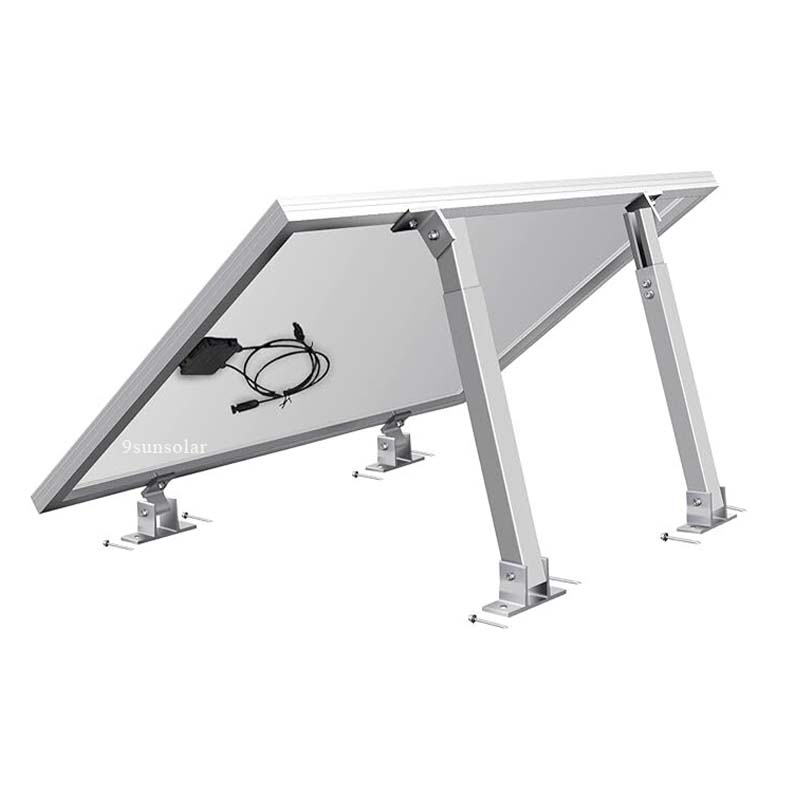
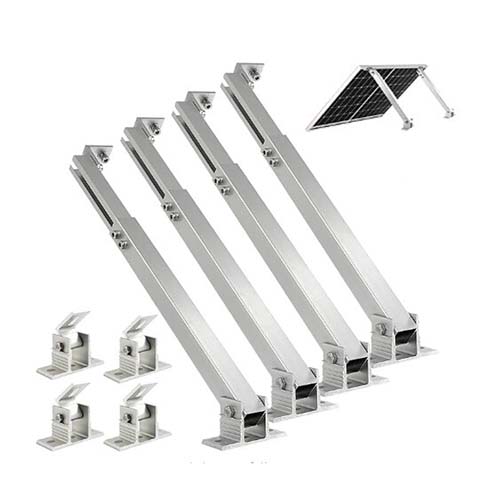
The NS-Adjustable Leg-1 is a triangular modular bracket built for flat and slightly pitched roofs. The triangular geometry carries the panel load into two adjustable legs, and the panel tilt angle is set on site anywhere between 10° and 30°. The angle can be fine-tuned per row rather than fixed at the factory, which matters on a roof with a slight fall or a parapet that shades the first row.
The commercial argument for this system is assembly time. Key components, including the leg assemblies, are pre-assembled before shipping, so on-site work reduces to positioning, fixing and final tilt adjustment. On a project with several hundred brackets, the difference in touch labour usually shows up in the installation quotation more clearly than the hardware price does.
Load ratings are stated as wind load up to 60 m/s and snow load up to 1.4 kN/m². The structure is aluminium AL6005-T5 with an anodized finish, and the fasteners and small components are stainless steel — a materials pairing chosen for outdoor corrosion resistance across humid, coastal and temperature-cycling conditions rather than for one specific climate.
Foundation options are the point where this system needs careful reading. 9Sun Solar lists expansion bolts for concrete and L-feet for metal roofs as foundation options for the adjustable leg bracket. Both are mechanical fixings into the roof build-up, which means whether the installation is penetrating depends on which option the project uses, not on the product name. A buyer who needs a guaranteed non-penetrating installation should not assume it from the bracket alone; the fixing schedule decides that.
Solar Roof Tripod Mounting System — NS-Roof Tripod-1
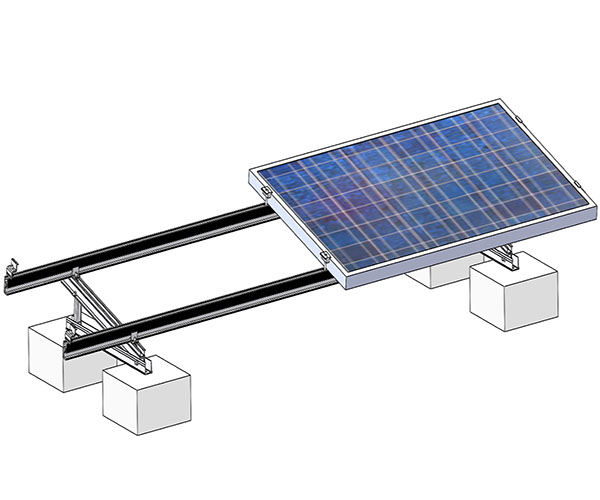
The NS-Roof Tripod-1 is a non-penetrating tripod. There is no drilling into the roof surface, which removes the most common cause of leak claims and of disputes with a waterproofing warranty provider. The tilt angle range is 0° to 60°, so the same product covers a near-flat layout and a steep, winter-oriented tilt.
Materials and ratings mirror the adjustable leg bracket: aluminium AL6005-T5 with an anodized finish, stainless steel components, wind load up to 60 m/s, snow load up to 1.4 kN/m², CE certification and a 10-year warranty. Performance parity on paper means the decision usually moves to the two factors that genuinely differ — tilt range and penetration policy.
The non-penetrating design also keeps the system movable. Because it is not permanently fixed into the roof structure, an array can be reconfigured or expanded later without leaving redundant fixing holes behind. That matters on leased buildings, on roofs where the tenant rather than the owner is installing the PV, and on phased projects where the first array is a pilot.
One specification gap worth flagging. The available product data confirms the non-penetrating design and the load ratings, but it does not state the anchorage or ballast method used to resist wind uplift. On an exposed roof, that is a structural question rather than a detail. Buyers should ask the supplier for the anchorage calculation for the specific wind zone before approving a layout, and should confirm how the tripod is restrained on the actual roof membrane or deck.
Step-by-Step Breakdown: How to Run the Comparison on a Live Project
The sequence below is the order that avoids rework. Each step eliminates a candidate or fixes a parameter, so the choice narrows rather than multiplying options.
- Establish the penetration rule first. Talk to the roofing contractor and the warranty provider before selecting hardware. If the answer is that no fixing may enter the membrane or the deck, the tripod is the only viable candidate from this pair, and the rest of the comparison becomes a check rather than a decision.
- Fix the tilt angle from the energy model. If the required tilt falls inside 10°–30°, both systems qualify and the comparison continues on other criteria. If the model calls for anything above 30°, the adjustable leg bracket is out of range and the tripod is the answer. This single number eliminates more projects than any other criterion.
- Check design loads against the site, not against the brochure. Both systems are rated to wind load up to 60 m/s and snow load up to 1.4 kN/m². Confirm that the project's design wind speed and ground snow load, converted to roof-level values, fall inside those limits — and confirm the same for the roof structure that has to carry the array.
- Map the roof surface to the foundation option. The adjustable leg bracket offers expansion bolts for concrete and L-feet for metal roofs. The tripod is non-penetrating. Match the surface to the option rather than forcing a surface to accept a bracket it was not designed for.
- Compare installation effort, not only unit price. Count the touch labour: parts per square metre, pre-assembly status, the number of fixing points, and the cost of any roof reinstatement. A pre-assembled bracket and a non-penetrating tripod both reduce different parts of the labour curve, and the cheaper unit price does not always produce the cheaper installed cost.
- Verify compliance documents for the destination market. Request the certificate that matches the exact model and configuration being quoted, not a category-level statement. For US projects, that means UL 2703 listing evidence; for EU projects, CE documentation. Confirm the scope, the standard edition and the validity date.
Use Cases: Which System Belongs on Which Roof
The roof tripod is usually the default in these situations:
- Single-ply and membrane roofs still under a waterproofing warranty, where any penetration triggers a reinstatement cost.
- Leased or multi-tenant buildings where the installing party does not control the roof asset.
- Sites at higher latitude where the energy model calls for a tilt beyond 30° — the adjustable leg bracket cannot reach that angle.
- Phased or pilot projects where the array may be extended or relocated, since a non-penetrating system leaves no redundant fixing holes.
The adjustable leg bracket is usually the default in these situations:
- Concrete decks and metal roofs where fixing points can be engineered and documented, and where mechanical fixing is acceptable to the roof owner.
- Mid-latitude commercial roofs targeting a 10°–30° tilt, where the full adjustable range is used rather than wasted.
- Projects where labour availability is the schedule constraint and pre-assembled legs shorten the install window.
- Portfolios that standardise on one bracket across many similar roofs, where a single adjustable product reduces spares and installer training.
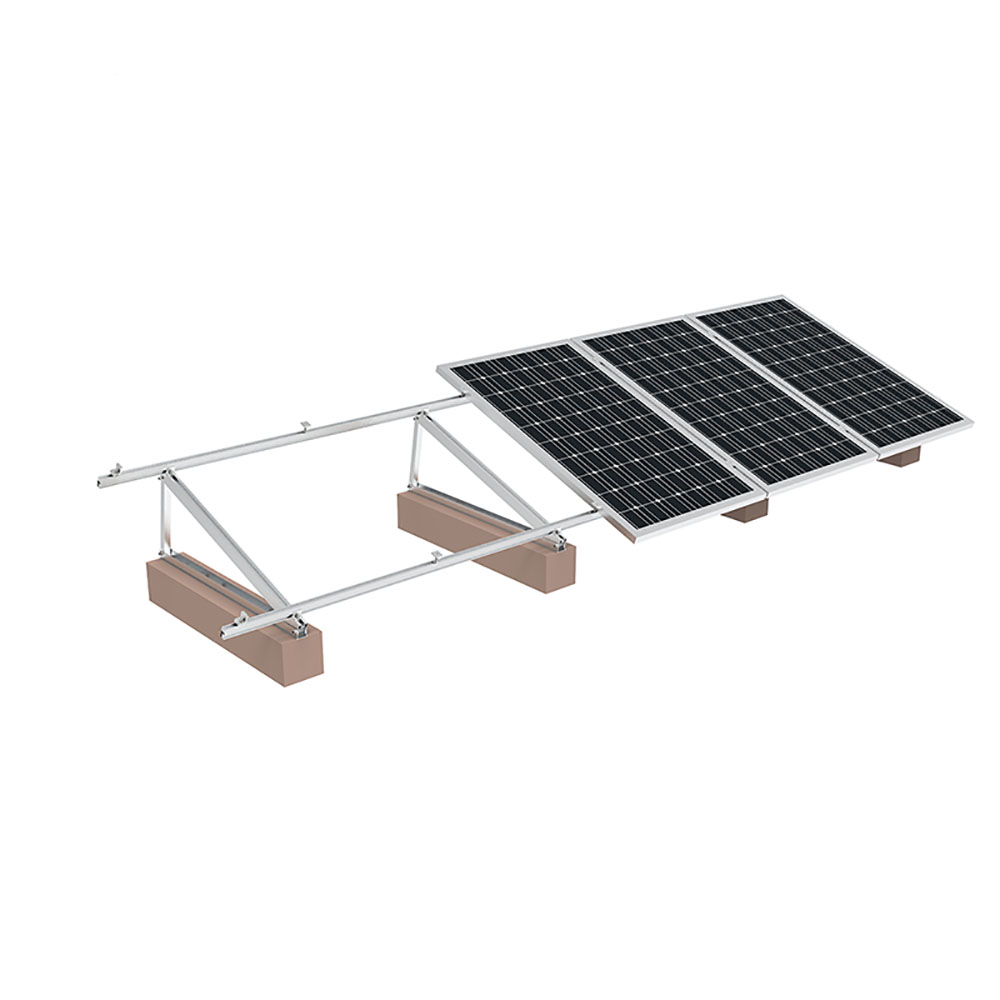
Comparison Table: NS-Adjustable Leg-1 vs NS-Roof Tripod-1
| Criterion | Solar Adjustable Leg Bracket System | Solar Roof Tripod Mounting System |
|---|---|---|
| Model | NS-Adjustable Leg-1 | NS-Roof Tripod-1 |
| Structural concept | Triangular modular bracket with adjustable legs; leg assemblies pre-assembled before shipping | Non-penetrating tripod |
| Tilt range | 10°–30°, adjustable on site | 0°–60° |
| Wind load rating | ≤60 m/s | ≤60 m/s |
| Snow load rating | ≤1.4 kN/m² | ≤1.4 kN/m² |
| Main material | Aluminium AL6005-T5 | Aluminium AL6005-T5 |
| Fasteners and small components | Stainless steel | Stainless steel |
| Surface treatment | Anodized | Anodized |
| Roof compatibility | Flat or slightly pitched roofs; expansion bolts for concrete, L-feet for metal roofs | Flat roofs; non-penetrating, no drilling into the roof surface |
| Penetration | Depends on the selected foundation option | Non-penetrating by design |
| Certification | CE | CE |
| Warranty | 10 years | 10 years |
| Colour | Silver, black, or customized | Silver, black, or customized |
| Best fit | 10°–30° tilt on fixable concrete or metal roofs, where pre-assembly shortens the schedule | Non-penetration is mandatory, or tilt above 30° is required |
What This Comparison Does Not Settle
A fair comparison should also state its boundaries. Four items fall outside the data available here, and each one should be closed with the supplier before an order is placed.
- Price. Neither system is published with a list price. Cost depends on configuration, quantity, fixing hardware and freight, so a line-item quotation is the only reliable basis for comparison.
- UL listing. Both models are documented as CE certified with a 10-year warranty. That documentation does not include a UL listing certificate. US projects need UL 2703 evidence for the exact model, and that has to be requested rather than assumed from a CE mark.
- Anchorage method for the tripod. The non-penetrating design is confirmed, but the uplift restraint method is not specified in the product data. Confirm it against the project wind zone.
- Row spacing and shading. These follow from tilt angle, latitude and roof geometry, not from the bracket. A steeper tilt on the tripod will need more row spacing than a 15° adjustable leg layout, and that changes the module count per roof.
Frequently Asked Questions
Are the NS-Adjustable Leg-1 and NS-Roof Tripod-1 CE certified, and are they UL listed for US projects?
The NS-Adjustable Leg-1 and the NS-Roof Tripod-1 are both documented as CE certified and both carry a 10-year warranty. For US projects, UL 2703 is the relevant North American safety standard for PV mounting systems and racking, covering structural and bonding requirements. The product documentation supplied for these two models covers CE; it does not include a UL listing certificate. Buyers specifying for US projects should request the UL listing document and confirm that the certified product scope matches the exact model, configuration and load case being quoted.
Which system covers a wider tilt range, and how do their wind and snow ratings compare?
The NS-Roof Tripod-1 covers a tilt range of 0° to 60°. The NS-Adjustable Leg-1 covers an adjustable range of 10° to 30°. On load ratings the two systems are identical: both are rated to a wind load up to 60 m/s and a snow load up to 1.4 kN/m². The practical difference is therefore not strength but geometry — the tripod can reach a steep winter tilt that the adjustable leg bracket cannot, while the adjustable leg bracket operates inside a narrower band.
How should buyers compare cost between the two systems?
Neither system is published with a list price, so the comparison has to be built from installed cost rather than unit price. Four drivers separate the two: the number of parts and the degree of pre-assembly (the adjustable leg bracket ships with leg assemblies pre-assembled), the fixing method and any roof reinstatement cost (the tripod is non-penetrating and requires no drilling), the labour hours per kilowatt, and the cost of future reconfiguration. Request a quotation with fixing hardware, freight and installation assumptions itemised so the two can be compared on the same basis.
Can buyers validate either system on a sample or a pilot roof before committing to a project order?
Yes — for a flat roof project the practical route is to validate on a pilot section rather than on a single bracket, because the installation sequence and the tilt setting are what usually need testing. 9Sun Solar supports OEM/ODM customisation and states 100% testing on its capability data. Buyers can request product samples, dimensional drawings and load documentation for the specific model before releasing a project order; the product catalogue and full range are available through the supplier's contact channels.
What lead time and minimum order quantity apply to these flat roof mounting systems?
9Sun Solar's capability data lists a lead time of 7 days, a minimum order quantity of 1,000 W, a monthly capacity of 170 MW, and OEM/ODM customisation with 100% testing. After-sales support is provided remotely, alongside a 10-year warranty on the mounting system. Because lead time depends on configuration, quantity and finishing options such as customized colours, confirm the delivery schedule against your installation window before finalising the order — the fastest way to do that is to send the roof layout, tilt target and wind/snow design values to exp@9sunsolar.com or WhatsApp +86 13599517330 for a project-specific response.
Conclusion
The choice between an adjustable leg bracket and a roof tripod on a flat roof is not a quality question. Both the NS-Adjustable Leg-1 and the NS-Roof Tripod-1 use aluminium AL6005-T5 with an anodized finish and stainless steel components, both are CE certified, both carry a 10-year warranty, and both are rated to a wind load up to 60 m/s and a snow load up to 1.4 kN/m². On the specifications that are shared, there is nothing to separate them.
The decision therefore sits in the two places where they diverge. Tilt range decides first: 10°–30° keeps both options open, while anything above 30° removes the adjustable leg bracket from consideration. Penetration policy decides second: if the roof cannot be drilled, the non-penetrating tripod is the answer regardless of tilt. Only when a project sits inside 10°–30° and the roof can accept mechanical fixing does the comparison move to installation effort — and at that point the pre-assembled legs of the adjustable bracket become the deciding factor.
Framed that way, the two systems are not competitors so much as two answers to different constraint sets. Specifying the constraint first, and the product second, is what keeps a flat roof project out of rework.
Next Step: Match the Bracket to Your Roof
Send 9Sun Solar your roof type, target tilt angle and design wind and snow loads, and the team will confirm which of the two systems fits — or flag where a different mounting family is required. Samples, dimensional drawings and project-specific quotations are available on request.
Email: exp@9sunsolar.com | WhatsApp: +86 13599517330 | Web: www.9sunsolar.com
Download the full product range: 9Sun Solar Product Catalog (PDF)
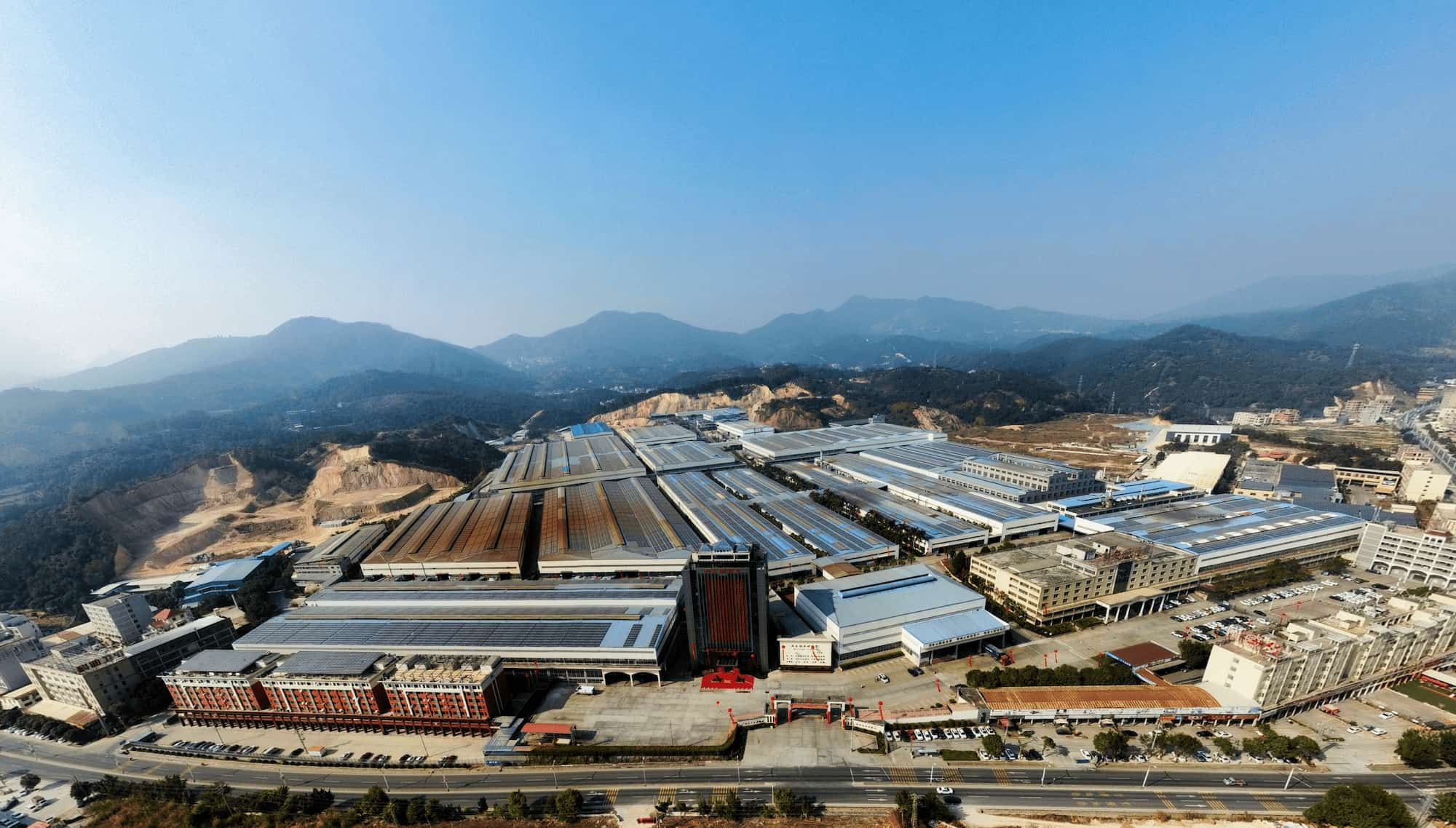
9Sun Solar (Xiamen 9Sun Solar Technology Co., Ltd.) is a solar mounting system manufacturer based in Xiamen, Fujian, China, supplying ground, roof, farm and carport mounting systems as well as solar ground screws. Specifications quoted in this article refer to the NS-Adjustable Leg-1 and NS-Roof Tripod-1 as documented by the manufacturer; project suitability should be confirmed against site-specific structural calculations.
Have Questions or Need More Details?
Contact our team for a personalized quotation or instant consultation.
Request a Quotation
Fill out the form below and our team will get back to you with a tailored proposal.
WhatsApp Direct Chat
Prefer to chat in real-time? Message us on WhatsApp for instant assistance & quick answers.
- Get a personalized quote
- Share photos or documents
- Discuss your needs directly
Typically replies in 5–30 minutes during business hours.