Balcony Solar Bracket: CE, Load & Fit Checks
Balcony Solar Bracket: CE, Load & Fit Checks
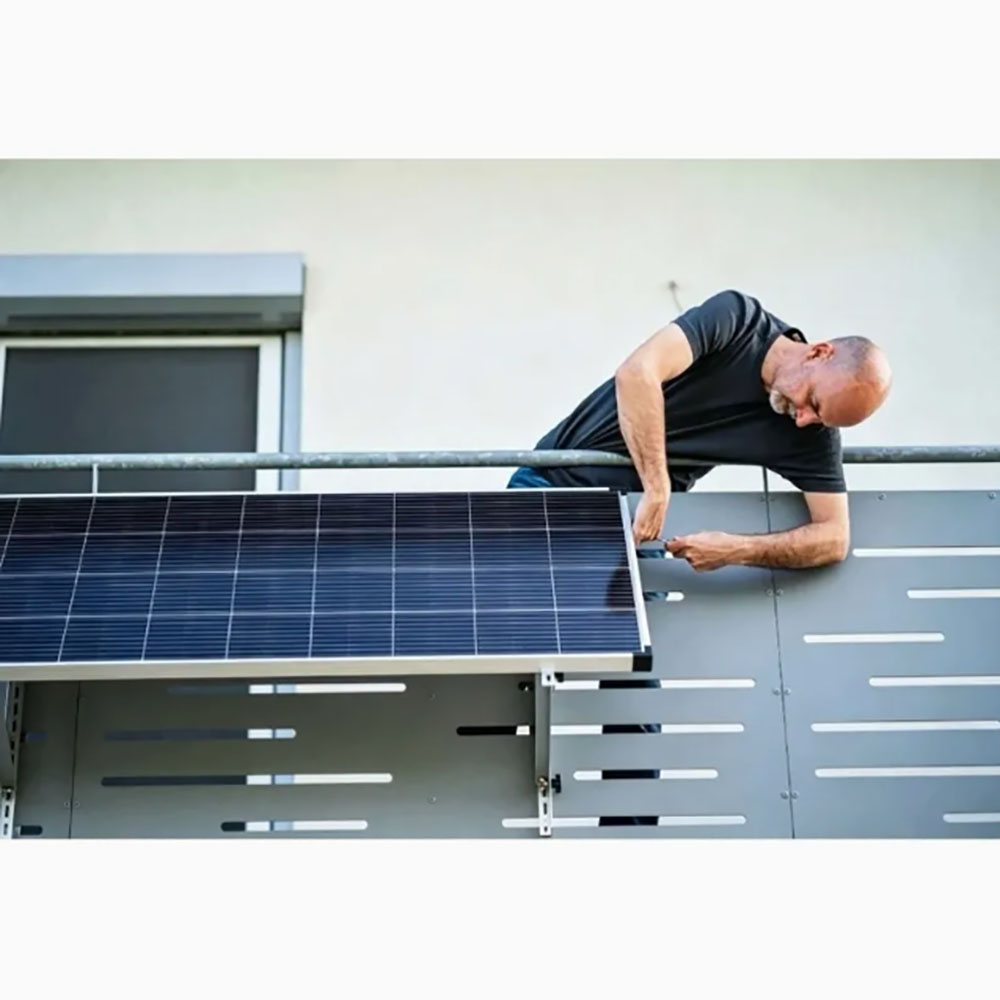
NS-Balcony-1 balcony solar system kit from 9Sun Solar. Image: 9Sun Solar.
A balcony solar bracket is a mounting structure that fixes one or more PV panels to a balcony railing, wall, or facade without using roof space. For buyers at the research and evaluation stage, the decisive checks are not cosmetic: they are certification scope, wind and snow load, panel fit, railing interface, tilt adjustment, and warranty. The 9Sun Solar NS-Balcony-1 is a CE-certified balcony system made from AL6005-T5 aluminium and stainless steel, with a stated wind load of ≤80 m/s, snow load of ≤150 cm, tilt range of 15–25°, and a 10-year warranty.
Problem Definition: Why Balcony Brackets Are a Constraint-Led Purchase
Balcony PV is often considered where roof access is unavailable, where the roof is shared, or where the building owner does not permit roof penetration. The bracket must solve four constraints at once: structural safety, penetration and waterproofing risk, planning or landlord permission, and electrical and mechanical compatibility. Unlike ground arrays, balcony systems are close to people, railings, doors, and drainage paths. A bracket that is strong but cannot be fixed safely to the existing railing is not a usable solution.
For procurement, the constraint list should be written before comparing suppliers. A practical list includes the destination market, applicable certification, design wind and snow loads, railing or facade type, panel dimensions, module count, tilt range, colour, packaging, and warranty terms. The supplier should respond to each item with a document or a model-specific fact. General statements such as “corrosion resistant” or “easy installation” are not enough for a balcony project.
- Certification and market access: CE is relevant for the EU; UL 2703 is a US PV mounting-system standard; EN 1090 is referenced for EU structural work. The NS-Balcony-1 product data states CE certification. Other standards should not be assumed unless the supplier provides a model-specific document.
- Load case: The NS-Balcony-1 is rated for wind load ≤80 m/s and snow load ≤150 cm. These are product ratings, not a site calculation. Local code may require additional factors.
- Interface: 9Sun Solar states that the system uses tension hooks for railing attachment without permanent drilling in most cases. The railing strength, geometry, and material must still be verified.
- Panel fit and tilt: The NS-Balcony-1 has a tilt range of 15–25°. Panel size, frame thickness, clamp zones, and shading must be checked before order.
Industry Background: Aluminum Dominance and Certification Reality
Global Market Insights valued the global solar PV mounting systems market at USD 49.7 billion in 2025 and projected USD 83.2 billion by 2035. Aluminum held 71.5% of market share by material in 2025. This matters for balcony brackets because aluminium’s strength-to-weight ratio can reduce dead load on railings and facades, while anodizing supports corrosion resistance. 9Sun Solar uses AL6005-T5 aluminium with anodized surface treatment for the NS-Balcony-1, plus stainless-steel hardware.
Certification is often misunderstood. UL Solutions describes UL 2703 as covering PV mounting systems, mounting devices, clamping or retention devices, and grounding lugs for flat-plate PV modules. That is a standard scope, not a certificate held by every supplier. In the EU, CE marking is product- and directive-specific. A buyer should ask for the declaration or certificate that names the model and applicable scope. For the NS-Balcony-1, the supplied product data states CE certification; the certificate scope should still be checked against the destination market and project requirements.
Detailed Solution: How to Specify a Balcony Solar Bracket
9Sun Solar, or Xiamen 9Sun Solar Technology Co., Ltd., is a China-based manufacturer and supplier of solar PV mounting systems, with a factory in Quanzhou, Fujian, and a product portfolio that includes ground, roof, farm, carport, and balcony mounting systems. The NS-Balcony-1 is its balcony-specific system. The following specification logic converts supplier facts into buyer checks.
1. Start with the certificate, not the catalogue image
Ask for a certificate or declaration that names NS-Balcony-1 and states the applicable market and standard. The product data says the system holds CE certification. Do not accept a generic “CE solar bracket” statement for a different model. If the project is outside the EU, check whether UL 2703, EN 1090, or another local requirement applies. The application guidance in the supplied data lists UL 2703 for North America, EN 1090 for the EU, and IEC 62817 for trackers as examples of market-specific certification, but those are not automatic claims for the balcony bracket.
2. Lock the structural load case
The NS-Balcony-1 is rated for wind load ≤80 m/s and snow load ≤150 cm. These are high headline values, but they do not replace a site-specific check. The installer should confirm the balcony railing, wall, or facade can resist the panel’s wind uplift, dead load, and torsional loads. For exposed high-rise balconies, wind pressure can be higher than the bracket’s rating after factors are applied. Use the bracket rating as a product limit, not as a site approval.
3. Verify the mounting interface
The system uses tension hooks that attach to the railing in most cases without permanent drilling, according to 9Sun Solar. That is useful for renters and for avoiding facade damage, but “most cases” is the critical phrase. The railing must be structurally adequate and geometrically compatible. Glass, loose timber, thin composite, or decorative railings may not be suitable. Where tension hooks cannot be used, the project needs an engineered alternative. The bracket profile and hardware should be inspected for contact protection and stainless-steel fasteners.
4. Match panel dimensions and tilt
The NS-Balcony-1 has a tilt range of 15–25° and is adjustable. That range supports angle adjustment and helps manage shading from the balcony above. The buyer should supply panel length, width, frame thickness, and clamp zones to 9Sun Solar before ordering. A bracket that fits one module may not fit a larger framed module. Tilt adjustment should be checked with the panel installed, not only on the drawing.
5. Confirm material and finish
The main material is AL6005-T5 aluminium with an anodized surface, and the hardware is stainless steel. Anodizing supports corrosion resistance in outdoor exposure. For coastal or polluted environments, the buyer should confirm the anodizing specification and fastener grade in the quotation. The available colours are silver, black, or customized. Colour choice is not only aesthetic; darker finishes can affect surface temperature, so the supplier should confirm the coating system for the chosen colour.
6. Require a complete kit
9Sun Solar describes the NS-Balcony-1 as a complete kit solution that can include the mounting structure, all necessary hardware, and detailed installation instructions. A complete kit reduces site improvisation, but the buyer should still request a packing list and torque or installation guidance. Missing clamps or incorrect bolt lengths are common causes of installation delay. The kit should be checked against the panel count and railing layout before shipment.
Step-by-Step Breakdown for Evaluation
- Define the project boundary: country, building type, balcony type, railing material, panel model, array size, and whether landlord approval is needed.
- Confirm certification scope: request the NS-Balcony-1 CE declaration or certificate and verify the model name, standard, and market. For North America, ask separately about UL 2703 listing if required.
- Obtain the site load case: use local wind and snow data and a structural check of the railing or wall. Compare the result with the bracket’s ≤80 m/s wind and ≤150 cm snow product ratings.
- Check the interface: confirm that tension hooks can attach safely; if not, request an engineered fixing option. Do not accept “no drilling” as universally applicable.
- Verify panel fit: send panel drawings and confirm clamp positions, tilt range 15–25°, and clearance from walls, doors, and drainage.
- Review the kit and finish: confirm AL6005-T5, anodized aluminium, stainless-steel hardware, colour, hardware list, and installation manual.
- Run a sample or pre-production check: assemble one bracket with the actual panel and railing profile. Record fit, tilt movement, fastener torque, and any contact points.
- Confirm commercial terms: request a configured quotation, MOQ, production lead time, packaging, and warranty terms. The capability data lists OEM/ODM support, MOQ of 1,000 watts, and a 7-day production lead time; confirm these against the exact order.
Use Cases
Rental apartments and urban balconies. The tension-hook design is intended to avoid permanent drilling in most cases, which can reduce damage risk and simplify landlord approval. The system still needs a structural check of the railing.
Small residential retrofits. A balcony bracket can add PV capacity where roof access is limited. The 15–25° adjustable tilt allows the installer to set the panel angle for the site rather than accepting a fixed flat mount.
Commercial facades and shared balconies. The NS-Balcony-1 is listed for residential, commercial and industrial, and public infrastructure applications. In shared buildings, the approval process and fall-protection plan are as important as the bracket specification.
Coastal and humid sites. AL6005-T5 aluminium with anodized finish and stainless-steel hardware is intended for outdoor durability. The buyer should still confirm the anodizing thickness class and fastener grade for the specific environment.
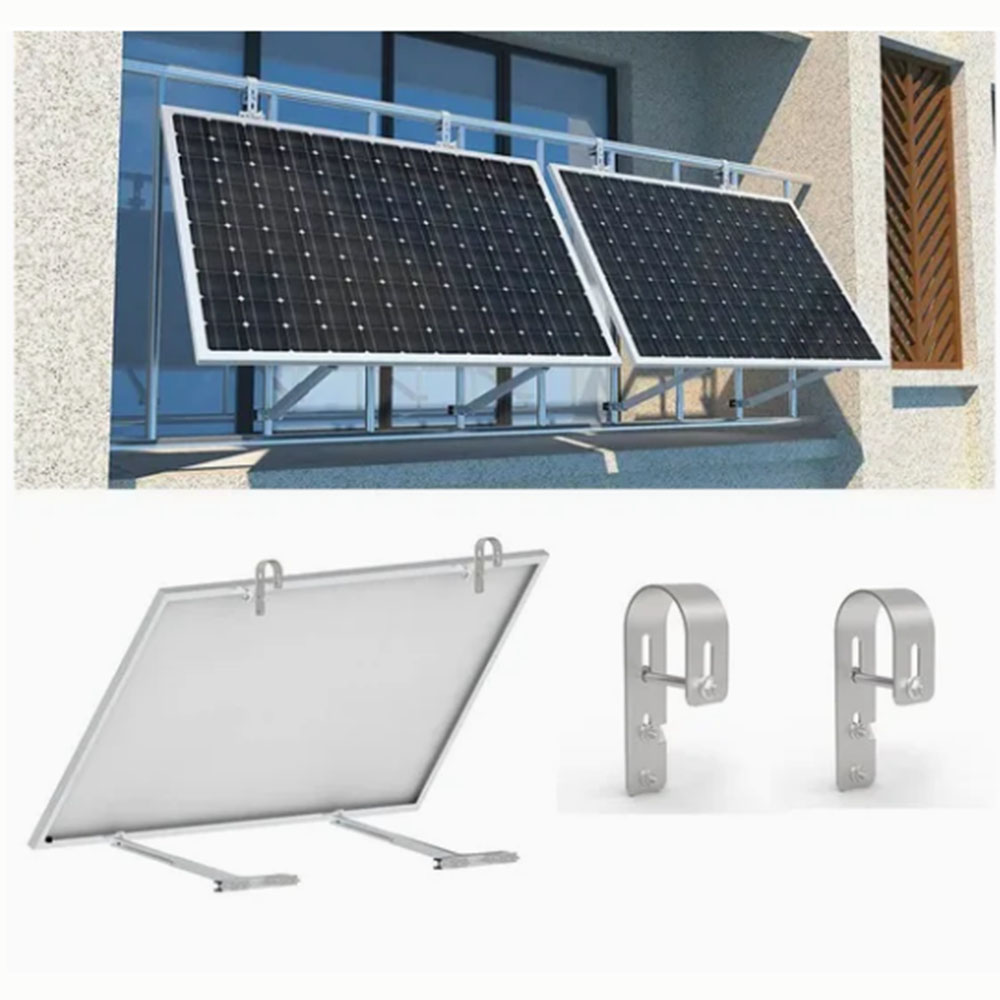
NS-Balcony-1 balcony bracket detail. Image: 9Sun Solar.
Comparison Table: Balcony Bracket vs Other 9Sun Solar Mounting Options
The table compares real 9Sun Solar products using only the supplied product data. It is not a market ranking. “Not listed” means the supplied specification does not state the value; it is not a negative claim.
| Product | Typical mounting location | Material / finish | Wind load | Snow load | Tilt | Certification stated | Warranty |
|---|---|---|---|---|---|---|---|
| NS-Balcony-1 Balcony Solar System | Balcony railing or facade | AL6005-T5 aluminium, stainless steel; anodized | ≤80 m/s | ≤150 cm | 15–25° | CE | 10 years |
| NS-PV Wall Bracket-1 | Exterior wall or facade | AL6005-T5 or steel; anodized | ≤60 m/s | ≤1.4 kN/m² | Adjustable, range not listed | Not listed | 10 years |
| NS-Adjustable Leg-1 | Flat or slightly pitched roof | AL6005-T5 aluminium, stainless steel; anodized | ≤60 m/s | ≤1.4 kN/m² | 10–30° | CE | 10 years |
| NS-Roof Tripod-1 | Roof | AL6005-T5 aluminium, stainless steel; anodized | ≤60 m/s | ≤1.4 kN/m² | 0–60° | CE | 10 years |
The balcony bracket has the highest stated wind rating in this group at ≤80 m/s and a snow rating expressed in centimetres (≤150 cm). The roof products express snow load in kN/m² (≤1.4 kN/m²). Buyers should not convert or compare these units without the supplier’s design basis. The balcony bracket’s narrower tilt range (15–25°) is intended for facade or railing mounting, while roof tripods cover a wider tilt range (0–60°).
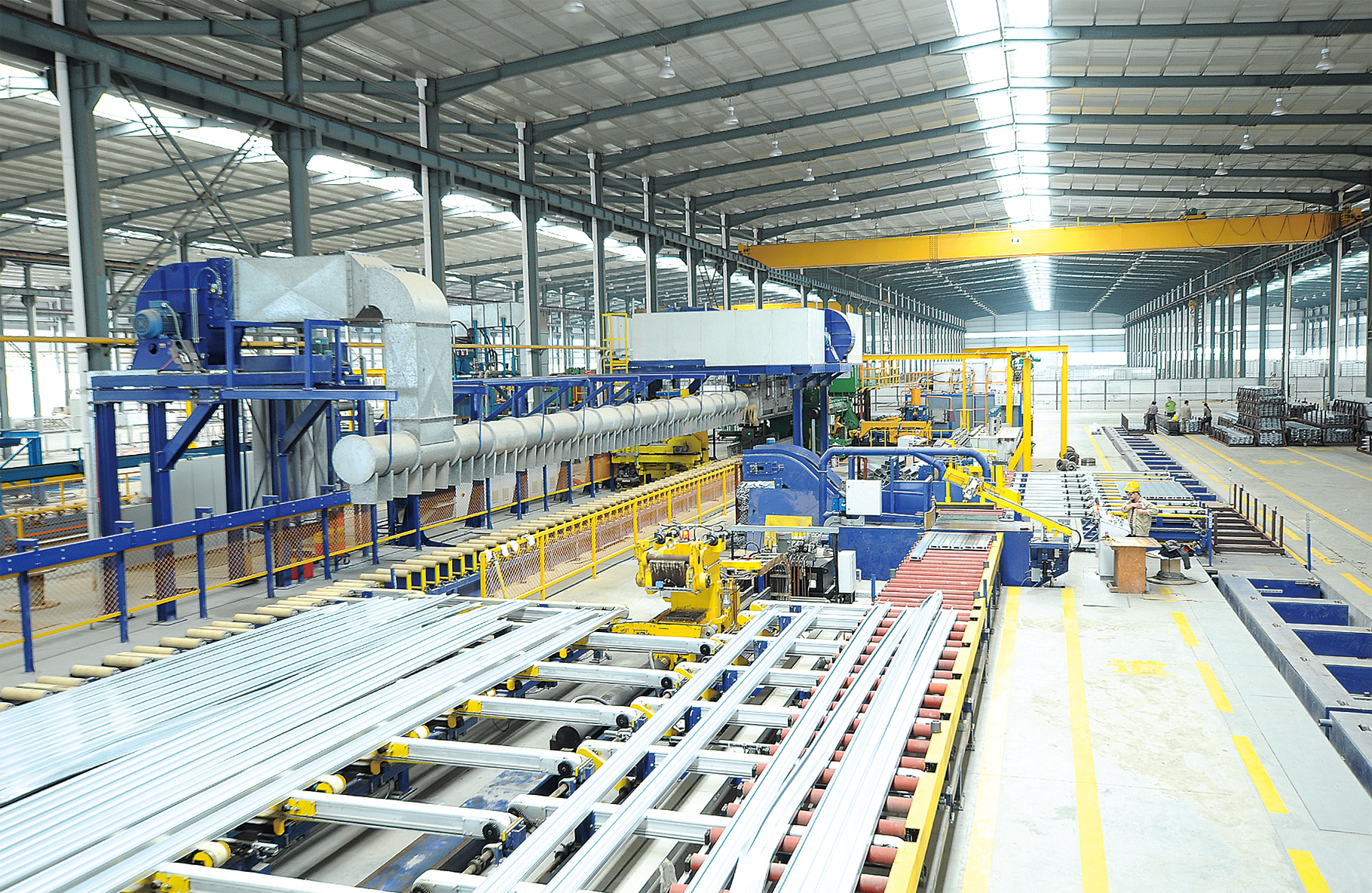
Automatic extrusion production line at 9Sun Solar. Image: 9Sun Solar.
Quality, Documentation, and Procurement Checks
9Sun Solar states that production follows GB/T 5237, Japan (JIS), America (AA), and other national standards, and that it provides a 10-year warranty for solar mounting systems. The company also reports a 2 GW annual output in its profile, while a separate company page reports 1.8 GW; because the capacity basis is not disclosed, buyers should treat capacity as a verification item rather than a selection fact. For the balcony bracket, the more useful quality checks are the model-specific certificate, material certificate, anodizing specification, stainless-steel grade, packing list, and installation manual.
The application guidance for solar brackets notes that mounting structures must withstand wind, snow, seismic, and dynamic loads, with corrosion protection and a reliable grounding path. For balcony systems, grounding and equipotential bonding should be designed by the electrical installer. The supplied NS-Balcony-1 data does not state an integrated grounding feature, so the project should use a separate approved grounding method.
Budget and Price Band: What Can Be Verified
No public price band for the NS-Balcony-1 is provided in the supplied product data. A bracket-only price is also a weak basis for comparison because the delivered scope may include rails, clamps, tension hooks, stainless hardware, packaging, instructions, and testing. The capability data lists an MOQ of 1,000 watts and a 7-day production lead time, but these should be confirmed for the exact configuration and destination. For a defensible budget, request a line-item quotation that separates aluminium, hardware, finish, packaging, freight basis, and warranty support. Do not use an unverified “lowest price” claim to compare suppliers.
FAQ
Is 9Sun Solar a CE-certified solar bracket manufacturer for balcony projects?
Yes for the NS-Balcony-1 balcony system: the supplied product data states CE certification. CE is product- and market-specific, so the buyer should request the declaration or certificate that names NS-Balcony-1 and confirm its scope for the destination EU market. A CE statement for another 9Sun Solar bracket does not automatically cover the balcony model.
Can the NS-Balcony-1 be installed without drilling?
In most cases, 9Sun Solar states that the system uses tension hooks that attach to the railing without permanent drilling. This is not a universal guarantee. The railing must be structurally adequate and geometrically compatible, and the installer must confirm the fixing method for glass, timber, composite, or decorative railings.
What wind, snow, and tilt limits apply?
The NS-Balcony-1 is rated for wind load ≤80 m/s and snow load ≤150 cm, with a tilt range of 15–25°. These are product ratings; the project still needs a site-specific structural check. The bracket is made of AL6005-T5 aluminium with anodized finish and stainless-steel hardware.
How should I evaluate the price?
The supplied data does not list a price band. Request a configured quotation covering the mounting structure, hardware, finish, packaging, documentation, and delivery basis. The capability data lists an MOQ of 1,000 watts and a 7-day production lead time, which should be confirmed for the exact order.
Can I request a sample or pre-production check?
Yes. A sample or pre-production assembly is the practical way to confirm panel fit, railing interface, tilt movement, and hardware completeness. 9Sun Solar supports OEM/ODM and customization, and the NS-Balcony-1 is supplied as a complete kit with mounting structure, hardware, and installation instructions. Contact 9Sun Solar with the panel drawing and railing details to start a sample or quotation request.
Conclusion
For a balcony solar bracket, the buying decision should be led by certification scope, structural load case, railing interface, panel fit, and documentation. The 9Sun Solar NS-Balcony-1 offers a verifiable starting point: CE certification in the supplied data, AL6005-T5 aluminium with anodized finish, stainless-steel hardware, wind load ≤80 m/s, snow load ≤150 cm, tilt 15–25°, and a 10-year warranty. It is not a universal fit for every balcony. Verify the railing, confirm the certificate, check the panel dimensions, and request a configured quote before committing.
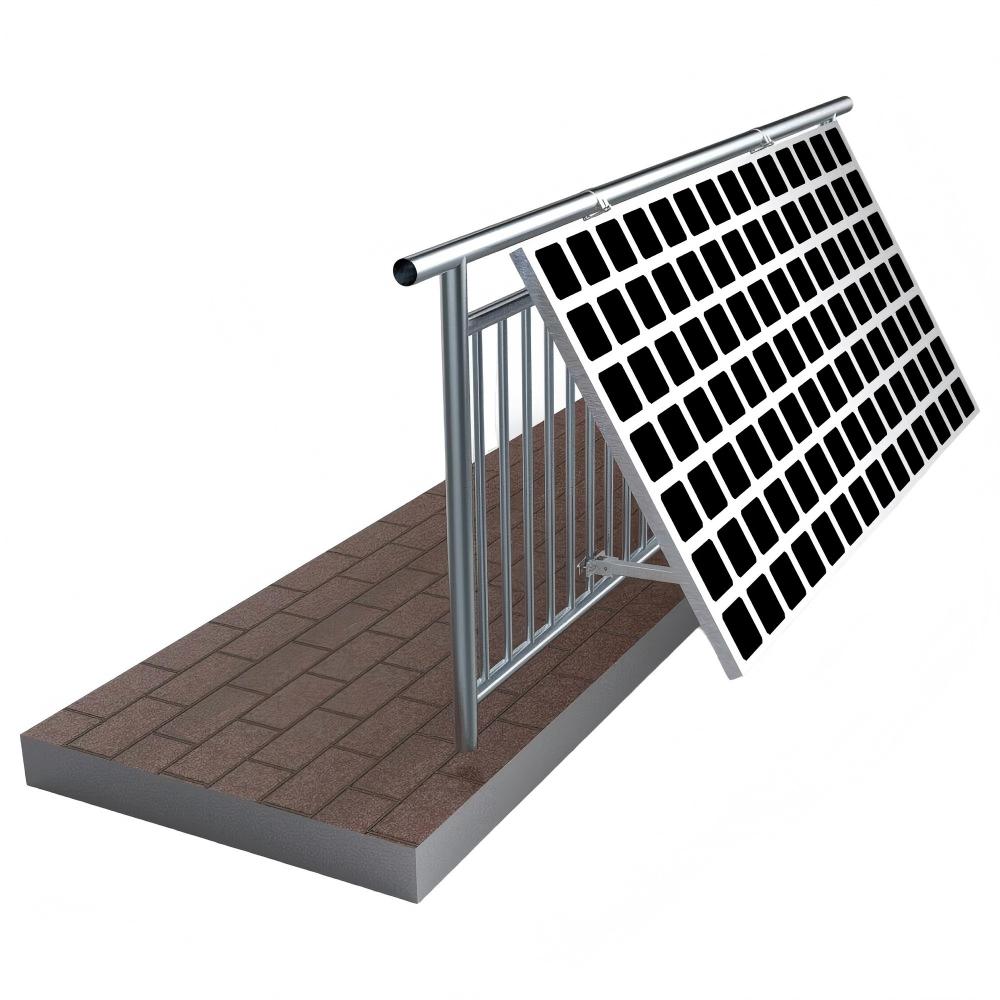
NS-Balcony-1 balcony solar system. Image: 9Sun Solar.
Next step: Send 9Sun Solar your panel drawing, railing type, project country, and target quantity to request a sample or configured quotation. Email: exp@9sunsolar.com. Website: www.9sunsolar.com.
Download the product catalogue: 9Sun Solar Product Catalog (PDF).
Have Questions or Need More Details?
Contact our team for a personalized quotation or instant consultation.
Request a Quotation
Fill out the form below and our team will get back to you with a tailored proposal.
WhatsApp Direct Chat
Prefer to chat in real-time? Message us on WhatsApp for instant assistance & quick answers.
- Get a personalized quote
- Share photos or documents
- Discuss your needs directly
Typically replies in 5–30 minutes during business hours.