Kids Balance Bike Guide: 12-Inch, 2-in-1 & Size Planning
Kids Balance Bike Application Guide: Daily Riding, 2-in-1 Conversion and Size Planning
The right kids balance bike configuration is settled by three inputs, not by a colour card: how hard the bike will be ridden, whether it must convert from balance mode to pedal mode, and the size ladder that covers the children who will actually ride it. A single 12-inch magnesium model with an air tyre on an aluminum rim is the daily-riding specification. A 12/14/16-inch 2-in-1 Kids Bike is the specification that covers a mixed age group in one purchase. Certification and acceptance terms belong in the purchase order, because neither can be retrofitted after the container is loaded.
Supplier facts in this guide come from Wuxi Purino International Trade Co., Ltd, a Wuxi (Jiangsu, China) trading enterprise founded in 2016 that supplies electric bicycles, kids scooters and children balance bikes to buyers in Europe, the USA, the UK, East and South Asia, and whose kids balance bike programme is presented here under the ACOPLEX Electric Bike brand. The programme runs on a 100-unit MOQ, a 45–60 day lead time and a 10,000-unit monthly capacity.
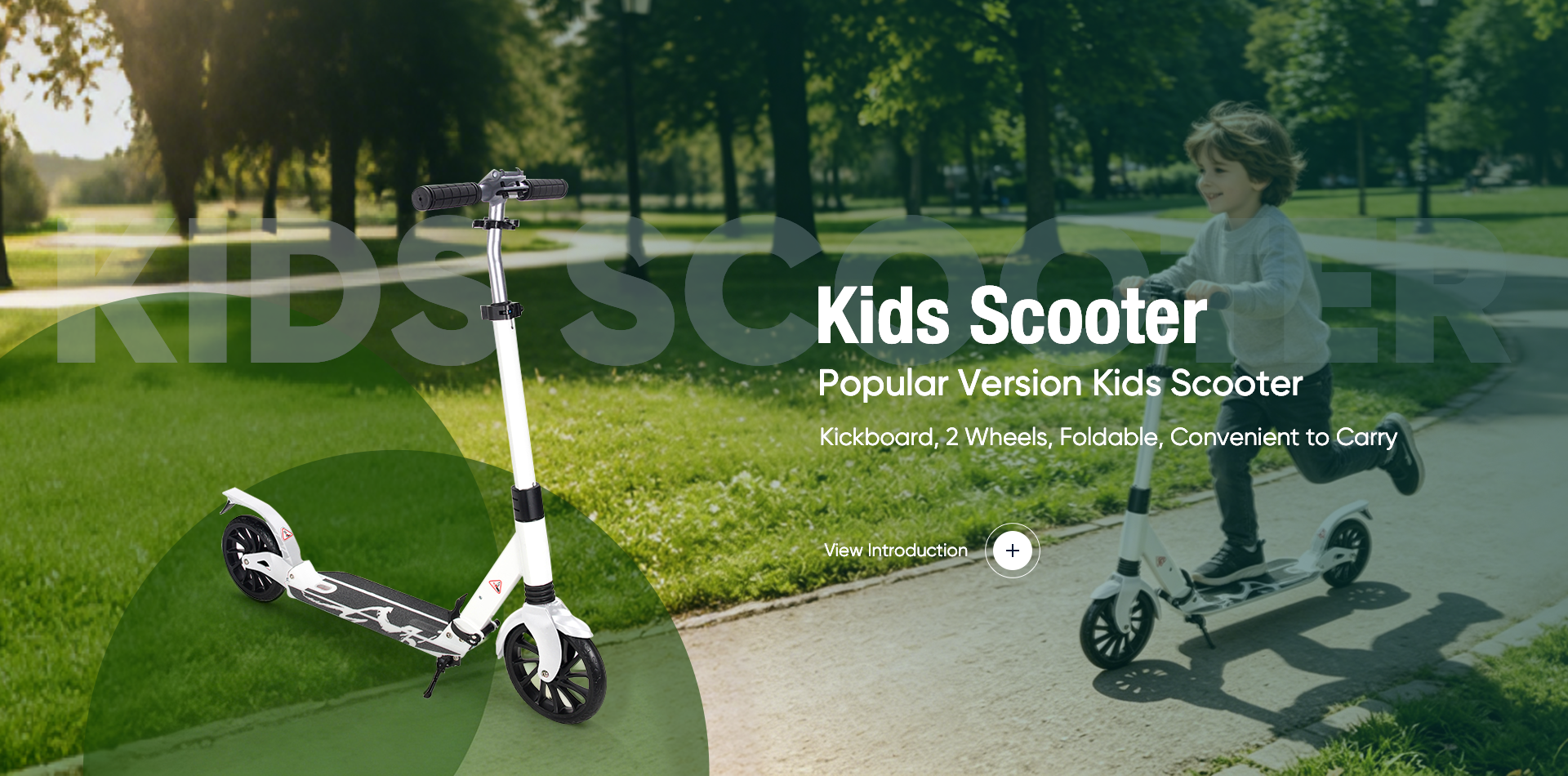
Balance bike and scooter formats used for daily children’s riding and group play.
Problem Definition: Most Balance Bike Programmes Break on Configuration, Not on Price
Three failures account for most balance bike programme problems, and none of them is a pricing failure.
- Duty mismatch. A bike specified for occasional indoor play is ordered for daily outdoor riding on paved and mixed ground. Tyre and rim choice decides whether the bike survives that duty: air tyres on aluminum rims ride better and absorb vibration, while PP rims with rubber tyres prioritise wear resistance and cost.
- Size mismatch. A single 12-inch model is bought for a group that spans several growth stages, producing a fleet that part of the group outgrows within a season.
- Handoff gap. Certification, tyre specification, colour and label files, packaging format and the quality report are agreed verbally, then reconstructed after production. Acceptance becomes a negotiation instead of a checklist.
Balance bikes also carry a compliance trap. EN 71 (toy safety) and EN 15194 (EPAC) are different standards with different scopes, and buyers routinely assume one covers the other. In the certification record available for this range, the AME-1202 children balance bike is certified to EN 15194, issued by TUV for the EU market, and the record explicitly states EN 15194 rather than EN 71. That distinction has to be settled before the purchase order, not after the container arrives.
Industry Background: Growth Plus Tighter Documentation Requirements
The global balance bike market is projected to reach approximately USD 1.43 billion by 2026, according to The Business Research Company, and Coherent Market Insights forecasts a CAGR of around 7.2% from 2026 to 2033. Published market-size figures for this category vary because research houses classify ride-on toys differently, so treat absolute values as directional planning inputs rather than as unit-cost drivers.
Two structural changes matter more to a programme buyer than the growth rate.
Compliance has become performance-based. Published EU compliance guidance states that EN71-1:2026 introduces mandatory performance testing for all ride-on toys, including balance bikes, effective 1 January 2026. Documentation requests that were optional a few years ago are now part of the order file, and they are requested per model, not per catalogue.
Trade classification is stable but form-sensitive. Balance bikes without pedals are classified under HS code 95030010, which simplifies duty planning. The nuance for buyers is that a 2-in-1 model ships in pedal form and is converted to balance mode later by the user, so the declared product form on the customs paperwork must match the shipment.
Weight has become a tender specification. Third-party frame comparisons cite magnesium alloy integrated casting frames at approximately 680 g, with a complete bike around 3.1 kg. Buyers now ask for weight per model, which is why frame material appears in tender documents next to price.
Brand concentration exists in the wider kids’ bicycle market — Fortune Business Insights attributes 15% to Giant Bicycles and 12% to Trek Bicycle Corporation — but programme supply is not decided by brand share. It is decided by whether a supplier can deliver a defined configuration, a defined size mix and a defined document set on a fixed date.
Detailed Solution: Three Configurations, Three Different Jobs
The range maps onto three jobs: light daily riding, comfort riding with suspension, and one purchase that covers several years through conversion. Each configuration below is described strictly with the specifications held in the supplier’s product data.
AME-1201: Magnesium Frame, Steel Fork, 12-Inch Air Tyre
AME-1201 uses a magnesium frame with a steel fork, a 12-inch air tyre on an aluminum rim, and a 12-inch wheel diameter. Running gear is a 180W motor with a 24V 2Ah battery and a maximum speed of 14.5 km/h, and the bike includes Bluetooth functionality for pairing with a mobile device.
The fork material is the detail buyers most often miss: the frame is magnesium, the fork is steel. That combination keeps the front end structurally durable while the frame stays light — the practical split for daily riding where the bike is repeatedly lifted and parked by a child rather than by an adult.
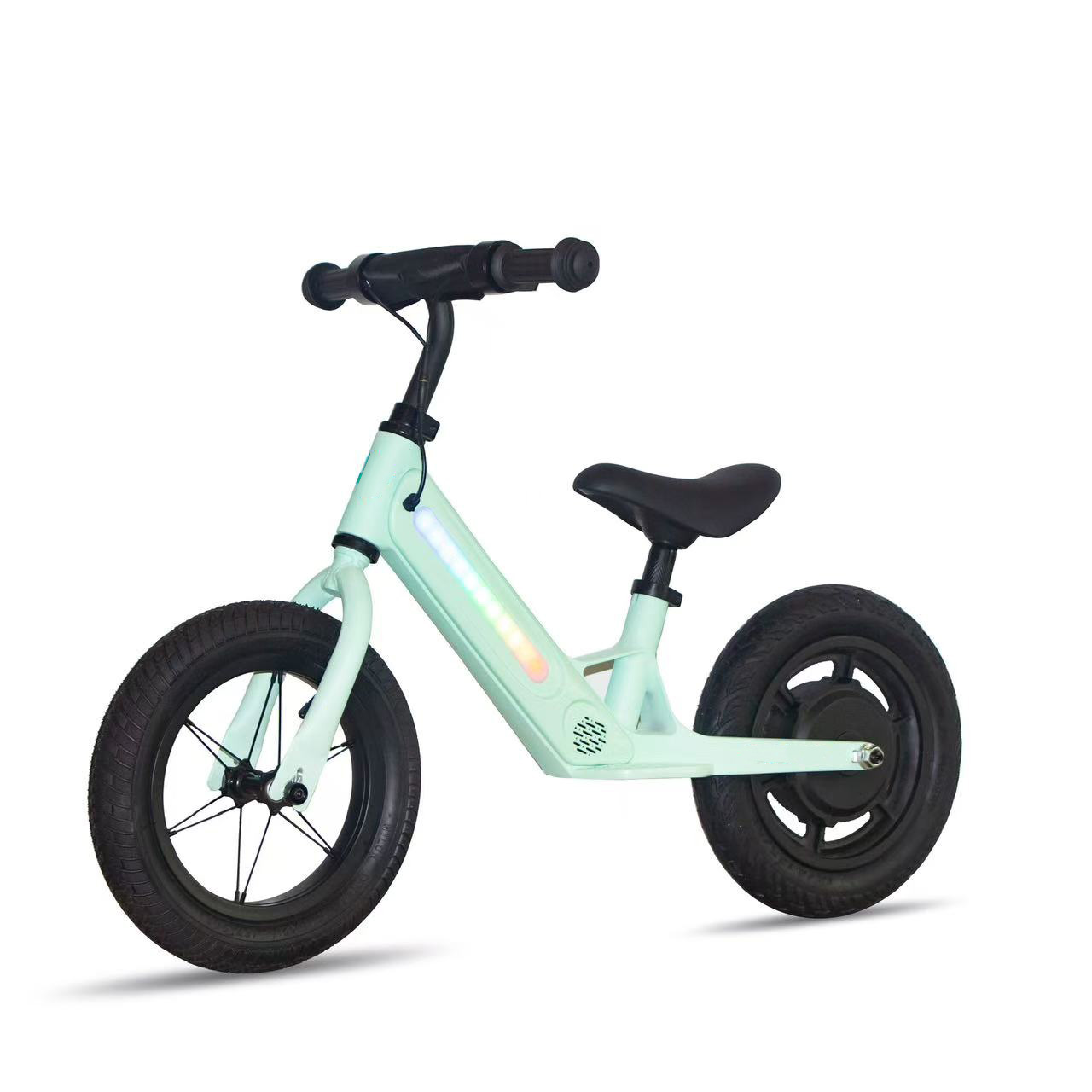
AME-1201: magnesium frame, steel fork, 12-inch air tyre on aluminum rim.
AME-1202: Magnesium Alloy Frame and Fork With Suspension
AME-1202 is the comfort specification. Frame and fork are both magnesium alloy and both are built with suspension; the surface treatment is full powder coating; the headset is metal and the grips are TPR. The tyre is again a 12-inch air tyre on an aluminum rim. Drive is a 24V 200W brushless 12-inch motor with an 18650-2500mAh/3C, 22.2V/2.5A, 55.0Wh lithium battery in 6S1P configuration. Maximum speed is 12 km/h, and with a digital display the bike offers 6, 12 and 18 km/h modes.
AME-1202 is also the model with the clearest certification record in this range: CE certification to EN 15194, issued by TUV, applicable to the EU market. For an EU-facing programme that is the difference between a quotation and an order file.
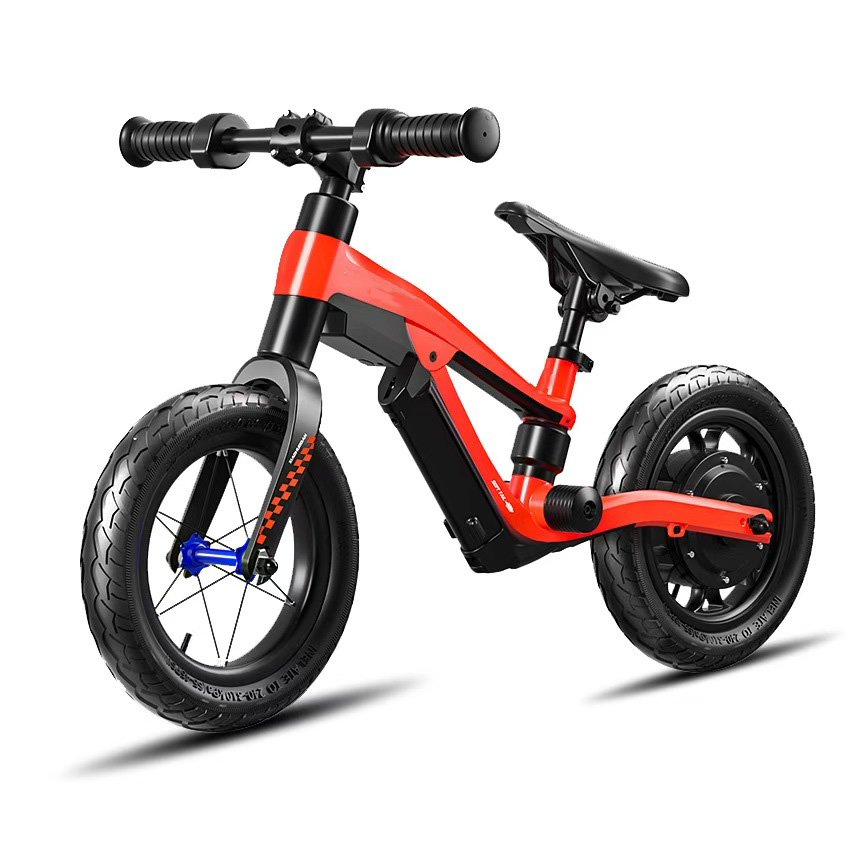
AME-1202: magnesium alloy frame and fork with suspension, 12-inch air tyre, EN 15194 record.
2-In-1 Kids Bike: Pedal-to-Balance Conversion in 12, 14 and 16 Inch
The 2-In-1 Kids Bike is a steel-frame, steel-fork platform with PP rims and rubber tyres, a rear band brake, and a conversion mechanism: remove the chain, crank and pedals and the bike becomes a balance bike. It is offered in three wheel sizes — 12, 14 and 16 inch — which is what allows one purchase to cover several growth stages. The platform also has high container loading capacity, which lowers ocean freight cost per unit.
Conversion is mechanical, so a kindergarten or a family can run the same bike in balance mode first and pedal mode later. The trade-off is straightforward: steel plus PP rims with rubber tyres is the durability-and-cost specification, not the featherweight specification, and no suspension is stated for this model.
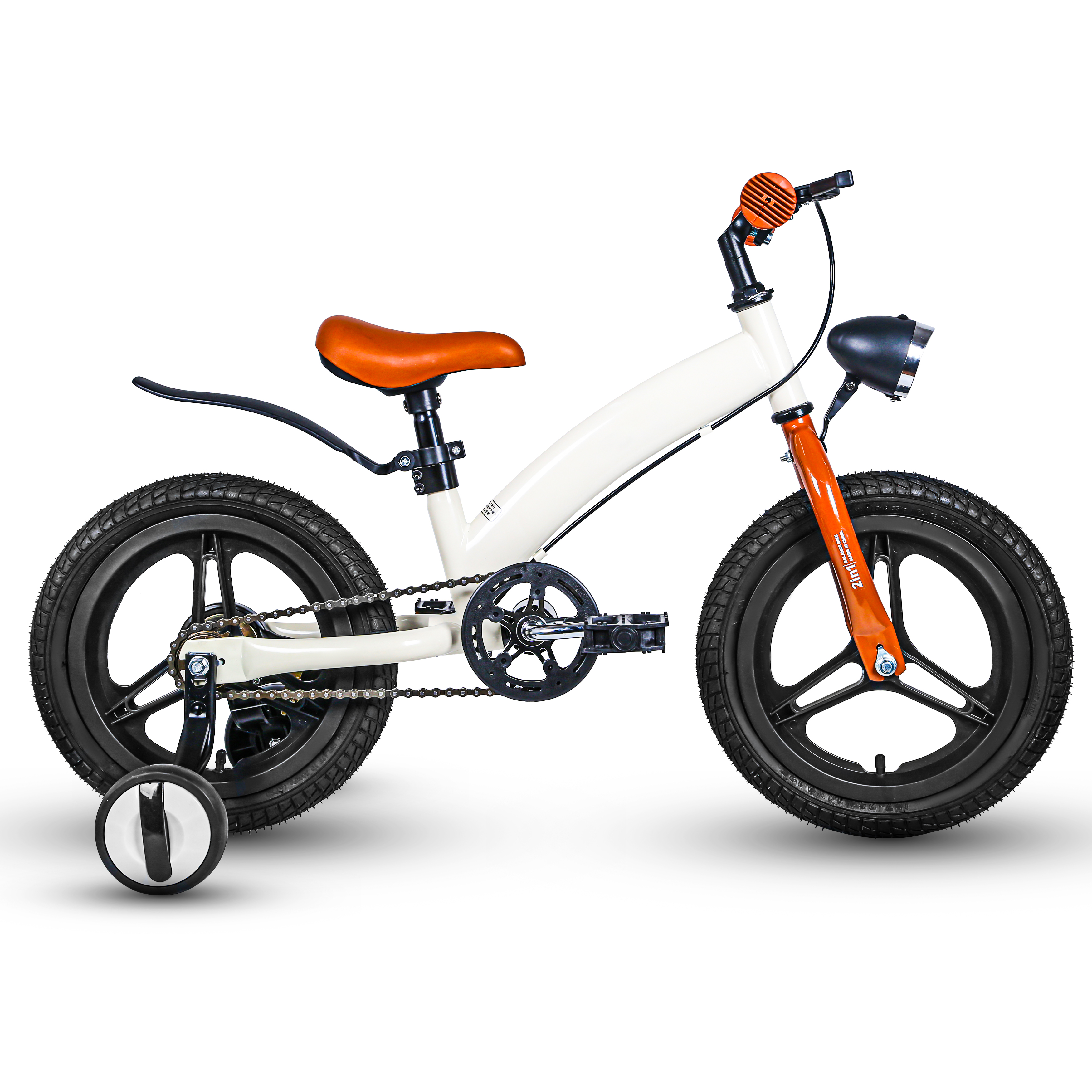
2-In-1 Kids Bike: steel frame, PP rim with rubber tyre, chain, crank and pedals removable.
Component Choice: Air Tyre With Aluminum Rim vs PP Rim With Rubber Tyre
Air tyre on aluminum rim is the comfort and rolling-quality option. The air chamber absorbs surface irregularity and the aluminum rim holds the tyre and resists deformation. This is the configuration used on both 12-inch models, AME-1201 and AME-1202, and it is the correct choice for daily outdoor riding on paved or lightly uneven ground.
PP rim with rubber tyre is the wear-resistant option. The supplier describes this pairing as wear-resistant and adaptable across ground conditions, which suits institutional fleets, high-turnover rental or retail volume where maintenance cycles matter more than ride refinement. The trade-off is less vibration absorption than an air tyre.
Tyre supply is a separate selection variable. The customization list includes tyre type selection across EVA, CST and air, and the application data for institutional orders lists EVA and inflated tyres as configurable. The supplier’s case record contrasts aluminium with CST inflated tyres for comfort against steel with EVA for durability and cost advantage. For a buyer, tyre selection is the single most useful cost-versus-comfort lever in this range, and it should be written into the order as a specified part, not left to production discretion.
Size Planning: 12-Inch Single Model vs 12/14/16-Inch 2-in-1
Two size strategies exist in this range and they answer different questions.
- Single 12-inch platform (AME-1201, AME-1202). One size, one spare-parts list, one packaging specification, one line on the customs paperwork. Correct where riders sit within a narrow band and the fleet is refreshed rather than extended.
- Three-size 2-in-1 platform (12, 14 and 16 inch). A size ladder inside one model family. Correct for kindergartens, retail assortments and family channels where the bike must stay usable across growth stages, and where conversion adds a second product life.
Where a buyer needs saddle-height or handlebar-height adjustment, that is a per-model specification question and should be confirmed in writing at quotation rather than inferred from the platform. The documented size strategy here is the 12/14/16 ladder, not a one-frame-fits-all design.
Step-by-Step Breakdown: From Riding Scenario to Signed Acceptance
- Define the duty level. Daily outdoor riding on paved ground, mixed surfaces, or indoor kindergarten floors. Write it down, because it decides the tyre and rim specification.
- Choose the frame and component tier. Magnesium frame with steel fork (AME-1201), magnesium alloy frame and fork with suspension (AME-1202), or steel frame and fork with PP rim and rubber tyre (2-In-1).
- Decide single-purpose or convertible. If the same bike must serve balance training and later pedal riding, specify the 2-In-1 and confirm the conversion steps during sampling — chain, crank and pedals removed.
- Fix the size plan and quantity split. Single 12-inch where the rider band is narrow; a 12/14/16 quantity mix where the programme spans growth stages. Convert the plan into units per size before requesting a quotation.
- Lock certification and documentation for the destination market. State the required standard per model and confirm what the certification record actually covers. For this range, the AME-1202 record covers EN 15194 for the EU market and states EN 15194 rather than EN 71.
- Agree purchase terms. MOQ 100 units, lead time 45–60 days, monthly capacity 10,000 units, and a customization scope covering frame colour and logo, packaging and accessories, tyre type selection, and saddle and grip material.
- Write acceptance criteria into the order. Tyre type and rim, colour and label files, bulk packaging for institutional delivery, the quality report requirement, and pre-shipment inspection. The documented quality process is quality control plus pre-shipment inspection; because the detailed inspection protocol is not published, the checklist has to be contractual.
Use Cases: Matching the Configuration to the Buyer
Daily Home and Neighbourhood Riding
Air tyre on aluminum rim, 12-inch wheel. AME-1201 where a light magnesium frame with a steel fork and a 14.5 km/h maximum speed fits the duty; AME-1202 where suspension comfort and the EN 15194 record matter. Both are single-size purchases, so the rider band should be checked before ordering volume.
Kindergarten and Childcare Group Fleets
The 2-In-1 12/14/16 ladder is the fleet specification. Institutional application data lists kindergarten group use and bulk delivery to retail stores or educational institutions, with colour and label customization, tyre type selection across EVA and inflated options, and a quality report requirement as the standard programme conditions. Conversion extends the service life of each unit, which is what institutional budgets respond to.
Retail and Wholesale Assortments
A mixed buy works here: magnesium models as the premium tier, the 2-In-1 as the volume tier with its container-loading advantage. The supplier’s case record covers wholesalers and retailers at volumes around 10,000 units per month, over relationships lasting 2–3 years, with durability and low maintenance emphasised for bulk models.
Gift, Promotional and Cross-Border E-Commerce Channels
Promotional and e-commerce channels are listed in the application data alongside gifts. The practical configuration is the 2-In-1 with EVA tyres, custom packaging and labels, where landed cost and packaging presentation matter more than suspension comfort.
Programme Handoff to an Institution or Distributor
This is the documentation-heavy case. The application data lists children’s helmets, elbow and knee pads, replacement saddles, spare inner tubes and wheels, and custom packaging and labels as matched equipment — a useful accessory attach list for a programme, subject to confirmation per order. Handoff acceptance should cover the bike, the accessory set and the paper file together.
Comparison Table: Three Configurations Side by Side
| Attribute | AME-1201 | AME-1202 | 2-In-1 Kids Bike |
|---|---|---|---|
| Frame / fork | Magnesium frame, steel fork | Magnesium alloy frame and fork | Steel frame and steel fork |
| Suspension | Not stated in product data | Frame and fork with suspension | Not stated in product data |
| Tyre and rim | 12-inch air tyre, aluminum rim | 12-inch air tyre, aluminum rim | PP rim, rubber tyre |
| Wheel diameter | 12 inch | 12 inch | 12, 14 and 16 inch |
| Brake | Not stated in product data | Not stated in product data | Rear band brake |
| Drive | 180W motor, 24V 2Ah battery, max 14.5 km/h | 24V 200W brushless motor, 22.2V/2.5A 55.0Wh lithium (18650, 6S1P), max 12 km/h; 6/12/18 km/h modes with digital display | Pedal drive; chain, crank and pedals removable for balance mode |
| Connectivity | Bluetooth | Not stated in product data | Not stated in product data |
| Surface and touchpoints | Metal headset, TPR grips | Full powder coating, metal headset, TPR grips | Not stated in product data |
| Certification record | Not listed in the record provided | CE, EN 15194, TUV, EU market | Not listed in the record provided |
| Container loading | Not stated in product data | Not stated in product data | High loading capacity, lower ocean freight per unit |
| Fits best | Light daily riding on paved ground | Comfort riding with suspension; EU documentation requirement | Mixed age groups, kindergartens, retail assortments |
Purchase Terms and Acceptance Criteria for Programme Handoff
These are the terms a buyer can plan against before requesting a quotation. Anything not listed here should be asked for in writing rather than assumed.
| Term | Documented value |
|---|---|
| Minimum order quantity | 100 units |
| Lead time | 45–60 days |
| Monthly capacity | 10,000 units |
| Annual output | 200,000 pcs |
| Customization scope | Frame colour and logo; packaging and accessories; tyre type selection (EVA / CST / air); saddle and grip material |
| Quality process | Quality control and pre-shipment inspection (detailed protocol not published) |
| Export markets | Europe, USA, UK, East and South Asia |
| Company profile | Founded 2016; 2,300 m² facility; 10 employees; 3 engineers; 100% export ratio |
A workable acceptance file for a balance bike programme contains five items: the model and tyre specification per size, the colour and label approval sheet, the packaging format (particularly for institutional bulk delivery), the quality report requirement, and the certification document set for the destination market. If the buyer needs an inspection protocol beyond pre-shipment inspection, it has to be written into the order at quotation stage.
FAQ
Do these kids balance bikes carry EN 71 certification?
The certification record available for this range covers EN 15194, not EN 71. The AME-1202 children balance bike is certified to EN 15194, CE type, issued by TUV and applicable to the EU market, and the record explicitly states EN 15194 rather than EN 71. EN 71 is the toy-safety standard family, and published EU compliance guidance states that EN71-1:2026 introduces mandatory performance testing for all ride-on toys, including balance bikes, effective 1 January 2026. A buyer who needs EN 71 evidence for a specific model and market should request it per model before ordering, because it is not part of the record supplied for AME-1201, AME-1202 or the 2-In-1 Kids Bike.
Can the 2-in-1 Kids Bike be ordered in more than one wheel size?
Yes. The 2-In-1 Kids Bike is available in three wheel sizes — 12, 14 and 16 inch — which allows a single order to cover different growth stages. The platform uses a steel frame and steel fork, PP rims with rubber tyres and a rear band brake, and converts to balance mode by removing the chain, crank and pedals. The quantity split between the three sizes has to be specified in the enquiry, since the size mix is part of the quotation rather than a standard allocation.
What is the minimum order quantity, and what drives the unit cost?
The minimum order quantity is 100 units, with a lead time of 45–60 days and a monthly capacity of 10,000 units. Unit cost is driven by four variables rather than by the model name alone: frame and fork material (magnesium, magnesium alloy or steel), tyre and rim package (air tyre with aluminum rim versus PP rim with rubber tyre, plus EVA, CST or air selection), the drive and battery specification on the electric variants, and packaging plus customization scope. Container loading also affects landed cost, since the 2-In-1 platform’s high loading capacity reduces ocean freight per unit. No unit price is published, so cost comparison has to be done on a configuration-matched quotation.
Can we test a sample before committing to a bulk order?
Sampling is part of the supplier’s one-stop service scope, which covers product selection, quotation, sample arrangement, production tracking, quality control and after-sales technical support. A useful sample test for this category checks four things: the conversion sequence on the 2-In-1 (chain, crank and pedals removed and refitted), the rear band brake on that model, the tyre and rim behaviour on the ground the programme will actually use, and whether the delivered sample matches the written specification. Confirm the exact model, tyre type and colour on the sample record, because that record becomes the acceptance reference.
What lead time applies, and what should be in the acceptance checklist?
Lead time is 45–60 days, with a monthly capacity of 10,000 units, so a programme larger than one month’s capacity needs a delivery schedule rather than a single ship date. The acceptance checklist should specify model and tyre type per size, colour and label approval, packaging format for institutional bulk delivery, the quality report requirement, and pre-shipment inspection — the documented quality process is quality control plus pre-shipment inspection, and the detailed protocol is not published, so it must be contractual. Buyers can request a sample or a configuration-matched quotation through purinocycle.com before fixing the acceptance file.
Conclusion
Configuration, conversion and size planning decide whether a kids balance bike programme holds up in daily use, and compliance paperwork decides whether it clears the border. The workable sequence is consistent: match the tyre and rim package to the duty level, choose between a single 12-inch model and a 12/14/16-inch 2-in-1 platform based on the rider band, confirm which standard the certification record actually covers for the destination market, and write the acceptance criteria before production starts rather than after. On this range, that means air tyres with aluminum rims for daily riding comfort, PP rims with rubber tyres for fleet durability, and a documented EN 15194 record on AME-1202 rather than an assumed EN 71 approval.
ACOPLEX Electric Bike — Kids Balance Bike Programme
Request a sample, a configuration-matched quotation or the product catalogue for AME-1201, AME-1202 and the 12/14/16-inch 2-in-1 Kids Bike. MOQ 100 units; lead time 45–60 days.
Wuxi Purino International Trade Co., Ltd · 5 Floor, Building C, No. 238, Xitai Road, Meicun, Xinwu District, Wuxi, Jiangsu, China · www.purinocycle.com · nancy@puruinuo.com · Tel +86 0510-88998686 · WhatsApp +86 153-1223-9200
Have Questions or Need More Details?
Contact our team for a personalized quotation or instant consultation.
Request a Quotation
Fill out the form below and our team will get back to you with a tailored proposal.
WhatsApp Direct Chat
Prefer to chat in real-time? Message us on WhatsApp for instant assistance & quick answers.
- Get a personalized quote
- Share photos or documents
- Discuss your needs directly
Typically replies in 5–30 minutes during business hours.