Kids Balance Bike Sourcing: Certification and Spec Checks
Buying a kids balance bike for the European or North American market is a documentation exercise before it is a product decision. Two constraints decide whether a shipment is sellable: the safety standard that applies to the exact model being purchased, and the specification items that get frozen into the purchase order. Wuxi Purino International Trade Co., Ltd — a Wuxi, Jiangsu–based supplier of children balance bikes, kids scooters and the ACOPLEX Electric Bike range — publishes model-level data for three balance bike models (AME-1201, AME-1202 and the 2-In-1 Kids Bike), which makes those constraints checkable instead of assumed.
Short answer: In the EU, a pedal-less balance bike sold as a ride-on toy falls under toy safety testing, while an electrically assisted model with a motor and battery falls under EN15194, the standard for electrically power assisted cycles. Wuxi Purino’s certification record places the AME-1202 children balance bike under EN15194 (CE, issued by TUV, EU market) and states explicitly that the applicable standard is EN15194, not EN 71. Buyers should therefore request a certificate naming the model number they intend to purchase, and lock frame material, tyre type, wheel size and brake configuration into the order.
Problem Definition: Where Balance Bike Orders Actually Break
Balance bike sourcing rarely fails because a factory cannot build the product. It fails because the buyer and the supplier are working from different definitions of the same order. Three gaps account for most of the friction.
The standard gap
“EN 71 certified” is often treated as a universal pass, but the EU framework splits by product type. Toy safety testing under EN 71-1:2026 introduces mandatory performance testing for all ride-on toys including balance bikes, effective from 1 January 2026 (reported by Alibaba.com / EU Standards Library). Electrically power assisted cycles sit under a different regime — EN15194. A 12-inch pedal-less balance bike and the same frame fitted with a 24V 200W brushless motor are therefore two different compliance objects, even when they look nearly identical on a catalogue page.
The specification gap
Purchase orders written against “kids balance bike” instead of a model code leave too many variables open: frame and fork material, wheel diameter, tyre construction, rim material, brake type and convertibility. Two models from the same supplier can differ on every one of these points. Wuxi Purino’s own range contains a magnesium model with an air tyre and aluminium rim, a suspension-equipped magnesium model, and a steel 2-in-1 convertible with a rubber tyre and rear band brake.
The commercial gap
Minimum order quantity, lead time, customization cut-offs and the quality documents that travel with a shipment are usually discovered late — after artwork is approved or after a retail listing is scheduled. These are constraint items, not negotiation details; they determine whether a launch date is achievable at all.
Industry Background: A Growing Category With Uneven Documentation
The global balance bike market is projected to reach approximately USD 1.43 billion by 2026 and is expected to grow at a CAGR of 7.2% between 2026 and 2033 (The Business Research Company; Coherent Market Insights). Growth of that scale pulls in a long tail of suppliers whose documentation quality varies far more than their prices do.
At the top of the adjacent kids’ bicycle market, scale is concentrated: Giant Bicycles and Trek Bicycle Corporation hold approximately 15% and 12% market share respectively (Fortune Business Insights, 2026). Balance bike supply, by contrast, is fragmented across trading companies, component assemblers and regional factories — which is precisely why model-level paperwork is the buyer’s primary risk control.
Three structural shifts matter for 2026 sourcing:
- Regulatory timing. EN 71-1:2026 raises the bar for ride-on toys, so test documentation has to be current rather than inherited from an older model year.
- Material shift. Magnesium alloy integrated casting frames weigh approximately 680 g, with complete 12-inch magnesium models near 3.1 kg (Montasen, 2026) — light enough for toddlers to handle, which is why magnesium is increasingly positioned as the premium option against steel and aluminium.
- Trade classification. Pedal-less balance bikes are classified under HS code 95030010 (Customs Tariff Number reference), which determines how the product is declared and how customs paperwork must be prepared.
Demand is also broadening beyond home play. Preschool and childcare, kids products retail, wholesale and distribution, and gift and promotional channels all buy balance bikes in bulk, each with different durability, packaging and paperwork expectations.
Detailed Solution: The Three Constraint Layers Buyers Need to Lock
Every balance bike order reduces to three layers of constraints: what the product must comply with, what the product physically is, and what the commercial terms allow. Wuxi Purino’s published data — product specifications, the certification record and the capability sheet — shows how each layer is verified in practice.
Layer 1 — Compliance: match the standard to the model, not the category
Wuxi Purino’s certification record for EN15194 (certification type CE, issued by TUV, applicable market EU) covers the AME-1202 children balance bike. The record states that the applicable standard is EN15194 and not EN 71. The same EN15194 certification also covers three electric bicycle models — TRAVEL (electric city bike), ROCKET (electric mountain bike) and UNICORN (electric city bike) — which is consistent with EN15194 being the standard for electrically power assisted cycles rather than for pedal-less toys.
The useful conclusion for a buyer is procedural, not promotional. A non-motorised balance bike sold as a ride-on toy points toward toy safety testing; a balance bike with a motor and battery points toward EPAC documentation. Ask for the certificate that names your model number, the issuing body, the market it applies to and the standard number. A general statement that a supplier “is CE certified” is not a model-level answer.
Verification rule: four data points make a certificate usable — model number, standard number, issuing authority, and applicable market. If any one is missing, the document does not support a retail or customs submission for that specific SKU.
Layer 2 — Specification: what each catalogue model physically is
Purino’s three balance bike models are configured around different buyer priorities rather than being colour variants of one product.
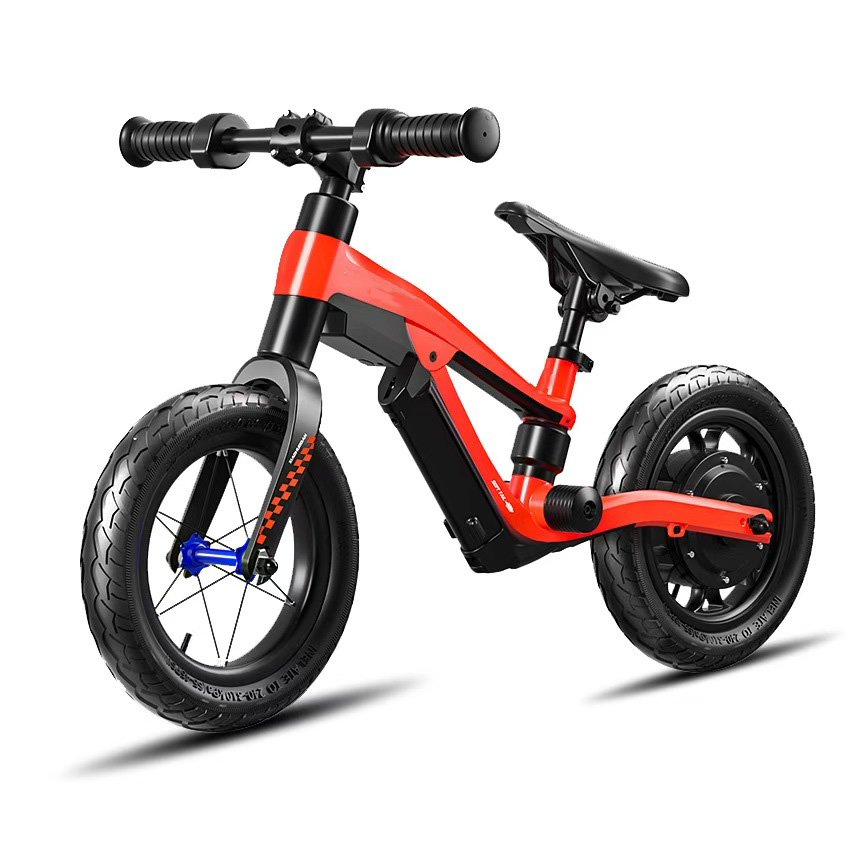
AME-1201 uses a magnesium frame with a steel fork, a 12-inch air tyre on an aluminium rim, Bluetooth connectivity, a 180W motor, a 24V 2Ah battery and a maximum speed of 14.5 km/h. The design logic is weight reduction at the front of the bike combined with a steel fork for structural durability.
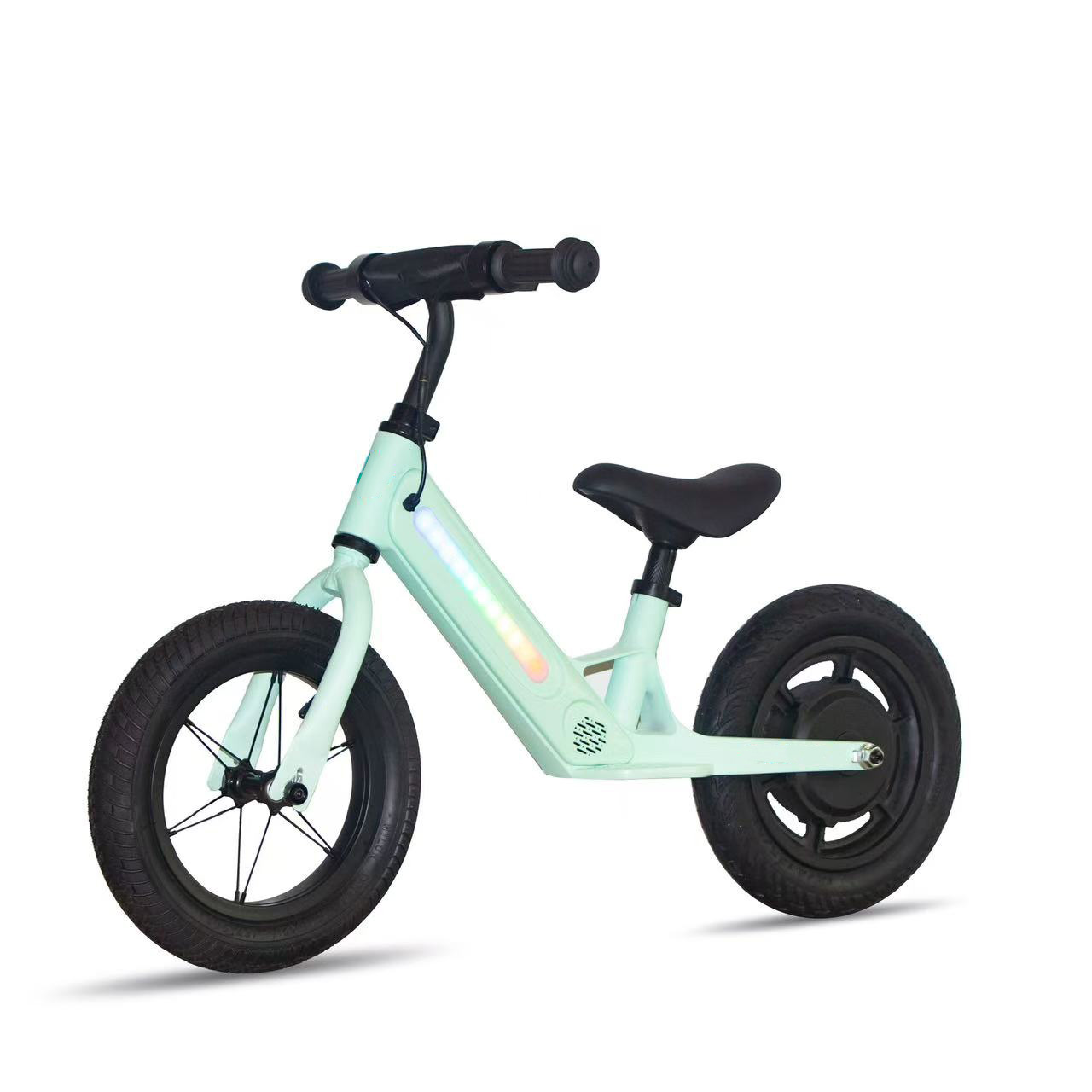
AME-1202 pairs a magnesium alloy frame and fork with a suspension design, a 12-inch air tyre on an aluminium rim, a 24V 200W brushless motor and an 18650 lithium battery (2,500mAh/3C, 22.2V/2.5A, 55.0Wh, 6S1P). Maximum speed is 12 km/h, with 6/12/18 km/h modes available when a digital display is fitted. The frame carries a full powder coating, a metal headset and TPR soft grips. For institutional buyers, the suspension and the three speed modes are the differentiating items; for cost-driven buyers they are the items to discuss.
The 2-In-1 Kids Bike takes the opposite approach: a steel frame and steel fork, a PP rim with rubber tyre, and a rear band brake. Its chain, crank and pedals can be removed so the same bike converts to balance bike mode. It is offered in 12", 14" and 16" sizes, and the design carries a high container loading capacity, which reduces ocean freight cost.
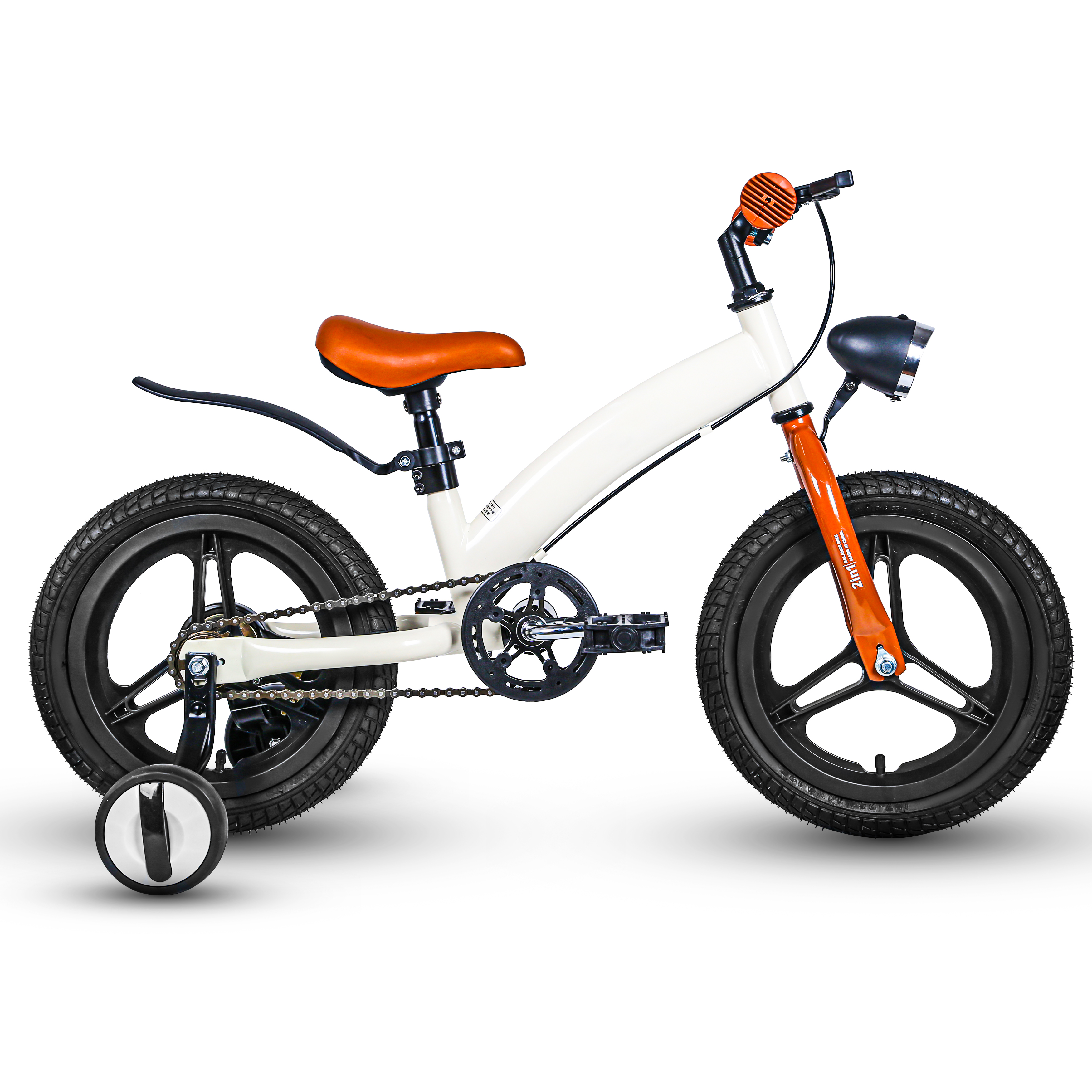
Where the AME-1201 and AME-1202 models optimise for weight and ride comfort, the 2-In-1 optimises for growth span and freight efficiency. That single distinction usually decides which model a distributor stocks first.
Layer 3 — Commercial: MOQ, lead time, customization and documentation
Purino’s capability data lists a minimum order quantity of 100 units, a lead time of 45–60 days and a monthly capacity of 10,000 units, operating as a trading and supply-chain oriented export business. Customization covers frame colour and logo, packaging and accessories, tyre type selection (EVA, CST or air), and saddle and grip material.
Quality control is described as including pre-shipment inspection, although detailed QC procedures and acceptance standards are not published. For programmes where claims or returns carry real cost, the inspection scope — incoming material checks, pre-shipment inspection, sample retention and the acceptance criteria themselves — should be written into the purchase agreement rather than assumed.
Documentation is the third commercial item. Institutional buyers, kindergartens and retail chains frequently require quality reports alongside the shipment, and Purino’s application data flags quality report requirements and bulk packaging for institutions as standard procurement conditions, with custom packaging and labels available.
Step-by-Step: A Six-Stage Constraint Verification Workflow
- Fix the destination regime first. Decide whether the SKU is a ride-on toy or an electrically power assisted cycle in the destination market. That single decision determines which test documentation, labelling and instructions apply.
- Match the certificate to a model code. Request documentation naming your exact model — for example AME-1202 — together with the standard number, the issuing authority and the applicable market.
- Freeze the specification sheet before artwork. Frame and fork material, wheel diameter, tyre and rim, brake type, and whether the bike converts between modes. Any item left open will be resolved by the factory, not by you.
- Choose the tyre and maintenance strategy deliberately. Inflated air or CST tyres favour ride comfort, while EVA and rubber options favour durability and low maintenance. For kindergarten or rental-style use, the maintenance model usually outweighs the comfort gain.
- Confirm customization cut-offs and documentation in writing. Colour, logo, packaging, accessory bundles, tyre substitution and required quality reports — with the point in the schedule at which each becomes fixed.
- Validate with a sample, then plan the order window. A sample confirms the specification physically; the 100-unit MOQ and 45–60 day lead time then determine whether the delivery date works for your selling season.
Use Cases: Where These Constraints Bite in Real Programmes
Kindergarten and preschool procurement
Group use multiplies every maintenance decision. Application data for this category describes kindergarten group use with daily indoor and outdoor play, and bulk models that emphasise durability and low maintenance. Steel-frame and rubber-tyre configurations reduce repair frequency, while suspension and air tyres raise ride quality. Institutional purchases also carry paperwork: quality reports, bulk packaging and label customization are standard requirements rather than optional extras.
Retail, wholesale and distribution
Distributors typically need a compact range that covers several price bands, and the three Purino models map onto that need: a lightweight magnesium model, a suspension-equipped magnesium model, and a steel 2-in-1 with high container loading capacity for freight-sensitive programmes. Case data for this category covers wholesalers, retailers and cross-border e-commerce sellers, with bulk volumes around 10,000 units per month and product lifecycles of 2–3 years — long enough that spare saddles, inner tubes, wheels and replacement parts should be ordered with the first shipment.
OEM and private-label programmes
Private-label buyers are purchasing the customization layer as much as the bike: frame colour and logo, packaging, accessory selection, tyre type, and saddle or grip material. Because standard lead time is 45–60 days, the artwork and specification approval cycle has to finish before production starts, not during it.
Cross-border e-commerce and promotional channels
For online sellers and gift programmes, container efficiency and packaging durability matter more than suspension. The 2-In-1’s high container loading capacity and the availability of custom packaging and labels fit that profile, and the 12"/14"/16" size range allows a single listing to cover several age brackets from one supplier relationship.
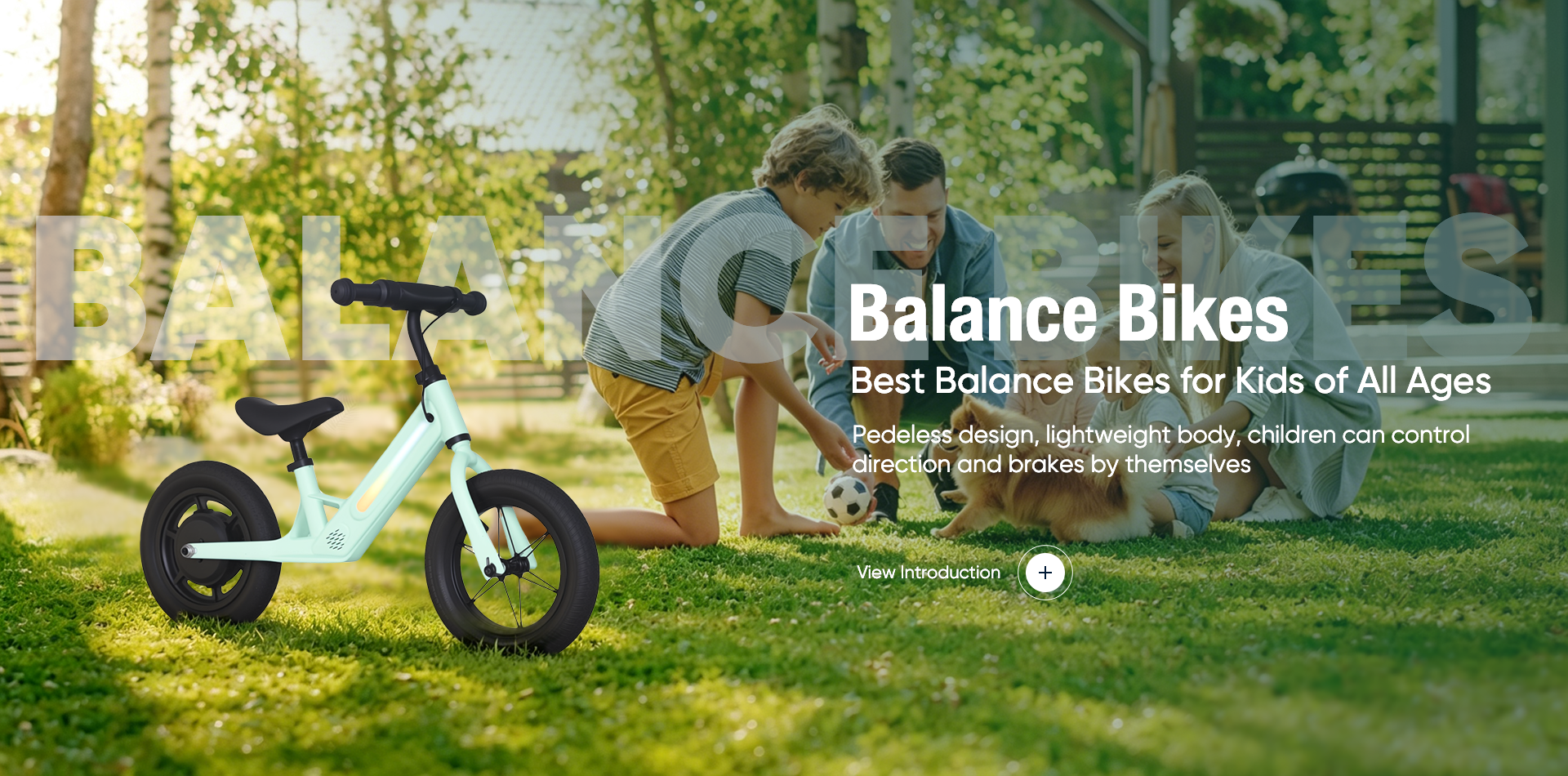
Comparison Table: AME-1201, AME-1202 and the 2-In-1 Kids Bike
The table below compares the published specification data for the three models a buyer is most likely to be quoted.
| Constraint item | AME-1201 | AME-1202 | 2-In-1 Kids Bike |
|---|---|---|---|
| Frame material | Magnesium | Magnesium alloy | Steel |
| Fork | Steel | Magnesium alloy, with suspension | Steel |
| Wheel diameter | 12" | 12" | 12", 14", 16" |
| Tyre and rim | Air tyre, aluminium rim | Air tyre, aluminium rim | PP rim, rubber tyre |
| Motor | 180W | 24V 200W brushless, 12" | Not applicable (manual) |
| Battery | 24V 2Ah | 18650 2,500mAh/3C, 22.2V/2.5A, 55.0Wh, 6S1P | Not applicable (manual) |
| Maximum speed | 14.5 km/h | 12 km/h; 6/12/18 km/h with digital display | Not applicable (manual) |
| Brake | Not stated in the published spec sheet | Not stated in the published spec sheet | Rear band brake |
| Convertibility | Not applicable | Not applicable | Chain, crank and pedals removable to convert to balance bike |
| Certification record | Not listed in the EN15194 record | Covered by EN15194 (CE, TUV, EU market) | Not listed in the EN15194 record |
The second table turns the same data into the four sourcing decisions that most directly change landed cost and service life.
| Decision | Option A | Option B | Buyer implication |
|---|---|---|---|
| Frame material | Magnesium alloy (AME-1201, AME-1202) | Steel (2-In-1 Kids Bike) | Magnesium targets light weight and premium positioning; steel targets durability and cost advantage in bulk programmes. |
| Tyre type | Inflated air tyre on aluminium rim (AME-1201, AME-1202; CST option available) | PP rim with rubber tyre; EVA option within the customization list | Inflated tyres favour comfort and shock absorption; rubber and EVA favour low maintenance and fewer replacements. |
| Suspension | Frame and fork with suspension (AME-1202) | Rigid fork (2-In-1 Kids Bike) | Suspension suits rougher surfaces and long daily use; a rigid fork suits paved playgrounds. |
| Freight efficiency | Compact 12-inch models | 2-In-1 with high container loading capacity | Container loading capacity changes landed cost per unit directly on bulk orders. |
FAQ: Certification, Capability, Cost, Sampling and Lead Time
Which kids balance bike manufacturers can supply EN 71 certified models?
The right question to put to a supplier is which standard applies to the specific model, because balance bikes can fall under two different EU regimes. Pedal-less ride-on toys are covered by toy safety testing — EN 71-1:2026 introduces mandatory performance testing for all ride-on toys including balance bikes — while electrically assisted models with a motor and battery are covered by EN15194 instead. Wuxi Purino’s certification record lists the AME-1202 children balance bike under EN15194 (CE, issued by TUV, EU market) and states that the applicable standard is EN15194, not EN 71. Buyers should request the certificate for the exact model number, together with the standard number, issuing authority and applicable market, before confirming an order.
What can be customized on a kids balance bike order?
Customization covers frame colour and logo, packaging and accessories, tyre type selection (EVA, CST or air), and saddle and grip material. The supply model is trading and supply-chain oriented, offering both standard ready models and OEM & ODM services, with a monthly capacity of 10,000 units. Customization is agreed at the specification stage, before production is scheduled.
What drives the price band of a kids balance bike order?
Price band is driven by four specification decisions rather than by a single list price: frame and fork material (magnesium alloy versus steel), tyre and rim configuration (inflated air tyre on an aluminium rim versus PP rim with rubber or EVA), motor and battery configuration on electric variants, and the depth of customization such as colour, logo, packaging, accessories and labels. Freight is a fifth factor, because container loading capacity differs between models — the 2-In-1 Kids Bike is explicitly designed with high container loading capacity to reduce ocean freight cost. A quotation issued against a locked specification sheet, with the 100-unit MOQ and 45–60 day lead time stated, is the only comparable number.
Can a sample be evaluated before committing to a bulk order?
Yes. Sampling is part of the standard service flow: the one-stop service covers product selection, quotation, sample arrangement, production tracking, quality control and after-sales technical support, so a sample can be requested against a defined specification. The sample’s job is to validate the items a certificate does not cover — frame finish and powder coating, grip material, saddle and tyre choice, brake function, and the conversion mechanism on the 2-in-1 model.
What is the minimum order quantity and lead time?
Minimum order quantity is 100 units and standard lead time is 45–60 days, against a monthly capacity of 10,000 units. Because lead time is measured from a confirmed specification rather than from first contact, artwork approval, tyre selection and packaging confirmation should be completed before the order window opens. To check the current schedule against your delivery date, send the model, quantity and destination market to nancy@puruinuo.com or request a specification-matched quotation through www.purinocycle.com.
Conclusion: Constraint Discipline Is the Buyer’s Real Advantage
Balance bike programmes go wrong at the constraint stage, not at the manufacturing stage. Three habits prevent most of the damage. Confirm which standard applies to the exact model — ride-on toy testing under EN 71-1:2026, or EN15194 for electrically assisted variants — and accept only certificates that name the model number, the issuing authority, the standard and the market. Freeze the physical specification before artwork: frame and fork material, wheel diameter, tyre and rim, brake type and convertibility. Then close the commercial loop early, with the 100-unit MOQ, the 45–60 day lead time, the customization list and the required quality documentation all recorded before production begins.
Wuxi Purino International Trade Co., Ltd’s published data supports that workflow directly: three distinct balance bike models with different material, tyre and drive configurations, a model-level EN15194 certification record for the AME-1202, and documented customization, capacity and lead-time parameters. Whether the goal is a kindergarten equipment tender, a retail range for several price bands or a private-label launch, the same discipline applies — verify the constraint, then commit the order.
Request a Kids Balance Bike Sample or Quotation
Wuxi Purino International Trade Co., Ltd supplies children balance bikes, kids scooters, electric bicycles and components to buyers across Europe and North America, with OEM & ODM customization, a 100-unit MOQ and a 45–60 day lead time.
Contact: Nancy Chen · nancy@puruinuo.com · Tel +86 0510-88998686 · WhatsApp +86 153-1223-9200
Send your target model (for example AME-1201, AME-1202 or the 2-In-1 Kids Bike), order quantity and destination market to receive a specification-matched quote and sample arrangement.
Have Questions or Need More Details?
Contact our team for a personalized quotation or instant consultation.
Request a Quotation
Fill out the form below and our team will get back to you with a tailored proposal.
WhatsApp Direct Chat
Prefer to chat in real-time? Message us on WhatsApp for instant assistance & quick answers.
- Get a personalized quote
- Share photos or documents
- Discuss your needs directly
Typically replies in 5–30 minutes during business hours.