
OPS-C Module Choice for Display Projects: Domestic-Platform vs Intel Alder Lake-U
Short answer: choose the Domestic-Platform OPS-C Computer (model AOS-SOZK6A341SXGE, Zhaoxin KX-6780 series) when the project requires a domestic computing platform, a specified optional graphics configuration, or six USB ports including two USB 3.0 ports. Choose the Intel Alder Lake-U OPS-C pluggable computer module (model AOS-SOHAUF41SC) when the project needs an Intel platform, configurable SO-DIMM memory and M.2 SSD storage, and BIOS-controlled behavior such as Wake-on-LAN, auto power-on and watchdog. Both are OPS-C slot-in modules supplied by Shenzhen Aiostar Electronics Co., Ltd. (AIOSTAR), so the real decision is not whether a module works, but which platform, configuration and acceptance path fits the display project.
Problem Definition: What the OPS-C Platform Decision Actually Settles
An OPS-C computer module is a pluggable computer that installs into a standardized slot at the rear of an interactive flat panel, interactive whiteboard or commercial display. Once it is seated, the module is supported by the display's own power and ventilation and becomes almost invisible to the end user. During procurement, however, it is the single most consequential and most frequently mis-specified component in the whole display bill of materials.
The decision is difficult because, judged against generic PC criteria, both candidates look adequate. Both install as OPS-C slot-in modules. Both use a sheet-metal enclosure, PCB assembly and an aluminum heat sink. Both come from the same supplier and the same customization workflow. The differences sit in the details: the CPU platform changes the software requirement, the optional graphics change the thermal budget, the memory and storage form factors change the product lifecycle, and the BIOS behavior decides how a deployed display recovers after a power interruption.
For a procurement manager or system integrator evaluating or executing a display project, the cost of picking the wrong module shows up in three predictable ways:
- Software risk — the platform does not match the operating system image or the application licensing the project requires.
- Physical risk — the module fits the slot but does not fit the display's thermal or power envelope.
- Lifecycle risk — the memory, storage or graphics configuration cannot be sourced as specified, or cannot be repeated across later project batches.
None of these depend on a benchmark score. They depend on determinism: whether the module, the display, the software and the acceptance criteria agree with one another.
Industry Background: Why the OPS-C Decision Now Matters More
Interactive flat panels (IFPs) are the primary application for OPS-class modules, and the global IFP market was valued at approximately USD 12.6 billion in 2024 (Grand View Research). Within those displays, integrated OPS-slot compute modules and Android-based SoC modules are estimated to ship in 15% to 25% of new Interactive Flat-Panel Display (IFPD) units. That makes OPS modules a durable, if modest, procurement category rather than a one-off accessory.
The wider industrial PC category — which includes industrial-grade OPS modules built for display projects — was estimated at USD 6.48 billion in 2024 and is projected to grow at a CAGR of 6.30% through 2032 (Grand View Research). A meaningful part of that growth comes from the modular architecture itself: the display does the displaying, the compute module does the computing, and the two are maintained independently.
Standardization is what makes that modularity possible. Intel's Open Pluggable Specification (OPS) defines a unified 80-pin JAE connector with a footprint of 180 mm × 119 mm × 30 mm. The OPS-C standard is a variant widely adopted in the Chinese domestic market, particularly for educational interactive whiteboards, and its dimensions are typically 180.8 mm × 195.2 mm × 42.5 mm, slightly different from the original Intel OPS. The practical consequence for a display project is straightforward: the mounting concept is standardized, but dimensional differences exist between standard variants and between display brands, which is why slot-level mechanical and interface validation on the customer's target display cannot be skipped.
Detailed Solution: The Two AIOSTAR OPS-C Modules Side by Side
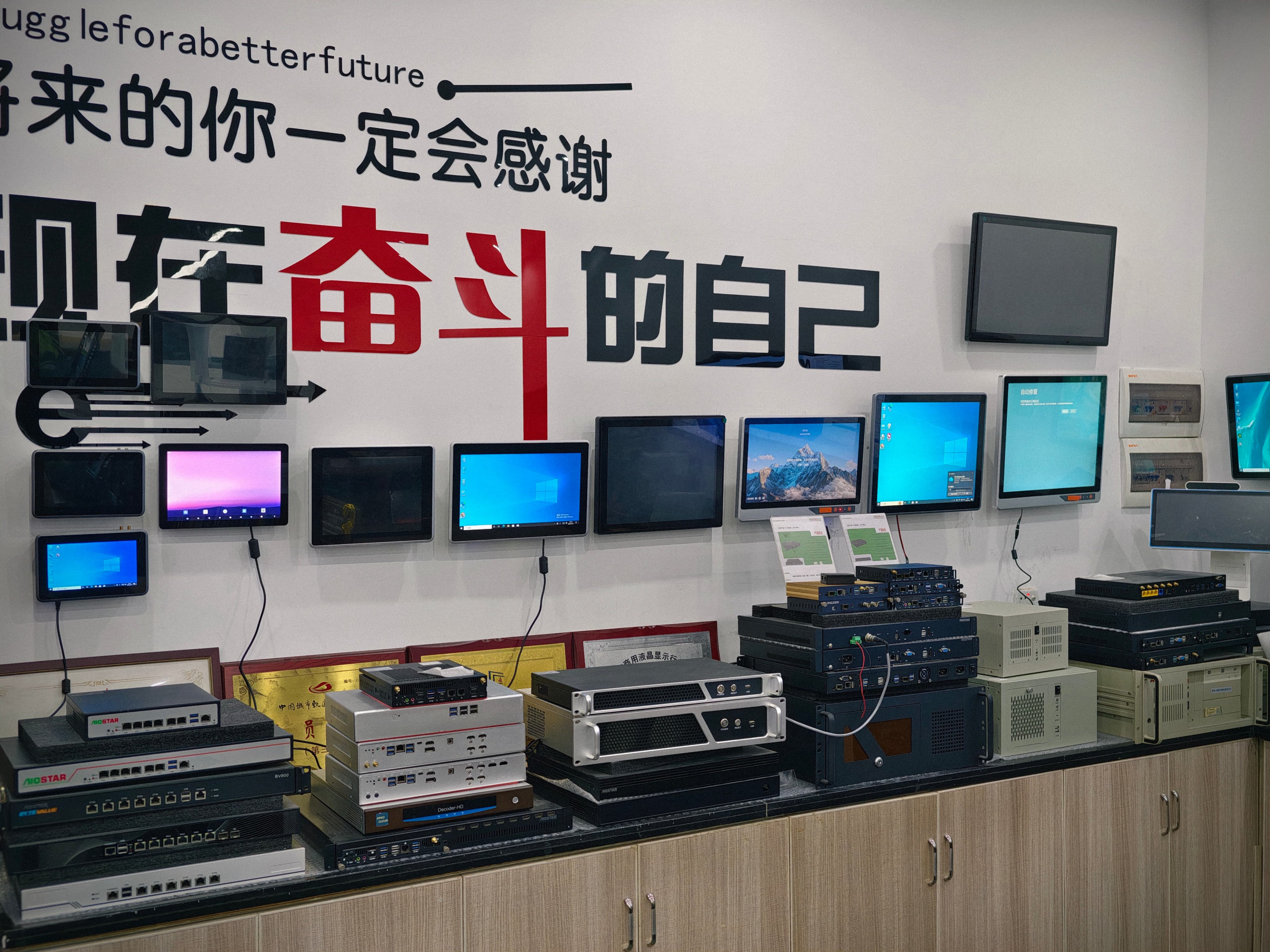
Shenzhen Aiostar Electronics Co., Ltd. (AIOSTAR) was established in 2015 in Shenzhen, China, and develops, produces and supplies OPS PCs, OPS-C pluggable computer modules, Android OPS PCs, industrial motherboards, mini PCs, BOX PCs, industrial panel PCs, servers and customized embedded computing systems. Its products are used in interactive displays, digital signage, education, corporate meetings, industrial automation, smart transportation, retail and security projects. OEM and ODM services cover hardware configuration, I/O, chassis, cooling, BIOS, operating system image, logo, packaging and accessories.
Domestic-Platform OPS-C Computer — AOS-SOZK6A341SXGE
The AOS-SOZK6A341SXGE is a domestic-platform OPS-C computer built on the Zhaoxin KX-6780 series. It supports Zhaoxin KX-U6780A, KX-U6740A, KX-U6640A and KX-U6640MA processors, and it provides six USB ports, of which two are USB 3.0. Optional GT730, GT1030, GTX 1050 or GTX 1050 Ti graphics are available depending on configuration. The module installs as an OPS-C slot-in unit, and its construction is a sheet-metal enclosure, PCB assembly, aluminum heat sink and cooling fan. AIOSTAR positions it for domestic-platform interactive displays, education, government information systems and project-specific commercial displays.
Three things in that specification matter to a display buyer. First, the platform sits in the domestic-platform category, so the module addresses projects that explicitly require a domestic computing platform rather than a general-purpose one. Second, the USB count is stated rather than implied: six ports, two of them USB 3.0. In a slot-in module mounted behind a display, USB channels are a real resource, because touch controllers, cameras, sensors and peripherals all draw on the same pool. Third, the cooling specification includes an active fan alongside the aluminum heat sink, which is worth noting when the display's thermal budget is being planned.
Note: the published parameter set for this model does not list memory and storage specifications. Those items must be confirmed in writing as part of the customization project rather than assumed from another model.
Intel Alder Lake-U OPS-C Pluggable Computer Module — AOS-SOHAUF41SC
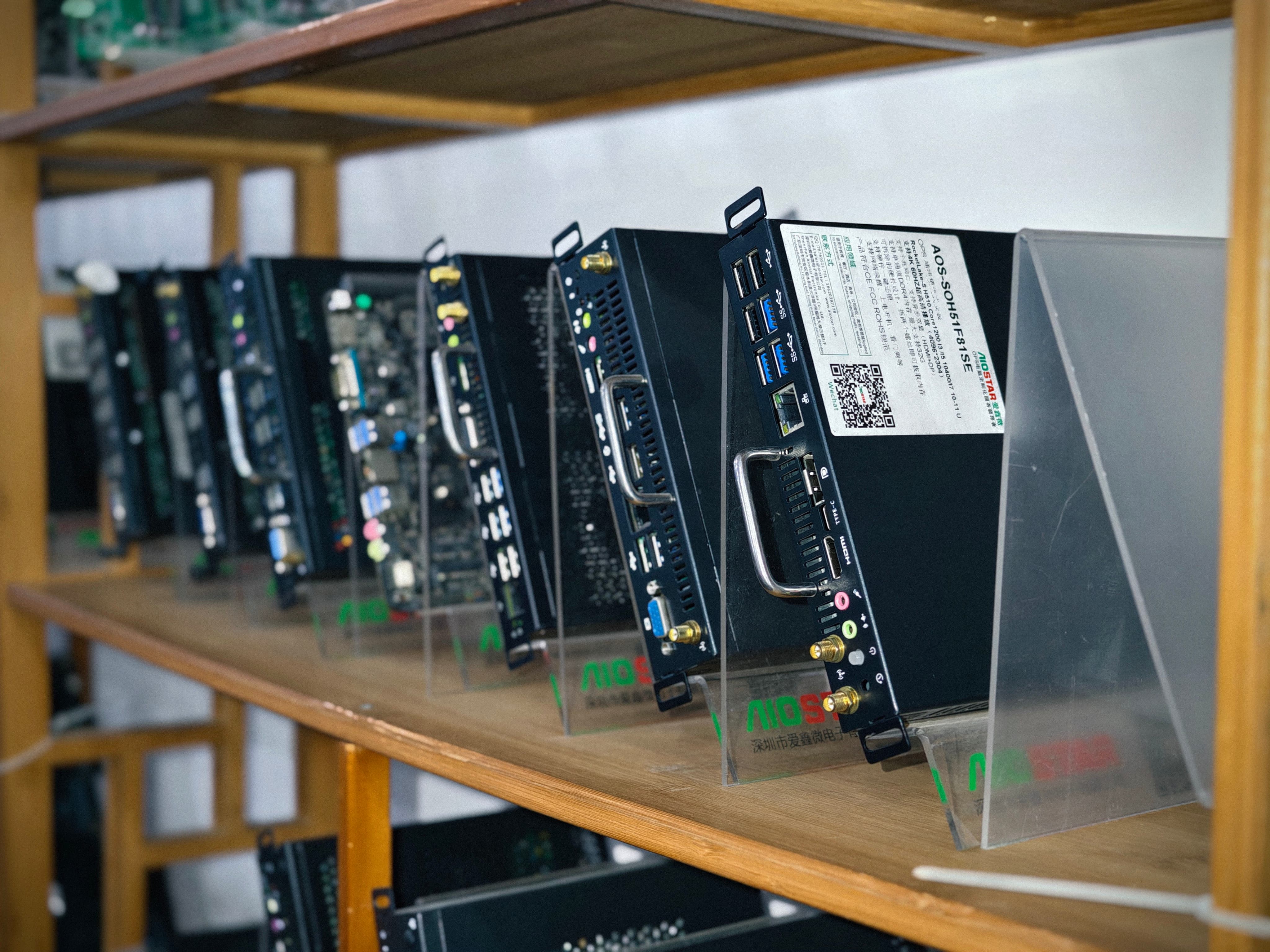
The AOS-SOHAUF41SC is an Intel Alder Lake-U OPS-C pluggable computer module. Its CPU options include Intel Core i5-1235U and i5-1240P. Memory is configurable SO-DIMM, and storage is M.2 SSD. It installs as an OPS-C slot-in module. Windows or Linux options depend on configuration, and Wake-on-LAN, auto power-on and watchdog functions are available through BIOS configuration. The construction is a sheet-metal enclosure, PCB assembly and an aluminum heat sink. AIOSTAR positions it for interactive whiteboards, education technology, corporate meeting displays and commercial display systems.
For a buyer moving from evaluation into execution, this specification answers the configuration questions early. SO-DIMM memory and M.2 SSD are named in the published parameters, so memory and storage capacity are a purchasing choice rather than a fixed board-level constraint. The BIOS-controlled functions are the ones that decide unattended behavior in the field: a classroom display that starts before the first lesson, or a signage unit that recovers after a power interruption without a site visit. Operating system support is stated as configuration-dependent, which means operating system image validation is a deliverable of the project, not an inherited default.
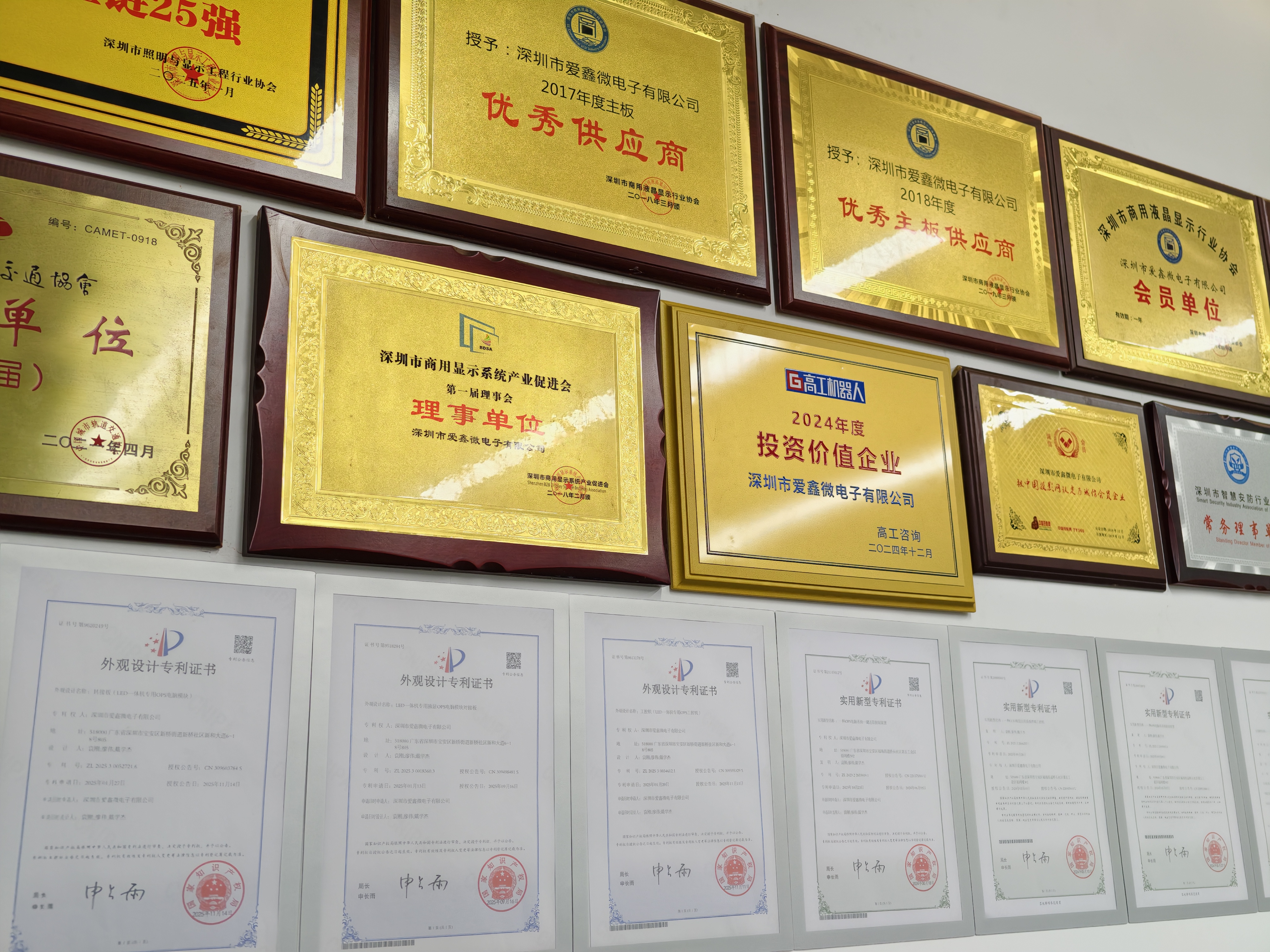
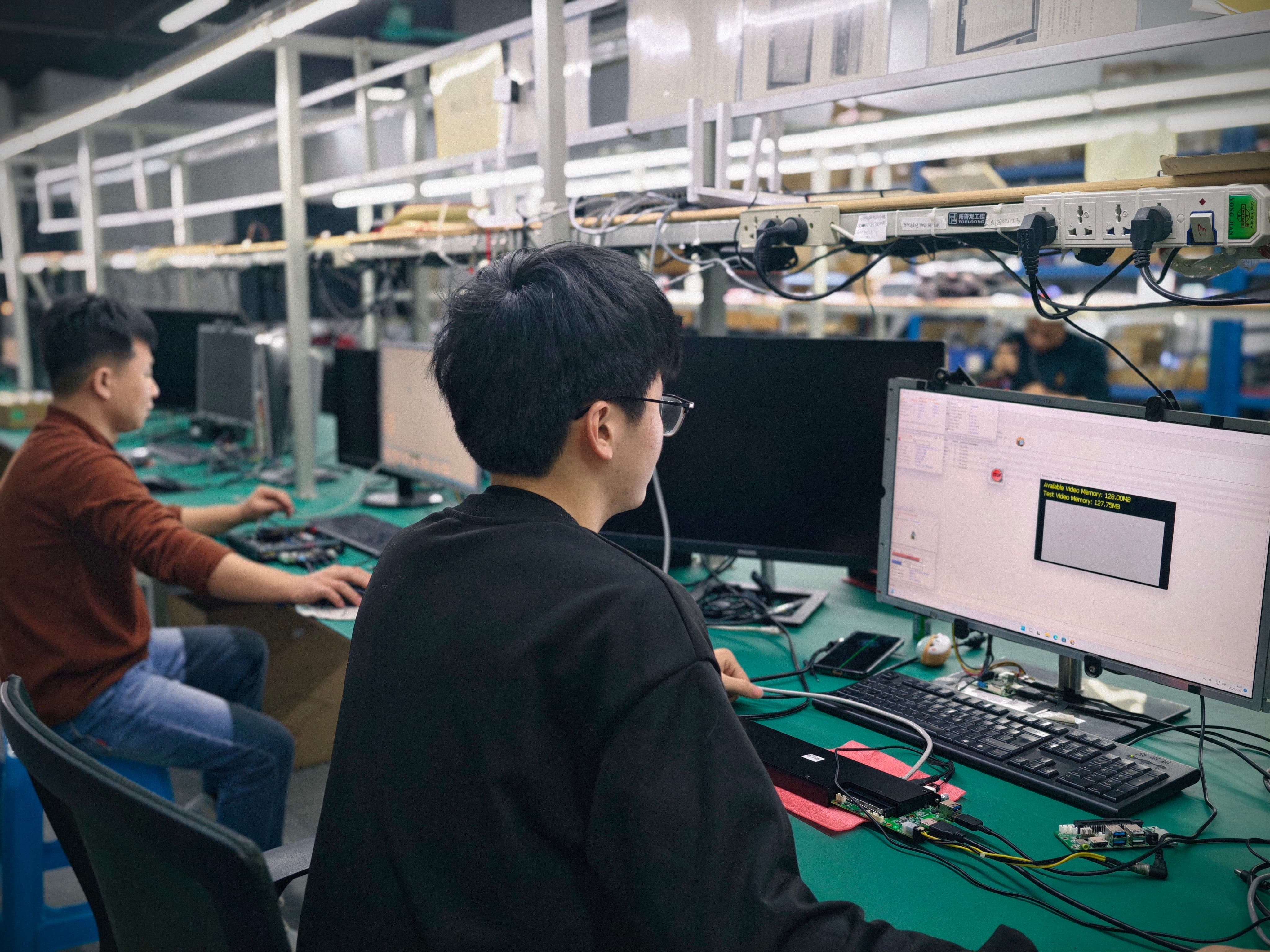
AIOSTAR's customization scope for both modules extends to CPU platform, memory, storage, I/O, chassis size, cooling solution, BIOS functions, operating system image, logo, packaging, power adapter and cables. Quality control covers incoming material inspection and functional and interface testing of finished units, with burn-in testing when specified, and temperature, humidity, vibration and drop testing arrangeable according to project requirements.
Step-by-Step Breakdown: How to Choose the OPS-C Platform for a Display Project
Step 1 — Establish the platform requirement before reading the datasheet
Start with the project, not the specification. Some project categories — domestic-platform interactive displays, education and government information systems — require a domestic computing platform by definition. When that is the case, the Intel module is not a candidate and the decision moves straight to configuration, I/O and validation. When no platform requirement exists, the mature Intel platform with configurable SO-DIMM and M.2 storage and BIOS-controlled power behavior is the more natural default.
Step 2 — Lock memory, storage and I/O configuration now, not later
The Intel Alder Lake-U module states configurable SO-DIMM memory and M.2 SSD storage, so memory and storage capacity are configuration choices. The domestic-platform module states six USB ports including two USB 3.0 ports, which matters because USB channel count is a hard constraint once the display's peripheral set is fixed. Any specification that is not listed in the published parameters for either module should be confirmed with the supplier as part of a custom project rather than inferred from a different model.
Step 3 — Treat operating system image and BIOS behavior as deliverables
The Intel Alder Lake-U module offers Windows or Linux depending on configuration, with Wake-on-LAN, auto power-on and watchdog configurable through BIOS. That combination directly shapes day-two operation: displays that power up on schedule, and terminals that recover from a power cut without manual intervention. For the domestic-platform module, operating system image is part of the customization scope. In both cases, the image and the BIOS settings should be fixed before mass production rather than discovered after the first deployment.
Step 4 — Test the module on the customer's target display
This is the step that most projects underestimate. The OPS-C standard governs the slot architecture, but dimensional differences exist between standard variants and between display brands. The module must be validated on the actual target display for mechanical fit, connector seating, interface behavior and power-up sequence — not on a generic bench fixture. A module that passes a bench test can still fail on a customer chassis because of rail tolerance, thermal ducting or firmware handshake timing.
Step 5 — Verify thermal, firmware and acceptance criteria before mass production
Thermal behavior is the most common failure point for slot-in modules, because the module sits inside the display's closed cavity and depends on the display's airflow path rather than its own. The domestic-platform module lists an aluminum heat sink with a cooling fan; the Intel Alder Lake-U module lists an aluminum heat sink. AIOSTAR's quality-control process includes incoming material inspection, functional and interface testing of finished units and burn-in testing when specified, and temperature, humidity, vibration and drop testing can be arranged according to project requirements. Acceptance criteria should be based on the approved sample or specification, functional testing, burn-in testing when specified, and customer or third-party inspection by agreement.
Step 6 — Confirm commercial terms before the purchase order
MOQ is 1 unit for evaluation samples, while the volume MOQ of a customized project depends on model and configuration. Delivery terms can be arranged as EXW Shenzhen, FOB Shenzhen, CIF or DAP by agreement. Accepted payment terms are 30% T/T deposit with 70% balance before shipment unless otherwise agreed in the proforma invoice. Production lead time is 60 days, and monthly production capacity exceeds 5,000 units.
Use Cases: Where Each Platform Fits
Education, government and domestic-platform display projects
AIOSTAR positions the domestic-platform OPS-C computer for domestic-platform interactive displays, education, government information systems and project-specific commercial displays. Where a project requires a domestic computing platform, the AOS-SOZK6A341SXGE is the corresponding OPS-C candidate, and it brings optional graphics configurations and six USB ports, two of them USB 3.0, into the same slot.
Corporate meeting displays, interactive whiteboards and commercial display systems
The Intel Alder Lake-U module is positioned for interactive whiteboards, education technology, corporate meeting displays and commercial display systems. Configurable SO-DIMM memory and M.2 SSD storage, combined with BIOS-controlled Wake-on-LAN, auto power-on and watchdog, suit meeting-room and signage deployments where predictable unattended power-up and recovery matter more than peak benchmark performance.
Long-life deployments and serviceability
A documented case project with an industrial or transportation solution provider in Japan covers 1,000 units built around an OPS adapter board, operating for 3 to 7 years with a reported result of stable operation. The project relies on a removable slot-in design that simplifies installation and maintenance, and on configurable memory, storage, BIOS and operating system images to support different interactive-display projects. For any buyer planning a multi-year display deployment, that combination is the practical measure of value: how easily a module can be serviced in the field, and how repeatably its configuration can be sourced across future batches.
Comparison Table: Domestic-Platform vs Intel Alder Lake-U OPS-C
| Comparison point | Domestic-Platform OPS-C Computer (AOS-SOZK6A341SXGE) | Intel Alder Lake-U OPS-C Pluggable Computer Module (AOS-SOHAUF41SC) |
|---|---|---|
| Platform | Zhaoxin KX-6780 series | Intel Alder Lake-U |
| CPU options | KX-U6780A, KX-U6740A, KX-U6640A, KX-U6640MA | Intel Core i5-1235U, Intel Core i5-1240P |
| Optional graphics | GT730, GT1030, GTX 1050 or GTX 1050 Ti depending on configuration | Not listed in the published parameter set |
| Memory | Not listed in the published parameter set — confirm in writing within the custom project | Configurable SO-DIMM memory |
| Storage | Not listed in the published parameter set — confirm in writing within the custom project | M.2 SSD |
| USB | Six ports, including two USB 3.0 ports | Not listed in the published parameter set |
| Installation | OPS-C slot-in installation | OPS-C slot-in installation |
| Cooling | Aluminum heat sink and cooling fan | Aluminum heat sink |
| Operating system | Not listed in the published parameter set; operating system image is available through AIOSTAR customization | Windows or Linux options depend on configuration |
| BIOS functions | Not listed in the published parameter set | Wake-on-LAN, auto power-on and watchdog available by BIOS configuration |
| Construction | Sheet-metal enclosure, PCB assembly, aluminum heat sink and cooling fan | Sheet-metal enclosure, PCB assembly and aluminum heat sink |
| Typical project fit | Domestic-platform interactive displays, education, government information systems, project-specific commercial displays | Interactive whiteboards, education technology, corporate meeting displays, commercial display systems |
| EU compliance (both modules) | CE-RED Certificate of Compliance number 25ITC1212094; RoHS Declaration of Compliance number 25ITC1212100 | |
All parameters in this table come from AIOSTAR's published product parameters and certification documents. Entries marked as not listed in the published parameter set indicate information absent from the supplier's released specification and should be confirmed rather than assumed.
FAQ
Are AIOSTAR OPS-C modules certified for EU display projects?
Yes. The relevant documents are a CE-RED Certificate of Compliance (certificate number 25ITC1212094, issued by Shenzhen iTC Product Testing Co., Ltd. on 2025-12-20) and a RoHS Declaration of Compliance (certificate number 25ITC1212100, issued by the same laboratory on 2025-12-18). The RoHS declaration is issued under EU RoHS Directive 2011/65/EU and amendment 2015/863/EU. Both documents list the Domestic-Platform OPS-C Computer AOS-SOZK6A341SXGE and the OPS-C Pluggable Computer Module AOS-SOHAUF41SC among the related products. Because certification scope follows the product as tested, project-specific requirements should still be confirmed against the final configuration.
Can AIOSTAR customize an OPS-C module for an OEM project?
Yes. AIOSTAR provides OEM, ODM and project customization production services. Customization can cover CPU platform, memory, storage, I/O, chassis size, cooling solution, BIOS functions, operating system image, logo, packaging, power adapter and cables. Quality control includes incoming material inspection, functional and interface testing of finished units, and burn-in testing when specified, with temperature, humidity, vibration and drop testing arrangeable according to project requirements. Monthly production capacity exceeds 5,000 units and production lead time is 60 days.
What are the payment and delivery terms for a customized OPS-C order?
Accepted payment terms are 30% T/T deposit with the 70% balance before shipment, unless otherwise agreed in the proforma invoice. Delivery terms can be arranged as EXW Shenzhen, FOB Shenzhen, CIF or DAP by agreement. MOQ is to be confirmed by customized project. Delivery terms and acceptance criteria are confirmed at the quotation stage, so the commercial structure is settled before tooling or batch production begins.
Can I evaluate a sample before committing to mass production?
Yes. Standard MOQ is 1 unit for evaluation samples, and volume MOQ depends on model and configuration. Sample approval and third-party inspection can be agreed for project orders, and functional and interface testing is performed before shipment. Testing the sample on the customer's target display is the most reliable way to close out mechanical fit, thermal behavior, firmware handshake and operating system image validation before mass production.
What is the lead time and warranty for OPS-C modules?
Production lead time is 60 days. Standard after-sales support includes remote technical support, BIOS, operating system and driver assistance, and a one-year warranty unless otherwise agreed in the quotation or proforma invoice. To start a project evaluation, contact AIOSTAR at salesos@aiostar.com or on WhatsApp at +86 153 3879 5007. The company introduction brochure is available at https://cdn.socialarks.com/sbsp/25107/common/2026/0724/Aiostar%20Introduction%202026_EN.pdf.
Conclusion: Choose by Fit, Not by Instinct
The domestic-platform OPS-C computer and the Intel Alder Lake-U OPS-C module are both genuine OPS-C slot-in modules produced by AIOSTAR under the same customization and quality-control process. Choosing between them comes down to three things: whether the project requires a domestic platform, which configuration items matter (memory, storage, I/O, graphics, BIOS behavior), and whether the module can be validated mechanically, thermally and at the firmware level on the customer's target display.
The domestic-platform module, AOS-SOZK6A341SXGE, addresses domestic-platform deployments in education, government information systems and project-specific commercial displays, and it pairs optional graphics configurations with six USB ports, two of them USB 3.0, inside a cooling design that includes an active fan. The Intel Alder Lake-U module, AOS-SOHAUF41SC, addresses interactive whiteboards, education technology, corporate meeting displays and commercial display systems, with configurable SO-DIMM memory and M.2 SSD storage and BIOS-controlled Wake-on-LAN, auto power-on and watchdog.
The disciplined sequence is short: fix the platform and configuration, confirm the operating system image and BIOS behavior, test the module on the customer's target display, and only then lock thermal performance, firmware behavior and acceptance criteria in writing before mass production. That sequence is what keeps a display project moving from evaluation into execution without carrying an avoidable risk into the first production batch.
Next Step: Evaluate a Sample First
Evaluation samples start at an MOQ of 1 unit, and production lead time is 60 days. Confirming the specification and testing a sample on the target display is the lowest-cost way to move from evaluation to execution.
Contact: salesos@aiostar.com · WhatsApp +86 153 3879 5007 · Brochure: https://cdn.socialarks.com/sbsp/25107/common/2026/0724/Aiostar%20Introduction%202026_EN.pdf · Website: https://www.aiostar.com/en/
Have Questions or Need More Details?
Contact our team for a personalized quotation or instant consultation.
Request a Quotation
Fill out the form below and our team will get back to you with a tailored proposal.
WhatsApp Direct Chat
Prefer to chat in real-time? Message us on WhatsApp for instant assistance & quick answers.
- Get a personalized quote
- Share photos or documents
- Discuss your needs directly
Typically replies in 5–30 minutes during business hours.