
OPS PC Module Compliance: Certification and Regional Standards Explained
An OPS PC module is a computer that ships inside somebody else's product. That single fact decides how its compliance has to be managed. The module is tested as a computer, declared as a computer, and then installed into an interactive flat panel, a signage display or a video wall that carries its own separate documents. When the two sets of paperwork do not line up, the problem appears at the customs desk, at the integrator's acceptance test or at the end customer's audit — normally long after the purchase order was signed.
This guide explains how compliance works in practice for OPS PC modules: what a CE-RED or RoHS declaration does and does not cover, which parts of a module are configuration-dependent, where component changes introduce risk, and how a buyer can verify a specific project configuration before it is released to production.
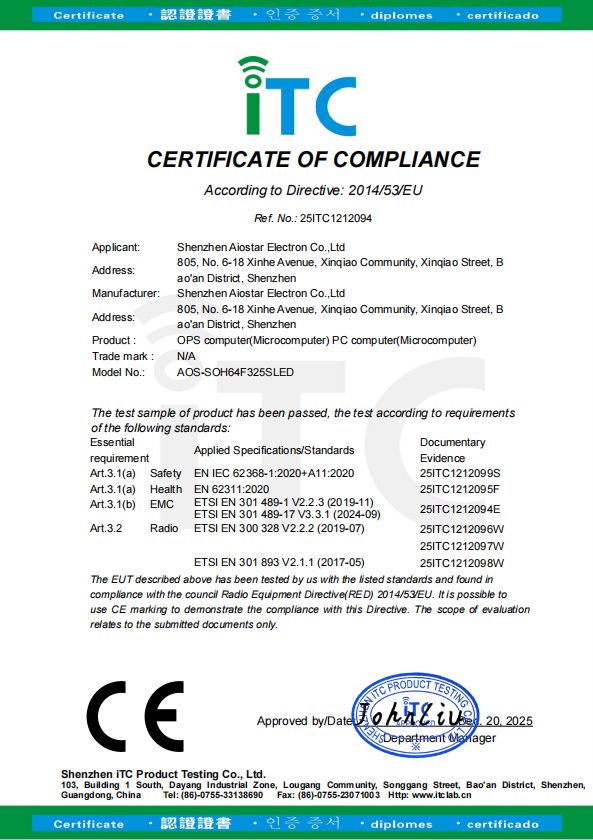
Short answer. OPS PC compliance is configuration-dependent, not family-dependent. The OPS-C Pluggable Computer Module AOS-SOHAUF41SC holds CE-RED certification number 25ITC1212094 and complies with EU RoHS Directive 2011/65/EU and amendment 2015/863/EU. The Android AI OPS Computer AOS-SOR358464H is certified to CE-RED under Directive 2014/53/EU and complies with the same RoHS requirements. Both declarations were issued by Shenzhen iTC Product Testing Co., Ltd. and apply to the EU market. Because modules are built to order — processor, memory, storage, graphics, wireless, cooling, BIOS and operating system image — a certificate must be checked against the exact configuration for each project.
Problem Definition: Why "Is It Certified?" Is the Wrong Question
Buyers usually ask one question: is this OPS PC certified? It is a reasonable question with an imprecise answer, because certification attaches to three separate layers — and only two of them belong to the module supplier.
Layer 1: the module
The OPS PC itself is a microcomputer. Safety, electromagnetic compatibility, radio performance where wireless is present, and hazardous-substance limits are evaluated on that unit.
Layer 2: the host display
The interactive flat panel, signage display or video wall has its own declarations. Slotting a module into a display changes the electrical and thermal environment of the assembly, but it does not automatically move the display's own certificate, and it does not automatically extend the module's certificate either.
Layer 3: the components inside the module
Memory, storage, wireless card, power adapter, cooling assembly and firmware each sit inside a tested design. If one of them changes after testing, the shipped unit can sit outside the configuration that was actually evaluated.
The practical consequence is that a certificate on file is not the same thing as a certificate that covers the unit about to be received. The mismatch is invisible in a product photograph and invisible in a specification table. It only becomes visible when the wrong document is presented in the wrong market — and at that point it is a schedule problem, not a paperwork problem.
That is also why certification status for OPS PC modules should be treated as configuration-dependent and verified per project, rather than assumed from a product family name or a previous orders' documents.
Industry Background: Why Modular Display Compute Attracts Compliance Scrutiny
Modular compute has become normal inside commercial displays. The global interactive flat panel market — the primary application for OPS PC modules — was valued at approximately USD 12.6 billion in 2024 (Grand View Research). Integrated OPS-slot compute modules and Android-based SoC modules are estimated to ship in 15–25% of new interactive flat-panel display units (IFPD Market Trends Report, 2023). Industrial PC demand, which includes industrial-grade OPS modules, was estimated at USD 6.48 billion in 2024 and is projected to grow at a CAGR of 6.30% through 2032 (Grand View Research).
Two structural features of the category explain why compliance questions cluster around it.
The interface is standardized. Intel's Open Pluggable Specification defines a mechanical and electrical interface between displays and media players using a unified 80-pin JAE connector with a footprint of 180 mm × 119 mm × 30 mm. A standardized slot means modules from different suppliers are physically interchangeable, and buyers reasonably expect them to be interchangeable on paper too. They are not: the slot is standardized, the electronics and radio inside it are not, and compliance is evaluated per design rather than per slot.
The regulated interfaces are optional. Wireless connectivity, discrete graphics, additional video outputs and project-specific I/O are configuration choices. A module with a wireless card and an identical-looking module without one are not the same declaration event, even when both carry the same product name on the box.
For buyers, the operating rule is short: the display's compliance file does not cover the module, and a module's certificate number does not cover a configuration that was never tested.
What the AIOSTAR Declaration Set Covers
Shenzhen Aiostar Electronics Co., Ltd. was established in 2015 in Shenzhen, China, and develops and supplies OPS PCs, OPS-C pluggable computer modules, Android OPS PCs, industrial motherboards, mini PCs, BOX PCs, industrial panel PCs, servers and customized embedded computing systems for interactive displays, digital signage, education, corporate meetings, industrial automation, smart transportation, retail and security projects. Two EU-market documents from this portfolio most often appear in buyer audits.
CE-RED — certification number 25ITC1212094
Issued by Shenzhen iTC Product Testing Co., Ltd. on 20 December 2025 and valid to 20 December 2099. The declared scope is OPS computer (Microcomputer) and PC computer (Microcomputer). The standard set includes the Radio Equipment Directive 2014/53/EU, EN IEC 62368-1:2020+A11:2020 for safety, EN 62311:2020 for electromagnetic field exposure, ETSI EN 301 489-1 V2.2.3 (2019-11) and ETSI EN 301 489-17 V3.3.1 (2024-09) for EMC, and ETSI EN 300 328 V2.2.2 (2019-07) with ETSI EN 301 893 V2.1.1 (2017-05) for radio performance. This is the document that carries weight when a display is specified with Wireless or Radio Equipment requirements.
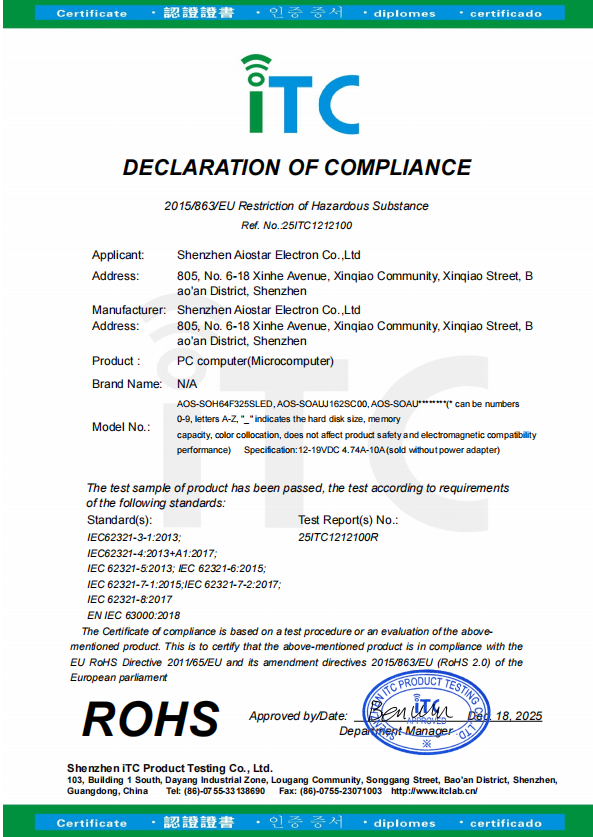
RoHS — declaration of compliance 25ITC1212100
Issued by Shenzhen iTC Product Testing Co., Ltd. on 18 December 2025 and valid to 18 December 2099, with the declared scope PC computer (Microcomputer). It references EU RoHS Directive 2011/65/EU and amendment 2015/863/EU, supported by the IEC 62321 test series (IEC 62321-3-1:2013; IEC 62321-4:2013+A1:2017; IEC 62321-5:2013; IEC 62321-6:2015; IEC 62321-7-1:2015; IEC 62321-7-2:2017; IEC 62321-8:2017) and EN IEC 63000:2018. This is the document used for hazardous-substance and material declarations.
| Declaration | Number | Issued by | Declared scope | Key standards referenced | Market |
|---|---|---|---|---|---|
| CE-RED Certificate of Compliance | 25ITC1212094 | Shenzhen iTC Product Testing Co., Ltd. | OPS computer (Microcomputer); PC computer (Microcomputer) | RED 2014/53/EU; EN IEC 62368-1:2020+A11:2020; EN 62311:2020; ETSI EN 301 489-1 V2.2.3; ETSI EN 301 489-17 V3.3.1; ETSI EN 300 328 V2.2.2; ETSI EN 301 893 V2.1.1 | EU |
| RoHS Declaration of Compliance | 25ITC1212100 | Shenzhen iTC Product Testing Co., Ltd. | PC computer (Microcomputer) | EU RoHS Directive 2011/65/EU and amendment 2015/863/EU; IEC 62321 series; EN IEC 63000:2018 | EU |
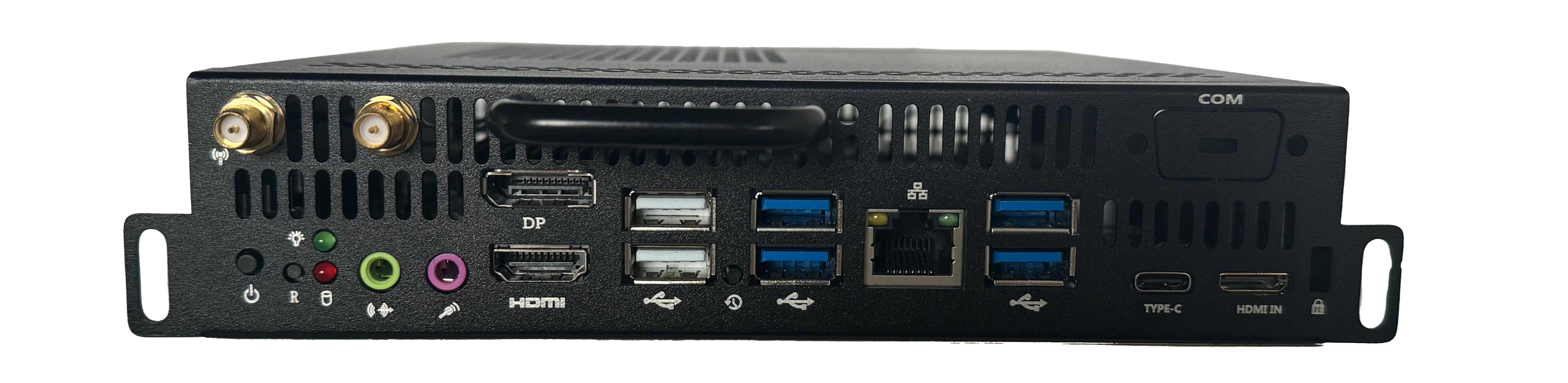
Which modules do these documents relate to? The OPS-C Pluggable Computer Module AOS-SOHAUF41SC and the Android AI OPS Computer AOS-SOR358464H are the configurations most directly tied to the CE-RED and RoHS declarations described above. The Domestic-Platform OPS-C Computer AOS-SOZK6A341SXGE and the Discrete-GPU OPS Computer AOS-SOH61I41SXG sit within the OPS PC product scope of the same declaration set, and their coverage should be confirmed against the configuration being ordered rather than assumed.
This guide deliberately does not name market-specific legal instruments beyond the standards referenced in the declarations above. National implementations, import procedures and product-specific requirements vary by destination, and they should be confirmed with the buyer's own compliance or import specialists before release.
Component Changes: Where Compliance Risk Actually Enters
Most compliance problems in OPS PC projects do not come from a design that was never tested. They come from a design that was tested and then changed.
A declaration is issued against a specific bill of materials. Once that BOM is fixed, the tested configuration has defined behaviour: the radio transmits within tested limits, the power stage stays inside safety margins, and the materials stay within substance thresholds. When a component changes, each of those assumptions is reopened. The categories that carry the most exposure are:
- Wireless module changes — these sit at the centre of Radio Equipment Directive testing, and a change of radio module or antenna arrangement affects the ETSI EN 300 328 and ETSI EN 301 893 results.
- Power supply and adapter changes — these affect the safety evaluation built on EN IEC 62368-1:2020+A11:2020.
- Enclosure, heat sink and cooling changes — these alter the thermal environment under which the unit was evaluated and can shift EMC behaviour.
- Memory, storage and optional graphics changes — these add or remove radiating and heat-generating elements inside the same chassis.
- Firmware, BIOS and operating system image changes — these can change radio power behaviour and feature configuration.
Because substitutions are commercially normal in a configure-to-order business, this risk is managed through two controls rather than through a promise that nothing will ever change.
Control one: a controlled bill of materials. The configuration that ships is built from a fixed, recorded component list — the same list the declaration was raised against. The BOM is what makes a certificate number meaningful for a specific order. A certificate without a controlled BOM is a statement about a sample, not about a shipment.
Control two: customer notification before change. When a substitution is unavoidable — an end-of-life memory module, a discontinued wireless card, an alternative adapter — the change should be communicated to the buyer before it enters production, together with the test areas it touches. That lets the buyer decide whether the changed configuration is acceptable as-is in their market or whether a re-test or updated declaration is required before release.
Neither control removes the underlying constraint. Certification covers a configuration, and the verification decision belongs to the project — not to the product family name, and not to the previous order.
Step-by-Step: Verifying OPS PC Module Compliance for a Project
- Fix the configuration and the destination market first. Processor, memory, storage, graphics, wireless, cooling, BIOS functions, operating system image and I/O should be listed before any document is requested. Compliance questions cannot be answered for an unfinished configuration.
- Request the declaration set for the exact model. Ask for the certificate number, the issuing authority, the issue date, the validity date and the declared scope wording. For AIOSTAR OPS PC modules, the current EU-market set is CE-RED 25ITC1212094 and RoHS 25ITC1212100, both issued by Shenzhen iTC Product Testing Co., Ltd.
- Read the scope line against the item being purchased. A scope written as "OPS computer (Microcomputer); PC computer (Microcomputer)" is the anchor. If the configuration being ordered is not represented in that scope, the certificate does not close the question by itself.
- Map components to the standards. Wireless parts map to the radio and EMC standards; power stages map to the safety standard; enclosure and materials map to the RoHS declaration and the IEC 62321 series. Any component without a mapping is a verification task.
- Freeze the BOM in writing and record the change-notification term. The purchase documentation should state that the shipped configuration matches the recorded component list, and that any substitution is notified before production so the buyer can assess re-verification.
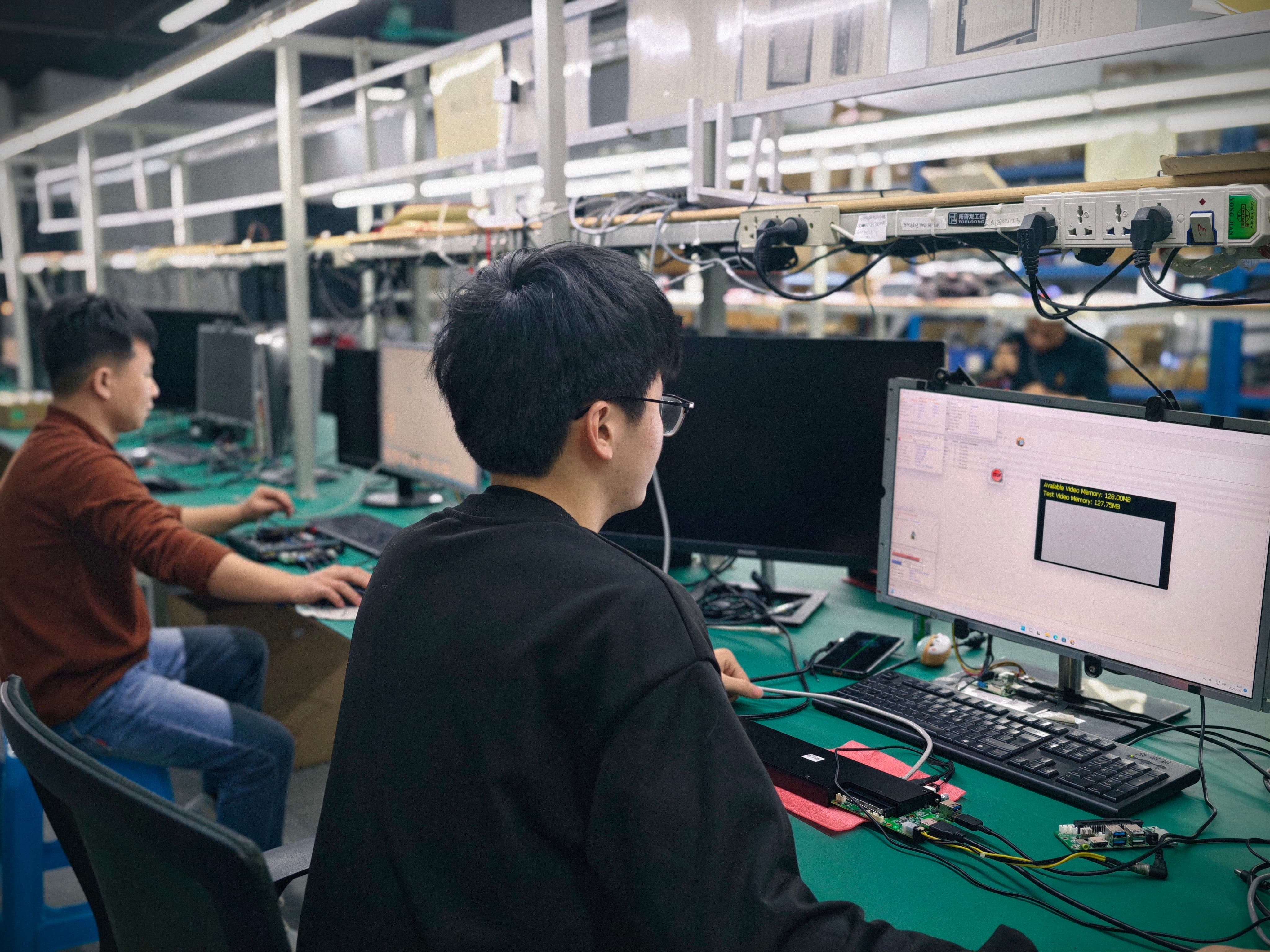
- Validate a physical sample. AIOSTAR provides evaluation samples with an MOQ of 1 unit; for customized projects the MOQ depends on configuration. For OPS-C education and integration projects, verify mechanical size, connector pinout, display resolution, cooling and the operating system image before mass production.
- Re-verify at every change and keep a project file. Certificate copies, the frozen BOM, test documentation and any burn-in records should travel with the project, so the next configuration change is assessed against evidence rather than memory.
Use Cases: Where OPS PC Compliance Decisions Play Out
Education and interactive whiteboards
Teaching displays run daily, often on a school network, and are purchased through tenders that require a document pack per project. The AOS-SOHAUF41SC OPS-C module fits this pattern: Intel Core i5-1235U and i5-1240P options, configurable SO-DIMM memory and M.2 SSD, OPS-C slot-in installation, and BIOS-configurable Wake-on-LAN, auto power-on and watchdog functions. Mechanical fit and connector pinout must be verified alongside the documents, because a compliant module that does not seat correctly stops a rollout just as effectively as a missing certificate.
Digital signage and smart retail
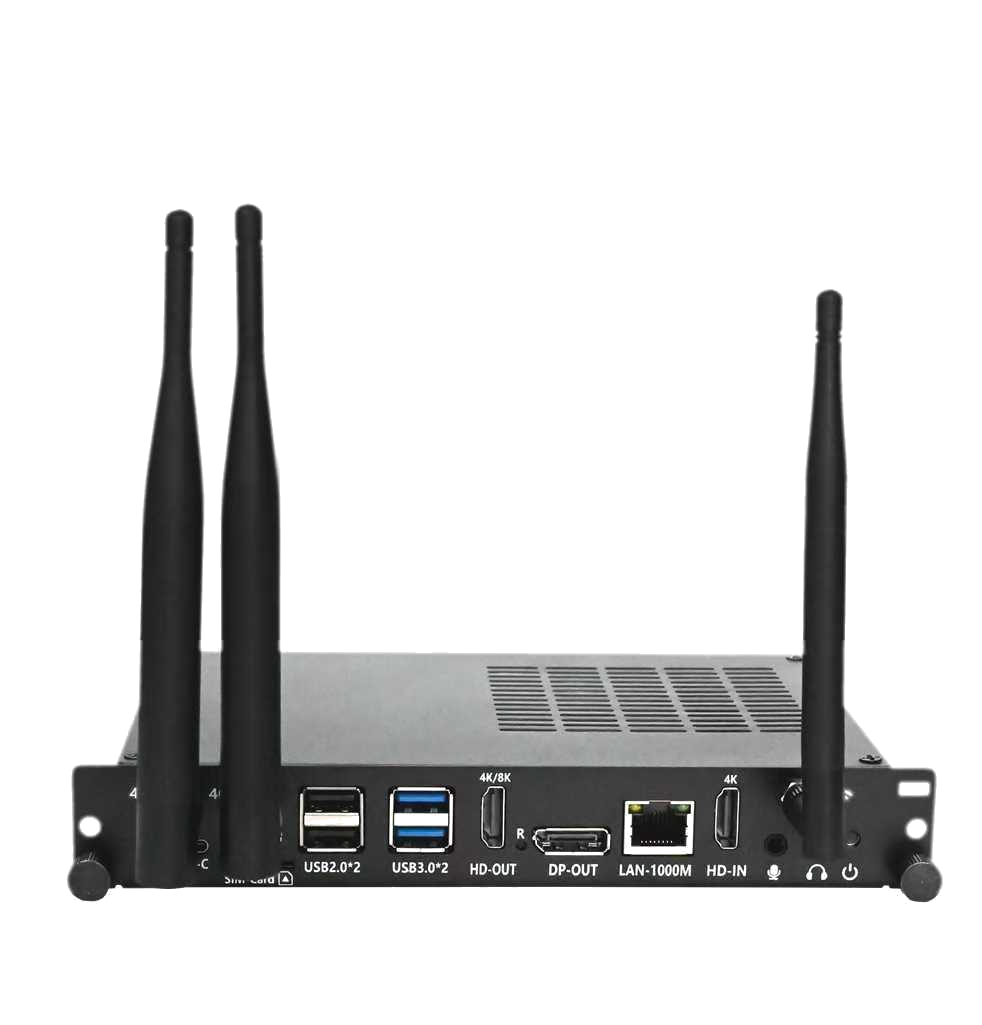
Signage runs unattended for long periods, which makes power behaviour and material declarations more relevant than peak performance. The AOS-SOR358464H Android AI OPS Computer combines a Rockchip RK3588 octa-core CPU with an integrated 6 TOPS NPU, 4 GB LPDDR4 memory as standard and up to 16 GB optional, eMMC storage, and Android 13, Ubuntu or Debian options, with 8K multimedia capability depending on firmware and interface configuration. Firmware and interface choices are exactly the variables that must be frozen before a compliance statement is issued for a project.
Domestic-platform deployments
Some education and government information projects are specified around a domestic processor platform, and there the compliance file is read as closely as the specification. The AOS-SOZK6A341SXGE Domestic-Platform OPS-C Computer supports Zhaoxin KX-U6780A, KX-U6740A, KX-U6640A and KX-U6640MA processors, provides six USB ports including two USB 3.0 ports, and offers optional GT730, GT1030, GTX 1050 or GTX 1050 Ti graphics depending on configuration — each of which is a configuration variable that belongs in the frozen BOM.
Large-format visualization and video walls
Video walls and LED meeting displays push output resolution and power budget at the same time. The AOS-SOH61I41SXG Discrete-GPU OPS Computer is built on an Intel H610 platform supporting selected 12th and 13th Gen Intel Core i3, i5 and i7 processors, with HDMI and DisplayPort video outputs and up to 8K 60 Hz output subject to the selected CPU, GPU and display configuration, plus optional discrete graphics by project. GPU choice and thermal design directly determine whether the delivered unit still matches what was evaluated.
Long-horizon field evidence
In Japan, an industrial and transportation solution provider deployed 1000 units of an OPS adapter board based on the domestic-platform OPS-C design, in operation for 3–7 years with stable operation. The removable slot-in design simplifies installation and maintenance, while configurable memory, storage, BIOS and operating system images support different interactive-display projects. Reliability over that horizon depends on a configuration staying inside its declared envelope for the whole service life — which is precisely what BOM control is for.
Comparison: AIOSTAR OPS PC Modules and Their Compliance Profile
| Module | Platform | Certification reference | Typical application | Configuration items to freeze |
|---|---|---|---|---|
| AOS-SOHAUF41SC — OPS-C Pluggable Computer Module | Intel Alder Lake-U, Intel Core i5-1235U / i5-1240P options; OPS-C slot-in | CE-RED 25ITC1212094; EU RoHS 25ITC1212100 — confirm against the ordered configuration | Interactive whiteboards, education technology, corporate meeting displays, commercial display systems | SO-DIMM memory, M.2 SSD, operating system, I/O, BIOS functions (Wake-on-LAN, auto power-on, watchdog) |
| AOS-SOR358464H — Android AI OPS Computer | Rockchip RK3588 octa-core up to 2.4 GHz; integrated 6 TOPS NPU | CE-RED per Directive 2014/53/EU; EU RoHS 2011/65/EU and amendment 2015/863/EU — confirm against the ordered configuration | Digital signage, interactive displays, smart retail, information kiosks, edge-AI display terminals | LPDDR4 memory (4 GB standard, up to 16 GB optional), eMMC storage, firmware, Android 13 / Ubuntu / Debian, interfaces |
| AOS-SOZK6A341SXGE — Domestic-Platform OPS-C Computer | Zhaoxin KX-U6780A, KX-U6740A, KX-U6640A, KX-U6640MA; OPS-C slot-in | Within the OPS PC scope of the declarations above — verify per project | Domestic-platform interactive displays, education, government information systems, project-specific commercial displays | Optional GT730 / GT1030 / GTX 1050 / GTX 1050 Ti graphics, memory, storage, operating system, project I/O |
| AOS-SOH61I41SXG — Discrete-GPU OPS Computer | Intel H610, selected 12th and 13th Gen Intel Core i3 / i5 / i7 | Within the OPS PC scope of the declarations above — verify per project | Large-format commercial displays, LED meeting displays, video walls, visualization systems, multi-display projects | Optional discrete graphics, memory, storage, video outputs, cooling, operating system |
Frequently Asked Questions
Which OPS PC manufacturers are CE-certified for interactive flat panels?
CE marking is not a status that applies to a manufacturer; it attaches to products and configurations. What a buyer should collect from any OPS PC supplier is the certificate number, the issuing authority, the issue date, the validity date and the declared scope. For the AIOSTAR OPS PC range, the EU-market references are CE-RED certification number 25ITC1212094, issued by Shenzhen iTC Product Testing Co., Ltd. on 20 December 2025 for the OPS computer (Microcomputer) and PC computer (Microcomputer) scope, and RoHS Declaration of Compliance 25ITC1212100, issued on 18 December 2025 for the PC computer (Microcomputer) scope. The OPS-C Pluggable Computer Module AOS-SOHAUF41SC and the Android AI OPS Computer AOS-SOR358464H are the configurations most directly tied to these declarations, and coverage should still be confirmed against the configuration a project actually orders.
Does one CE certificate cover every OPS PC configuration?
No. Certification is configuration-dependent. An OPS PC module is a configure-to-order product: processor, memory, storage, optional graphics, wireless, cooling, BIOS functions and operating system image are all variables. A wireless card, a discrete GPU, a different power adapter or a revised cooling design changes what was evaluated. The certificate number identifies a declaration, not a blanket permission for every option list, so the configuration must be checked against the current declaration before an order is released.
What happens to compliance if a component changes after certification?
Risk is managed through two controls. First, a controlled bill of materials fixes the component sources that were declared, so the shipped configuration matches what was tested. Second, when a substitution is unavoidable — for example an end-of-life memory module, a discontinued wireless card or an alternative adapter — the change is communicated to the customer before it enters production, together with the test areas it affects. The buyer then decides whether the change can be accepted as-is in their market or whether re-testing or an updated declaration is needed. This keeps component changes from becoming undocumented compliance drift.
What sample and ordering terms apply before a compliant configuration is confirmed?
AIOSTAR supplies evaluation samples with an MOQ of 1 unit; for customized projects the MOQ depends on configuration. Shenzhen Aiostar Electronics Co., Ltd. operates a 1500 m² facility with 50 employees, an 8-engineer R&D team and a monthly capacity of 5,000+ units, with a standard lead time of 60 days. Production quality control covers incoming material inspection and functional and interface testing of finished units, while burn-in testing and temperature, humidity, vibration and drop testing can be arranged according to project requirements. For OPS-C integration projects, mechanical size, connector pinout, display resolution, cooling and the operating system image should be verified on the sample before mass production begins.
How long does delivery take once a configuration is confirmed, and what support is included?
The standard lead time is 60 days from configuration confirmation. After delivery, AIOSTAR provides remote technical support plus BIOS, operating system and driver assistance, with a one-year warranty unless otherwise agreed in the quotation or proforma invoice. If a project needs a compliance file reviewed against a specific configuration, the practical next step is to send the target configuration — platform, memory, storage, graphics, wireless, operating system image and destination market — to the team at salesos@aiostar.com or WhatsApp +86 153 3879 5007, and request a sample for validation. The full product range and capability overview are available in the AIOSTAR company brochure.
Conclusion
Compliance for OPS PC modules is not a badge that a product carries permanently. It is a relationship between a model, a configuration, a test scope and a market — and that relationship has to be re-checked whenever any of the four changes. The useful questions are therefore narrower than "is it certified": which declaration covers this model, what scope wording does it use, which components does it depend on, and what happens if one of those components is substituted.
For AIOSTAR OPS PC modules, the EU-market reference points are CE-RED 25ITC1212094 and RoHS 25ITC1212100, both issued by Shenzhen iTC Product Testing Co., Ltd., with the OPS-C Pluggable Computer Module AOS-SOHAUF41SC and the Android AI OPS Computer AOS-SOR358464H as the configurations most directly tied to them. Whether a specific AOS-SOZK6A341SXGE, AOS-SOH61I41SXG or custom build fits a given project still has to be confirmed configuration by configuration — and that confirmation, backed by a controlled BOM and a notification step for component changes, is what keeps a display rollout on schedule instead of at the customs desk.
Next step
Send the target configuration and destination market to salesos@aiostar.com or WhatsApp +86 153 3879 5007 to request a sample, a quotation and the applicable declaration set for your project. Browse the OPS PC range at aiostar.com or download the 2026 AIOSTAR introduction brochure.
Have Questions or Need More Details?
Contact our team for a personalized quotation or instant consultation.
Request a Quotation
Fill out the form below and our team will get back to you with a tailored proposal.
WhatsApp Direct Chat
Prefer to chat in real-time? Message us on WhatsApp for instant assistance & quick answers.
- Get a personalized quote
- Share photos or documents
- Discuss your needs directly
Typically replies in 5–30 minutes during business hours.