
How to Specify Porcelain Tile for Commercial Projects
How to Specify Porcelain Tile for Commercial Projects
Commercial projects put unusual demands on flooring. A shopping mall lobby, a hotel corridor, or an airport departure hall must survive continuous foot traffic, heavy carts, wet cleaning, and occasional spills — while still looking consistent and professional. Choosing the right porcelain tile is a specification decision that affects safety, maintenance, and the building's long-term appearance.
This guide is written for developers, general contractors, architects, and building material wholesalers who need a fact-based method for specifying porcelain tile project solutions. It focuses on the 60x120cm porcelain tiles manufactured by ZIBO ALL-KING CERAMICS CO., LTD (All-King Ceramics), a manufacturer and direct exporter based in Zibo, China. The article explains how the product's technical parameters map to typical commercial project scenarios such as shopping malls, hotel lobbies, healthcare facilities, and mixed-use developments.
Why Commercial Flooring Projects Fail on Specification
Flooring failure in commercial buildings is rarely sudden. It shows up as cracked tiles under heavy loads, slippery surfaces in wet areas, stains that no longer come clean, or frost damage on facades and outdoor paving. The root cause is often a mismatch between the tile specification and the working conditions of the project.
The most common specification gaps include water absorption that is too high for moist or freeze-thaw environments, abrasion resistance that is too low for high-traffic floors, and a lack of anti-slip performance in areas that are routinely wet. For buyers, the question is not only 'which tile looks right' but 'which tile is documented to perform under these conditions.'
Porcelain Tile Market Context for Commercial Construction
The ceramic and porcelain tiles market is a large and growing category. Grand View Research valued the global ceramic and porcelain tiles market at USD 226.4 billion in 2025, with a projection to USD 380.6 billion by 2033. Porcelain tiles accounted for 52.4% of ceramic tile revenue in 2025, and commercial end-uses represented the largest revenue share in the same year.
For buyers sourcing internationally, China remains a major supply origin. In 2024, China's ceramic tile exports totaled USD 3.21 billion with a volume of 599 million m², and an average export price of USD 5.36 per square meter, according to China Customs data reported by CeramBath. These figures underline the importance of aligning tile selection with both project conditions and supply economics.
All-King Ceramics: Manufacturer and Direct Exporter
ZIBO ALL-KING CERAMICS CO., LTD (All-King Ceramics) is a manufacturer and direct exporter of architectural ceramics, founded in 2011 and located in Zibo, China. The company operates a 60,000 m² factory with 320 employees and an annual output of 12–16 million m². It maintains a 25-person R&D team and exports approximately 70% of its production to markets including Australia, New Zealand, Russia, Belarus, Central Africa, South Korea, Vietnam, Malaysia, the Philippines, Peru, Panama, Colombia, Chile, Bolivia, Guatemala, Palestine, Iraq, Ukraine, and the United Arab Emirates.
The company's main products are 60x120cm porcelain tiles, 75x150cm porcelain tiles, 80x80cm porcelain tiles, 60x60cm ceramic tiles, and 100x100cm floor tiles. As a direct exporter, All-King Ceramics positions itself as an OEM/ODM partner for contractors, distributors, and builders.
The 60x120cm Porcelain Tiles: Technical Specification
For commercial project applications, All-King Ceramics offers two relevant models: the Marble Series and the Travertine Series. Both are 60x120cm porcelain tiles made from porcelain clay, classified as vitrified porcelain tiles.
The technical parameters for both series are as follows:
- Thickness range: 9.0–10.5 mm
- Water absorption: < 0.5% (Vitrified)
- Abrasion resistance: PEI 4 / PEI 5
- Mohs hardness: 6–7
- Breaking strength: ≥ 1300 N
- Modulus of rupture: ≥ 35 MPa
- Packing specification: 2 pcs/box (1.44 m²/box)
The water absorption rate below 0.5% classifies these tiles as vitrified. Low water absorption is directly relevant for commercial kitchens, bathrooms, outdoor terraces, and building facades, where moisture, freezing, or staining is a risk. The PEI 4 / PEI 5 abrasion resistance rating indicates the tiles can withstand the friction of continuous foot traffic. Breaking strength of at least 1300 N and modulus of rupture of at least 35 MPa describe the tile's structural capacity under heavy surface loads such as furniture, trolleys, or dense footfall in a shopping mall or hotel lobby.
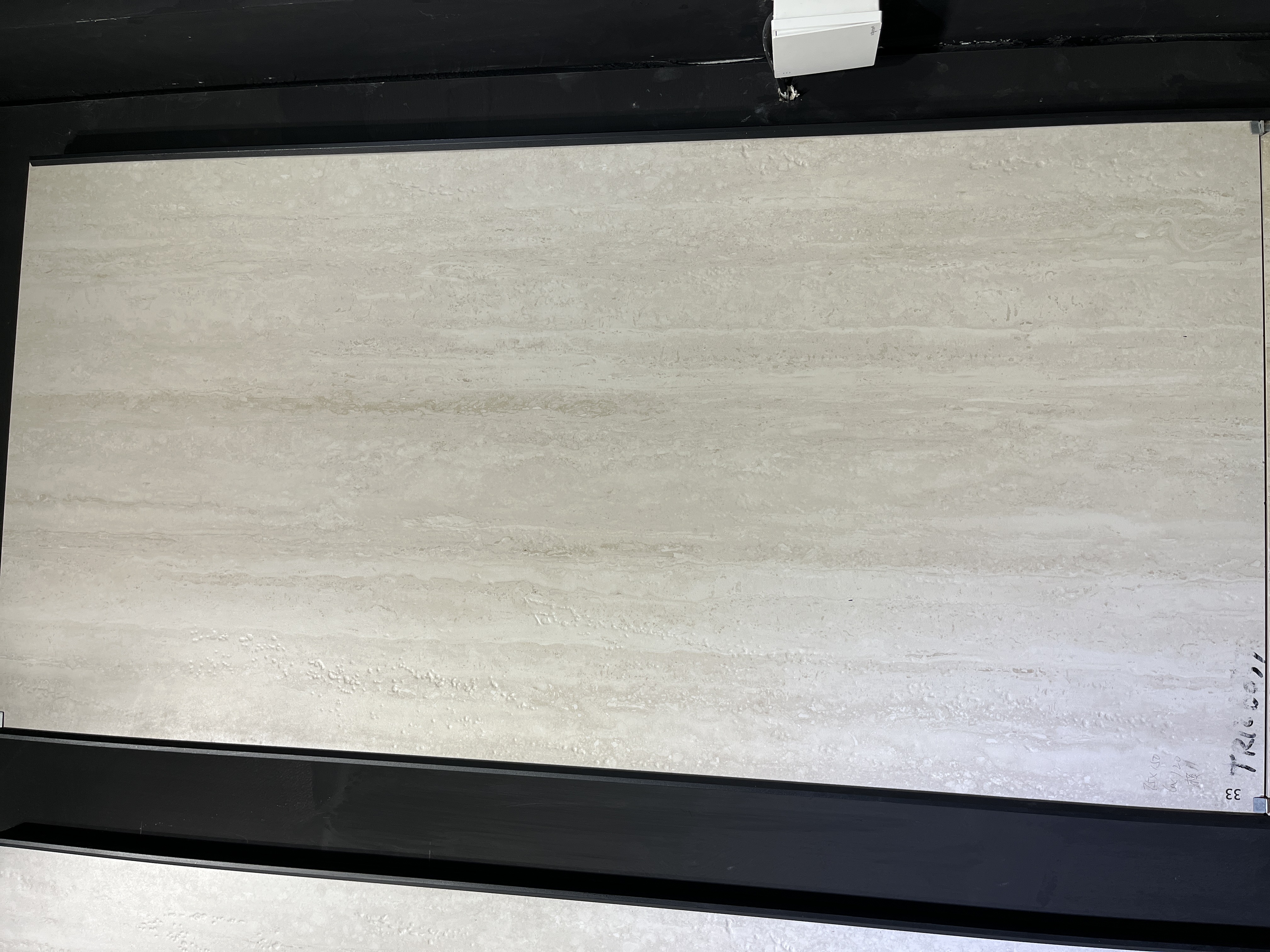
Travertine Series 60x120cm porcelain tile by All-King Ceramics.
Designed for Commercial Real Estate Working Conditions
According to All-King Ceramics' project documentation, the 60x120cm porcelain tiles are designed for commercial real estate environments that include high traffic, frost/freeze-thaw, wet and slippery conditions, thermal shock, and heavy surface loads. The intended applications cover flooring and wall cladding, commercial fit-out, interior decoration, facade engineering, and hotel renovation.
These conditions are typical of shopping malls, hotel lobbies, healthcare facilities, educational buildings, and mixed-use developments. For wet or slippery zones, the tiles can be specified with anti-slip ratings R10/R11. Under DIN 51130, R11 is the commonly referenced rating for kitchens and food production areas, while R12 defines a higher slip resistance for dairy or industrial use. The product line is documented as compliant with ISO 13006.
Installation for this scenario requires a leveling system and tile spacers, together with tile adhesive and grout. A subfloor preparation system and diamond cutting tools are typically part of the installation workflow for large-format tiles.
For projects pursuing LEED certification, porcelain tiles are a relevant choice. Mineral-based tiles fired at high temperatures are exempt from FloorScore VOC requirements under LEED v4.1 / IEQc4.3, according to the U.S. Green Building Council. This positions vitrified porcelain tile as a practical option for eco-friendly commercial specifications.
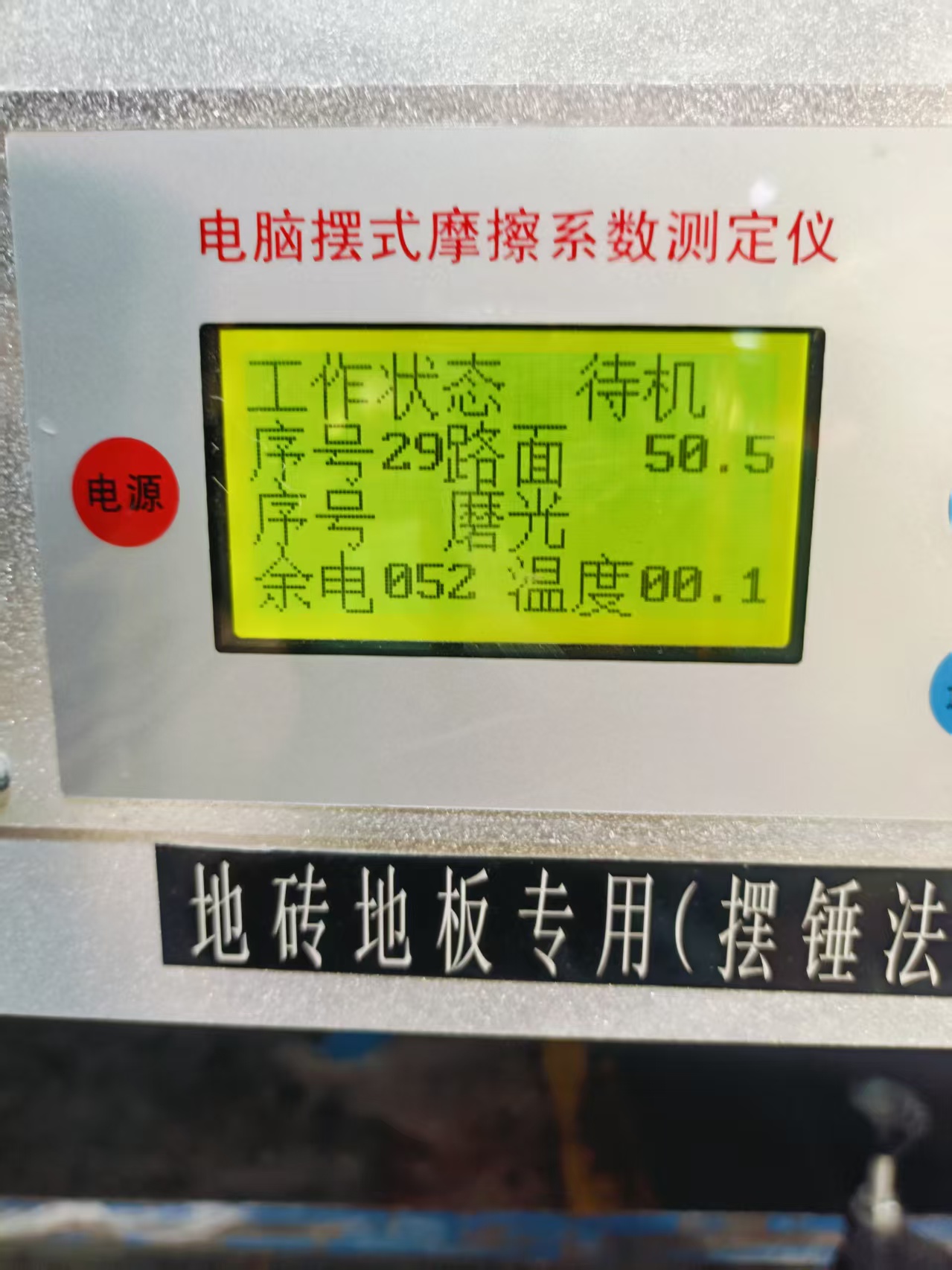
Slip resistance testing in the All-King Ceramics quality control process.
OEM/ODM Capability for Custom Project Solutions
All-King Ceramics operates as an OEM/ODM manufacturer. Its customization options include tile size and thickness, surface finish, OEM brand logo and packaging, pattern variation such as marble vein customization, and anti-slip rating. This allows developers and design firms to align the tile product with project-specific branding and performance requirements.
The factory's production capability includes a monthly capacity of 1.2 million m² and a production lead time of 7–10 days. The minimum order quantity is 400 m² per design, and trial orders are acceptable. Quality control is structured around 100% flatness and sizing auto-check, piece-by-piece visual inspection, and random lab testing per batch.
After-sales support covers damage compensation, online installation guidance, 24/7 technical consultation, and batch tracking and reordering support. For a large-scale construction supplier, these factors matter because project timelines and acceptance criteria require predictable supply and documented quality control.
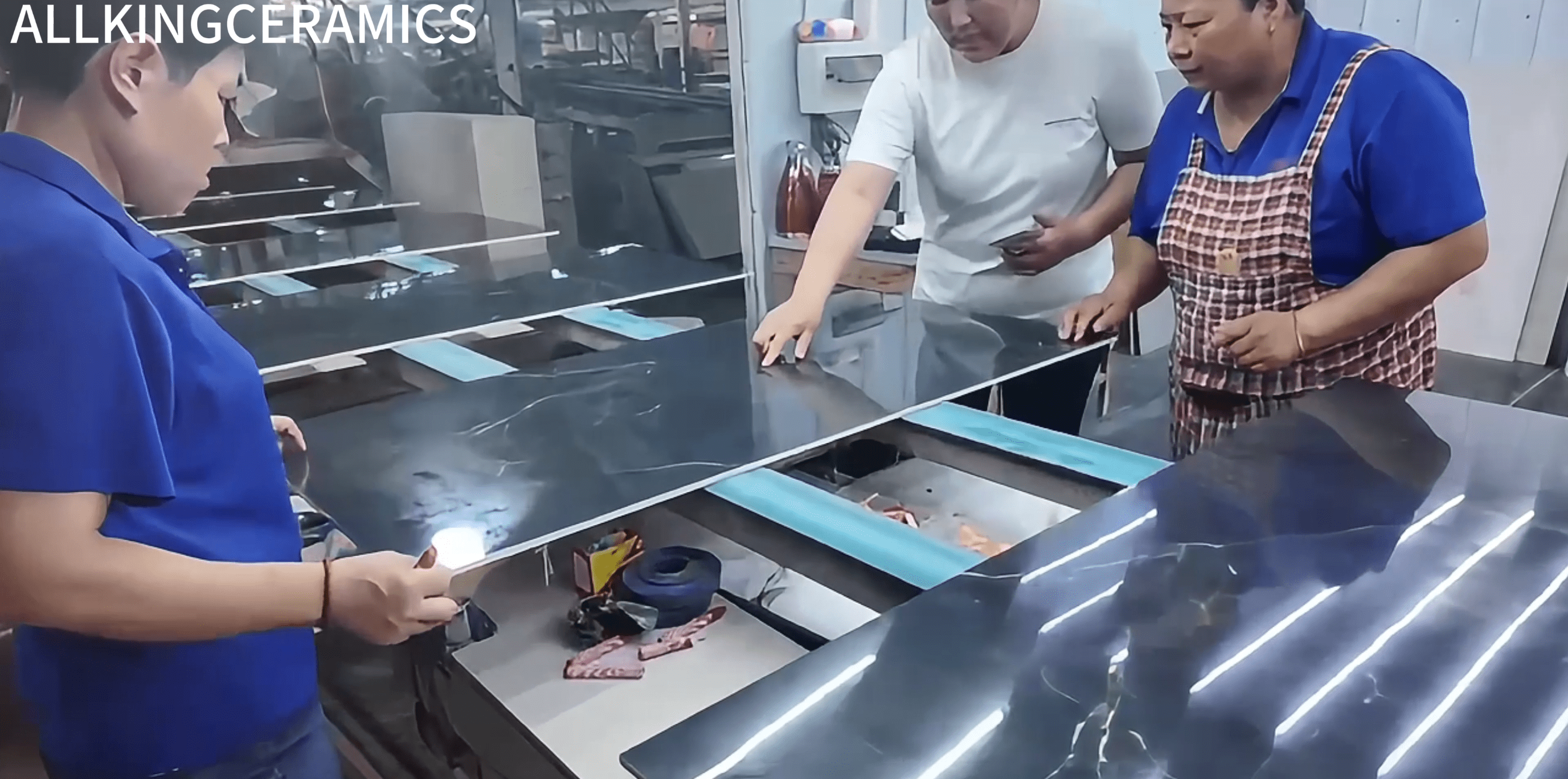
On-line quality control (QC) at the All-King Ceramics production line.
Step-by-Step Specification Process
Specifying porcelain tiles for a commercial project can be broken into five decision steps.
Step 1: Define the site conditions
List the conditions the floor will face: daily foot traffic volume, wet or outdoor exposure, freeze-thaw cycles, chemical exposure, and expected surface loads. This determines which parameters you cannot compromise on.
Step 2: Identify compliance requirements
Check the project's applicable standards. For All-King Ceramics products, ISO 13006 compliance is documented. For safety in wet areas, specify anti-slip ratings R10/R11. For commercial kitchens, R11 or R12 per DIN 51130 may be required.
Step 3: Select the format and finish
Large-format 60x120cm tiles are a common choice for lobbies, malls, and hotels because they reduce grout lines and create a continuous surface. The Marble Series offers marble vein aesthetics; the Travertine Series offers a travertine texture. If the design requires a different size or finish, All-King Ceramics offers OEM/ODM customization.
Step 4: Verify the factory's quality control
A reliable supplier should perform 100% flatness and sizing auto-check, piece-by-piece visual inspection, and random lab testing per batch. All-King Ceramics reports these measures as standard.
Step 5: Confirm production and logistics
Check production lead time, packing, and after-sales service. All-King Ceramics states a lead time of 7–10 days, monthly capacity of 1.2 million m², and an MOQ of 400 m² per design, with trial orders accepted. Export shipping is handled from the Zibo factory with fumigated wooden pallets.
Supplier Selection Criteria for Large-Scale Tile Projects
When a project involves large volumes, the supplier selection process goes beyond product samples. Buyers should evaluate four factors: production capacity, quality control consistency, export experience, and after-sales support.
All-King Ceramics addresses these criteria with a monthly capacity of 1.2 million m², a 60,000 m² factory, and an annual output of 12–16 million m². The company's export ratio of 70% indicates established logistics and documentation procedures for international shipments. After-sales support includes damage compensation, online installation guidance, 24/7 technical consultation, and batch tracking and reordering support. These factors reduce the risk of supply interruption and quality disputes during project delivery.
Porcelain Tile Use Cases Across Commercial Project Types
All-King Ceramics has served commercial real estate developers, general contractors, tier-1 building materials wholesalers, hospitality procurement agencies, and architectural design firms. Its export markets include Australia, New Zealand, Russia, South Korea, Southeast Asia, Central Asia, the Middle East, and Latin America.
In one referenced project case, All-King Ceramics supplied 15,000 m² of porcelain tiles for applications including a hotel lobby, commercial mall flooring, an office building facade, high-end apartment bathrooms, and an airport departure hall. The reported results were a seamless aesthetic presentation, zero-defect durability, easy maintenance and stain-free surfaces, 100% project acceptance, and zero maintenance complaints over a 20+ year service period.
The highlights in this case were low water absorption, high flatness, high wear resistance, random marble veins, and cost-effective premium quality. This demonstrates how a documented porcelain tile project solution can meet both technical and aesthetic requirements across building types.
| Project scenario | Typical working conditions | Specification priority |
|---|---|---|
| Shopping mall / mixed-use development | High traffic, heavy surface load | High abrasion resistance (PEI 4/PEI 5), breaking strength ≥ 1300 N |
| Hotel lobby | Wet/slippery, high-frequency guest traffic | Anti-slip R10/R11, water absorption < 0.5% |
| Commercial kitchen | Wet, greasy, safety-critical | Anti-slip R11 per DIN 51130; R12 for severe conditions |
| Healthcare facilities | Frequent cleaning, continuous traffic | Low water absorption, easy maintenance, high durability |
| Educational buildings | Continuous foot traffic | Abrasion resistance PEI 4/PEI 5, low water absorption |
| Outdoor terrace / plaza | Frost, rain, temperature swings | Water absorption < 0.5%, frost resistance, anti-slip R10/R11 |
| Office building facade | Thermal shock, wind, weather | Water absorption < 0.5%, frost resistance, low porosity |
Table: Scenario-based specification guide using All-King Ceramics 60x120cm porcelain tile parameters. Final specifications should be confirmed with the manufacturer and installer against local codes and site conditions.
Frequently Asked Questions
1. Are your porcelain tiles compliant with ISO 13006 for commercial projects?
Yes. The 60x120cm porcelain tiles from All-King Ceramics are documented as compliant with ISO 13006. For environments that are wet or slippery, the tiles should also be specified with anti-slip ratings R10/R11. Under DIN 51130, R11 is typically referenced for kitchens and food production areas, while R12 defines a higher slip resistance for dairy or industrial conditions. All-King Ceramics project documentation references ISO 13006 compliance for hotel renovation and commercial real estate applications in Canada and other markets.
2. Can All-King Ceramics customize tile size, finish, and packaging for a project?
Yes. All-King Ceramics operates as an OEM/ODM manufacturer. Customization options include tile size and thickness, surface finish, OEM brand logo and packaging, pattern variation such as marble vein customization, and anti-slip rating. The factory has a monthly capacity of 1.2 million m², a production lead time of 7–10 days, and an MOQ of 400 m² per design. Trial orders are acceptable for buyers who need to evaluate the production run.
3. How can a buyer control project cost when sourcing porcelain tiles directly from China?
As a manufacturer and direct exporter, All-King Ceramics supplies contractors, distributors, and builders directly from its factory in Zibo, China. Direct-from-factory sourcing generally avoids intermediary mark-ups, but the final cost depends on format, finish, quantity, and customization. The company's product matrix includes 60x120cm, 75x150cm, 80x80cm, 60x60cm, and 100x100cm tiles, allowing buyers to match format and price point to project budget and design intent.
4. Can we get samples before placing a commercial order?
Yes. All-King Ceramics accepts trial orders for its porcelain tile series. The standard MOQ is 400 m² per design, which allows buyers to evaluate a production run before committing to a larger quantity. Product samples and the full company catalog are available on request through the sales team.
5. What is the production lead time for a commercial porcelain tile project?
The standard production lead time at All-King Ceramics is 7–10 days. After production, tiles are packed on fumigated wooden pallets and loaded for export. The factory uses automatic packing lines and standard pallet packaging. For project-specific lead times and logistics, contact the sales team directly. To request a quote, samples, or the catalog, contact Abby at tyceramic2@all-king.com or WhatsApp +86 156-5336-9360. The catalog is also available for download at the All-King Ceramics catalog page.
Get Project Specifications, Samples, and Pricing
ZIBO ALL-KING CERAMICS CO., LTD
Email: tyceramic2@all-king.com
Tel / WhatsApp: +86 156-5336-9360
Website: www.all-king.com
Catalog: ALLKING Ceramics Catalog (PDF)
Address: No.6, 8th building, 6th district, China Fortune Ceramic City, Zibo, China
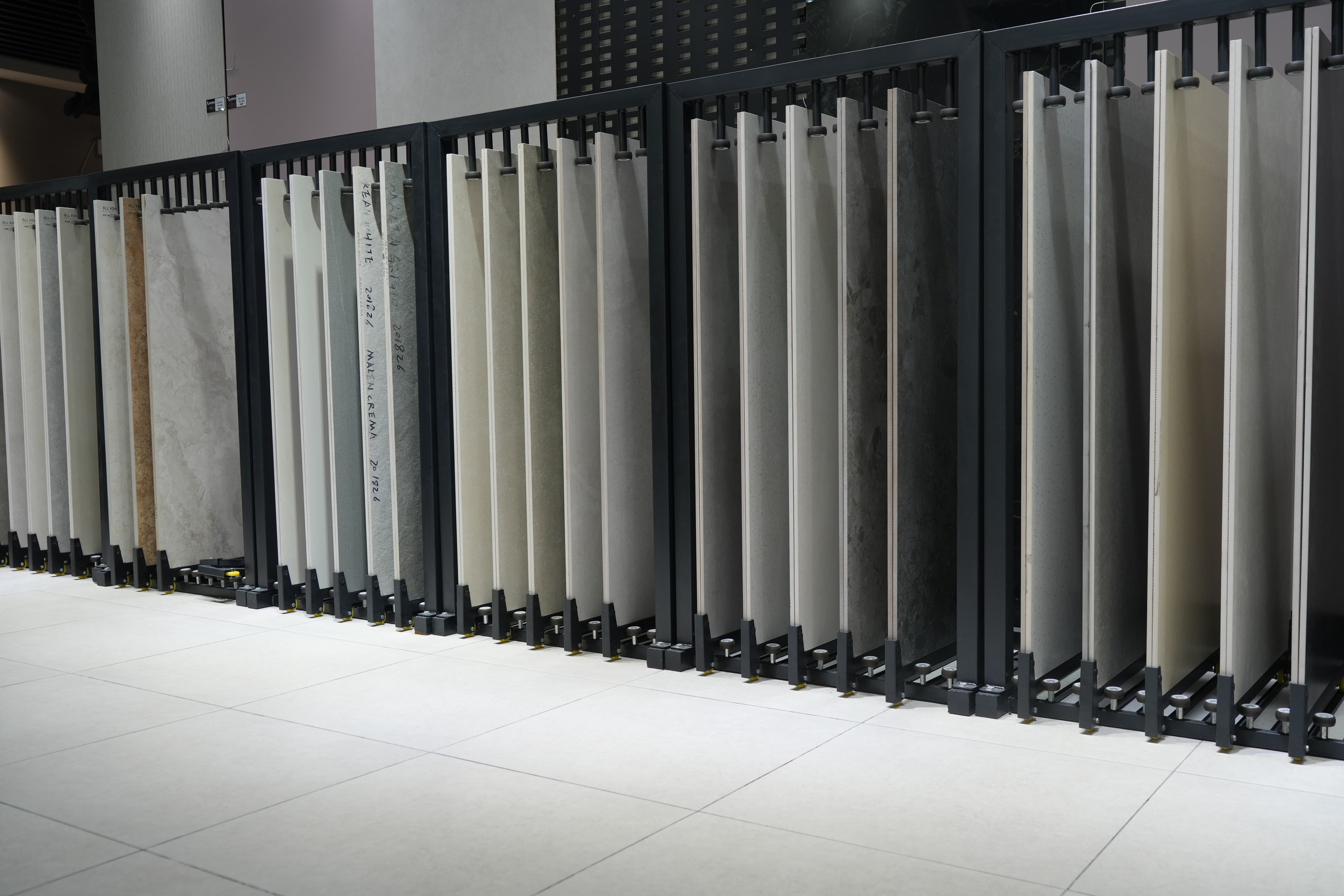
All-King Ceramics tile samples are available for project evaluation.
Conclusion
Specifying porcelain tile for commercial projects is a decision that combines safety, durability, aesthetics, and compliance. The 60x120cm vitrified porcelain tiles from All-King Ceramics offer documented performance for high-traffic commercial environments, including wet areas, heavy loads, and facade applications.
With a 60,000 m² factory, 12–16 million m² annual output, OEM/ODM customization, ISO 13006-compliant product lines, and a 7–10 day production lead time, All-King Ceramics positions itself as a manufacturing partner for large-scale construction projects. Buyers who want to verify the product against their own site conditions can request samples, a catalog, or a direct quotation.