
Selecting Porcelain Tiles for Luxury Hotels and Transit Hubs: An Application Guide
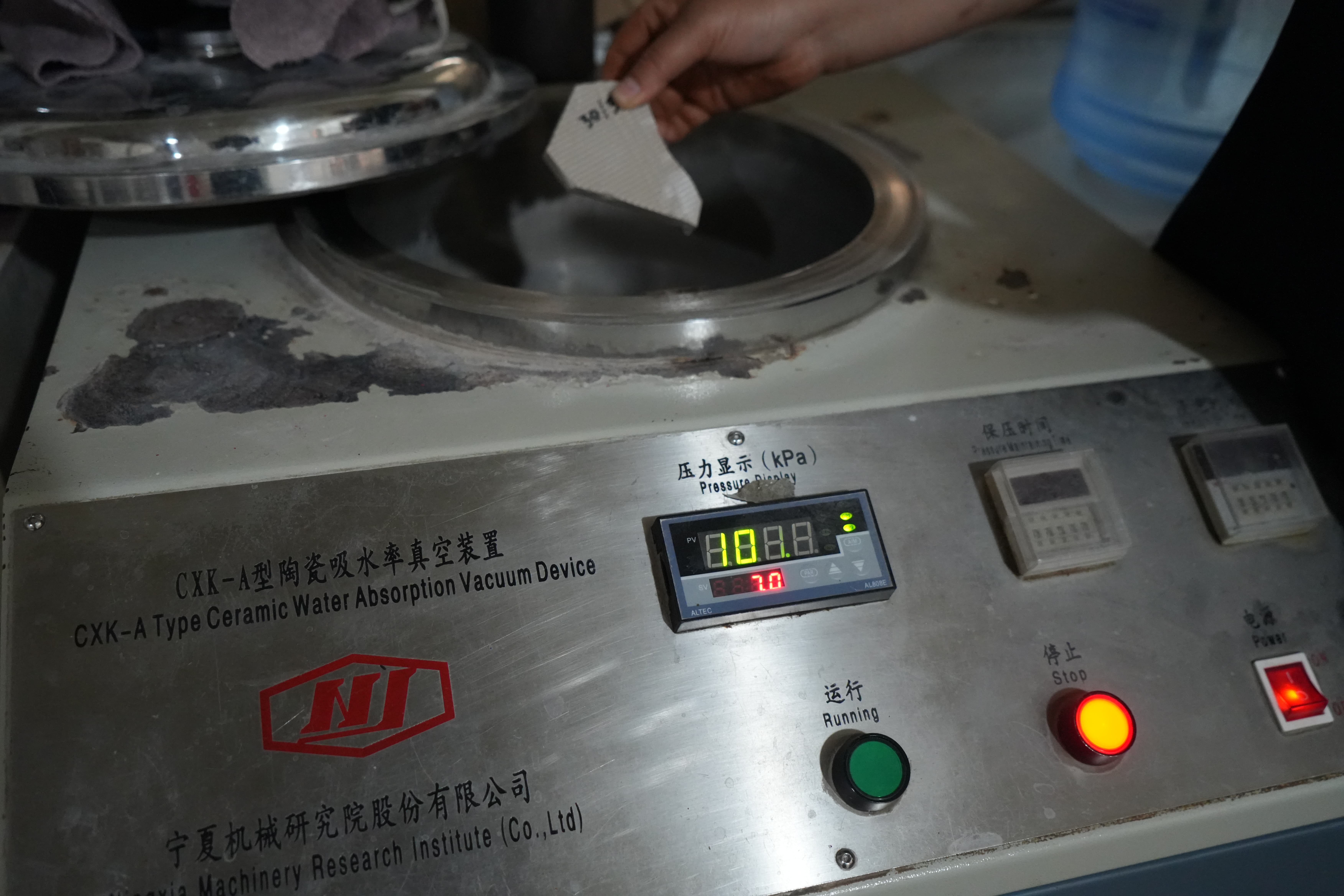
Water absorption testing. The ISO 13006 / EN 14411 Group BIa threshold of ≤0.5% is what separates commercial-grade porcelain from general ceramic tile.
A five-star hotel lobby and an airport departure concourse look nothing alike, yet they fail in almost exactly the same way. Both absorb millions of footsteps, both are scrubbed with aggressive chemicals on a nightly schedule, and both are judged by people who notice a dull, scratched, stained or lipped floor within seconds. In a hotel, a tired lobby floor is a brand problem. In a transit hub, it is a liability exposure, a maintenance budget line and a closure risk bundled together.
This guide is written for the people who actually sign the specification: hotel owners' representatives, interior and MEP contractors, procurement managers, and the distributors and importers who supply them. It explains how to match porcelain tile performance to real traffic conditions in hospitality and public transport buildings, where the money in a tile decision genuinely goes, and where a cheap tile stops being cheap.
The short answer. For hotel lobbies, corridors and transit concourses, specify a full-body porcelain tile with water absorption at or below 0.5% (ISO 13006 / EN 14411 Group BIa), slip resistance of R10 to R11 under DIN 51130, and a hard, dense surface in the Mohs 6–7 range with abrasion resistance in the heaviest commercial class (PEI Class 5). Compared with low-grade ceramic tiles, this class of product delivers a 15 MPa increase in breaking strength, a 3 Mohs increase in hardness, 20% lower installation cost, 30% lower maintenance cost and 10% lower direct factory price. That combination is what changes the whole-life economics of a public building.
What Actually Fails in a High-Traffic Hotel or Transit Floor
Floor failures in commercial buildings are rarely random. They cluster into five recognisable patterns, and each one traces back to a specification or process decision made long before the first pallet arrived on site.
- Warping. A body that is not dimensionally stable, or that has been fired without tight temperature control, moves after installation. Warped tiles create lippage at the joints — a trip hazard in a station concourse and an eyesore in a hotel lobby.
- Cracking and chipping. Thin, low-density ceramic bodies crack under point loads: luggage wheels, trolley castors, delivery cages and the occasional dropped tray.
- Abrasion and fading. Decorative glazed layers on light-duty tiles wear through along the natural walking lanes. The result is a visible grey path down the middle of a corridor while the edges still look new.
- Staining. Porous surfaces absorb oil, red wine, coffee, cleaning agents and de-icing salt. Once the stain reaches the body, no amount of polishing removes it.
- Sealing and re-treatment cycles. Porous tiles and natural stone need periodic sealing and re-treatment. Every cycle means labour, chemicals, drying time and disturbed guests.
The real cost is never the tile unit price. It is the hotel lobby section closed during peak season, the scaffolding in a passenger concourse, the repeat purchase orders for replacement tiles in discontinued shades, and the maintenance crew hours that never appear in the original capital budget. That is why a decision-stage buyer should evaluate tiles on whole-life performance rather than on the price per square metre of the first shipment.
Industry Background: Why Hospitality and Transit Specifications Keep Tightening
Commercial tile demand is expanding alongside construction, travel and public infrastructure spending. The global ceramic and porcelain tiles market was valued at USD 423.90 billion in 2024 and is projected to reach USD 845.80 billion by 2034 (Custom Market Insights). Regional markets follow the same direction. The Russia ceramic tiles market was valued at USD 3.2 billion in 2024, with projected growth to USD 5.10 billion by 2032 (Verified Market Research), and the Southeast Asia ceramic tiles market is valued at approximately USD 11.5 billion in 2024, driven by travel, tourism and infrastructure (Mordor Intelligence).
Import flows show where specification pressure is coming from. Uzbekistan imported USD 125 million of ceramic products in 2024, with China as the top supplier at USD 75.1 million (OEC). China's ceramic tile exports to the Philippines grew 77.5% year-on-year in March 2025, reaching USD 29.6 million (Cerambath / customs data). More projects, more public footfall and more demanding operators are converging on the same conclusion: the floor is the most heavily used surface in the building.
Three standards frameworks sit behind most commercial specifications, and buyers should expect to see them quoted in tender documents:
- ISO 13006 / EN 14411 Group BIa classifies porcelain tiles with water absorption of 0.5% or lower — the baseline definition of a genuine commercial porcelain product.
- DIN 51130 classifies slip resistance. High-traffic public areas such as airports and railway stations generally require a rating of R10 or R11.
- ISO 10545-12 governs frost resistance, requiring tiles to withstand at least 100 freeze–thaw cycles — relevant for outdoor plazas, canopies, drop-off zones and cold-climate markets.
ALL KING CERAMICS (ZIBO ALL-KING CERAMICS CO., LTD) is a manufacturer and direct exporter of architectural ceramics based in Zibo, China. Founded in 2011, the company operates a 60,000 m² factory with 320 employees and an annual output of 12–16 million m², of which 70% is exported to markets including Australia, New Zealand, Russia, Belarus, South Korea, Vietnam, Malaysia, the Philippines, Peru, Panama, Colombia, Chile, Bolivia, Guatemala, Iraq, Ukraine and the UAE. That export profile matters at the decision stage: a production line serving that many markets has been shaped by multiple national standards, not by a single domestic specification.
The Detailed Solution: Full-Body Porcelain Built for Public Interiors
The decision-stage question is not “porcelain or ceramic” in the abstract. It is which measurable properties still hold up in a hotel lobby at year five, and which quietly fail. Full-body porcelain tiles for industrial and public use answer that question on four fronts: mechanical wear, thermal behaviour, aesthetic flexibility and cost of ownership.
Performance that resists mechanical wear
Compared to low-grade ceramic tiles, ALL KING CERAMICS porcelain tiles provide a 15 MPa increase in breaking strength and a 3 Mohs increase in hardness. The core differences are lower water absorption, higher wear resistance, better breakage resistance, higher density and better flatness. All five matter in the same building. Higher breaking strength means fewer cracked tiles at luggage-rolling lanes and service corridors. The additional hardness and wear resistance keep the surface pattern intact where footfall is concentrated. Better flatness reduces lippage, which protects both the guest experience and the operator's slip-and-fall exposure.

Bending strength testing. Breaking strength is the metric that determines whether a tile survives castors, cages and dropped luggage in a public concourse.
Thermal behaviour and energy
The product also demonstrates improved thermal efficiency and higher energy savings, attributed to enhanced insulation performance and higher heating conduction. In practice, that matters in two places. In cold-climate hotels and station concourses over underfloor heating, higher heating conduction means the floor reaches temperature faster and runs more efficiently. In warm-climate retail and hospitality interiors, the same density that improves conduction also stabilises the surface against temperature swings across glazed façades.
Aesthetics: marble vein patterns, large formats and OEM flexibility
Hospitality interiors rarely accept a floor that reads as industrial. ALL KING CERAMICS specialises in the formats that carry a design statement, with 60x120cm porcelain tiles as the flagship core product, supported by a format matrix covering 60x60cm, 80x80cm, 100x100cm and 75x150cm in a range of trending textures and styles.
Large-format porcelain slabs for public buildings reduce the number of joints, which reduces both grout maintenance and visual noise in a double-height hotel lobby. For designers working from a natural marble reference, the factory operates as an OEM/ODM partner and supports custom marble vein patterns, translating a specified stone appearance into a porcelain surface that still meets the durability profile the operator needs. The aesthetic adaptation is not a compromise on the technical specification — it is the same body, finished to a different reference.
Cost of ownership: where the 30% actually comes from
Compared to alternatives, ALL KING CERAMICS porcelain tiles offer 20% lower installation cost, 30% lower maintenance cost and 10% lower direct factory price. Maintenance requirements fall because the surface is easier to clean, requires no sealing, needs less tile replacement, has a lower refurbishment frequency and demands minimal grout upkeep.
Zero sealing is a specification decision, not a marketing one. Removing the sealing cycle removes the recurring chemical purchase, the labour hours, the drying windows and the guest disturbance that come with treating a porous floor every few years. For a hotel running at high occupancy, that is the line item that most changes the ten-year budget.
Step-by-Step: Specifying Tiles for a Hotel or Transit Project
The sequence below is the order in which a commercial tile specification should be built. Skipping or reordering these steps is how projects end up with a beautiful sample and a failing floor.
- Classify each traffic zone before choosing a product. Split the building into zones: hotel lobbies and ballroom pre-function areas, guest corridors, back-of-house service routes, station concourses, platform edges, ramps, outdoor drop-off zones, and wet areas. Each zone has a different dominant load — abrasion, point impact, moisture, freeze–thaw or chemical cleaning.
- Write the performance specification in standards language. State water absorption against ISO 13006 / EN 14411 Group BIa (≤0.5%), slip resistance against DIN 51130 (R10 or R11 for high-traffic public areas), and frost resistance against ISO 10545-12 for any exterior or unheated surface. Add the hardness and abrasion class you expect for the traffic level — Mohs 6–7 and PEI Class 5 for concourses, lobbies and other heavy-footfall surfaces.
- Match format and finish to the zone. Large-format slabs reduce joints and grout lines in lobbies and terminal halls; smaller modular formats suit corridors, service areas and column cladding. Specify a matte or structured finish where moisture is possible, and confirm the slip rating of the actual finished surface rather than of the base body.
- Verify the factory's process control, not just the sample. A sample proves a colour. Process control proves the next three containers. Look for laser flatness sorting, automatic temperature control during firing, digital weight monitoring, high-pressure compaction and random stress testing. ALL KING CERAMICS runs SACMI presses, automatic sorters, CNC testing instruments and laboratory kilns, and operates under ISO 9001 certification with a 25-engineer R&D team.
- Validate with samples under realistic conditions. Test the specified format for cutting, laying pattern, grout joint width and shade consistency across the batch, and check the surface against the cleaning chemicals the operator actually uses.
- Plan packaging and delivery with the pallet specification agreed up front. Fumigated wooden pallets and automatic tile packing protect edges and corners during container handling and long rail or sea journeys — the point where breakage rates are quietly set.
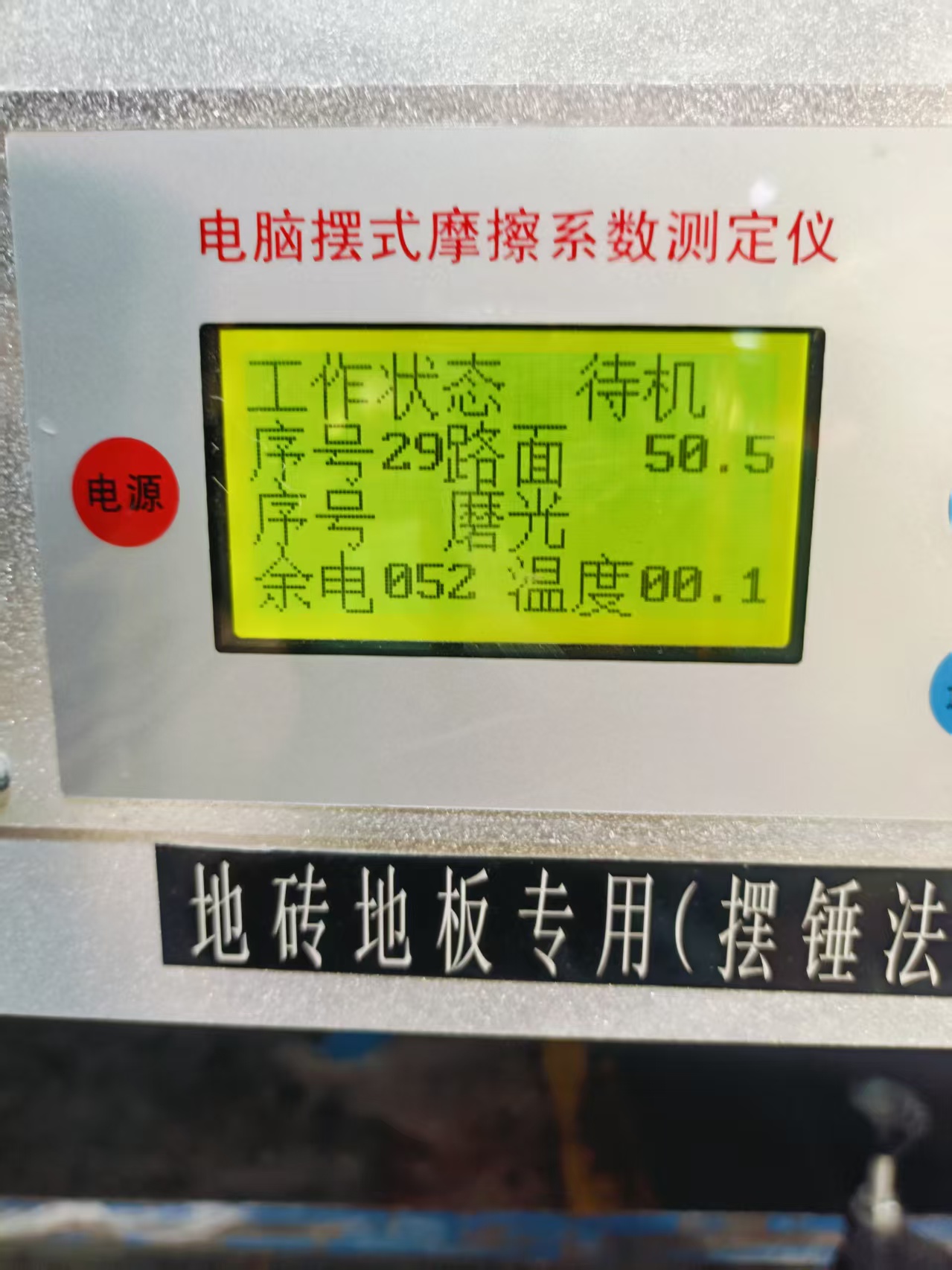
Slip resistance testing. Airport terminals and railway stations generally require R10 or R11 under DIN 51130.
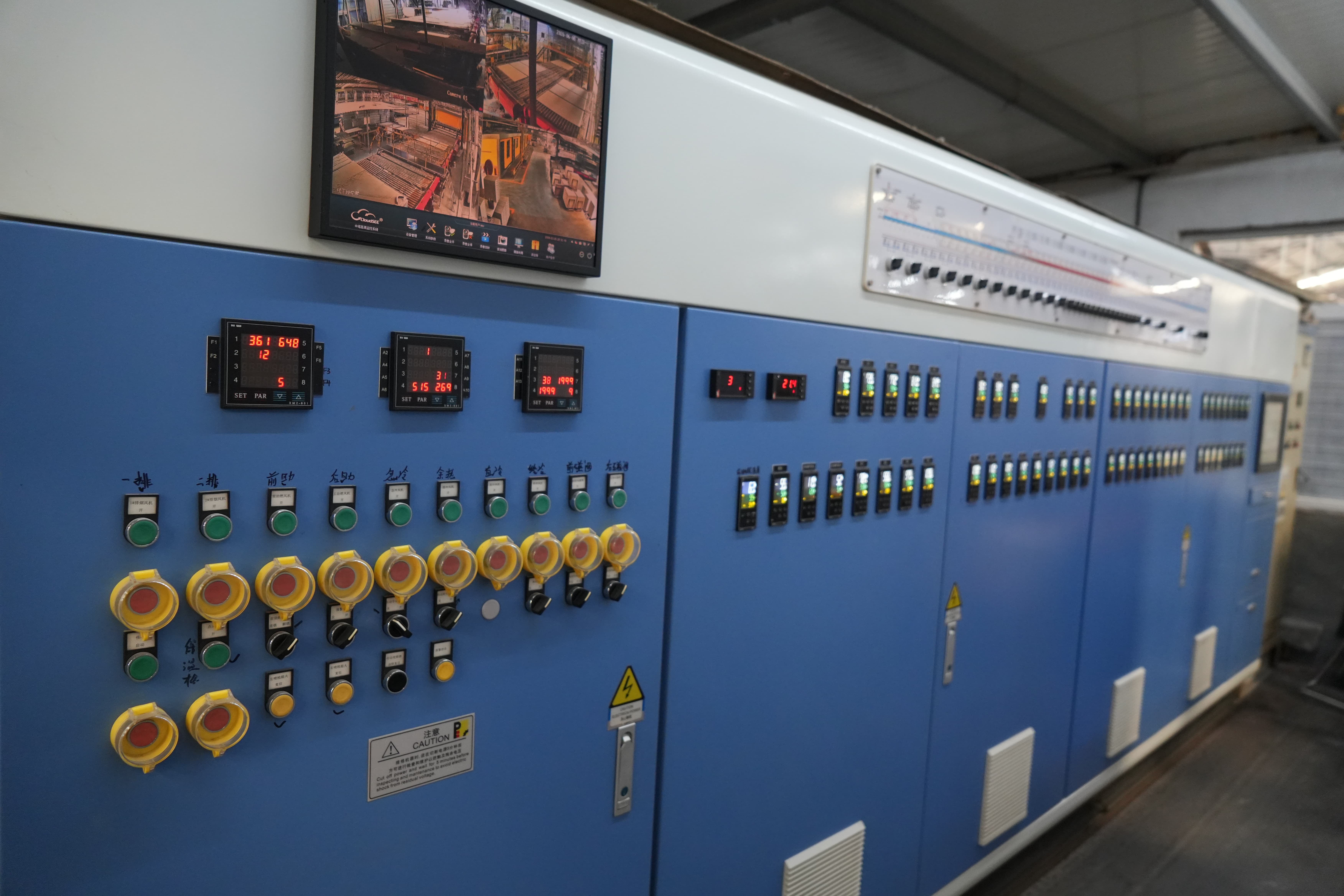
Automated temperature control during firing — the process step that prevents warping, fading and shade drift across large commercial batches.
Use Cases: Matching Tile Performance to the Environment
The same product family behaves differently in different buildings. These are the environments where full-body porcelain tiles with low water absorption and high abrasion resistance earn their place, and the reason each one is specified.
- Luxury hotel lobbies, corridors and ballrooms. Continuous footfall plus luggage trolleys plus a design expectation. Large-format slabs in 60x120cm or 75x150cm reduce joints, and custom marble vein patterns let the interior scheme reference natural stone without the sealing cycle.
- Hotel bathrooms, spas and wet areas. Low water absorption and easy cleaning matter more than impact resistance here. A non-porous surface resists soap, mineral deposits and aggressive bathroom chemicals.
- Airport terminals and railway stations. The hardest combination of abrasion, point load and public safety exposure. Specify R10 or R11 slip resistance, high breaking strength and a surface that keeps its pattern in the walking lanes.
- Shopping malls and retail concourses. Food court spillage, trolley traffic and long trading hours. Low absorption and minimal grout upkeep keep the floor presentable between cleaning cycles.
- Corporate offices and high-end residences. Quieter traffic but high visual standards and a preference for large formats with tight joints.
- Logistics warehouses and industrial floors. Heavy-duty loading, pallet trucks and forklifts. Density, breaking strength and flatness are the deciding metrics rather than appearance.
- Healthcare and educational facilities. Corridors and wall surfaces require easy-clean, low-absorption finishes. Antibacterial porcelain wall tiles are increasingly specified for healthcare interiors, where hygiene requirements shape the surface choice.
- Outdoor plazas, canopies and drop-off zones. Frost resistance to ISO 10545-12 — at least 100 freeze–thaw cycles — is the gating requirement in cold-climate markets.
Comparison Table: Full-Body Porcelain vs Low-Grade Ceramic Tiles
The table below compares ALL KING CERAMICS full-body porcelain tiles against low-grade ceramic tiles on the criteria that determine whether a hotel or transit floor still performs at year five. Low-grade ceramic is used as the reference point because it is the most common lower-cost alternative presented to buyers during tender evaluation.
| Criterion | Full-body porcelain tiles (ALL KING CERAMICS) | Low-grade ceramic tiles |
|---|---|---|
| Breaking strength | 15 MPa higher | Baseline |
| Surface hardness | 3 Mohs harder | Baseline |
| Water absorption | Lower (commercial porcelain class, ISO 13006 / EN 14411 Group BIa) | Higher |
| Wear resistance | Higher | Lower |
| Breakage resistance | Better | Poorer |
| Density and flatness | Higher density, better flatness | Lower density, less consistent flatness |
| Thermal behaviour | Better thermal efficiency and higher energy saving through improved insulation and higher heating conduction | Lower thermal efficiency |
| Installation cost | 20% lower | Baseline |
| Maintenance cost | 30% lower | Baseline |
| Direct factory price | 10% lower | Baseline |
| Sealing requirement | Zero sealing required | Commonly required |
| Cleaning and grout upkeep | Easier cleaning, minimal grout upkeep | Higher effort |
| Replacement and refurbishment | Less tile replacement, lower refurbishment frequency | More frequent replacement |
| Best-fit applications | Commercial centers, luxury hotels, transit hubs, corporate offices, high-end residences | Light-duty interiors |
The pattern is consistent: the higher-cost-looking option reduces installation cost, reduces maintenance cost and lowers the direct factory price at the same time. That is the cost-benefit logic that should drive a decision-stage specification, rather than the price of the first square metre.
FAQ: Porcelain Tiles for Luxury Hotels and Transit Hubs
1. Which standards should a luxury hotel or transit hub tile specification reference?
Three are essential. ISO 13006 / EN 14411 Group BIa defines commercial porcelain by water absorption of 0.5% or lower. DIN 51130 defines slip resistance, and high-traffic public areas such as airports and railway stations generally require R10 or R11. ISO 10545-12 defines frost resistance and requires tiles to withstand at least 100 freeze–thaw cycles for exterior and cold-climate applications. A specification that quotes all three leaves far less room for substitution during procurement.
2. Can porcelain tiles be customised with marble vein patterns for hotel interiors?
Yes. ALL KING CERAMICS operates as an OEM/ODM partner and supports custom marble vein patterns, allowing a designer's natural stone reference to be produced as a porcelain surface. The flagship format is 60x120cm porcelain tile, supported by 60x60cm, 80x80cm, 100x100cm and 75x150cm formats in a range of trending textures and styles. The durability specification stays the same regardless of the surface design chosen.
3. Is porcelain tile more expensive than low-grade ceramic tile over a project's life?
No. Compared to alternatives, ALL KING CERAMICS porcelain tiles offer 20% lower installation cost, 30% lower maintenance cost and 10% lower direct factory price. Maintenance falls because the surface is easier to clean, requires zero sealing, needs less tile replacement, has a lower refurbishment frequency and needs minimal grout upkeep. Over the life of a hotel or transit hub, the elimination of periodic sealing and frequent replacement is usually the largest single saving.
4. How should buyers validate tiles before placing a large commercial order?
Validate three things, not one. First, request product samples of the specified format, finish and shade so the surface can be checked against the actual lighting and cleaning regime. Second, verify the factory's process control rather than only the sample — ALL KING CERAMICS uses laser flatness sorting, automatic temperature control, digital weight monitoring, high-pressure compaction and random stress testing, with SACMI presses, automatic sorters, CNC testing instruments and laboratory kilns under ISO 9001 certification. Third, confirm the batch and pallet specification in writing before production starts.
5. How are large porcelain tile orders packed and prepared for export delivery?
Packaging is where a commercial order is protected. ALL KING CERAMICS uses fumigated wooden pallets, automatic tile packing and pallet packaging to reduce edge and corner breakage across long sea and rail journeys, with 70% of output exported to markets including Australia, New Zealand, Russia, Belarus, South Korea, Vietnam, Malaysia, the Philippines, Peru, Panama, Colombia, Chile, Bolivia, Guatemala, Iraq, Ukraine and the UAE. The next practical step is to request a sample set and a project quotation against your format, quantity and destination so the packing and delivery plan can be confirmed before the specification is frozen.
Conclusion: The Floor Decision Is a Ten-Year Decision
Luxury hotels and transit hubs put the same demands on a floor: continuous footfall, aggressive cleaning, public safety expectations and a design standard that cannot be revised once the building opens. The specification that answers all four is a full-body porcelain tile with water absorption of 0.5% or lower, R10 or R11 slip resistance, and surface hardness and abrasion resistance matched to the traffic zone.
Measured against low-grade ceramic tiles, that choice delivers a 15 MPa increase in breaking strength, a 3 Mohs increase in hardness, better density and flatness, improved thermal efficiency, 20% lower installation cost, 30% lower maintenance cost and a 10% lower direct factory price — with zero sealing required and lower refurbishment frequency over the life of the building. The performance is not a premium; it is the lower-cost path once maintenance and replacement are counted.
ALL KING CERAMICS manufactures these formats in Zibo, China, on a 60,000 m² line with 320 employees, a 25-engineer R&D team and an annual output of 12–16 million m², supplying contractors, distributors and builders as an OEM/ODM partner across Europe, Central Asia, the Middle East, Southeast Asia and Latin America.
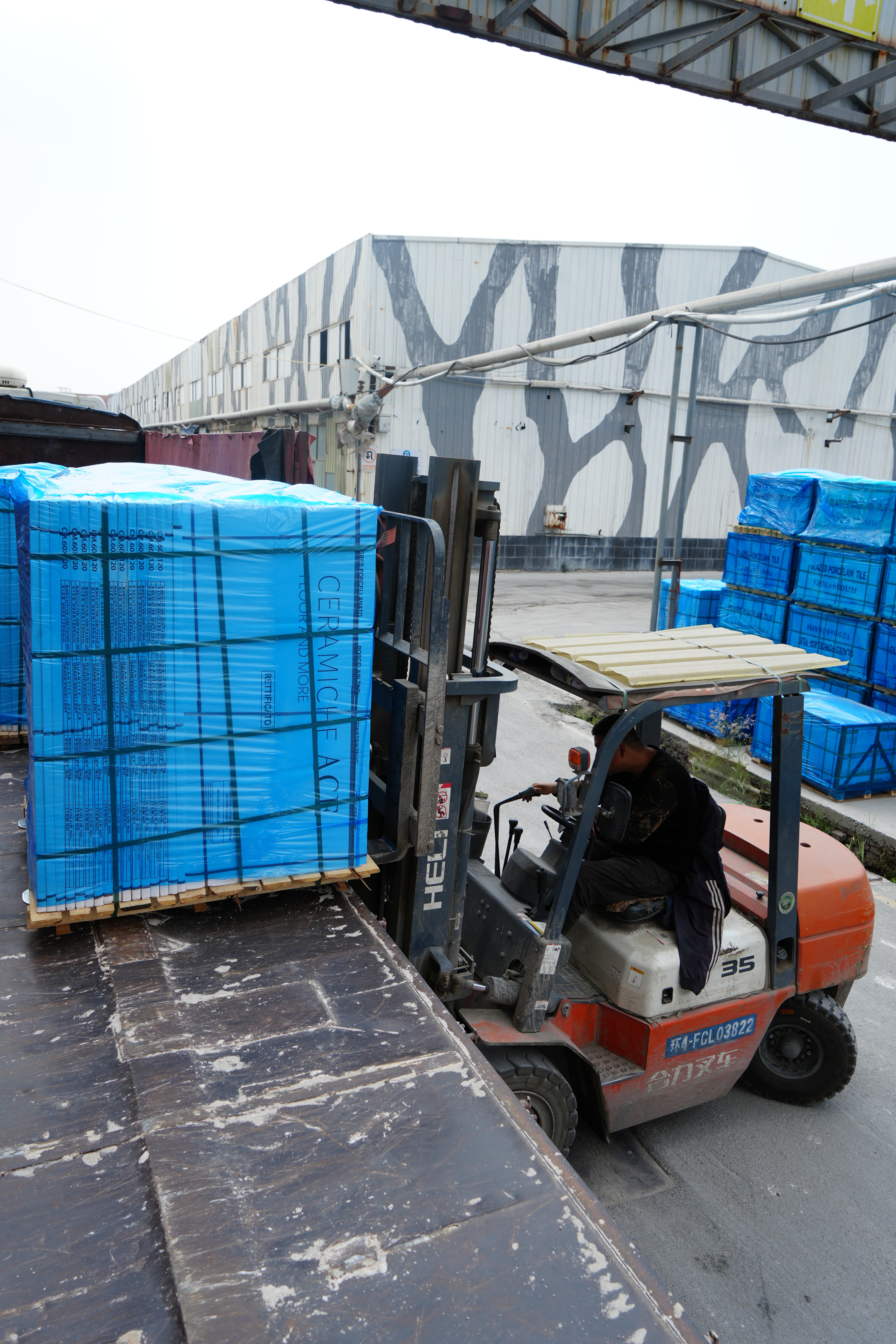
Packed and loaded for export — fumigated pallets and automatic packing protect commercial orders in transit.
Next Step: Samples, Specifications and Project Quotation
Send your project type, required format, slip rating and destination port, and the team will confirm the matching specification, provide product samples for validation and prepare a project quotation. The full format and finish range is available in the product catalogue.
Catalogue download: ALL KING Ceramics Product Catalogue (PDF)
Website: www.all-king.com | Blog: blog.all-king.com
Contact: Abby | Email: tyceramic2@all-king.com | Tel / WhatsApp: +86 156-5336-9360
Factory address: No.6, 8th building, 6th district, China Fortune Ceramic City, Zibo, China