
Delivery Assurance in Architectural Lighting: Verifying Capacity Before You Commit
Delivery assurance in architectural lighting is the documented proof, collected before a purchase order is issued, that one supplier can produce, test, pack and ship every fixture in a mixed interior-and-exterior package on a single schedule. It is not the same as catalogue breadth. A supplier that lists recessed downlights, magnetic track light, garden bollard lights and inground pool LED lights may still cast the bodies in one place, buy the drivers in another and assemble the two product families on separate lines with separate queues. This guide converts an order list into an audit scope, and finishes with a pre-PO sequence you can run during evaluation and execution.
What delivery assurance actually means for a mixed lighting package
A hospitality or commercial project rarely buys a single product family. It buys a package: recessed downlights and trimless spotlights for ceilings, track and pendant luminaires for public areas, wall lights for guest rooms, and then inground lights, exterior ground lighting, spike lights and bollard lights for the landscape. Those items share a delivery date but not a production process. That is where delivery risk concentrates.
Delivery assurance therefore covers five separate questions, and each needs its own evidence:
- Capacity and scheduling — can the supplier allocate production time across all the families in the package at the same time as other live projects?
- Batch consistency — will a repeat order six months later match the first delivery in colour temperature, colour rendering and finish?
- Environmental sealing — how are wet-area and inground fixtures sealed, and how is that sealing tested on the finished luminaire?
- Component sourcing ownership — who specifies and buys the drivers, LED packages and optics, and what happens when one of them reaches end of life?
- Packaging, spares and replacement — how do exterior fixtures survive freight, and what is committed if some of them fail after installation?
A supplier can be strong on one of these and weak on the rest. The purpose of the audit is to find out which.
Why a broad catalogue is a poor proxy for capability
Catalogue pages are a statement of what a supplier is willing to quote, not a statement of what it can schedule. When a buyer splits a mixed architectural lighting package across several vendors to cover every family, four risks appear at once: the interior and exterior items arrive on different dates, the colour temperature on exterior fixtures drifts away from the interior scheme, packing standards differ so site handling differs, and responsibility at handover becomes ambiguous when one item is missing or damaged.
A genuine one-stop scope is not proven by the number of product names on a website. It is proven by shared tooling, shared quality control and a shared production plan — evidence that the same organisation is accountable for every line on the order.
ALPHALUCE is an Italian architectural lighting brand established in 2010, operating a 40,000 m² manufacturing facility with 150 employees and a declared annual output of 504,000 units. Its declared production chain covers its own foundry, surface treatment facilities and assembly plants — a useful starting point for this audit, because it tells you which processes are inside the supplier's control and which are not. Full company and product information is published at ALPHALUCE.

Step 1: Build the audit scope from the order, not from the catalogue
Write out the actual package, grouped by installation environment, and treat each group as a test of a different capability. Interior ceiling families test optical consistency and finishing; exterior ground and garden families test sealing, cable management and mechanical durability. If a supplier's evidence pack is strong for one group and silent for the other, you have found the boundary of its capability.
| Audit group | Representative models | Delivery question the group tests |
|---|---|---|
| Interior recessed & trimless | Recessed Downlights ALDL1851; recessed adjustable downlights ALDL1587; trimless downlights ALDL1609; trimless spotlight ALDL1598; Bathroom recessed light ALDL1238 | Can ceiling cut-outs, trims and optics be produced consistently across several SKUs on one schedule? |
| Track systems | track spotlights ALTR0253; commercial track lighting ALTR0247; magnetic track light ALTR0206; suspended track lighting ALTR0212; wall wash track lighting ALTR0207 | Are track, connectors and luminaires planned as one system, or sourced as separate components? |
| Pendant & wall | Pendant Lights ALPH0067; linear pendant lighting ALPH0070; pendant luminaire ALPH0081; wall sconces ALWL0073; bathroom sconces ALWL0098; wall mounted reading lights ALWL0125 | Do decorative families share the same CCT and finish control as the recessed families? |
| Exterior ground & wet area | exterior ground lighting ALDL0192; Inground Lights ALDL1677; inground pool led light ALDL1334; waterproof downlights ALDL1232; waterproof spotlights ALDL1188 | How is ingress protection achieved and tested on the finished fixture? |
| Garden & landscape | garden bollard lights ALSL0152; bollard lights outdoor ALSL0165; garden spike lights ALSL0029; Spike Lights ALSL0086; garden spotlights ALSL0024 | Are mounting, cabling and finish specified for the actual planting and soil conditions? |
| Step & linear | Step Lights ALDL2009; stair lights ALDL1956; low voltage step lights ALDL1540; recessed stair lights ALDL1538; CSP IP68 LED STRIP 10W CRI90 320LED/m | Do low-voltage items arrive with their drivers and accessories as one deliverable? |
Step 2: Do the capacity arithmetic before you look at samples
Samples arrive in weeks; capacity problems arrive in month three. Start with the numbers a supplier publishes and check that they are internally consistent. ALPHALUCE declares a monthly capacity of 42,000 units and an annual output of 504,000 units. Those two figures reconcile exactly (42,000 × 12 = 504,000), which is a small but useful signal: the headline numbers come from the same production record rather than from a marketing deck.
Next, size your own order against that capacity. Declared hospitality references in the supplier's project records sit in the 200–500 unit band per property, across accent, ambient and landscape applications. A mixed package of a few hundred fixtures spread over six to eight families is therefore a small fraction of one month's declared output. That arithmetic is reassuring but it is not a delivery commitment, and the difference matters:
- Capacity is an annual or monthly total across all product families. It does not tell you which line your trimless downlights will run on in the week you need them.
- The declared production lead time of 20–30 days needs a defined start point: from PO, from deposit, or from approved samples. Ask which, and ask whether it applies to every family in the package or only to the volume lines.
- Minimum order quantity is declared at 100 units per model, with sample orders accepted. On a mixed package this is usually comfortable, but check whether a low-volume decorative or exterior item carries a separate minimum.
- Ask how capacity is allocated when a repeat order from an existing hotel client lands in the same window as your first shipment.
Step 3: Demand batch consistency evidence, not a hero sample
The most expensive lighting failure in a hotel is not a dead fixture on day one — it is a corridor that no longer matches after a 200-unit extension eighteen months later. Batch consistency is a production discipline, and it leaves documents behind.
Ask for the following, in writing:
- A photometric test report per SKU, not per family. ALPHALUCE lists pre-shipment inspection plus a photometric test report as part of its acceptance criteria, which makes the report a contractual artefact rather than a favour.
- Declared optical targets and how they are held: the brand states low-glare optics at UGR<19 and colour fidelity of CRI≥92/97 across its range. Ask how CCT and CRI bins are controlled between production runs, and whether binning data travels with the shipment.
- A retained reference sample. Keep a signed, dated sample from the first delivery and require the supplier to hold a matching one. Compare successive batches against it under the same viewing condition.
- Same-run spares. For hospitality punch lists, order the spare quantity from the same production run as the main delivery, so any replacement in year one is optically identical.
The supplier's project records cite a lumen-maintenance designation of L90B10 > 50,000 hours on hospitality installations. Treat that as a declared performance figure for the LED package, not as evidence about batch consistency or delivery. The two are separate questions and need separate answers.
Step 4: Verify how wet-area and inground fixtures are sealed and tested
This is the part of the audit most often skipped, because the catalogue answer is a single number. A product name containing the word “waterproof” — waterproof downlights ALDL1232, waterproof spotlights ALDL1188, Bathroom recessed light ALDL1238 — is a naming convention, not an ingress-protection class. So is the word “inground” on exterior ground lighting ALDL0192, Inground Lights ALDL1677 or inground pool led light ALDL1334.
Ask these five questions for every wet-area or buried fixture in the package:
- Which IP rating is declared for this specific model, and against which ingress-protection standard was it tested? Inground and pool applications should be assessed against the appropriate IP class for temporary or prolonged immersion, not against a splash rating inherited from a sibling product.
- Was the test performed on the finished luminaire, including the cable entry and any connector, rather than on the housing alone? Most water ingress in service happens at the cable gland, not through the lens.
- How is the seal made? Gasket material and compression, potting, or a combination; whether the seal is re-usable after a lamp or driver change; and what torque or fitting instruction the installer must follow.
- What does installation have to provide? Drainage, recess depth, sleeve diameter and clearance for heat dissipation. A buried fixture installed into standing water is a site failure, not a product failure.
- What maintenance access is required? If the driver sits in the ground, the replacement procedure and the required cable length should be agreed before the PO, not discovered at commissioning.
Note that electrical safety certification and ingress protection are separate evidence streams. ALPHALUCE's CE-LVD certificate 24AS121634S598A002, issued 25 March 2025 by Guangdong GTG Testing Technology Co., Ltd., covers electrical safety testing of recessed LED lighting fixtures against EN 60598-2-2:2012 and EN IEC 60598-1:2021 with AMD11:2022. That document is evidence of safety compliance for recessed luminaires; it is not an IP certificate and should not be accepted as one.
Step 5: Establish who owns driver and LED sourcing
The declared in-house chain — foundry, surface treatment and assembly — tells you precisely where the supplier's process control ends. Metalwork, finishing and assembly are inside the fence. The driver, the LED package and the optic are specified components: their quality is controlled by specification, incoming inspection and approval, not by ownership of the production process.
That is not a weakness, but it must be documented, because a driver shortage can delay a finished-goods shipment that is otherwise ready. Ask:
- Which driver brand and model is specified for each SKU, and is the driver covered by the same certification file as the luminaire?
- Is the driver field-replaceable, and is the replacement procedure documented?
- Which control protocols are supported on the models you are buying? The brand states DALI and Bluetooth control options within its range; confirm which of your SKUs actually carries them rather than assuming a family-wide capability.
- What is the end-of-life plan if the specified driver or LED bin is discontinued during a multi-phase project?
- Which party accepts responsibility if a component substitution is proposed after the PO?
A supplier that can answer these questions from a specification sheet is a supplier that controls its bill of materials. A supplier that answers “equivalent” is asking you to accept an uncontrolled variable on a project you will have to maintain for years.
Step 6: Check packaging, spares and replacement commitments for exterior fixtures
Exterior fixtures are heavier, more exposed and more likely to be damaged in transit than ceiling items, and they are usually installed last, when the site schedule is already under pressure. With 80% of output exported to Europe, the Middle East, North America and Australia, export packing should be a routine rather than a special request — but routine still has to be specified.
- Packing specification: carton grade, internal protection, pallet pattern and stacking limit. Ask what happens to a mixed pallet containing both inground lights and trimless downlights.
- Labelling: per-SKU and per-room or per-area marking. On a hotel floor-by-floor installation, mislabelled cartons cost more site time than the fixtures cost in freight.
- Spare quantity: agree a spare quantity per SKU for the defects and breakages that occur during commissioning, and specify that spares come from the same production run.
- Warranty scope: ALPHALUCE declares a 5-year warranty. Confirm what it covers — driver, finish, ingress — how a claim is raised, and whether a replacement is supplied as same-run stock or as the current equivalent. On a phased project, a finish or CCT drift on a “current equivalent” is a real cost even when the replacement itself is free.
Step 7: Match the document pack to the fixture families
Certificates are frequently presented as a bundle, which hides the fact that each has a defined scope. Map them to the audit groups you built in Step 1.
| Document | What it establishes | What it does not establish |
|---|---|---|
| CE-LVD 24AS121634S598A002 (GTG, 25 Mar 2025) | Electrical safety of recessed LED lighting fixtures to EN 60598-2-2 and EN IEC 60598-1 | Ingress protection; performance; exterior fixture suitability |
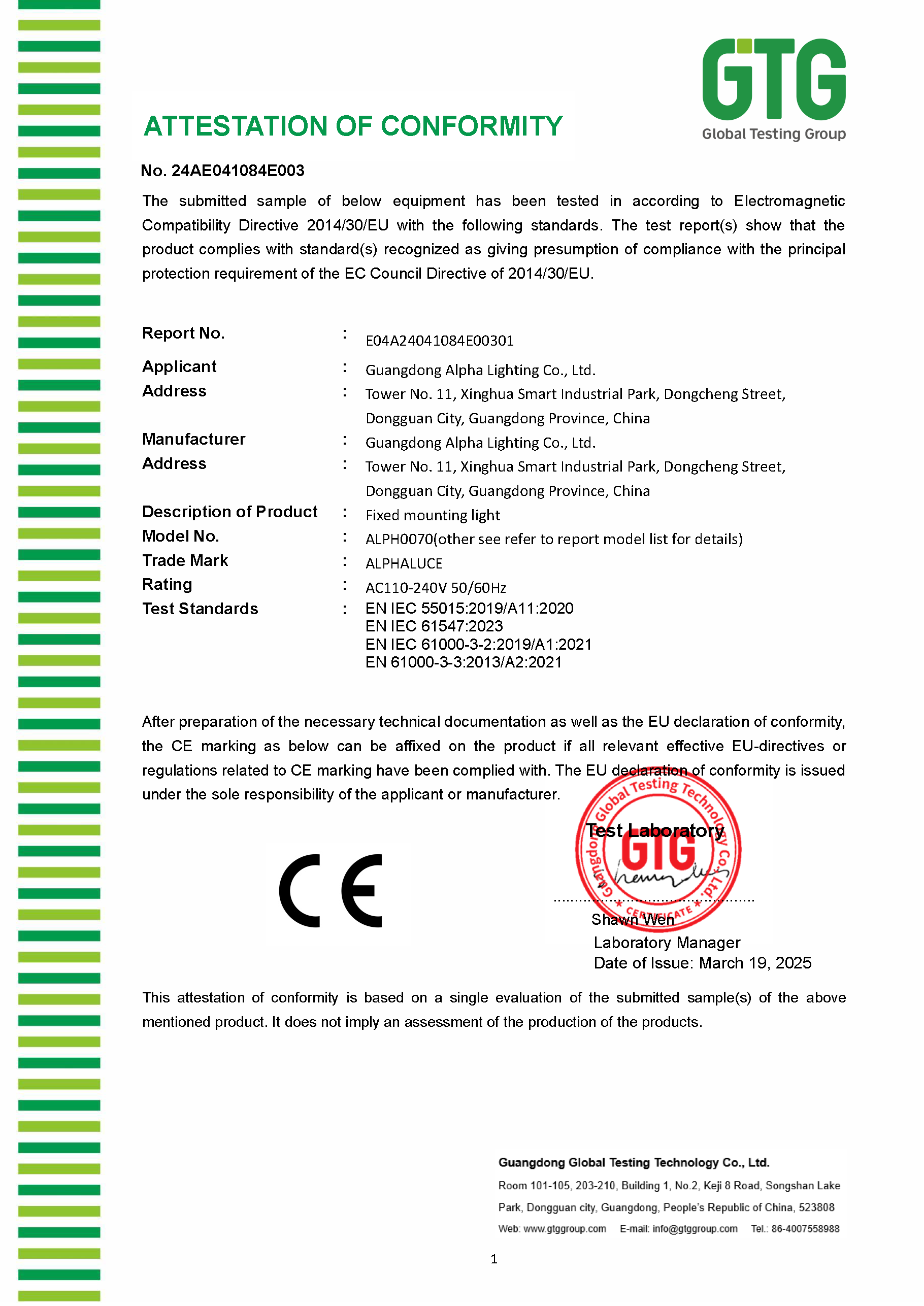
| CE-EMC 24AE041084E003 (GTG, 19 Mar 2025) | Electromagnetic compatibility to EN IEC 55015, EN IEC 61547, EN IEC 61000-3-2 and EN 61000-3-3 | Optical quality; delivery capability |
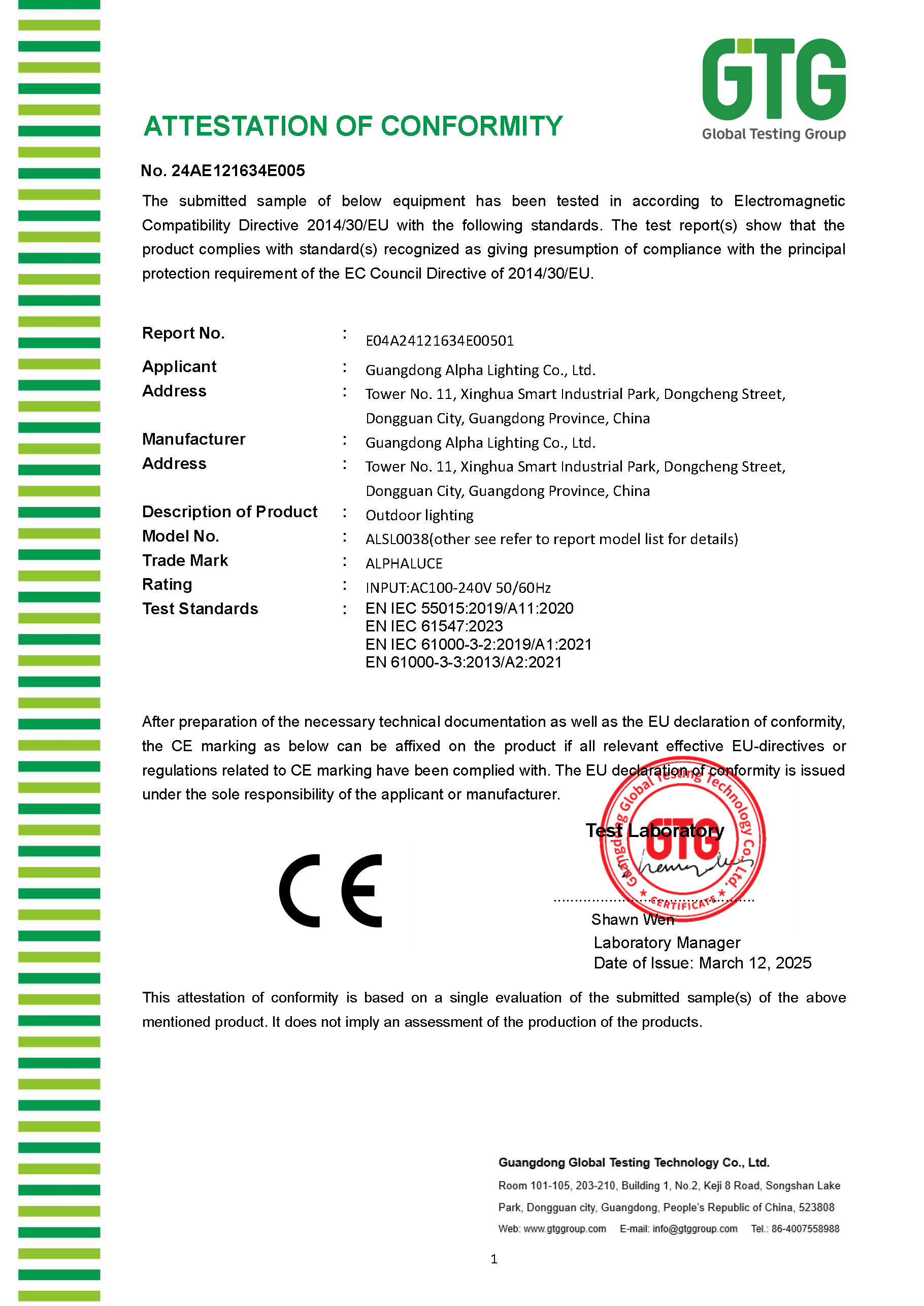
| CE-EMC 24AE121634E005 (GTG, 12 Mar 2025) | Electromagnetic compatibility for outdoor lighting fixtures, covering the exterior and step-light families | That every exterior SKU on your list falls inside that scope |
| RoHS DTI20241484-1DC (DTI, 23 Apr 2024) | Hazardous-substance limits tested to the IEC 62321 series | Product performance; batch consistency |
| ISO 9001:2015 QMS 04623Q13200R0M (issued 14 Jan 2025) | A certified quality management system for LED light production | Anything about a specific order — and check the expiry date on the copy you receive |
Two habits make this table useful. First, always ask which SKUs sit inside each certificate's scope; a family name on a certificate list is not the same as your model number. Second, always read the validity date. A quality-system certificate is a renewable document, and the date printed on the copy in your tender file should be checked at PO stage rather than assumed.
The pre-PO verification sequence
Run these ten steps in order. Each one produces a document or a decision that the next step depends on, and none of them can be completed retrospectively without cost.
- Lock the schedule-critical list. Separate long-lead and exterior items from standard ceiling items. The long-lead list drives the whole plan.
- Request capacity allocation, not a ship date. Ask which lines will run your families and when, and request the same for any concurrent project the supplier has already committed to.
- Request the certificate pack with numbers, dates and scope. Confirm validity dates on receipt and confirm that each of your model numbers falls within a certificate's scope.
- Request a photometric test report for every SKU in the package, and confirm it forms part of the acceptance criteria rather than a pre-sales courtesy.
- Place a mixed sample order. With a declared MOQ of 100 units per model and sample orders accepted, build a sample covering at least one interior and one exterior family so that you test the handover between them, not just the products.
- Interrogate the seals. Declared IP class, the standard and object tested, the cable-entry method, and the installation conditions the fixture assumes.
- Fix the bill of materials. Driver brand and model, LED bin policy, control protocol, field-replaceability and the end-of-life substitution rule.
- Approve the packing specification and labels before production, including the mixed-pallet pattern and per-area marking.
- Agree spares and the replacement process, including the spare quantity, same-run sourcing and the warranty claim route.
- Put it in the commercial terms. Confirm the incoterm (FOB, CIF or EXW), the payment split of 30% deposit and 70% before shipment, and the acceptance basis of pre-shipment inspection plus photometric test report. If the terms are not written into the order, none of the evidence above is enforceable.
What this evidence does not prove
Being precise about the limits of verification is part of using it well.
- Capacity is not a date. A monthly figure of 42,000 units shows scale, not the week your trimless downlights are cast.
- A certificate is not an installation. Safety compliance says nothing about whether an inground fixture was buried with adequate drainage on your site.
- A sample is not production. The sample tests design intent; batch consistency testing is what protects the second and third deliveries.
- Another project's result is not your project's result. Reference installations demonstrate experience in a segment; they do not transfer a result to your building, your climate or your maintenance regime.
Applying the sequence to hospitality projects
Hospitality is where mixed packages and long maintenance horizons meet. The supplier's project records include a six-star hotel in Korea supplied with 200–500 units for accent and display lighting, where the stated result was consistent 3000K warmth from lobby to guest corridors; a Four Seasons resort property in Vietnam; and an Alpine golf resort in Austria that combined architectural and landscape lighting in a single scope. Read those references as evidence that interior and exterior families have been delivered together, then ask the questions that transfer to your own project: which of the models in my package appeared in that project, what did the punch list contain, and how were replacements handled after opening.
The most useful reference conversation is not about the finished photographs. It is about the week the site needed forty replacement downlights.
Frequently asked questions
What certification documents should an architectural lighting supplier provide before a PO?
Ask for the certificate pack with numbers, issue dates, issuing bodies and scope, then map each document to your model numbers. For EU-bound projects this typically means an LVD safety certificate, EMC certificates for both indoor and outdoor fixture families, a RoHS test report and the quality management system certificate. ALPHALUCE's pack includes CE-LVD 24AS121634S598A002 for recessed LED luminaires, CE-EMC 24AE041084E003 for indoor products and 24AE121634E005 for outdoor fixtures, RoHS DTI20241484-1DC and ISO 9001:2015 certificate 04623Q13200R0M. Check every validity date on the copy you receive.
Can one OEM manufacturer genuinely cover both interior and exterior fixtures in a hospitality package?
It can, and the way to verify it is to look at what is shared rather than what is listed. Shared tooling, a shared quality process and a shared production plan are the real indicators. ALPHALUCE declares an in-house chain covering foundry, surface treatment and assembly across a 40,000 m² facility, with a product range that runs from recessed downlights and magnetic track light to inground pool LED lights, garden bollard lights and spike lights. Ask for a line-level schedule showing both families in the same production window; that is what turns a range into a capability.
How do I test batch consistency across repeat orders?
Build three controls into the order. First, require a photometric test report per SKU and make it part of acceptance criteria. Second, retain a signed, dated reference sample from the first delivery and require the supplier to hold a matching one, then compare later batches against it. Third, buy spares from the same production run as the main delivery. Where CCT and CRI targets are declared — ALPHALUCE states UGR<19 and CRI≥92/97 across its range — ask how bins are controlled between runs and whether binning data ships with the goods.
How are waterproof downlights and inground lights sealed and tested?
Ask for the declared IP rating of the specific model, the ingress-protection standard it was tested to, and whether the test covered the finished luminaire including the cable entry rather than the housing alone. Then ask how the seal is made — gasket compression, potting or both — and whether it survives a driver or lamp change. Installation conditions matter as much as the product: drainage, recess depth and clearance must be specified. Note that a safety certificate such as the CE-LVD file for recessed luminaires is not ingress-protection evidence; the two are separate documents.
Who should own driver and LED sourcing, and what changes if the supplier does?
The supplier should own the specification and the incoming inspection, even where it does not manufacture the component. Ask which driver brand and model is specified per SKU, whether the driver is field-replaceable, which control protocol the specific model carries, and what happens if the driver or LED bin reaches end of life mid-project. A supplier that answers from a documented bill of materials gives you a controlled variable. An answer of “equivalent” leaves a substitution decision open after the PO, which is where optical consistency on a phased hotel project is usually lost.
What MOQ, lead time and payment terms should I expect on a mixed architectural order?
ALPHALUCE declares a minimum order of 100 units per model with sample orders accepted, a production lead time of 20–30 days, delivery terms of FOB, CIF or EXW, and payment of 30% deposit with 70% before shipment. Confirm what the lead time is measured from — PO, deposit or sample approval — and whether it applies to every family in the package or only to volume lines. Acceptance is based on pre-shipment inspection plus a photometric test report, so both should appear in the order documents.
How should a buyer start verifying delivery capability in practice?
Start with a mixed sample order rather than a single hero sample: one interior family and one exterior family, ordered together so that you test the handover between them. With that in hand, review the certificate scope, ask the sealing and driver-sourcing questions, and confirm the packing and spare-part commitments. Buyers who want the full product reference before that step can request the ALPHALUCE catalogue through the contact details published on the company website, and use it to build the audit scope described above.
Conclusion: assurance is a document trail, not a promise
Delivery assurance in architectural lighting is built from a small number of verifiable things: a capacity figure that reconciles with annual output, a line-level schedule rather than a ship date, a photometric report attached to acceptance, a declared IP class tested on the finished fixture, a named driver and LED bill of materials, and a packing and spares commitment that survives the first maintenance season. Each one is answerable before the PO and expensive to discover afterwards.
The product range is the most efficient audit scope available, precisely because it is the supplier's own claim about itself. Take the recessed downlights, the trimless spotlights, the magnetic track light and pendant luminaires, then the inground pool LED lights, exterior ground lighting, garden spike lights and bollard lights, and ask the same five questions of every group. Where the answers are documented, you have a supplier. Where they are verbal, you have a quotation.
Before you commit volume
Use the mixed-sample route to test interior and exterior families together, and request the catalogue and certificate pack to build your own audit scope.
Have Questions or Need More Details?
Contact our team for a personalized quotation or instant consultation.
Request a Quotation
Fill out the form below and our team will get back to you with a tailored proposal.
WhatsApp Direct Chat
Prefer to chat in real-time? Message us on WhatsApp for instant assistance & quick answers.
- Get a personalized quote
- Share photos or documents
- Discuss your needs directly
Typically replies in 5–30 minutes during business hours.