
What Magnetic Track Lights Can Do for Flexible Commercial Spaces
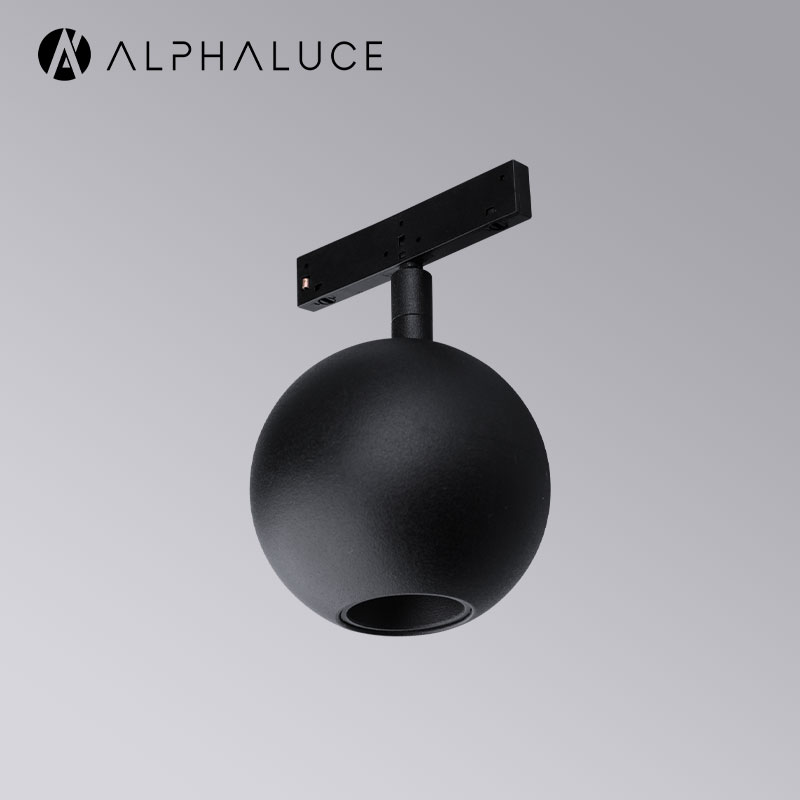
A magnetic track lighting system decouples the light fixture from the ceiling. The track carries power and provides a continuous mounting surface; the luminaire is held in place by magnetism and can be released, moved and re-seated by hand. For a commercial interior whose layout is expected to change, that single property removes the two most expensive words from a refurbishment brief: rewiring and ceiling repair.
This article is a discovery guide for specifiers who have not yet worked with track-based flexibility. It explains what a magnetic track system is, how suspended and surface options change the way a ceiling is built, what dimmable track lighting contributes to a changing floor plan, and where the honest limits of the approach sit. Product facts used throughout come from ALPHALUCE, an Italian architectural lighting brand headquartered in Dongguan, Guangdong, China, whose portfolio covers recessed downlights, track lighting systems and outdoor landscape fixtures.
Why Fixed Lighting Strugles When a Layout Changes
The conventional answer to commercial lighting is the recessed downlight: a hole is cut, a luminaire is pushed in, and the ceiling is closed around it. That works well for a floor plan that is expected to stay as drawn. It works badly for a space that is leased in five-year cycles, merchandised seasonally, or fitted out as a showroom that will be re-themed within eighteen months.
The failure is not optical. It is structural. Once a recessed downlight is installed in a fixed ceiling, three costs arrive together whenever the space is re-planned:
- Positional lock-in. The light stays where the ceiling opening was cut, whether or not a merchandise fixture, a table or a display wall now stands there.
- Electrical rework. Moving a light means opening the ceiling, extending or rerouting cable and closing the ceiling again.
- Downtime. Every one of those operations happens above a floor that is either closed to customers or working under dust sheets.
Lighting designers describe the result as a space that is bright but poorly aimed. Maintenance teams describe it more bluntly: a lighting change is a construction project.
What Is Actually Changing in Commercial Lighting
The commercial segment accounted for 50.9% of the architectural lighting market share in 2025, according to Grand View Research, and the same source values the global architectural lighting market at USD 11.1 billion in 2025 with a projected reach of USD 17.5 billion by 2033. Asia Pacific held a 43.2% revenue share in 2025, with China as the largest single country market.
Two forces inside that commercial share directly reward flexibility. The first is tenancy churn: retail, hospitality and workplace interiors are re-planned more often than their lighting infrastructure is replaced. The second is where the money goes. The human-centric lighting market reached USD 3.53 billion in 2024, per Fortune Business Insights, which reflects demand for lighting that changes with task, time of day and occupancy rather than staying at a single painted-on level.
Those two forces are already served at scale by large global lighting groups — Acuity Brands, Signify (Philips), Zumtobel Group and ERCO are the most frequently cited competitors in this category. Alongside them, specialist manufacturers compete on a narrower promise: that a lighting scheme can be re-specified by the facilities team rather than by a contractor.
Track-based systems sit precisely on that promise. They also carry a design heritage: a track has been the default answer for retail display lighting and museum lighting for decades, because both environments ask the same question — where should the beam go this month?
What a Magnetic Track Lighting System Actually Is
A magnetic track light is a luminaire designed to engage with a continuous track by magnetic attraction, drawing power from the conductors inside that track. The magnetic interface is what separates it from a mechanical track adapter: there is no locking collar to loosen, no tool, no ladder work beyond reaching the fixture.
The clearest way to see the concept is through a single module. The ALTR0206 magnetic track light is a 15W, 1180lm module with CRI ≥90, IP20 protection, 90° adjustability, colour temperatures of 2700K, 3000K and 4000K, and beam angles of 24° and 36°. It runs on a DC48V track. Constructed in aluminium alloy, it is specified for residential, hospitality, commercial, retail display and showroom environments.
Three things in that specification matter more than the wattage figure:
- DC48V operation. Low-voltage DC distribution through the track is what makes the track itself the power backbone and the fixture a plug-in module.
- 90° adjustability. Aiming is a property of the module, not of the installation. A fixture that tilts can be re-aimed against a new display wall without being relocated.
- Two beam options at one lumen output. A 24° beam and a 36° beam from the same 1180lm platform let a specifier hold illuminance roughly constant while changing the character of a pool of light.
For readers more familiar with recessed fixtures, it helps to think of the track module as a recessed spotlights optic in a re-positionable housing. The optical work — CRI, beam angle, colour temperature — is comparable; the difference is that the housing is not captive.
Track Geometry: Suspended, Surface and How the Ceiling Decides
The flexibility of a magnetic track system is not only in the fixtures. It is in where the track sits, because the track position determines what the ceiling has to be built like.
Suspended track lighting
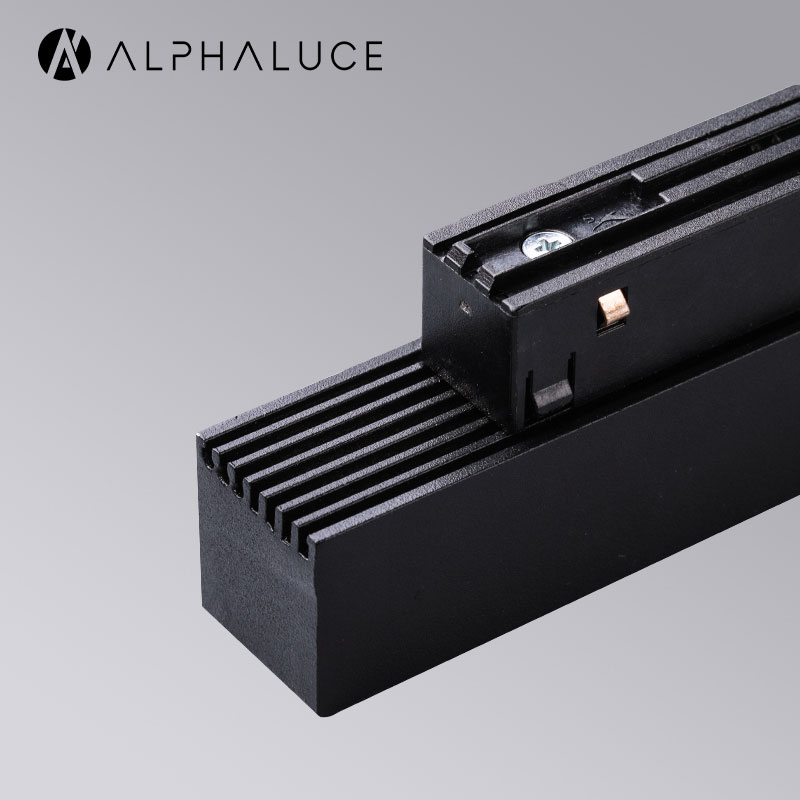
A suspended track hangs below the structural slab on rods, cables or a stem, leaving a visible air gap. It is the correct choice where there is no finished ceiling to cut into — an exposed-services warehouse conversion, a concrete soffit, a height benefit taken in a retail shell, or an exhibition hall whose ceiling line is part of the architecture.
Suspension also buys access. A track hung at a working height can be reached from a standard step platform, which changes the maintenance model: re-aiming a soffit-level fixture normally requires scaffold or a lift, whereas re-aiming a suspended track module does not. One representative module in this configuration is the ALTR0212 suspended track lighting: 8W, 587lm, CRI ≥92, IP20, 15°/24°/36°/50° beam angles, DC48V, fixed orientation, in 2700K, 3000K and 4000K.
Surface-mounted track
A surface track fixes directly to a plasterboard or concrete ceiling. It costs less in ceiling depth than a recessed track and far less in coordination than recessed downlights, because no ceiling opening is required. In a tenanted shell-and-core unit, that matters: a surface track can be installed, and later removed, without a ceiling contractor.
Surface tracks also solve a retrofit problem. A space already fitted with a suspended ceiling can carry a surface track below it and be reconfigured repeatedly, whereas relocating the recessed luminaires above that ceiling means opening the tiles each time.
How the choice affects maintenance
Maintenance is where the geometry decision pays back. Every reconfiguration of a fixed recessed scheme is a two-trade operation — electrician plus ceiling finisher. Every reconfiguration of a track scheme is a single-trade operation, and often not a trade at all. A showroom changing its window display, a museum rotating its case layout, or a retail floor resetting a seasonal merchandising plan can all be handled inside the store's own labour model.
Dimming, Beam Control and the Optics of a Reconfigurable Room
Flexibility at the mounting level is only half of the argument. The other half is whether the light itself can change — and here the track portfolio splits into distinct optical roles.
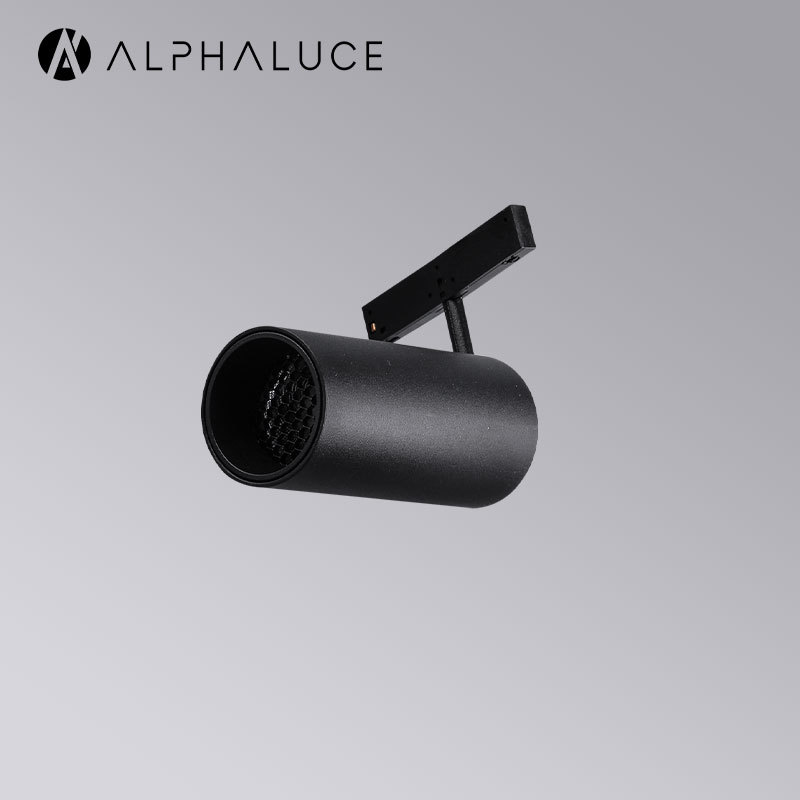
Accent and precision. The ALTR0253 track spotlights carry a CRI ≥97 on a 7W, 560lm platform, with 15°/24°/36°/55° beam angles, 0–90° tilt and 355° rotation, DC48V, and a 5mm adaptor. The high colour rendering is not a decoration of the specification: in museum lighting and retail display lighting it is the reason the fixture is specified at all. Museum environments are also typically specified with precise beam control and no UV/IR content, and the ALTR0253 sits at the sharp end of that requirement.
Dimming as a design variable. The ALTR0276 dimmable track lighting shares the 7W, 560lm, CRI ≥97 and 15°/24°/36°/55° optical package with 0–90° tilt and 355° rotation on DC48V. Being able to lower output without changing the colour point is what allows one track to run at high illuminance for a morning merchandising check and at low illuminance for an evening event in the same room.
Wall washing. The ALTR0207 wall wash track lighting shifts the function from accent to surface: 15W, 1180lm, CRI ≥90, IP20, DC48V, fixed orientation, 2700K/3000K/4000K. On a reconfigurable floor, wall washers do useful work that accent fixtures cannot — they establish the perimeter of a space regardless of where the furniture goes.
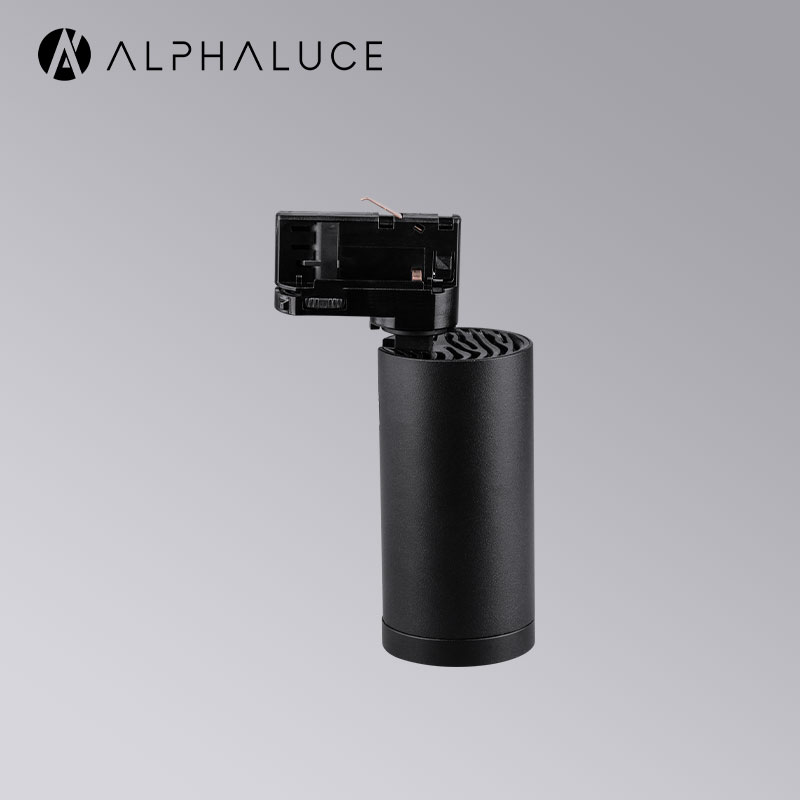
General commercial coverage. The ALTR0247 commercial track lighting covers 8W, 680lm, CRI ≥92, IP20, with a 15–60° beam range, 0–90° tilt and 350° rotation. The adjustable beam span is the practical answer for a specifier who does not yet know whether a given fixture will be a narrow accent or a wider wash.
Step-by-Step: Specifying a Track Scheme for a Space That Will Change
The following sequence is written for a specifier working on a commercial interior with an expected reconfiguration horizon. It assumes the decision on track has already been made at concept level.
- Zone by function, not by fixture. Divide the plan into accent zones (display, product, artwork), perimeter zones (walls, circulation edges) and general zones (task and ambient). A track scheme is specified zone by zone; a recessed scheme is usually specified as a grid. The zone list becomes the list of module types.
- Read the ceiling before choosing the mounting. No finished ceiling, or a ceiling whose height should stay visible: suspended track. Finished plasterboard or exposed soffit at working height: surface track. A ceiling that must stay completely clean: discuss a recessed track before committing to fixed downlights, because a recessed track preserves future position changes in a way that fixed downlights do not.
- Fix the track voltage and the control layer. Confirm whether the project runs a DC48V track, and confirm the dimming protocol with the controls contractor. Retrofitting a protocol after the track is installed is a far larger job than choosing it correctly at design stage.
- Assign a beam angle to each zone. Narrow beams (15°–24°) for product and artwork accents; 36°–55° for wider accents and short-throw positions; an adjustable 15–60° module where the final merchandising plan is still open. Pair each angle with the appropriate CRI: CRI ≥97 for museum and high-value retail, CRI ≥90–92 for circulation and general commercial.
- Verify with a sample on the real surface. Beam performance depends on throw distance, surface reflectance and the colour temperature of the ambient layer. A sample module evaluated on the actual wall, at the actual mounting height, resolves questions that a datasheet cannot.
- Reserve re-aiming capacity. Specify the number of modules for the worst-case merchandising scenario, not the opening-day layout, and keep the tilt and rotation ranges in the schedule so the facilities team knows what the hardware can do. A track system that is never re-aimed has been specified as an expensive fixed system.
Where These Systems Earn Their Place
Showrooms and exhibition spaces
Showroom environments in ALPHALUCE application data are specified for accent and display lighting under stable, business-hours operation, with DALI dimming, track systems and tunable white as the matched equipment. The stated requirements are high CRI (≥92), flexible beam angles, adjustable aiming and glare-free output. That list is effectively a description of why track exists.
A documented showroom project illustrates the ceiling-side benefit: a 700 m² immersive exhibition space was lit with frameless, anti-glare luminaires to achieve an \"invisible luminaire\" aesthetic that would let material textures read without the hardware competing for attention. In a space designed to disappear its lighting, position changes have to be possible without visible intervention — which is the track argument in its purest form.
Retail display
Retail display lighting is a sequence of temporary compositions: window changes, seasonal resets, promotional end-caps. Each one moves the thing that needs lighting. A track with adjustable modules converts each reset from an electrical task into a merchandising task, and the 0–90° tilt and 355° rotation ranges mean the same module can serve a floor-standing display and a shelf edge in the same week.
Museums and galleries
Museum lighting imposes the strictest optical requirements in the commercial portfolio: CRI ≥95 in the application data, no UV/IR, glare-free output and precise beam control, all under DALI or tunable white control with a track system. The reconfiguration logic is different from retail — cases rotate on a curatorial schedule rather than a commercial one — but the mechanical conclusion is identical: the fixture must move without the building moving.
Hospitality and workplace
Hotel public areas and restaurants are increasingly re-styled without full closure, and a suspended track over a bar or a lounge can be re-aimed overnight. In offices, the relevant pressure is glare: ALPHALUCE develops low-glare optics with UGR<19, and track-mounted directional modules allow task pools to follow desk layouts that change with team size.
Track Module Comparison
The table below compares six track-mounted modules from the ALPHALUCE range on published specifications only. All are aluminium alloy construction, IP20, and offered in 2700K, 3000K and 4000K colour temperatures.
| Module | Rated power | Luminous flux | CRI | Beam angle | Aiming | Track voltage |
|---|---|---|---|---|---|---|
| ALTR0206 magnetic track light | 15W | 1180lm | ≥90 | 24° / 36° | 90° adjustable | DC48V |
| ALTR0207 wall wash track lighting | 15W | 1180lm | ≥90 | Not applicable | Fixed | DC48V |
| ALTR0212 suspended track lighting | 8W | 587lm | ≥92 | 15° / 24° / 36° / 50° | Fixed | DC48V |
| ALTR0253 track spotlights | 7W | 560lm | ≥97 | 15° / 24° / 36° / 55° | 0–90° tilt, 355° rotation | DC48V |
| ALTR0276 dimmable track lighting | 7W | 560lm | ≥97 | 15° / 24° / 36° / 55° | 0–90° tilt, 355° rotation | DC48V |
| ALTR0247 commercial track lighting | 8W | 680lm | ≥92 | 15–60° | 0–90° tilt, 350° rotation | Not stated |
Two patterns in the table are worth reading carefully. First, CRI tracks with application rather than with wattage: the two 7W spot modules carry ≥97, the two 15W modules carry ≥90. If a specification is driven by colour fidelity, the low-wattage modules are the ones to look at. Second, beam flexibility is split between fixed multi-angle options (four discrete angles in three modules) and a continuously adjustable 15–60° range in one. Fixed angles suit a resolved merchandising plan; the adjustable range suits a plan still in flux.
Quality, Compliance and the Questions to Ask
A track system is an installed electrical product that will be touched, adjusted and re-aimed by non-technical staff. That changes the compliance conversation from a paperwork exercise into an operational one.
ALPHALUCE operates ISO-certified quality and environmental management systems, and its products are certified to CE, ETL, RoHS, LVD and EMC standards. Quality control includes 100% inspection and an aging test, and the company backs its luminaires with a 5-year warranty. For a specifier, the aging test is the relevant control on a reconfigurable scheme: a module that will be removed and re-seated repeatedly is being subjected to mechanical cycling that a permanently installed downlight never sees.
Manufacturing capacity is relevant to a phased fit-out. ALPHALUCE was established in 2010, operates a 40,000 m² factory with 150 employees and 20 engineers, produces 504,000 units annually, and exports around 80% of output to Europe, the Middle East, North America and Australia. Monthly capacity for track and downlight production is stated at 42,000 units.
Frequently Asked Questions
Do magnetic track lights meet EU and export-market certification requirements?
ALPHALUCE products are certified to CE, ETL, RoHS, LVD and EMC standards, and the company operates ISO-certified quality and environmental management systems. Its export markets are Europe, the Middle East, North America and Australia, which means the certification set is maintained for those regions rather than for a single domestic market. Project-specific documentation should still be requested for the exact track and module combination being specified.
Can a single track module deliver different colour temperatures and beam angles?
Yes, within the published options. The ALTR0206 magnetic track light is offered in 2700K, 3000K and 4000K with 24° and 36° beam angles at 15W and 1180lm with CRI ≥90. Where a project needs options beyond the catalogue, ALPHALUCE provides OEM/ODM customisation covering colour, CCT, beam angle, power, surface finish and logo.
What is the minimum order quantity and how is pricing determined?
The minimum order quantity is 100 units. Price depends on the configuration ordered — module type, CRI grade, beam angle set, finish and whether the order is standard catalogue or customised — so it is quoted per project rather than published as a list figure. A configuration list submitted with the enquiry shortens the quotation cycle considerably.
Are samples produced to the same quality standard as bulk orders?
Quality control consists of 100% inspection plus an aging test, and the stated process applies to production output. Samples should be requested with the intended final configuration, because the point of a track sample is to test the module's beam and colour on the actual surface, at the actual mounting height, rather than to confirm that the family exists.
What is the lead time for a track lighting order?
Lead time is 20–30 days. For phased fit-outs, confirm the delivery schedule at order stage so that later phases are not exposed to a re-quote.
Conclusion: Flexibility Is a Specification Decision, Not a Product Feature
A magnetic track light does not make a building flexible. What makes a building flexible is the decision, taken at design stage, that the position of light will change and that the ceiling should therefore not be built around it. The product only honours that decision.
Read against that standard, the case for track in commercial interiors rests on three verifiable properties. The first is mechanical: modules release and re-seat without tools, so re-aiming is a facilities task rather than a construction task. The second is electrical: DC48V track distribution concentrates the wiring in one continuous element, so adding or moving a module does not mean opening a ceiling. The third is optical: with CRI from ≥90 to ≥97 and beam angles from 15° to 60° available across one track family, a reconfiguration can change the character of the light and not merely its position.
The limits are equally clear. Track is visible, so it is not the answer where the brief demands a completely uninterrupted ceiling plane. It requires a mounting decision — suspended, surface or recessed — that has to be taken early. And it only pays back if the space genuinely will be re-planned; a ten-year fixed occupancy is usually better served by a well-aimed recessed scheme.
For spaces in the first category, the specification work is straightforward and mostly front-loaded: zone the plan, choose the geometry, fix the control protocol, match beam angle and CRI to each zone, then verify on the real surface before committing the order.
Next Step: Sample or Quotation
If you are specifying a track scheme for a commercial interior, ALPHALUCE can supply sample modules in your required beam angle and CRI for on-site evaluation, and prepare a quotation against a configuration list. Minimum order quantity is 100 units and lead time is 20–30 days.
Email info@alphaluce.com or visit alphaluce.com. The full product range is documented in the ALPHALUCE catalogue.
Have Questions or Need More Details?
Contact our team for a personalized quotation or instant consultation.
Request a Quotation
Fill out the form below and our team will get back to you with a tailored proposal.
WhatsApp Direct Chat
Prefer to chat in real-time? Message us on WhatsApp for instant assistance & quick answers.
- Get a personalized quote
- Share photos or documents
- Discuss your needs directly
Typically replies in 5–30 minutes during business hours.