Exam vs. Industrial Nitrile Gloves: A Side-by-Side Comparison Guide for Buyers
Exam vs. Industrial Nitrile Gloves: A Side-by-Side Comparison Guide for Buyers
The short answer: both products are made from nitrile, both are usually powder-free and disposable, and both can sit inside a similar price band. What separates a medical exam nitrile glove from an industrial nitrile glove is the compliance claim behind it. Medical exam gloves are regulated devices that must demonstrate conformity with standards such as ASTM D6319 in the United States or EN 455 in the European Union, typically at an AQL of 1.5, and are supported by clearance such as FDA 510(k) and an ISO 13485 quality management system. Industrial nitrile gloves are protective equipment evaluated for mechanical and chemical performance, for example under EN 388 and EN 374, and they are not medical devices. Sourcing the wrong category creates either a compliance failure at the border or an avoidable cost on your invoice.
This comparison guide works through applicable standards, certification documents, physical specifications and commercial terms for both categories, so that importers, distributors, procurement teams and brand owners can map the right glove to the right environment.
Problem Definition: Why the Two Categories Are Not Interchangeable
Nitrile gloves are made from synthetic nitrile rubber, and the base material performs the same barrier function whether the glove ends up in a clinic or a workshop. That similarity causes most buying mistakes. The two product families look alike in the box, share colour and texture options, and are frequently listed next to each other in supplier catalogues under the single keyword "nitrile gloves".
The real difference is what the product is allowed to claim:
- A medical exam nitrile glove is placed on the market as a medical device. It has to demonstrate conformity with medical glove standards and be backed by market clearance and a medical quality system.
- An industrial nitrile glove is placed on the market as protective equipment. It is evaluated against mechanical and chemical protection standards and carries no medical claim.
The cost of mixing them up is asymmetric. Shipping industrial gloves into a medical tender or a clinical distribution channel creates a documentation and compliance failure that cannot be repaired after the container has left. Buying exam-grade gloves for general workshop tasks adds compliance cost and inspection burden without improving mechanical durability.
Industry Background: Where Each Category Sits in the Market
Demand for nitrile gloves is broad and still expanding. Grand View Research values the global nitrile gloves market at USD 6.5 billion in 2025 and projects it to reach USD 13.2 billion by 2033. Published estimates diverge because analysts define the category differently — Global Market Insights reports USD 31.5 billion for 2024 and IMARC Group USD 8.6 billion — so market-size figures are best read as directional rather than exact.
Two structural facts matter more to buyers than the headline number. First, powder-free nitrile gloves accounted for 74.8% of global revenue in 2025, which makes the powder-free specification the market default rather than a premium add-on. Second, the medical and healthcare segment held the largest revenue share at 80.1% in 2025. Most nitrile glove volume therefore moves through regulated medical channels, and industrial buyers are effectively competing for capacity with medical demand.
On the supply side the market remains fragmented. Global Market Insights reports that Top Glove Corporation Bhd led the global nitrile market with over 8.4% share in 2024, followed by Hartalega and Kossan Rubber, which leaves the majority of the market to a long tail of manufacturers. That long tail is exactly where supplier documentation quality varies most — and it is why the category question in this article is settled by documents rather than by brand size.
Standards and Certification: The Core of the Comparison
Medical Exam Nitrile Gloves: ASTM D6319, EN 455, FDA 510(k), ISO 13485
Medical nitrile examination gloves must comply with ASTM D6319 in the United States or EN 455 in the European Union, and are typically required to meet an AQL of 1.5, according to the FDA and CEN standards framework. In practice, three documents define the category for a buyer:
- Product standard conformity — ASTM D6319 (US) or EN 455 (EU), with AQL 1.5 as the typical acceptance level.
- Market clearance — FDA 510(k) clearance for the United States and CE marking for the European Union.
- Quality management system — ISO 13485, the medical device quality system standard.
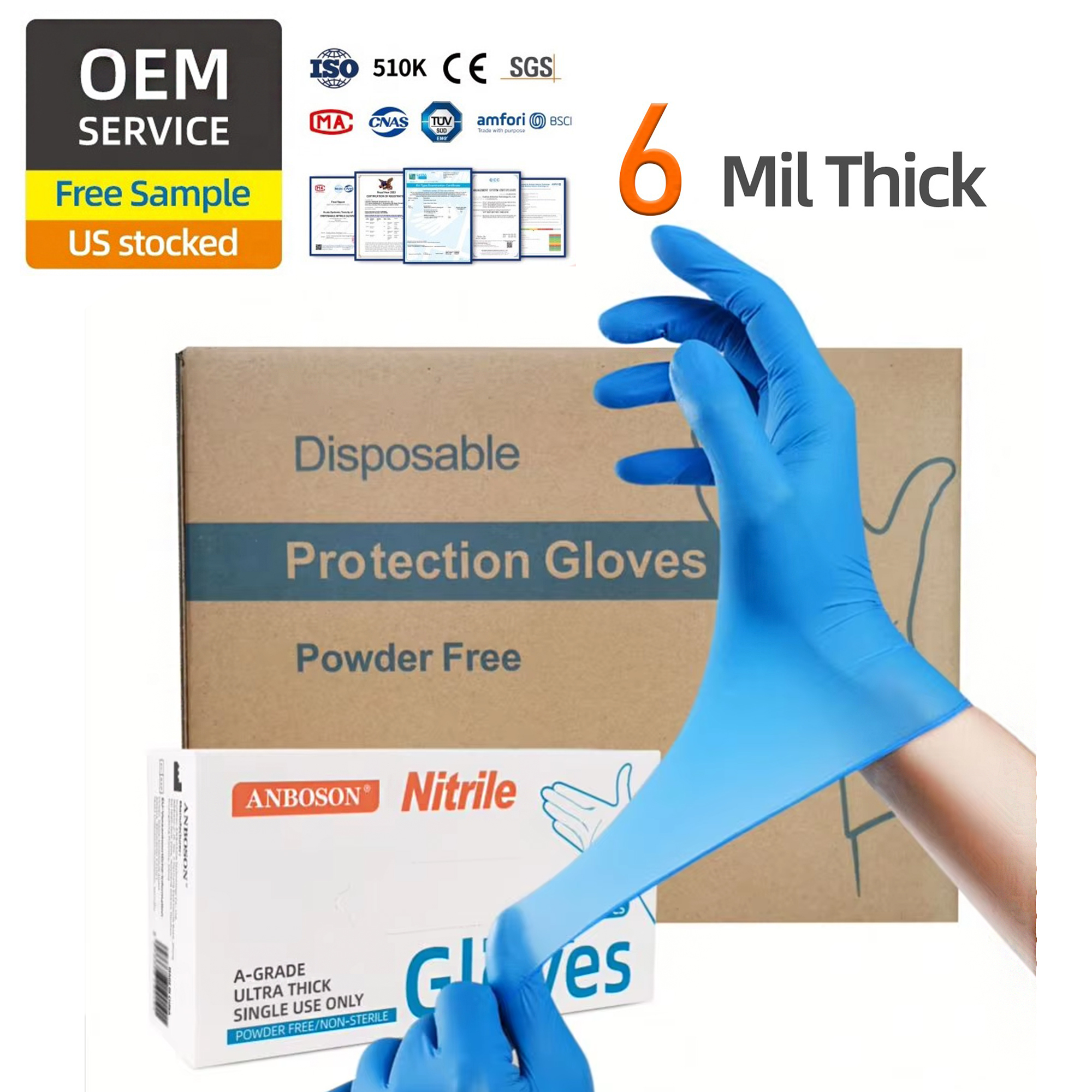
ANBOSON's Medical Exam Nitrile Glove, model ABC-DG01, shows the typical specification profile of the category: 3 mil thickness, powder-free, textured surface, AQL 1.5, intended for medical examination in healthcare and dental settings, at a minimum order quantity of 1,000 pieces and a published price range of $0.02 to $0.03 per piece. The compliance condition travels with the application: hospital and clinic supply projects require EU EN 455 medical glove compliance and FDA 510K clearance.
Industrial Nitrile Gloves: EN 388, EN 374 and What "Not a Medical Device" Means
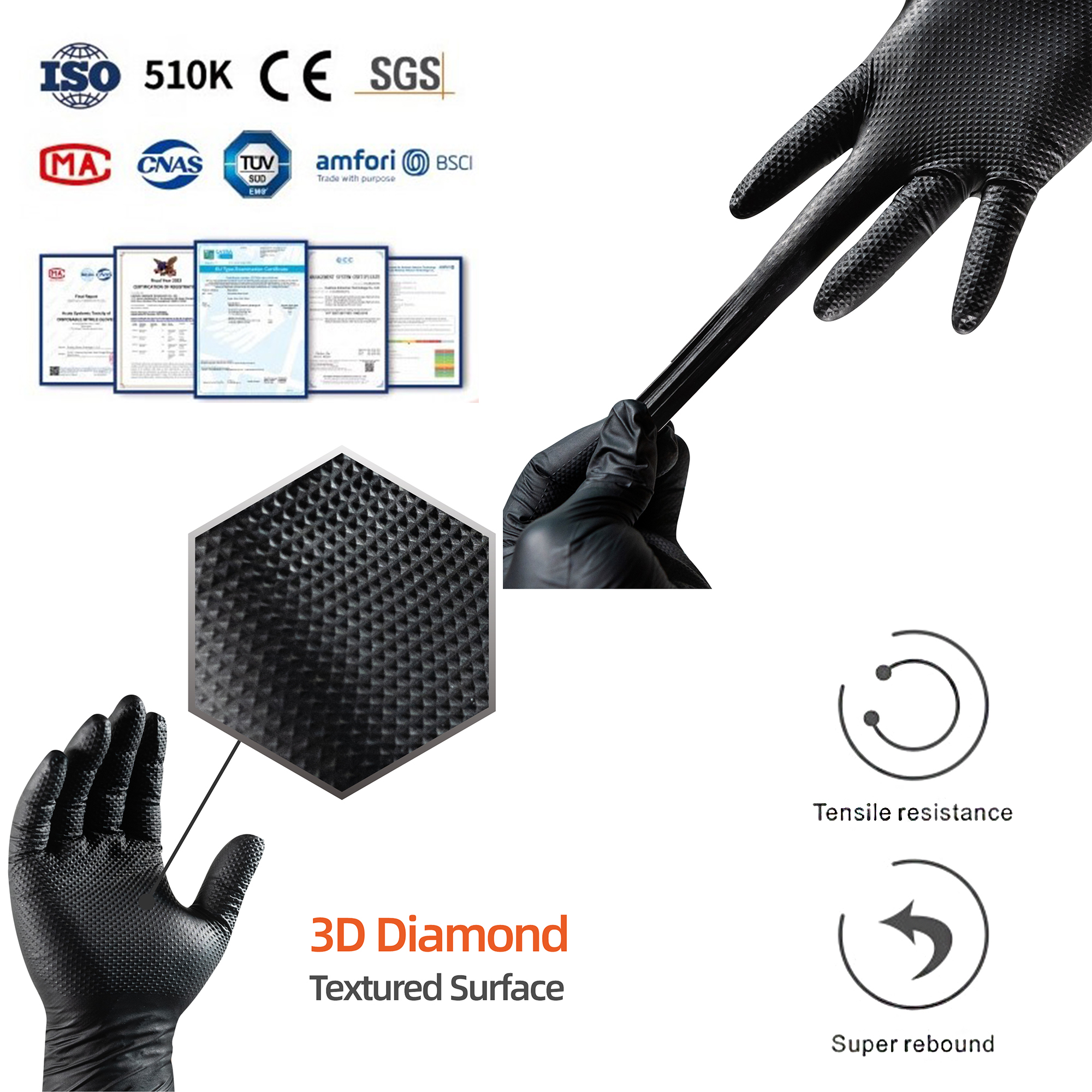
Industrial-grade nitrile gloves are tested under EN 388 for mechanical risks and EN 374 for chemical protection. Grip engineering sits inside the same framework: high-performance diamond textures increase wet grip by up to 27%, according to Ansell International and industry analysis.
The phrase that matters most for buyers is "not a medical device". An industrial glove does not carry FDA 510(k) clearance or an EN 455 conformity claim, and it must not be promoted for examination, diagnosis or patient contact. It can still be manufactured inside a medical-grade quality system — ANBOSON holds ISO 13485 Quality Management System certification, and the company is verified by SGS and TÜV SÜD — but the product-level claim is what defines the category.
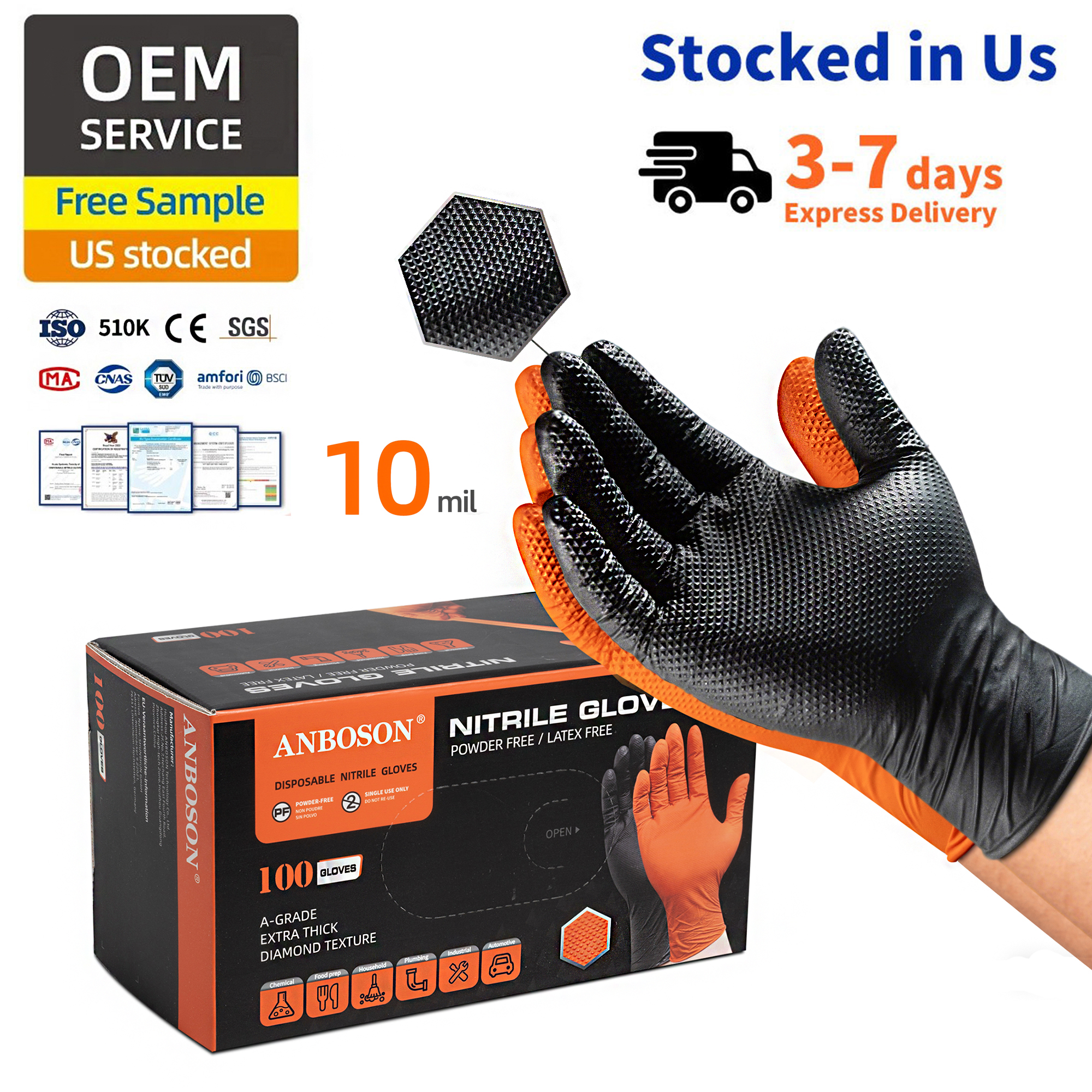
Specifications follow the use case. ANBOSON's Industrial Nitrile Gloves (ABC-DG01) are 4 mil, powder-free and touch-screen compatible, intended for industrial, kitchen and tattoo environments, with a minimum order quantity of 1,000 pieces at $0.02 to $0.03 per piece. Where abrasion, puncture risk and chemical exposure increase, the Heavy Duty Industrial Glove (ABC-DG01) is available in 8 mil and 10 mil with a diamond grip texture and waterproof construction, supplied in boxes of 100 at a minimum order quantity of 10 boxes and a published price of $3.28 to $3.68 per box. Factory and workshop projects typically specify a 6–8 mil thick gauge with puncture resistance and high wear resistance.
The Third Category Buyers Often Overlook: Food Grade
Food contact is neither medical nor heavy industrial, and it has its own rulebook. Food grade nitrile gloves must meet FDA 21 CFR 177.2600 in the United States and EU Regulation 10/2011 (EN 1186) for food contact compliance. ANBOSON's Food Grade Nitrile Glove (ABC-DG01) is 5 mil, powder-free with textured fingertips, intended for food service and food preparation environments at a minimum order quantity of 1,000 pieces and $0.02 to $0.03 per piece. The Box Exam Gloves (ABC-DG01) sit at the intersection of two categories: classified as a medical glove, 6 mil, food grade, packed 100 pieces per box and used in food processing and kitchen scenarios.
Side-by-Side Comparison Table
| Attribute | Medical Exam Nitrile Gloves | Industrial Nitrile Gloves | Heavy Duty Industrial Nitrile Gloves |
|---|---|---|---|
| Product classification | Medical glove (ABC-DG01) | Safety glove (ABC-DG01) | Safety glove (ABC-DG01) |
| Material | Nitrile | Nitrile (synthetic nitrile rubber) | Nitrile |
| Wall thickness | 3 mil | 4 mil | 8 mil / 10 mil |
| Surface and features | Powder-free, textured surface | Powder-free, touch screen compatible | Diamond grip texture, waterproof |
| Standards framework | ASTM D6319 (US) / EN 455 (EU); AQL 1.5 typical | EN 388 (mechanical risks) / EN 374 (chemical protection) | EN 388 (mechanical risks) / EN 374 (chemical protection) |
| Medical claim | FDA 510(k) clearance, CE marking, ISO 13485 quality system | Not a medical device — no FDA 510(k) or EN 455 claim | Not a medical device — no FDA 510(k) or EN 455 claim |
| Intended environment | Medical / healthcare / dental examination | Industrial, kitchen, tattoo | Home, machinery, industrial |
| Minimum order quantity | 1,000 pieces | 1,000 pieces | 10 boxes |
| Published price range | $0.02–0.03 per piece | $0.02–0.03 per piece | $3.28–3.68 per box of 100 |
Step-by-Step: How Buyers Decide Between Exam and Industrial
- Define the exposure, not the product. Biological contact with patients points to medical exam gloves. Chemical, oil, abrasion and sharp-part exposure point to industrial gloves. Food contact points to food grade. The hazard determines the standard you are required to meet.
- Confirm the standard your destination market requires. For US medical supply that means ASTM D6319 plus FDA 510(k) clearance; for EU medical supply, EN 455 plus CE marking. Industrial supply is assessed under EN 388 and EN 374. Food contact follows FDA 21 CFR 177.2600 or EU Regulation 10/2011 (EN 1186).
- Match thickness and grip to the task. A 3 mil exam glove prioritises tactile sensitivity. A 4 mil general-purpose industrial glove balances dexterity and durability. An 8–10 mil diamond grip glove is built for wet, oily, high-wear work where grip retention matters more than touch.
- Verify the quality system and inspection regime. Check ISO 13485 certification, the stated AQL acceptance level, and how inspection is performed. ANBOSON states that every glove undergoes a 100% full-scale inspection before leaving the facility, held to an AQL 1.5 standard.
- Validate with samples under your own conditions. Test donning, grip, exposure to the chemicals you actually use, thickness feel, packaging integrity and print quality before committing to a container.
- Lock commercial and documentation terms. Agree MOQ, packaging format, customisation options (thickness, colour, logo, carton) and the document package that must accompany each shipment, then confirm the production and shipping schedule in writing.
Scope note: this comparison covers the standards framework and the product data published by ANBOSON. It is not legal or regulatory advice. Classification requirements change by market and by product claim, so confirm current requirements with your importer, notified body or regulatory consultant before labelling any product as a medical device.
Use Cases: Matching the Glove to the Environment
- Medical, healthcare and dental. Medical Exam Nitrile Gloves at 3 mil with AQL 1.5, supported by EN 455 compliance and FDA 510K clearance, are the correct specification for hospital, clinic and dental supply projects where cross-infection control and single-use disposal are mandatory.
- Food processing and food service. Food Grade Nitrile Gloves at 5 mil, powder-free with textured fingertips, address food contact compliance and low-allergy requirements while protecting operators' hands from oil and heat. Powder-free construction reduces contamination risk in preparation areas.
- Industrial, machinery and workshop. Industrial Nitrile Gloves at 4 mil suit light assembly, sorting and touch-screen operation, while Heavy Duty Industrial Gloves at 8 mil and 10 mil with diamond grip are designed for chemical, oil and mechanical exposure, puncture resistance and high wear resistance.
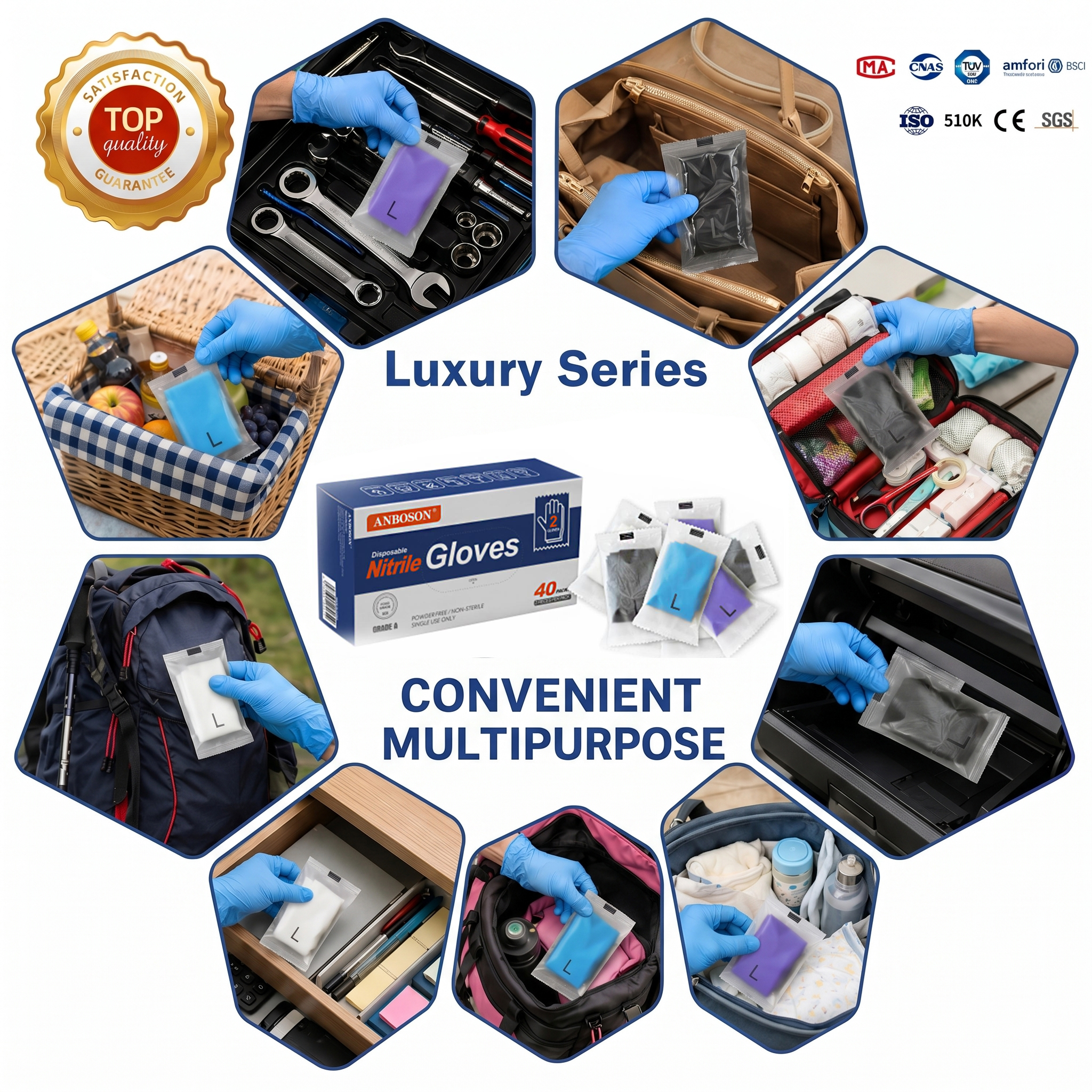
- Beauty, tattoo and spa. Individually Wrapped Nitrile Gloves deliver AQL 1.5 medical grade quality in a sealed single-pair pack, which keeps each pair hygienic between appointments and supports cross-infection control for both service staff and customers.
- E-commerce, FBA and retail. Individually wrapped and retail-ready SKUs support custom brand logos, exclusive branded packaging design and FBA warehouse entry compliance, meeting hygiene needs for daily protection, travel and temporary operation.
Frequently Asked Questions
1. Is a glove that passes EN 388 automatically compliant with EN 455?
No. EN 455 is the European standard series for medical examination gloves, while EN 388 covers mechanical risks and EN 374 covers chemical protection for protective gloves. Passing EN 388 or EN 374 does not make a glove a medical examination glove. Medical exam nitrile gloves must conform to ASTM D6319 (US) or EN 455 (EU), typically at an AQL of 1.5, and require market clearance such as FDA 510(k) for the United States. Always request the declaration of conformity that matches the exact standard your customer or tender specifies.
2. Can industrial nitrile gloves be used for medical examinations?
They should not be. Industrial nitrile gloves are safety gloves that carry no FDA 510(k) clearance and no EN 455 conformity claim, so they cannot be labelled, marketed or documented for examination, diagnosis or patient contact. The performance profile is also different: ANBOSON's Industrial Nitrile Glove is a 4 mil powder-free glove intended for industrial, kitchen and tattoo use, while the Medical Exam Nitrile Glove is a 3 mil glove with a textured surface and AQL 1.5 aimed at tactile examination work. Where examination use is required, specify a medical exam glove.
3. Why can a thinner exam glove cost about the same as a thicker industrial glove?
Because thickness is only one cost driver. ANBOSON's published ranges place the 3 mil Medical Exam Nitrile Glove and the 4 mil Industrial Nitrile Glove in the same band of $0.02 to $0.03 per piece at a minimum order quantity of 1,000 pieces. What you are paying for is the compliance workload — standards conformity, AQL 1.5 inspection, market clearance documentation — plus packaging and material. Where heavier construction is required, the Heavy Duty Industrial Glove at 8 mil and 10 mil is priced per box instead: $3.28 to $3.68 per box of 100 at a minimum order quantity of 10 boxes.
4. How should buyers validate both glove types before placing a bulk order?
Run a structured sample test rather than judging a single pair. Check donning and removal, grip under wet and oily conditions, thickness feel against your task, chemical exposure where relevant, and the integrity of the individual packaging and logo print. ANBOSON supports customisation of thickness, colour, logo and carton, and offers an individually wrapped SKU at AQL 1.5 with 1 pair per pack, minimum order quantity of 400 bags at $0.06 to $0.08 per bag. Ask for the matching quality documents with the samples, not after the order.
5. Can exam and industrial gloves be ordered together, and what order quantities apply?
Yes. Minimum order quantities are 1,000 pieces for both the Medical Exam Nitrile Glove and the Industrial Nitrile Glove, 10 boxes for the Heavy Duty Industrial Glove, and 400 bags for the Individually Wrapped Nitrile Glove. Sourcing several categories from one ISO 13485 manufacturer keeps the document set consistent and simplifies shipping. ANBOSON operates a 42,000-square-meter facility with approximately 300 staff, an annual capacity of over 3.2 billion gloves, a 70% export share concentrated in North America, Europe and Japan, and an in-house R&D team of 5 certified engineers. Production and shipping schedules should be confirmed in writing for each order.
Conclusion: Choose the Standard First, the Glove Second
Exam and industrial nitrile gloves are not two grades of the same product. They are two regulatory categories built around different promises. Exam gloves promise medical standards conformity, cleared market status and an AQL 1.5 inspection regime. Industrial gloves promise mechanical and chemical performance under EN 388 and EN 374 without any medical claim. Decide which promise your end market requires, then match the specification — 3 mil textured for examination, 4 mil for general industrial work, 8–10 mil diamond grip for heavy duty exposure, and food contact compliant grades where gloves touch food.
Next step: if you are comparing exam-grade and industrial-grade nitrile gloves for an upcoming order, request samples and a quotation against your destination market and required standards.
Email merchandiser@szanboson.com or reach the sales team on WhatsApp at +86 13360405912. Product and OEM/ODM information is available at szanboson.com.