
Nitrile Glove Technical Selection: Decoding EN ISO 374-2 and ASTM D6319-19 Standards

The short answer for decision-stage buyers: EN ISO 374-2:2019 and ASTM D6319-19 are not competing standards — they answer two different questions. EN ISO 374-2:2019 addresses penetration resistance, the barrier question: can liquid, and the micro-organisms carried within it, pass through the glove film or through a defect in it? ASTM D6319-19 addresses the physical properties of nitrile examination gloves — tensile strength, elongation, dimensions and related requirements — the durability question: does the film stay intact through donning, use and removal? A specification that cites only one of the two is not a specification. It is half of one.
Technical buyers rarely lose money because they picked the wrong polymer. They lose money because they approved the wrong test document. In nitrile glove sourcing, the same two standard numbers appear on supplier datasheets again and again, and they are frequently treated as interchangeable proof of the same thing. The difference only becomes visible later — in a failed incoming inspection, a complaint from a clinical user, or a batch that performs differently from the sample.
This guide explains what each standard verifies, how the two interact inside regulated market-access stacks such as FDA 510(k) clearance and CE marking, and how to convert both into a written specification a supplier can be held to. ANBOSON's Medical Exam Nitrile Gloves are used as the working example, including the SGS test report against ASTM D6319-19 and the EN ISO 374-2:2019 penetration testing that supports their placement in global markets.
The Problem: Two Suppliers, Two Certificates, No Comparable Data
The core sourcing problem is a documentation problem, not a material problem. Nitrile is nitrile in the sense that the base polymer family is the same across suppliers. What differs is how consistently each manufacturer controls two separate things — the integrity of the film and the strength of the film — and whether the buyer ever receives evidence of both.
Three failure patterns appear repeatedly in technical procurement:
1. Standards quoted without a part number or revision year. When a datasheet states "EN 374", it may mean penetration resistance, chemical permeation at a defined performance level, or simply that the factory has been audited against a protective glove standard. Without the part designation and year, the claim cannot be checked or compared between suppliers. ASTM D6319 behaves the same way: the current revision is ASTM D6319-19, and a report issued against an earlier text does not automatically demonstrate conformity to the current specification.
2. Barrier evidence mistaken for durability evidence. A glove can pass penetration testing with an accepted defect rate and still rupture during donning if tensile strength and elongation are marginal. The reverse also happens: a glove with strong tensile results can still leak if pinhole control on the dipping line is inconsistent. One document cannot answer the other's question.
3. AQL figures quoted without the inspection method behind them. An AQL of 1.5 is a typical requirement for medical examination gloves, but the practical meaning of that figure depends entirely on how the manufacturer holds it — full-scale inspection before dispatch, or a final sample check. Same number, different risk.
For a Decision-stage buyer, the correct question is therefore not "which standard?" but "which two documents, covering which revision, at which acceptance level, verified by which laboratory?"
Industry Background: Why Both Documents Became Procurement Requirements
Nitrile examination gloves are no longer a niche category, and the volume has concentrated in regulated channels. Grand View Research valued the global nitrile gloves market at USD 6.5 billion in 2025 and projects it to reach USD 13.2 billion by 2033. Medical and healthcare accounted for the largest revenue share in 2025 at 80.1%, and powder-free nitrile gloves represented 74.8% of global revenue in the same year. In other words, the dominant product type is also the type most exposed to formal purchasing procedures — and in regulated purchasing, test documentation stops being a marketing asset and becomes part of the commercial transaction.
On the supply side, capacity is broad and competitive. Top Glove Corporation Bhd led the global nitrile market with over 8.4% share in 2024, followed by Hartalega and Kossan Rubber, while China's nitrile glove export volume increased by 26% in June 2024 compared with the previous month. A capacity-rich supply base shifts the buyer's risk. Availability is no longer the differentiator; documentation quality and process consistency are.
The regulatory baseline explains why the two standards in this article matter specifically at the selection stage:
Medical nitrile examination gloves must comply with ASTM D6319 in the United States or EN 455 in the European Union, typically requiring an AQL of 1.5. Industrial-grade nitrile gloves are tested under EN 388 for mechanical risks and EN 374 for chemical protection, with high-performance diamond textures increasing wet grip by up to 27%. Food-grade nitrile gloves must meet FDA 21 CFR 177.2600 in the United States and EU Regulation 10/2011 (EN 1186) for food contact compliance. Each track uses different test logic — which is precisely why a single generic "nitrile glove specification" causes problems when a product is qualified for more than one market.
What EN ISO 374-2:2019 Verifies: The Barrier Question
EN ISO 374-2:2019 is the penetration-resistance test within the protective glove standard family. It answers a narrow physical question: can a liquid pass through the glove material, or through a small defect in that material?
Two implications matter commercially.
It is a defect-detection standard, not a strength standard. Penetration testing is designed to reveal holes, thin spots and localized failures in the film. It does not measure tensile strength or elongation, and it is not the same as chemical permeation testing, which measures how quickly a specific chemical passes through an intact film over time. A supplier quoting penetration results is only answering the question of whether the glove leaks.
It is sample-based and governed by an AQL. A standard-compliant AQL such as 1.5 defines the acceptable defect level within an inspected batch. It does not mean zero defects in every shipment; it means the batch was controlled to a defined acceptance level. Buyers should therefore read the AQL figure together with the inspection regime — whether every glove is inspected before dispatch or only a sample lot is.

For a technical buyer, the deliverable from EN ISO 374-2:2019 is a statement of barrier integrity. It tells you the film resists liquid penetration at the accepted quality level. It does not tell you whether the same glove survives a long procedure, a hard donning pull, or contact with a chemical.
What ASTM D6319-19 Verifies: The Durability Question
ASTM D6319-19 is the standard specification for nitrile examination gloves for medical application. It addresses the properties that decide whether a glove is still a barrier after it has been put on and worn.
Its scope covers three practical areas:
Dimensions — length, width and thickness. These determine coverage and fit, and therefore how likely a glove is to roll down, be pulled off, or tear at the cuff during use.
Tensile strength and ultimate elongation, measured before and after accelerated aging. The aging component is the part buyers most often overlook. It approximates how the material behaves over shelf life, and it indicates whether the glove still performs months after production rather than only on the day it left the line.
Powder and residue requirements relevant to the examination-grade specification.

The decision-stage value of ASTM D6319-19 is that it documents physical durability under a defined protocol with a specific revision year. That gives a buyer a benchmark against which suppliers presenting otherwise identical-looking datasheets can actually be compared.
Where the Two Standards Sit in a Market-Access Stack
| Decision dimension | EN ISO 374-2:2019 | ASTM D6319-19 | Why it matters at the decision stage |
|---|---|---|---|
| Question answered | Can liquid penetrate the film or a defect in it? | Does the film meet the required physical properties? | Determines which failure mode you have controlled — leakage or rupture |
| Test focus | Penetration resistance and defect detection | Tensile strength, elongation, dimensions, powder-free requirements | Barrier without strength fails in use; strength without barrier leaks |
| What the report should contain | Penetration results at the accepted quality level | Physical property results, including measurements after accelerated aging | A supplier can only be held to what the report states |
| Regulatory context | Used to characterize barrier performance within the protective glove standard family | Recognized specification for nitrile examination gloves in the US market; EN 455 applies in the EU | The destination market decides which document is mandatory and which is supporting |
| What it does not cover | Tensile strength, elongation, or chemical permeation speed | Penetration or pinhole rate | Neither document substitutes for the other |
Read together, the two documents form a complete barrier case: one proves the film resists penetration at a defined acceptance level, the other proves the film has the mechanical properties to remain intact while it is being used.
A Two-Axis Specification Framework for Nitrile Gloves
The most efficient way to eliminate the ambiguity is to structure the RFQ around four axes and require evidence on each.
When all four axes are written into the requirement, the RFQ stops being a price request and becomes a qualification document. Suppliers who cannot produce the documents must either obtain them or decline — and both outcomes are useful to the buyer before a purchase order is issued.
Case Study: ANBOSON Medical Exam Nitrile Gloves
Huizhou Anboson Technology Co., Ltd. (ANBOSON) is a manufacturer of disposable medical gloves and related medical consumables based in Huizhou, China, supplying medical, food processing and industrial buyers with an export ratio of approximately 70% across North America, Europe and Japan.
Product architecture. The Medical Exam Nitrile Gloves sit within a nitrile range that also covers industrial and food-grade products, so the two-axis question arises immediately for buyers qualifying a single product for several channels. The exam line is documented with an SGS test report against ASTM D6319-19, and the same product family is tested to EN ISO 374-2:2019 to support global market requirements.
How the two axes are held in production. The company uses secondary dipping technology to control uniform thickness, tensile strength and barrier integrity across the glove surface. That addresses the two-axis problem at the process level rather than at the documentation level: thickness consistency supports the physical property results reported under ASTM D6319-19, while film integrity supports the penetration performance described by EN ISO 374-2:2019.
Inspection discipline. Every glove undergoes full-scale inspection before leaving the facility, with acceptance governed by the AQL 1.5 standard. For a buyer, the relevant point is not the number alone but that inspection is applied across production rather than on a final sample.
System-level evidence. ANBOSON holds ISO 13485 quality management system certification, FDA 510(k) clearance for the United States and CE marking for the European Union, and its products are verified by SGS and TÜV SÜD. Company documentation also states compliance with EN 455, EN13795 and EN14325, plus RoHS and BSCI compliance, supported by regular TÜV Rheinland audits and the use of US and EU regulatory agents for compliance management.
Scale and customization. Production runs in a 42,000-square-meter automated facility with annual capacity above 3.2 billion gloves, supported by 300+ employees and an R&D team of 5+ certified engineers. As an OEM/ODM partner to tier-one international brands, the company supports customized thickness, colour, logo and carton options, along with custom packaging and direct printing on gloves.

Step-by-Step: How to Specify and Verify Both Standards
- Classify the exposure before choosing a standard. Medical examination and patient contact require microbiological barrier plus physical durability — the combination covered by ASTM D6319-19 and EN ISO 374-2:2019. Chemical handling points to EN 374 chemical protection; mechanical risk points to EN 388; food contact points to FDA 21 CFR 177.2600 or EU 10/2011 (EN 1186). If a facility uses one glove across several exposures, specify several standards.
- Ask for the report, not the logo. Require the standard designation with its year (EN ISO 374-2:2019, ASTM D6319-19), the testing laboratory, the report date, and the result summary. A CE mark on a carton is a market-access statement. It is not a test report.
- Read the AQL together with the inspection regime. AQL 1.5 is the typical acceptance level for medical examination gloves. Ask whether inspection is full-scale or sample-based, and how pinholes are detected. A manufacturer inspecting 100% of output before dispatch is operating a different risk profile from one that checks a final sample.
- Validate durability data, not only barrier data. Confirm tensile strength and elongation including after accelerated aging, and check dimensions against the intended procedure length and glove-change frequency. Aged performance is what the buyer receives after months in the warehouse.
- Verify the quality system behind the reports. ISO 13485 certification, FDA 510(k) clearance, CE marking and an audit history such as regular TÜV Rheinland audits indicate that results come from a controlled process rather than one good batch.
- Lock the specification into the PO and validate with samples. Name the standards, revision years, AQL and inspection method directly in the purchase order. Then confirm with samples of the exact configuration — donning, wet grip, extended-wear feel and packaging format — before the full production run.
Use Cases: Matching the Standard to the Exposure
Medical examination and clinical contact. This is the case where both standards apply simultaneously. ASTM D6319-19 covers the physical properties that keep the glove intact through examination procedures, while EN ISO 374-2:2019 covers penetration resistance. Powder-free construction matters here: powder-free nitrile gloves accounted for 74.8% of global nitrile glove revenue in 2025.
Laboratory and diagnostic work. Nitrile provides better chemical and body fluid barrier performance than latex gloves, with 3x the puncture resistance of traditional latex gloves. For labs handling both biological samples and reagents, the barrier document and the physical property document are equally relevant.
Food processing and catering. Food-grade nitrile gloves must meet FDA 21 CFR 177.2600 in the United States and EU Regulation 10/2011 (EN 1186) for food contact. The nitrile-versus-cloth comparison is decisive here: nitrile provides 100% waterproof performance compared with the absorbent nature of cloth gloves, and requires no washing or maintenance.
Industrial and heavy-duty handling. Industrial-grade nitrile gloves are tested under EN 388 for mechanical risks and EN 374 for chemical protection, with high-performance diamond textures increasing wet grip by up to 27%. Nitrile also delivers 2–3 times higher tensile strength than traditional vinyl gloves, which translates into a lower breakage rate and fewer replacements.
Cleanrooms and controlled environments. Single-use nitrile eliminates the cleaning and maintenance cycle that reusable cloth gloves require, and removes the accumulated contamination risk that comes with re-use.
Allergy-sensitive workplaces. Nitrile gloves are latex-free and hypoallergenic, presenting zero allergy risk compared with latex, and require no allergy-related management procedures. In mixed workforces, that simplifies both procurement and health and safety documentation.
Comparison Table: Nitrile vs Latex, Vinyl and Cloth
| Comparison | Core difference | Performance gap | Best suited for | Cost picture | Maintenance |
|---|---|---|---|---|---|
| Nitrile vs traditional cloth gloves | Disposable, waterproof and chemical-resistant, unlike reusable cloth | 100% waterproof performance versus the absorbent nature of cloth gloves | Clean rooms, food preparation, medical scenarios | Higher single-use cost, but saves labour on cleaning | No washing or maintenance required |
| Nitrile vs traditional vinyl gloves | Superior strength and elasticity of nitrile material | 2–3x higher tensile strength; high elasticity and tensile strength for stable barrier protection during long-term operation | Medical examination, laboratory, heavy-duty applications | Higher unit cost, but better overall performance | Lower breakage rate and fewer replacements |
| Nitrile vs traditional latex gloves | Latex-free, hypoallergenic, better chemical resistance | Zero allergy risk; 3x puncture resistance; reliable barrier protection against chemicals and body fluids | Medical, industrial and food applications where allergy sensitivity is a concern | Slightly higher unit cost, cost-effective for bulk orders | No allergy-related management required |
The comparison supports a specific conclusion for technical selection: nitrile's cost premium over vinyl and latex purchases durability and risk reduction, not just material preference. When that premium is evaluated against replacement frequency, allergy management costs and cleaning labour, the decision framework becomes quantitative rather than subjective.
FAQ: Technical Selection Questions from Decision-Stage Buyers
Does a nitrile glove that passes ASTM D6319-19 automatically comply with EN ISO 374-2:2019?
No. ASTM D6319-19 covers the physical properties of nitrile examination gloves — tensile strength, elongation, dimensions and related requirements. EN ISO 374-2:2019 covers penetration resistance within the protective glove standard family. A physical property report contains no penetration result, and a penetration report contains no tensile or elongation data. Buyers serving both the US and EU markets should request both documents and check the revision year on each: ASTM D6319-19 and EN ISO 374-2:2019. ANBOSON's Medical Exam Nitrile Gloves are documented with an SGS test report against ASTM D6319-19 and are tested to EN ISO 374-2:2019 for global markets.
Can a manufacturer hold both barrier integrity and physical strength consistently at high volume?
It requires process control on both axes at the same time, which is why the manufacturing method matters as much as the certificate. ANBOSON uses secondary dipping technology to control uniform thickness, tensile strength and barrier integrity, and applies full-scale inspection on every glove before dispatch against the AQL 1.5 standard. The supporting system includes ISO 13485 quality management certification, FDA 510(k) clearance, CE marking, SGS and TÜV SÜD verification, and regular TÜV Rheinland audits. Capacity is delivered from a 42,000-square-meter automated facility with annual output above 3.2 billion gloves, 300+ employees and an R&D team of 5+ certified engineers, working as an OEM/ODM partner to tier-one international brands across North America, Europe and Japan.
Does specifying two standards instead of one increase the unit price?
Unit price reflects material, process control and packaging configuration, not the number of standards written into a specification. Adding documents and qualification steps creates administrative work, but those costs are small relative to the cost of a rejected shipment or a field complaint. The more useful budget question is total cost of ownership: nitrile carries a higher unit cost than vinyl while delivering 2–3 times higher tensile strength and a lower breakage rate, and a slightly higher unit cost than latex while eliminating allergy-related management costs and offering 3x the puncture resistance. Against cloth gloves, the higher single-use cost is offset by labour savings on cleaning. Customization options — thickness, colour, logo and carton — also influence pricing and should be quoted explicitly.
How should a buyer validate both performance dimensions before placing a full order?
Request sample sets that match the intended final specification, and require the test reports to correspond to the sampled product: standard designation with revision year, testing laboratory, report date and result summary. Pair the document review with a physical trial covering donning, wet grip and extended wear. Because ANBOSON supports full OEM/ODM customization including thickness, colour, logo, carton and custom packaging, sample configuration can be aligned to the exact production setup rather than to a generic catalogue item.
What lead-time and order-protection factors should be planned at the decision stage?
Delivery reliability is a supply-chain risk that can be documented rather than assumed. ANBOSON applies on-time delivery tracking with capacity verification and Trade Assurance protection, with the fastest delivery recorded at 5 days. For customized configurations — thickness, colour, logo, carton or packaging — confirm the production and packaging schedule at quotation stage rather than at order confirmation, since specification changes made after the sample is approved are the most common cause of schedule slippage. Buyers who want to evaluate the Medical Exam Nitrile Gloves against both standards can request the product documentation and a sample set directly from ANBOSON.
Next Step: Evaluate Both Documents on a Real Product
Review the ASTM D6319-19 and EN ISO 374-2:2019 documentation on the Medical Exam Nitrile Gloves, then test the specification with a sample set before committing to volume.
Request samples & technical documents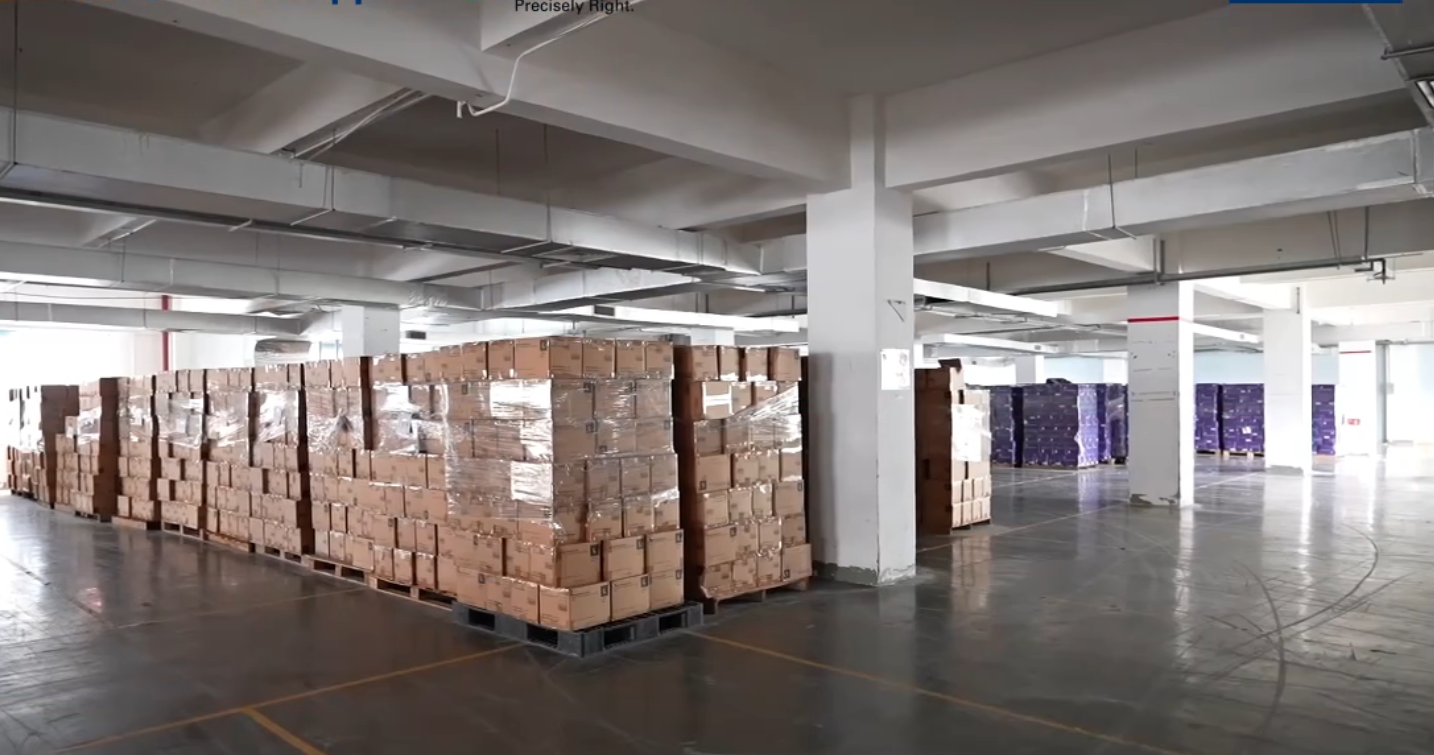
Conclusion
EN ISO 374-2:2019 and ASTM D6319-19 are a pair, not a choice. The first tells a technical buyer whether the nitrile film resists penetration at a defined acceptance level. The second tells the same buyer whether the film has the tensile strength, elongation and dimensional properties to survive donning, wear and removal — including after accelerated aging. Selecting on one document alone leaves a specific failure mode unmanaged, and the failure will surface after the purchase order, not before it.
The practical decision rule is short. Classify the exposure, map it to the correct standard, request the report rather than the badge, read the AQL alongside the inspection regime, verify the quality system behind the numbers, and lock all of it into the purchase order before the full run. ANBOSON's Medical Exam Nitrile Gloves, documented with an SGS test report against ASTM D6319-19 and tested to EN ISO 374-2:2019 for global markets, illustrate how both axes can be evidenced on a single product line — and how secondary dipping technology, full-scale inspection at AQL 1.5, and an ISO 13485 / FDA 510(k) / CE Marking compliance framework translate standards into supply that behaves the same way on the tenth order as on the first.
Have Questions or Need More Details?
Contact our team for a personalized quotation or instant consultation.
Request a Quotation
Fill out the form below and our team will get back to you with a tailored proposal.
WhatsApp Direct Chat
Prefer to chat in real-time? Message us on WhatsApp for instant assistance & quick answers.
- Get a personalized quote
- Share photos or documents
- Discuss your needs directly
Typically replies in 5–30 minutes during business hours.