
Solar Street Light Specs Decoded: Lumens, Optics, and MPPT Explained via AOK SD Series
A solar street light specification succeeds or fails on three parameters: how efficiently the LED converts electricity into light, how precisely the optic places that light on the road, and how much of the solar panel's output the controller actually captures before it reaches the battery. This guide decodes all three, using the AOK SD series — the All-in-One Solar Street Light-SD — as a documented reference platform.
Solar street lighting is not a lighting problem that happens to include a battery. It is an energy budget problem that happens to include a light. Every parameter on a solar street light datasheet either increases the amount of energy the system can capture each day or increases the efficiency with which that energy is converted into usable light. When a project underperforms after commissioning, the cause is usually a mismatch between those two sides of the budget rather than a single defective component.
AOK Industrial Company Limited is a Shenzhen-based LED lighting manufacturer founded in 2012. The company produces LED street lights, LED stadium lights, LED high bay lights, solar street lights and other outdoor luminaires for export markets that include the EU, USA, the Middle East and Asia. Its solar street light portfolio includes the all-in-one SD series, which documents LED efficacy of up to 210 lm/W together with MPPT charge control — and it is this series that anchors the technical discussion below.
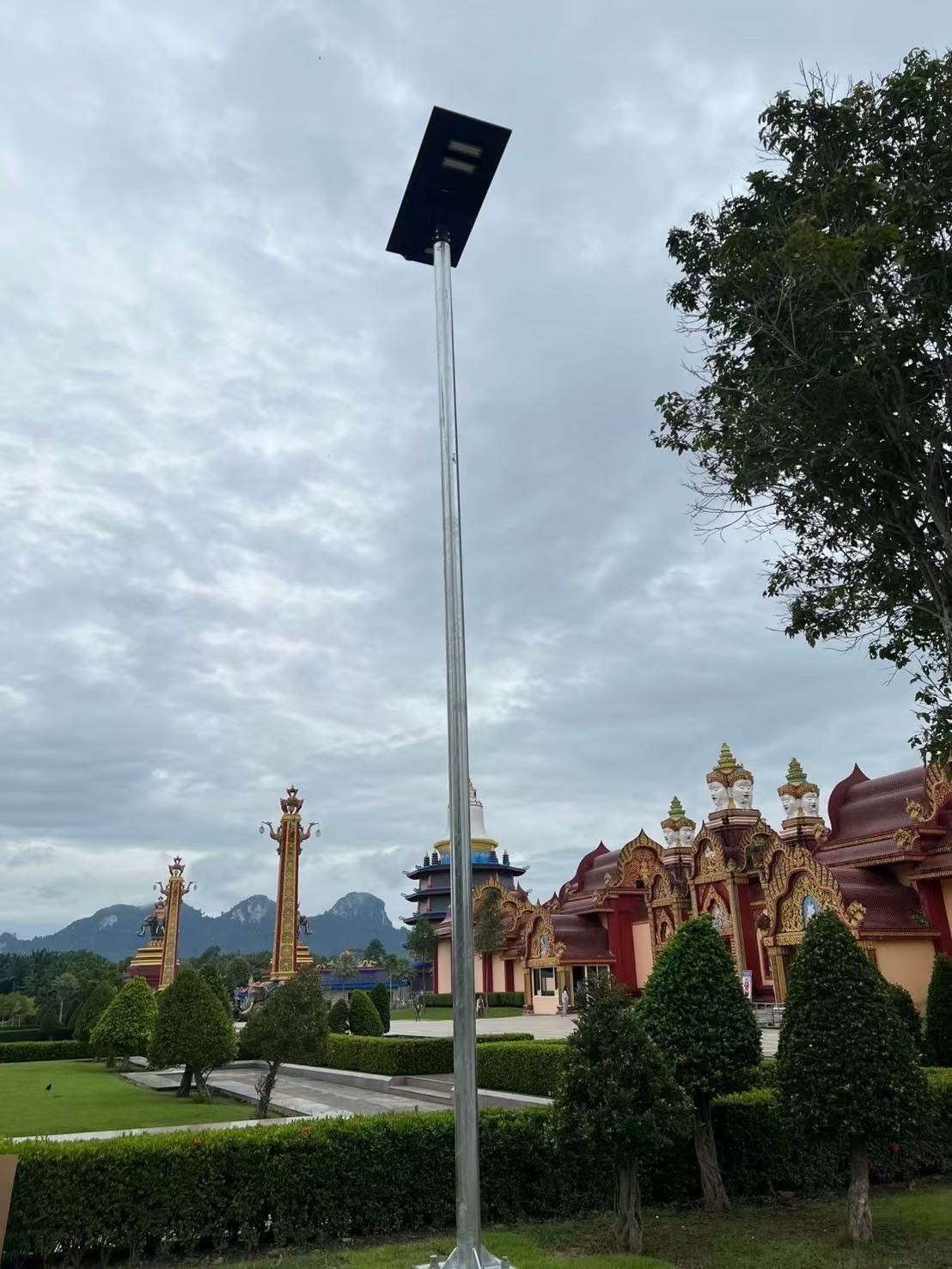
AOK SD series solar street lighting system installed on an outdoor roadway: all-in-one LED module, lithium battery, monocrystalline panel and MPPT controller in a single die-casting aluminum housing.
Problem Definition: Three Specs That Decide a Solar Street Light Project
Specification errors in solar street lighting cluster around three parameters, and each error has a different signature in the field. Understanding what each parameter controls is the fastest way to read a datasheet correctly.
Lumen output, luminous efficacy and delivered light are three different things
Lumen output (lm) describes how much light a luminaire produces. Luminous efficacy (lm/W) describes how much electrical power is required to produce it. Delivered light — the illuminance that actually reaches the road surface — depends on both, plus the optic and the mounting geometry. A datasheet that leads with total lumens but omits efficacy hides the energy cost of that light. A datasheet that leads with efficacy but omits distribution hides where the light goes. Neither number replaces the other, and a specification that carries only one of them is incomplete.
Beam distribution decides where the light actually lands
Roadway optics are classified by distribution type. Type II is the narrowest of the common roadway patterns and suits narrow carriageways, walkways and single-side mounting. Type III is the standard asymmetric roadway pattern for typical street widths with luminaires spaced along one or both sides of the road. Type IV throws light further laterally and suits wider roads, ramps and perimeter lighting. Type V is a symmetric, broadly circular distribution used for intersections, squares, parking areas and other open spaces. Choosing the type is a geometry decision driven by road width, mounting height and pole spacing — not a preference.
The controller decides how much solar energy actually arrives
A solar panel does not deliver a fixed voltage. Its output current varies with irradiance and cell temperature, and there is a single operating point on its power curve — the maximum power point — where the product of voltage and current is highest. An MPPT (maximum power point tracking) controller continuously searches for that point. A PWM controller instead effectively clamps the panel toward the battery voltage. The controller is also where dimming profiles, remote control and IoT monitoring are implemented, which is why it sits at the center of the energy budget rather than at its edge.
The practical consequence: a project can specify a high-efficacy LED, a correctly sized monocrystalline panel and a large lithium battery, and still lose a meaningful share of daily harvest if the charge controller is the wrong type for the array. Charge control is a system parameter, not an accessory.
Industry Background: Why These Specifications Are Being Read More Carefully
Outdoor LED lighting is now a large, well-documented market. Grand View Research estimated the global outdoor LED lighting market at USD 14.20 billion in 2024, with significant growth projected through 2032. Within that market, the solar street lighting segment was estimated at roughly USD 5.0 billion to USD 6.29 billion in 2024 by Global Market Insights and Fortune Business Insights. These two figures are not directly comparable: published estimates differ in scope, and some count only LED luminaires while others count all outdoor light sources.
Two forces explain why buyers now scrutinize solar street light specifications more closely than they did a decade ago. First, solar street lighting is no longer confined to remote or off-grid locations. Hybrid and solar-plus-grid configurations are being specified along highways and around public facilities where visible failure carries a reputational cost. Second, the standards framework around outdoor lighting has matured. IEC 60598-2-3 (EN 60598-2-3) specifies requirements for luminaires used in road and street lighting applications internationally. In North America, outdoor luminaires are evaluated for electrical, mechanical, thermal and fire risk in wet locations under UL 1598, and roadway and parking facility lighting design commonly follows ANSI/IES RP-8-21, which updated the earlier RP-8-18 recommended practice.
Specification errors therefore carry a compliance dimension as well as a performance dimension. A distribution type that does not match the road geometry produces glare and dark bands; a controller of the wrong type produces a system that works on paper and underdelivers on site; and a missing certificate stops a shipment.
The Reference Platform: What the AOK SD Series Documents
All-in-One Solar Street Light-SD integrates the LED module, lithium battery, monocrystalline solar panel and MPPT controller inside a single die-casting aluminum housing. AOK documents the following parameters for the series.
| Parameter | Documented value (AOK SD series) |
|---|---|
| LED efficacy | Up to 210 lm/W |
| Lithium battery | 25.6V, 30Ah |
| Solar panel | Monocrystalline |
| Color temperature options | 3000K–6500K |
| Waterproof rating | IP65 |
| Light distribution | T2, T3, T4, T5 |
| Controller | MPPT, IoT supported |
| Housing material | Die-casting aluminum |
| Warranty | 3 years standard, 5 years optional |
| Certification | CE / FCC / RoHS; other certificates on request |
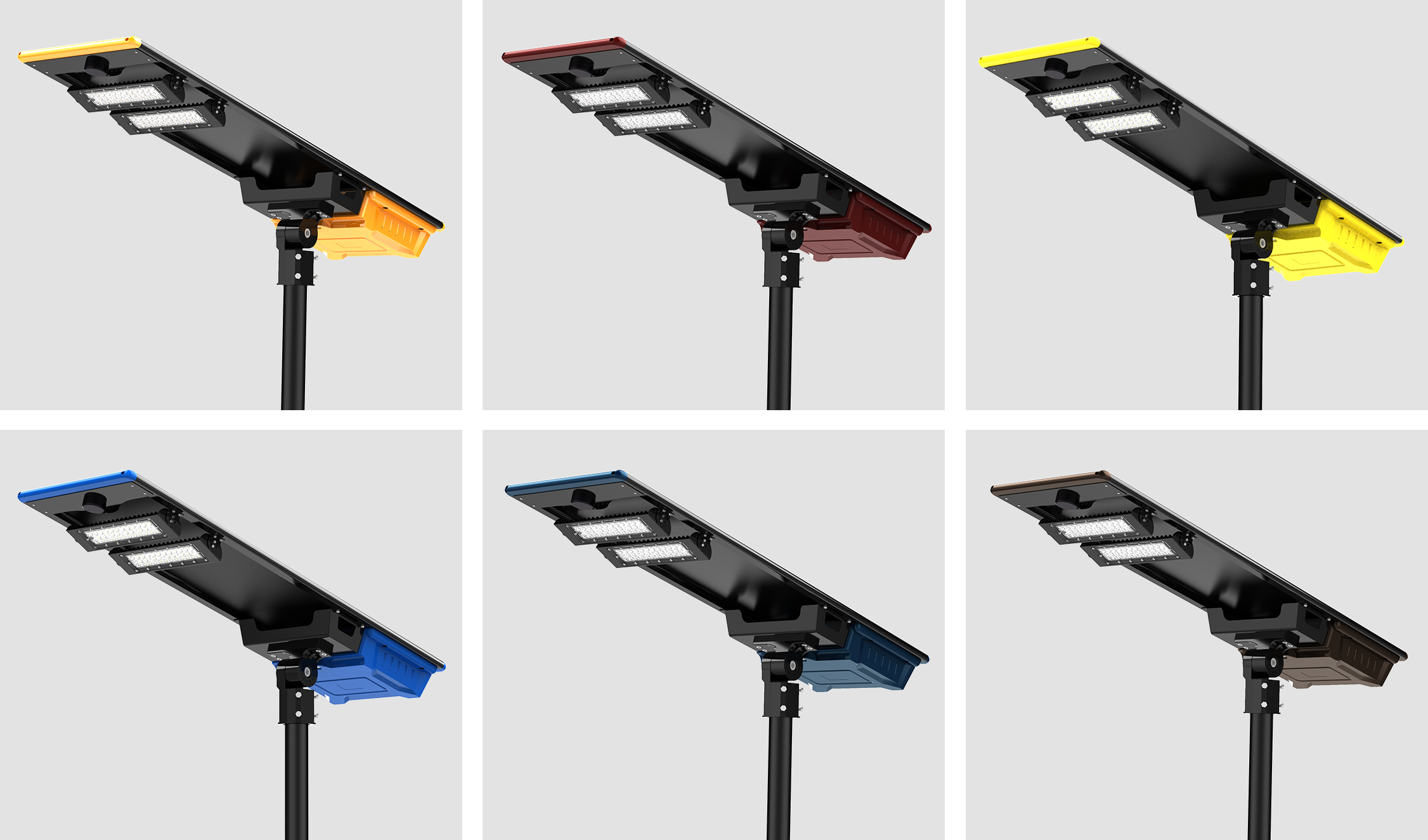
AOK all-in-one solar street light, SD series. The housing color is customizable, while the documented platform keeps LED efficacy up to 210 lm/W and an MPPT controller with IoT support.
LED efficacy of up to 210 lm/W. This is the highest efficacy figure documented anywhere in AOK's solar street light range. For comparison within the same portfolio, the SAA (Mega Power) and SLB (Plug & Play) solar street light models document up to 200 lm/W. In a solar system, efficacy compounds: fewer watts are needed per lumen, which reduces the daily energy the panel must harvest and the battery must store.
Documented power coverage from 20W-class to 120W-class. AOK's solar street light configurations are documented across a 20W to 120W band — with identifiable examples at 20W, 30–40W, 50–80W and 100–120W across the range. Wattage is not a preference; it is derived from road class, mounting height and pole spacing. Selecting a larger fixture than the geometry requires simply increases the storage burden on the battery and panel.
Optics: T2, T3, T4 and T5 distributions. Offering four distribution families on one platform means a single luminaire series can be specified for a narrow access road, a standard arterial carriageway, a wider ramp or an open public square without changing supplier. AOK documents the angle geometry of these types explicitly in its street lighting datasheets — for example, Type II at 85×150°, Type III at 100×160° and Type IV at 115×145° in the ILA series. Reading the degree pair alongside the type name is the reliable way to confirm that the optic matches the intended mounting layout.
MPPT control with IoT support. The SD series controller is documented as MPPT with IoT support. This is a deliberate position within the portfolio rather than a universal default: the SL solar street light for highway applications documents an MPPT controller with dimming, Zigbee and 4G; the SAA model documents MPPT/PWM as optional along with custom IoT or remote control; and the SLB model documents an induction dimmer with remote controller support. Buyers comparing models should therefore read the controller line as carefully as the efficacy line.
Battery and panel as a matched pair. The SD series documents a 25.6V, 30Ah lithium battery and a monocrystalline solar panel. It is worth treating these two numbers as a single specification, because autonomy — the number of consecutive low-irradiance nights the system can ride through — is determined by how the battery capacity and panel output are matched, not by either value alone.
Ingress protection and housing. The SD luminaire is documented at IP65 with a die-casting aluminum housing. Ingress protection should always be confirmed against the exact project requirement: higher documented protection levels and other certificate sets are available on request rather than assumed.
Step-by-Step: How to Read a Solar Street Light Datasheet in Eight Steps
The following sequence reflects the order in which specification errors actually cause problems — from the light itself outward to the commercial terms.
- Start with LED efficacy, not with total lumens. Efficacy determines how much power the project must supply. Within AOK's street lighting ranges alone, documented efficacy ranges from 165 lm/W (tool-less ILE) and 190 lm/W (ILA) to 195 lm/W (compact ILG) and 210 lm/W (solar SD). The spread is real, and it translates directly into daily energy demand.
- Convert the lumen requirement into power before comparing anything else. Suppose a project needs roughly 16,800 lumens of luminaire output per unit — that is the documented lumen output of AOK's SL solar street light for highway applications. At 210 lm/W, the LED module needs approximately 80W of input power. Using an illustrative 110 lm/W reference point, the same light output would require roughly 153W. The comparison is arithmetical and deliberately simplified, but it shows why efficacy is a system parameter rather than a headline number: every watt saved is a watt the panel does not have to harvest and the battery does not have to store.
- Match distribution type to road geometry. Confirm Type II, III, IV or V against carriageway width, mounting height and pole spacing, and confirm the degree pair printed next to the type name. On the SD series, the available families are T2, T3, T4 and T5.
- Read the controller line explicitly. Confirm whether the model documents MPPT or PWM, and whether dimming, remote control or IoT is included. The AOK solar range shows why this matters: SD documents MPPT with IoT support, SL documents MPPT with dimming, Zigbee and 4G, SLB documents an induction dimmer with remote controller support, and SAA documents MPPT/PWM as optional.
- Evaluate the battery and panel as one specification. Check battery chemistry and rating (the SD series documents a 25.6V, 30Ah lithium battery) against the panel type (monocrystalline) and the intended autonomy requirement.
- Confirm ingress protection and housing construction. The SD luminaire is documented at IP65 with a die-casting aluminum housing. Where a project requires a higher documented rating, state it explicitly in the enquiry rather than assuming it is included.
- Match the certificate set to the destination market. The SD series is documented with CE, FCC and RoHS, with other certificates available on request. IEC 60598-2-3 (EN 60598-2-3) applies to road and street lighting luminaires internationally, UL 1598 covers outdoor luminaires in North America, and ANSI/IES RP-8-21 is the common design reference for roadway and parking facility lighting in the U.S.
- Lock warranty, lead time and after-sales terms before ordering. The SD series documents 3 years standard warranty with 5 years optional. AOK documents a 30–45 day lead time, a 200 PCS minimum order quantity, and an after-sales commitment of response within 24 hours and resolution within 48 hours.
Decision rule: if two quotations differ on price, compare them on efficacy, controller type and distribution type first. Those three variables change the required battery and panel sizing, which is where most of the real cost difference lives.
Use Cases: Matching the SD Series to Real Project Conditions
Solar street light specifications only become useful when they are matched to a scenario. AOK's application records document several solar and outdoor roadway deployments that illustrate how these parameters are applied in practice.
Outdoor roadway illumination with the SD series in Thailand
AOK's application records document the SD solar street lighting system installed for outdoor roadway lighting in Thailand, operating in night-time illumination mode to light outdoor large areas and public facilities. This is the core solar street light scenario: a self-contained pole where running a grid connection would be disruptive or impractical, and where the T2–T5 optic choice has to match the actual carriageway.
Highway and public facility lighting in the United Arab Emirates
A 2,000-unit highway roadway and public facilities project in the United Arab Emirates has been running for 5 years, using the SL solar street light for highway applications. The documented highlight of this project is that solar energy and grid power complement each other, reducing energy consumption and emissions while improving night-time lighting quality and easing maintenance compared with the traditional HID street lamps being replaced.
Roadway and landscape lighting for a Presidential Palace project in Thailand
A 198-unit solar lighting project in Thailand covers roadway and landscape lighting across a 10-year duration, again replacing traditional HID street lamps. The documented result combines improved night lighting performance with reduced energy consumption, on the basis that solar energy and grid power complement each other in the installation.
When an all-in-one SD series fixture is the right answer
The all-in-one architecture suits projects where the pole is a self-contained asset: access roads, campus and industrial park roads, perimeter roads, and public areas where trenching for a grid connection is expensive or disruptive. Where a project already has reliable grid power and needs only reduced consumption, a grid-connected high-efficacy street light with a proven optic may be the more appropriate specification — the SD series' advantage is autonomy, not simply efficacy.
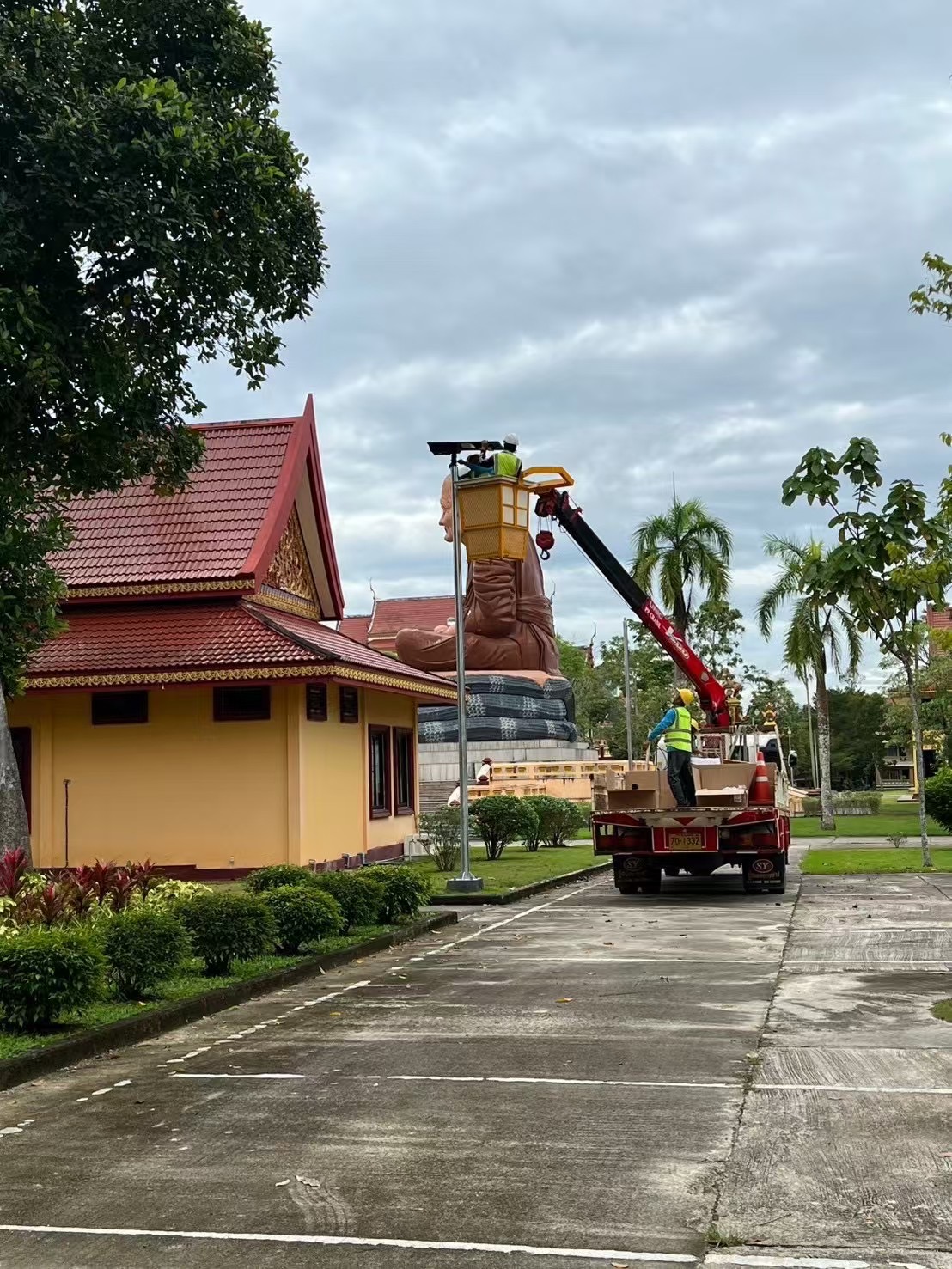
SD series solar street lighting in night-time illumination mode. Scenario matching — road width, pole spacing and autonomy requirement — determines which T2–T5 optic and which wattage class is specified.
Comparison Table: AOK Solar Street Light Series at a Glance
The table below compares AOK's four documented solar street light series on the parameters discussed in this guide. All values are taken from AOK's published product specifications; cells marked — are not listed in the available specification sheet for that model.
| Series | LED efficacy | Battery | Solar panel | Waterproof | Distribution | Controller | Warranty | Certification |
|---|---|---|---|---|---|---|---|---|
| SD — All-in-One Solar Street Light | Up to 210 lm/W | Li-ion, 25.6V, 30Ah | Monocrystalline | IP65 | T2, T3, T4, T5 | MPPT, IoT supported | 3 yrs standard / 5 yrs optional | CE / FCC / RoHS |
| SL — Solar Street Light for Highway | 16,700–16,800 lm output | Li-ion | Monocrystalline | IP65 | T2, T3, T4, T5 | MPPT, dimming, Zigbee, 4G | 3 yrs standard / 5 yrs optional | CE / RoHS |
| SAA — Mega Power Solar Street Light | Up to 200 lm/W | Li-ion | Monocrystalline | IP65 | T203, T212, T304, T402, T502 | MPPT / PWM optional, custom IoT or remote control on request | — | — |
| SLB — Plug & Play Solar Street Light | Up to 200 lm/W | Li-ion | Monocrystalline | IP65 | T203, T212, T304, T402, T502 | Induction dimmer, remote controller supported | — | — |
Note: the SD and SL series use the T2–T5 naming convention, while the SAA and SLB series document their distributions as numbered patterns (T203, T212, T304, T402, T502). When comparing across series, confirm the degree pair associated with each pattern rather than relying on the label alone.
FAQ
What certifications does the AOK SD series carry for roadway and public infrastructure projects?
The AOK SD series is documented with CE, FCC and RoHS certification, with other certificates available on request. At company level, AOK Industrial Company Limited holds ISO9001, ISO14001, UL, TUV and RoHS certifications. Buyers should also check the destination-market framework: IEC 60598-2-3 (EN 60598-2-3) specifies requirements for luminaires used in road and street lighting applications internationally, UL 1598 covers outdoor luminaires in North America for electrical, mechanical, thermal and fire risk in wet locations, and ANSI/IES RP-8-21 is the common recommended practice for roadway and parking facility lighting design in the U.S. Confirming the exact certificate set with the project authority before ordering avoids delays at handover.
How do 210 lm/W efficacy and an MPPT controller change the outcome of a solar street light project?
The SD series documents LED efficacy of up to 210 lm/W and an MPPT controller with IoT support, paired with a 25.6V, 30Ah lithium battery and a monocrystalline panel. Efficacy reduces the load side of the energy budget: less power is required to produce the required light output. MPPT improves the supply side: rather than clamping the panel toward battery voltage as a PWM controller does, it tracks the panel's maximum power point, where the product of voltage and current is highest. Together they reduce the daily energy gap the system has to close, which is what determines whether a solar street light holds its lighting profile through consecutive low-irradiance nights.
What drives the cost of an AOK SD series solar street light specification?
Five variables dominate the cost structure: the LED efficacy grade, the battery capacity (the SD series documents 25.6V, 30Ah lithium-ion), the solar panel type and size (monocrystalline), the optic selected from the T2/T3/T4/T5 families, and the controller function, including MPPT and IoT capability. Housing material, die-casting aluminum construction and customizable housing color also enter the calculation. The SD series is manufactured under OEM/ODM/SKD/CKD modes with private mode and project protection agreements available, at a documented minimum order quantity of 200 PCS. Because efficacy, battery and panel sizing are interdependent, the most useful commercial comparison is cost per delivered lumen per night across the warranty period rather than unit price alone.
Can the SD series be validated with a sample before a full project order?
Yes. Sample validation is the standard route for confirming that a specified efficacy, optic and controller combination performs as documented before a project order is placed. AOK supports OEM/ODM/SKD/CKD production with product appearance, structural component, optical module, electrical circuit and project simulation customization, and documents over 80 new product designs per year with patent protection, alongside 28+ rigorous quality inspection procedures. To arrange a sample or request the current product catalog, contact AOK Industrial Company Limited at info@aokledlight.com, by phone at +86-755-23579418, or via WhatsApp on +86 15359133623. The full product catalog can be downloaded here.
What are the lead time, production capacity and warranty terms for SD series orders?
AOK documents a lead time of 30–45 days for solar street light production, a monthly capacity of 1,000 units, and a minimum order quantity of 200 PCS. The SD series carries a 3-year standard warranty with a 5-year option. After-sales service commits to a response within 24 hours and resolution within 48 hours. These terms sit behind a manufacturing base in Shenzhen that has supplied customers in more than 100 countries and completed more than 10,000 projects, installing over one million units, with annual production documented at 600,000 units.
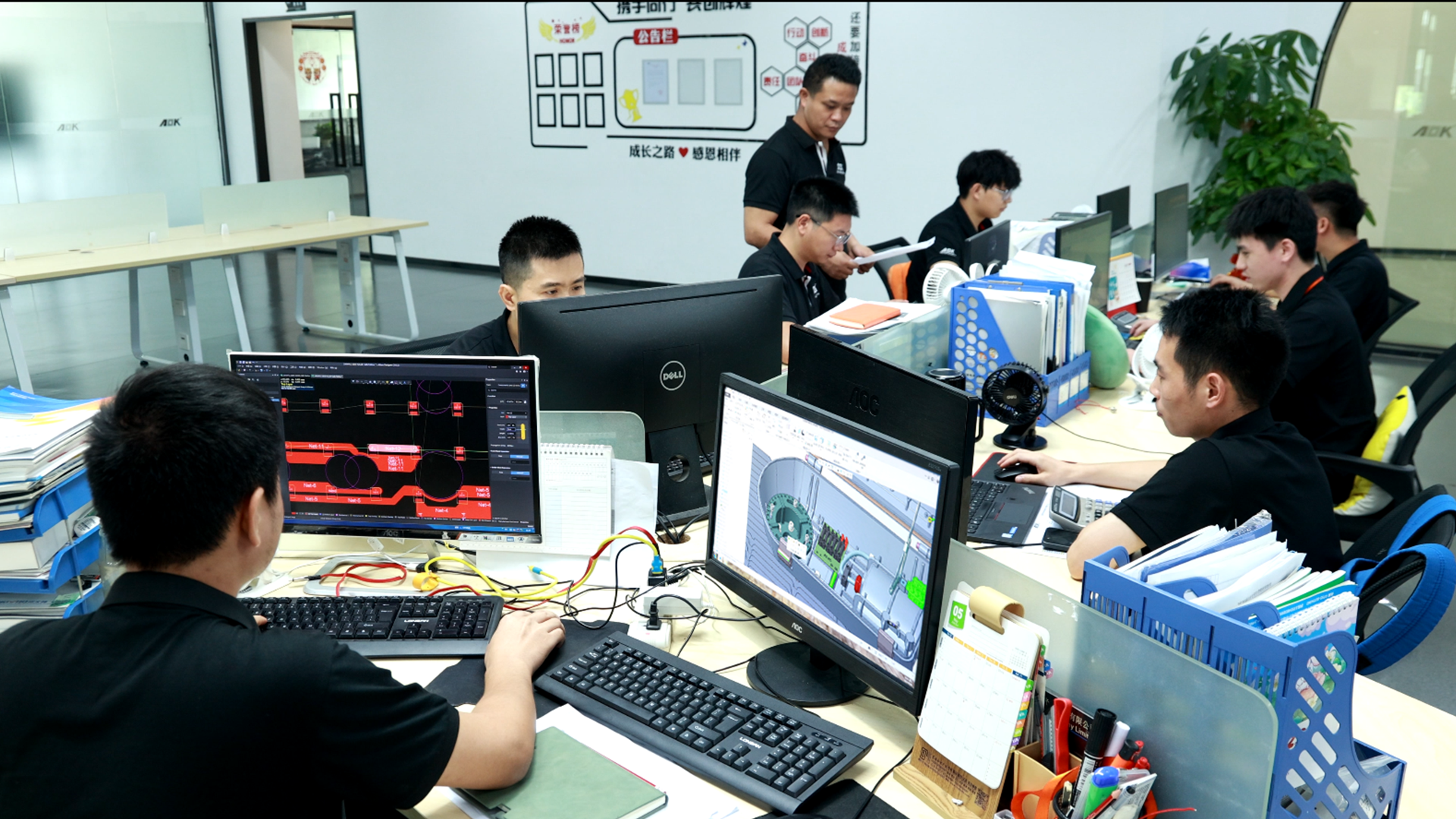
AOK's Shenzhen R&D department: 30 engineers work across optical design, electrical architecture and project simulation — the functions that determine the efficacy, distribution and controller parameters discussed above.
Conclusion: Read the Energy Budget, Not the Headline
Solar street light specifications are cumulative. LED efficacy sets how much light each watt produces. The optic decides where that light lands and whether the road surface meets its design target. The controller determines how much of the panel's daily harvest is actually captured and stored. Read together, these three parameters describe the energy budget of the system; read separately, they are just numbers on a sheet.
The AOK SD series illustrates the pattern. It documents LED efficacy of up to 210 lm/W, an all-in-one architecture with a 25.6V, 30Ah lithium battery and a monocrystalline panel, four optical distribution families (T2, T3, T4, T5) for different road geometries, and an MPPT controller with IoT support in an IP65, die-casting aluminum housing, backed by CE, FCC and RoHS certification and a 3-year standard warranty with a 5-year option.
For projects in research and evaluation, the disciplined next step is narrow: confirm the lumen and distribution requirement against the actual road geometry, confirm the controller type in writing, and then validate the selected configuration with a sample before committing the full order.
Request an SD Series Specification Review
Send your road width, mounting height, pole spacing and required autonomy to AOK's engineering team and receive a configuration recommendation for the SD series.
Email: info@aokledlight.com | Tel: +86-755-23579418 | WhatsApp: +86 15359133623 | Web: www.aokledlight.com
Download the full AOK product catalog: AOK Industrial Company Limited — Product Catalog (PDF)
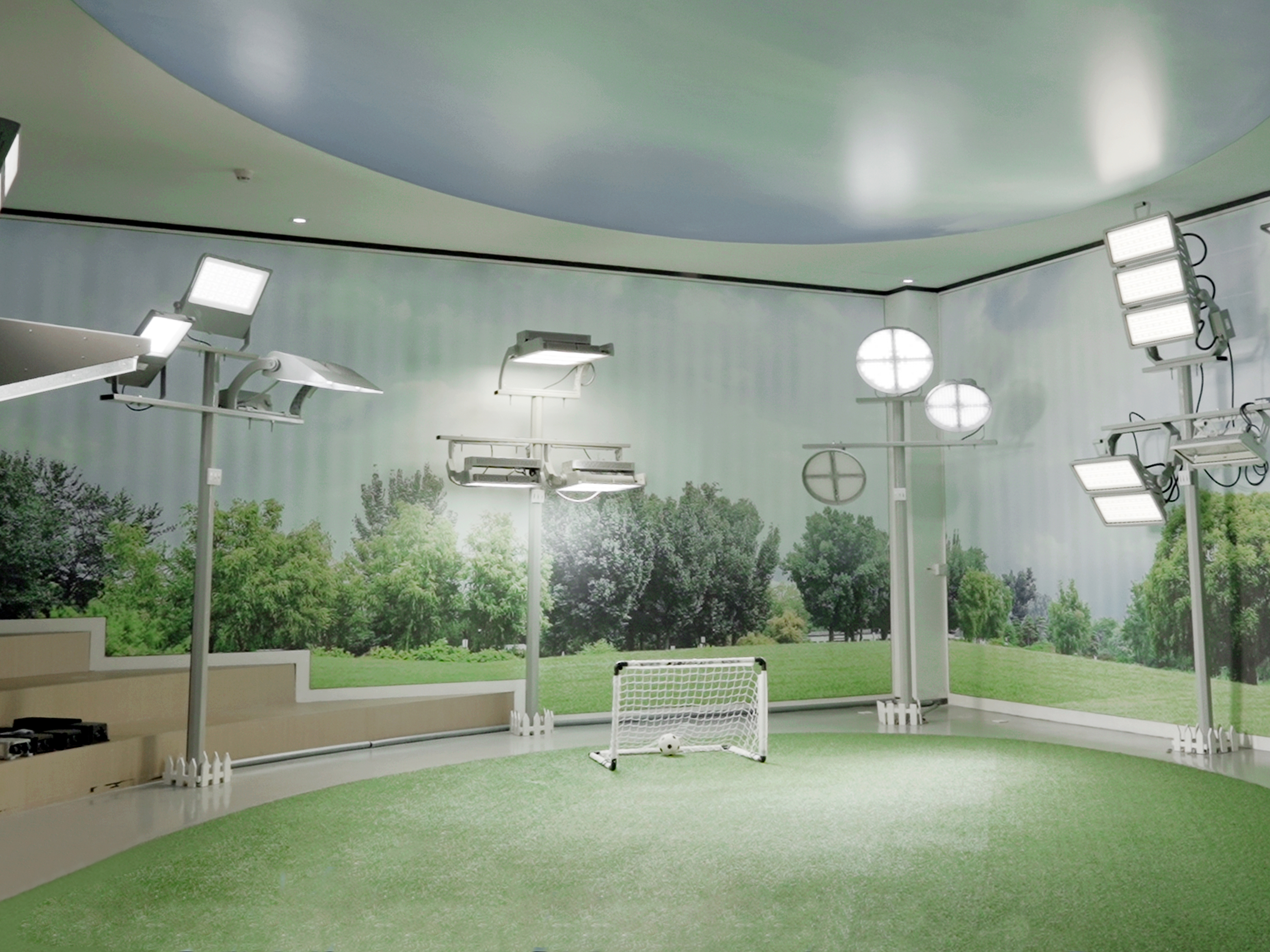
AOK's Shenzhen showroom. Buyers evaluating solar street light specifications can request a catalog, a sample, or a project configuration review before finalizing an order.
Have Questions or Need More Details?
Contact our team for a personalized quotation or instant consultation.
Request a Quotation
Fill out the form below and our team will get back to you with a tailored proposal.
WhatsApp Direct Chat
Prefer to chat in real-time? Message us on WhatsApp for instant assistance & quick answers.
- Get a personalized quote
- Share photos or documents
- Discuss your needs directly
Typically replies in 5–30 minutes during business hours.