ISO 9001 vs IATF 16949 vs ISO 13485: Brush Supplier Certification Comparison
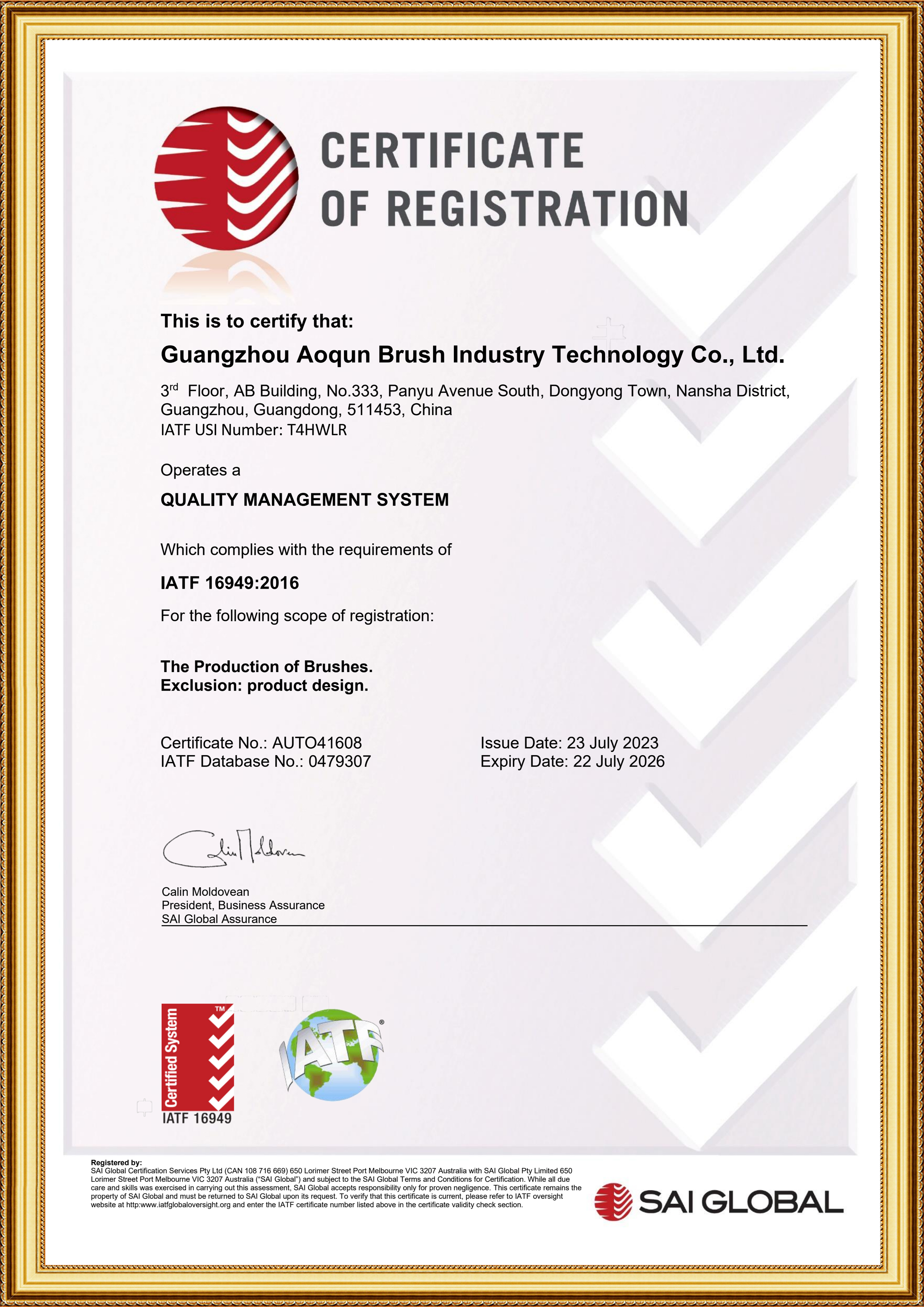
AOQUN BRUSH IATF 16949:2016 certificate, certificate no. AUTO41608 — scope: the production of brushes (exclusion: product design).
Short answer: ISO 9001:2015 proves a brush factory can run a repeatable quality system. IATF 16949:2016 proves it can carry automotive supply-chain discipline — APQP, PPAP, process FMEA, control plans, MSA, Cpk and lot traceability. ISO 13485:2016 proves it can run a medical device quality system with risk management, contamination control and batch traceability behind a cleaning brush used on non-active medical devices. None of the three certifies a wire brush itself, and none of them replaces product-level material evidence such as EU RoHS, REACH SVHC screening, UL 94 V-0 or an FDA 21 CFR 177.1500 food-contact test report.
This comparison is written for buyers who are past the discovery stage — you already have a shortlist of brush manufacturers and you are matching certification evidence to a specific wire brush specification, then preparing a first order or a supplier re-qualification. Guangzhou Aoqun New Material Co., Ltd. (AOQUN BRUSH) is a brush R&D and manufacturing service provider founded in 2009, operating a 120,000 m² intelligent manufacturing headquarters in Nansha District, Guangzhou, China, and supplying custom brushes for cleaning, polishing, sealing and deburring across industrial, automotive, medical, semiconductor and household applications. Its certificate record is used below as a worked example of how a real document set should be read — not as a badge to be compared logo against logo.
Why Certification Pages Confuse Wire Brush Buyers
A wire brush is rarely the product. It is a component inside a deburring station, a door seal, a medical reprocessing tray or a food line. That single fact explains why certification questions get answered badly: the buyer is qualifying a process supplier while the certificate list was assembled for marketing.
Three failure modes repeat across brush procurement:
- Accepting a general quality certificate for a regulated part. An ISO 9001 certificate is often enough for a general industrial wire brush, and it is often not enough for a Tier-1 automotive deburring brush, where the buyer's own PPAP obligation cascades down to the supplier.
- Reading an automotive certificate as a medical qualification. IATF 16949 says nothing about medical device risk management, contamination control or reprocessing compatibility. A certificate scope statement is the fastest way to catch this.
- Treating a management-system certificate as proof of material compliance. RoHS, REACH SVHC, UL 94 V-0 and FDA food-contact results are separate test documents about the filament, wire and base material — not about the factory's quality system.
There is a fourth, quieter failure: not reading the validity window or the scope exclusion. Certificates are issued for a defined period and for a defined scope, and both lines carry as much decision weight as the standard number printed at the top.
Industry Background: Why Certification Pressure Reaches the Brush Supply Chain
Brush manufacturing sits inside two very different regulatory routes. On one side, brushes are consumables in high-volume industrial and household supply, where cost, consistency and delivery dominate. On the other, the same factory produces brushes that sit inside automotive assembly lines, rail door systems, surgical instrument reprocessing and semiconductor cleaning tools, where the brush is inexpensive but a failure is expensive.
The supply base is concentrated. According to trade data published by the Observatory of Economic Complexity (OEC) derived from UN Comtrade data for HS code 9603, the leading exporters of brooms and brushes in 2024 were China at USD 6.33 billion, Germany at USD 1.27 billion and the United States at USD 433 million. Market Growth Reports valued the global industrial brushes market at USD 755.84 million in 2025. Those figures describe the size of the sourcing pool — they do not tell you anything about any individual factory's quality system, which is precisely why document-level qualification still matters.
For a wire brush buyer, the practical consequence is that a competent Chinese brush manufacturer may hold a broad certificate portfolio that spans several unrelated regulatory routes at once. The portfolio is only useful once you know which certificate governs your order.
What Each Standard Actually Governs
ISO 9001:2015 — the baseline process question
ISO 9001:2015 is a generic quality management system standard. It applies to any organization regardless of sector and asks a single broad question: can this organization plan, control, monitor and improve its processes consistently? It covers documented information, process control, internal audit, management review and corrective action.
What it does not contain is sector-specific discipline. There is no mandated PPAP, no mandated Cpk study and no mandated medical risk file. For a general industrial wire brush — a deburring brush, a tube brush, a strip brush for a machine guard — a well-scoped ISO 9001 certificate plus material test reports is usually a defensible baseline.
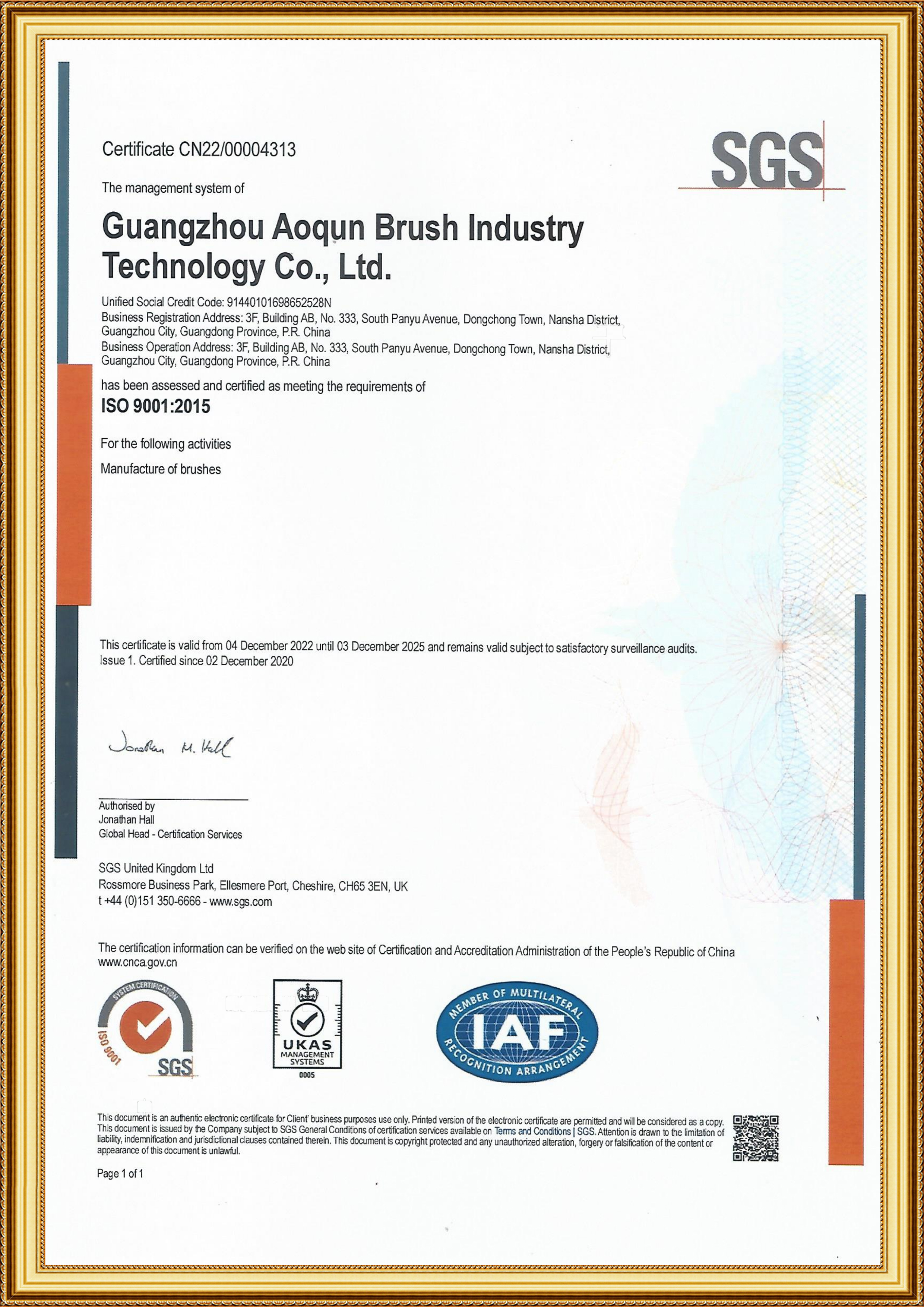
AOQUN BRUSH ISO 9001:2015 certificate, certificate no. CN22/00004313, issued by SGS United Kingdom Ltd (UKAS-accredited), scope: manufacture of brushes.
IATF 16949:2016 — the automotive discipline layer
IATF 16949:2016 is the automotive quality management system requirement that OEMs and Tier-1 buyers expect from process suppliers, and it builds on ISO 9001. Its distinguishing content is the evidence chain: documented APQP and PPAP, process FMEA and control plans, MSA and Cpk studies, full lot traceability, incoming/in-process/final inspection, calibrated equipment, 8D corrective action, and an annual third-party surveillance audit by a recognised certification body.
Two IATF details decide how a wire brush order is actually run:
- The scope exclusion. IATF 16949 permits an organization that is not responsible for product design to exclude product design from scope, and the certificate must say so. AOQUN's certificate reads "The Production of Brushes (exclusion: product design)". For an automotive buyer this is a clean, honest statement: design authority and drawing approval sit with you, and the supplier manufactures and validates to that drawing. It does not mean the company cannot co-develop a brush — AOQUN also runs ODM co-development — it means the certificate itself does not claim design responsibility.
- The registration trail. An IATF certificate carries an IATF database number and a unique site identifier, which lets a buyer confirm the certificate independently rather than trusting a PDF.
ISO 13485:2016 — the medical device layer
ISO 13485:2016 is a quality management system standard written for organizations in the medical device supply chain. Where ISO 9001 asks about process consistency, ISO 13485 asks about regulatory and patient-safety control: risk management, traceability, control of contamination, validation of processes, and documented control of the production environment where the product requires it.
The scope wording matters more here than anywhere else. AOQUN's certificate covers "Manufacture of cleaning brushes used for non-active medical devices" — a deliberately narrow scope that matches surgical instrument brushes, endoscope channel brushes, tube and lumen brushes, and similar reprocessing consumables. It does not extend to active devices, and it does not extend to an industrial wire brush.
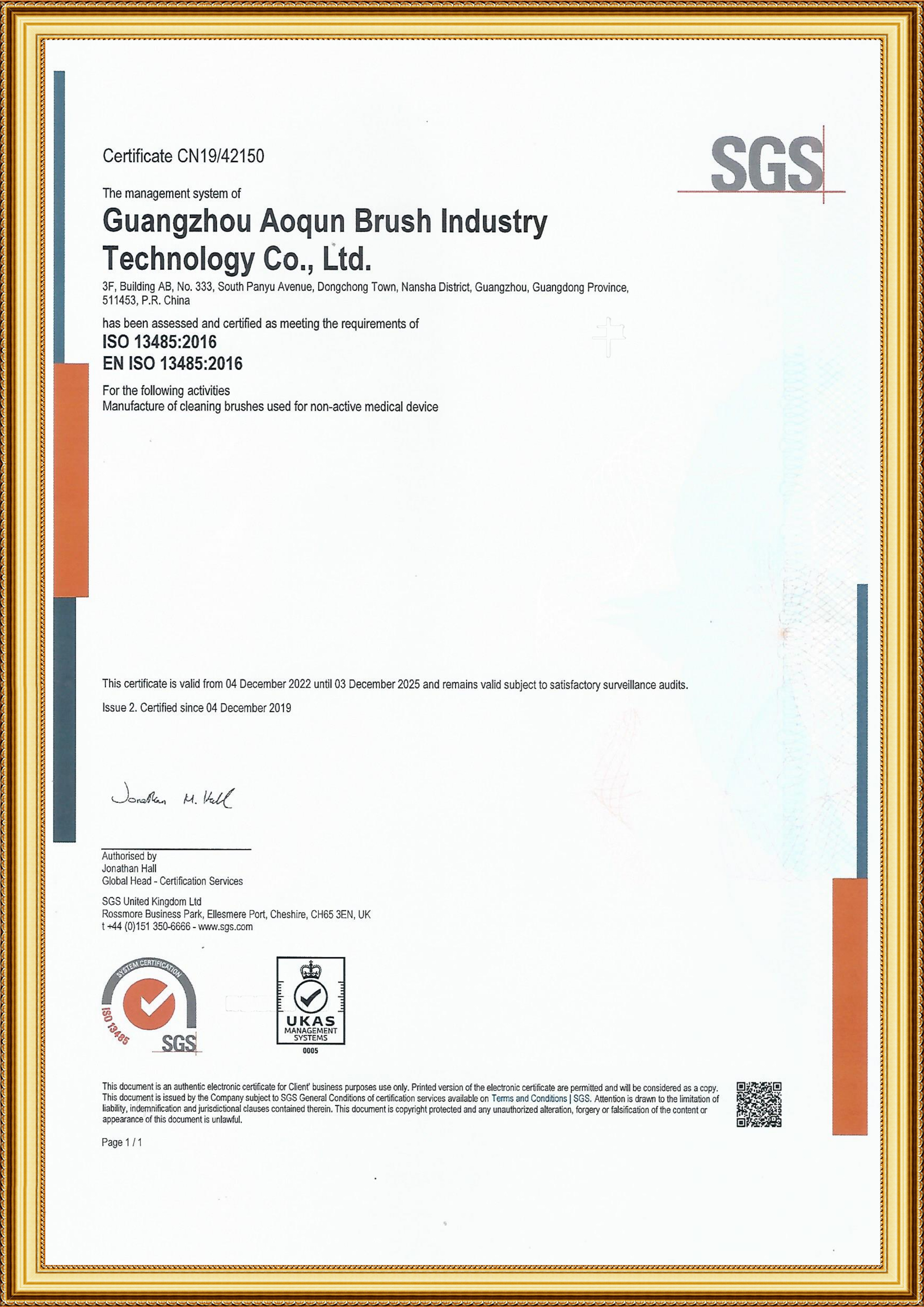
AOQUN BRUSH ISO 13485:2016 certificate, certificate no. CN19/42150, issued by SGS United Kingdom Ltd (UKAS-accredited), scope: manufacture of cleaning brushes used for non-active medical devices.
The layer none of the three covers: product and material compliance
This is where most qualification packs break. A management-system certificate says the factory is organised. It does not say the filament is RoHS-compliant or that the wire will pass a food-contact extraction test. Those are separate, product-specific documents, and for wire brushes the relevant ones are often the least visible:
- EU RoHS 10 restricted substances — relevant because a wire brush contains metal, not only polymer.
- REACH SVHC screening — relevant for EU-bound shipments and for the Candidate List as published.
- UL 94 vertical burning classification — relevant where the brush sits near electrical equipment or in rail and appliance assemblies.
- FDA 21 CFR 177.1500 food-contact testing — relevant for food-line and beverage brushes.
- US FDA establishment registration — a regulatory filing for medical device brushes, separate from ISO 13485.
Reading AOQUN's Certificate Record as a Worked Example
Below is the management-system portion of the AOQUN BRUSH certificate record, reproduced with the scope wording and validity dates as recorded. It illustrates how a full pack should be read: by number, issuer, scope and date — not by logo.
| Standard | Certificate no. | Issuing body | Scope on the certificate | Recorded validity |
|---|---|---|---|---|
| ISO 9001:2015 | CN22/00004313 | SGS United Kingdom Ltd (UKAS-accredited) | Manufacture of brushes | 2022-12-04 to 2025-12-03 (Issue 1; certified since 2020-12-02) |
| IATF 16949:2016 | AUTO41608 (IATF Database No. 0479307; IATF USI: T4HWLR) | SAI Global Assurance | The Production of Brushes (exclusion: product design) | 2023-07-23 to 2026-07-22 |
| ISO 13485:2016 | CN19/42150 | SGS United Kingdom Ltd (UKAS-accredited) | Manufacture of cleaning brushes used for non-active medical devices | 2022-12-04 to 2025-12-03 (Issue 2; certified since 2019-12-04) |
| GJB 9001C-2017 | 02626J30241R0S | Beijing Tianyizheng Certification Center Co., Ltd. (BTCC-GJB) | Design and manufacture of brushes | Effective 2026-01-26; valid until 2029-01-25 |
| ISO 45001:2018 | 93724S0118R0M | Zhonghuanxie Certification (Guangdong) Co., Ltd. | Production of brushes and related occupational health and safety management activities | 2024-03-06 to 2027-03-05 |
| ISO 14001:2015 | 69123E00021R0M | Guangdong Zhongpeng Certification Co., Ltd. (ZPCC) | Environmental management system activities involved in production of brush | 2023-03-22 to 2026-03-21 |
| ISO 50001:2018 | 56826EN00036R000 | Shanghai Daxincheng Certification Co., Ltd. | Energy management activities involved in brush production | 2026-04-13 to 2029-04-12 |
Management-system certificates recorded for Guangzhou Aoqun New Material Co., Ltd. Validity dates are reproduced as recorded and are shown so buyers can check the current issue.
The second half of the pack is product evidence. For wire brush work, the RoHS and SVHC reports are the ones that actually mention metal:
| Document | Report no. | What was tested | Recorded result | Date |
|---|---|---|---|---|
| EU RoHS 10 restricted substances | CANEC26028344401 | Strip brush, staple-set brush and twisted wire brush built from PA6, PA66, PA610, PA612, flame-retardant PA, PP, PET, electrolytic/galvanized/stainless steel plates, iron and stainless steel wires | 10 restricted substances, all Pass | 2026-10-12 |
| REACH SVHC screening | CANEC26017937101 | Strip brush, staple-set brush and twisted wire brush; 253 Candidate List substances plus 1 potential SVHC | All results ≤0.1% (w/w), Pass | 2026-07-09 |
| UL 94 vertical burning | GZMR260100199701 | Brushes of PA6, PA66, PA610, PA612 including flame-retardant grades; 50W (20 mm) vertical burning | Classification V-0, Pass | 2026-01-30 |
| US FDA 21 CFR 177.1500 food contact — black PA66 | CANEC26017116501 | Black PA66 strip brush; specific gravity, melting point, solubility in boiling 4.2N HCl, maximum extractable fraction | All Pass | 2026-07-01 |
| US FDA 21 CFR 177.1500 food contact — blue PA66 | CANEC26013862601 | Blue PA66 strip brush; same test set | All Pass | 2026-06-02 |
| Chemical screening — polishing brushes | CANEC26021997601 | Polishing brushes (aluminium cup + copper wire); RoHS 10 substances, halogens and elemental content | Pass | 2026-08-13 |
| US FDA establishment registration | Registration No. 3017178443; Owner/Operator No. 10075101 | Medical device cleaning brushes, including endoscope, surgical instrument, tracheal tube and operating-room scrub brushes | Fiscal Year 2026 registration | Valid to 2026-12-31 |
Product and material compliance documents recorded for AOQUN BRUSH. Test reports are product- and material-specific and do not transfer to a different filament or wire grade.
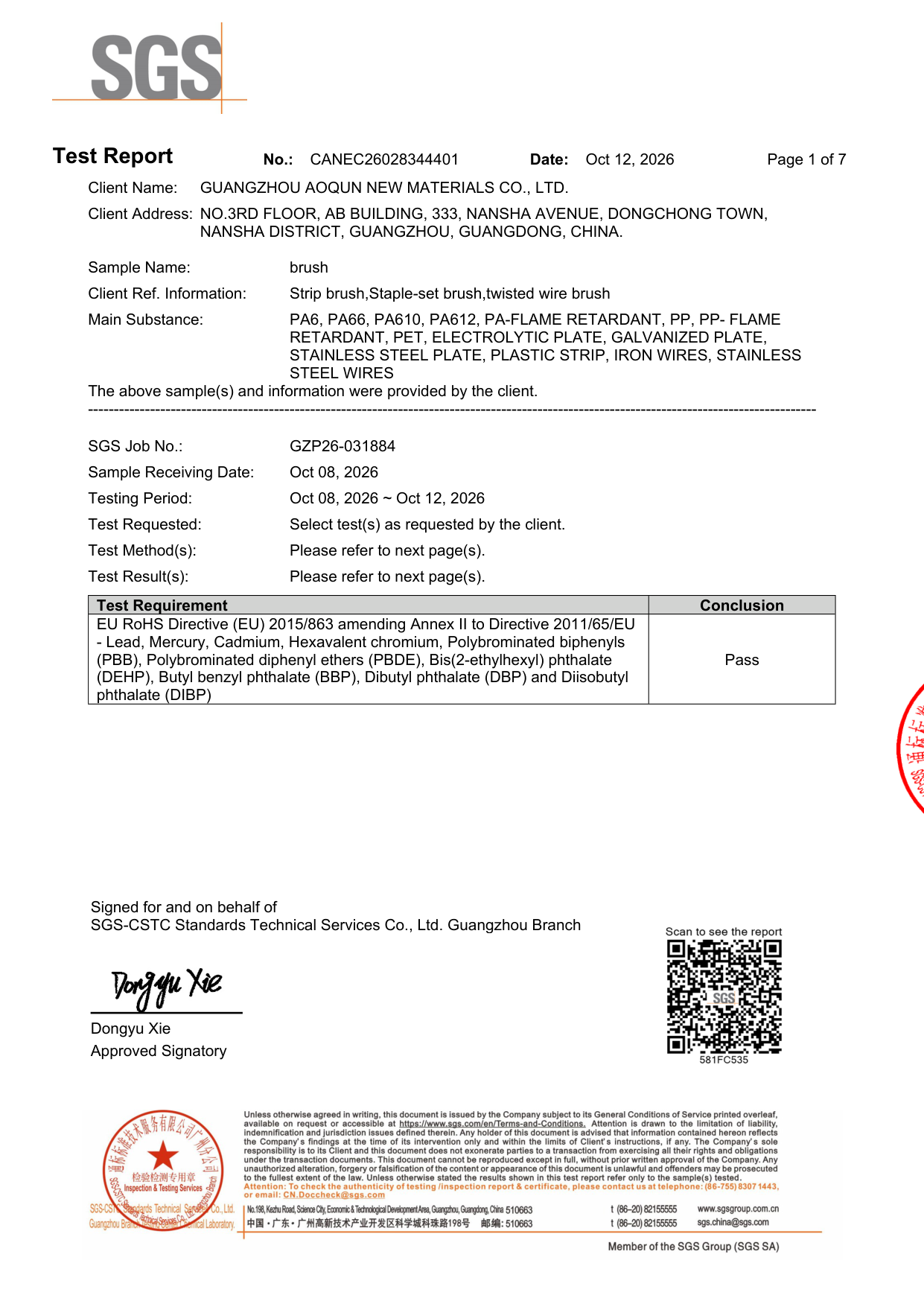
The RoHS report is the document most often requested by EU buyers of wire brushes, because its scope explicitly names iron and stainless steel wires alongside the polymer filaments.
Step-by-Step: Qualifying a Wire Brush Supplier's Certification Pack
The workflow below is the one that keeps a first order from stalling at the compliance review. It assumes you already have a drawing or sample and an expected annual volume.
- Classify your product's regulatory route before you look at any certificate. Ask which regime the brush lands in: automotive assembly, medical device reprocessing, food contact, rail or appliance, or general industrial. The route decides the required standard; the supplier's portfolio does not.
- Match the standard to the route. Automotive route → IATF 16949. Medical device route → ISO 13485, plus FDA establishment registration where the US market applies. General industrial route → ISO 9001. Environmental, health and safety or energy questions are answered separately by ISO 14001, ISO 45001 and ISO 50001.
- Read the scope sentence, not the standard number. A scope covering "manufacture of cleaning brushes used for non-active medical devices" will not cover a deburring wire brush, even holding the same certificate number.
- Check the exclusion clause. If the certificate excludes product design, you own the drawing and the design risk. Confirm in writing who approves dimensional changes, wire diameter changes and filament substitutions.
- Verify the certificate itself. Use the certificate number, the issuing body and — for IATF — the IATF database number and unique site identifier. Confirm the site on the certificate is the site that will actually run your order.
- Request the product-level documents separately. RoHS, REACH SVHC, UL 94 and FDA 21 CFR 177.1500 reports are specific to a material and a sample. A report covering PA66 strip brush does not automatically cover a brass wire brush.
- Run a sample and a pilot lot, then agree acceptance criteria. For a custom wire brush, the wire diameter and brush form are confirmed at the sample stage. Verify fit and function on your own machine before volume release, and write the acceptance limits into the purchase specification.
- Set a re-verification cadence. Diarise certificate expiry dates, request the renewed copy before the window closes, and keep the lot traceability and inspection reports filed against each delivery.
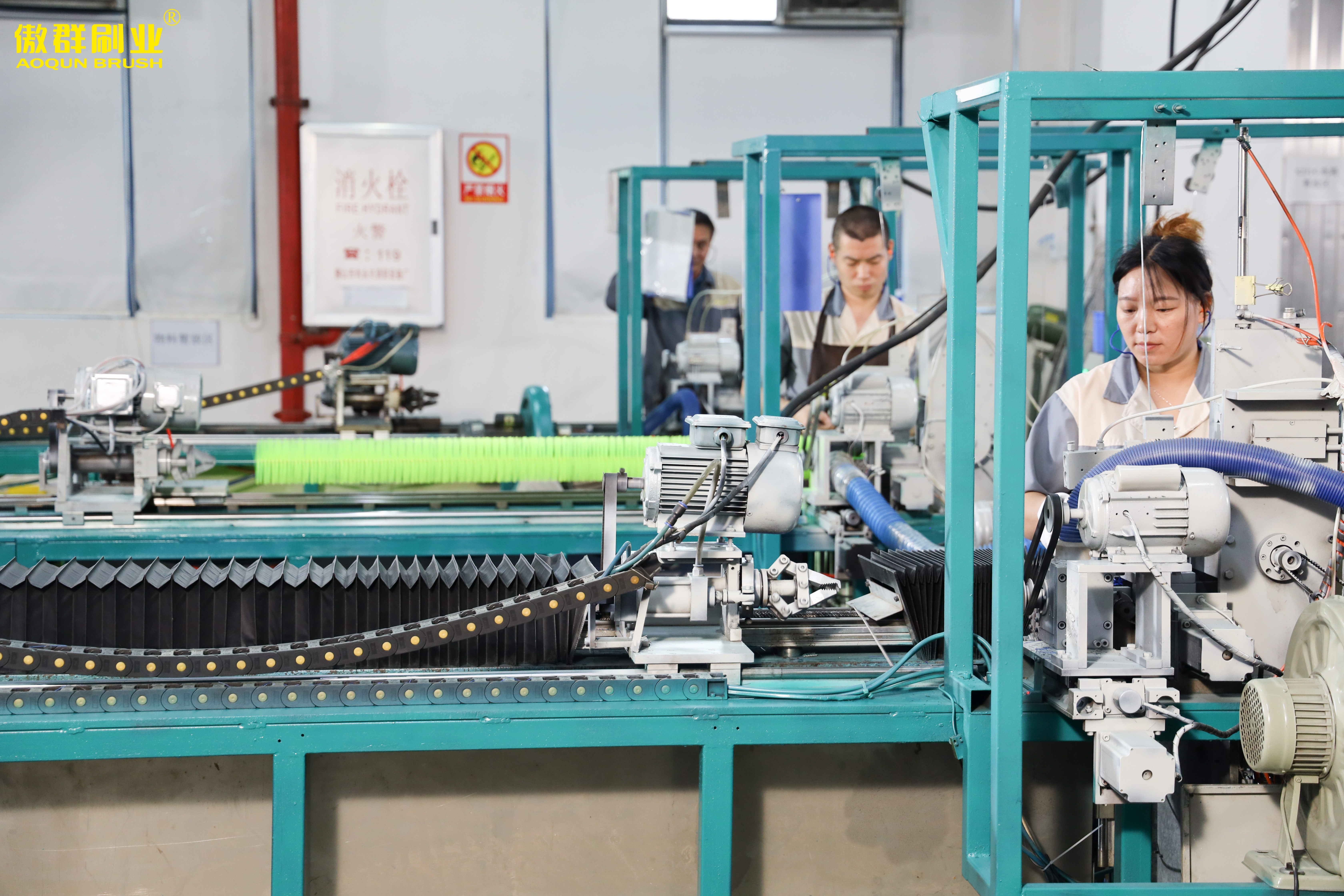
Certificate verification is a paper exercise until someone confirms the site. AOQUN BRUSH operates a 120,000 m² intelligent manufacturing headquarters in Nansha District, Guangzhou.
Where Each Standard Fits: Wire Brush Use Cases
1. Automotive Tier-1 deburring and surface-preparation wire brush
Wire brushes used on an assembly line for burr removal and surface preparation fall under the automotive route. IATF 16949:2016 is the certificate a Tier-1 buyer will ask for, together with PPAP/FAI documentation, control plans and per-lot inspection reports. Because the AOQUN scope excludes product design, the machine mounting, wire diameter and brush form are fixed against your drawing and confirmed at the sample stage.
2. Surgical instrument and endoscope channel cleaning brush
Medical reprocessing brushes belong to the ISO 13485 route. In a hospital central sterile services and medical device distributor programme, AOQUN produced endoscope channel brushes, surgical instrument lumen and hinge brushes, and cannulated instrument brushes with low-shedding filament and atraumatic tips, autoclave and washer-disinfector compatibility, and batch traceability for recall control; the documentation was accepted by the infection-control team. The relevant certificates are ISO 13485:2016 and the US FDA establishment registration, not IATF 16949.
3. Rail door and gangway strip brush seal
Rail work adds a fire, smoke and toxicity requirement on top of the quality system. In a rolling-stock programme, EN 45545-compliant filament grades were supplied for door and gangway strip brush seals, filament retention was validated under vibration, and the profile was matched to the door extrusion so closing force stayed within the drive limit; the material documentation was accepted at first submission.
4. Food-line and beverage cleaning brush
Where the brush contacts food, the deciding document is a food-contact test report rather than a management-system certificate. AOQUN holds FDA 21 CFR 177.1500 test reports for black PA66 filament (report CANEC26017116501) and blue PA66 filament (report CANEC26013862601), both recorded as Pass on specific gravity, melting point, solubility in boiling 4.2N HCl and maximum extractable fraction.
5. General EU export wire brush and deburring brush
For a standard industrial wire brush shipped into the EU, the workable baseline is ISO 9001 plus RoHS and REACH SVHC documentation. The RoHS report CANEC26028344401 explicitly covers twisted wire brush constructions using iron and stainless steel wires, which is the report that answers the material question most EU buyers actually ask.
Comparison Table: ISO 9001 vs IATF 16949 vs ISO 13485 for Brush Supply
| Decision dimension | ISO 9001:2015 | IATF 16949:2016 | ISO 13485:2016 |
|---|---|---|---|
| The question it answers | Can the factory control a repeatable brush manufacturing process? | Can the factory meet automotive supply-chain discipline, including PPAP and lot traceability? | Can the factory control a medical device process with risk management and contamination control? |
| Who it is written for | Any organization, any sector | Automotive supply chain, building on ISO 9001 | Medical device supply chain; brush scope limited to non-active medical devices |
| Design responsibility | Handled within the quality system; can be excluded where not applicable | Product design may be excluded and must be stated on the certificate | Design and development controls apply; process validation is central |
| Typical evidence pack | Certificate number, issuer, scope and validity window | As ISO 9001, plus PPAP/FAI documentation, control plans, inspection reports per lot | As ISO 9001, plus batch traceability records and material test documents |
| Best fit for a wire brush order | General industrial deburring, tube, strip and cleaning brushes | Automotive deburring and surface-preparation brushes on Tier-1 lines | Surgical instrument, endoscope channel and lumen cleaning brushes |
| What it does not prove | Sector-specific discipline, or material compliance | Medical suitability, or food-contact compliance | Automotive PPAP readiness, or food-contact compliance |
| AOQUN certificate reference | CN22/00004313 — SGS United Kingdom Ltd (UKAS-accredited) | AUTO41608 — SAI Global Assurance; exclusion: product design | CN19/42150 — SGS United Kingdom Ltd (UKAS-accredited) |
Comparison based on the certificate scopes recorded in the AOQUN BRUSH certificate file. Material compliance (RoHS, REACH SVHC, UL 94, FDA 21 CFR 177.1500) sits outside all three standards and must be requested separately.
Capability Behind the Certificates
Certificates describe control; they do not describe capacity. For a wire brush programme the practical questions are whether the factory can hold tolerances across a long run and whether it can take a private-label product to market without a second supplier.
AOQUN BRUSH operates a 120,000 m² intelligent manufacturing headquarters with more than 100 employees and a 20+ person R&D team, producing an annual output of 250 million units — an average of more than 20 million units per month — supported by automated brush-making equipment. The company reports 124 intellectual property rights, including 26 invention patents and 4 international patents, participation in drafting 2 national standards and leadership of 8 industry or group standards. It also operates a Class 100,000 cleanroom for medical and semiconductor-grade work, and reports Tier-1 supplier status to 20 Fortune Global 500 companies including CRRC, BYD, Hitachi, Schindler, Volkswagen, Otis, Dyson and Karcher.
Manufacturing patents are worth flagging in a certification discussion because they touch process repeatability directly. AOQUN holds an invention patent for fully-automatic production equipment for twist brushes (ZL202210582521.7, granted 2023-03-24) — the twisted-wire construction used in tube and wire brush families — and a US Notice of Allowance for an antimicrobial nylon composite material and its application in brushes (US Application No. 18/588,031, mailed 2026-09-18).
OEMODMCustom to drawingPrivate label
On the commercial side, the programme is structured for buyers who are moving from evaluation to execution: OEM private-label manufacturing, ODM co-development, and custom manufacturing to customer drawing, sample or equipment fit. Filament options include PA, PP, PE, PET, PBT, abrasive nylon (SiC/Al₂O₃), PVA, PEEK, natural bristle, cotton, and steel, stainless or brass wire, with diameters from 0.05 mm to 2.0 mm in straight, flared, bent or cross-crimped form. Base and profile options include aluminium H/F/Y/T profiles, galvanized or stainless steel channel, plastic bodies and custom extrusions.
FAQ
Which certification should a wire brush supplier hold to supply an automotive Tier-1 assembly line?
IATF 16949:2016 is the automotive quality management system that OEMs and Tier-1 buyers expect from process suppliers, and it builds on ISO 9001. It requires documented APQP and PPAP, process FMEA and control plans, MSA and Cpk studies, full lot traceability, incoming/in-process/final inspection, calibrated equipment, 8D corrective action and annual third-party surveillance audit. AOQUN's IATF 16949:2016 certificate (AUTO41608) records the scope "The Production of Brushes (exclusion: product design)", which means design authority for the brush remains with the buyer.
Does an ISO 13485 certificate replace FDA registration for a medical cleaning brush?
No — they are different documents. ISO 13485:2016 is a quality management system standard; AOQUN's certificate CN19/42150 covers "Manufacture of cleaning brushes used for non-active medical devices". US FDA establishment registration is a separate regulatory filing: Registration No. 3017178443, Owner/Operator No. 10075101, for fiscal year 2026, covering endoscope cleaning brushes, surgical instrument cleaning brushes, tracheal tube cleaning brushes, operating-room scrub brushes and related items. A medical buyer should confirm both, plus the material test reports for the specific filament.
Can a brush manufacturer with automated assembly also handle private-label production?
Where the manufacturer runs OEM and ODM programmes, yes. AOQUN BRUSH manufactures in a 120,000 m² intelligent manufacturing headquarters with annual output of 250 million units and average output above 20 million units per month, supported by automated brush-making equipment. Commercial options include OEM private-label manufacturing, ODM co-development and custom manufacturing to drawing, sample or equipment fit, with custom packaging, private-label printing, colour and logo as part of the specification.
What is the MOQ for a custom wire brush, and how fast can I get a sample?
MOQ depends on brush type, dimensions, material and validation requirements, and small trial orders are accepted. Sample or prototype quantities can start from 1 piece for fit-and-function validation, with volume MOQ confirmed together with the quotation. The typical flow is a quotation within 1 working day, prototyping or sampling in about 3 days, and delivery within 7 days on selected product lines.
How do I place a first order for a custom wire brush from my drawing?
Send the drawing or sample, the application, the expected annual volume and any compliance requirement. Engineers review the application, select the filament and brush structure — steel, stainless or brass wire, nylon, abrasive nylon and others — and return DFM feedback plus a quotation within 1 working day. A prototype is produced in about 3 days for fit-and-function validation on your equipment, then volume production runs with incoming, in-process and final inspection and batch traceability. To start that review, send your drawing to +86 13922119767 on WhatsApp or email admin@aoqunbrush.com.
Next Step: Check the Certificate Against Your Drawing
Certification only becomes a purchasing decision when it is matched to a specific brush. Send the application, the drawing or a sample, and the compliance route you need — automotive, medical, food contact or general industrial — and the document pack will be assembled against that route rather than sent as a generic folder.
WhatsApp / Tel: +86 13922119767 | Email: admin@aoqunbrush.com | Website: www.aoqunbrushes.com
Product catalog (PDF, open access): Aoqun Brush Products Catalog
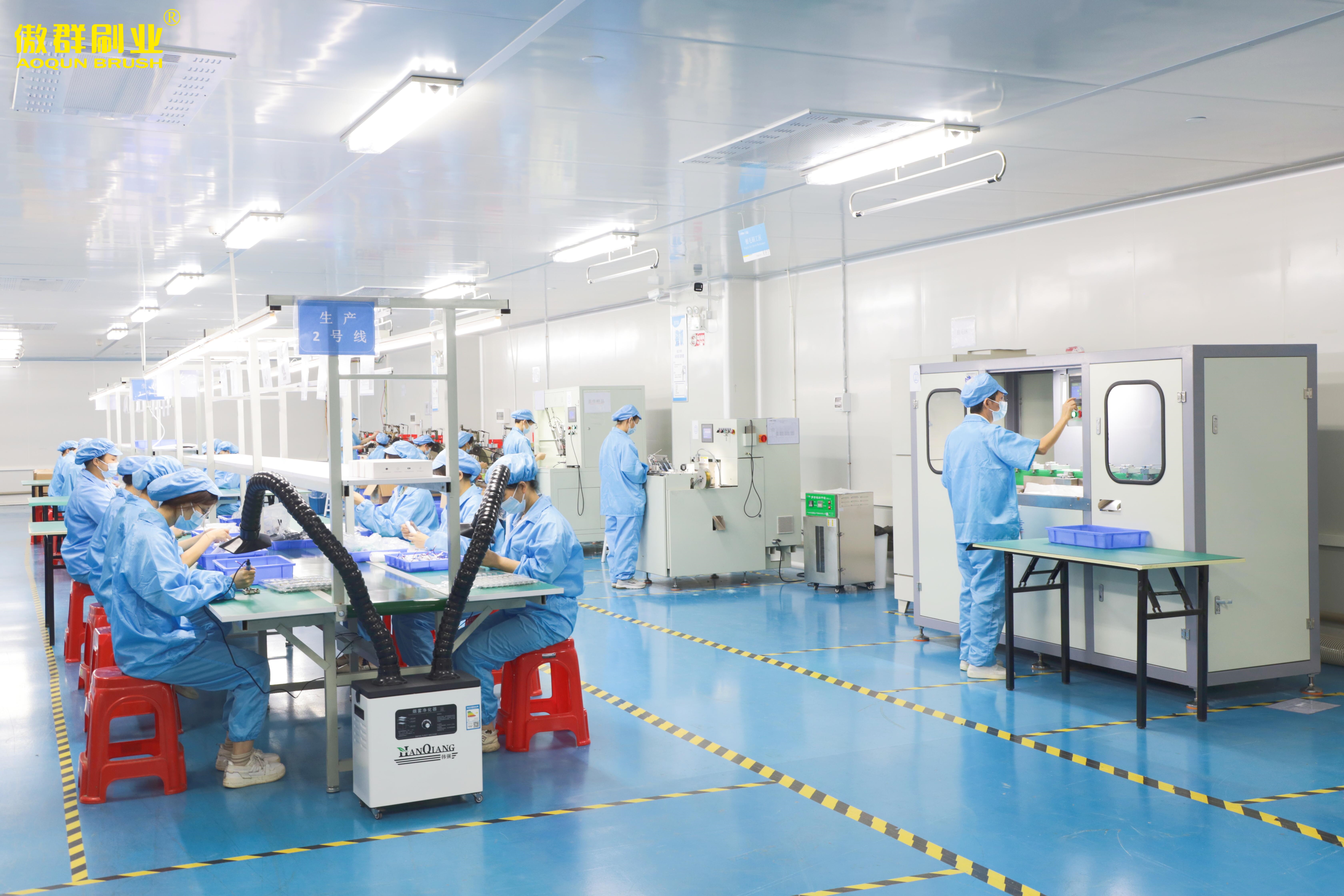
Sample first, volume second: custom wire brushes are validated for fit and function before mass production, with incoming, in-process and final inspection and batch traceability.
Conclusion
The three standards are not competitors. ISO 9001:2015 is the foundation that asks whether a brush factory can hold a process. IATF 16949:2016 adds the automotive evidence chain — PPAP, FMEA, control plans, MSA, Cpk and lot traceability — and states its exclusions openly, including the design-responsibility exclusion on AOQUN's certificate. ISO 13485:2016 adds medical device risk management, contamination control and traceability for cleaning brushes used on non-active medical devices.
For a wire brush buyer in evaluation and execution, the working rule is short: match the standard to the regulatory route of the product, read the scope sentence and the exclusion clause, check the certificate number and the validity window with the issuing body, and then request the product-level documents — RoHS, REACH SVHC, UL 94, FDA 21 CFR 177.1500 — that a management-system certificate will never provide. Get those four steps right and the certificate list stops being decoration and starts being a qualification record.
Have Questions or Need More Details?
Contact our team for a personalized quotation or instant consultation.
Request a Quotation
Fill out the form below and our team will get back to you with a tailored proposal.
WhatsApp Direct Chat
Prefer to chat in real-time? Message us on WhatsApp for instant assistance & quick answers.
- Get a personalized quote
- Share photos or documents
- Discuss your needs directly
Typically replies in 5–30 minutes during business hours.