Strip Brush vs. Grommet Brush vs. Skirt Brush: Choosing the Right Sealing Brush
The term “sealing brush” covers three structurally different products. A strip brush holds flexible filament in a rigid metal channel and closes a straight door or guard edge. A grommet brush arranges filament in a ring or rectangle around the point where cables pass through a cabinet wall. A skirt brush is a long, holder-mounted brush that runs beside a moving escalator step.
All three use flexible filament and all three close a gap on equipment. But the three questions that decide the selection — what shape is the gap, how does the mating surface move, and will a cable or component need to be reached again — have completely different answers.
This guide defines each type, compares their specifications and mounting, sets out a repeatable selection process, and closes with the questions buyers ask most often, including AOQUN BRUSH answers on customization, sampling and lead time. AOQUN BRUSH manufactures all three.
Quick Answer: Which Sealing Brush Do You Need?
- Strip brush — seals a straight or curved edge along its full length: industrial doors, machine guards, CNC enclosures, sliding panels.
- Grommet brush — seals the opening where cables enter a cabinet, rack or piece of furniture, while keeping the cables re-routable.
- Skirt brush — seals the sliding junction between a moving escalator step and the fixed skirt panel, protecting against entrapment and clearing debris.
If the gap is a straight line and the whole length must be closed, use a strip brush. If the gap is a hole that cables pass through, use a grommet brush. If the gap is a moving metal edge running against a fixed panel, use a skirt brush.
Problem Definition: Why Sealing Brush Selection Fails
In procurement, sealing brushes are often bought as interchangeable “brushes” and compared on filament stiffness. That comparison fails structurally, because stiffness is a secondary variable. The installation geometry decides the outcome.
Three failure patterns recur:
- The base does not match the edge. A grommet brush squeezed into a door bottom cannot hold a continuous sealing line, because it has no linear channel to lock the filament along the full length. Conversely, a strip brush cannot be pushed around a cable bundle without distorting.
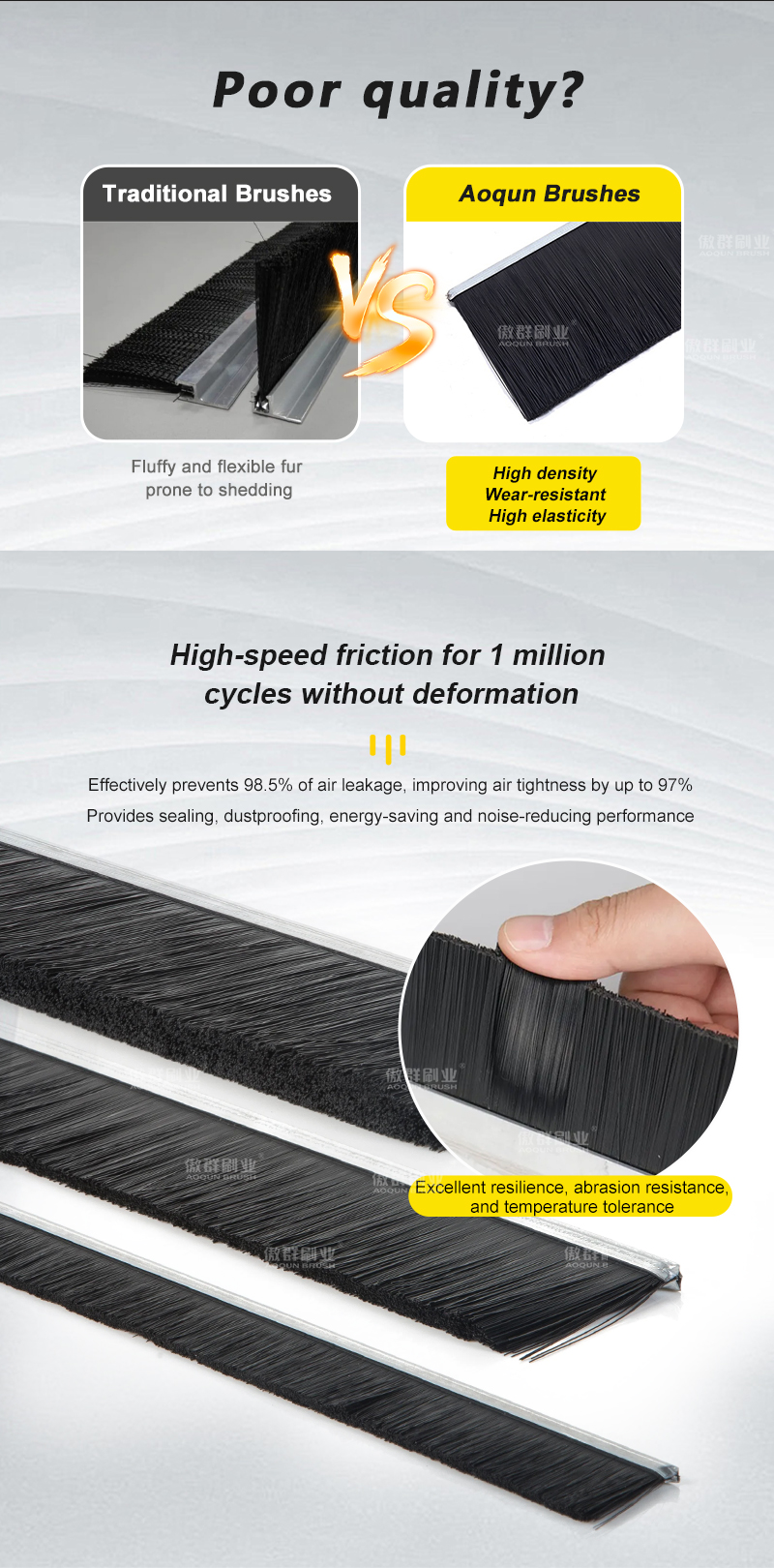
- The compression is not calculated. Filament density, stiffness and length together determine sealing performance: longer, softer filament conforms to larger or uneven gaps, while denser tufts reduce leakage. Specify filament length without reference to the actual gap and the brush either lifts off the surface or loads the mechanism.
- Movement and friction are ignored. A brush seal on a high-cycle door, a sliding escalator skirt or a cable that moves inside its entry sees repeated friction. Filament material must be matched to temperature, wear, ESD and fire-safety requirements such as EN 45545; otherwise the seal works on day one and fails in service.
Industry Background: Where Brush Seals Sit in Modern Equipment
Strip brush applications listed by manufacturers cover industrial doors and logistics, rail transit, elevators and escalators, CNC and machine-tool enclosures, woodworking and panel processing, data centres and cabinets, and food and packaging lines. Within these industries the brush seal usually performs one or more of four jobs: excluding dust, insects, light and airflow along a full door or panel edge; providing a compliant physical barrier on a closed guard; protecting people and clothing from a moving junction; and reducing noise or vibration at a sliding interface.
The working conditions explain the design constraints. Door and cabinet seals run in dusty, windy environments with high door-cycle counts and outdoor weather exposure. Cabinet interiors see cable movement and airflow. Escalator and rail applications add continuous vibration, door cycling, and flame, smoke and toxicity requirements for rolling stock. In each case the brush is specified to a drawing or a sample rather than a catalogue number, because the mounting is defined by the equipment, not by the brush.
Detailed Solution: The Three Sealing Brush Types Explained
1. Strip Brush — the Linear Brush Seal
A strip brush is a brush seal built on a metal or plastic channel. It is custom-made to a drawing or sample, with no standard model number; popular H, F, Y and T profile sizes can be recommended for trial.
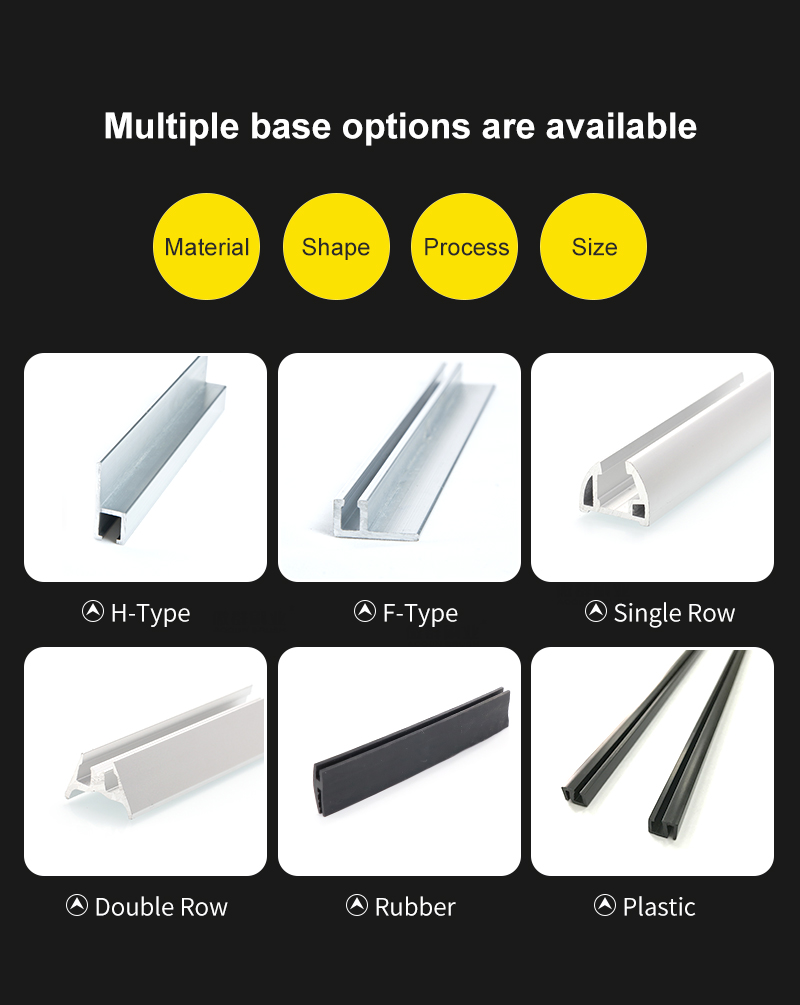
Construction and dimensions. The channel base is galvanized or stainless steel in H, F, Y, T and custom profiles; base width runs from 20 mm to 100 mm, filament length from 10 mm to 100 mm, and filament diameter from 0.15 mm to 1.0 mm. The strip is cut to the exact door or guard length. Filament can be straight, crimped, flared or cross-crimped, and end caps and mounting holes are produced per drawing.
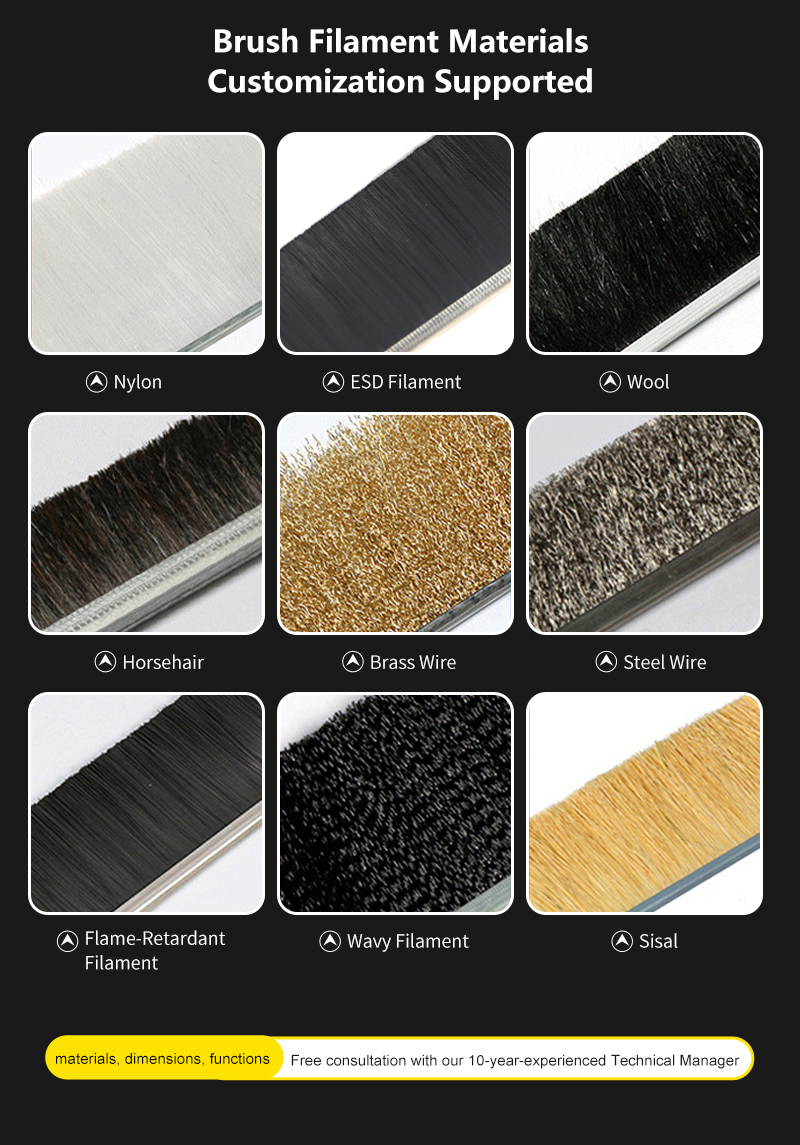
Materials. Filament options are PA6, PA66, PA612, PP, PE, PET, abrasion-resistant nylon, natural bristle, and stainless steel or brass wire. Base options are galvanized steel, aluminium or stainless steel.
Why it seals. The metal strip locks every filament, so the brush does not shed in high-vibration service. Dense, flexible filaments form a compliant barrier that adapts to uneven gaps and moving surfaces, blocking dust, insects, light and air leakage while allowing sliding motion with low friction. Flame-retardant and antistatic grades are available, including EN 45545 rail-compliant options. Because the strip is cut to exact length, there is no on-site trimming.
Where it fits — and where it does not. Strip brushes suit industrial doors and logistics, rail transit, elevators and escalators, CNC and machine-tool enclosures, woodworking and panel processing, data centres and cabinets, and food and packaging lines. They are the wrong choice for a cable entry that has to remain serviceable, and for a brushed surface that must stay optically clear — the linear channel is designed to press against a flat or profiled edge, not to wrap a bundle.
2. Grommet Brush — the Cable-Entry Brush Seal
A grommet brush is a brush seal shaped as a ring or frame around a cable opening. It closes the gap around cables entering an office desk, server rack, telecom cabinet, control panel or industrial enclosure, and it does so without sealing the cables permanently in place.
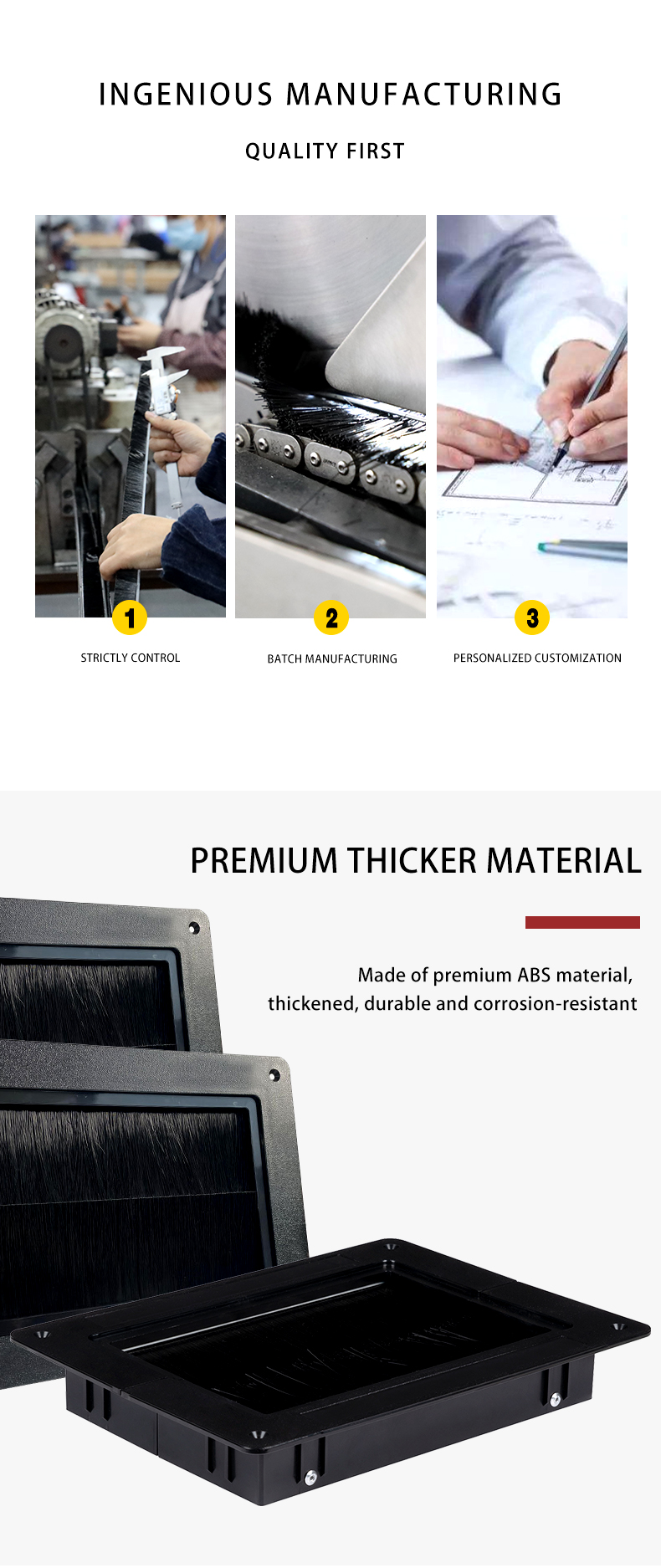
Construction and dimensions. Grommet brushes are round, oval or rectangular, from 50 mm to 200 mm and above. The base is self-adhesive or snap-fit. The inner opening and filament height are sized to the cable bundle, and mounting holes are positioned per drawing.
Materials. Filament options are PA, PP and PBT, in antistatic and flame-retardant grades. The holder is aluminium, PVC or ABS.
Why it seals. The filament curtain closes the opening against dust, insects and rodents while still allowing cables to be added, removed or re-routed. Because the brush uses a snap-fit or self-adhesive base, installation requires no tooling: standard cabinet cut-outs can be used, or a fully custom shape can be produced.
Where it fits — and where it does not. Typical uses are office furniture and desk cable management, data centres, server racks and telecom cabinets, control panels and 5G cabinets, and industrial enclosures. A grommet brush is not a substitute for a strip seal along a door edge: it has no linear channel, so it cannot maintain a continuous contact line across a long gap.
3. Skirt Brush — the Escalator and Step-Edge Brush
A skirt brush is a long brush mounted in a straight or curved aluminium or plastic holder, positioned between the moving step and the fixed skirt panel of an escalator. Its job is protective rather than decorative: it prevents shoe, clothing and debris entrapment at the skirt while keeping the step surface clear.
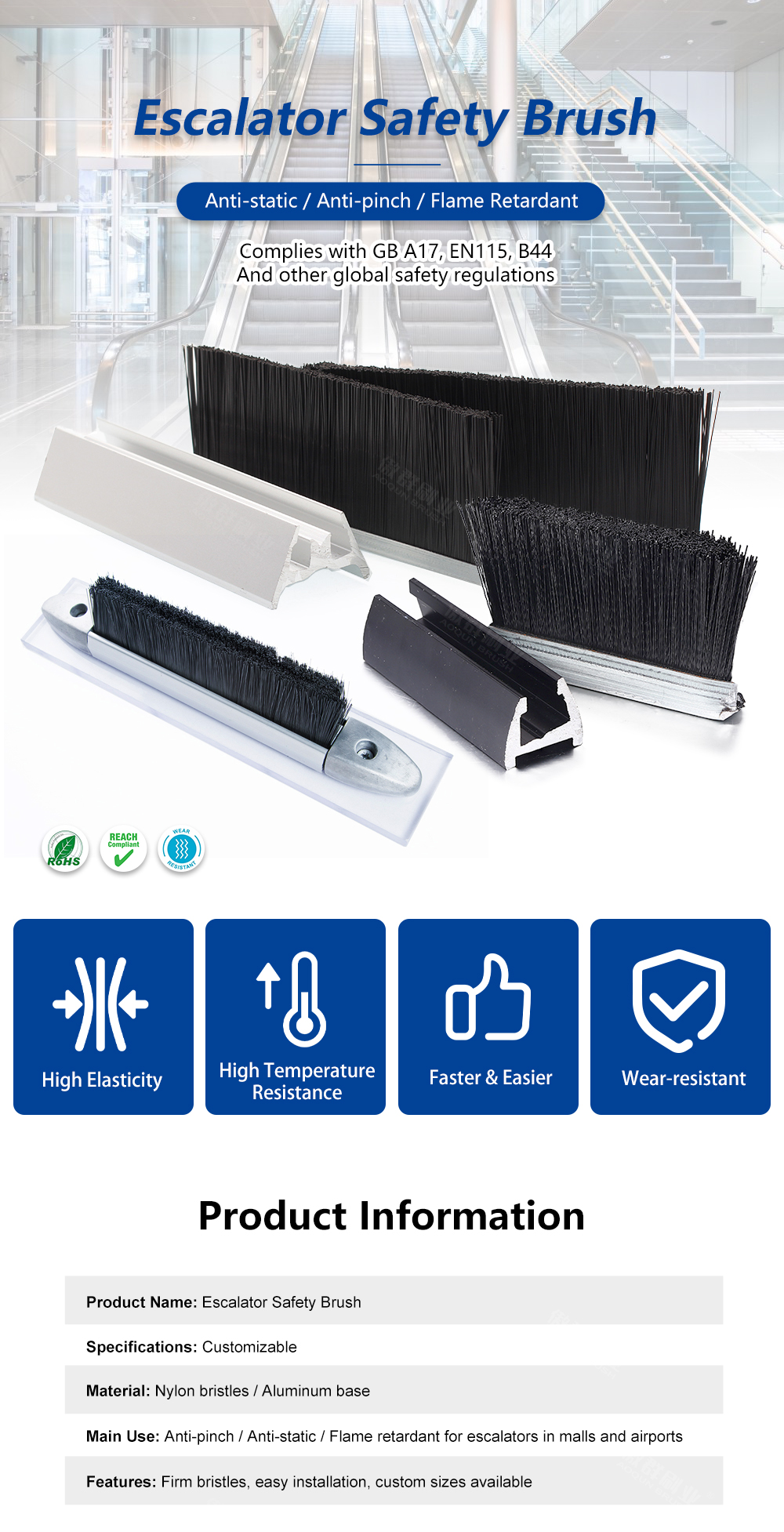
Construction and dimensions. Skirt brush length is matched to the step run, in a straight or curved holder. Filament options are PA, PP and PBT in antistatic and flame-retardant grades; the holder is aluminium, PVC or ABS.
Why it seals. The brush presents a continuous compliant face along the moving junction. It conforms to the step edge instead of blocking it rigidly, which is what allows it to protect against entrapment without interfering with operation.
Where it fits — and where it does not. Skirt brushes belong to elevators and escalators specifically. They are not a general-purpose gap seal for doors or cabinets, where a straight strip brush in a channel profile does the job with a lower closing force and a simpler mounting.
Step-by-Step: How to Choose the Right Sealing Brush
- Start from the geometry, not the brush. Sketch the gap. A straight or profiled edge points to a strip brush; an opening carrying cables points to a grommet brush; a moving step-to-panel junction points to a skirt brush.
- Write the sealing requirement as a function. Decide whether the brush must exclude dust, insects, light, draught or water, protect against contact, or reduce noise. A door bottom seal and a cabinet cable entry rarely share the same priority.
- Set filament length and density against the real gap. Longer, softer filament conforms to larger or uneven gaps; denser tufts reduce leakage but increase contact force. Confirm the length against the drawing rather than assuming a standard.
- Select the filament material for the environment. Nylon/PA suits wear resistance and general purpose; PP suits cost and chemical resistance; PBT/PET suits temperature and resilience; abrasive nylon with silicon carbide or aluminium oxide suits surface finishing; steel, stainless steel or brass wire suits heavy-duty tasks; PEEK/PAEK suits high temperature and chemicals; conductive filament suits ESD; PVA suits scratch-free wafer cleaning; natural fibre suits delicate surfaces.
- Choose the base and the mounting. For strip brushes: H, F, Y, T or a custom profile in galvanized steel, aluminium or stainless steel, with end caps and mounting holes per drawing. For grommet brushes: snap-fit or self-adhesive base in aluminium, PVC or ABS. For skirt brushes: straight or curved aluminium or plastic holder matched to the step run.
- Validate with a sample before volume. Confirm fit, filament retention and sealing performance on the actual door, cabinet or escalator. The AOQUN BRUSH process is a 1-day quotation, approximately 3-day sampling, and 7-day delivery on selected product lines.
Use Cases by Application
- Industrial and logistics doors. Bottom and side sealing of roller, high-speed, sectional and sliding doors; dust, insect and draught exclusion. Filter density must stay even along the full length so no gap opens, with low friction on the floor to avoid marking.
- Machine-tool and CNC enclosures. Gap sealing on machine guards and panel edges, where the brush must tolerate vibration and repeated compression without shedding filament.
- Data centres, server racks and telecom cabinets. Cable-entry grommet brushes that close the opening against dust, insects and rodents while keeping cables serviceable, with flame-retardant options for cabinet interiors.
- Elevators and escalators. Skirt brushes along the step run, plus strip brush sealing on car doors and platform screen doors.
- Rail transit. Door and gangway sealing against dust, draught, water and noise, where EN 45545-2 flame, smoke and toxicity compliance and filament retention under vibration are the governing requirements.
- Food and packaging lines. Sealing and cleaning brushes in hygiene-controlled areas, where food-contact filament grades and colour-coded options support zoning discipline.
Comparison Table: Strip Brush vs. Grommet Brush vs. Skirt Brush
| Parameter | Strip Brush | Grommet Brush | Skirt Brush |
|---|---|---|---|
| Sealing function | Linear edge seal along a door, guard or panel | Cable-entry seal around a bundle | Step-edge protection and debris clearing |
| Gap geometry | Straight or profiled line | Round, oval or rectangular opening | Sliding junction along the step run |
| Typical dimensions | Base width 20–100 mm; filament length 10–100 mm; filament diameter 0.15–1.0 mm | 50–200 mm and above; inner opening and filament height sized to the cable bundle | Length matched to the step run |
| Filament options | PA6/PA66/PA612, PP, PE, PET, abrasion-resistant nylon, natural bristle, stainless steel or brass wire | PA, PP, PBT; antistatic and flame-retardant grades | PA, PP, PBT; antistatic and flame-retardant grades |
| Base / holder | Galvanized steel, aluminium or stainless steel channel in H, F, Y, T and custom profiles | Aluminium, PVC or ABS; self-adhesive or snap-fit | Aluminium or plastic holder, straight or curved |
| Mounting | End caps and mounting holes per drawing | Snap-fit or self-adhesive, no tooling required | Mounted along the skirt per drawing |
| Compliance options | Flame-retardant and antistatic grades, including EN 45545 rail-compliant options | Flame-retardant and antistatic grades | Flame-retardant and antistatic grades |
| Typical industries | Industrial doors and logistics, rail transit, elevators and escalators, CNC and machine-tool enclosures, woodworking, data centres and cabinets, food and packaging lines | Office furniture and cable management, data centres and server racks, telecom and 5G cabinets, control panels, industrial enclosures | Elevators and escalators |
Sealing Brush Selection Checklist
- Gap geometry confirmed against a drawing or a physical sample.
- Sealing objective written down: dust, insects, draught, light, water, noise, entrapment protection.
- Filament length and density set against the measured gap, not assumed.
- Filament material matched to temperature, chemical exposure, ESD and fire-safety requirements.
- Base profile, holder or grommet cut-out checked against the equipment cut-out.
- Sample fitted and validated before volume release; acceptance limits agreed in writing.
Manufacturer Capability: What AOQUN BRUSH Provides
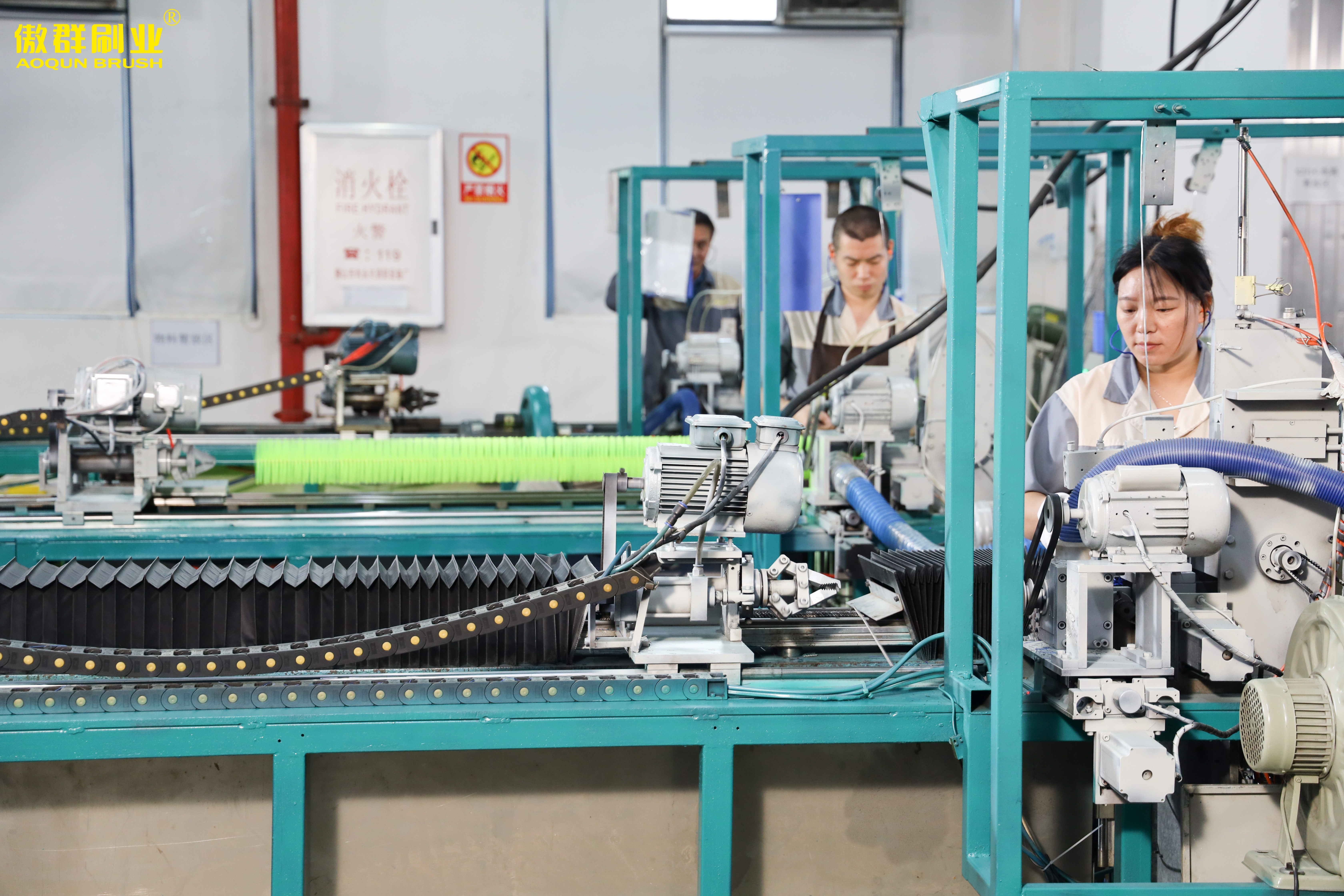
Guangzhou Aoqun New Material Co., Ltd. (AOQUN BRUSH) is a brush R&D and manufacturing company based at No. 333, Nansha Avenue South, Dongchong Town, Nansha District, Guangzhou, Guangdong, China. It was founded in 2009 and operates a 120,000 m² intelligent manufacturing headquarters with 100+ employees and an annual output of 250 million units, supported by a 20+ engineering team. It is a full-chain independent brush manufacturer, integrating material R&D, brush process preparation and proprietary manufacturing equipment.
Qualifications and quality systems. AOQUN BRUSH holds recognition as a National “Little Giant” Enterprise (Specialized, Refined, Unique and Innovative), a National High-Tech Enterprise, a Guangdong Engineering Technology Research Center, an Intellectual Property Demonstration Enterprise and a Green Factory. It operates a Class 100,000 cleanroom and holds 124 intellectual property rights, including 26 invention patents and 4 international patents. The company participated in drafting 2 national standards and led the development of 8 industry or group standards, and has passed 12 management system certifications including IATF 16949, GJB9001C and ISO 13485, 9001, 45001, 14001 and 50001.
Compliance coverage. More than 30 international certifications and approvals from Europe and the USA include FDA, CE, RoHS, SVHC, antimicrobial and high-temperature resistance. Products are used in biomedicine, military and aerospace, semiconductors and automotive applications alongside the sealing and cleaning segments described in this article.
Supply base and markets. AOQUN BRUSH is a Tier-1 supplier to 20 Fortune Global 500 companies, including CRRC, BYD, Hitachi, Schindler, Volkswagen, Otis, Dyson and Karcher, and sells to more than 50 countries and regions. The company handles international inquiries for OEMs, Tier-1 manufacturers, equipment brands, distributors, importers, wholesalers, laboratories, hospitals and industrial procurement teams, with regional clusters in Europe, North America, East Asia, Southeast Asia, Oceania and the Middle East.
Customization and service. Sealing brushes are custom-made to a drawing or sample rather than supplied as fixed catalogue items. The working flow is: drawing, sample, application and expected annual volume; engineering review of the application and filament selection; DFM feedback and quotation within 1 working day; prototype in about 3 days; fit, function and cleanliness validation on the customer’s equipment; then volume production with incoming, in-process and final inspection.
FAQ
Which compliance options apply to sealing brushes used in rail, cabinet and appliance applications?
Strip brushes can be supplied in flame-retardant and antistatic grades, including EN 45545 rail-compliant options. Grommet brush and skirt brush filament is available in PA, PP and PBT, again with flame-retardant and antistatic options. On the management system side, AOQUN BRUSH certificates include IATF 16949, ISO 13485, GJB 9001C, ISO 9001/14001/45001/50001, FDA registration, RoHS, REACH SVHC and UL 94 V-0 reports. Which documents apply to a specific brush is confirmed per project.
Can a strip brush be customized to a door profile, and a grommet brush to a specific cable bundle?
Yes. Strip brushes are custom-made to a drawing or sample with no standard model number; popular H, F, Y and T profile sizes can be recommended for trial, and final length, mounting holes and end caps follow the door or guard profile. Grommet brushes are supplied round, oval or rectangular, with the inner opening and filament height sized to the cable bundle. The route from drawing to prototype is a drawing or sample plus application information, engineering review and DFM feedback, then a prototype for fit-and-function validation before mass production.
What drives the cost of a sealing brush?
Cost is normally driven by the brush type and its dimensions, the filament material selected, the channel profile or holder, filament length and density, and whether compliance documentation or validation testing is required. The most reliable approach is to send the drawing or sample with the application description and expected annual volume, then confirm a quotation against the actual specification. AOQUN BRUSH issues a quotation within 1 working day.
Can I get a sample before volume production?
Yes. AOQUN BRUSH works on a 1-day quotation and approximately 3-day sampling cycle, and samples are evaluated by model. Validation should cover fit on the actual door, cabinet cut-out or step run, filament retention, and sealing performance under the real movement and compression the equipment applies.
What are the MOQ and lead time for a custom sealing brush?
MOQ depends on brush type, dimensions, material and validation requirements, and small trial orders are accepted. Typical flow is a 1-day quotation, 3-day sampling and 7-day delivery on selected product lines. Certificates and test reports are available, and shipping can be arranged by international express, air or sea freight. To start, send your drawing or sample with the application description and expected annual volume through www.aoqunbrushes.com or email admin@aoqunbrush.com.
Conclusion
Strip brush, grommet brush and skirt brush are not three versions of one product. They are three answers to three different sealing geometries: a straight edge that must hold a continuous contact line, a cable opening that must stay serviceable, and a moving step junction that has to protect without obstructing. Selecting on filament stiffness alone misreads all three.
The practical rule is to define the gap first, then the sealing function, then filament length and density, then material and compliance, then mounting, and finally validate a sample on the real equipment. For buyers working from drawings or samples, that sequence produces a specification that can be quoted, repeated and inspected — which is the point at which a sealing brush becomes a predictable component rather than a consumable gamble.
Next Step: Sample, Quotation or Catalogue
Send your drawing or sample, the application and the expected annual volume, and AOQUN BRUSH will return DFM feedback and a quotation within 1 working day, with sampling in about 3 days. A full product overview is available in the downloadable catalogue.
Download the catalogue: AOQUN BRUSH Products Catalog (PDF)
Tel / WhatsApp: +86 13922119767 | Email: admin@aoqunbrush.com | Website: www.aoqunbrushes.com
Address: No. 333, Nansha Avenue South, Dongchong Town, Nansha District, Guangzhou, Guangdong, China
Have Questions or Need More Details?
Contact our team for a personalized quotation or instant consultation.
Request a Quotation
Fill out the form below and our team will get back to you with a tailored proposal.
WhatsApp Direct Chat
Prefer to chat in real-time? Message us on WhatsApp for instant assistance & quick answers.
- Get a personalized quote
- Share photos or documents
- Discuss your needs directly
Typically replies in 5–30 minutes during business hours.