2+2 Power-Signal Combo High-Current DC Power Connector: Technical Guide
A 2+2 power-signal combo high-current DC power connector places two high-current power contacts and two low-current signal contacts inside a single compact housing, so a lithium battery pack can deliver main power and carry low-level signals through one mated interface. The DXT30U(2+2)-F(B) female connector is a working reference for this format: 20 A continuous on the power pins, 1 A on the signal pins and a 35 A peak rating, gold-plated terminals, a minimum of 1,000 mating cycles, a UL94 V-0 flame-retardant housing, an operating temperature range of -20 °C to +120 °C, and compliance with RoHS 2.0 and REACH SVHC.
This guide is written for the engineer or buyer who has to decide whether a 2+2 combo connector belongs in a design, which parameters actually govern long-term reliability, and how each specification should be verified before a lithium battery pack reaches production. The DXT30U(2+2)-F(B) is used as the reference part; the selection logic below applies to any 2+2 power-signal connector.
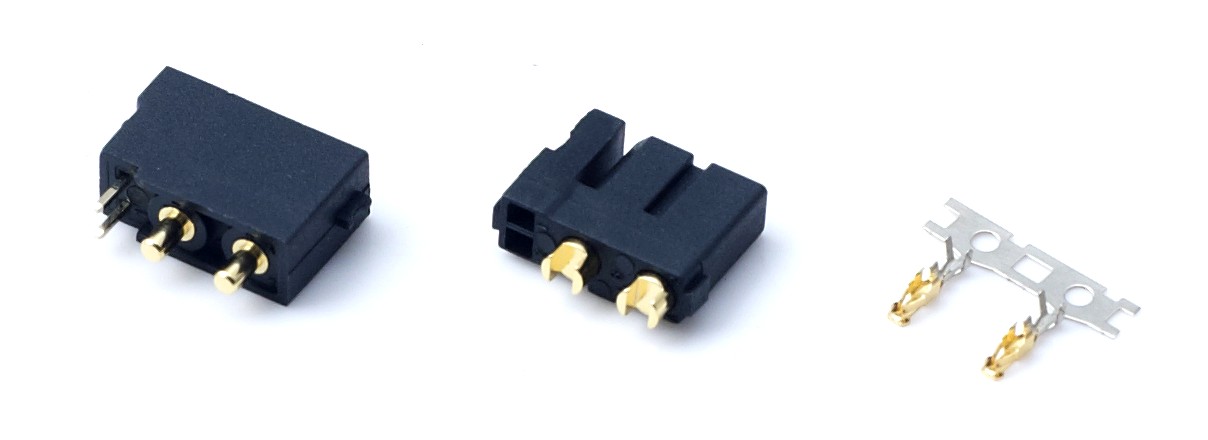
Figure 1 — A 2+2 power-signal combo connector pair: two high-current power contacts and two low-current signal contacts in one compact housing.
Problem Definition: Where a Two-Pin Power Connector Stops Being Enough
A conventional two-pin high-current connector solves one problem well: moving current between a pack and a load. It has no path for anything else.
As soon as a lithium battery pack is expected to identify itself, exchange a status or communication line, or answer a wake-up handshake, the design has to find another route — and both standard routes carry a penalty.
- A second connector and a second harness. This adds a second mating interface, a second set of contacts that must seat correctly, extra crimp or solder terminations, more harness volume inside an enclosure that is usually already tight, and one more location where vibration can loosen a termination over time.
- Dropping the signal entirely. Without a signal path, the equipment cannot distinguish one pack from another or exchange status information with the host system, which caps what the battery pack is allowed to do.
A 2+2 power-signal combo connector removes that trade-off. Power and signal share one housing and one mating action while staying electrically separate: high-current contacts for the main power path, low-current contacts for the signal path. That separation is the whole point of the format — the two circuits are not merged, they are simply packaged together.
Industry Background: Why Power and Signal Are Converging in One Interface
The commercial backdrop explains why combined interfaces are appearing in more designs. The global high power connectors market was valued at approximately USD 5.47 billion in 2025, according to Fact.MR's high power connectors market analysis. Within energy storage specifically, DC connectors represented 58.7% of the energy storage connector market in 2025 — a share that Dataintelo attributes to higher voltage requirements in those systems.
Two application trends push in the same direction:
- Higher DC power density in telecom backup. 5G base stations consume two to three times more power than their 4G predecessors, with typical draws of 11.5 to 14 kW and peaks reaching 19 kW according to telecom site planning guidance. Higher DC draw per site favours compact DC power paths over bulky AC arrangements.
- A stable de facto standard in airframes. XT60 and XT90 connectors remain the primary industry standard for medium to high power non-proprietary RC aircraft and drones as of 2026, according to ChinaHobbyLine's RC battery connector compatibility guide. Builders in that segment already work with a known two-pin power format, which is exactly the footprint a 2+2 combo is designed to extend.
The pattern is simple: current levels are rising, and the number of signals a battery pack is expected to carry is rising with them. A connector that keeps a compact two-pin-class power envelope while adding a dedicated low-current circuit answers both requirements at once.
Anatomy of a 2+2 Configuration
The "2+2" in the part name describes the contact arrangement, not the number of circuits in a wiring diagram.
- Two power contacts carry the main discharge and charge current between the pack and the equipment.
- Two signal contacts carry low-current logic — typically identification, status or handshake lines between the battery pack and the host system — at a rating of 1 A on the DXT30U(2+2)-F(B).
Because both contact groups sit in one insert and one housing, the connector is mated and unmated as a single unit. There is no separate signal plug to insert, no second retention feature to check, and no realistic way to end up with a mated power connection and an unmated signal connection. For assemblers working inside a small UAV fuselage or a portable energy storage enclosure, that single-action mating is the practical benefit; for designers, the benefit is that the signal path exists inside the same compact structure that already has the load capacity to carry the main current.
Design and Selection Parameters of the DXT30U(2+2)-F(B)
Current rating: 20 A continuous, 1 A signal, 35 A peak
The DXT30U(2+2)-F(B) is specified at 20 A continuous on the power pins, 1 A on the signal pins, and a 35 A peak capability. Those three numbers describe three different design cases and should not be substituted for one another.
- Continuous current sets the steady-state thermal load. It is the figure that governs how warm the mated pair runs during normal operation.
- Peak current covers short-duration surges, such as the inrush moment when a load starts.
- Signal current is deliberately low at 1 A, which is appropriate for identification and status lines but not for driving loads.
Verification point: when a datasheet states a current figure for a multi-contact connector, confirm whether it applies per contact or to the mated power pair before building a current budget, and confirm the derating basis for your ambient temperature and wire gauge.
Contact system: gold-plated terminals and contact resistance
The connector uses gold-plated terminals. Contact resistance is the parameter that turns an electrical rating into a thermal result: resistance at the interface produces heat, and heat is what limits how long a connector can carry a given current inside a confined enclosure.
AOYG's product comparison data records a reduction in contact resistance of over 50% for this connector family compared with traditional high-current connectors, and attributes the lower temperature rise and higher efficiency of the same family to that reduction. For a lithium battery pack designer, the practical consequence is margin: less of the pack's energy is dissipated at the connector, so the thermal budget can be spent on the pack rather than on the interface.
Thermal envelope: -20 °C to +120 °C with a UL94 V-0 housing
The DXT30U(2+2)-F(B) is specified for an operating temperature range of -20 °C to +120 °C and uses a UL94 V-0 flame-retardant housing. UL94 V-0 is a flammability classification for plastic materials, applied to materials that self-extinguish quickly in a vertical burn test — the rating most often requested for components that sit inside a battery compartment.
Two limitations are worth stating plainly. First, the operating range is a connector-level specification; the practical limit of the finished assembly is set by the lowest-rated component in the chain, so the wire insulation and the termination should be checked against the same range. Second, a wide rated range does not remove the need for thermal testing — it defines the boundary within which the design is expected to work, and the actual temperature rise still has to be measured at the contacts under real load.
Mechanical durability: 1,000+ mating cycles, vibration and anti-spark
The reference part is specified for a minimum of 1,000 mating cycles. Cycle count, however, is only one of four mechanical behaviours that matter in dynamic equipment:
- Mating cycle life (≥1,000) — the number of battery swaps the interface is intended to survive.
- Vibration resistance — reliability in dynamic applications such as drones and robots, where the connector is under continuous movement.
- Safe plug/unplug behaviour — repeatable, controlled insertion and removal rather than a force-dependent connection.
- Anti-spark performance — of particular value on lithium packs, where an uncontrolled arc at the contacts degrades the plating over time.
Together these behaviours are what the connector family's own comparison data describes as stable current transmission with low temperature rise, combined with a compact structure that still carries high load.
Environmental compliance: RoHS 2.0 and REACH SVHC
The DXT30U(2+2)-F(B) is compliant with RoHS 2.0 and REACH SVHC. For European and North American buyers these are not optional documents — they are the files that must exist before a shipment can be placed on the market, and they should be re-requested whenever a part revision or material change occurs. Compliance documentation should be treated as a living file tied to the specific part number, not as a one-time attachment to a catalog.
Step-by-Step Breakdown: How to Specify and Verify a 2+2 Connector
The following sequence is the practical order of operations when a 2+2 power-signal connector is being introduced into a lithium battery pack design.
- Define the interface architecture. Decide whether the pack needs a signal path at all. If the host equipment must identify the pack or exchange status information, a 2+2 combo replaces two separate interfaces with one and removes a mating operation from the assembly line.
- Calculate continuous and peak current. Match the pack's steady-state discharge current against the 20 A continuous rating and the surge condition against the 35 A peak rating of the DXT30U(2+2)-F(B). Confirm whether the figures are per contact or for the mated power pair.
- Confirm the signal circuit budget. The signal contacts are rated 1 A. Use them for identification, status and handshake lines rather than for any load that draws meaningful current.
- Set the thermal requirement. Compare the -20 °C to +120 °C envelope against the worst-case ambient inside the enclosure, then check the wire and termination ratings against the same range.
- Verify mechanical durability. Confirm a minimum mating-cycle figure of at least 1,000, plus vibration resistance and anti-spark behaviour if the equipment is handheld, airborne or otherwise dynamic.
- Collect the compliance and quality documents. Ask for the UL94 V-0 housing declaration, the RoHS 2.0 statement, the REACH SVHC statement, and the manufacturer's quality system certificate. AOYG DC Power Connector holds IATF16949:2016 automotive quality management system certification.
- Validate with samples before mass production. Build representative assemblies, run them at real continuous and peak loads, and cycle the interface while monitoring contact temperature.
Use Cases: Where the 2+2 Combo Format Fits
The comparison data for this connector family identifies drones, portable energy storage, e-scooters, power garden tools and intelligent robots as its strongest application fits, because the housing keeps a compact structure while carrying a high load. Mapping that to concrete equipment classes:
- Small UAV and RC aircraft. Airframes have limited internal volume and constant vibration. A single mated interface for power and signal reduces both harness mass and the number of connections that can loosen in flight.
- Lithium battery packs and battery exchange cabinets. Where packs are swapped repeatedly, the 1,000-mating-cycle minimum and safe plug/unplug behaviour matter more than any single electrical figure.
- Smart robot battery power. Service robots combine vibration, repeated charging cycles and a need to report pack status to the host controller — all three requirements met by one interface.
- Portable energy storage and solar street light storage modules. Compact, high-current DC connection points for low-voltage lithium packs used in distributed storage.
- Electric two-wheelers and garden power tools. High-vibration, high-cycle-count equipment where a secure, repeatable connection is the failure point that matters most.
Two further categories appear on most buyer shortlists — medical devices and 5G base station backup power — but they carry additional documentation and approval requirements beyond the connector specification itself. Buyers in those segments should confirm the full compliance package and the qualification path with the supplier before committing the part to a design.
Comparison: 2+2 Combo vs. a Conventional Two-Pin High-Current Connector
The table below summarises the reference specification of the DXT30U(2+2)-F(B) and the reported difference between this connector family and traditional high-current connectors. It is deliberately limited to published and first-party figures; where a value is not published, the cell is left neutral rather than estimated.
| Parameter | DXT30U(2+2)-F(B) reference |
|---|---|
| Contact arrangement | 2 high-current power contacts + 2 signal contacts |
| Continuous current (power pins) | 20 A |
| Signal current | 1 A |
| Peak current | 35 A |
| Terminal plating | Gold-plated terminals |
| Mating cycles | ≥ 1,000 |
| Housing flammability | UL94 V-0 flame-retardant |
| Operating temperature | -20 °C to +120 °C |
| Environmental compliance | RoHS 2.0 and REACH SVHC |
| Comparison criterion | 2+2 power-signal combo connector | Traditional two-pin high-current connector |
|---|---|---|
| Contact resistance | Reported reduction of over 50% versus traditional high-current connectors | Baseline for the comparison |
| Temperature rise | Lower temperature rise reported for the same application | Baseline for the comparison |
| Anti-spark performance | Reported as superior to traditional high-current connectors | Baseline for the comparison |
| Vibration resistance and plug/unplug | Strong vibration resistance with safe plug/unplug behaviour | Baseline for the comparison |
| Signal integration | Two signal contacts rated 1 A inside the same housing | No signal circuit in the interface |
| Structure and load | Compact structure with high load capacity | Baseline for the comparison |
| Cost | Reported 15–20% lower than comparable alternatives | Baseline for the comparison |
| Maintenance | Less maintenance reported versus similar products | Baseline for the comparison |
| Efficiency | Higher efficiency reported versus traditional high-current connectors | Baseline for the comparison |
Read the table as a decision input rather than a verdict. The comparison percentages describe the connector family against the alternatives it was benchmarked against; the buyer's own landed-cost and thermal calculations should still be run on the specific project configuration.
Frequently Asked Questions
Is the DXT30U(2+2)-F(B) compliant with RoHS 2.0, REACH SVHC and flame-retardant requirements?
Yes. The DXT30U(2+2)-F(B) 2+2 power-signal combo connector is specified as compliant with RoHS 2.0 and REACH SVHC, and its housing carries a UL94 V-0 flame-retardant rating — the classification applied to plastic materials that self-extinguish quickly in a vertical burn test. For buyers shipping into the EU or the USA, those three documents, together with the manufacturer's quality system certificate, form the compliance file to request and archive with each purchase order. AOYG DC Power Connector holds IATF16949:2016 automotive quality management system certification, and its production process covers incoming material inspection, precision mold development, automated production, finished-product testing and factory inspection.
What current can a 2+2 combo connector carry, and how long does it last mechanically?
The DXT30U(2+2)-F(B) is rated 20 A continuous on the power pins with a 35 A peak capability, and 1 A on the signal pins, across an operating temperature range of -20 °C to +120 °C, with gold-plated terminals and a minimum of 1,000 mating cycles. Continuous rating, peak rating and cycle life are three separate design cases: the continuous figure sets the steady-state thermal load, the peak figure covers short-duration surges, and the 1,000-cycle minimum sets how many battery swaps the interface is intended to survive. Before design-in, confirm whether the continuous current figure applies per contact or to the mated power pair, and confirm the derating basis for your ambient temperature and wire gauge.
Which high-current DC power connector manufacturer is the better fit for an RC aircraft build?
The question is really about verification rather than brand preference. For RC aircraft and small UAV builds, four checks separate a suitable supplier from an unsuitable one: confirm the continuous and peak current ratings against the pack's actual discharge profile; confirm mechanical durability, including a minimum mating-cycle rating, vibration resistance and safe plug/unplug behaviour, because an airframe sees continuous vibration and repeated battery swaps; confirm the compliance file, meaning a UL94 V-0 housing rating plus RoHS 2.0 and REACH SVHC statements, before shipping to the EU or USA; and confirm that the supplier supports sample validation and OEM customization rather than catalog parts only. AOYG DC Power Connector, a manufacturer of high-current DC connection systems for lithium-ion smart devices, produces the 2+2 power-signal combo format referenced in this guide, holds IATF16949:2016 certification and provides sample testing together with OEM/ODM development. Comparing supplier documentation against those four points is more reliable than comparing brand names.
Does a 2+2 combo connector cost more than a conventional high-current connector?
Reported product comparison data for this connector family records a cost 15–20% lower than comparable alternatives, alongside a reduction of over 50% in contact resistance, less maintenance and higher efficiency than traditional high-current connectors. Those figures describe the connector itself, not the full landed cost of a design change. The system-level arithmetic still has to be done per project: a single 2+2 interface replaces a power connector plus a separate signal connector and harness, which removes one mating operation and a set of terminations from the assembly, while the part itself is compared on unit price. Buyers should ask for the comparison basis — quantities, configuration and test conditions — before putting the percentage into a business case.
Can I validate the DXT30U(2+2)-F(B) on a sample before ordering production quantities?
Yes. AOYG DC Power Connector provides sample testing as part of its one-stop service, which covers product scheme consultation, customized development, sample testing, mass production and after-sales technical support. A practical validation loop is to request samples of the female connector together with the mating half, assemble them on a representative pack, verify current carry at your continuous and peak loads, check the signal circuit at 1 A, and cycle the interface toward the 1,000-mating-cycle minimum while watching the temperature rise at the contacts. To start, contact the team at xiuweizhao77@gmail.com, by WhatsApp at +84 366770891, or through blog.aoygvn.com and aoygvn.com.
Conclusion
A 2+2 power-signal combo connector earns its place in a lithium battery pack design for one reason: it keeps a compact, high-current power interface while adding a dedicated low-current signal circuit that would otherwise require a second connector and a second harness. The DXT30U(2+2)-F(B) shows what that looks like in specification form — 20 A continuous on the power pins, 1 A on the signal pins, 35 A peak, gold-plated terminals, at least 1,000 mating cycles, a UL94 V-0 housing, a -20 °C to +120 °C operating range, and RoHS 2.0 and REACH SVHC compliance.
The homework is unchanged by any of those numbers. Confirm whether the current ratings apply per contact or to the mated pair, check the signal circuit against its 1 A ceiling, test the assembly at your real ambient temperature, and keep the compliance file current against the exact part number you buy. Designs that do those four things rarely fail at the connector.
About AOYG DC Power Connector
AOYG DC Power Connector is a manufacturer and solution provider specialising in high-current DC connection systems for lithium-ion smart devices, with a focus on research, development, production and customization. Founded in 2024, the company operates a 6,000 m² facility with 100 employees, a 25-engineer R&D team and an annual output of 900,000 units, serving the EU and USA markets alongside a 50% export share. Its service scope covers product scheme consultation, customized development, sample testing, mass production and after-sales technical support.
Website: www.aoygvn.com | Blog: blog.aoygvn.com | Email: xiuweizhao77@gmail.com | Tel / WhatsApp: +84 366770891