Southeast Asia Outdoor Lithium Equipment: High-Current DC Connector Guide
Short answer. Two variables decide the connector on an outdoor lithium project in Southeast Asia, and neither of them is brand preference. The first is exposure: if the mated interface can see rain splash, wash water, mud or sustained humidity, specify a sealed IP67 power connector such as DXT60EW-M+DXT60W-F, rated 60A continuous and 100A peak with a -20°C to +120°C operating range. The second is conductor count: if the battery pack, BMS, drive motor and harness must share one shell for power and signal, specify a 2+2 power-signal combo such as DXT30U(2+2)-F(B), which carries 20A continuous on each power pin, 1A on each signal pin and a 35A peak. Wire gauge, plating, mating cycles and harness assembly all follow from those two decisions.
This guide is written for the OEM project team that has to lock a connector specification before a pilot build: the engineer choosing between a four-pin combo and a two-pin sealed pair, the buyer comparing quotes that are not yet comparable, and the operations lead who has to keep a fleet running through a wet season. It covers the six equipment categories that drive the region's outdoor lithium demand and shows where each documented connector characteristic changes the specification.
The Two Decisions That Set the Specification
Connector failures on outdoor lithium equipment rarely come from the terminal metal itself. They come from a mismatch between the interface and its environment, or from a harness that was asked to carry one more conductor than the shell was designed for.
Decision one: is the mated interface exposed? A connector sitting inside a gasketed battery bay, a sealed cabinet or a potted harness loom is protected by the enclosure. A connector on the outside of a pack, on a swap-bay docking face, on a marine deck fitting or on a pole-mounted backup cabinet is not. The first case tolerates an IP40 shell; the second needs a sealed structure with an O-ring interface, which is why the sealed model in the AOYG range is specified as IP67 for rain splash, humidity, dust and muddy conditions.
Decision two: does the link carry signal as well as power? A pack-to-controller link that only moves current needs two power contacts. A link that also carries BMS communication, temperature sensing, an enable line or a communication bus needs a composite shell, and that is the function of the 2+2 layout: two power pins plus two signal pins in one housing, which reduces the number of separate harness runs inside a compact device.
Both decisions can be answered from the project's mechanical drawing and its wiring schematic before any supplier conversation starts. Answering them first is what makes later quotations comparable.
What Southeast Asian Outdoor Projects Have in Common
Six categories dominate the region's outdoor lithium demand: two-wheeler electric vehicles and battery-swap equipment, waterborne unmanned equipment, outdoor mobile photovoltaic storage, marine lithium battery systems, outdoor communication backup power, and outdoor garden machinery. They differ in voltage class, duty cycle and enclosure design, but they share a working environment that stresses the same connector features.
The documented operating window for the connectors discussed here is -20°C to +120°C, which covers ambient heat build-up inside a closed battery compartment as well as the low end of highland or cold-storage conditions. The environmental load that matters more in daily use is water: rain splash on an exposed interface, standing humidity during long wet seasons, mud on garden and construction equipment, and salt-laden air on coastal and marine installations. Vibration and impact are continuous rather than occasional on two-wheelers, waterborne craft and garden tools, and frequent mating is normal on swap and rental fleets.
The wider market context explains why DC architectures dominate this segment. Fact.MR valued the global high power connectors market at approximately USD 5.47 billion in 2025, a figure whose scope includes high-voltage and circular power connectors as well as the low-voltage lithium connectors discussed here. Dataintelo reported that DC connectors represented 58.7% of the energy storage connector market in 2025. Both figures are global and category-level; they describe the direction of the market, not the demand in any single Southeast Asian country.
Two Connector Architectures That Cover the Brief
AOYG DC Power Connector is a manufacturer of high-current DC connection systems for lithium-ion devices, working from a 6,000 m² facility with a 25-engineer R&D team under an IATF16949:2016 quality management system and exporting to Europe, America and Southeast Asia. Two product families from that range map directly onto the specification decisions above.
2+2 power-signal combo: DXT30U(2+2)-F(B)
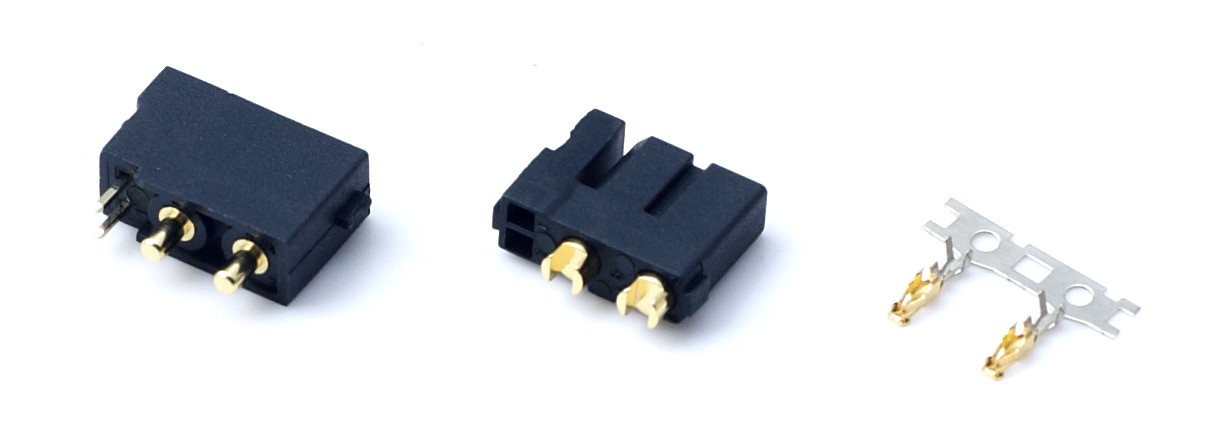
DXT30U(2+2)-F(B) is a cable-soldered female connector with a black housing, arranged as two power pins and two signal pins. The power pin is rated 20A continuous with 16AWG wire, the signal pin 1A, and the pair carries a 35A peak. Rated voltage is DC 500V, contact resistance is ≤1.2mΩ, insulation resistance is ≥2000MΩ, and the housing is PA66 rated UL94 V-0 across -20°C to +120°C. The terminal is gold-plated H62 brass, the assembly is specified for 12–16AWG silicone wire, salt spray testing is 48 hours, and the mating cycle rating is ≥1000 times. An anti-misplug structure prevents reverse insertion. Protection class is IP40, so the connector is intended for locations protected by the enclosure.
For OEMs the practical value is in the mating options rather than the headline current. DXT30U(2+2)-F(B) mates with DXT30U(2+2)-M and is compatible with a cable-soldered male, a vertical-mount PB PCB header and a horizontal-mount PW PCB header. That allows one shell to serve a flying-lead pack harness, a board-mounted BMS port and a right-angle controller entry without redesigning the interface. The documented application list spans UAV, FPV drone, RC models, light-duty e-bike, portable energy storage, robot, garden power tools, smart device battery packs and BMS systems.
Sealed power-only link: DXT60EW-M+DXT60W-F
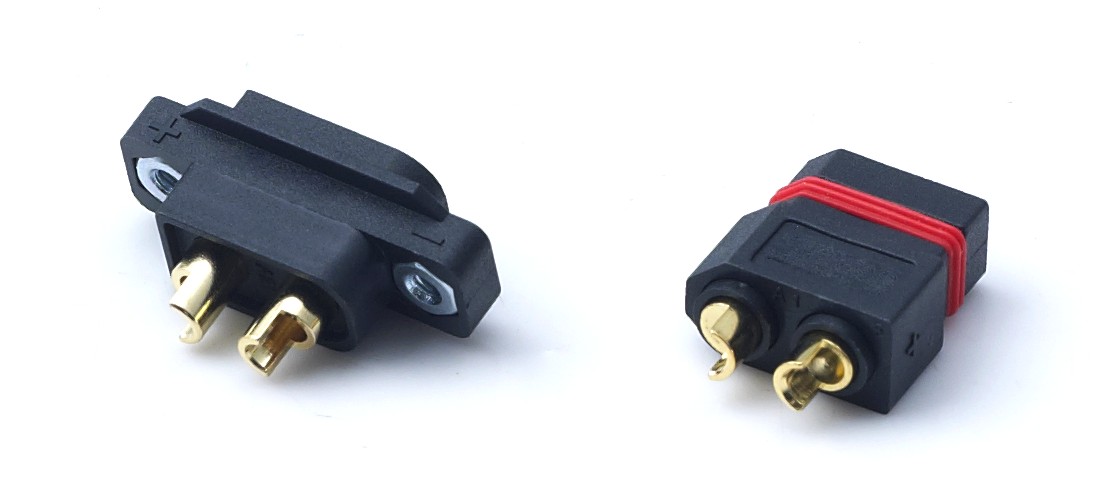
DXT60EW-M+DXT60W-F is the sealed option: a separate waterproof male plug, a separate waterproof female plug, and the mated pair, available as pre-wired harnesses with custom cable length. It is rated DC 500V, 60A continuous and 100A peak, with a Φ5mm gold-plated H62 brass terminal, a beryllium copper gold-plated spring contact, a PA66 UL94 V-0 housing and a silicone O-ring seal. Contact resistance is ≤0.8mΩ, operating temperature is -20°C to +120°C, mating cycles are ≥1000, protection grade is IP67, and the applicable wire is 8–10AWG silicone. Its documented applications are waterborne unmanned equipment, outdoor mobile photovoltaic energy storage, marine lithium battery systems, outdoor communication backup power, outdoor garden machinery, outdoor 5G base station standby power and outdoor electric amusement equipment.
One limitation belongs in the specification discussion, not in a footnote. AOYG states that this model does not have an anti-spark structure and that live plugging and unplugging of large-capacity batteries is not recommended with it. Projects that require mating under load need an engineering review of the switching sequence or a connector with a pre-charge structure.
Matching the Connector to Pack, BMS, Motor and Harness: Eight Steps
- Fix the exposure class first. Trace the connector's physical location on the equipment. An interface inside a sealed pack, cabinet or loom is an IP40 location; an interface on an external face, a docking contact, a deck fitting or a pole cabinet is an IP67 location. Write the answer into the specification, because it removes an entire product family from later negotiation.
- Count conductors from the schematic. Two power conductors only, or power plus BMS communication, temperature sense or an enable line. Two extra conductors justify the 2+2 shell; a power-only link does not, and paying for unused signal pins adds a failure point without a function.
- Set the current per pin, not per connector. The 2+2 power pin is rated 20A continuous and the connector 35A peak; the sealed pair is rated 60A continuous and 100A peak. Compare those numbers with the pack's continuous discharge and its short-term surge, and keep the peak figure attached to its short-term condition rather than treating it as a continuous rating.
- Match the wire gauge to the pin. The 2+2 assembly is specified for 12–16AWG silicone wire, with 20A quoted at 16AWG; the sealed pair uses 8–10AWG silicone wire. A correct connector on an undersized cable simply relocates the heat problem into the harness.
- Choose the mating half by assembly method. Cable-soldered female for a flying harness, cable-soldered male where the pack side needs a plug, and a vertical PB or horizontal PW PCB header where the BMS or controller is board-mounted. Deciding this at the drawing stage avoids a harness redesign at the pilot build.
- Confirm the temperature and cycling budget. Both families are documented from -20°C to +120°C with ≥1000 mating cycles. On a rental or swap fleet, the cycle rating and the temperature range should appear in the purchase specification as acceptance criteria, not as background text.
- Specify the harness, not just the connector. Pre-wired male and female harnesses are available with custom cable length. On waterborne, marine and two-wheeler projects, the pull force at the solder joint and the strain relief at the housing exit determine whether the joint survives service, so the harness drawing belongs in the same document as the connector part number.
- Validate on the equipment, not on the datasheet. Temperature rise at the project's continuous current, retention after vibration, ingress after exposure and mating feel after repeated cycles are application-level results. The connector rating defines the starting point; the equipment test defines the acceptance.
When IP67 Is the Right Specification — and When IP40 Is Enough
The sealed pair and the 2+2 combo are not competitors; they answer different exposure conditions. The decision rule that holds up in field reviews is straightforward.
Specify IP67 when the mated interface is reachable by rain splash, hose water or wash-down; when the equipment operates on water or at the shoreline; when mud or dust accumulates around the coupling; when the interface sits in a location that sees repeated condensation from temperature swings; or when the connector is mated and left outdoors for long static periods. The silicone O-ring and sealed housing structure exist precisely for these conditions, and the 60A continuous rating means the seal does not have to be traded against current capacity.
IP40 is defensible when the connector sits inside a gasketed battery compartment, a sealed electronics cabinet or a protected loom, and the enclosure carries the ingress protection. In that case the 2+2 combo adds functions the sealed pair cannot: two signal paths in the same shell, a smaller footprint for compact devices, and a choice of board-mount or cable-solder mating.
Do not assume the enclosure. The most common specification error in this segment is specifying an IP40 connector for an external interface on the assumption that a rubber cover will be fitted in production. Covers get lost on rental fleets. If the interface can be left open, treat it as exposed.
Handle the anti-spark question separately. Ingress protection and inrush protection are different requirements. The sealed DXT60EW-M+DXT60W-F has no anti-spark structure and AOYG does not recommend live plugging of large-capacity batteries with it. Where a swap or service procedure requires mating under load, the sequence must be engineered — pre-charge, contactor sequencing or a connector with a pre-charge resistor. Within the documented range, the anti-spark structure appears on DXT90S-F, a 90A IP40 female connector with a built-in pre-charge resistor intended for LiPo UAV packs, which illustrates the trade-off rather than solving it for a sealed outdoor interface.
Six Project Types and Their Connector Fit
Two-wheeler EV and battery-swap equipment
Two-wheeler packs need a compact power link plus BMS communication, which is why the 2+2 layout appears in light-duty e-bike and battery-swap applications: one shell carries the power pair and the signal pair between pack, BMS and controller. Where the swap-bay interface is exposed to rain, the external link moves to an IP67 power pair and the signal path is routed separately or protected inside the pack. The documented support equipment for these projects is a lithium battery pack, BMS, drive motor, wire harness assembly, outdoor charger and inverter, with continuous energization during operation and manual mating and locking. Mating cycle rating and gold-plated terminals with 48-hour salt spray performance matter more here than on a fixed installation, because the connector is opened daily.
Waterborne unmanned equipment
Waterborne platforms combine splash, humidity and continuous vibration, and the connector is usually the highest point of water ingress risk on the pack. DXT60EW-M+DXT60W-F is documented for this category at 60A continuous and 100A peak with an IP67 sealed structure, 8–10AWG wire and a -20°C to +120°C range. The specification should also fix the harness exit and strain relief, because a sealed connector on a poorly supported cable still leaks at the gland.
Outdoor mobile photovoltaic storage
Mobile PV storage units are moved, re-cabled and left in the open, so the pack-to-inverter and pack-to-charger links see both mating cycles and weather. The IP67 pair covers the exposed power link; the 2+2 combo is the better fit for the internal pack-to-BMS link inside the enclosure. Projects should state the continuous current of the DC link and compare it with the 60A continuous rating rather than with the 100A peak figure.
Marine lithium battery systems
Marine installations add salt exposure to the humidity and vibration already present. The gold-plated terminal and beryllium copper spring contact are specified with a 48-hour salt spray test, and the sealed housing is rated IP67. Two practical notes belong in the project file: the IP rating describes the connector, not the through-deck installation, and the anti-spark limitation applies to any procedure that connects a large marine bank under load.
Outdoor communication backup power
Pole-mounted and cabinet-based backup systems are serviced infrequently and left exposed for long periods, which favours a sealed power pair with a high continuous rating. If the site also requires battery telemetry at the same interface, note the limitation honestly: the sealed model in this range is power-only, so monitoring conductors need their own protected path or an internal route inside the cabinet.
Garden machinery and outdoor power tools
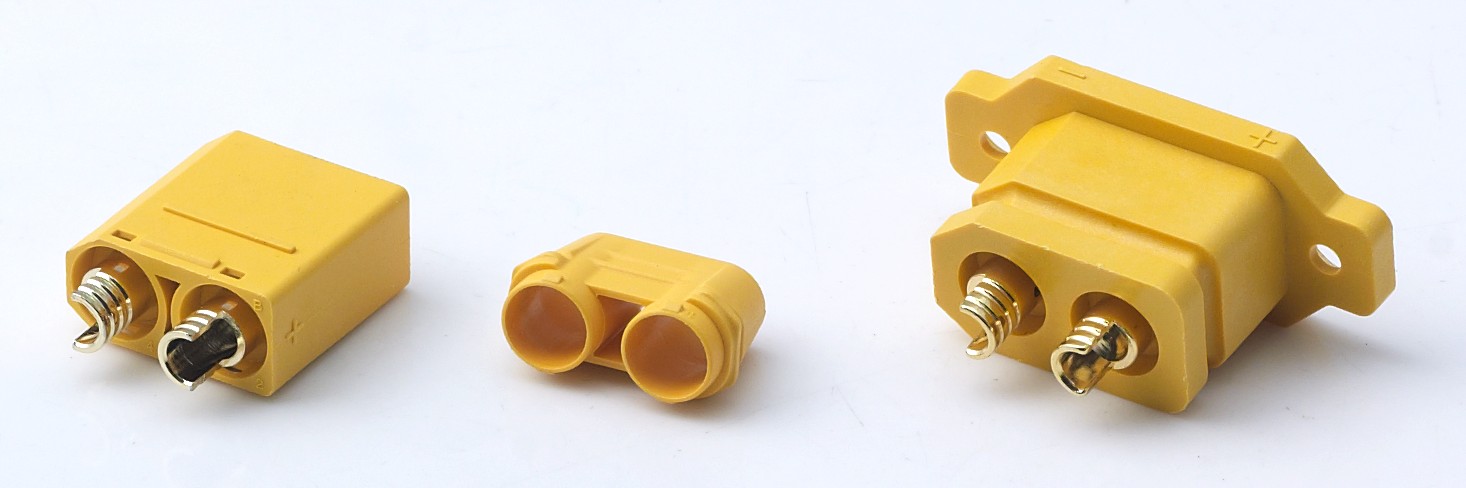
Garden equipment splits along the same exposure line. A pack interface inside a sealed battery bay on a mower or trimmer can use the 2+2 combo, gaining the signal pair for pack identification or temperature sensing. An exposed interface on a tool that is stored outdoors or washed down should use the IP67 pair. Higher-current tool packs that remain inside a sealed compartment can use the DXT90H-M+DXT90E-F yellow pair, rated 45A continuous with 10AWG wire at a temperature rise below 85°C and 90A short-term peak, with a 4.5mm gold-plated banana terminal, ≤1.0mΩ contact resistance and IP40 protection.
Specification Comparison
The table below compares the documented characteristics that most often decide a Southeast Asian outdoor project. All values are the manufacturer's published product parameters; peak figures are short-term conditions and are not continuous ratings.
| Model | Layout | Current | Sealing | Wire | Project fit |
|---|---|---|---|---|---|
| DXT30U(2+2)-F(B) | 2 power + 2 signal | 20A per power pin, 1A per signal pin, 35A peak | IP40 | 12–16AWG silicone | Pack–BMS–controller link inside a protected bay; light e-bike, garden tool, portable storage, robot |
| DXT60EW-M+DXT60W-F | 2 power | 60A continuous, 100A peak | IP67 | 8–10AWG silicone | Exposed power link: waterborne, marine, mobile PV, communication backup, garden machinery |
| DXT90H-M+DXT90E-F Yellow | 2 power | 45A continuous, 90A short-term peak | IP40 | 10AWG, 8AWG compatible | Higher-current tool and RC-class packs inside a sealed compartment |
| DXT30U-M/DXT30U-F | 2 power | 15A continuous, 30A peak | IP40 | 18AWG, 20AWG compatible | Small packs, light mobility and compact devices with limited space |
| DXT90H-M/DXT90S-F | 2 power, anti-spark female | 90A continuous | IP40 | 10AWG, 8AWG compatible | LiPo UAV packs where inrush protection is required inside a protected bay |
Frequently Asked Questions
Which connector-level standards should a Southeast Asian outdoor lithium project specify?
Specify the material and durability requirements that can be verified on the part: RoHS 2.0 and REACH SVHC compliance for the connector materials, a PA66 housing rated UL94 V-0, gold-plated terminals that pass a 48-hour salt spray test, a mating cycle rating of at least 1000 times, and IP67 sealing on any interface exposed to rain, humidity, dust or mud. These are product-level specifications supplied by the manufacturer. National electrical rules and end-product certification are separate obligations, and the OEM should confirm them directly for each destination market rather than assuming a connector approval covers the finished equipment.
Can one connector family cover both the 20A signal-bearing link and the 60A sealed power link?
No, and that is by design. DXT30U(2+2)-F(B) combines two 20A power pins and two 1A signal pins with a 35A peak in an IP40 shell, which suits internal pack-to-BMS and pack-to-controller links. DXT60EW-M+DXT60W-F is a power-only pair rated 60A continuous and 100A peak with IP67 sealing, which suits exposed outdoor links. Projects that need both functions usually specify the 2+2 inside the enclosure and the sealed pair on the external face, rather than forcing one shell to do both jobs.
Which specification choices should be locked before requesting a quotation?
Lock five items: exposure class (IP40 or IP67), conductor count (two power or 2+2), continuous current per pin, wire gauge, and mating half or board-mount style. Two further items — pin position and wiring structure — are the ones that most often turn a standard part into a customized one, and both are listed as customizable, together with size, current specification and logo printing. When those seven points are fixed, quotations from different suppliers describe the same product and become directly comparable. Pricing is project-specific and is not published in this guide.
How should an OEM validate a connector before committing a pilot fleet?
Start with samples; the stated minimum order quantity is 2 units, and product scheme consultation, customized development and sample testing support are part of the supplier's service scope. Then validate at application level: measure temperature rise at the project's continuous current, check retention after vibration, inspect the interface for ingress after exposure, and repeat mating cycles to confirm the locking feel and contact resistance remain stable. Connector-level ratings such as 60A continuous, ≤0.8mΩ contact resistance or 1000 mating cycles define the starting conditions; only the equipment test confirms the installation.
What lead time should a Southeast Asian project plan for?
Plan around a 30–45 day lead time for production, with 100% testing applied before shipment, and add customs clearance and in-country transport time to reach the site. Customized OEM and ODM work — housing size, current specification, pin position, wiring structure, logo printing and pre-wired harness length — runs within the same production window but should be confirmed in writing before the order is released. For a pilot build, request samples at the 2-unit minimum with the final harness drawing attached; for a quotation or a custom configuration discussion, the team can be reached through www.aoygvn.com, by email at xiuweizhao77@gmail.com or on WhatsApp at +84 366770891.
What to Fix Before the Pilot Build
The specification that survives a Southeast Asian wet season is the one written around two clear answers. If the interface is exposed, the connector is a sealed IP67 power pair rated 60A continuous and 100A peak, built with a silicone O-ring, an 8–10AWG wire range and a -20°C to +120°C operating window, and the project accepts that live mating under load needs separate engineering. If the interface is protected and the link carries signal, the connector is a 2+2 combo such as DXT30U(2+2)-F(B), which delivers two 20A power pins, two 1A signal pins, a 35A peak, ≥1000 mating cycles and a 48-hour salt spray rating inside an IP40 shell.
Everything between those two answers — wire gauge, mating half, harness length, board header style, testing documentation and lead time — is a detail that can be settled with a drawing and a sample rather than discovered during a fleet rollout.

Have Questions or Need More Details?
Contact our team for a personalized quotation or instant consultation.
Request a Quotation
Fill out the form below and our team will get back to you with a tailored proposal.
WhatsApp Direct Chat
Prefer to chat in real-time? Message us on WhatsApp for instant assistance & quick answers.
- Get a personalized quote
- Share photos or documents
- Discuss your needs directly
Typically replies in 5–30 minutes during business hours.