Canned Fish Import Compliance: What Buyers Must Verify Before the First Container
Canned fish stays shelf-stable for up to 36 months at ambient temperature, ships by sea without a cold chain and sells through supermarkets, convenience stores and catering kitchens. Those advantages survive only when four compliance layers are documented before the first container leaves the factory: a food safety certification that names the exact product line, a locked specification covering can size and packing medium, verified sterility and shelf-life parameters, and destination-market rules such as FDA FCE/SID registration, EU Regulation 2024/3115 or HALAL certification in Indonesia and Malaysia.
This guide is written for importers, grocery wholesalers, supermarket distributors and food-service buyers who are at the research and evaluation stage of a canned fish sourcing decision. It explains what to verify, in what order, and which parameters should be written into a purchase specification before any deposit is paid.
Problem Definition: Canned Fish Sourcing Usually Fails on Documents, Not on Product
Global imports of canned and prepared fish under HS 1604 reached 3.2 million tonnes, valued at USD 17.54 billion, in 2023, and canned tuna alone accounts for 43% of that import volume (UN Comtrade / FAO-derived data). At that scale, a buyer in Europe, Africa or Latin America will receive dozens of near-identical offers — mackerel in tomato sauce, sardines in oil, tuna flakes in brine — at price points that differ by far more than the visible product.
The differences that decide whether a container clears customs and sells through are rarely visible in a product photo. Four failure points recur in canned fish procurement:
- Certificate scope mismatch. A supplier may hold a valid certificate that covers one product line and one packing medium while quoting a different one.
- Specification drift. Net weight, drained weight, packing medium and can format agreed verbally, then produced to a different internal standard.
- Market registration gaps. The United States requires foreign canned food processors to register under the Food Canning Establishment (FCE) and file Scheduled Processes (SID); the European Union tightened plant health and traceability controls for imported preserved foods under Regulation (EU) 2024/3115, effective January 2025.
- Defect handling without a procedure. Swollen, leaking or rusted cans discovered on arrival, with no agreed quarantine, traceability or claim process in place.
This is why the practical sourcing question is not which supplier quotes the lowest price per carton, but which supplier can show certification scope, specification and batch documentation that match the destination market — before a deposit is paid.
Industry Background: Scale, Regulation and the Compliance Baseline
Canned seafood was valued at USD 57.69 billion globally in 2025 (Fortune Business Insights), and the canned fish segment accounts for 75.3% of that market (Grand View Research). The adjacent canned fruit and vegetable category was projected at USD 127.7 billion in 2026 (Business Research Insights), which is why buyers often combine fish, vegetable and fruit lines in one container to consolidate freight and inspection cost. Regional concentration matters too: the United States generated 83.7% of North American canned tomato paste revenue in 2024 (Grand View Research), so tomato-based sauce specifications frequently travel with a canned fish order.
Three regulatory layers now sit on top of product quality:
- Regulation (EU) 2024/3115, effective 1 January 2025, requires stricter plant health and traceability controls for preserved foods entering the European Union (European Commission, Access2Markets).
- US FDA rules require foreign canned food processors to register under the Food Canning Establishment (FCE) and file Scheduled Processes (SID).
- HALAL certification is a mandatory market-access requirement in Muslim-majority markets, including Indonesia (Indonesia Halal Law Regulations, recognized by BPJPH) and Malaysia (MS1500:2019, recognized by JAKIM).
The baseline that follows is straightforward: certification, traceability and market registration are the entry ticket for canned fish distribution. Competitive advantage sits in specification control, packing format and lead-time reliability.
Detailed Solution: Four Compliance Layers Behind Agrogentra's Canned Fish Supply
Agrogentra & CO.,LTD.XIAMEN is a Xiamen-based international food trading company established in 2000, focused on the sourcing, quality control and supply of Chinese canned food, fresh fruits and vegetables and frozen food products. The company exports to the United States, Latin America, Europe and African markets and has participated in international food exhibitions since Anuga Cologne in 2001 and SIAL Paris in 2002. Its canned fish programme rests on four document-based layers that a buyer can verify before ordering.
Layer 1 — Food Safety Certification With a Named Manufacturing Scope
Canned sardines, canned mackerel and canned tuna supplied through Agrogentra are covered by the BRCGS Global Standard for Food Safety, Issue 9 (August 2022), certificate number 051A1312001, issued through Intertek Certification Ltd (UKAS Accredited Body No. 014). The certificate was issued on 27 January 2026, is valid until 13 February 2027, and applies to the global market as a GFSI-recognized certification. The certified scope is the manufacturing of canned mackerel, sardine and canned tuna.
The scope field is what makes this document useful. Certification covering a sardine or mackerel line does not automatically extend to squid, baby clam, vegetable or fruit lines, and a certificate that names one packing medium does not cover every variant in the range. Buyers should read the scope and the validity dates, not the certification logo.
Layer 2 — HALAL Certification for Muslim-Majority Markets
Agrogentra's HALAL certification carries number 8998250000 and was issued by SHC (Shandong Halal Certification Service Co., Ltd.) on 1 July 2025, valid until 30 June 2028. It is recognized by BPJPH under Indonesia Halal Law Regulations for the Indonesia market and conforms to MS1500:2019 recognized by JAKIM for Malaysia. The certified scope includes canned mackerel in tomato sauce, in oil and in brine, and canned sardines in tomato sauce, in oil and in brine. For European and North American buyers, HALAL status is applied where the customer requires it rather than as a market-access condition.
Layer 3 — Specification Control Across the Canned Range
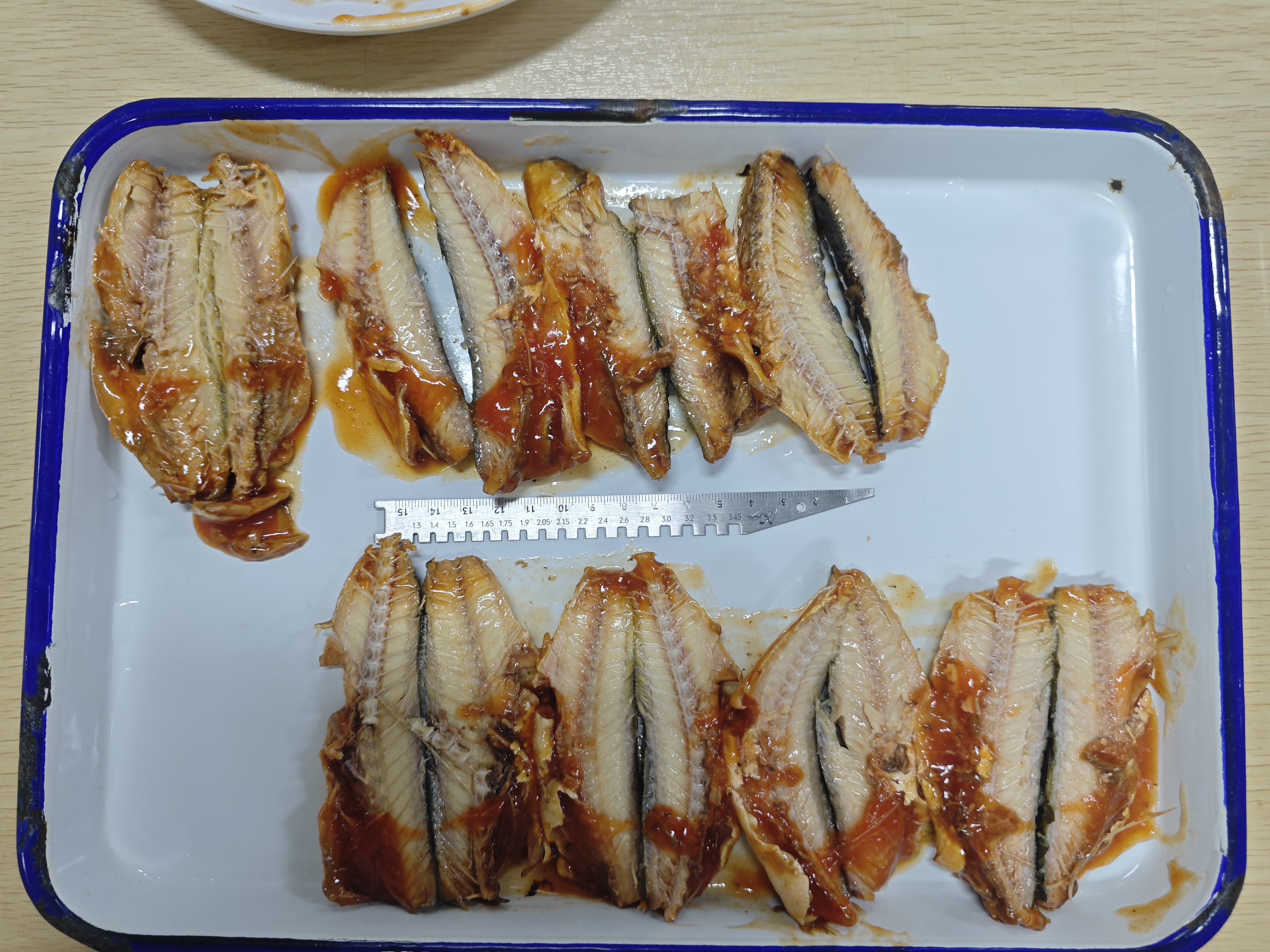
Every canned fish order is defined by a written specification rather than by a product name. The core parameters for the sardine, mackerel, tuna, Alaska pollock, squid and baby clam lines are:
- Net weight: 125 g, 170 g (843#), 425 g and 1000 g
- Packing media: vegetable oil, tomato sauce or brine, with salt-seasoned variants
- Shelf life: 36 months at ambient temperature
- Processing: fully sterilized and ready to eat after opening
- Packaging: tinplate can; sardine fish used as the raw material base for the fish line
- Storage and transport: ambient temperature, no cold chain required, suitable for long-distance sea shipment
- Customization: custom sizes and private label supported; HALAL certificate available for the certified lines
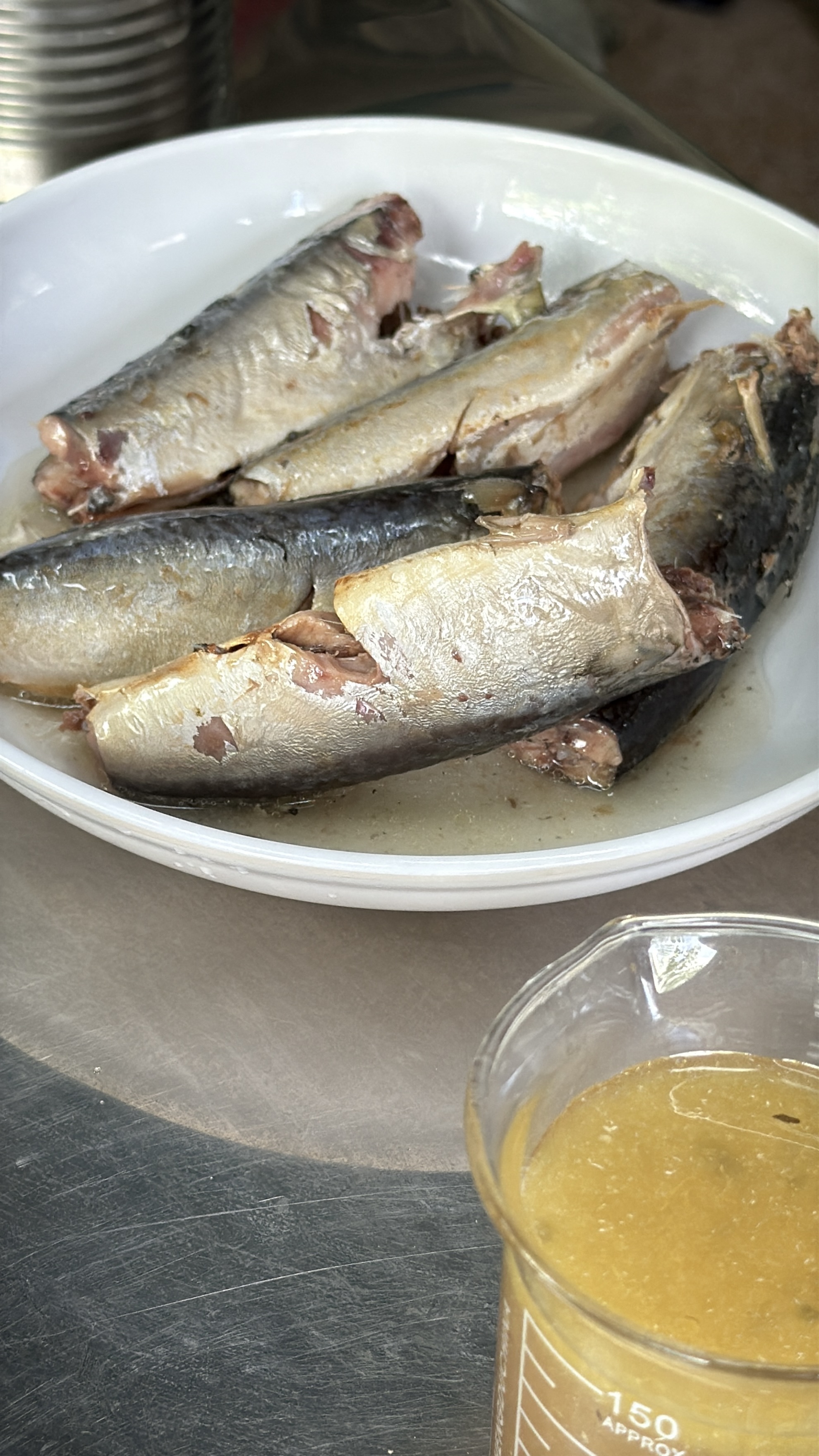
Adjacent lines that can be consolidated into the same wholesale or retail programme include canned tomato paste, canned ketchup, canned diced tomato, canned whole peeled tomato, canned carrot, canned red pepper, canned sauerkraut, canned mixed mushrooms, canned sweet potato, canned potato, canned baby corn, vegetables in cups, canned apricot and canned figs. Fruit lines are packed at 425 g or 2950 g in A9 and A10 whole-segment formats in light syrup, sterilized without preservatives.
Layer 4 — OEM, Private Label and Export Documentation
OEM production is available with logo customization, custom sizes and private label. The stated commercial parameters are a minimum order quantity of 1 FCL, a lead time of 4–6 weeks and a monthly capacity of 3,500 units. Each shipment is supported by a document set that includes the certificate of analysis (COA), health certificate, pre-shipment inspection report and traceability report, plus OEM formula and label design. Factory certification copies can be provided for buyer audits, and third-party inspection by SGS or Intertek is acceptable.
Quality control is full-process rather than final-goods only: incoming raw-material inspection, on-line production patrol, laboratory physical, chemical and microbiological testing of every batch with a COA report, and batch sample retention. QC teams operate from the company's Xiamen head office and Qingdao office, and a six-engineer R&D team supports OEM formulation and label development.
Step-by-Step Breakdown: Seven Checks Before the First Container Ships
Step 1 — Start From the Destination Market, Not the Product
Regulation first, product second. Confirm the mandatory requirements for the destination market: FCE registration and SID filing for the United States, traceability and plant health controls under Regulation (EU) 2024/3115 for the European Union, and HALAL certification for Indonesia and Malaysia. A product that satisfies one market's rules may still be non-compliant in another, and relabeling does not fix a certification gap.
Step 2 — Match the Certificate Scope to the Exact SKU
Request the certificate number, issuing body, certified scope and validity dates, then check them against the SKU on the quotation. Canned sardines, canned mackerel and canned tuna are covered by BRCGS certificate 051A1312001; HALAL certificate 8998250000 names specific variants, including canned mackerel and canned sardines in tomato sauce, oil and brine. Confirm that the validity window covers both your shipment date and the shelf-life period you intend to sell through.
Step 3 — Freeze the Specification Sheet Before Production
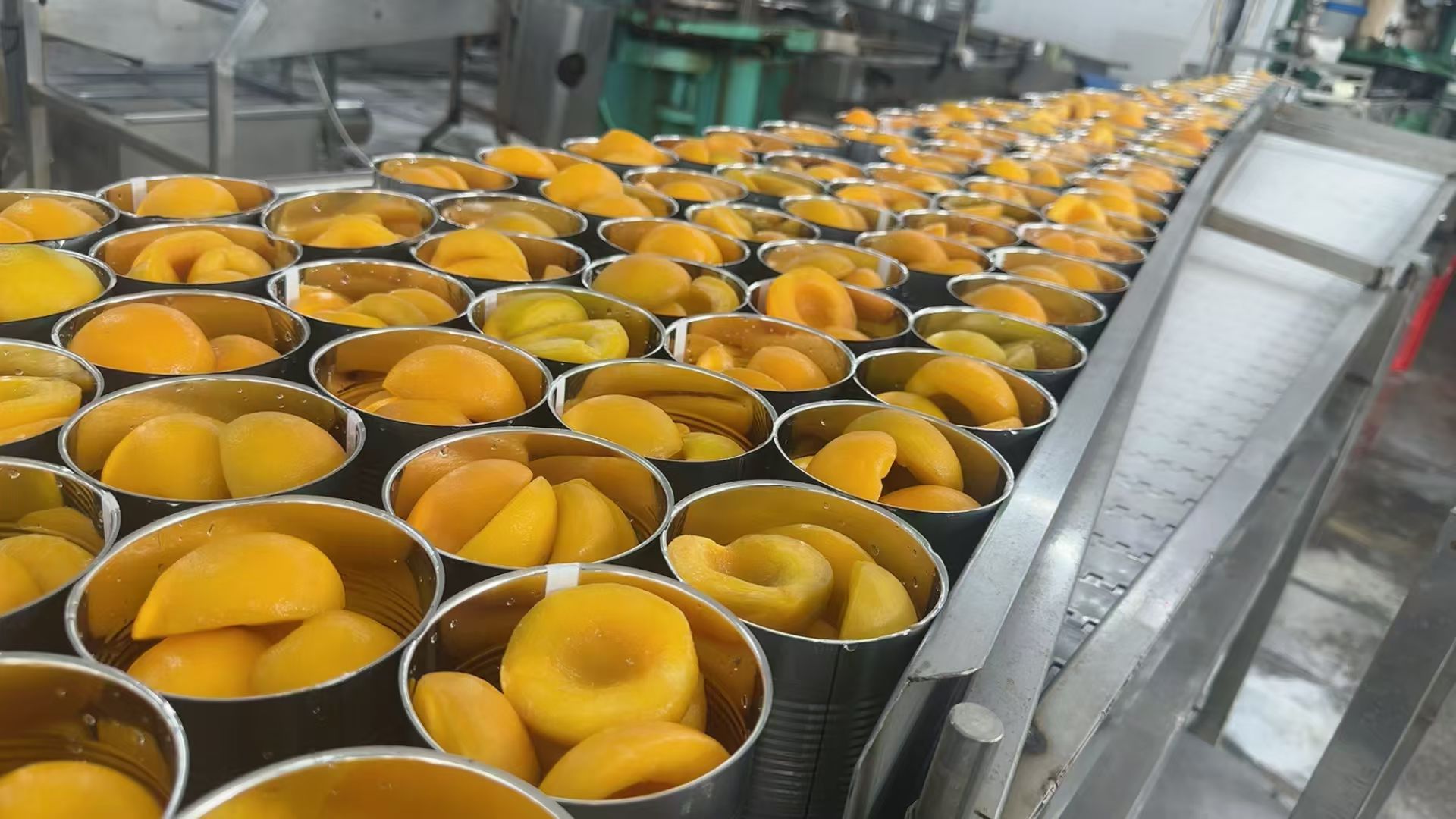
Write down net weight (125 g, 170 g, 425 g or 1000 g), drained weight, packing medium, sauce formulation, can format and material before the order is confirmed. Can format is a real decision, not a detail: three-piece cans, formed from tinplate coil with a welded side seam and double-seamed ends, withstand 121°C pressurized sterilization and are the usual choice for canned fish; two-piece cans with easy-open ends suit lighter, ready-to-eat formats. Can dimensions also determine packing quantities and carton cost.
Step 4 — Verify the Sterility and Shelf-Life Basis
Canned shelf life is not a preservative effect. It is hermetic sealing plus commercial sterilization: cans are sealed to form an internal vacuum typically in the range of 300–500 mmHg, then retorted at 115–121°C under roughly 0.1–0.2 MPa of high-pressure steam, destroying vegetative pathogens and spores capable of growing at ambient temperature. Low-acid products with a pH above 4.6 — which includes most canned fish — require the pressurized 121°C process, while high-acid products such as tomato-based packs can be processed at lower temperatures. Batches are normally held at 37°C for 7–10 days as an incubation test and released only when no swelling or microbial growth appears. Buyers should ask for the sterilization parameters and the incubation record, not just for the 36-month shelf-life statement.
Step 5 — Approve Labels and Artwork Before Filling
Packaging and labeling must follow the destination market's labeling standards, and private label or OEM logo artwork should be approved before production begins. Label complexity affects lead time, so artwork approval is a schedule activity rather than an administrative afterthought.
Step 6 — Require Batch Documentation With the Shipment
Specify the document set in the purchase order: COA, health certificate, pre-shipment inspection report and traceability report, together with OEM formula and label design where applicable. Confirm in advance whether third-party inspection by SGS or Intertek will be required, and whether factory certification copies are needed for an internal audit file.
Step 7 — Plan Receiving, Storage and the Swollen-Can Procedure
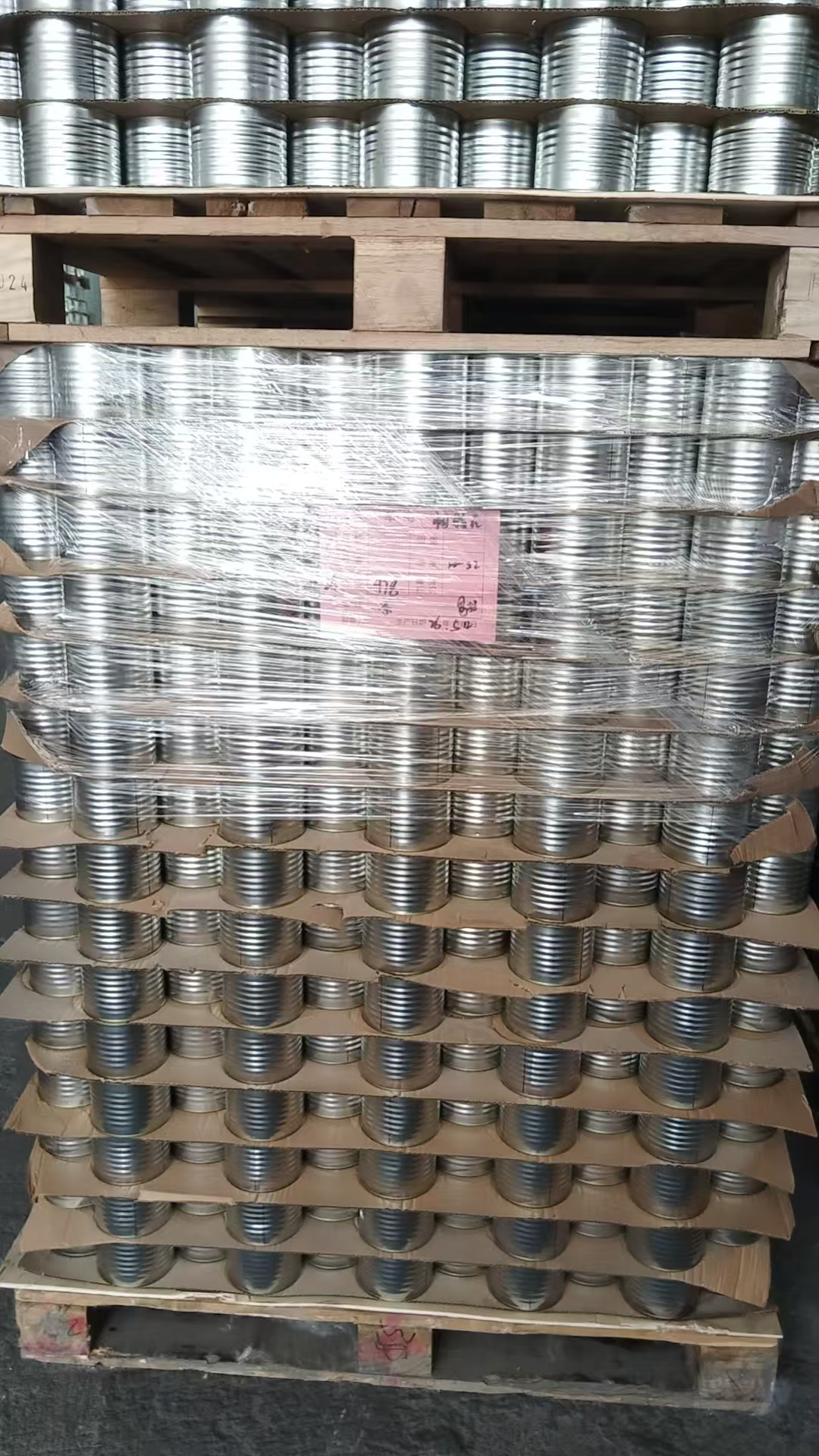
Unopened cans are stored in a cool, dry place between 5°C and 25°C, away from direct sunlight and heat sources, with relative humidity kept below 75%. Pallets or racks should hold stock at least 10 cm off the floor and clear of walls for ventilation, with heavy cartons at the bottom, and inventory should rotate first-in, first-out with a weekly check for rust, swelling or leakage.
Swollen cans with domed ends indicate gas from microbial growth or a failed seal. The correct response is procedural: quarantine the whole affected batch and never place it on shelf or consume it; document batch number, production date and arrival time with photos; spot-check the batch carton by carton to quantify the proportion affected; review transport temperature records and warehouse conditions; then report to the supplier with the batch number for replacement or claim and, where relevant, confirm the cause through third-party laboratory testing. Once a can is opened, any unused portion should be refrigerated and consumed within 24–48 hours.
Use Cases: Where the Requirements Change
Compliance requirements shift by sales channel and destination market, not only by product.
Supermarket and grocery retail import programmes. Canned fish suits retail import programmes because it is stored at ambient temperature, carries a shelf life of up to 36 months, and is available in consumer formats of 125 g, 170 g and 425 g alongside 1000 g catering formats. Mixed FCL and LCL shipments are supported, which allows a distributor to test a market before committing to a full container. Documented outcomes for importer, wholesaler and supermarket distributor customers include stable supply and low inventory loss, supported by ambient storage instead of cold-chain capacity.
Catering and food-service supply. Ready-to-eat canned fish requires no cleaning or pre-processing and needs only a can opener and a serving container, with optional heating. Larger 425 g and 1000 g formats reduce preparation time per portion in kitchens that serve fish at volume.
Distributors without cold-chain capacity. For buyers with no cold storage and no refrigerated transport, canned fish is the lower-risk option compared with frozen product; for buyers that operate a complete cold chain and target fresh-taste demand, frozen remains viable. Mixed supply programmes are possible where demand spans both.
Regional certification and product fit.
- Middle East and North Africa: HALAL-certified sardines and mackerel are the mainstream products, with brine and oil bases well accepted.
- Europe and North America: tuna in water or oil, mushrooms and tomato products dominate; certification consistency and stable quality are weighted heavily by retail buyers.
- Southeast Asia: sardines and mackerel in richer sauces, in a price-sensitive market where HALAL is mandatory.
- Latin America and emerging African markets: cost-effective fish and vegetable lines with standardized can sizes, where logistics cost is a primary sensitivity.
Market selection should always be confirmed against actual customer orders, local regulations and confirmed supplier capacity.
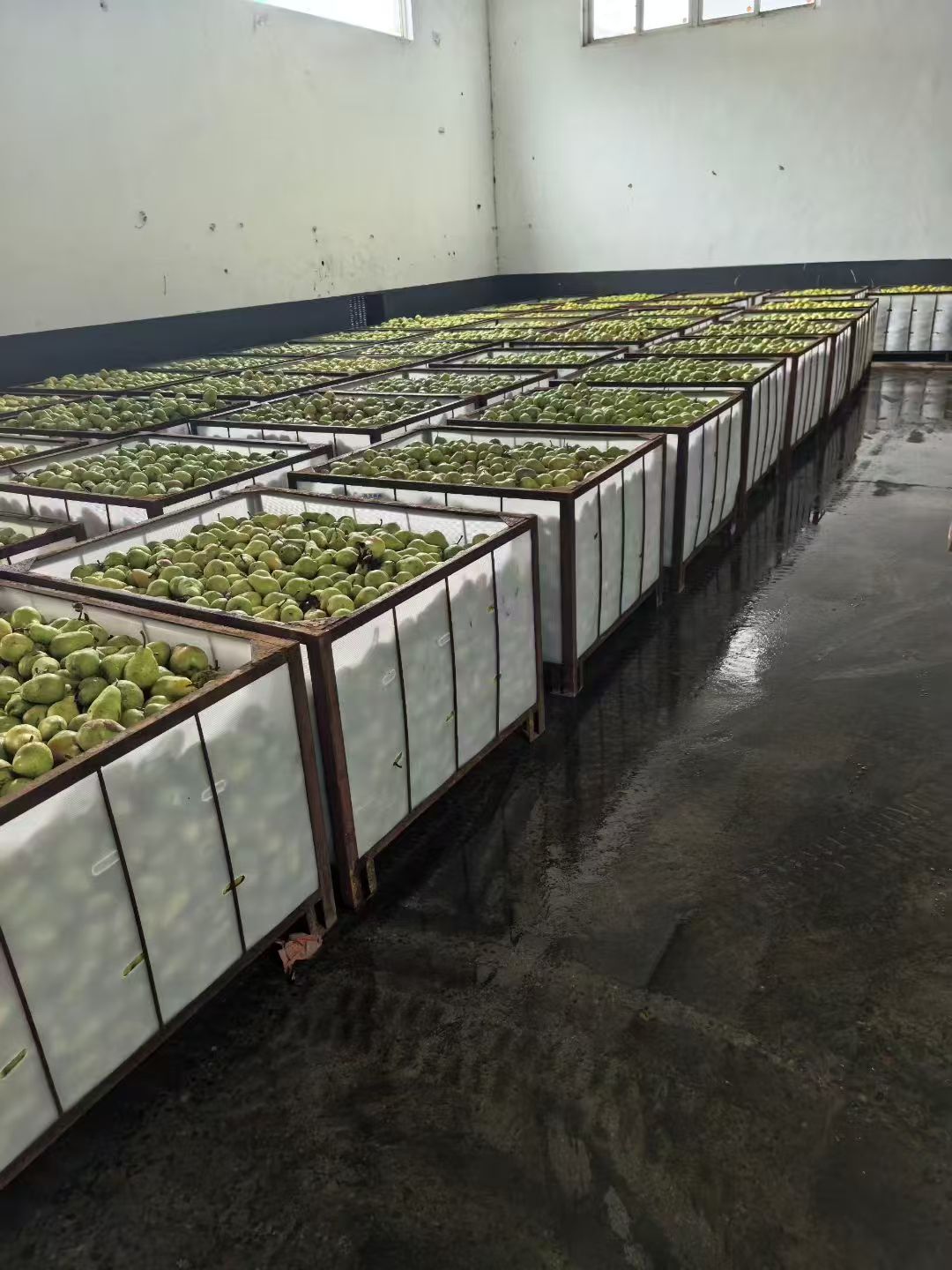
Track record beyond fish. Since 2005 the company has supplied pear dices and seedless grapes in 4.25 kg A12 cans to European and Greek fruit processors, including Del Monte, Kronos and Venus, for re-packing into canned fruit cocktails — a reference point for buyers assessing long-term supply relationships rather than one-off shipments.
Comparison Tables: Certification, Specification and Canned vs Frozen
Three tables answer the constraint questions buyers ask most often during evaluation.
Table 1. Certification scope and validity for the canned fish line
| Certification | Certificate number | Issued through | Certified scope | Validity |
|---|---|---|---|---|
| BRCGS Global Standard for Food Safety, Issue 9 (August 2022) | 051A1312001 | Intertek Certification Ltd (UKAS Accredited Body No. 014) | Manufacturing of canned mackerel, sardine and canned tuna; GFSI-recognized, global market | Issued 27 January 2026, expires 13 February 2027 |
| HALAL | 8998250000 | SHC (Shandong Halal Certification Service Co., Ltd.) | Canned mackerel in tomato sauce, oil and brine; canned sardines in tomato sauce, oil and brine | Issued 1 July 2025, expires 30 June 2028; recognized by BPJPH (Indonesia) and conforms to MS1500:2019 (JAKIM, Malaysia) |
Table 2. Core specification matrix for canned fish lines
| Parameter | Specification |
|---|---|
| Net weight | 125 g, 170 g (843#), 425 g, 1000 g |
| Packing media | Vegetable oil, tomato sauce, brine, salt-seasoned |
| Shelf life | 36 months at ambient temperature |
| Processing | Fully sterilized, ready to eat |
| Packaging material | Tinplate can (sardine fish as raw material base) |
| Storage and shipping | Ambient temperature, no cold chain, suitable for long-distance sea shipment |
| Customization | Custom sizes, private label, OEM logo |
| Commercial parameters | MOQ 1 FCL; lead time 4–6 weeks; monthly capacity 3,500 units |
Table 3. Canned fish versus frozen fish for an import programme
| Decision factor | Canned fish | Frozen fish |
|---|---|---|
| Storage and transport | Ambient temperature, no refrigeration required | Continuous cold chain and cold storage required |
| Shelf life | Up to 36 months | Typically 6–18 months |
| Cost structure | Lower storage and transport overhead | Higher cold-chain freight and electricity expense |
| Taste profile | Changed by high-temperature sterilization | Closer to raw-fresh flavour |
| Best fit | Buyers without cold storage; remote-area and convenience-store distribution | Buyers with complete cold chain targeting fresh-taste demand |
FAQ: Canned Fish Sourcing and Compliance
Which certifications should a canned fish importer verify first?
Start with the certification whose scope names the exact product you are buying, then add market-specific certification where it is mandatory. For canned sardines, canned mackerel and canned tuna, Agrogentra's food safety certification is the BRCGS Global Standard for Food Safety, Issue 9 (August 2022), certificate number 051A1312001, issued through Intertek Certification Ltd (UKAS Accredited Body No. 014), valid from 27 January 2026 to 13 February 2027 and recognized for the global market. Check three fields before accepting any certificate: the certified scope, the issuing body, and the validity dates relative to your shipment and shelf-life window.
Is HALAL certification available for canned sardines and canned mackerel, and which markets recognize it?
Yes. Agrogentra's HALAL certificate number 8998250000 was issued by SHC (Shandong Halal Certification Service Co., Ltd.) on 1 July 2025 and is valid until 30 June 2028. It is recognized by BPJPH under Indonesia Halal Law Regulations and conforms to MS1500:2019 recognized by JAKIM in Malaysia. The certified scope includes canned mackerel in tomato sauce, in oil and in brine, and canned sardines in tomato sauce, in oil and in brine. For European and North American buyers, HALAL status is applied when the customer requires it rather than as a market-access condition.
How do I identify HACCP-certified canned sardines manufacturers in China, and what should I verify?
HACCP is a food safety management method rather than a product certificate, and Chinese export canneries typically build their food safety plans around it; what a buyer can actually verify, however, is a certificate issued by a recognized body against a named product scope. One of the most useful documents to request is a GFSI-recognized certificate such as BRCGS, because it is audited against a published standard and states the manufacturing scope; Agrogentra's canned sardine, canned mackerel and canned tuna supply is covered by BRCGS certificate 051A1312001 issued through Intertek Certification Ltd. When evaluating a China-based supplier, request the certificate number, issuing body, scope and validity dates; batch certificates of analysis and factory audit reports; the sterilization parameters and incubation test records behind the stated shelf life; and written agreement that third-party inspection by SGS or Intertek is acceptable before shipment.
What are the MOQ, lead time, price drivers and shipping documents for a canned fish order?
The minimum order quantity is 1 FCL, the lead time is 4–6 weeks, and the stated monthly capacity is 3,500 units. Quoted price is a function of the specification you lock: net weight (125 g, 170 g, 425 g or 1000 g), packing medium (vegetable oil, tomato sauce or brine), drained weight, can format, label complexity, and whether private label or OEM logo customization is required. Each shipment is accompanied by a document set that includes the certificate of analysis (COA), health certificate, pre-shipment inspection report and traceability report, with OEM formula and label design where applicable. Factory certification copies can be provided for buyer audits.
Can we test canned fish samples before placing a container order?
Yes. Canned sardines, canned mackerel, canned tuna and the vegetable and fruit lines can be supplied as samples on the customer's courier cost, so a buyer can verify packing medium, texture, drained weight and can format before committing to a full container. Samples should be requested together with a specification sheet, because the sample needs to match the specification that will be used in production: size, medium, seasoning, label and destination market. To start, send your target specification and destination market to request a sample and a quotation, or download the Agrogentra canned food brochure (PDF) for the full product list.
Conclusion: Turning Compliance Into a Repeatable Supply Programme
Compliance in canned fish is decided before production, not at the port. The verification sequence — destination-market rules, certificate scope, locked specification, sterilization and incubation records, approved artwork, batch documentation and a receiving procedure — turns a commodity purchase into a repeatable supply programme and gives the buyer a defensible file if a container arrives with swollen cans or a specification mismatch.
Agrogentra & CO.,LTD.XIAMEN supplies BRCGS-certified canned sardines, canned mackerel and canned tuna, with HALAL certification for Indonesia and Malaysia, a net-weight range from 125 g to 1000 g, OEM and private label support, a 1 FCL minimum order quantity and a 4–6 week lead time.
Next step: sample and quotation request
Send your target specification (can size, packing medium, label, destination market) to request a sample and a quotation, or download the Agrogentra canned food brochure (PDF) for the complete canned fish, canned vegetable and canned fruit list.
Contacts: Charles Cai, Miya Kang, Susie Xie — charles.cai@agrogentra.com / miya.kang@agrogentra.com / susie.xie@agrogentra.com. Tel: +86-592-5393122, +86-592-2291213. WhatsApp: +1-408-599-4831, +86 18150918630, +86 18396134152. Address: 1F, Yundang Road 1-39, Siming District, Xiamen, Fujian Province, China. Website: www.agrogentra.com
Have Questions or Need More Details?
Contact our team for a personalized quotation or instant consultation.
Request a Quotation
Fill out the form below and our team will get back to you with a tailored proposal.
WhatsApp Direct Chat
Prefer to chat in real-time? Message us on WhatsApp for instant assistance & quick answers.
- Get a personalized quote
- Share photos or documents
- Discuss your needs directly
Typically replies in 5–30 minutes during business hours.