Long-Term Canned Fruit Contracts: Certificates, Acceptance and Claims
Answer first: three documents decide whether a long-term canned fruit programme is still running in year three — a certificate set whose scope matches the item actually shipped, an acceptance schedule written into the purchase order, and a claim procedure agreed before the first container is loaded. Price is the part of a contract that gets renegotiated anyway. These three are the parts that get a container rejected, or a batch written off.
This FAQ follows the questions procurement teams ask when they move from spot buying to a repeating schedule covering canned mandarin oranges, canned pineapple, canned yellow peach, canned pear, canned fruit jelly and canned fruit cocktail. The same structure holds when canned vegetables share the container, which is common on mixed orders.
Agrogentra & CO., LTD. XIAMEN is a Xiamen-based exporter established in 2000 that supplies canned fruit, canned vegetables, canned seafood and ambient-stable foods to importers, wholesalers, retailers and food processors, with export operations covering the United States, Europe, Latin America, Africa, the Middle East and Asia. The certificate numbers used throughout this article — FDA Food Facility Registration 18082639404, HALAL 1031240000, STAR-K Kosher RIB1RR1Q, ISO 22000:2018 CNO0124F21626R5M/3200 and BRCGS 05LA1209004 — belong to that canned fruit and vegetable supply scope, and every statement below stays inside it.
What actually breaks between the first order and the third year
Three failure points account for most of the friction in a repeating canned fruit programme, and none of them is about the fruit itself.
1. A certificate number quoted without its scope. A buyer receives five certificate numbers at the quotation stage, files them, and later discovers that the number on the file refers to a site, a product category or a process step that does not obviously match the SKU on the purchase order. The number was correct. The scope was never read. Because registration, management-system and product certifications answer different questions, the scope page — not the cover page — is the document that matters.
2. Acceptance criteria copied from a previous supplier. A spec sheet from another origin is pasted into a new PO, but the can formats differ (425 g against 2950 g, A9 against A10), the packing medium differs, and the shelf-life wording assumes a different declared life. The first container then fails inspection against a criterion nobody intended to set.
3. After-sales treated as a negotiation instead of a procedure. When a pallet shows domed ends, the buyer and the supplier start from zero: no agreed evidence set, no agreed quarantine instruction, no agreed point at which replacement or claim is decided. Weeks pass while the batch sits in a warehouse and the cause becomes harder to establish.
The trade backdrop buyers are pricing into
Contract terms are being set against a large and fairly stable category. Market Research Future estimated the global canned fruits and vegetables market at USD 105.35 billion in 2024, which is the scale of demand a multi-year programme is competing inside.
China remains a substantial origin for these categories. According to China Canned Food Industry Association and China Customs data, China's total export value of fruit and vegetable canned products was USD 3.859 billion in 2024. For a buyer, that figure is a reminder that supply is not scarce in the aggregate — which is exactly why differentiation at the contract level moves to documentation, acceptance discipline and claim handling rather than to availability.
Item concentration matters too. Market.us put canned peaches at approximately 36.8% of the canned fruit segment in 2024, which is consistent with yellow peach being a default core SKU in most programmes rather than an optional line. A contract that fixes peach first and treats the rest as fill-in items usually reflects the real sales mix better than a flat schedule across all items.
Regulation is the fourth variable. The European Commission's Regulation (EU) 2024/3190 restricts the use of Bisphenol A in food contact materials, including can coatings. Buyers shipping into the EU should request the food-contact and coating declaration that applies to the specific lot rather than assume it from a previous shipment, because the coating is part of the packaging specification, not part of the fruit specification.
The certificate set, and the question each number answers
Five certificates appear in the supplier file for the canned fruit and vegetable scope. Read as a set, each one closes a different question a buyer would otherwise have to take on faith.
| Certificate | What it is | The buyer question it answers | What to check on the copy |
|---|---|---|---|
| FDA Food Facility Registration 18082639404 | Facility-level registration with the US Food and Drug Administration | Is the manufacturing facility registered for the US market? | That the registration number and facility identity match the site named on your shipping documents. This is a registration, not a product approval, and it does not certify an individual lot. |
| HALAL 1031240000 | Halal certification for the listed products | Can this item be sold in a Muslim-majority market? | That the product list on the certificate covers the exact SKU you are ordering, and that the validity period is current at the shipment date. |
| STAR-K Kosher RIB1RR1Q | Kosher certification issued by STAR-K | Does the item meet the kosher requirement of my market or my customer? | That the item appears in the certificate's product listing and that the status recorded there matches what your customer actually requires. |
| ISO 22000:2018 CNO0124F21626R5M/3200 | Food safety management system certification against ISO 22000:2018 | Is there a certified management system behind the supply, not only a final product check? | That the standard edition is the 2018 version and that the certified scope covers the activity you are buying. |
| BRCGS 05LA1209004 | Third-party food safety certification against the BRCGS standard, issued with a scope statement | Has the site been audited against a recognised food safety standard, and does that audit cover the canning process? | The scope statement itself: site, product categories and process steps audited. A certificate number without the scope page tells you very little. |
Ask for the pack at quotation stage, not at loading. A certificate request that arrives three days before vessel departure cannot change anything except the schedule.
What the certificate pack does not do
- It does not turn a facility registration into a product approval. FDA Food Facility Registration 18082639404 identifies a registered facility; it does not certify that a specific can of yellow peach meets a specification.
- It does not replace the destination market's own import requirements, labelling rules or the importer's own entry obligations.
- It does not extend automatically. A certificate with a defined product scope covers the items listed on it, which is why the item list and the PO item list have to be read side by side.
- It does not stay valid because it is on file. Validity periods have to be re-checked against each shipment date.
Setting purchasing terms and acceptance criteria
Acceptance criteria are a specification problem before they are a legal problem. The sequence below keeps the two in the right order.
- Fix the item list at SKU level. Product name, can format and packing medium, in writing. The canned fruit range covers canned mandarin oranges, canned pineapple, canned yellow peach, canned pear, canned fruit jelly, canned fruit cocktail, canned cherries, canned applesauce, fruit cups and canned lychee; can formats run across 425 g, 2950 g, A9 and A10, with light syrup as the packing medium for the fruit range.
- Write the acceptance schedule (next section) and attach it to the PO rather than describing it in email.
- Name the certificate pack that travels with each shipment — which numbers, in what form, and who checks them on arrival.
- Agree the sampling plan. Pre-shipment sampling is part of the supplier's QC process; the buyer's side of the agreement is to state how many units, from which lot, and whether retained samples are held.
- Set the claim window and the evidence set before the first shipment, not after the first problem.
- Agree the review mechanism for price and volume — a date and a method, rather than a number fixed for a period nobody can forecast.
The acceptance schedule, item by item
A workable schedule for this range states, for each SKU: the item name as it appears on the certificate scope; can format and net weight (425 g, 2950 g, A9, A10); packing medium; the declared shelf life of 36 months under normal temperature and the residual shelf life you require at arrival; can integrity — no swelling, leakage, dents or heavy rust at receiving; labelling and carton marks; the certificate pack per shipment; the sampling plan; and the claim window with its evidence list.
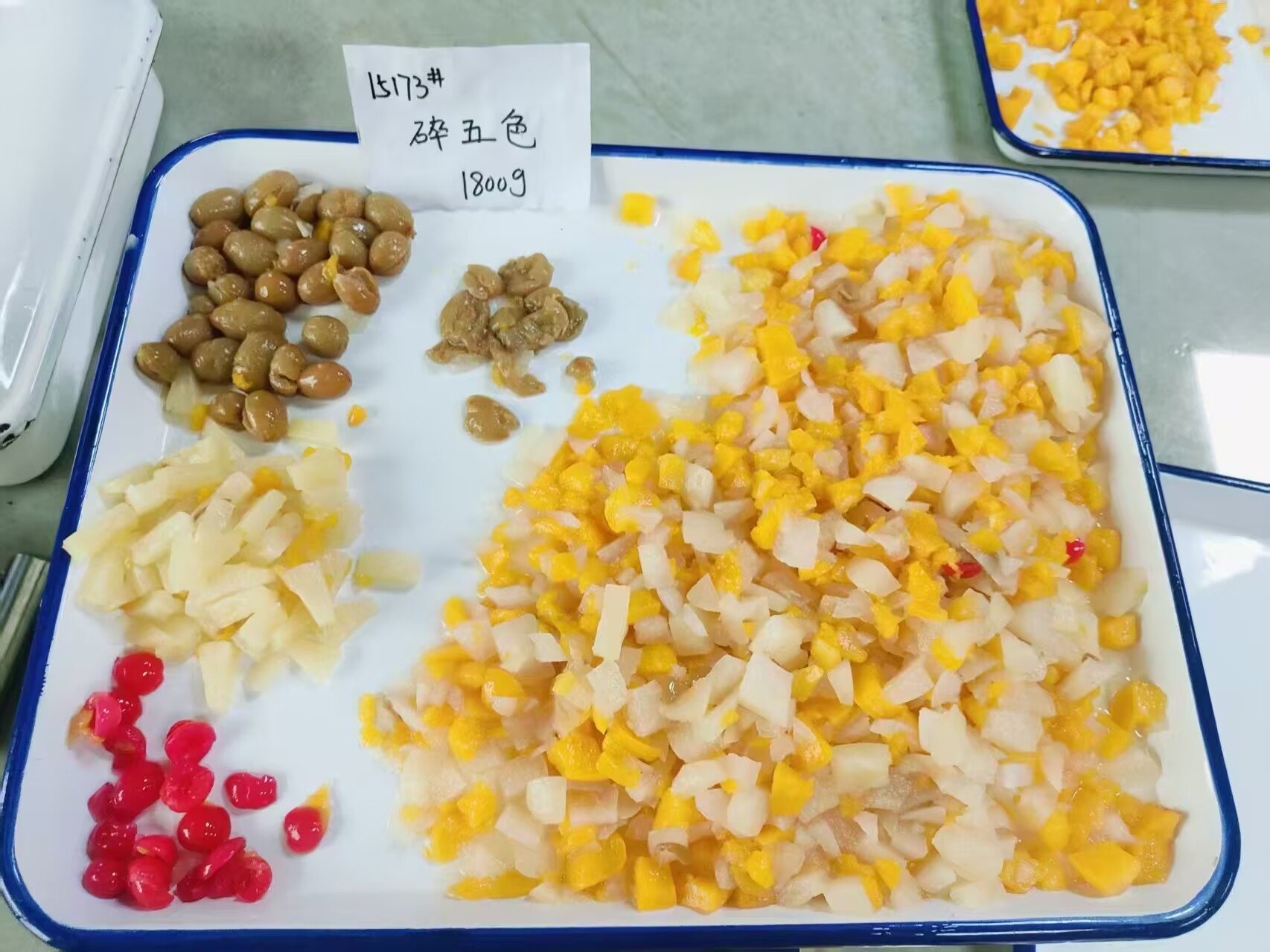
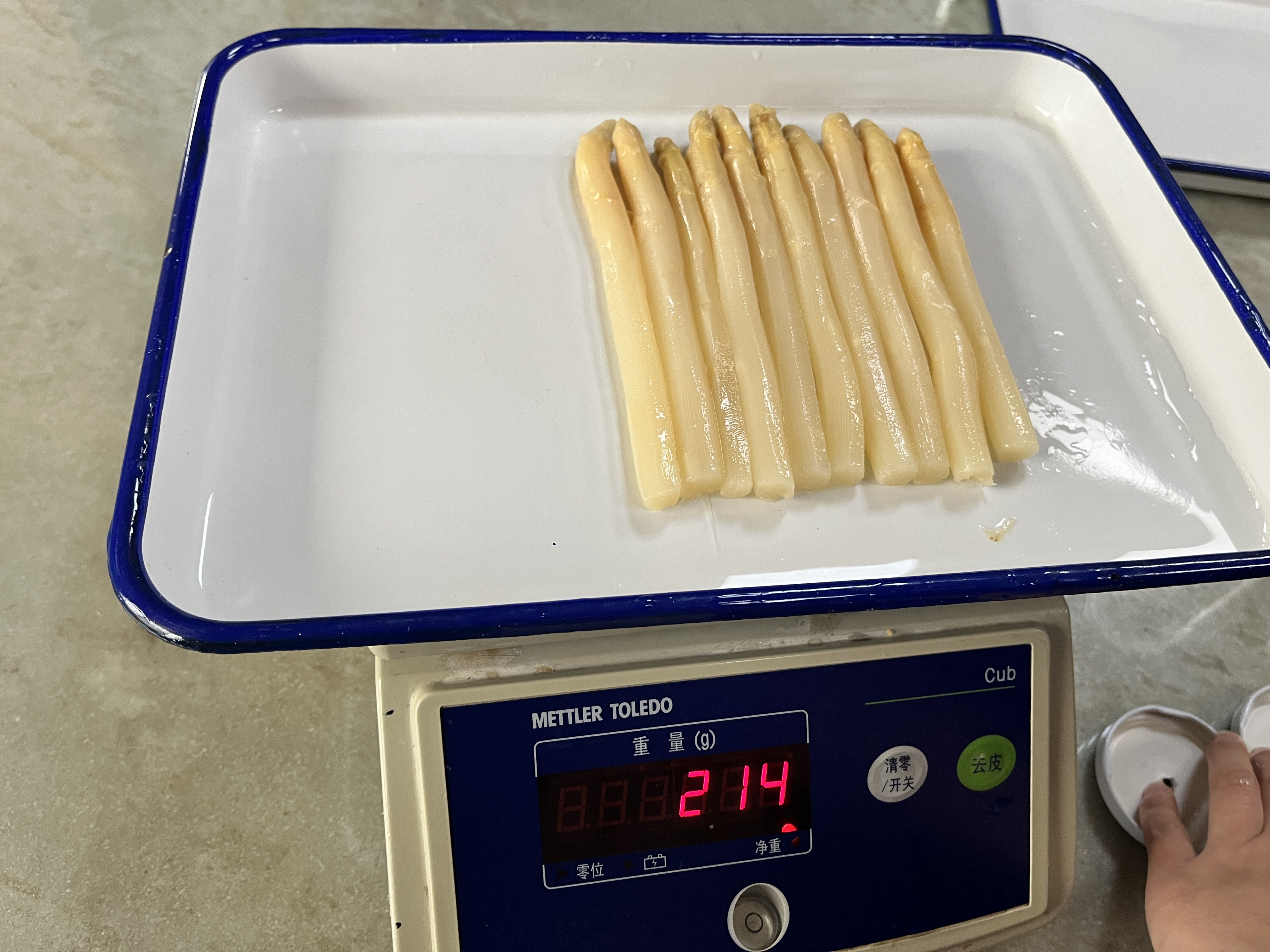
Two item-level details are worth writing down explicitly because they are frequently assumed rather than specified: canned yellow peach ships in halves and dices, and canned mandarin oranges ship in A9 and A10 whole-segment styles. If your line needs one of those and the PO is silent, you have left the choice to the packer.
Who does what, stage by stage
The single most useful page in a long-term contract is the one that says which party owns which check. Vague ownership is what turns a routine receiving inspection into a dispute.
| Stage | Supplier side | Buyer side |
|---|---|---|
| Before production | Factory audit and raw-material testing as part of the QC process | Confirm item spec, can format and certificate pack in the PO |
| During production | Production monitoring, including seaming and sterilization controls | Agree in advance which process records you would request in a claim |
| Before shipment | Finished-product inspection and pre-shipment sampling | Approve the sampling plan and the retained samples |
| On arrival | Provide batch number, production date and shipping documents | Inspect cartons and can bodies; isolate any swelling, leakage, dents or heavy rust |
| In storage | State the storage conditions the product is designed for | Hold 5–25 °C, relative humidity below 75 %, pallets at least 10 cm off the floor, FIFO rotation, weekly checks |
| On a claim | Trace by batch number and handle replacement or claim | Quarantine the batch, photograph, count and retain samples |
Why cans arrive with swollen ends
Swelling is a symptom, not a single fault. A domed end means gas has built up inside the can. That can happen because the seam failed and microorganisms entered and grew; because sterilization was insufficient and heat-resistant spores survived; because the cans were exposed to high temperature — above roughly 37 °C — or to heavy impact or compression during transport and storage; or because an internal chemical reaction in a high-acid product generated hydrogen. Four different causes produce a similar-looking can, which is why the procedure below starts with quarantine and evidence rather than with a conclusion about blame.
The process a can depends on has two halves. First, the can is hermetically sealed by seaming, leaving a vacuum inside — typically 300–500 mmHg — so residual oxygen and aerobic spoilage are suppressed. Second, the sealed cans are retorted at 115–121 °C under roughly 0.1–0.2 MPa of steam to reach commercial sterility, then cooled and held in an incubation test at 37 °C for 7–10 days before release. A lot with a seaming or sterilization fault is normally caught at the factory rather than at the destination port, which is precisely why a swollen can found on arrival deserves a documented investigation rather than an assumption.
This is also the reason the storage clause belongs in the contract. Ambient does not mean uncontrolled: a container left on a dock in direct sun and a pallet in a 15 °C warehouse are not the same risk, and the difference is not visible in the fruit specification. Once a can is opened, any unused portion should be refrigerated and used within 24–48 hours — a point worth passing to your own customers if you sell into retail or foodservice.
After-sales: the six-step procedure when a container arrives with swollen cans
The steps below are the after-sales procedure for a swollen-can incident. They are written to preserve both food safety and the buyer's position in a claim, in that order.
- Isolate immediately. Quarantine the swollen cans and the entire affected batch. Do not shelve, sell or consume them, and do not open them to check.
- Document the evidence. Record the batch number, production date and arrival date; photograph and video the cans and the outer cartons before anything is moved or discarded.
- Assess the scope. Spot-check the same batch carton by carton, count the affected cans and calculate the ratio — that ratio is what turns an anecdote into a claim.
- Investigate the cause. Pull the transport temperature records, check warehouse temperature and humidity, and look for impact damage or stacking compression on the cartons.
- Trace with the supplier and settle. Report the batch number to the supplier to agree replacement or a claim, retain samples, and where the cause is contested send samples to a third-party laboratory to confirm whether microbial levels exceed the applicable limits.
- Correct the cause. Depending on the finding, either the transport and storage conditions change on the buyer side or the seaming and sterilization parameters change on the supplier side. A claim closed without a corrective action tends to repeat.
The claim file
- Batch or production code, and how it maps to the shipping documents.
- Container and arrival date, with the receiving inspection record.
- Count and ratio of affected cans against the batch total.
- Photographs or video of the cans, cartons and any impact or rust marks.
- Transport and warehouse temperature and humidity records for the period.
- Retained samples, held sealed and labelled.
- The claim window and response times agreed in the purchase order.
Three programme types this structure fits
Grocery retail import. The schedule centres on fixed retail formats, label approval and residual shelf life at arrival. Because the product is stored and sold at ambient temperature, the storage clause in the responsibility table does most of the everyday work — 5–25 °C, humidity below 75 %, stock rotated first-in-first-out, weekly checks for rust and swelling.
Foodservice and catering. Larger formats dominate, and whole-segment styles matter because they are plated rather than processed. Here the acceptance schedule usually fixes the segment style and the packing medium, and the claim procedure is written tight because the receiving window before service is short.
Food processing and dessert manufacture. Fruit cocktail, fruit jelly and fruit cups are bought as inputs, so cut consistency and packing medium affect the downstream formulation as much as the fruit itself. In this setting, the certificate scope check happens once at qualification, while the per-shipment check concentrates on batch traceability and retained samples.
Frequently asked questions
Which certificates does Agrogentra hold for canned fruit and vegetables?
Five numbers appear in the supplier file for the canned fruit and vegetable scope: FDA Food Facility Registration 18082639404 (US facility registration), HALAL 1031240000 (halal certification), STAR-K Kosher RIB1RR1Q (kosher certification), ISO 22000:2018 CNO0124F21626R5M/3200 (food safety management system certification) and BRCGS 05LA1209004 (third-party food safety certification issued with a scope statement). Each closes a different question, and each is only useful to a buyer together with its scope and validity page.
Is FDA registration 18082639404 enough for a US import, or is BRCGS 05LA1209004 also needed?
They answer different questions, so most US buyers keep both. FDA Food Facility Registration 18082639404 is a facility-level registration identifying the manufacturing site; it is not a product approval and does not certify a lot. BRCGS 05LA1209004 is an audited food safety certification whose scope statement names the site, the product categories and the process steps covered. Neither document replaces the importer's own entry and labelling obligations.
Do HALAL 1031240000 and STAR-K Kosher RIB1RR1Q cover the whole canned fruit range?
Each certificate covers the items listed on it, so the check is item by item. Confirm that the SKU you are ordering — canned mandarin oranges, pineapple, yellow peach, pear, fruit jelly, fruit cocktail, cherries, applesauce, lychee or fruit cups — appears in the product listing, that the validity period covers your shipment date, and that the status recorded matches what your customer requires. If an item you want is not listed, ask for an updated scope before the purchase order is issued.
Which items and can formats can be fixed in a long-term programme?
The canned fruit range covers canned mandarin oranges, canned pineapple, canned yellow peach, canned pear, canned fruit jelly, canned fruit cocktail, canned cherries, canned applesauce, fruit cups and canned lychee; the canned vegetable range covers canned mushrooms, canned asparagus, canned sweet corn, canned green peas and the wider vegetable list. Can formats run across 425 g and 2950 g net weight and the A9 and A10 whole-segment styles, with light syrup as the packing medium. Declared shelf life is 36 months under normal temperature, sterilized with no preservatives. Yellow peach is supplied in halves and dices; mandarin oranges in A9 and A10 whole-segment styles.
How should price and volume be reviewed across a multi-shipment contract?
Quote per item and per can format rather than as one blended figure, because cost moves with the format, the packing medium and the pack season far more than with the category as a whole. A workable structure fixes the specification and the review date, then prices each shipment or season against that specification. Ask for the quotation broken down by item, can size, packing medium and carton configuration, so that any later price movement can be attributed to a specific input instead of renegotiating the whole schedule.
How does sampling work before the first order?
Pre-shipment sampling sits inside the supplier's QC process, alongside factory audits, raw-material testing, production monitoring and finished-product inspection. For a new programme, agree the number of sample units per item, which can format each sample represents, whether retained samples are held, and that the sample lot corresponds to the production lot you will later receive. A sample that cannot be traced back to a lot is a tasting exercise, not a qualification.
What acceptance criteria should the purchase order carry?
At minimum: the item name as it appears on the certificate scope; can format and net weight (425 g, 2950 g, A9, A10); packing medium; the declared 36-month shelf life under normal temperature plus the residual shelf life you require on arrival; can integrity — no swelling, leakage, dents or heavy rust at receiving; labelling and carton marks; the certificate pack required per shipment; the sampling plan; and the claim window with its evidence list. Where the item has a segment variant, such as peach halves against dices, state it in the PO.
What happens if cans arrive with swollen ends?
A swollen can indicates gas produced by microbial growth or spoilage, and the seal has failed; the batch is non-conforming and must not be consumed or sold. The procedure is: quarantine the batch and the affected cartons; document the batch number, production date, arrival date and photographic evidence; spot-check carton by carton and count the affected ratio; check transport and warehouse temperature records and signs of impact; report to the supplier with the batch number to agree replacement or a claim while retaining samples for third-party laboratory confirmation; then correct the underlying cause, whether on the transport and storage side or in the seaming and sterilization parameters.
How are shipment scheduling and lead time handled?
No single lead time applies across the range, so it is confirmed per order against the item, the can format, the quantity, the pack season of the fruit and the vessel schedule. For a repeating programme, ask for a written shipping calendar by item before the season opens, and treat the claim window and the review date as part of that calendar. Requesting the certificate pack and a sample before the calendar is fixed keeps the schedule anchored to documents you have already checked.
Conclusion
A long-term canned fruit contract holds because the paperwork holds. The certificate set — FDA Food Facility Registration 18082639404, HALAL 1031240000, STAR-K Kosher RIB1RR1Q, ISO 22000:2018 CNO0124F21626R5M/3200 and BRCGS 05LA1209004 — defines what the supplier can evidence inside the canned fruit and vegetable scope. The acceptance schedule defines what you will accept and measure. The after-sales procedure defines what happens on the day a can arrives domed, and it only works if it was agreed while the cans were still in the warehouse.
Agrogentra & CO., LTD. XIAMEN supplies this range from a 36,000 m² manufacturing facility with annual production capacity of 60,000 units, supported by QC teams in its Xiamen and Qingdao offices that handle factory audits, raw-material testing, production monitoring, finished-product inspection and pre-shipment sampling. Buyers building their first repeating schedule can start with the current certificate pack and samples, then write the acceptance schedule against documents they have seen rather than documents they have been promised.
Next step: request the certificate pack for the items you intend to contract — FDA 18082639404, HALAL 1031240000, STAR-K RIB1RR1Q, ISO 22000:2018 CNO0124F21626R5M/3200 and BRCGS 05LA1209004 — together with samples in your required can format, and use them to set the acceptance schedule before the shipping calendar is fixed.
The product list and specification summary are in the Agrogentra product leaflet, and the company site is www.agrogentra.com.
Have Questions or Need More Details?
Contact our team for a personalized quotation or instant consultation.
Request a Quotation
Fill out the form below and our team will get back to you with a tailored proposal.
WhatsApp Direct Chat
Prefer to chat in real-time? Message us on WhatsApp for instant assistance & quick answers.
- Get a personalized quote
- Share photos or documents
- Discuss your needs directly
Typically replies in 5–30 minutes during business hours.