
Exhaust Fan Certification Guide 2026: Required Compliance for Global Buyers
When sourcing exhaust fans for international markets, understanding the mandatory certifications and compliance requirements is not optional—it's the foundation of successful market access. Whether you are importing ceiling exhaust fans, bathroom light exhaust fans, or kitchen exhaust fans, failing to verify certifications can lead to shipment rejections, legal penalties, and loss of customer trust. This comprehensive guide answers every buyer's core question: What certifications do I need? How do I ensure compliance?
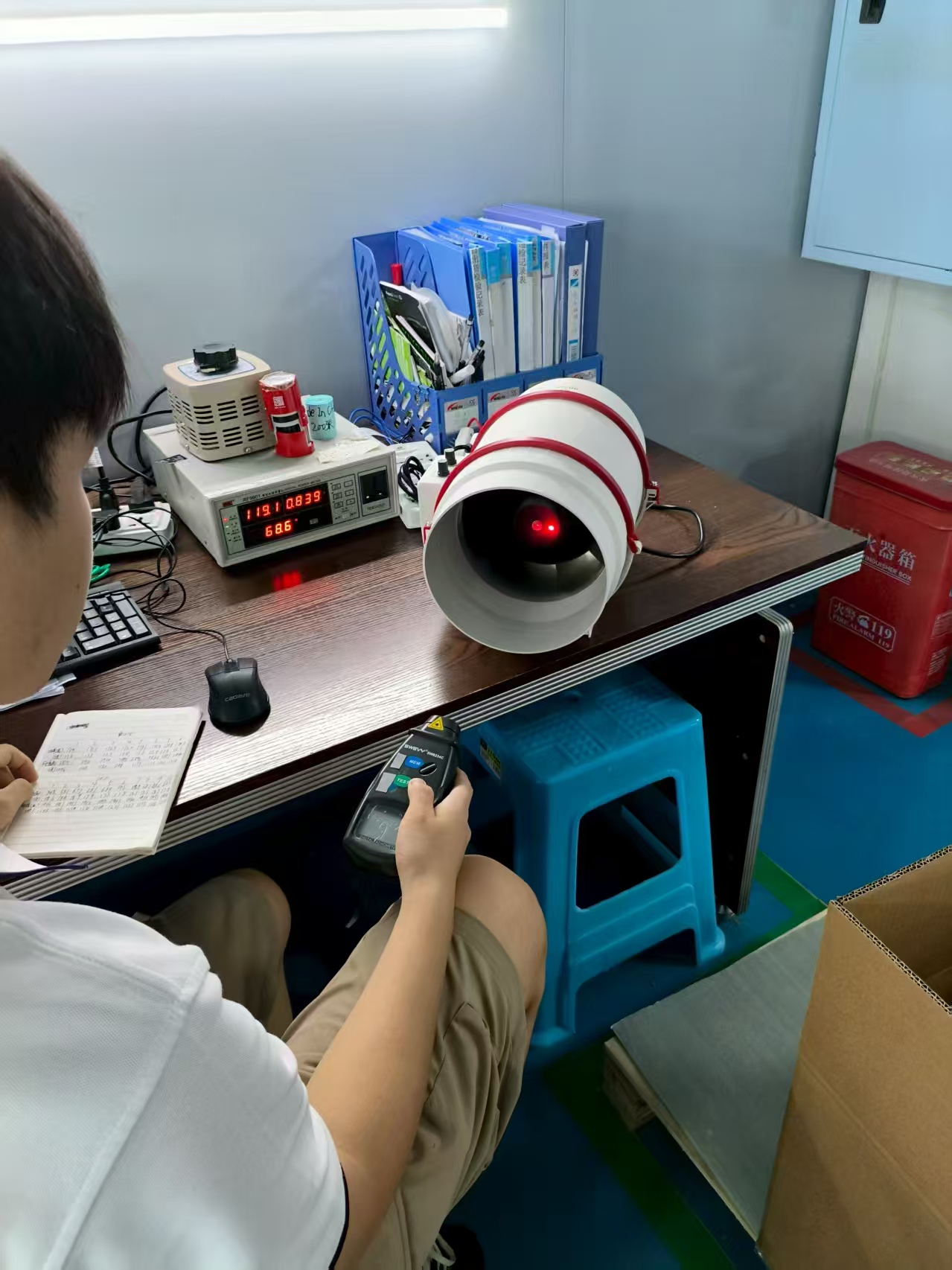
Aosun’s in-house fan air volume detection room – a critical step in ensuring each exhaust fan meets international compliance standards.
What Are Exhaust Fan Certifications?
Exhaust fan certifications are official documents or marks issued by recognized testing and standards organizations that verify a fan’s safety, electromagnetic compatibility (EMC), energy efficiency, and material compliance. These certifications for exhaust fans are typically mandatory for selling in specific regions – e.g., CE marking for Europe, UKCA for the United Kingdom, and RoHS for restricting hazardous substances.
Key Definitions
- CE Certification (LVD & EMC): Low Voltage Directive (LVD) and Electromagnetic Compatibility (EMC) – required for exhaust fans sold in the European Economic Area.
- UKCA Certification: UK equivalent of CE, mandatory for products placed on the Great Britain market.
- RoHS Compliance: Restriction of Hazardous Substances – ensures no excessive levels of lead, mercury, cadmium, etc.
- ETL / UL (North America): Safety certification for the US and Canada (though not in the provided data, note as industry context).
Why Are Certifications Critical for Exhaust Fans?
Without proper ventilation fan compliance, buyers face serious consequences:
- Market access denial: Customs can hold or destroy uncertified goods.
- Liability and insurance issues: Non-compliant electrical products increase fire and shock risks.
- Reputation damage: End-users, especially in Europe, demand certified products.
- Costly rework: Retrofitting or re-testing after shipment is expensive and time-consuming.
For industrial buyers, verifying that a supplier holds valid exhaust fan CE certificates, UKCA certification, and RoHS compliance reports is the first step in risk mitigation.
Who Needs Exhaust Fan Compliance?
Certification requirements affect everyone in the supply chain:
- Importers & Distributors – Must ensure products meet local regulations.
- OEM/ODM buyers – Need certified components for their final products.
- Architects & contractors – Specify certified fans for building codes.
- E-commerce sellers – Amazon, eBay, and other platforms often demand compliance documents.
Common Buyer Concerns About Certifications
❓ “How can I be sure the certificate is genuine?”
Always ask for the certificate number and the notified body that issued it. For CE, verify the number on the EU's NANDO database. For UKCA, check the UK Approved Bodies list. A genuine certificate includes the manufacturer's name, product model, standard references, and valid dates.
❓ “Do I need separate certifications for each product model?”
Yes. Each exhaust fan model (e.g., ceiling exhaust fan vs. wall-mounted exhaust fan) should have its own certification or be covered under a family report. A single certificate for a whole range is rare; ask for model-specific reports.
❓ “Are Chinese-made exhaust fans compliant with European standards?”
Many reputable Chinese manufacturers, such as Aosun, hold valid CE, UKCA, RoHS certificates. Aosun exports to 50+ countries and operates strict quality control. Always request scanned copies of the certificates before placing an order.
How to Verify Exhaust Fan Compliance: A Step-by-Step Guide
- Identify target markets: EU requires CE (LVD+EMC); UK requires UKCA; global markets accept RoHS as a baseline.
- Request certificate copies: Ask the supplier to provide PDFs of CE-LVD, CE-EMC, UKCA-EMC, and RoHS reports.
- Cross-check certificate details: Ensure the model number (e.g., QW9A-10G, ZM9A-10S-C) matches the product you intend to buy.
- Validate issuing body: Look up the certification agency (e.g., TÜV, SGS, Intertek) on their official website.
- Audit factory testing capabilities: Confirm the factory has in-house testing facilities like air volume detection rooms and motor performance testers.
- Request sample testing: Order samples and have them independently tested in your country, if budget allows.
Case Example: Aosun’s Certification Portfolio
Aosun is a professional ventilation equipment manufacturer with over 10 years of experience, operating an 8-line factory that produces 1 million+ units annually. Their product range includes ceiling exhaust fans, bathroom light exhaust fans, kitchen exhaust fans, attic exhaust fans, garage exhaust fans, window exhaust fans, toilet exhaust fans, wall mounted exhaust fans, and ventilation exhaust fans. To serve global buyers, Aosun has obtained the following certifications (verified from their provided documents):
| Certificate | Certification Number | Scope |
|---|---|---|
| CE-LVD | WTF22F01009448X1E, 61.11.23.1318.01, etc. | Safety compliance for low voltage equipment |
| CE-EMC | QTS800225512 | Electromagnetic compatibility |
| UKCA-EMC | QTS800225513 | UK market electromagnetic compatibility |
| RoHS | QTS800524557 | Restriction of hazardous substances |
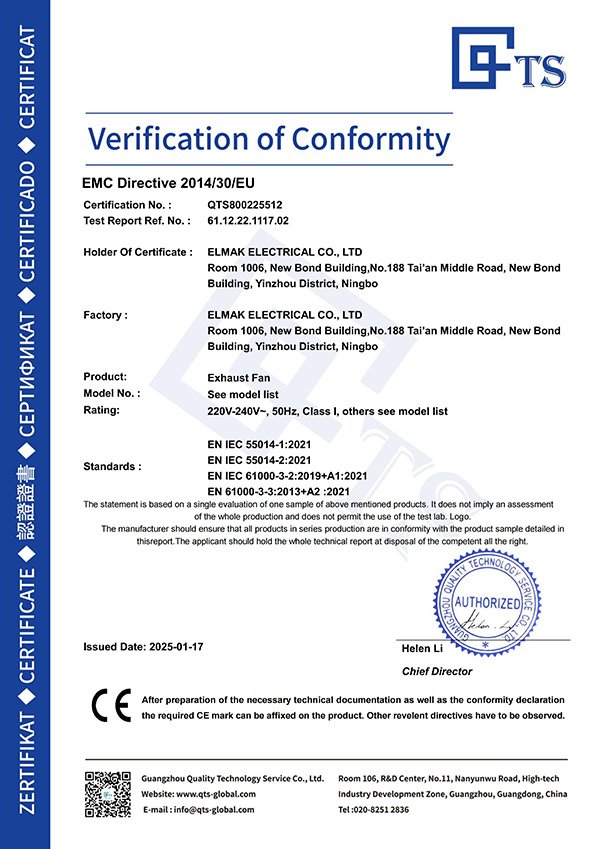
Aosun’s CE-EMC certificate (QTS800225512) – a mandatory document for selling exhaust fans in the European Union.
These certifications cover multiple models including QM series, ZM9A series, 9A series and others. Aosun also maintains an in-house fan air volume detection room and motor performance testing station, ensuring every unit meets declared specifications. Their factory spans 20,000sqm with 190 employees, and they export to over 50 countries in Europe, America, Asia, Oceania, and South America.
How to Choose a Compliant Exhaust Fan Supplier
Based on industry best practices, here are the key criteria:
- Full certification package: Supplier should provide at least CE, UKCA, RoHS for European buyers. For North America, look for ETL or UL.
- Traceable certificate numbers: Avoid suppliers who only show photos of certificates without readable numbers.
- Factory audit reports: Request photos or videos of testing labs and production lines.
- Independent testing: Some suppliers like Aosun allow buyers to witness testing or offer samples for third-party verification.
- Long export history: A supplier that has consistently exported to regulated markets is more likely to maintain valid compliance documents.
Frequently Asked Questions (FAQ)
Q: What is the difference between CE-LVD and CE-EMC?
CE-LVD covers safety (low voltage directive), while CE-EMC covers electromagnetic emissions and immunity. Both are required for exhaust fans sold in the EU.
Q: Do bathroom exhaust fans need water resistance certification?
Water resistance (IP rating) is separate from safety certification. However, CE includes requirements for protection against moisture in bathrooms. Always confirm the IP rating with the supplier.
Q: Can I use a CE certificate for the UK market?
No. Since Brexit, the UK requires UKCA marking for most products. Some dual CE/UKCA certificates exist, but verify separately.
Q: How long does a certification remain valid?
Typically 5 years, but may require annual surveillance audits. Always check the issue and expiry dates.
Q: Does Aosun provide certificates for their wall mounted exhaust fan models?
Yes. Aosun holds multiple CE, UKCA, and RoHS certificates covering various models including wall mounted types (e.g., QW9A-10G, BPT8-20 D).
Need Verified Exhaust Fan Certifications?
Contact Aosun’s compliance team to request certificate copies and discuss testing procedures.
Phone/Whatsapp: +8618606589361
Email: alan.h@elmakelectrical.com
Website: www.aosvents.com
Marketing Center: Room 801-802, MeiJing Mansion, Southern CBD, Ningbo City, Zhejiang Province, China.
Conclusion
Navigating exhaust fan certifications and global compliance is a complex but essential process for any international buyer. By understanding the required marks (CE, UKCA, RoHS), verifying certificates with third-party bodies, and partnering with manufacturers that invest in in-house testing—like Aosun—you can ensure smooth customs clearance, reduce liability, and build a reputation for quality. Always request full documentation before committing to large orders, and don’t hesitate to audit the supplier’s testing facilities. The cost of non-compliance far outweighs the effort of due diligence.