Agricultural Loader Hydraulic Cylinder Application Guide: Lift, Bucket, Grapple, and Fork Circuits
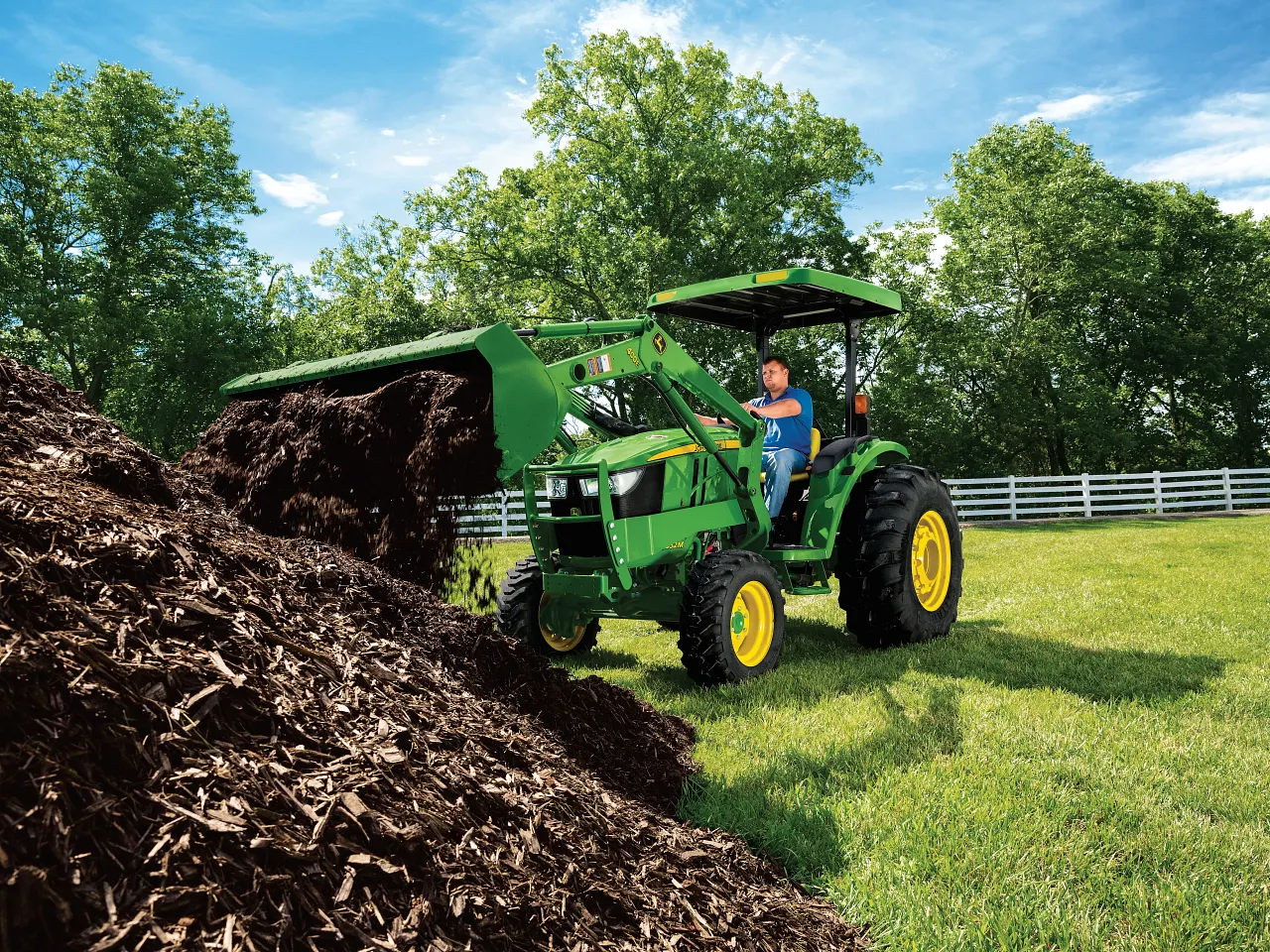
A tractor front-end loader is not one hydraulic application — it is four circuits sharing a single machine. The lift circuit raises and lowers the boom. The bucket circuit rolls the attachment back, holds it level and dumps it. The grapple circuit opens and closes jaws under alternating load. The fork and bale spear circuit carries a load at a fixed position while the tractor moves. Each circuit loads its cylinders differently, so a cylinder specified only for “the loader” is usually over-built in one circuit and under-built in another.
This application guide explains how to match custom hydraulic cylinders to agricultural loader, tractor front-end loader and loader hydraulic system upgrade projects, circuit by circuit. It covers lift and lower, bucket tilt and dump, hydraulic grapple, pallet fork and bale spear circuits, the operating modes that shape cylinder duty, and the supporting hydraulic equipment — accumulators, loader suspension systems, pressure relief valves and load-holding valves — that determines whether the cylinders complete a full season.
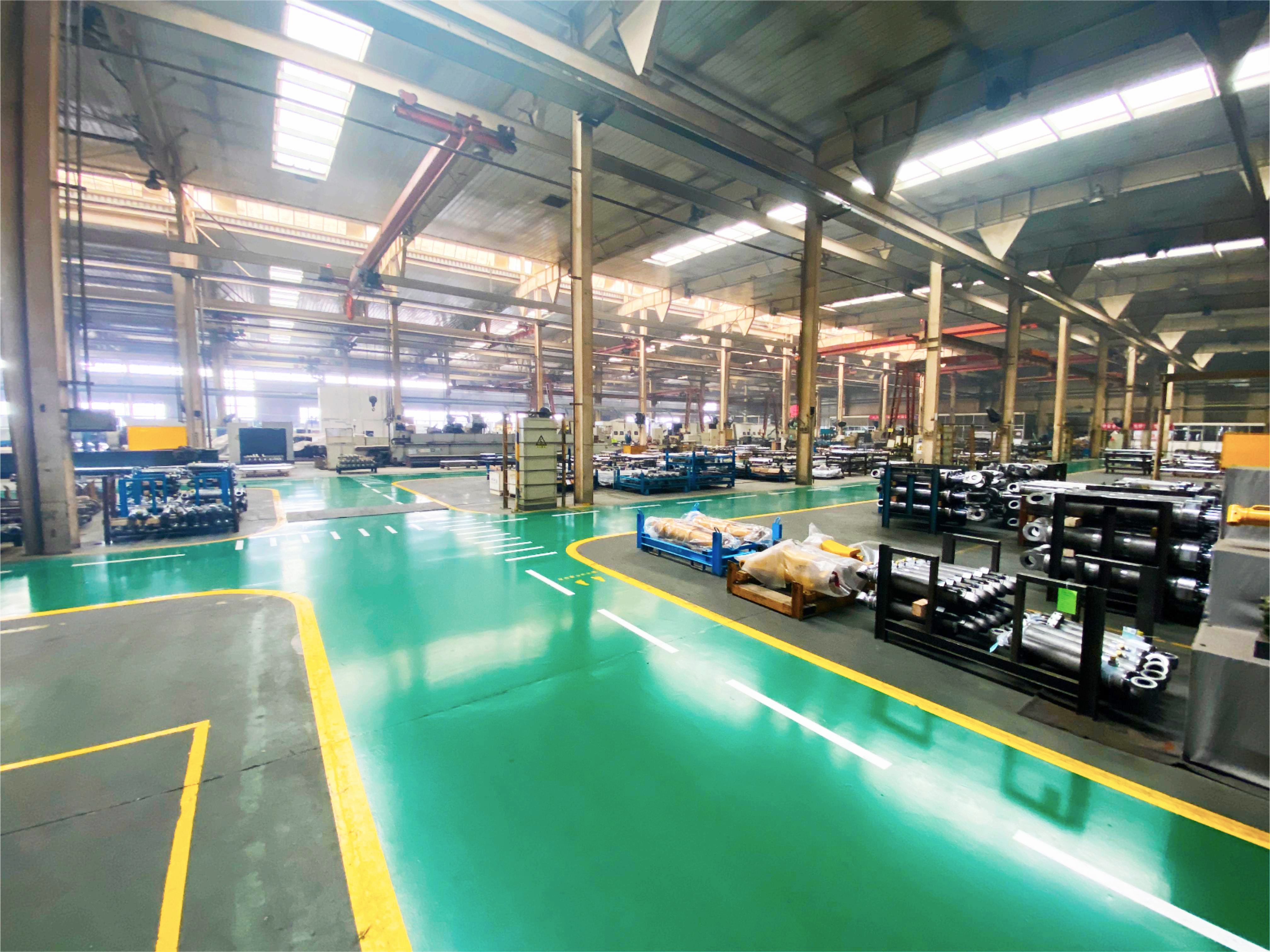
Apex Hydraulic Co., Ltd. is a hydraulic cylinder and hydraulic power unit manufacturer established in 2009 in Qingdao City, Shandong Province, China. The company operates a 50,000 m² manufacturing facility with 560 employees and a 25-engineer R&D team, produces more than 8,000 hydraulic cylinders and 1,500 hydraulic power units per month, and exports roughly 70% of its output to North America, Western Europe, South America, Australia, Southeast Asia and the Middle East. Its range covers welded, tie-rod, telescopic, double-rod, position-sensing, grapple and heavy-duty high-pressure cylinders used in agricultural, construction, material-handling and mobile equipment.
The Four Loader Circuits and Why One Cylinder Specification Rarely Fits
Loader cylinders share a working environment but not a duty profile. Recognising that difference is the first step in matching a cylinder to a circuit.
- Lift and lower. Two double-acting cylinders, one per loader arm, extend together to raise the boom and retract together to lower it. They carry the highest sustained load on the machine and must stay matched — bore, rod diameter, stroke and internal displacement — or the boom tilts and the bucket runs uneven.
- Bucket tilt and dump. Tilt cylinders cycle far more often than lift cylinders and absorb shock when the bucket edge contacts the ground or a pile. They need end-of-stroke cushioning, a protected rod surface and a wiper system that keeps dust and abrasive material out of the gland.
- Hydraulic grapple. Grapple cylinders open and close under alternating push-and-pull load, with impact at the moment of grip. Side load, port damage and dust ingress are the three most common failure routes, and load retention matters whenever a load is suspended.
- Pallet fork and bale spear. These circuits carry rather than dig. The cylinder must hold a position while the tractor travels over uneven ground, which makes load-holding protection and positioning accuracy more important than peak breakout force.
All four circuits operate outdoors on uneven, frozen, muddy or dusty ground, with exposure to rain, fertilizer, manure and temperature swings. Cylinders also face vibration and impact from tractor movement, variable loads from different buckets, forks and grapples, and shock loading when an attachment contacts the ground or a load pile. The operator may control the loader through a mechanical joystick, hydraulic pilot control or an electro-hydraulic valve — and that choice changes how precisely the cylinder has to position and hold, not only how much force it has to produce.
Industry Background: Where Agricultural Loader Cylinders Sit
Mobile hydraulics is the largest single demand block for hydraulic cylinders. Grand View Research reported that mobile applications, including construction and agriculture, accounted for 51.8% of hydraulic cylinder demand in 2025, while double-acting cylinders held a 71.6% revenue share of the function segment. That matches what a loader shows in practice: almost every lift and tilt circuit on a modern front-end loader is double-acting.
Product form follows the same pattern. Welded hydraulic cylinders held a dominant 53.6% market share in 2025 because of their durability in heavy-duty applications, and bore sizes up to 150 mm accounted for 61.6% of the market — a range that covers most agricultural loader lift and tilt cylinders. Tie-rod cylinders, still common on ASAE-style agricultural equipment because the tie rods allow straightforward disassembly and seal replacement, represented approximately 38.9% of the product-type segment in 2025.
Demand is also expanding. Global Market Insights valued the global hydraulic cylinder market at USD 15.7 billion in 2024 and projected USD 24.7 billion by 2034, and Mordor Intelligence identified industrial manufacturing as the fastest-growing end-user segment at a 6.12% CAGR through 2031.
Matching Cylinders to Each Loader Circuit
Lift and Lower Circuit
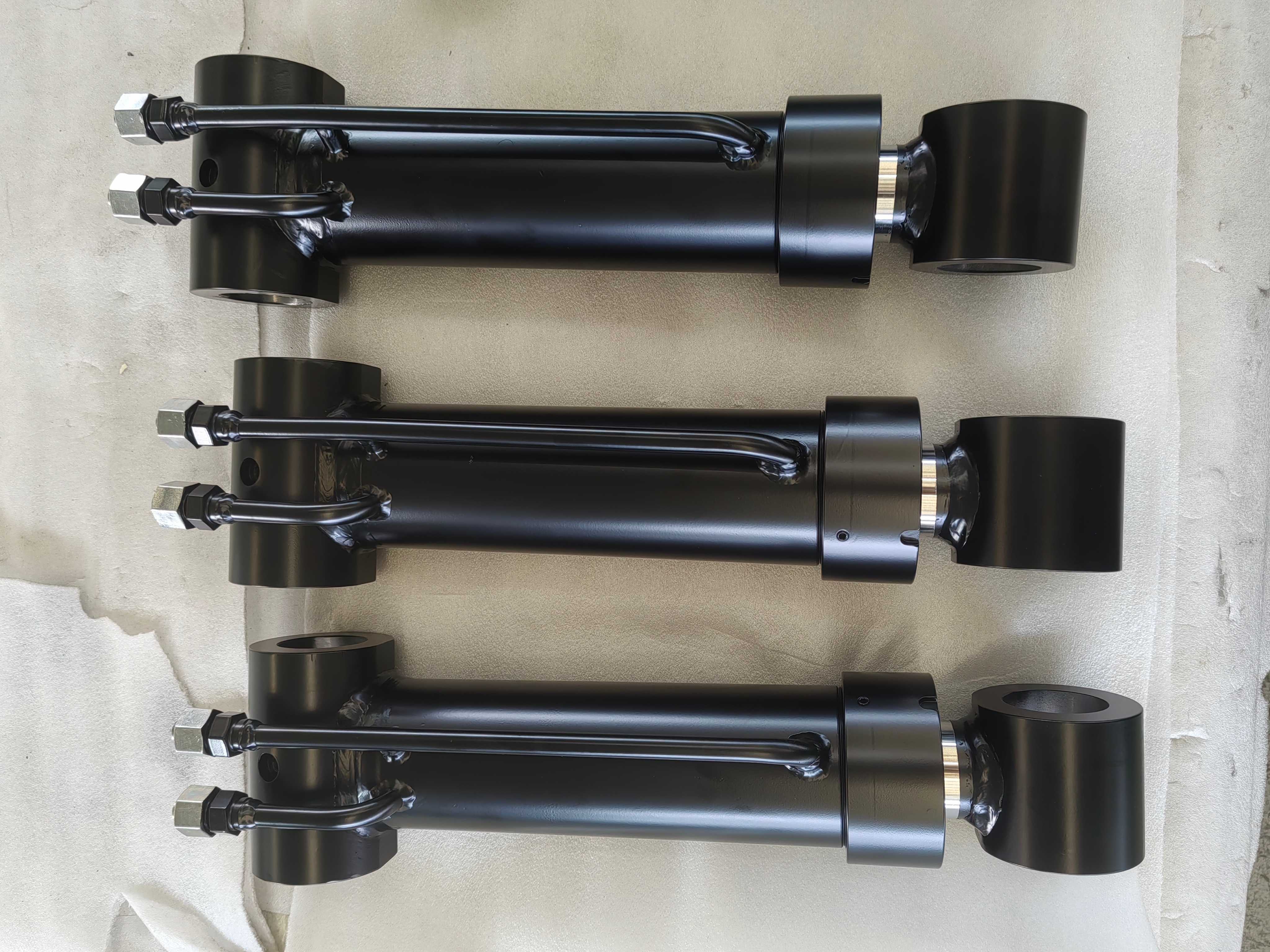
The lift pair is the only matched set on the loader. Both cylinders receive oil from the same control valve, so their dimensions and internal displacement have to agree. Apex Hydraulic builds the three mounting families used most often on loader lift arms:
- HBU series — double-acting welded cylinder with cross-tube bushing mounts. Bore 1.5–5.0 in, stroke 4–48 in, rod diameter 1.0–2.5 in, retracted length 12–60 in, bushing inside diameter 0.75–1.75 in.
- HCL series — double-acting welded cylinder with fixed clevis mounts. Bore 1.5–5.0 in, stroke 4–36 in, rod diameter 1.25–2.5 in, retracted length 14.25–48.25 in, pin diameters 1.0, 1.25 or 1.5 in.
- HTG series — double-acting welded cylinder with an adjustable threaded female clevis and locking bolt. Bore 2.0–4.0 in, stroke 4–36 in, rod diameter 1.125–1.75 in, retracted length 14.25–46.25 in, 1.0 in pin.
All three families are rated to 3,000 PSI, use SAE O-ring boss ports as standard with NPT available on confirmation, and use a threaded, serviceable gland so seals can be replaced without scrapping the barrel. Rods are induction-hardened steel with a hard-chrome surface: published rod core hardness is 45–50 HRC, chrome thickness approximately 0.001 in, final rod surface hardness 69–71 HRC, and a published corrosion test of 96 hours according to ASTM B117-07a. Standard finish is a black industrial coating. Bore and rod diameter are selected against the required lifting force and the tractor’s actual working pressure, not against the loader’s rated capacity alone.
Bucket Tilt and Dump Circuit
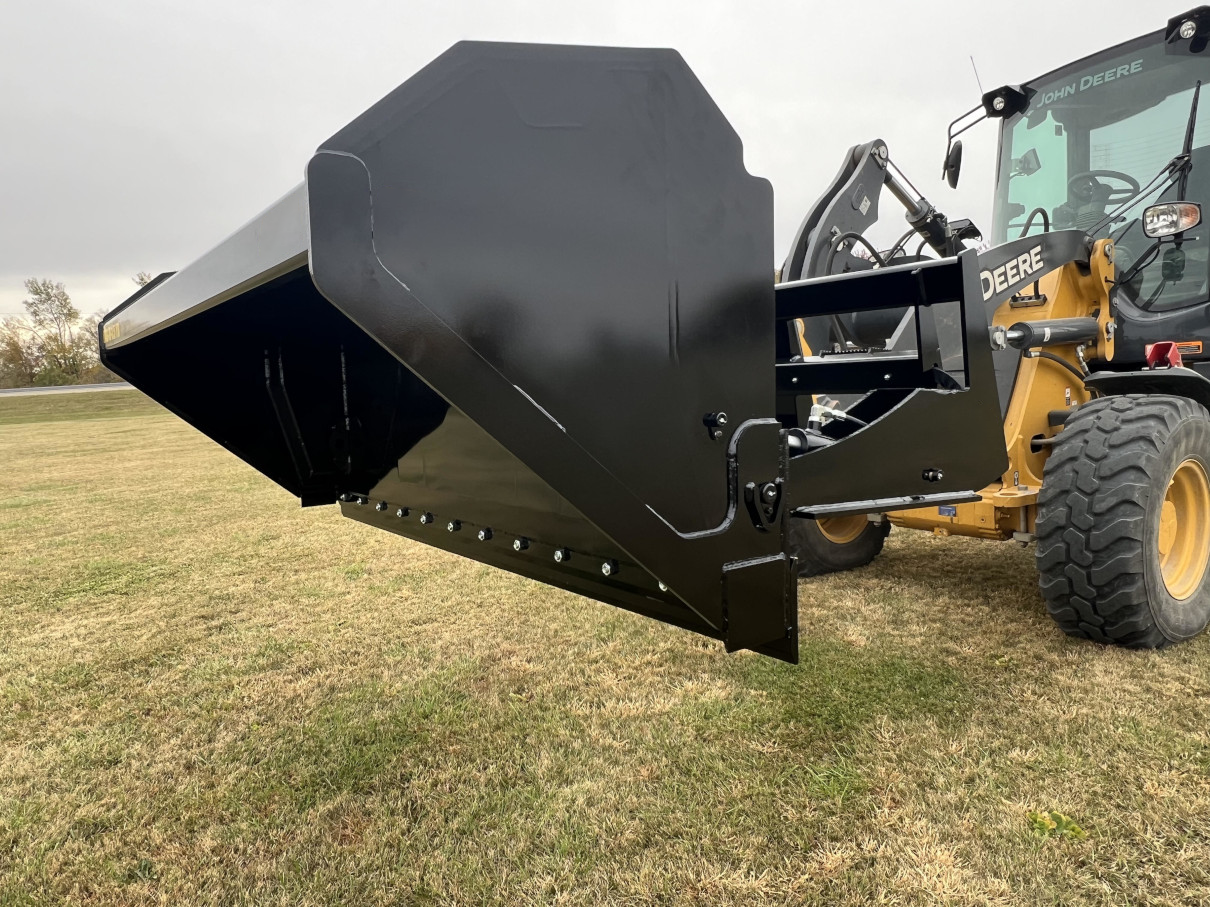
Tilt cylinders are shorter in stroke than lift cylinders but cycle several times more often in a working day. Three specification points matter more than raw force:
- Cushioning. Optional head-end, cap-end or dual-end cushioning reduces end-of-stroke impact when the bucket is snapped back or dumped quickly, which also protects the loader linkage.
- Rod protection. Heavy-duty polyurethane wipers, metal-cased scrapers or dual-wiper systems keep soil, sand, manure and crop residue out of the sealing system. Optional rod bellows and protective sleeves are available where the rod is exposed to thrown material.
- Port position. Ports are oriented to suit hose routing through the full range of attachment movement, and the hose run must stay clear of tires, sharp edges, pinch points and the loader linkage.
Sealing material is selected against the operating environment rather than by default. Polyurethane, NBR, PTFE and FKM seals cover most agricultural conditions, and low-temperature sealing materials are available where a loader works in frozen ground conditions.
Hydraulic Grapple Circuit
Grapple circuits are the most punishing attachment circuit on any loader. Cylinders open and close jaws repeatedly under alternating load, absorb impact at the moment of grip, and often work in dust, chips and debris.
The Apex Hydraulic grapple and attachment cylinder is built for that duty profile: heavy-duty welded construction, double acting, bore 50–250 mm, rod diameter 30–180 mm, stroke 100–1,500 mm, working pressure 160–350 bar, and a maximum design pressure up to 420 bar for specially engineered configurations. Operating temperature range is −30°C to +100°C with operating speeds of 10–500 mm/s, and mounting pin diameters from 30–180 mm. Rod eyes, base eyes and mounting pins are forged or machined high-strength alloy steel, with hardened steel, bronze, composite or spherical plain bearings depending on the linkage.
Pallet Fork and Bale Spear Circuits
Fork and bale spear work changes the load case. Instead of digging, the cylinder carries a load at a fixed position while the tractor moves over uneven ground. Two consequences follow:
- Load retention. A pilot-operated check valve or load-holding valve prevents the attachment from drifting when the control valve is centred and the machine is travelling. On a bale spear, where the load sits well forward of the loader frame, drift is both a handling problem and a safety problem.
- Position confirmation. Level indicators, dump-angle stops and automated loader functions benefit from position feedback. The Apex Hydraulic position-sensing cylinder family covers bore 40–320 mm, rod diameter 25–220 mm and stroke 50–2,400 mm at working pressures up to 250 bar, with either continuous feedback through a magnetostrictive linear position transducer or discrete end-of-stroke sensing through proximity, inductive, reed or end-of-stroke switches. Output options include analog voltage, analog current, SSI, CANbus, PWM and start/stop, and absolute-position sensor technology can retain valid position information after a power interruption.
Double-Acting or Double-Rod: Choosing the Motion Profile
Most loader circuits use a standard double-acting cylinder, which derives force from the full bore in one direction and the annular area in the other. That asymmetry is normal on lift and tilt circuits, where extension and retraction do different jobs.
Where a circuit needs symmetrical behaviour — steering, leveling or a linkage-driven mechanism that must move at the same speed and force in both directions — a double-rod (through-rod) cylinder is the better match. The Apex Hydraulic double-rod series covers bore 32–250 mm, rod diameter 16–160 mm and stroke 25–3,000 mm at working pressures of 100–250 bar, with a maximum design pressure up to 350 bar for specially engineered configurations. When both rod diameters are identical, effective area, push force, pull force, extension speed, retraction speed and displacement volume are equal in both directions, which simplifies symmetric circuit design. Centre trunnion mounting, standard on the series, suits oscillating and linkage-driven machinery.
Corrosion Protection and Supporting Equipment
Farm environments attack cylinder exteriors as much as they attack seals. Surface protection options include industrial paint, powder coating, zinc-based coating and application-specific corrosion protection, and rods carry both a hard-chrome surface and a documented corrosion test result. Where a loader works around fertilizer, slurry or washdown operations, stainless-steel barrel, rod and port options are available in a corrosion-resistant cylinder series.
Supporting equipment determines whether correctly specified cylinders reach their expected service life:
- A pressure relief valve protects the cylinders and the loader structure from overload and pressure spikes.
- A load-holding valve prevents unintended movement after pressure loss or hose failure.
- A hydraulic accumulator and loader suspension system allow limited cylinder movement to absorb shock during transport, reducing cylinder and loader-frame fatigue.
- Mounting pins and greaseable bushings require regular lubrication to limit wear and misalignment.
- A mechanical boom lock is required before any service work is carried out beneath a raised loader.
Step-by-Step: Specifying a Cylinder for a Loader Circuit
- Name the circuit and its duty. Lift, tilt, grapple, fork or spear. The circuit determines duty cycle, shock exposure and whether load holding is mandatory.
- Establish the force requirement. Work from the maximum load at the attachment and the linkage geometry to derive required cylinder force, then select bore diameter against the tractor’s real working pressure.
- Fix the installation envelope. Confirm stroke length, retracted pin-to-pin length and extended pin-to-pin length against the existing loader geometry.
- Confirm the mounting interface. Cross-tube, clevis, pin-eye, trunnion, flange or spherical bearing, plus mounting pin diameter and mounting width. Cross-tube, pin-eye and clevis mounts must match the existing loader brackets and pin diameters.
- Match paired cylinders. For the lift pair, specify matched bore, rod diameter, stroke and internal displacement so both sides extend equally.
- Select rod and sealing system for the environment. Induction-hardened chrome-plated rod, heavy-duty wiper arrangement and seal material chosen for mud, dust, fertilizer or low temperature.
- Define ports and hose routing. Port type, port size and port orientation, checked through the complete range of attachment movement. Standard ports are SAE O-ring boss, with NPT and other thread standards available.
- Decide the auxiliary functions. End-of-stroke cushioning, load-holding valve, hose-burst protection, position sensing, accumulator or loader suspension compatibility.
- Confirm documentation and testing. Approved drawing, dimensional report, pressure-test record and inspection records before shipment.
Apex Hydraulic supports this process through OEM manufacturing, ODM development, custom design and hydraulic engineering services, with a 25-engineer R&D team covering product design, engineering drawings, prototype development, testing, manufacturing and quality inspection. Standard products carry a minimum order quantity of 1 piece, with OEM and customized quantities negotiable according to project requirements.
Use Case: Grapple Cylinders for an Attachment Manufacturer
An Italian manufacturer of hydraulic grapples for scrap handling, recycling, forestry, waste management and material handling ordered 150 custom cylinders across a one-year programme. The cylinders were fully customized around optimized mounting dimensions, high-strength welded construction, a heavy-duty sealing system and corrosion-resistant surface treatment.
Reported outcomes were improved gripping force, enhanced operational stability and reduced maintenance requirements, with reliable performance maintained under continuous heavy-duty working conditions. The same cylinder architecture — heavy-duty welded body, forged rod eyes, protected ports and load-holding capability — carries directly into agricultural loader grapples used for silage, manure and brush handling, where cycle counts and contamination levels are comparable.
Cylinder Options Compared for Agricultural Loader Circuits
| Cylinder family | Acting type | Bore range | Stroke range | Working pressure | Typical loader circuit |
|---|---|---|---|---|---|
| HBU series welded cylinder, cross-tube bushing mount | Double acting | 1.5–5.0 in | 4–48 in | Up to 3,000 PSI | Lift and lower |
| HCL series welded cylinder, fixed clevis mount | Double acting | 1.5–5.0 in | 4–36 in | Up to 3,000 PSI | Lift and lower, tilt |
| HTG series welded cylinder, adjustable threaded clevis | Double acting | 2.0–4.0 in | 4–36 in | Up to 3,000 PSI | Bucket tilt, linkage |
| HTR / HTH tie-rod cylinder, adjustable clevis | Double acting | 2–5 in | HTR 4–36 in; HTH 4–48 in | HTR 2,500 PSI; HTH 3,000 PSI | Agricultural implements, serviceable linkages |
| Grapple and attachment cylinder | Double acting | 50–250 mm | 100–1,500 mm | 160–350 bar; up to 420 bar design | Hydraulic grapple, attachment clamps |
| Double-rod / through-rod cylinder | Double acting, double rod | 32–250 mm | 25–3,000 mm | 100–250 bar; up to 350 bar design | Steering, leveling, symmetric linkage |
| Position-sensing cylinder | Double acting | 40–320 mm | 50–2,400 mm | Up to 250 bar | Bucket level, dump-angle control |
| Custom welded double-acting cylinder | Double acting | Customized | Customized | Customized per system | Lift, tilt, fork and spear, build-to-print replacement |
Row-level selection is rarely decided by one figure. A wider bore lowers the pressure needed for a given lift force but also increases oil volume and cycle time. A longer stroke solves reach but raises buckling risk on the rod, which is why long-stroke designs are checked against load direction, unsupported length and side-load conditions before a drawing is released.

Frequently Asked Questions
Which standards apply to agricultural loader hydraulic cylinder dimensions and testing?
ISO 6022:2006 establishes mounting dimensions for single-rod hydraulic cylinders in the 250 bar series, and ISO 6020-2:2015 specifies mounting dimensions for the 160 bar compact series; both exist to support interchangeability. NFPA/T3.6.7 R3-2009 (R2024) is the North American standard for square-head industrial cylinder mounting dimensions. On a mobile loader, however, the linkage and the existing bracket usually define the critical dimensions, so final dimensional interchangeability is confirmed against the customer’s existing cylinder measurements, equipment information, OEM part number or an approved engineering drawing. Every cylinder then passes through incoming material inspection, in-process quality control and final quality inspection, including pressure testing, leakage testing, dimensional inspection, welding inspection, surface finish inspection and functional testing, with 100% final inspection before shipment.
Can Apex Hydraulic manufacture lift, bucket, grapple and fork cylinders for the same loader model?
Yes. Apex Hydraulic provides OEM manufacturing, ODM development, custom design and hydraulic engineering solutions, supported by a 25-engineer R&D team. The customization scope covers cylinder bore, rod diameter, stroke length, mounting style, installation dimensions, working pressure, seal system, materials, surface treatment, ports and threads, painting colour, logo and packaging. Monthly capacity is more than 8,000 hydraulic cylinders and 1,500 hydraulic power units, so a four-circuit loader programme can be produced as a coordinated set rather than sourced circuit by circuit.
What drives the cost of a custom agricultural loader cylinder?
Cost tracks the specification: bore and rod diameter, stroke, mounting style, working pressure, sealing system, material and surface treatment, plus auxiliary functions such as cushioning, load-holding valves, port protection or position sensing, and finally order quantity. For context, IndexBox reported an average export price of approximately USD 382 per unit for hydraulic cylinders and systems in 2024 — a broad market average across all cylinder sizes and categories, not a quotation for a specific loader cylinder. Because the standard minimum order quantity is 1 piece, a single circuit can be evaluated before committing to a complete loader set.
Can I validate a cylinder on a sample before ordering production volumes?
Yes. The standard minimum order quantity is 1 piece, and OEM and customized quantities are negotiable according to project requirements. Customization services include product design, engineering drawings, prototype development, testing, manufacturing and quality inspection, and cylinders can be manufactured from a customer drawing or reverse-engineered from a verified sample and measured dimensions. For loader replacement work, supplying existing cylinder photographs, mounting dimensions, port detail and pin-to-pin lengths shortens the confirmation stage considerably.
What lead time should I plan for, and what information does Apex Hydraulic need to quote?
Standard products ship in 7–20 days. Customized products ship in 25–45 days. Large OEM projects follow the project schedule agreed at order confirmation. To start a quotation, send the loader model, cylinder function, required stroke, retracted and extended pin-to-pin length, working pressure, mounting style, mounting pin diameter and mounting width, hydraulic port type and position, operating temperature, and the existing drawing, part number or cylinder photographs. Requests can be sent to jason@hydraulicapex.com or +86 182-5318-1828; the full range is documented in the APEX Hydraulic product catalog.
Conclusion
Four circuits, four duty profiles, one loader. The lift pair has to be dimensionally matched and strong enough for sustained load. The tilt circuit has to survive constant cycling and ground shock. The grapple circuit has to absorb impact, resist side load and keep gripping after pressure loss. The fork and spear circuits have to hold a load steady while the tractor moves. Getting those four specifications right comes down to bore, rod diameter, stroke, mounting interface and sealing system — and to the valves and accumulators around the cylinders.
Because agricultural loader cylinders are almost always replacement, upgrade or OEM-fit items, dimensional confirmation matters as much as performance. Apex Hydraulic manufactures custom hydraulic cylinders and hydraulic power units for loader builds, loader hydraulic system upgrades and replacement programmes, with engineering support from specification review through pressure and leakage testing.
Send Your Loader Circuit Specification
Share the loader model, circuit function, stroke, pin-to-pin dimensions, working pressure and existing cylinder photographs, and the engineering team will confirm cylinder configuration, mounting interface and lead time.
Apex Hydraulic Co., Ltd.
Qingdao City, Shandong Province, China
Email: jason@hydraulicapex.com
Tel / WhatsApp: +86 182-5318-1828
Website: www.hydraulicapex.com
Have Questions or Need More Details?
Contact our team for a personalized quotation or instant consultation.
Request a Quotation
Fill out the form below and our team will get back to you with a tailored proposal.
WhatsApp Direct Chat
Prefer to chat in real-time? Message us on WhatsApp for instant assistance & quick answers.
- Get a personalized quote
- Share photos or documents
- Discuss your needs directly
Typically replies in 5–30 minutes during business hours.