Hydraulic Cylinder Compliance Guide: Certifications, Standards, and Regional Export Requirements
A hydraulic cylinder is compliant when the supplier can prove — with records attached to the actual shipment — that the unit was built to an approved drawing, inspected at defined stages, pressure-tested, leak-tested, and cycled through its full stroke. A certificate shown on a website does not prove any of that. For OEM buyers, the practical question is not which certificates does the factory hold, but which documents arrive with my order, and do they match the standard my market requires. This guide sets out how that evidence is built, which mounting and cleanliness standards apply, and how port, environment, and documentation requirements shift between North America, Western Europe, South America, Australia, Southeast Asia, and the Middle East.
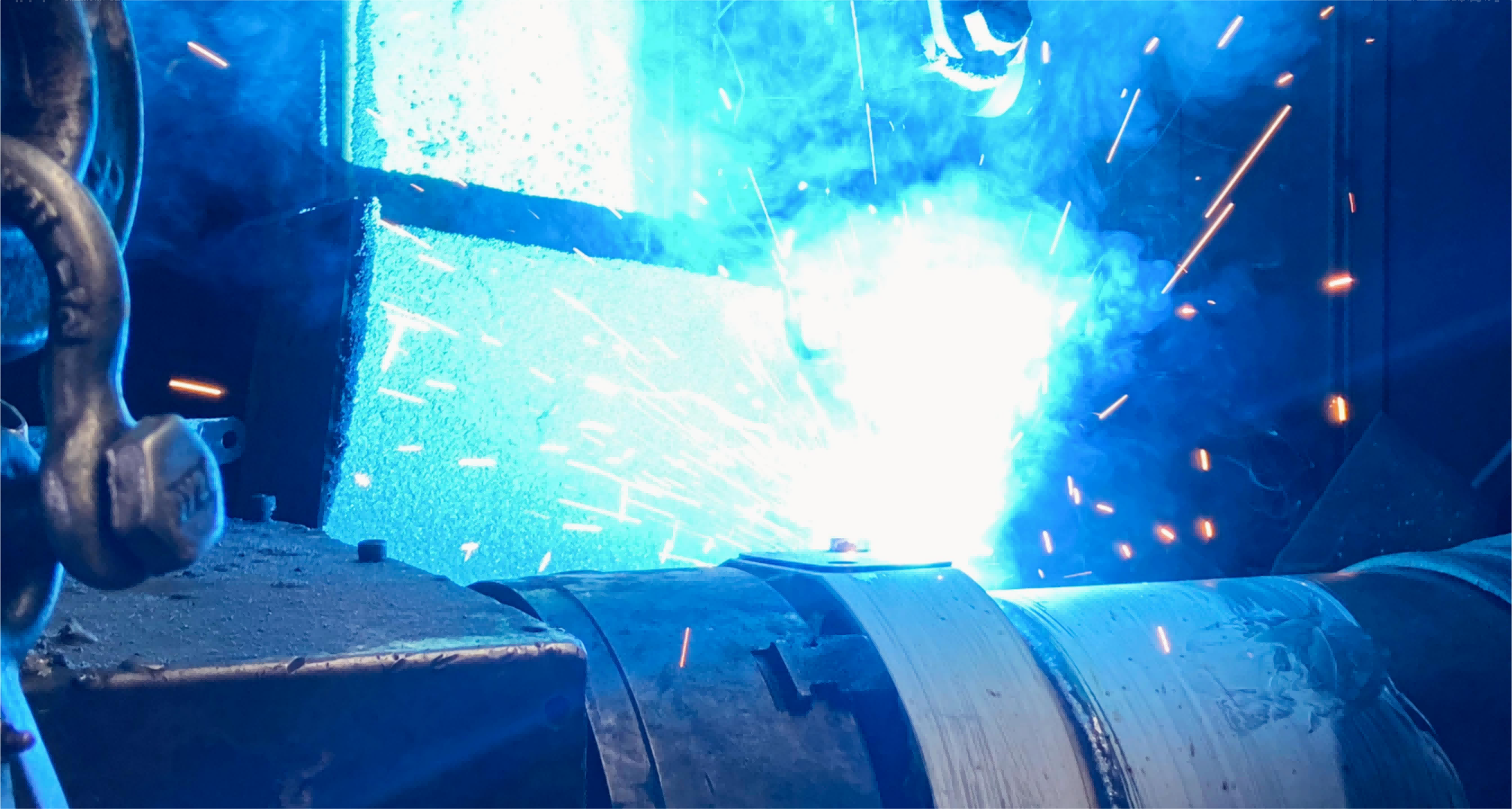
Component welding is one of the stages where a written weld inspection record — not a finished-goods photo — supports an OEM compliance file. Source: Apex Hydraulic production documentation.
Problem Definition: Why Cylinder Compliance Is Hard to Verify
Three specific gaps cause most compliance disputes between hydraulic cylinder buyers and suppliers.
Gap 1 — Certificate versus evidence. A management-system certificate describes how a factory is organised. It says nothing about the bore diameter of the cylinder in crate 14, the proof pressure it was subjected to, or whether the weld on its mounting cross-tube was inspected. OEM buyers auditing a hydraulic cylinder programme need per-batch, per-unit records. Where those records do not exist, the certificate becomes decoration.
Gap 2 — Standards are not universal. Mounting dimensions follow different conventions by region and cylinder type. ISO 6022:2006 fixes mounting dimensions for single-rod hydraulic cylinders in the 250 bar series to ensure interchangeability. ISO 6020-2:2015 does the same for the 160 bar compact cylinder series. In North America, NFPA/T3.6.7 R3-2009 (R2024) is the industry standard for square-head industrial cylinder mounting dimensions. A cylinder that is dimensionally correct against one convention is not automatically interchangeable against another, and the difference usually appears at installation, not at the drawing review.
Gap 3 — Regional requirements are not one list. Port threads, surface protection, operating temperature range, and documentation language all change with the destination market and the application. A cylinder destined for a North American roll-off hoist and a cylinder destined for a European underbody dump trailer may share a bore and stroke while sharing almost nothing else about their interface and their paperwork.
Industry Background: Why Documentation Pressure Is Rising
The global hydraulic cylinder market was valued at USD 15.7 billion in 2024 and is projected to reach USD 24.7 billion by 2034, according to Global Market Insights. Growth of that scale shifts competitive pressure away from basic capacity and toward verifiable quality, because the buyers driving volume are OEMs who must themselves answer to their own customers.
Several structural facts explain the shift:
- Welded construction dominates. Welded hydraulic cylinders held a 53.6% market share in 2025, with high durability in heavy-duty applications cited as the driver (Grand View Research). Welded bodies cannot be opened for inspection the way tie-rod bodies can, which makes the weld record and the pressure-test report the primary evidence of build quality.
- Double-acting designs dominate function. Double-acting cylinders account for a 71.6% revenue share of the function segment as of 2025 (Grand View Research), meaning most procurement reviews now involve two pressure chambers, two sealing sets, and twice the leak paths to document.
- Mobile applications dominate demand. Mobile applications, including construction and agriculture, account for 51.8% of hydraulic cylinder demand (Grand View Research). Mobile equipment buyers are the most audit-driven segment because field failure means machine downtime, not a nuisance repair.
- Supply is concentrated in Asia Pacific. The region commanded a 40.5% revenue share in 2025, led by China and India (Grand View Research), while China recorded an export value growth rate of +11.5% CAGR for hydraulic cylinders and systems in recent years (IndexBox). For non-Asian OEMs, this means Chinese suppliers are now a normal part of the qualified vendor list — and are therefore subject to the same evidence requirements as domestic suppliers.
- Tie-rod remains a distinct segment. Tie-rod cylinders accounted for approximately 38.9% of the product type segment in 2025 (Future Market Insights), which matters because tie-rod construction allows disassembly, seal replacement, and internal inspection in a way welded construction does not.
Apex Hydraulic Co., Ltd., established in 2009 in Qingdao, Shandong Province, China, is a manufacturer of custom hydraulic cylinders, standard hydraulic cylinders, hydraulic power units, hydraulic systems, hydraulic scissor hoist kits, and hydraulic components. The company operates a 50,000 m² manufacturing facility with approximately 560 staff, an engineering and R&D team of 25 engineers, and an annual production capacity of 100,000 hydraulic cylinders and 15,000 power units. Approximately 70% of output is exported, with customers in North America, Western Europe, South America, Southeast Asia, the Middle East, and Australia.
Detailed Solution: Building a Verifiable Compliance File
Compliance for a hydraulic cylinder programme is assembled in four layers. Each layer produces a record. The records, taken together, are what an OEM quality department, an importer, or a third-party inspector actually reviews.
Layer 1 — Incoming material inspection
The file starts before machining. Incoming material inspection covers the seamless steel tube, the piston rod stock, forged or machined mounting components, and the sealing components. The output is a material record tied to the production batch. Without it, a later dimensional pass cannot be traced back to the steel it was cut from.
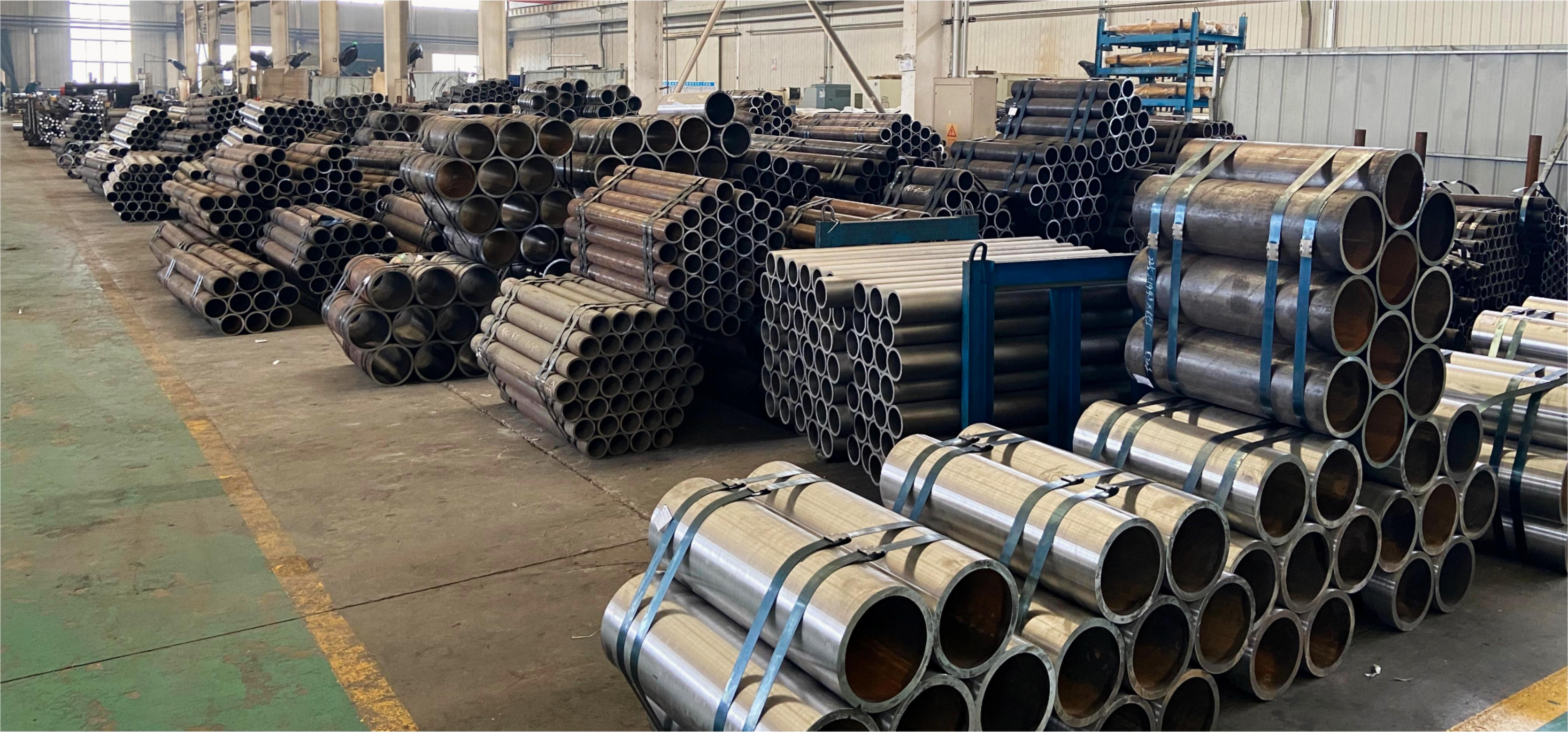
Raw material storage is where the traceability chain begins. Every downstream inspection record should reference material that entered here. Source: Apex Hydraulic.
Layer 2 — In-process inspection
Three in-process checks carry most of the compliance weight:
- Bore and rod dimensional inspection — verifies honed bore diameter, rod diameter, straightness, and surface condition against the approved drawing.
- Mounting-dimension inspection — verifies pin diameters, mounting widths, closed length, and pin-to-pin dimensions. This is the check that determines whether the cylinder will physically install, and it is the check most often omitted when a supplier works from a photo rather than a drawing.
- Weld inspection — verifies weld quality on the barrel, base, mounting cross-tubes, and clevis interfaces. On welded-body cylinders this is the structural record that substitutes for the ability to open the body later.
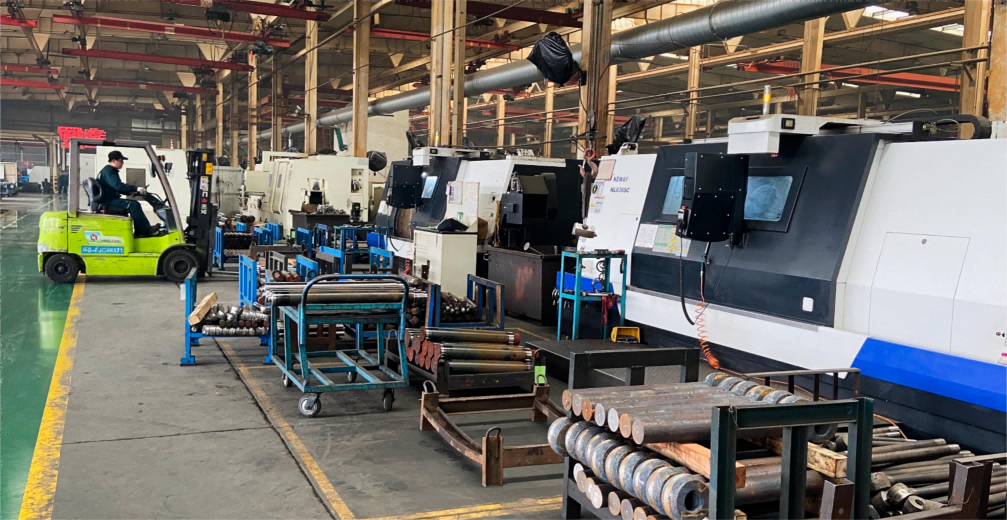
Precision machining determines the dimensional values that later appear on the inspection report. Source: Apex Hydraulic.
Layer 3 — Final testing
Final testing is where compliance evidence becomes measurable. A standard Apex final test sequence covers:
- Hydraulic pressure testing — held at the proof pressure defined in the approved inspection and testing plan.
- Internal leakage testing — detects bypass across the piston seal, which is invisible from outside the cylinder.
- External leakage testing — detects gland, port, and weld-path leaks.
- Full-stroke functional testing — cycles the cylinder through its complete stroke; on telescopic units this includes stage-sequence testing, where extension runs largest stage to smallest and retraction runs smallest to largest unless the approved design specifies otherwise.
For position-sensing cylinders, the test sequence extends to sensor-output and signal-repeatability testing. For power units, pressure testing is supplemented by flow testing, relief-valve verification, solenoid-valve functional testing, motor current testing, and leakage inspection.
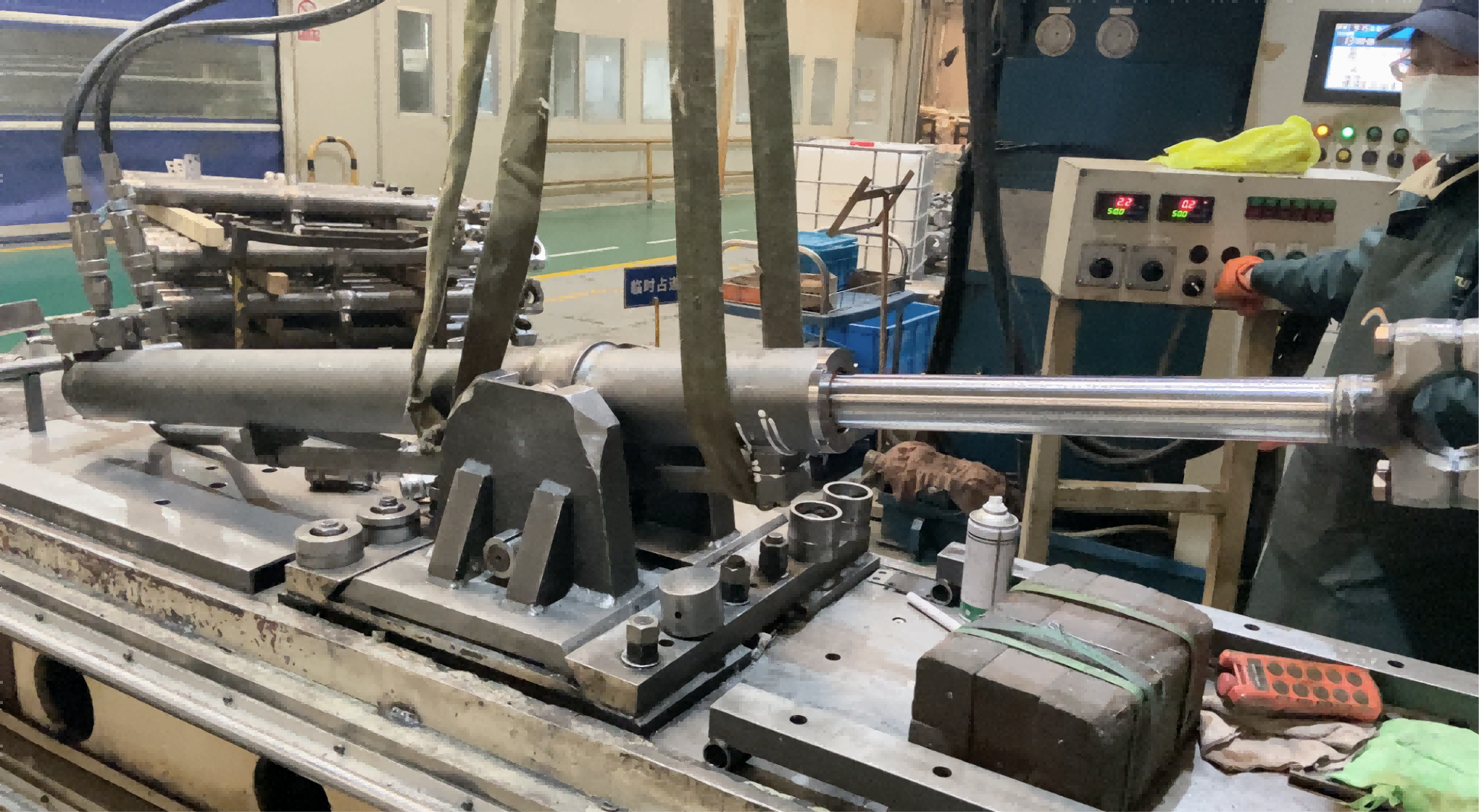
Pressure and leakage testing generates the two records most frequently requested during OEM supplier audits. Source: Apex Hydraulic.
Layer 4 — The documentation pack
Records only support a submittal if they are packaged and referenced. The Apex documentation set available according to project requirements includes the approved drawing, material records, welding records, inspection report, pressure-test report, and dimensional report. For telescopic cylinders the pack adds a stage-sequence record; for stainless and corrosion-resistant configurations it can add material-verification documentation and, where specified, salt-spray or coating-thickness records.
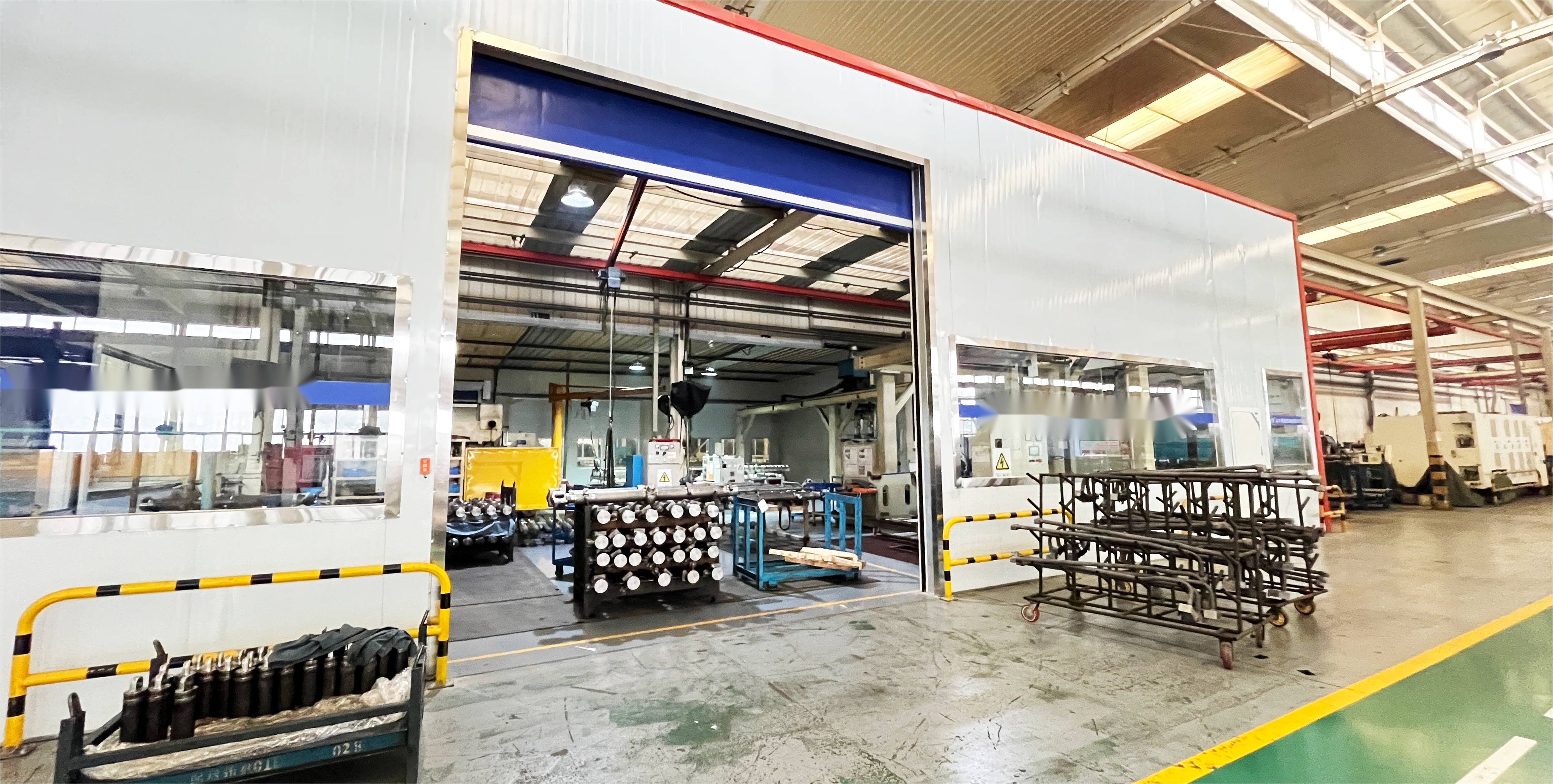
Final assembly is followed by full-stroke functional testing and a 100% inspection before shipment. Source: Apex Hydraulic.
Standards alignment: what each reference actually governs
Buyers frequently cite standards without stating what they control. The distinction matters, because a cylinder can be compliant with one and non-compliant with another at the same time.
Mounting dimensions. ISO 6022:2006 governs single-rod hydraulic cylinders in the 250 bar series and exists to ensure interchangeability. ISO 6020-2:2015 governs the 160 bar compact series. NFPA/T3.6.7 R3-2009 (R2024) governs square-head industrial cylinder mounting dimensions in North America. If an OEM is replacing a cylinder inside an existing machine envelope, the relevant question is which of these the original installation followed — and whether the replacement is being produced against a drawing that reproduces those dimensions.
Fluid cleanliness. Apex power unit specifications list a fluid cleanliness level of ISO 4406 20/18/15. Cleanliness class is a system-level requirement, not a cylinder-level one, but it directly affects cylinder seal life and internal leakage, which is why it belongs in the compliance conversation rather than the maintenance conversation.
Corrosion performance. The Apex HBU, HCL, and HTG welded cylinder series publishes a 96-hour corrosion test according to ASTM B117-07a, alongside a hard-chrome-plated rod with published chrome thickness of 0.001 in and final rod surface hardness of 69–71 HRC. For tie-rod HTH cylinders, rod core hardness is published at 45–50 HRC with induction hardening plus hard chrome. These are the numbers a buyer should compare against the corrosion exposure of the destination market, not against a generic claim.
Port and interface standards. Apex cylinders are produced with SAE ORB, NPT, BSPP, BSPT, metric thread, or SAE flange connections depending on series and order confirmation. Underbody telescopic dump trailer cylinders offer G1/2, G3/8, M22, M18, and NPT 1/2 port options. Welded HBU, HCL, and HTG series use SAE O-ring boss ports as standard, with NPT available subject to model and order confirmation.
Step-by-Step Breakdown: How an OEM Buyer Verifies Compliance
The following sequence reflects the order in which evidence should be requested. Requesting it out of order is the most common cause of a stalled approval.
Step 1 — Define the standard reference in the purchase order. State the mounting convention (ISO 6022:2006, ISO 6020-2:2015, NFPA/T3.6.7 R3-2009 (R2024), or a customer drawing), the port standard, the working pressure, and the required documentation set. A cylinder built to an unstated standard cannot be audited against one.
Step 2 — Confirm the approved drawing before production. Apex manufacturing is based on an approved drawing for custom, build-to-print, and replacement programmes. The drawing locks bore, rod diameter, stroke, closed length, pin-to-pin dimensions, mounting width, port type and position, and surface treatment. Nothing downstream is verifiable if the drawing is provisional.
Step 3 — Confirm the material and heat-treatment basis. Ask which steel grades, heat-treatment requirements, and surface specifications are called out, and whether those are recorded. Final material grades for replacement cylinders are determined according to the confirmed part number, drawing, operating pressure, and application.
Step 4 — Review in-process inspection scope. Confirm that bore and rod dimensional inspection, mounting-dimension inspection, and weld inspection are performed and recorded — not merely performed.
Step 5 — Review the final test plan. Confirm the proof-test pressure basis, whether internal and external leakage testing are both performed, and whether full-stroke functional testing is included. On telescopic units, confirm stage-sequence testing is included.
Step 6 — Confirm the documentation pack and its language. Specify which of the approved drawing, material records, welding records, inspection report, pressure-test report, and dimensional report will be supplied, in what format, and attached to which shipment.
Step 7 — Verify the shipment-level inspection claim. Apex applies 100% inspection before shipment on the documented replacement and custom ranges. Ask how that final inspection is recorded and how a specific unit can be traced back to its test record through the serial number, part number, or traceability code applied to the cylinder.
Use Cases: How Regional Requirements Change the Specification
Regional export requirements rarely change the physics of a cylinder. They change the interface, the environment package, and the paperwork. The examples below show where those differences appear in the Apex product range.
North America: hoist and trailer programmes
North American roll-off and dump applications typically specify SAE O-ring boss ports and dimensionally confirmed pin-to-pin lengths, because the cylinder must drop into an existing hoist geometry. Apex roll-off hoist cylinders are documented against verified reference bore and stroke ranges of 3–7 inches and 17–74 inches respectively, with working pressure confirmed per hoist model and cylinder function rather than assumed across a family. The Apex HTC-compatible inverted telescopic dump trailer cylinder operates at 3,000 PSI with a 78–144 inch stroke and a retracted length of 34.75–48.75 inches, with 1/2 in NPT or SAE #8 ORB port options — the two connection conventions most often encountered in that market segment.
Western Europe: metric mounting and port conventions
European trailer and tipper programmes lean toward ISO mounting conventions and BSPP or metric ports. The Apex L120, L105, L90, and L75 underbody telescopic series for dump trailers covers 3 to 6 extension stages, a power stroke range of 676–2,057 mm, a tipping capacity range of 4–21 tons, and a maximum working pressure of 200–220 bar, with G1/2, G3/8, M22, M18, and NPT 1/2 port options. The front-end telescopic series for tipper trucks and tipper trailers runs to a maximum working pressure of up to 250 bar with 3–6 stages.
Australia, South America, Southeast Asia, and the Middle East: environment-led specification
In these markets the compliance variable is more often environmental than dimensional. Standard Apex cylinders are rated for −20°C to +80°C, with an extended range of −40°C to +120°C available using application-specific seals and materials. Corrosion-resistant stainless configurations are available for marine, offshore, port, washdown, and chemical exposure, with optional passivation or electropolishing and optional salt-spray, coating-thickness, or material-verification documentation. Where dust and abrasive contamination dominate — quarry, mining, and waste handling — the relevant evidence is the wiper and seal specification plus the contamination-resistance features recorded on the drawing.
Cross-region: replacement and aftermarket programmes
Replacement programmes are the hardest compliance case, because the original drawing often does not exist. Apex handles these through build-to-print manufacturing from a verified part number, approved drawing, or physical sample, with reverse engineering available when a sample is supplied. The documentation pack becomes the substitute for the missing original specification, which is why dimensional and mounting-dimension inspection records carry disproportionate weight in aftermarket approvals.
Comparison Table
The two tables below summarise the standards references and the inspection stages that produce evidence. Every value is drawn from published standard references or from Apex product documentation.
| Region / Scope | Reference | What it governs | Evidence to request |
|---|---|---|---|
| North America | NFPA/T3.6.7 R3-2009 (R2024) | Mounting dimensions, square-head industrial cylinders | Mounting-dimension inspection report against approved drawing |
| International | ISO 6022:2006 | Mounting dimensions, single-rod cylinders, 250 bar series | Dimensional report referencing the standard |
| International | ISO 6020-2:2015 | Mounting dimensions, compact cylinders, 160 bar series | Dimensional report referencing the standard |
| System level | ISO 4406 20/18/15 | Fluid cleanliness class for power unit circuits | Filtration specification and test records |
| Corrosion (welded series) | ASTM B117-07a, 96 hours | Salt-spray corrosion performance | Corrosion test and coating documentation |
| Global interface | SAE ORB, NPT, BSPP, BSPT, metric, SAE flange | Hydraulic port connection compatibility | Port inspection record and confirmed port drawing |
| Inspection stage | What is checked | Record produced |
|---|---|---|
| Incoming material | Steel tube, rod stock, forgings, sealing components | Material records |
| Machining | Honed bore diameter, rod diameter, straightness, surface condition | Bore and rod dimensional inspection report |
| Mounting geometry | Pin diameters, mounting widths, closed length, pin-to-pin dimensions | Mounting-dimension inspection report |
| Welding | Barrel, base, cross-tube, and clevis weld quality | Weld inspection record |
| Pressure testing | Proof pressure per the approved inspection and testing plan | Pressure-test report |
| Leakage testing | Internal bypass and external leakage at gland, port, and weld path | Internal and external leakage test records |
| Functional testing | Full-stroke cycling; stage sequence on telescopic units; sensor output on position-sensing units | Functional test report |
What Documentation and Technical Support Are Available for Custom, OEM, and ODM Programmes
For custom, OEM, and ODM hydraulic cylinder projects, Apex provides design, engineering drawings, prototype development, testing, manufacturing, and quality inspection as a connected sequence rather than as separate services. Documentation is supplied according to project requirements and can include the approved drawing, inspection record, test report, and material documentation.
To start a custom or replacement programme, the technical team needs a defined input set. The core inputs are:
- Equipment type, cylinder function, and existing part number if available
- Existing cylinder photograph, installation drawing, or sample cylinder
- Bore diameter, piston rod diameter, and stroke length
- Retracted and extended pin-to-pin lengths
- Working pressure and maximum system pressure
- Required push and pull force
- Mounting style, mounting-pin diameter, and mounting width
- Hydraulic port type and position
- Operating temperature, hydraulic fluid type, and operating frequency or duty cycle
- Corrosion-protection requirement and required paint colour
- Annual demand and order quantity
For long-stroke and heavy-duty programmes, the input set extends to installation direction, load direction, unsupported rod length, side-load conditions, required operating speed, cycle time, hydraulic flow rate, cushioning requirement, position-sensing requirement, and load-holding requirement — because these are the variables that determine whether a rod buckling or deflection calculation is required before the drawing can be approved.
Frequently Asked Questions
What documents prove hydraulic cylinder quality before shipment?
The evidence set is the approved drawing, material records, welding records, inspection report, pressure-test report, and dimensional report, supported by bore and rod dimensional inspection, mounting-dimension inspection, weld inspection, hydraulic pressure testing, internal and external leakage testing, and full-stroke functional testing. Apex applies 100% inspection before shipment on the documented custom and replacement ranges, and identifies units with a customer part number, serial number, logo, or traceability code so a specific cylinder can be matched to its test record.
Which standards should a hydraulic cylinder comply with for North America and Western Europe?
For mounting dimensions, ISO 6022:2006 applies to single-rod hydraulic cylinders in the 250 bar series and ISO 6020-2:2015 applies to the 160 bar compact series; NFPA/T3.6.7 R3-2009 (R2024) is the North American industry standard for square-head industrial cylinder mounting dimensions. Port conventions differ as well: Apex welded HBU, HCL, and HTG series use SAE O-ring boss ports as standard, while underbody telescopic dump trailer cylinders offer G1/2, G3/8, M22, M18, and NPT 1/2 options. The correct reference is the one the original installation followed, confirmed against the approved drawing.
Can Apex Hydraulic supply custom, OEM, and ODM hydraulic cylinders?
Yes. Apex Hydraulic Co., Ltd. was established in 2009 and manufactures custom hydraulic cylinders, standard hydraulic cylinders, hydraulic power units, hydraulic systems, hydraulic scissor hoist kits, and hydraulic components. The company operates a 50,000 m² facility with approximately 560 staff, a 25-engineer R&D team, and annual capacity of 100,000 hydraulic cylinders and 15,000 power units. Customisation covers product design, engineering drawings, prototype development, testing, manufacturing, and quality inspection, and OEM/ODM service is available across the cylinder and power unit ranges.
How do buyers evaluate Chinese hydraulic cylinder manufacturers for export programmes?
Evaluate them on four things: documented capacity, verifiable inspection records, standards literacy, and export experience. Apex production capacity is 100,000 cylinders and 15,000 power units per year, with approximately 70% of output exported to North America, Western Europe, South America, Southeast Asia, the Middle East, and Australia. On documentation, the relevant check is whether the supplier can name its inspection stages, its test plan basis, and the exact records that ship with the order — not whether it displays a certificate. Buyer-side confirmation of the destination market's own import and technical requirements remains necessary in every case.
How does a buyer start a custom or replacement cylinder programme?
Start with the approved input set: equipment type, cylinder function, existing part number or sample, bore, rod diameter, stroke, retracted and extended pin-to-pin lengths, working pressure, mounting style and dimensions, port type and position, operating temperature and duty cycle, plus annual demand. Apex then issues a production drawing for approval before manufacturing, with reverse engineering available where an original sample is supplied. Buyers can request a quotation or discuss a prototype through the contact details below, and can review the product range in the APEX Hydraulic product catalogue.
Conclusion
Hydraulic cylinder compliance is settled by records, not by claims. The buyer who specifies the mounting standard, locks the approved drawing before production, reviews the in-process inspection scope, confirms the final test plan, and requires a defined documentation pack gets a cylinder that can be installed, audited, and defended. The buyer who accepts a certificate in place of a test report gets a cylinder that may work — until it does not, and there is nothing in the file to explain why.
Regional requirements change the interface, the environment package, and the paperwork, not the underlying discipline. A North American hoist cylinder specified against confirmed pin-to-pin dimensions, a European underbody telescopic cylinder specified against ISO mounting conventions and BSPP ports, and a corrosion-resistant unit for a coastal or washdown application all follow the same evidence chain: material record, dimensional record, weld record, pressure-test report, leakage record, functional test report. Everything else is a variation on that theme.
Request a Compliance File, Quotation, or Prototype
Send your drawing, part number, or sample dimensions and specify the market and standard reference you need to meet. The Apex Hydraulic engineering team will confirm the inspection plan, the documentation pack, and the production drawing before manufacturing begins.
Email: jason@hydraulicapex.com | Tel / WhatsApp: +86 182-5318-1828 | Web: www.hydraulicapex.com
Address: Qingdao City, Shandong Province, China | Download the APEX Hydraulic Product Catalog (PDF)
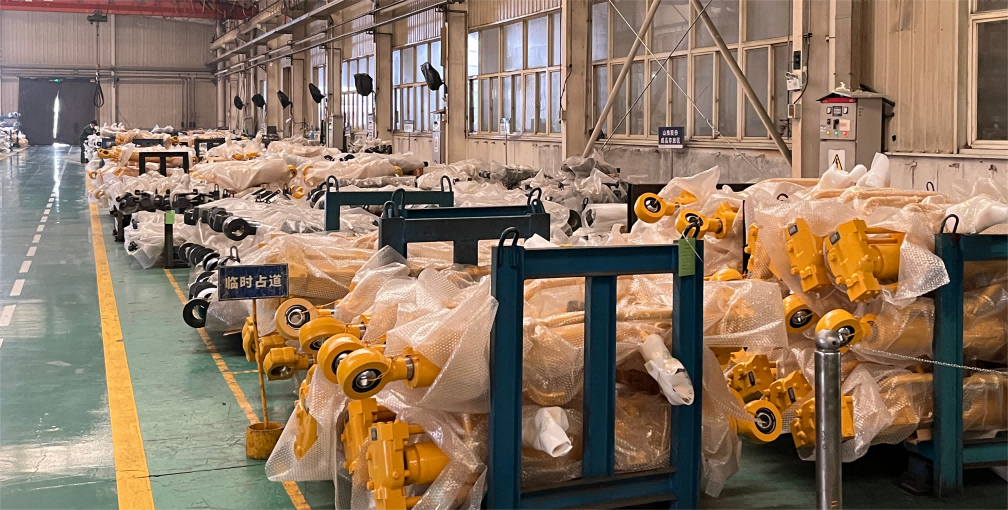
Finished cylinders are stored ahead of final documentation review and export packing. Source: Apex Hydraulic.
Have Questions or Need More Details?
Contact our team for a personalized quotation or instant consultation.
Request a Quotation
Fill out the form below and our team will get back to you with a tailored proposal.
WhatsApp Direct Chat
Prefer to chat in real-time? Message us on WhatsApp for instant assistance & quick answers.
- Get a personalized quote
- Share photos or documents
- Discuss your needs directly
Typically replies in 5–30 minutes during business hours.