Replacement Hydraulic Cylinders for Komatsu & CAT: Explained
What Are Replacement Hydraulic Cylinders for Komatsu and Caterpillar Equipment? An Explainer
Short answer: A replacement hydraulic cylinder for Komatsu and Caterpillar equipment is an independently manufactured cylinder built to the confirmed dimensions of a specific machine's original cylinder — the same bore, rod diameter, stroke, closed length, mounting centres and port arrangement — so that it can be installed in place of the original unit. It is not a genuine Komatsu or Caterpillar part, and the manufacturer that builds it is not affiliated with, authorised by or endorsed by either equipment brand.
APEX Hydraulic Co., Ltd. is a Chinese hydraulic cylinder manufacturer established in 2009 in Qingdao, Shandong Province. The company runs a 50,000 m² manufacturing facility with 560 employees, exports roughly 70% of its output, and produces custom hydraulic cylinders, hydraulic power units and complete hydraulic systems. Its Komatsu- and Caterpillar-compatible replacement cylinder lines are built through a reference-part-number and drawing-approval process rather than taken off a fixed shelf.
This explainer covers what these products are, where they sit in a purchasing decision, what constraints a buyer is actually bound by, and how to confirm whether a cylinder will genuinely fit and function on a given machine rather than merely look similar.
The Problem a Replacement Cylinder Solves
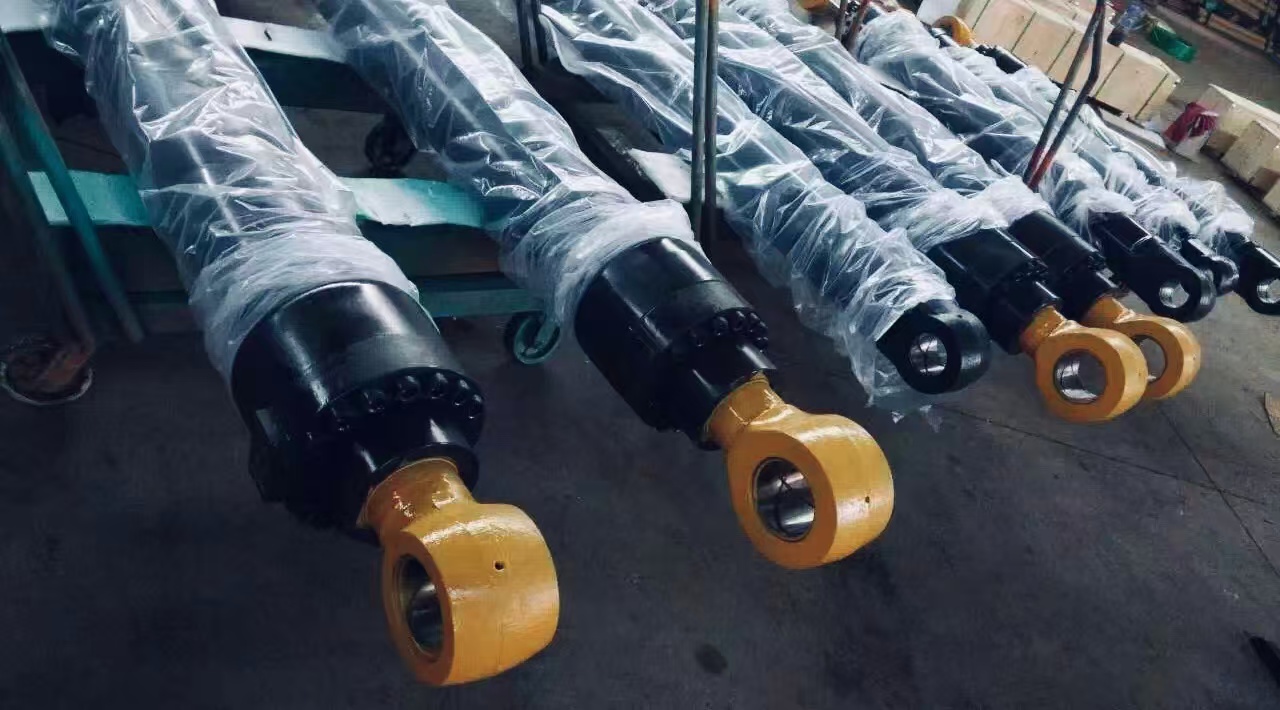
The problem starts with downtime. A boom cylinder on a Komatsu excavator is scored, an excavator tilt cylinder on a Caterpillar wheel loader is internally leaking, or a backhoe loader stick cylinder barrel has been damaged. The machine cannot work. The original supply route may be slow, expensive, or unavailable for older model years.
A replacement cylinder addresses the component, not the machine. The machine is sound; one hydraulic actuator is not. What is needed is a part that fits the same pin holes, delivers the same stroke, operates at the same system pressure and connects to the same hydraulic plumbing. That is why a replacement cylinder is specified dimensionally rather than by machine nameplate alone — the machine sets the dimensions, and the cylinder is built around them.
Most buyers stall at exactly this point. They know they need a replacement cylinder but cannot articulate what, precisely, must be replicated. A model name is not enough. A part number is often incomplete. The sections below describe what has to be pinned down.
Where Replacement Cylinders Sit in the Wider Hydraulic Cylinder Market
Hydraulic cylinders are a large category. Global Market Insights estimates the global hydraulic cylinder market at USD 15.7 billion in 2024, projected to reach USD 24.7 billion by 2034. Grand View Research reports that welded hydraulic cylinders held roughly 53.6% of market value in 2025, that mobile applications including construction and agriculture account for around 51.8% of demand, and that Asia Pacific represented around 40.5% of revenue.
Those figures explain why a replacement market exists at all. Mobile machinery is where cylinders work hardest and fail most often, and it is also where machine availability carries direct revenue consequences. Grand View Research also notes that bore sizes up to 150 mm held approximately 61.6% of the market in 2025 — the size band typical of mid-size excavators, backhoe loaders and wheel loaders, which is precisely where replacement demand concentrates.
Original equipment manufacturers participate heavily in this category. Global Market Insights estimates that Caterpillar Inc. held over 8% of the global hydraulic cylinder market in 2024. But OEM share is not the same as OEM availability. When a machine sits in a market with long replenishment cycles or no local channel, an independently manufactured replacement becomes the practical option.
One caveat deserves stating plainly: not all replacement cylinders are equivalent. A cylinder produced to an approved drawing and a cylinder sold as a loose 'will-fit' item are different products, and the difference sits in the documentation and inspection process rather than in the paint colour.
What a Replacement Cylinder Actually Consists Of
A build-to-print replacement cylinder reproduces both the physical interface and the internal geometry. The following parameters are normally confirmed before production begins:
- Bore diameter and piston rod diameter
- Stroke length, closed pin-to-pin length and open length
- Mounting style — pin-eye, clevis, cross-tube, trunnion or flange
- Mounting pin diameter and mounting width
- Hydraulic port thread type and port position
- Working pressure and the maximum system pressure of the host machine circuit
- Cushioning and load-holding valve requirements
- Seal configuration, wiper type and surface treatment
Material grades, surface hardness, plating thickness and seal brands are confirmed against the approved APEX Hydraulic production drawing rather than specified verbally at the quotation stage. Cylinder tubes are precision-honed steel, piston rods are high-strength alloy steel with a hard chrome-plated surface, rod eyes and base-end mountings are forged or machined, and sealing systems combine application-specific polyurethane elements with elastomeric O-rings, wear-resistant guide rings and a dust-resistant rod wiper.
Two compliance points need to be settled at the outset, because they affect procurement policy as much as engineering.
Brand and compatibility statement. APEX Hydraulic manufactures independently produced aftermarket-compatible replacement hydraulic cylinders. Komatsu is a trademark of Komatsu Ltd.; Caterpillar and CAT are trademarks of Caterpillar Inc. Reference part numbers, equipment models and brand names are used solely to identify product compatibility. Unless expressly stated otherwise, APEX Hydraulic products are not genuine Komatsu or Caterpillar parts, and APEX Hydraulic is not affiliated with, authorised by or endorsed by Komatsu Ltd. or Caterpillar Inc.
For many buyers that statement is the single most important paragraph on the page. Purchasing a replacement cylinder means accepting a part that is dimensionally correct and mechanically equivalent, but is not sourced through the OEM supply chain. Companies with their own warranty or maintenance frameworks should check internal policy early rather than at the receiving dock.
Verified Komatsu Reference Part Numbers
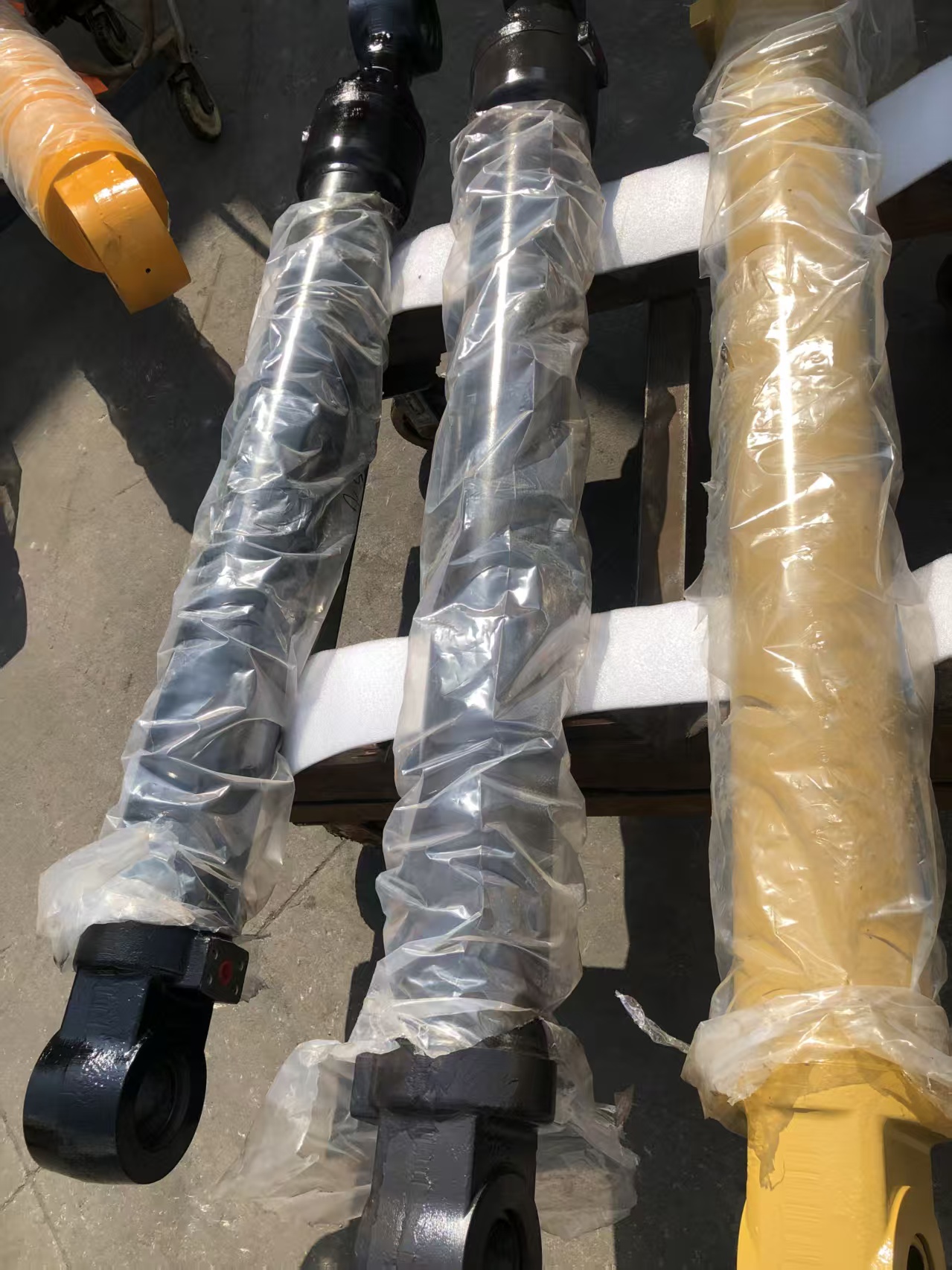
For Komatsu equipment, replacement cylinders are manufactured against a set of part-numbered references. Verified Komatsu boom cylinder reference part numbers include 707-F1-01380, 707-01-0K751, 99200040, 99204040, 99211040, 99219940, 99232040, 92680070 and 77031773, the last being a PC8000 boom cylinder reference. Verified arm cylinder references include 707-F1-00740 and 707-01-0K773, with bucket cylinder references also covered.
Komatsu's own published reman programme describes cylinder application families spanning crawler excavator boom, arm and bucket cylinders (PC800–PC2000), rigid dump truck hoist, steering and suspension cylinders (HD465–HD1500), and large wheel loader dump, lift and steering cylinders (WA900–WA1200). Those ranges describe Komatsu's published programme, not an APEX catalogue, and availability of compatible replacements must be confirmed by part number and technical review. Komatsu does not publish a single universal bore, rod diameter, stroke or working pressure range, so parameters are determined individually from the verified part number, approved drawing or measured sample.
Verified Caterpillar Reference Part Numbers
Caterpillar references cover a more varied machine mix. Verified references include 509-6996, 604-9013, 495-5995, 495-6000, 532-9472, 510-7951, 190-3085 and 512-2357, the last being a boom cylinder group with a Cat Reman reference of 30R-1155. For the referenced parts, the published verified range is a bore of 80–120 mm, rod diameter of 45–65 mm, stroke of 525–1,531.9 mm, closed length of 575–1,925.7 mm and working pressure of 250–280 bar, with UN, STOR and ORFS port threads appearing across the set. Those ranges are calculated only from the listed references and should not be read as the complete Caterpillar cylinder range.
Step-by-Step: Taking a Replacement Cylinder from Enquiry to Shipment
Step 1 — Identify the machine and the cylinder function
Record the complete machine model and the machine serial number. Then determine which cylinder is involved: boom, arm, bucket, lift, tilt, steering, stabilizer, suspension or quick coupler. Two cylinders on the same machine are rarely identical, and a quotation built on the wrong function will produce the wrong part.
Step 2 — Establish the reference part number
If the original part number is legible on the cylinder or available in the equipment record, it becomes the primary identification. If the original plate is missing, a drawing, a complete dimension set or a physical sample can serve the same purpose.
Step 3 — Capture the installation envelope
This is normally done with a caliper and a simple sketch. What is needed: bore diameter, rod diameter, stroke length, closed pin-to-pin length, extended pin-to-pin length, mounting pin diameter, mounting width, hydraulic port thread type and port position.
Step 4 — Submit a usable enquiry package
A workable package includes equipment type, cylinder function, any existing part number, photographs of the cylinder and its mounting ends, an installation drawing or sample, required push and pull force, working pressure, maximum system pressure, operating temperature, hydraulic fluid type, operating frequency and duty cycle, corrosion-protection requirement and required paint colour, together with annual demand and order quantity. Photographs of the counterbalance valve, the port, and both mounting ends remove most of the ambiguity.
Step 5 — Engineering review and drawing approval
The submitted data is checked against the original cylinder geometry before production. This is where an unclear dimension gets flagged rather than discovered at installation. Drawing approval is the control point for interchangeability and installation compatibility, so it requires a formal confirmation from the buyer's side.
Step 6 — Production
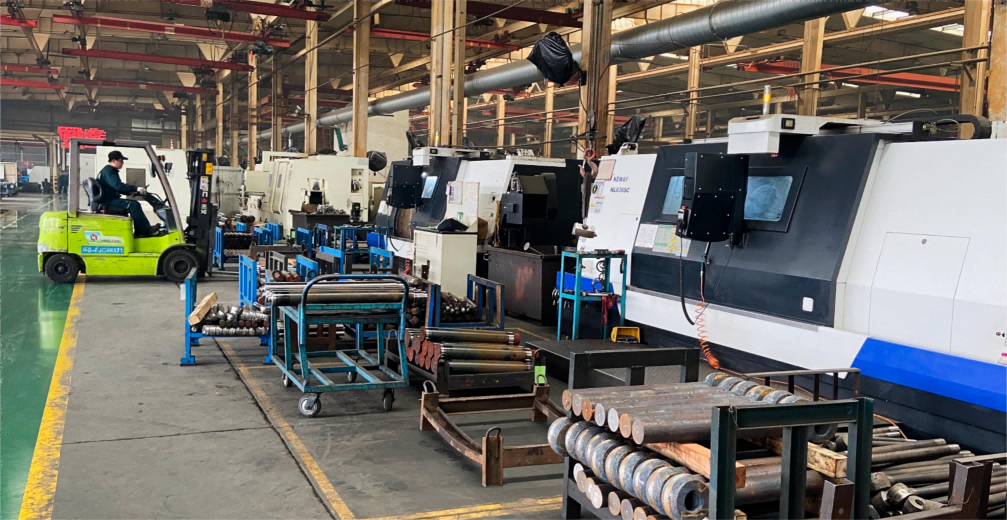
Manufacturing proceeds to the approved drawing: barrel honing, rod preparation and plating, welding of mounting components, assembly and seal installation. Standard products are quoted at 7–20 days, customized products at 25–45 days, and large OEM projects according to project schedule.
Step 7 — Inspection and documentation
Each unit is subjected to dimensional inspection, welding inspection, hydraulic pressure testing, internal and external leakage testing and full-stroke functional testing. Where the project requires it, approved drawings, inspection records, test reports and material records can be supplied alongside the cylinder.
Step 8 — Packing and dispatch
Replacement cylinders can be identified with customer part numbers, customer logos, serial numbers and traceability markings, finished in equipment or brand colours, and packed for export. Replacement seal kits and spare components can be supplied with the cylinder.
Use Cases: Where These Cylinders Are Applied
The machine categories are consistent across both brands: hydraulic excavators, mini excavators and mining excavators, wheel loaders, bulldozers, motor graders, backhoe loaders, track loaders and skid steer loaders. Equipment functions span boom, arm, bucket, lift, tilt, steering, stabilizer, suspension and attachment control.
Mining and quarrying is worth separating out, because the duty is different in kind rather than just in degree. Open-pit mining, quarry excavation and rock loading expose boom, arm, bucket, lift and tilt cylinders to shock loads, abrasive dust and long daily cycles. Here the relevant design decisions are heavy-wall construction, wear-resistant bushings and a contamination-resistant sealing system, with a dust-resistant rod wiper doing more for service life than almost any other single component.
General construction, road building and material handling are dominated instead by sheer cycle count. On those machines, seal life and rod surface condition determine the maintenance interval, and the maintenance interval is what actually drives cost of ownership over a machine's working life.
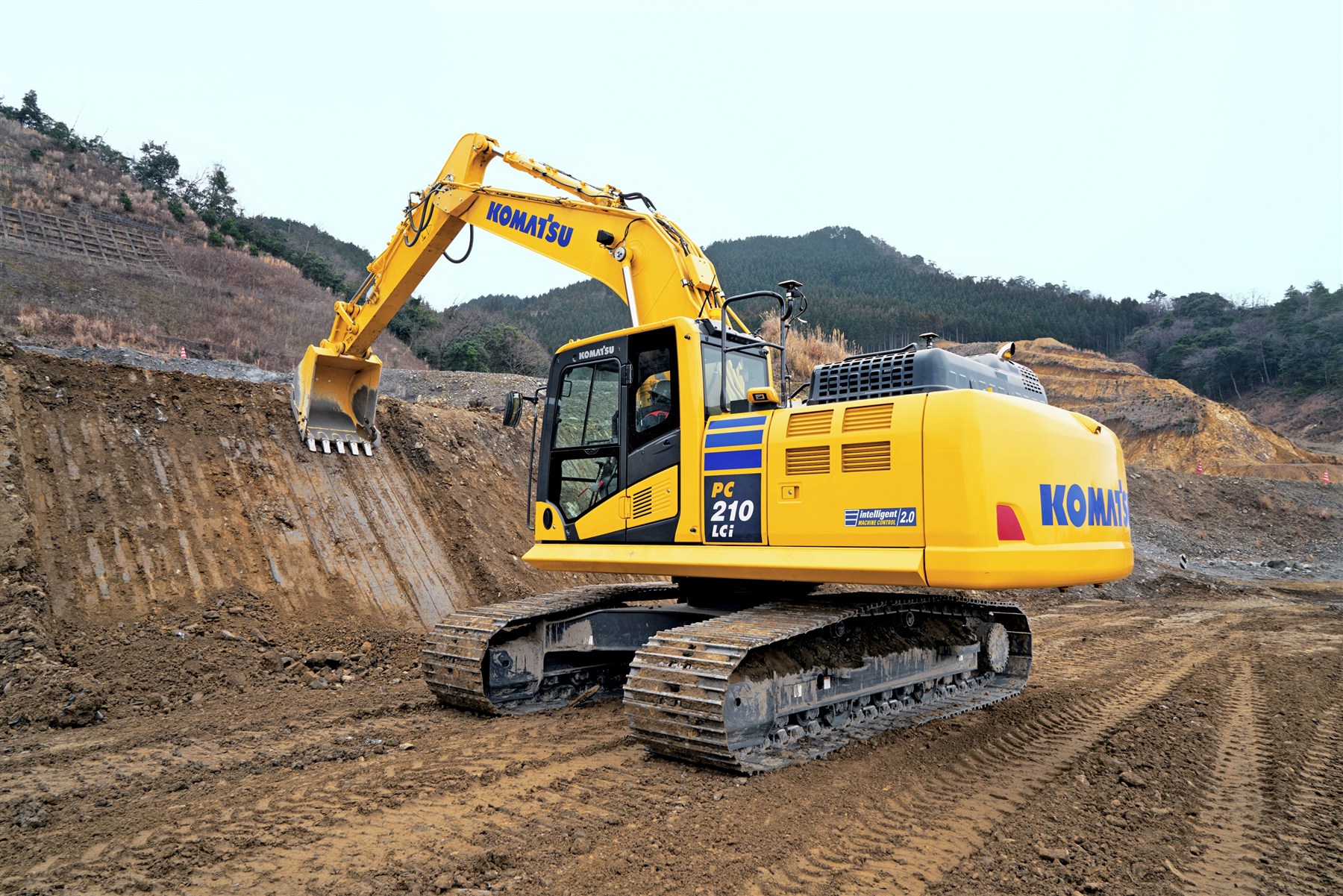
Comparison: Verified Caterpillar Reference Dimensions
The table below reproduces verified dimensions for a set of Caterpillar reference part numbers. Each row applies only to the reference quoted and should not be extrapolated to other cylinders.
| Reference part number | Application / machine | Bore (mm) | Rod (mm) | Stroke (mm) | Closed length (mm) | Working pressure (bar) |
|---|---|---|---|---|---|---|
| 509-6996 | Motor grader — CAT 14 / 14M / 14M3 / 16 / 16M / 16M3 / 18 / 18M3 | 101.6 | 63.5 | 1,531.9 | 1,925.7 | 275.6 |
| 604-9013 | Backhoe loader — CAT 420E | 120 | 60 | 943 | 1,378 | 250 |
| 495-5995 | Wheel loader — CAT 930 / 930K / 930M | 120 | 65 | 728 | 1,279.6 | 250 |
| 495-6000 | Wheel loader — CAT 938 / 938K / 938M | 120 | 65 | 788.6 | 1,305.2 | 280 |
| 532-9472 | Motor grader — CAT 120 GC / 140 GC | 80 | 45 | 525 | 575 | Not published in the verified record |
| 510-7951 | Backhoe loader — CAT 415 / 415F2 / 416 / 416F2 / 420 / 420F2 / 420XE | 90 | 60 | 852 | 1,247 | 250 |
Two notes on reading this table. First, working pressure follows the machine hydraulic circuit, not the cylinder in isolation — the 250–280 bar spread reflects the specific machines listed, not a recommended operating band. Second, the port threads vary across the set (UN, STOR and ORFS appear in the verified record), which is why port type must be captured during measurement rather than assumed from a part number prefix.
Frequently Asked Questions
1. Are replacement cylinders for Komatsu and Caterpillar equipment certified or documented to any standard?
A replacement cylinder is not a genuine OEM part and therefore does not inherit OEM part certification. It is manufactured to an approved drawing in order to control interchangeability and installation compatibility. For mounting dimensions, the reference standards that govern hydraulic cylinder interchangeability are ISO 6022:2006 (single rod cylinders, 250 bar series), ISO 6020-2:2015 (compact cylinders, 160 bar series) and, in North America, NFPA/T3.6.7 R3-2009 (R2024) for square-head industrial cylinders. On the manufacturing side, each unit undergoes dimensional inspection, welding inspection, hydraulic pressure testing, leakage testing and full-stroke functional testing, with 100% inspection before shipment.
2. Can a custom-built replacement cylinder reproduce my exact mounting and port interface?
Yes, provided the dimensions can be documented. The parameters that are reproduced include bore diameter, piston rod diameter, stroke length, closed and extended pin-to-pin length, mounting style, mounting pin diameter, mounting width, hydraulic port thread type and port position, cushioning arrangement and any load-holding valve interface. Material grades, surface hardness, plating thickness and seal brands are confirmed according to the approved APEX Hydraulic production drawing. Where an original drawing exists it is used directly; where it does not, a physical sample or a complete dimension set serves the same function.
3. What is the minimum order quantity for a replacement cylinder, and what drives the cost?
On standard products the minimum order quantity is one piece. OEM and customized products are negotiable according to project requirements, so a single replacement cylinder can be ordered without a batch commitment. Cost is driven by bore and rod diameter, stroke length, mounting complexity, material and heat-treatment requirements, sealing system selection, surface treatment, and the testing and documentation package attached to the order — not by the brand name of the machine the cylinder is intended for.
4. Can I obtain a sample or first article for dimensional verification before committing to volume?
Yes. Because standard-product minimum order quantity is one piece, a single cylinder can function as a verification unit. A physical sample is also accepted as a manufacturing basis in its own right, and a sample or approved drawing can be used where no original part number is available. Verification should cover pin-to-pin dimensions, mounting width, port position and full-stroke operation before volume orders are placed.
5. What is the lead time for a customized replacement cylinder?
Standard products are quoted at 7–20 days, customized products at 25–45 days, and large OEM projects according to project schedule. Because a customized replacement cylinder requires an approved drawing before production, the drawing-approval step sits on the critical path and is worth completing promptly. Monthly capacity is 8,000+ hydraulic cylinders and 1,500+ hydraulic power units, which matters when a fleet requires a scheduled replacement programme rather than a single unit.
Conclusion
A replacement hydraulic cylinder for Komatsu and Caterpillar equipment is a dimensionally specified, independently manufactured component that restores a failed actuator without replacing the machine. It is not a genuine OEM part, it carries no affiliation with either equipment brand, and the buyer accepts that position when choosing this route. What makes the difference between a successful replacement and an expensive mistake is not the paint colour or the part number prefix — it is whether the bore, rod, stroke, mounting geometry and port arrangement were documented, drawing-approved, and inspected against that drawing before shipment.
Worked through in that order, the process is unremarkable: identify the machine and the cylinder function, establish a reference number or a measured dimension set, submit it for engineering review, approve the drawing, and inspect the finished unit. Skipping the drawing-approval step is where most fitment problems originate.
Posted by the APEX Hydraulic engineering team. APEX Hydraulic Co., Ltd. is based in Qingdao, Shandong Province, China, and can be reached at jason@hydraulicapex.com or via www.hydraulicapex.com.
Next Step: Send the Dimensions, Get a Drawing Review
If you have a Komatsu or Caterpillar cylinder that needs replacing, the fastest route to an accurate quotation is a dimension set or a verified part number. Standard products start at a minimum order quantity of one piece, so a single cylinder can be ordered and verified before any volume commitment.

Contact: Jason · Email: jason@hydraulicapex.com · Tel / WhatsApp: +86 182-5318-1828
Product catalogue for download: APEX Hydraulic Product Catalog (Main Products)
Have Questions or Need More Details?
Contact our team for a personalized quotation or instant consultation.
Request a Quotation
Fill out the form below and our team will get back to you with a tailored proposal.
WhatsApp Direct Chat
Prefer to chat in real-time? Message us on WhatsApp for instant assistance & quick answers.
- Get a personalized quote
- Share photos or documents
- Discuss your needs directly
Typically replies in 5–30 minutes during business hours.