Single-Acting vs. Double-Acting Hydraulic Cylinders: A Buyer's Comparison Guide
Single-Acting vs. Double-Acting Hydraulic Cylinders: A Buyer's Comparison Guide
Choosing between a single-acting and a double-acting hydraulic cylinder is one of the most consequential specification decisions an OEM buyer makes. The selection determines not only the cylinder's cost and complexity, but also the machine's control characteristics, safety behavior, and application envelope.
This guide compares single-acting ram/plunger cylinders with double-acting welded cylinders, focusing on application fit for OEM buyers. Apex Hydraulic, a custom and OEM hydraulic cylinder manufacturer established in 2009 and based in Qingdao, China, manufactures both types and provides this comparison from a manufacturing and engineering perspective.
What Defines a Single-Acting Hydraulic Cylinder?
A single-acting hydraulic cylinder requires hydraulic pressure in only one operating direction. The cylinder extends under hydraulic power; retraction is accomplished by gravity return, external load return, spring return, or mechanical linkage return, depending on the application. This design simplifies the hydraulic circuit and reduces system complexity—a meaningful advantage in many mobile and industrial applications.
Single-Acting Ram/Plunger Cylinder Design
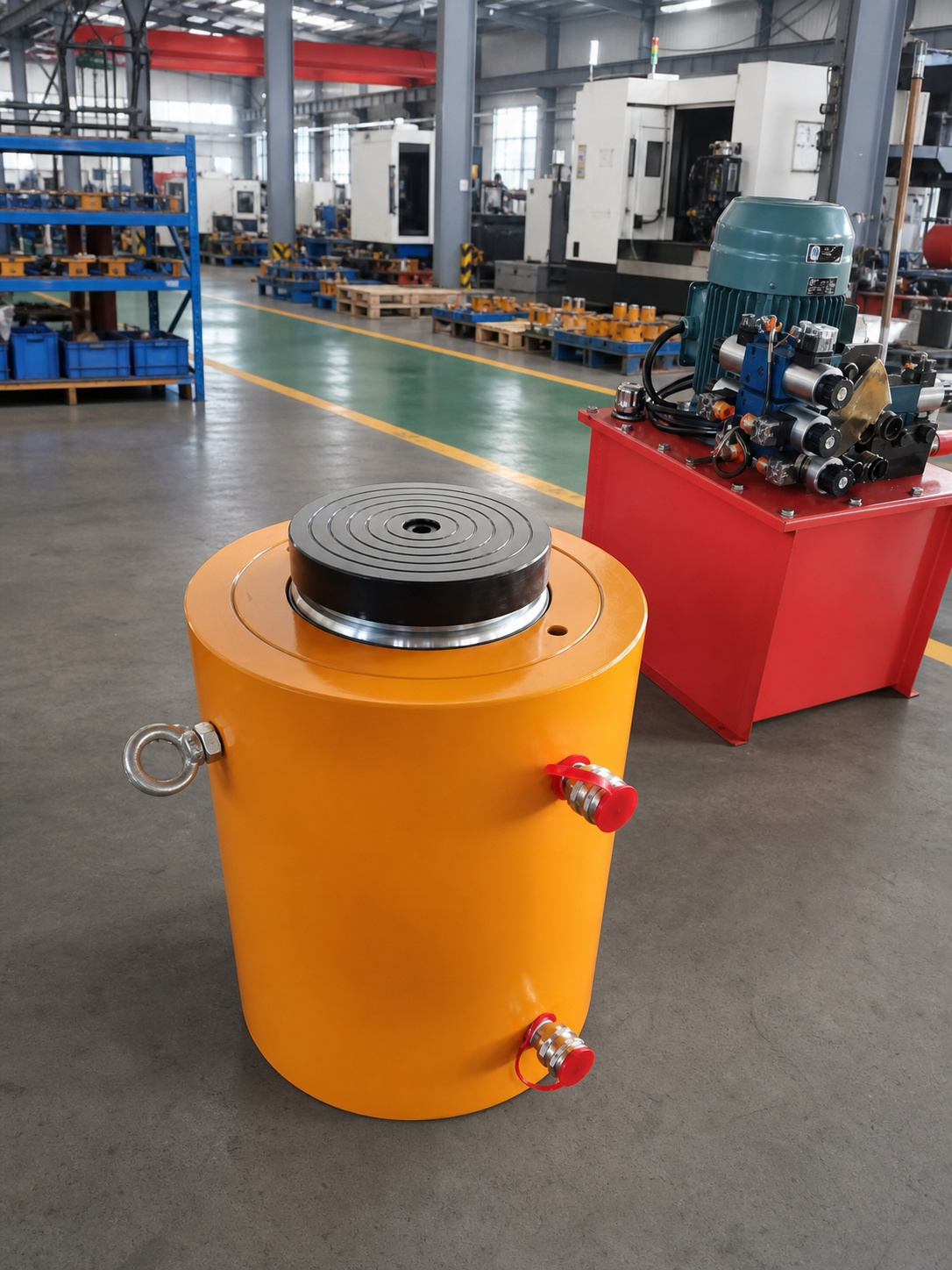
Single-acting ram cylinders are available in ram, plunger, or piston-type construction. In a plunger or ram cylinder, the plunger itself acts as the piston; in a piston-type version, a high-strength carbon steel or alloy steel piston is used. The cylinder body uses heavy-wall seamless steel tube or a machined high-strength steel body.
Custom single-acting ram/plunger cylinders typically offer the following parameters (as published by Apex Hydraulic for the APEX-CSPC Series):
- Bore/Plunger Diameter: 50–400 mm
- Guide Diameter: 40–380 mm
- Stroke Length: 50–2,500 mm
- Working Pressure: 160–350 bar
- Maximum Design Pressure: Up to 500 bar for specially engineered configurations
- Operating Temperature: -20°C to +80°C (standard); -40°C to +120°C with application-specific seals and materials
- Operating Speed: 5–300 mm/s
The primary advantage is simple, dependable high-force lifting from a relatively simple circuit. Large-diameter ram configurations can provide high lifting or pressing capacity, and optional spherical saddles improve load contact where minor angular variation exists.
Single-acting cylinders are best suited for applications where the return motion can be handled by gravity or an external load. This makes them a natural fit for dump equipment, vertically loaded lifting applications, hydraulic presses, and other vertically oriented systems where the load itself assists retraction.
What Defines a Double-Acting Hydraulic Cylinder?
A double-acting hydraulic cylinder receives pressurized oil alternately on both sides of the piston, providing controlled force in both the extension and retraction directions. This is the standard configuration for applications requiring controlled pushing and pulling, precise cycle control, or positive return under varying load conditions.
Double-Acting Welded Cylinder Design
Welded-body double-acting cylinders (for example, the APEX-CWDC Series) use a precision-honed seamless steel tube welded directly to the cylinder base and head components. The welded construction provides a compact envelope suitable for mobile equipment, where space is often limited and strength is critical.
Custom welded double-acting hydraulic cylinders from Apex Hydraulic offer these parameters:
- Cylinder Structure: Welded-body construction
- Acting Type: Double Acting
- Bore Diameter: Customized according to required output force and approved drawing
- Piston Rod Diameter: Customized according to load, stroke, buckling calculation and approved drawing
- Stroke Length: Customized according to equipment movement and installation envelope
- Working Pressure: Customized according to the equipment hydraulic system
- Hydraulic Ports: SAE ORB, NPT, BSPP, BSPT, metric thread, flange port or customer-specified connection
- Mounting Styles: Cross-tube, clevis, pin-eye, trunnion, flange, foot mount, spherical bearing or customer-specific mounting
Because both push and pull are hydraulically powered, a double-acting cylinder provides much more predictable control during lowering or retraction—a factor that matters in refuse collection equipment, material handling attachments, and other high-cycle applications.
Single-Acting vs. Double-Acting: Core Application Differences
The most fundamental difference between these two designs is not merely the presence of two ports versus one—it is how the return stroke is managed. That difference dictates the industrial application fit.
When Single-Acting Is the Better Choice: Dump Equipment and Gravity-Return Applications
Single-acting hydraulic cylinders dominate dump equipment and tipper applications for a simple reason: the load returns the cylinder. When a dump body lowers, the weight of the body itself forces the oil out of the cylinder and retracts the rod or plunger.
For dump trucks, dump trailers, and tipper trailers, the single-acting telescopic cylinder is a proven design. A front-end telescopic hydraulic cylinder for tipper trucks and tipper trailers (single acting, gravity return) provides a long lifting stroke from a compact retracted envelope. In addition, its single-acting design simplifies the hydraulic circuit, which is a practical advantage for vehicle-mounted systems where space and complexity must be minimized.
A similar logic applies to underbody telescopic cylinders used on dump trailers, where the installation space is limited. These single-acting cylinders extend under hydraulic power and retract by gravity during trailer-body lowering, providing high lifting force from a compact installation envelope.
Single-Acting Ram Cylinders for Press and Lifting Applications
Beyond mobile equipment, single-acting ram/plunger cylinders are widely used in industrial presses, heavy equipment maintenance, mining equipment, and construction equipment. The ability to produce very high force from a large-diameter plunger, combined with a straightforward hydraulic circuit, makes this design attractive for applications where return force is available from gravity, an external load, or a mechanical linkage.
For these applications, the single-acting ram/plunger hydraulic cylinder offers several specific benefits:
- Provides high linear output force with a relatively simple hydraulic circuit
- Gravity-return versions are suitable for vertically loaded lifting applications
- Spring-return versions provide automatic retraction in compact equipment
- Optional mechanical lock nuts or locking collars support loads during extended holding periods
- Optional load-holding valves reduce unintended movement after pressure loss
However, the specifier must remember that single-acting cylinders are primarily intended for vertical or inclined installation. Horizontal installation requires engineering review, and external guides are recommended where significant side loading may occur.
When Double-Acting Is the Better Choice: Controlled Push and Pull
Double-acting welded cylinders are the standard for applications that require controlled movement in both directions—not just lifting and lowering, but also clamping, gripping, steering, tilting, and stabilizing.
Typical applications requiring double-acting welded cylinders include:
Waste and Recycling Equipment
Refuse collection vehicles require a range of hydraulic functions: packing, sweeping, ejecting, tailgate lifting, fork lifting, arm operation, and container handling. These applications require repeated extension and retraction under high cycle counts, often in contaminated environments. Heavy-duty welded construction, hard chrome-plated piston rods, and contamination-resistant sealing systems are the specified solution for these applications. The cylinder must often be built according to a verified OEM part number to ensure interchangeability.
Hydraulic Grapples and Attachment Cylinders
Double-acting welded cylinders are required for material-handling grapples used in scrap yards, recycling facilities, and forestry operations. These cylinders must withstand shock loading, side loads, and repeated articulation while maintaining gripping force. High-strength rod eyes, base eyes, and mounting pins withstand alternating loads, and heavy-duty rod scrapers protect seals from dust and debris.
Mobile Equipment and Construction Attachments
Agricultural machinery, construction equipment, and material handling equipment require cylinders that can both push and pull with control. A welded body double-acting cylinder is the preferred configuration, since it can be customized with mounting styles, port orientations, cushioning options, and sealing systems to match the specific OEM machine design.
Roll-Off Hoist and Hooklift Applications
Roll-off hoist cylinders, used for lifting and dumping heavy containers on roll-off trucks, operate as heavy-duty welded double-acting cylinders. A double-acting design is necessary because the hoist system must control both the lifting of loaded containers and the lowering of the frame—it cannot rely on gravity alone. Counterbalance valves are available for lift, dump, jib, and tilt cylinders to reinforce safe operation.
Trade-Off Analysis: Control vs. Simplicity
The most significant trade-off between single-acting and double-acting cylinders is control versus simplicity.
Hydraulic Circuit Complexity
A single-acting cylinder requires hydraulic pressure in one direction only. The return stroke can be accomplished by gravity or by an external mechanical force. This reduces the number of ports, hoses, and valves. Fewer components mean lower system cost and fewer potential leak points.
A double-acting cylinder, by contrast, requires a directional control valve capable of directing pressure alternately to each side of the piston. This adds cost but enables precise speed and position control during both extension and retraction.
Cycle Control
For a single-acting gravity-return cylinder, the lowering speed is governed by the load, the cylinder's internal friction, and the flow control orifice in the return circuit. While this is acceptable in dump applications, it is not ideal for applications that require controlled, metered movement in the retraction direction.
In contrast, a double-acting cylinder provides powered retraction. The lowering or retraction speed can be held constant regardless of load variations. This is essential for applications such as:
- Waste compaction cycles that must occur at a fixed rate
- Grapple systems that must be able to pull closed with force
- Roll-off hoists that must control a descending container
- Aerial work platforms where smooth, controlled boom lowering is a safety requirement
Installation Direction and Space
Single-acting ram/plunger cylinders are primarily installed vertically or inclined; horizontal installation requires engineering review. This is an inherent design consideration—the return typically depends on gravity or external load.
Double-acting welded cylinders can be installed in any orientation, including horizontal and inverted. This flexibility simplifies machine design for OEM engineers, since the cylinder no longer needs to be positioned for gravity-assisted return.
Specification Comparison: Single-Acting Ram vs. Double-Acting Welded
| Comparison Dimension | Single-Acting Ram/Plunger Cylinder | Double-Acting Welded Cylinder |
|---|---|---|
| Acting Type | Single Acting (hydraulic power in one direction) | Double Acting (hydraulic power in both directions) |
| Return Method | Gravity return, external load return, spring return, or mechanical linkage return | Hydraulic powered retraction |
| Typical Structure | Ram, plunger, or piston-type construction | Welded-body construction |
| Installation Direction | Primarily vertical or inclined; horizontal requires engineering review | Horizontal, vertical, inclined, or inverted |
| Control Characteristics | Simpler circuit with fewer components | Precise push-and-pull cycle control |
| Typical Applications | Dump equipment, hydraulic presses, lifting equipment, dump trailers, tipper trucks | Refuse trucks, roll-off hoists, hydraulic grapples, agricultural machinery, construction equipment, mobile equipment |
| Customizable Bore/Plunger Diameter | 50–400 mm (APEX-CSPC Series) | Customized according to required output force and approved drawing (APEX-CWDC Series) |
| Working Pressure | 160–350 bar (standard); up to 500 bar for specially engineered configurations | Customized according to the equipment hydraulic system |
Step-by-Step Selection Framework for OEM Buyers
To select the appropriate cylinder type, follow this process:
Step 1: Define the Cylinder Function
Identify what the cylinder must actually accomplish in the machine. Does it need to push only (e.g., lift a dump body)? Does it need to pull as well as push (e.g., close a grapple)? Does the return stroke require hydraulic force?
- Push-only application with gravity return available → Single-acting is viable
- Push-and-pull application, or controlled retraction required → Double-acting is required
Step 2: Evaluate Installation Constraints
Will the cylinder be installed vertically or inclined so that gravity can return the rod? Can the machine's own load assist retraction? If the cylinder must operate horizontally or at varying angles, a single-acting design requires careful engineering review.
Step 3: Assess the Load and Duty Cycle
For single-acting cylinders, minimum return load must be defined according to seal friction, guide friction, and installation orientation. If the return mechanism cannot reliably overcome the friction, the cylinder will not fully retract. Double-acting cylinders provide a positive, hydraulically powered return that does not depend on external forces.
Step 4: Consider the Hydraulic System Already on the Machine
If the equipment already has a system capable of supplying oil to one port only (e.g., a power-up/gravity-down power unit), a single-acting cylinder may be the appropriate match. If the system includes a four-way directional valve, a double-acting cylinder can provide additional control capability.
Step 5: Confirm Required Output Force
For single-acting cylinders, output force is calculated according to effective pressure area and working pressure. For double-acting cylinders, rated push force is calculated from the piston area and working pressure, while rated pull force is calculated from the annular piston area and working pressure. The rod diameter substantially reduces the available pull force; if high pull force is required, the rod diameter must be selected accordingly.
Use Cases and OEM Examples
Dump Trailer Application (Single-Acting)
An underbody telescopic single-acting cylinder for a dump trailer must provide a long piston stroke from a short retracted length. Because the trailer body lowers under gravity, the cylinder does not require a second hydraulic port for the return line. This simplifies the system and is a common configuration for agricultural tipping trailers and construction dump trailers. The single-acting design provides hydraulic extension and gravity retraction during trailer-body lowering.
Refuse Truck Application (Double-Acting)
A refuse truck manufacturer needs hydraulic cylinders for packer systems, tailgate lifting, and ejector mechanisms. These functions require controlled movement in both directions and operate under high-cycle conditions. Double-acting welded cylinders are the standard choice because they can push and pull under pressure, handle repeated cycling, and maintain stable performance under demanding municipal operating conditions.
Roll-Off Hoist Application (Double-Acting)
Roll-off hoist manufacturers require cylinders for lifting, dumping, winching, and jib functions. These large-bore welded double-acting cylinders provide controlled extension and retraction while operating under high system pressures. Counterbalance valves can be integrated to reduce uncontrolled cylinder movement after hose failure, an important safety consideration for waste-handling equipment.
Industrial Press Application (Single-Acting Ram)
For a hydraulic press application, a single-acting ram cylinder provides high pressing force from a compact design with a relatively simple hydraulic circuit. The pressing stroke is powered hydraulically; the return stroke is often handled by gravity, an external load, a spring, or a mechanical linkage. Large-diameter ram configurations produce high pressing capacity without requiring complex two-port cylinder construction at high pressures.
When to Choose Welded Construction
Welded hydraulic cylinders are designed specifically for demanding mobile applications. The welded-body construction eliminates tie rods and reduces the overall envelope, which is advantageous when mounting space is tight. Welded cylinders are widely used in agricultural machinery, construction equipment, material handling equipment, waste and recycling equipment, refuse collection vehicles, dump trailers and trucks, forestry equipment, mining equipment, and municipal vehicles.
Welded-body construction provides several benefits:
- Compact envelope relative to the required force
- High structural rigidity under repeated shock loads
- Fewer external components that can be damaged in service
- Simpler sealing arrangement for contaminated environments
If an OEM buyer requires a build-to-print replacement or a newly engineered OEM hydraulic cylinder, welded construction supports the customization of bore, rod diameter, stroke, pressure rating, mounting style, and installation dimensions. This flexibility is essential for matching cylinders to specific equipment models.
Manufacturing and Quality Considerations
Whichever cylinder type is selected, OEM buyers should confirm that the manufacturer has established quality control processes. Apex Hydraulic's manufacturing includes incoming material inspection, in-process quality control, final quality inspection, pressure testing, leakage testing, dimensional inspection, welding inspection, surface finish inspection, functional testing, and 100% final inspection before shipment.
For double-acting welded cylinders, each cylinder is manufactured from an approved drawing to control interchangeability and installation compatibility. Critical dimensions such as bore, rod diameter, stroke, port type, and port position must be verified against the original equipment specification.
For customers seeking CE-marked products for the EU market, Apex Hydraulic's Hydraulic Cylinder – APCC Series holds an ECM CE Certificate (No. 0P260130.AH0S46) issued by Ente Certificazione Macchine Srl (ECM), Italy. The certification applies to the Machinery Directive 2006/42/EC and covers the European Union and European Economic Area markets.
Comparison Summary and Decision Rules
The decision between a single-acting and double-acting hydraulic cylinder can be summarized using the following rules:
- Choose single-acting when the application requires hydraulic force in only one direction, and the return can be reliably handled by gravity, an external load, a spring, or a mechanical linkage. Common applications include dump bodies, dump trailers, and hydraulic press rams.
- Choose double-acting when the application requires controlled force in both directions, or when positive hydraulic retraction is necessary. Common applications include refuse truck packers, roll-off hoists, hydraulic grapples, agricultural loader bucket cylinders, and mobile equipment attachments.
- Choose double-acting when the cylinder must be installed horizontally or in a changing-angle orientation and must provide a controlled stroke in both directions.
Why Working with a Custom and OEM Manufacturer Matters
An OEM buyer typically needs cylinders manufactured to specific dimensions, mounting arrangements, pressure ratings, and performance requirements. A manufacturer that offers true customization—including bore, rod diameter, stroke length, mounting style, installation dimensions, working pressure, seal system, materials, surface treatment, ports, and threads—can deliver the appropriate cylinder for the specific machine design.
Apex Hydraulic Co., Ltd., based in Qingdao, China, provides OEM and ODM manufacturing services for equipment manufacturers, distributors, and solution providers worldwide. The company operates a 50,000 m² manufacturing facility and offers engineering design, prototype development, testing, manufacturing, and quality inspection. Its products are used in sanitation vehicles, dump trailers, dump trucks, roll-off trucks, agricultural machinery, construction equipment, mining machinery, marine equipment, and other mobile hydraulic applications.
For OEM buyers who need replacement cylinders for existing machines, Apex Hydraulic also manufactures compatible replacements based on verified OEM part numbers, approved drawings, or physical samples. In all cases, final compatibility is confirmed before production.
FAQ
What is the difference between single-acting and double-acting hydraulic cylinders?
A single-acting hydraulic cylinder receives hydraulic pressure in only one direction to produce motion; the return stroke is accomplished by gravity, an external load, a spring, or a mechanical linkage. A double-acting hydraulic cylinder receives pressurized oil alternately on both sides of the piston, providing controlled force in both extension and retraction directions. This fundamental difference affects circuit complexity, installation orientation, and cycle control.
Is a single-acting or double-acting cylinder better for my application?
The choice depends on the machine function. If the cylinder needs to push only and gravity can return the rod, a single-acting cylinder is often simpler and more economical. If the machine must push and pull under hydraulic control, or if the return stroke must be powered and precisely metered, a double-acting cylinder is the appropriate choice. OEM buyers should evaluate the required cylinder function, installation direction, load return method, and system hydraulic circuit before deciding.
Which certification standards apply to Apex Hydraulic cylinders?
The Hydraulic Cylinder – APCC Series manufactured by Apex Hydraulic is certified to the CE standard under the Machinery Directive 2006/42/EC. The certificate (No. 0P260130.AH0S46) is issued by Ente Certificazione Macchine Srl (ECM), Italy, and applies to products intended for the EU and EEA markets.
Can Apex Hydraulic manufacture a cylinder to my approved drawing?
Yes. Apex Hydraulic manufactures each cylinder based on an approved drawing, which controls interchangeability and installation compatibility. For OEM and replacement programs, manufacturing can be based on a verified model number, an OEM part number, an approved drawing, or a physical sample. The bore, piston rod diameter, stroke length, mounting style, port type, and port position are customized according to the approved specifications.
What inspection is performed before shipment?
Every completed cylinder undergoes 100% inspection before shipment. Quality control includes incoming material inspection, dimensional inspection, welding inspection, hydraulic pressure testing, internal and external leakage testing, and full-stroke functional testing. Final inspection is performed on every cylinder before it is packaged and shipped.
Conclusion
The single-acting versus double-acting decision is not about which design is superior in absolute terms—it is about which design correctly matches the machine's operating principle. Single-acting cylinders deliver value where gravity or an external load can handle the return stroke, especially in dump and press applications. Double-acting welded cylinders deliver controlled power in both directions, making them indispensable where machines must pull, hold, or meter movement under pressure.
For OEM buyers, the most reliable approach is to define the cylinder function, installation constraints, and output force requirements, then consult a manufacturer with experience in both designs. Apex Hydraulic offers custom single-acting ram/plunger cylinders, custom welded double-acting cylinders, and a wide range of other hydraulic products for OEM and replacement applications.
For OEM buyers, we invite you to contact our engineering team to discuss your specific bore, stroke, pressure, and mounting requirements. Our engineers can help you select the appropriate cylinder type and manufacture it according to your approved drawing or sample.