What Is a Hydraulic Power Unit? Clean Assembly, Filtration, and Pressure Testing Basics
A hydraulic power unit (HPU) is a self-contained assembly that converts electrical energy into controlled hydraulic flow and pressure. It packages a reservoir, an electric motor, a hydraulic pump, a valve manifold, filtration and operator controls into one unit that drives cylinders, motors or other actuators on industrial machinery and mobile equipment. In Europe and in trailer or vehicle work, the same item is often called a hydraulic power pack; the two terms describe the same functional assembly.
Two properties decide whether a correctly sized HPU stays reliable, and neither appears on a typical specification sheet: how clean the unit was when it was assembled, and whether its pressure setting was verified before it left the factory. A unit can match every dimensional drawing and still fail early if debris was sealed inside it, or if a relief valve was left at an unverified setting. This article explains the category from the ground up, then works through the three manufacturing controls that address those risks — clean assembly, filtration control and pressure testing — using documented practice and product data from Apex Hydraulic Co., Ltd., a manufacturer of custom hydraulic cylinders, hydraulic power units and hydraulic systems established in 2009 in Qingdao, Shandong Province, China (hydraulicapex.com).
Two failure paths that begin before installation
Contamination is the first path. Particle debris reaches an HPU from several directions: machining residue on manifolds, pump components and fittings; cuttings and scale from hoses and tube work; dust that settles into an open reservoir or an uncapped port during assembly; and particles generated the first time the pump runs. Once inside the circuit, those particles pass through pump clearances, score valve spools and seats, and can hold a seal partly open. ISO 4406 exists precisely because hydraulic fluid cleanliness has to be expressed as a measurable particle-count code rather than an impression; the standard provides the coding method for the quantity of solid particles in hydraulic fluid, and the ISO page for the 2017 edition notes that a 2021 edition exists, so the applicable edition should be confirmed before a formal compliance claim is made.
Unverified pressure is the second path. An HPU's relief valve defines what the system is allowed to do: set too high, it permits loads and stall conditions that pump, motor, seals and structure were not designed for; set too low, lifting or clamping functions become slow, incomplete or intermittent. ISO 4413:2010 sets out general rules and safety requirements for hydraulic fluid power systems and components used on machinery as defined by ISO 12100, which is the system-level frame the power unit becomes part of. A standard, however, does not confirm that a specific unit was adjusted and checked — only a recorded setting and a test result do that.
Both failure paths share a feature that matters to buyers at the research stage: they are manufacturing controls, not product features. They cannot be recovered later by better maintenance, and they cannot be read from a catalogue page unless the supplier documents them.
Where hydraulic power units sit in the equipment mix
An HPU is the energy source for a hydraulic circuit, not the actuator. In stationary equipment — machine tools, presses, lift tables, dock levelers, clamping fixtures, packaging and recycling machinery — an AC unit normally draws from plant power and runs continuously or on a defined duty cycle. In mobile equipment — dump trailers, refuse and municipal vehicles, aerial work platforms, truck tailgates, agricultural and construction machinery — a DC unit runs from the vehicle battery, or a vehicle-mounted unit is driven from the chassis electrical system.
The category is traded heavily across borders. Eurostat-based trade data reported for EU customs code CN 84135020 shows that the EU imported €79.2 million of hydraulic power units from outside the EU in 2025, with China supplying 28% of that value (€22.2 million). Customs codes group products by tariff description rather than by circuit type, so such figures are useful for market context and sourcing-region assessment, not for comparing AC and DC unit demand or pricing.
Three ISO documents come up repeatedly when HPU specifications are reviewed. ISO 4406 covers the fluid contamination code. ISO 4413:2010 covers general rules and safety requirements for hydraulic fluid power systems and components. ISO 16028:2023 specifies interface dimensions and performance requirements for flush-face quick-action couplings used at pressures of 10 MPa to 31.5 MPa, depending on coupling size — a coupling requirement that affects interchangeability and replacement sourcing, not a pressure rating for a complete power unit. ISO 2944:2000, listed in the ISO/TC 131 catalogue, addresses nominal pressures in fluid power systems and components, which helps normalise how pressure is written in a request for quotation. None of these documents certifies a particular manufacturer's unit; they define the vocabulary and the requirements a buyer can test against.
What is inside a hydraulic power unit
Every configuration in this category contains the same functional blocks, arranged differently. The reservoir stores and cools fluid and carries the fill, breather and level interfaces. The electric motor drives the pump; motor type and duty class set how the unit behaves under repeated or extended cycles. The pump — commonly an external gear pump in compact and mobile units — converts motor torque into flow. The manifold carries the relief valve, directional valves and any load-holding, counterbalance or flow-control functions, and integrates them to reduce external hoses and potential leak points. Filtration elements protect the pump and valves. Controls range from a two-button pendant through cab switches and wired pendants to wireless remotes, PLC and CAN bus interfaces.
Circuit type is the most consequential choice. A single-acting unit pressurises one side of the circuit, typically power up with gravity down. A double-acting unit powers both extension and retraction. A reversible-pump system changes flow direction through the pump instead of a directional valve. Multi-function units combine several circuits — lift, steer, level, outrigger — in one manifold, which is how mobile elevating equipment is usually supplied.
Six configurations and where each one fits
Low-noise compact unit — APEX-CLNCHPU
The Custom Low-Noise Compact Hydraulic Power Unit is built for indoor and noise-sensitive applications such as medical and patient-lifting equipment, accessibility lifts, lift tables, ergonomic workstations, packaging machinery and general industrial machinery. It covers 1–4 hydraulic functions with single-acting, double-acting or reversible-pump circuits, 12/24/48 VDC or 220/380 VAC supply at 50/60 Hz, 0.35–4.0 kW motor power, 1–20 L/min flow, 0.5–18 L reservoirs and a maximum working pressure of 230 bar (3,335 PSI), with IP54, IP55 or IP65 ingress protection. Noise control comes from low-noise motor and gear pump configurations, optional anti-vibration mounts, optional acoustic enclosures and flexible motor-pump couplings.
Vehicle-mounted auxiliary unit — APEX-CVMAHPU
The Custom Vehicle-Mounted Auxiliary Hydraulic Power Unit serves refuse collection vehicles, tailgates, street sweepers, utility and service trucks, truck-mounted cranes, stabiliser systems and other special-purpose vehicles. It provides 1–6 functions from 24 or 48 VDC, 1.5–8.0 kW motor power, 3–40 L/min flow and 5–60 L reservoirs, with a maximum working pressure of 250 bar (3,625 PSI) and optional IP66 weather-resistant enclosures, sealed connectors, load-holding and counterbalance valves, emergency lowering and manual backup.
AC industrial unit — APEX-ACHPU Series
The Custom AC Industrial Hydraulic Power Unit is the stationary option: 220 or 380 VAC single- or three-phase, a TEFC AC induction motor from 0.12–4.0 kW, 1.5–30 L/min flow, 1.5–18 L reservoirs and a maximum working pressure of 230 bar (3,335 PSI), with 1–8 functions on an integrated manifold or CETOP modular valve block. It is used on hydraulic presses, machine tools, dock levelers, lift tables, clamping equipment, metal forming and test benches, where PLC and HMI interfaces allow integration into automated production lines.
Multi-function aerial work platform unit — APEX-CMFHPU
The Custom Multi-Function Hydraulic Power Unit for Aerial Work Platforms integrates 2–8 functions — main lift, emergency auxiliary power, steering, platform levelling, outriggers — in one unit. It runs on 12/24/48 VDC at 0.8–4.0 kW, delivers 1.5–30 L/min and up to 280 bar (4,000 PSI), with a stated standard intermittent duty cycle of 1 minute on-load and 9 minutes off-load, on single or double gear pump configurations.
Double-acting mobile unit — APEX-CDAMHPU
The Custom Double-Acting Mobile Hydraulic Power Unit provides powered extension and powered retraction for scissor hoists, tilt-bed and equipment trailers, liftgates, small cranes and outrigger systems. It covers 12/24/48 VDC, 0.35–3.0 kW, 1.5–30 L/min and 0.9–18 L reservoirs up to 280 bar (4,000 PSI), using a 4-way 2-position or 4-way 3-position solenoid valve with load-holding, counterbalance and pilot-operated check options.
12V DC dump trailer unit — APEX-DTHPU
The 12V DC Dump Trailer Hydraulic Power Unit is the classic North American trailer configuration: power up, gravity down, matched to a single-acting telescopic cylinder. It uses a 12 VDC intermittent-duty motor, a 6 US quart translucent horizontal reservoir (3, 4, 6, 8 and 13 US quart options), a maximum flow of 2.0 GPM, a maximum relief setting of 3,200 PSI at the A port and 1,500 PSI at the B port, SAE #6 ports and a two-button pendant on a 15 ft removable cord.
Step by step: clean assembly, filtration, and pressure testing
The three controls below are sequential. Filtration cannot rescue a unit assembled from contaminated parts, and a pressure test cannot confirm a setting that was never made to a specification. Apex Hydraulic describes its cylinder and power unit production as running under strict quality control, and the steps below show what that control has to include in practice.
Step 1 — Clean every component before it reaches the bench
Reservoirs, manifolds, pump bodies and fittings are cleaned as separate parts before they are joined, because a circuit assembled from contaminated parts cannot be cleaned by its own filter afterwards. Machining residue, preservative coatings and handling dust are removed at this stage, and hydraulic components wait in a controlled state rather than open on a bench. This is a pre-assembly discipline: once a manifold is populated and a reservoir is closed, the internal surfaces are no longer accessible.
Step 2 — Control the assembly stage and keep the circuit closed
Assembly is where a clean component becomes a contaminated unit. Open ports, uncapped fittings and open reservoir fill necks admit airborne dust, and thread debris from fittings enters the circuit at the moment of make-up. Practical controls are simple and unglamorous — caps stay on until the connection is made, sealing surfaces are inspected, and clean benches are separated from machining and painting areas. The final assembly stage is also when internal cleanliness is confirmed rather than assumed.
Step 3 — Place filtration where contamination actually enters
Filtration is specified as a set of locations, not a single filter. A suction strainer protects the pump inlet from coarse debris. A return-line filter captures wear particles generated by valves and actuators before they return to the reservoir. An air breather filter stops airborne dust from being drawn in as the reservoir level moves. Where circuit sensitivity justifies it, a pressure-line filter protects specific components downstream. Apex Hydraulic lists return-line filters, suction strainers, pressure-line filters and air breather filters as available options across its power unit range, and its product documentation notes that return filtration and suction protection reduce hydraulic contamination risk.
Step 4 — Specify and verify hydraulic oil cleanliness
Cleanliness has to be written as a number the supplier and the buyer both test against. Apex Hydraulic power unit specifications list ISO 4406 20/18/15 as the fluid cleanliness level for the low-noise compact, vehicle-mounted auxiliary, AC industrial, multi-function and double-acting mobile series, together with recommended ISO VG 22, 32, 46 or 68 fluids depending on the series and ambient conditions. That code belongs in the purchase specification next to the filtration arrangement, so a unit cannot be accepted on the basis of a fitted filter alone. Because ISO 4406 has more than one edition in circulation, the edition and the test method should be agreed at the quotation stage.
Step 5 — Set pressure to the approved system specification
Pressure is adjusted, not inherited from a generic setting. The power units carry adjustable pressure relief valves, and the setting is made to the approved hydraulic system within the rated limits of the components — a statement that appears explicitly in the APEX-DTHPU data as adjustable pressure setting according to the approved hydraulic system. Setting to the approved specification rather than to a default matters because the same power unit family spans wide pressure ranges: 230 bar on the compact and AC industrial series, 250 bar on the vehicle-mounted series, and 280 bar on the multi-function and double-acting mobile series.
Step 6 — Test for stable pressure, leakage and full function
Testing is the release gate. Documented test schedules across the range include pressure testing, flow testing, relief-valve verification, solenoid-valve functional testing, motor current testing and leakage inspection, with the compact series additionally listing vibration, electrical and full-function testing before shipment. What a buyer should read from this is not that a test exists, but what the test covers: a pressure test confirms the setting, a flow test confirms the pump and circuit deliver the rated output, a relief-valve verification confirms the safety function operates, and a leakage inspection confirms seals and joints under pressure. A unit released without those four checks has an unverified safety-relevant setting.
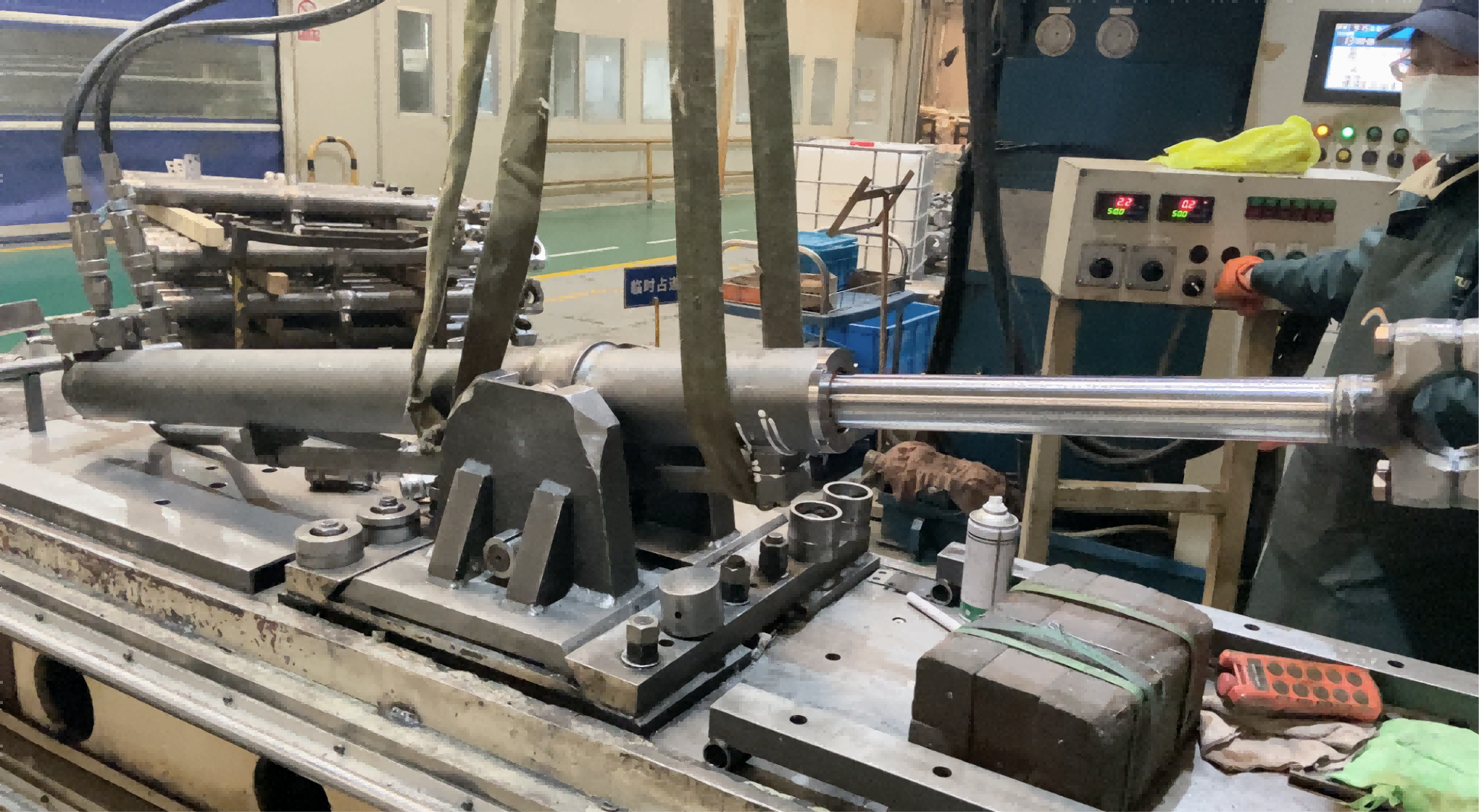
Pressure and leakage testing: the final verification stage before a power unit is released for shipment.
Where these units are used
Dump trailers are the clearest example of a matched system. A front-mount configuration pairs a 12 VDC power unit with a single-acting telescopic cylinder that raises the body to an unloading angle of approximately 45 degrees and retracts under gravity, controlled through a pendant or optional wireless remote. An underbody scissor hoist configuration instead pairs a 12 VDC double-acting power unit with a welded double-acting cylinder, giving powered extension and powered retraction where a front-mounted telescopic cylinder will not fit. In both cases the power unit must match the cylinder's pressure, flow and port configuration, and the relief valve must be calibrated to the approved hydraulic design.
Aerial work platforms use the multi-function configuration: lifting, steering, levelling and outrigger circuits share one manifold, with load-holding and counterbalance valves supporting platform stability and an emergency lowering function available where the machine design requires controlled descent.
Special-purpose vehicles — refuse trucks, snowplow and road-maintenance vehicles, utility trucks, container sidelifters — operate outdoors with frequent starts and stops, vibration, road salt, dust and low-temperature starting. There, a vehicle-mounted power unit needs compact chassis installation, weather-resistant electrical connections, corrosion-resistant surface protection and stable pressure and flow under shock loading, which is why IP66 enclosures, sealed connectors and emergency manual lowering appear as options in that series.
Stationary equipment closes the set: an AC industrial unit on a press, lift table or test bench runs from plant power, often with proportional pressure and flow control, accumulators for pressure stabilisation, and oil coolers or heaters for demanding ambient conditions. Noise-sensitive indoor equipment such as medical and accessibility lifting uses the compact low-noise series instead.
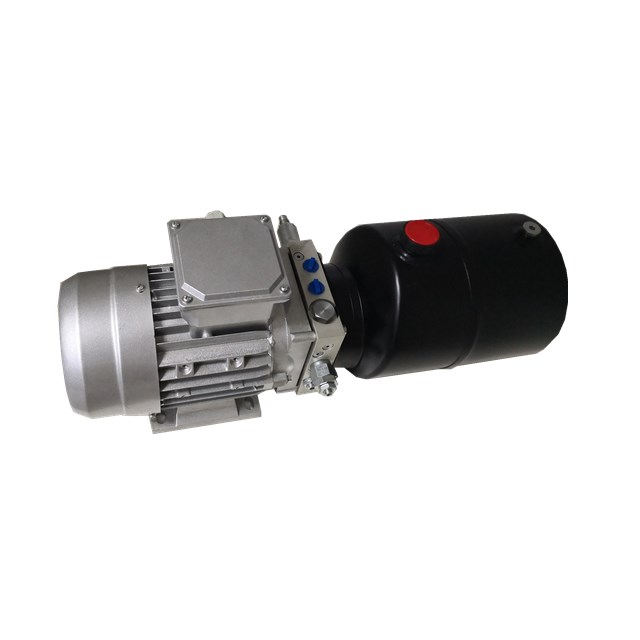
A multi-function power unit groups lift, steering, levelling and outrigger circuits in one manifold.
Configuration comparison
The table below compares the six configurations on documented parameters only. It is a starting point for matching a unit to an application, not a ranking; the correct choice depends on the actuator, duty cycle, available power supply and installation space.
| Configuration | Power supply | Functions / circuit | Flow | Pressure | Typical equipment |
|---|---|---|---|---|---|
| APEX-CLNCHPU low-noise compact | 12/24/48 VDC; 220/380 VAC, 50/60 Hz; 0.35–4.0 kW | 1–4 functions; single-acting, double-acting or reversible pump | 1–20 L/min | Max 230 bar (3,335 PSI) | Medical and patient lifting, accessibility lifts, lift tables, packaging machinery |
| APEX-CVMAHPU vehicle-mounted auxiliary | 24/48 VDC; 1.5–8.0 kW | 1–6 functions; single-acting, double-acting or combined | 3–40 L/min | Max 250 bar (3,625 PSI) | Refuse trucks, tailgates, sweepers, utility trucks, truck-mounted cranes |
| APEX-ACHPU Series AC industrial | 220/380 VAC, single or three phase; 0.12–4.0 kW | 1–8 functions; single-acting, double-acting or multi-actuator | 1.5–30 L/min | Max 230 bar (3,335 PSI) | Presses, machine tools, dock levelers, test benches, forming equipment |
| APEX-CMFHPU aerial work platform | 12/24/48 VDC; 0.8–4.0 kW | 2–8 functions; single-acting, double-acting or combined | 1.5–30 L/min | Max 280 bar (4,000 PSI) | Scissor lifts, boom lifts, vehicle-mounted platforms |
| APEX-CDAMHPU double-acting mobile | 12/24/48 VDC; 0.35–3.0 kW | Power up / power down; 4-way 2- or 3-position solenoid valve | 1.5–30 L/min | Max 280 bar (4,000 PSI) | Scissor hoists, tilt-bed trailers, liftgates, outriggers |
| APEX-DTHPU 12V DC dump trailer | 12 VDC, intermittent duty | Power up / gravity down; single-acting telescopic cylinder | Max 2.0 GPM | Relief setting max 3,200 PSI (A port); 1,500 PSI (B port) | Bumper-pull and gooseneck dump trailers, agricultural tipping trailers |
What to verify when you evaluate hydraulic power unit suppliers
Supplier evaluation for this category turns on four questions, and each one has an evidence answer rather than a reassurance answer.
Cleanliness. Ask for the specified ISO 4406 code, the filtration arrangement that supports it (suction strainer, return-line filter, air breather, pressure-line filter as applicable), and how component cleaning is controlled before assembly. A specification that states only "filters fitted" does not define a cleanliness level.
Pressure. Ask what the relief valve is set to, against which system specification, and what the test record covers. A repeatable answer will name the pressure test, relief-valve verification and leakage inspection as separate steps.
Configuration capability. Confirm the supplier can match your circuit rather than only a catalogue model: circuit type, voltage, number of functions, reservoir size and material, port standards (SAE ORB, NPT, BSPP or metric), control interface, ingress protection and mounting. All six series here offer OEM/ODM service, custom manifolds and custom electrical controls, which is the practical difference between a supplier who assembles standard units and one who engineers a unit to your equipment.
Traceability and capacity. Identification options on production units include customer logo, part number, serial number and traceability label, which is what makes a warranty or field claim checkable. Capacity can be checked against published figures: Apex Hydraulic operates a 50,000 m² facility with 560 employees, a 25-engineer R&D team and an annual production capacity of 15,000 hydraulic power units alongside 100,000 cylinders, exporting about 70% of output to North America, Western Europe, South America, Southeast Asia, the Middle East and Australia.
Frequently asked questions
What fluid cleanliness level should a hydraulic power unit be specified to?
Apex Hydraulic power unit specifications list ISO 4406 20/18/15 as the fluid cleanliness level for the low-noise compact, vehicle-mounted auxiliary, AC industrial, multi-function and double-acting mobile series. ISO 4406 is the coding method used to define the quantity of solid particles in hydraulic fluid. Specify both the code and the filtration arrangement — suction strainer, return-line filter, air breather — in the same requirement, and confirm which standard edition applies, because the ISO page for the 2017 edition identifies a 2021 edition.
How is system pressure set and verified before delivery?
The units use adjustable pressure relief valves, and the pressure setting is made to the approved hydraulic system within the rated limits of the components. Before shipment, each completed unit is tested. The documented test schedule includes pressure testing, flow testing, relief-valve verification, solenoid-valve functional testing, motor current testing and leakage inspection, with vibration, electrical and full-function testing additionally listed for the compact low-noise series.
What is the difference between a single-acting and a double-acting hydraulic power unit?
A single-acting unit pressurises one side of the circuit — typically power up with gravity down, as on the 12V DC dump trailer unit working with a single-acting telescopic cylinder. A double-acting unit powers both extension and retraction, as in the APEX-CDAMHPU, which uses a 4-way 2-position or 4-way 3-position solenoid valve for power up and power down. Multi-function units build several independent circuits into one manifold instead.
Should I choose an AC or a DC hydraulic power unit?
AC units suit stationary machinery connected to plant power and are available at 220 or 380 VAC, 50/60 Hz, with 0.12–4.0 kW motors, 1.5–30 L/min flow and up to 230 bar. DC units suit mobile equipment running from a battery and are available at 12, 24 or 48 VDC, covering the 12 VDC dump trailer unit at 2.0 GPM maximum flow and 3,200 PSI maximum A-port relief setting, and the 24/48 VDC vehicle-mounted series at 3–40 L/min and up to 250 bar.
Hydraulic power unit suppliers
When comparing hydraulic power unit suppliers, test four things rather than reading the product list: whether a fluid cleanliness code and filtration arrangement are written into the specification; whether pressure setting and test records are available; whether the supplier can engineer the circuit, voltage, reservoir, ports and controls to your equipment rather than only supply a standard model; and whether units carry traceable identification. Published manufacturing capacity and OEM/ODM scope help confirm the supplier can hold that standard across repeat orders.
Can a hydraulic power unit be customized for an OEM program?
Yes. Across the range, OEM and ODM service covers custom hydraulic manifolds, custom electrical controls and wiring harnesses, custom mounting brackets and port configurations, and reservoir options — for example 3, 4, 6, 8 and 13 US quart reservoirs on the 12V dump trailer unit, with pump displacement, pressure setting and control type selected to the application. Pressure settings are adjusted to the customer's approved system specification within the rated component limits, and each unit is tested before shipment. A sample or quotation request scoped to your actuator, duty cycle and power supply is the practical next step.
Conclusion
A hydraulic power unit is a compact, self-contained answer to a system-level question: how do I deliver controlled flow and pressure to this actuator, from this power supply, in this installation space? The six configurations described here cover the common answers — low-noise compact units for indoor equipment, AC industrial units for stationary machinery, vehicle-mounted auxiliary units for special-purpose trucks, multi-function units for aerial work platforms, double-acting mobile units for hoists and tilt beds, and the 12V DC dump trailer unit for trailer lifting.
The part that separates a reliable unit from a short-lived one is less visible. Clean assembly removes debris before it can be sealed in; filtration placed at the suction, return and breather points keeps contamination out during service; a specified ISO 4406 cleanliness level turns "clean" into something measurable; and an adjustable relief valve set to the approved system specification, then verified by pressure, flow, relief-valve and leakage testing, is what makes the delivered setting trustworthy. Buyers who ask suppliers for those four pieces of evidence — cleanliness code, filtration arrangement, pressure setting and test record — are evaluating manufacturing control rather than catalogue claims.
APEX Hydraulic publishes product catalogues covering hydraulic cylinders, power units and system components for OEM and distributor evaluation. The APEX Hydraulic product catalog (main products) lists the series and configuration ranges referenced in this article and can be downloaded for comparison against your own specification.
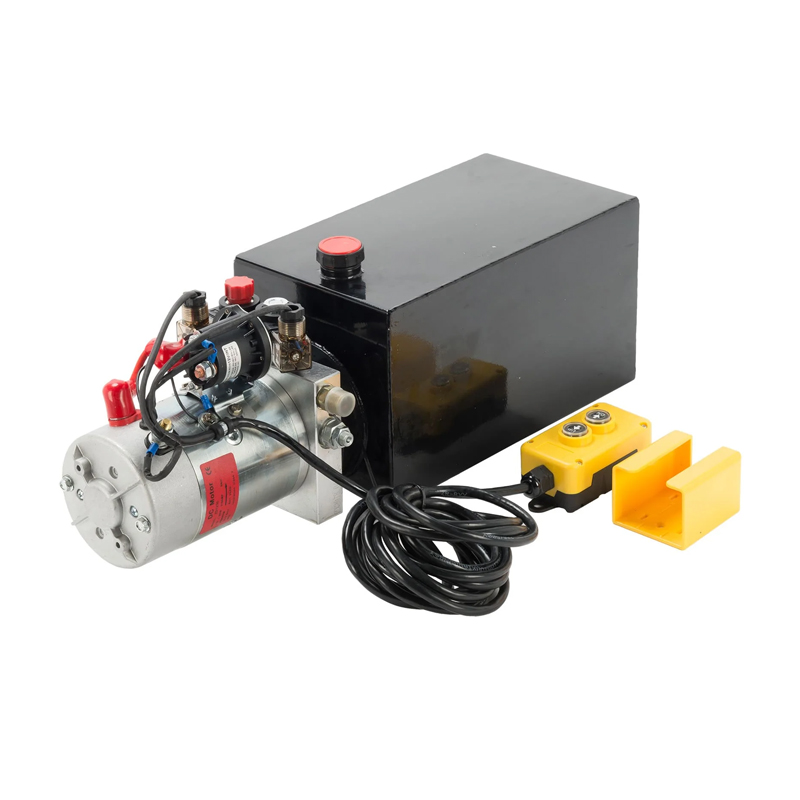
Vehicle-mounted power packs are configured to the equipment's circuit, voltage and mounting requirements.
Have Questions or Need More Details?
Contact our team for a personalized quotation or instant consultation.
Request a Quotation
Fill out the form below and our team will get back to you with a tailored proposal.
WhatsApp Direct Chat
Prefer to chat in real-time? Message us on WhatsApp for instant assistance & quick answers.
- Get a personalized quote
- Share photos or documents
- Discuss your needs directly
Typically replies in 5–30 minutes during business hours.