Why Your Agricultural Loader Cylinder Fails Prematurely—and the Custom Fix That Extends Service Life
Why Your Agricultural Loader Cylinder Fails Prematurely—and the Custom Fix That Extends Service Life
An agricultural loader hydraulic cylinder usually fails because of what gets into it, not because of what it is asked to lift. Rod scoring from dust and grit, a wiper that cannot clear packed mud, and a hydraulic circuit with no load-holding protection will shorten service life long before the cylinder is structurally worn out. The practical fix is a custom hydraulic cylinder engineered around the machine: rod wipers specified for the working environment, hardened and hard-chrome-plated piston rods, and system integration that includes load-holding and pressure protection.
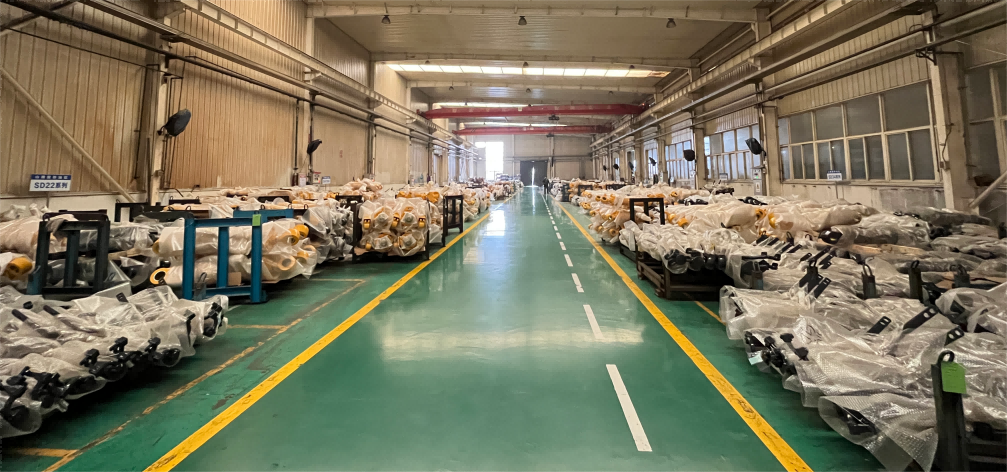
Custom hydraulic cylinders built for mobile equipment projects, inspected and prepared for shipment at Apex Hydraulic.
Problem Definition: Why Agricultural Loader Cylinders Fail Early
A loader working on a farm repeats the same motion all day: fill the bucket, lift, travel, dump, lower. The hydraulic cylinder delivers the controlled push and pull force that makes that cycle possible, but the conditions around it actively work against it.
Four failure patterns repeat across agricultural loader fleets:
- Piston rod scoring and chrome loss. Dust, sand, silage residue and mud all cling to an exposed piston rod. When the rod retracts, that material is dragged into the sealing system. Once the hard chrome layer is scratched or pitted, the rod itself becomes an abrasive carrier and the seal can never run clean again.
- Wiper failure under continuous contamination. If the rod wiper is undersized or not suited to heavy contamination, mud stays in front of the sealing lip. Internal leakage follows, holding force drops, and the oil temperature rises because energy is being converted into heat instead of lift.
- No load-holding protection. A lift cylinder spends long periods holding a raised load. Without a counterbalance valve, pilot-operated check valve or hose-burst valve in the circuit, a burst hose or a stuck valve removes control of the load rather than just removing pressure.
- Shock and side loading on frozen, muddy or uneven ground. Frozen ruts and soft, waterlogged soil produce impact loads and lateral forces that a general-purpose cylinder was never dimensioned for. Guide rings, bushings and the piston rod itself take the punishment.
The distinction matters commercially. A cylinder that fails at the rod seal is not a cylinder that needs to be replaced with an identical part—it is a cylinder whose sealing and protection specification was wrong for the job. Replacing it with the same specification simply restarts the same failure clock.
Industry Background: Where Agricultural Loader Hydraulics Sit in the Wider Market
Agricultural loaders are part of the mobile hydraulics segment, and that segment is where most cylinder demand sits. Mobile applications, including construction and agriculture, accounted for 51.8% of hydraulic cylinder market demand in 2025, according to Grand View Research. The same source reports that welded hydraulic cylinders held a dominant 53.6% market share in 2025 because of their durability in heavy-duty applications, and that double-acting cylinders represent 71.6% of the function segment.
Regionally, Asia Pacific commanded a 40.5% revenue share of the hydraulic cylinder market in 2025, led by China and India. Global Market Insights valued the overall hydraulic cylinder market at USD 15.7 billion in 2024, with a projected path to USD 24.7 billion by 2034. Within the product mix, telescopic cylinders generated USD 2,225.1 million in 2024 with a projected CAGR of 5.9%.
What those figures describe is a market where the volume sits in exactly the kind of cylinder that agricultural loaders use—welded, double-acting, mobile-duty units operating outdoors. A separate trend line matters just as much for buyers: customization and OEM services are identified by Market Research Future as a growing segment as industries shift toward more specialized machinery. Loaders are a clear example. Fitting a commodity cylinder into a loader that works in dust, mud and frost is a specification gap, not a price decision.
Environmental range is part of that gap. In Apex Hydraulic published data for its telescopic cylinder family, standard operating temperature range is stated as −40 °F to +200 °F, approximately −40 °C to +93 °C. Agricultural equipment crosses most of that band across a single season, which is why seal material selection and rod protection cannot be treated as afterthoughts.
Detailed Solution: Custom Cylinders with Rod Wipers and Proper System Integration
The solution is not a stronger cylinder in the abstract. It is a cylinder specified against the specific contamination, load-holding and temperature conditions of the machine it will sit on. Apex Hydraulic Co., Ltd., established in 2009, is a Chinese manufacturer of custom hydraulic cylinders and hydraulic power units based in Qingdao City, Shandong Province, serving OEM manufacturers and distributors in North America, Western Europe, South America, Southeast Asia, the Middle East and Australia.
1. Rod wipers as the first line of defence
Every sealing system in a load-buried cylinder is only as good as the wiper in front of it. Apex custom cylinder series—including the custom welded double-acting APEX-CWDC Series and the custom heavy-duty high-pressure APEX-CHDC Series—offer wiper configurations in polyurethane, NBR, metal-cased or heavy-duty scraper designs. The custom telescopic APEX-CTC Series uses heavy-duty polyurethane stage wipers, and the custom long-stroke APEX-CLSC Series offers polyurethane, metal-cased scraper or dual-wiper arrangements.
For an agricultural loader operating in mud and grit, the wiper is the component that decides whether the rod seal behind it sees clean oil or an abrasive slurry. Wiper material, lip geometry and scraper type are specified during engineering review rather than pulled from a default bill of materials.
2. Piston rod and barrel specification that survives abrasion
Surface hardness is what allows a rod to resist scoring once a particle is trapped against it. In Apex published specifications for the welded hydraulic cylinder HBU, HCL and HTG series, the piston rod is induction-hardened steel with a rod core hardness of 45–50 HRC, hard chrome plated to a published chrome thickness of 0.001 in, with a published final rod surface hardness of 69–71 HRC. The same specification list includes a published corrosion test of 96 hours in accordance with ASTM B117-07a. The tie-rod HTR and HTH series publish comparable figures, with the HTH rod both induction-hardened and hard chrome plated.
Abrasion resistance is not only a rod issue. Cylinder tubes are precision-honed, and the piston is ductile iron or high-strength steel depending on the series. On a loader, barrel and rod both need to hold tolerance through repeated impact loading, which is why straightness and dimensional inspection are part of the production flow rather than a final visual check.
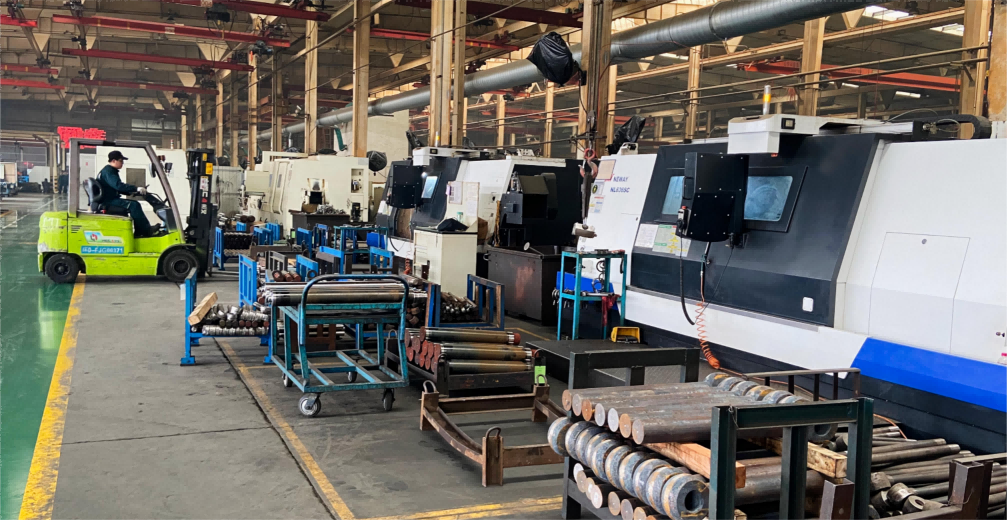
Precision machining of cylinder components. Rod diameter, bore and concentricity are decided by load, stroke and buckling calculation, not by catalogue convenience.
3. Load-holding and pressure protection in the circuit
This is the change that buyers most often overlook. Load-holding protection is available as an option across the custom range: counterbalance valve, pilot-operated check valve or hose-burst valve. Pressure protection is available as an integrated relief valve or as external circuit protection. End-of-stroke cushioning can be specified at one end or both ends on the same cylinders.
On a loader lift circuit, that combination changes the consequence of a failure. The cylinder still has to hold a raised boom, but the circuit is no longer relying on a single hose or valve to keep the load under control.
4. System integration: accumulators, relief and loader suspension
A boom cylinder does not operate in isolation. On machines that carry loader suspension, the cylinder shares the load path with an accumulator and valve arrangement, and shock pressure has to be absorbed somewhere. Cylinder specification—rod diameter, cushioning, porting and seal selection—should be reviewed together with that system rather than against the cylinder alone. When the accumulator, relief setting and cylinder are reviewed as one system, the cylinder stops being the component that absorbs every shock the machine produces.
5. Sealing, porting and mounting matched to the machine
Seal compounds are selected according to operating environment. Apex custom cylinders use polyurethane, NBR, PTFE, FKM or low-temperature sealing materials, with wipers available in polyurethane, NBR, metal-cased or heavy-duty scraper configurations. Ports can be SAE ORB, NPT, BSPP, BSPT, metric thread, flange port or a customer-specified connection. Mounting options include cross-tube, clevis, pin-eye, trunnion, flange, foot mount, spherical bearing or a fully custom arrangement.
Optional piston rod protection—bellows, protective sleeve or a heavy-duty scraper system—is available for machines working in particularly aggressive ground conditions. Identification, part numbering and traceability marking can be applied to the customer part number, with documentation such as approved drawings, inspection records and test reports available according to project requirements.
Step-by-Step Breakdown: Running a Loader Cylinder Upgrade Project
Upgrading from a repeated-failure cylinder to a specified one follows a defined sequence. The steps below reflect the Apex Hydraulic procurement flow: inquiry, technical review, drawing confirmation, quotation, sample approval where required, PI confirmation, deposit payment, manufacturing, inspection and testing, final payment, shipment and after-sales technical support.
Step 1 — Record what actually failed. Note where the damage sits: rod scoring position, wiper condition, seal wear pattern, port condition, bushing play. Photograph the failed cylinder before it is cleaned. The damage pattern is the specification input.
Step 2 — Capture the installation envelope. The data set for a custom cylinder includes bore diameter, piston rod diameter, stroke length, retracted pin-to-pin length, extended pin-to-pin length, working pressure, maximum system pressure, required push and pull force, mounting style, mounting-pin diameter, mounting width, hydraulic port type and position, operating temperature, hydraulic fluid type, operating frequency and duty cycle.
Step 3 — Define the protection requirements. This is where rod wiper type, rod surface treatment, load-holding valve selection, cushioning, position sensing and rod protection are decided. On a loader working in mud and frost, this step is the difference between a cylinder that lasts and one that returns to the workshop.
Step 4 — Engineering review and drawing approval. Bore and rod diameters are calculated from required force and working pressure. Long-stroke compression applications require piston rod buckling verification, and horizontal or inclined installations require deflection verification. Production does not begin until the drawing is approved.
Step 5 — Sample validation where required. A sample build allows the wiper behaviour, sealing performance and mounting fit to be confirmed on the actual machine before batch production.
Step 6 — Manufacturing and inspection. Production is followed by dimensional inspection, pressure testing, leakage testing and full-stroke functional testing, with 100% final inspection before shipment as standard practice.
Step 7 — Delivery and support. Custom product lead time is 25–45 days. Standard products run 7–20 days, and large OEM projects follow the agreed project schedule. Apex Hydraulic operates a 50,000 m² manufacturing facility with 560 employees, a 25-engineer R&D team, and an annual output of 100,000 units, with monthly capacity of more than 8,000 hydraulic cylinders and more than 1,500 hydraulic power units.
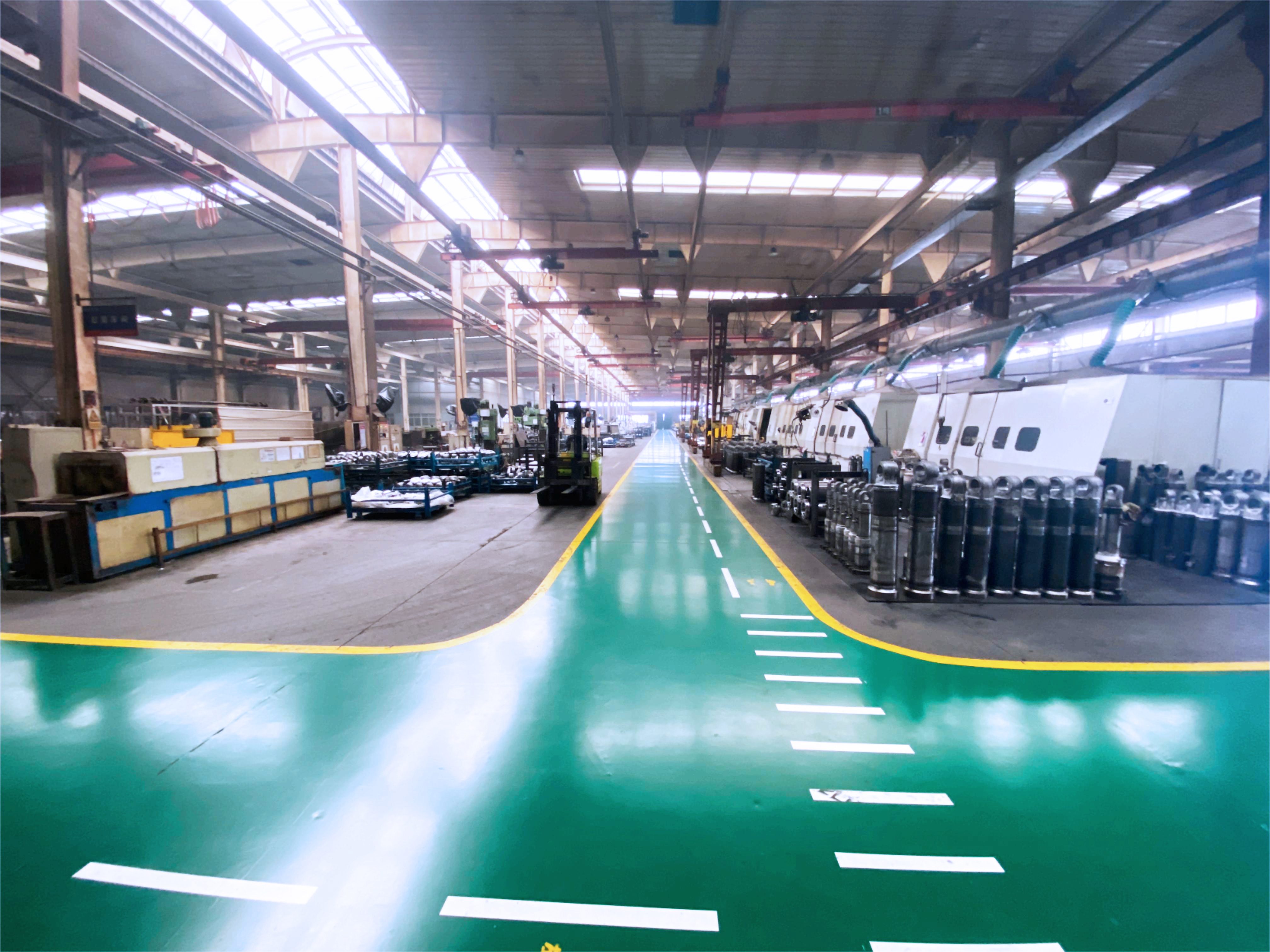
Barrel processing at Apex Hydraulic. Precision-honed tubes support consistent sealing performance under repeated impact loading.
Use Cases: Where This Specification Change Pays Back
Farm front-end loaders on mixed-duty work. Bucket work in soil, silage and manure exposes the rod to a different contaminant every week. A cylinder specified with a heavy-duty scraper wiper and induction-hardened chrome-plated rod is built for that variation rather than for clean-oil bench conditions.
Loaders handling bulk and loose material. Dust from grain, feed and mineral products is fine enough to migrate past a light wiper. The published final rod surface hardness of 69–71 HRC and the published ASTM B117-07a corrosion test result of 96 hours both matter more in this duty than on a light-intermittent machine.
Loaders operating in frost and snow. Seal compound selection drives low-temperature behaviour. Apex custom cylinders offer FKM, low-temperature sealing materials and application-specific elastomers selected against the operating environment, and published telescopic cylinder data covers a −40 °F to +200 °F band.
Loader attachments in scrap, waste and material handling. Attachment and grapple work produces alternating push-and-pull load and shock loading. The APEX-CGAC Series is engineered for alternating loads and shock-load capability according to attachment type and operating conditions, with optional hose-burst protection and heavy-duty wiper systems.
Existing loader hydraulic system upgrades. Where a fleet already runs and the cylinders are the recurring cost, a build-to-print custom cylinder using verified dimensions allows the upgrade to be phased without changing the machine interface.
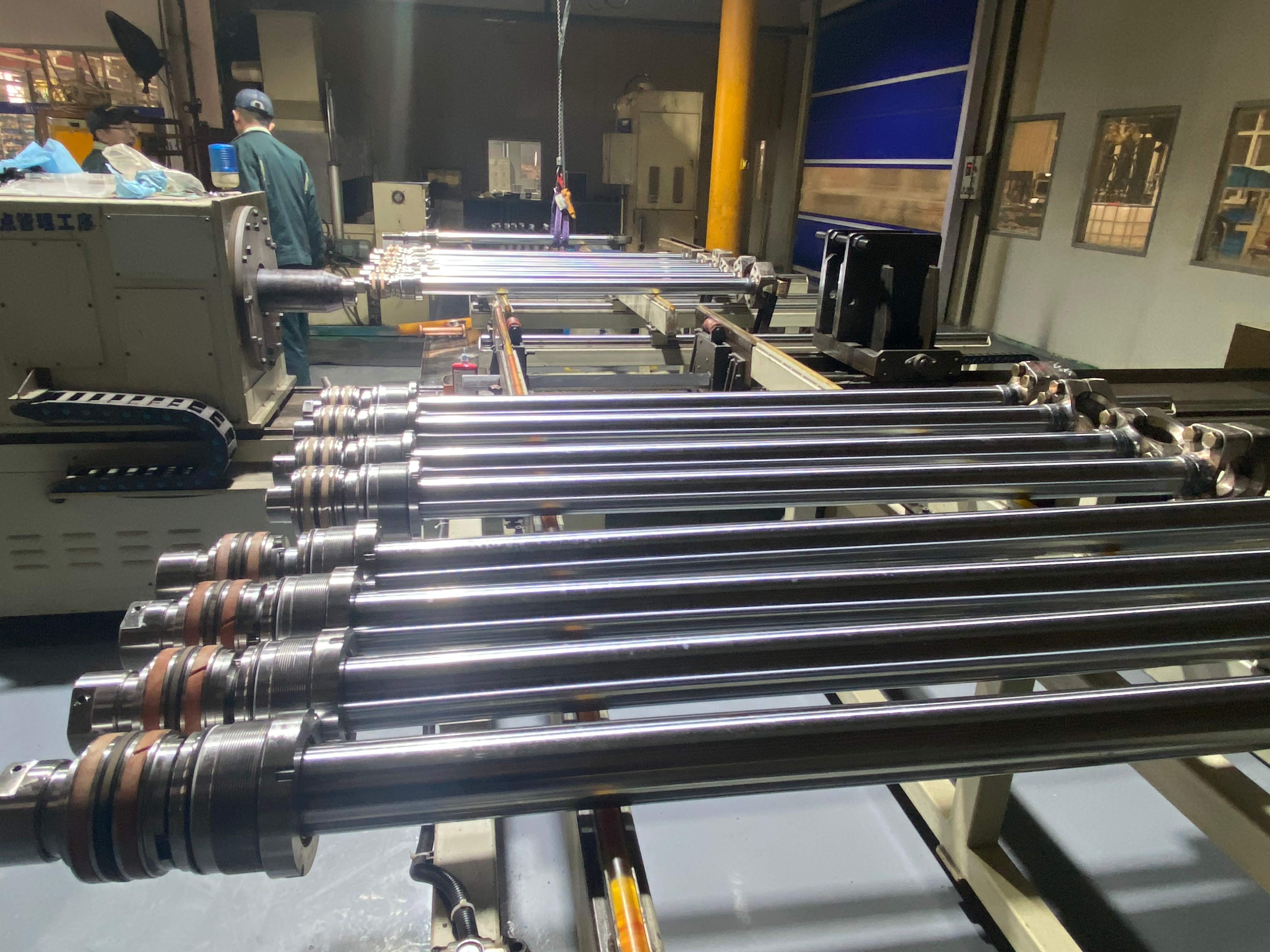
Final assembly of a custom hydraulic cylinder, ahead of pressure, leakage and full-stroke functional testing.
Comparison Table: Cylinder Options for Loader Duty
The table below compares published specifications across three Apex Hydraulic cylinder families. Figures are drawn from published product data and apply to the models listed. Final configuration is confirmed against the approved drawing.
| Parameter | Welded Cylinder (HBU / HCL / HTG) | Tie-Rod Cylinder (HTR / HTH) | Custom Heavy-Duty Cylinder (APEX-CHDC Series) |
|---|---|---|---|
| Acting type | Double acting | Double acting | Double acting |
| Published rated working pressure | Up to 3,000 PSI | HTR 2,500 PSI; HTH 3,000 PSI | Customized according to the approved hydraulic-system specification |
| Bore diameter range | HBU and HCL 1.5–5.0 in; HTG 2.0–4.0 in | 2–5 in | Engineered according to required force, working pressure and installation envelope |
| Stroke range | HBU 4–48 in; HCL 4–36 in; HTG 4–36 in | HTR 4–36 in; HTH 4–48 in | Customized according to equipment movement and installation dimensions |
| Piston rod surface | Induction-hardened, hard chrome plated | Hard chrome plated; HTH induction-hardened and hard chrome plated | Hard chrome plated or application-specific treated surface |
| Published rod core hardness | 45–50 HRC | HTH approximately 45–50 HRC | Determined according to the approved design |
| Published chrome thickness | 0.001 in | Approximately 0.001 in | Defined according to the approved drawing |
| Published final rod surface hardness | 69–71 HRC | Approximately 69–71 HRC | Defined according to the approved drawing |
| Published corrosion test | 96 hours per ASTM B117-07a | Not listed in the published specification set | Optional salt-spray or coating documentation according to project requirements |
| Contamination protection | Industrial hydraulic seals and wiper system selected by pressure, temperature and application | Application-specific polyurethane and NBR hydraulic seals | Heavy-duty polyurethane or metal-cased scraper rod wiper |
| Load-holding and pressure protection | Not listed as standard in the published specification set; confirm by order agreement | Not listed as standard in the published specification set; confirm by order agreement | Optional counterbalance valve, pilot-operated check valve, hose-burst valve or integrated relief protection |
| Mounting options | Cross-tube bushing mount, fixed clevis, adjustable threaded female clevis | Adjustable threaded female clevis | Heavy-duty clevis, pin-eye, cross-tube, trunnion, flange, spherical bearing or custom mounting |
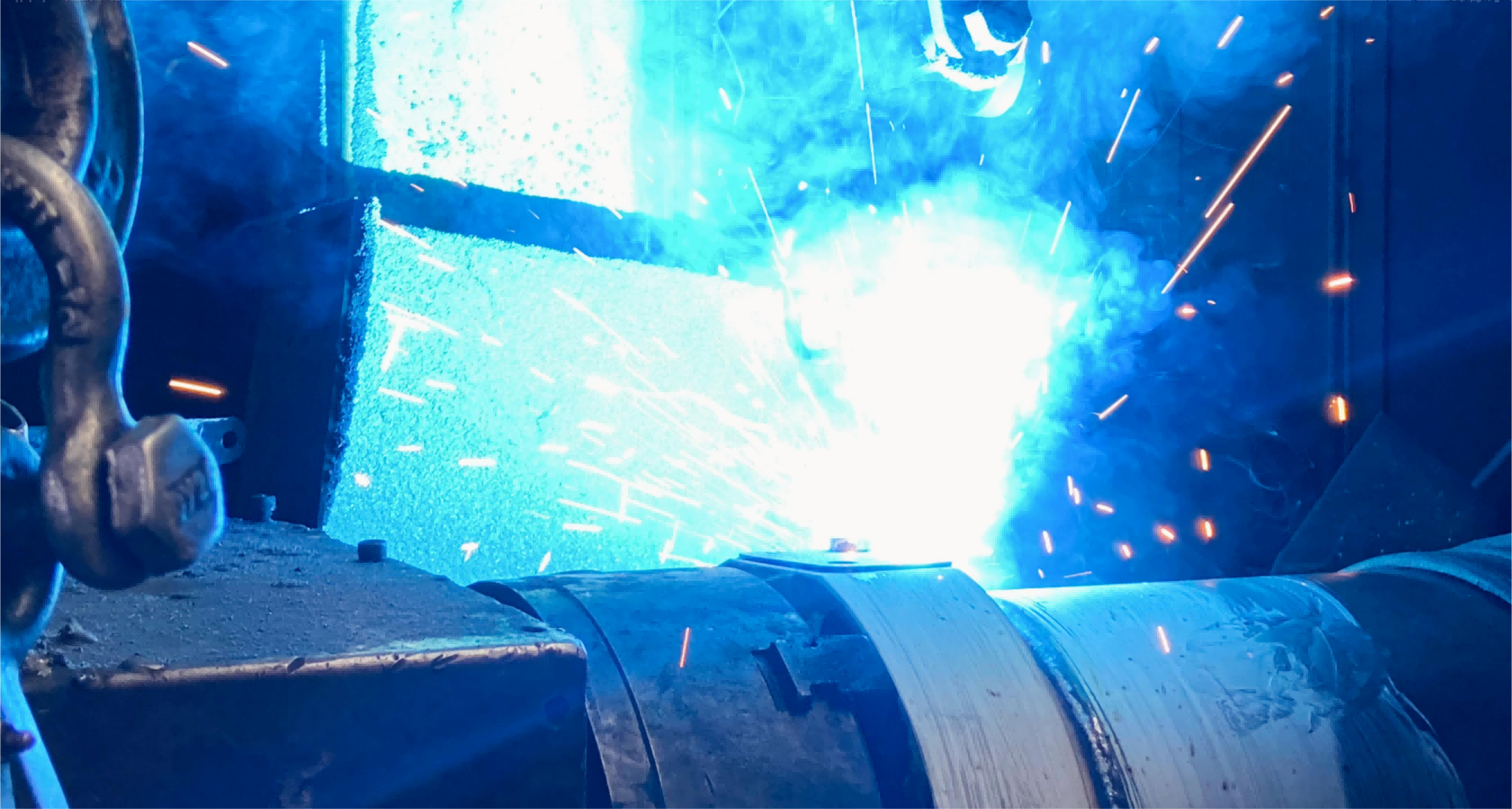
Component welding during custom cylinder production. Welded-body construction is selected where heavy-duty durability is the priority.
FAQ: Custom Agricultural Loader Cylinders
What standards and certifications apply to these hydraulic cylinders?
Apex Hydraulic holds an ECM CE Certificate, issued by Ente Certificazione Macchine Srl of Italy, under certificate number 0P260130.AH0S46, issued on 2026-01-30 and valid to 2031-01-29. The certificate scope is Hydraulic Cylinder – APCC Series, and it cites EN ISO 12100:2010, EN ISO 4413:2010, ISO 6020-1:2007 and ISO 10100:2020 under Machinery Directive 2006/42/EC. It applies to the European Union, the European Economic Area and global export markets requiring CE compliance.
When selecting a custom hydraulic cylinder manufacturer for industrial equipment, what should I check first?
Check whether the manufacturer engineers to your drawing rather than to a catalogue. Apex Hydraulic provides OEM manufacturing, ODM development, custom design and hydraulic engineering solutions, with customization covering bore, rod diameter, stroke length, mounting style, installation dimensions, working pressure, seal system, materials, surface treatment, ports and threads, painting color, logo and packaging. Companies such as Parker Hannifin, Bosch Rexroth and Eaton are identified as top-tier global leaders in industrial hydraulics, and Caterpillar Inc. held over 8% global hydraulic cylinder market share in 2024—useful context when benchmarking a supplier, but the deciding factor for a loader cylinder is whether the wiper, rod treatment and load-holding protection are specified for your ground conditions.
What are the minimum order quantity, payment and delivery terms?
Standard products have a minimum order quantity of 1 piece; custom OEM and ODM projects are negotiable according to product specifications and project requirements. Payment methods include T/T, Letter of Credit, Alibaba Trade Assurance and other mutually agreed international payment methods, with terms varying by order value and project requirements. Delivery methods available are EXW, FOB, FCA, CIF, CFR, DAP and DDP.
Can I validate a sample cylinder before committing to production?
Yes. The Apex Hydraulic procurement flow includes sample approval where required, positioned after drawing confirmation and quotation and before PI confirmation. Acceptance criteria can be set against approved drawings, technical specifications or mutually agreed criteria, and include dimensional inspection, hydraulic pressure testing, leakage testing, functional testing and quality inspection. Documentation such as approved drawings, inspection records and test reports is available according to project requirements.
How long does a custom loader cylinder take to produce, and how do I start?
Standard products are produced in 7–20 days, custom products in 25–45 days, and large OEM projects according to the agreed project schedule. To start, send the equipment type, cylinder function, existing part number or drawing, bore, rod diameter, stroke, retracted and extended pin-to-pin lengths, working pressure, mounting style, port type and position, operating environment, duty cycle and annual demand. Apex Hydraulic provides pre-sales engineering consultation, product selection, drawing optimization and OEM design support before order confirmation. You can send your details to Jason at jason@hydraulicapex.com or by WhatsApp on +86 182-5318-1828.
Conclusion: Specify the Cylinder Around the Machine
Agricultural loader cylinders fail early because they are usually bought as a part number rather than specified as a system component. The failure sequence is predictable—contamination reaches the sealing system, the wiper cannot stop it, the rod loses its protective surface, and a circuit without load-holding protection turns a seal failure into a control problem.
The fix follows the same logic in reverse. Specify the rod wiper for the actual contamination. Specify the rod treatment for abrasion and corrosion, with published values such as 45–50 HRC core hardness, 69–71 HRC final rod surface hardness and a 96-hour ASTM B117-07a corrosion test as reference points. Add load-holding and pressure protection so the circuit, not a single hose, carries the risk. Then confirm the whole arrangement against the accumulator, relief and loader suspension system on the machine.
Apex Hydraulic manufactures custom hydraulic cylinders, hydraulic power units and complete hydraulic system solutions, exporting to North America, Western Europe, South America, Australia, Southeast Asia and the Middle East. Every cylinder and power unit is produced under incoming material inspection, in-process quality control and 100% final inspection, supported by after-sales technical consultation, engineering support, spare parts supply and warranty support.
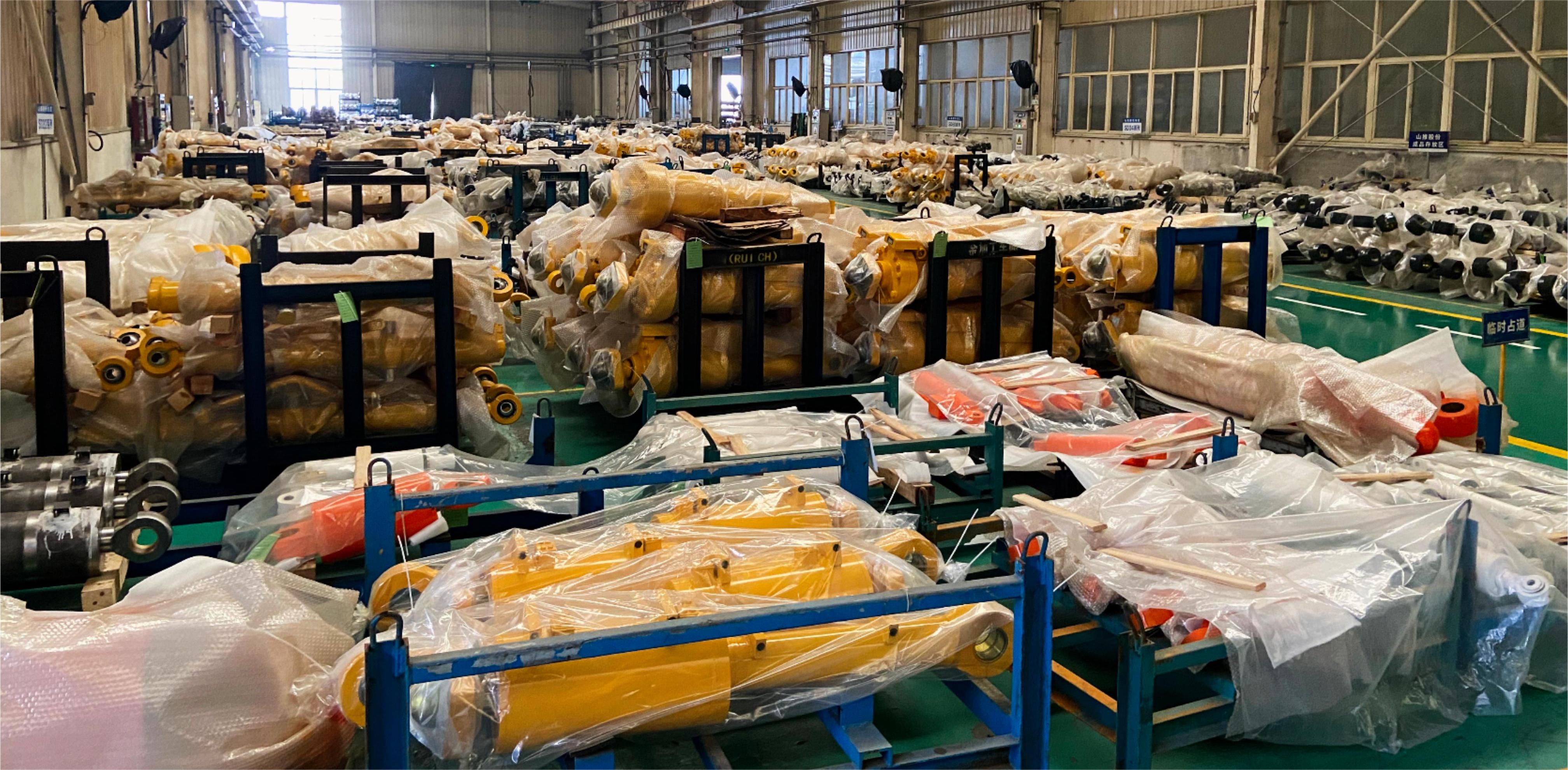
Finished cylinders in the Apex Hydraulic warehouse, ready for OEM and replacement-market shipment.
Next Step
Download the Apex Hydraulic product catalogue for the full cylinder and power unit range, or send your loader cylinder dimensions and failure photos for an engineering review and quotation.
Email: jason@hydraulicapex.com | Tel / WhatsApp: +86 182-5318-1828 | Website: www.hydraulicapex.com