Apex Power Systems: Custom Transformer Supply Partner Review
Apex Power Systems: A Custom Transformer Supply Partner Review
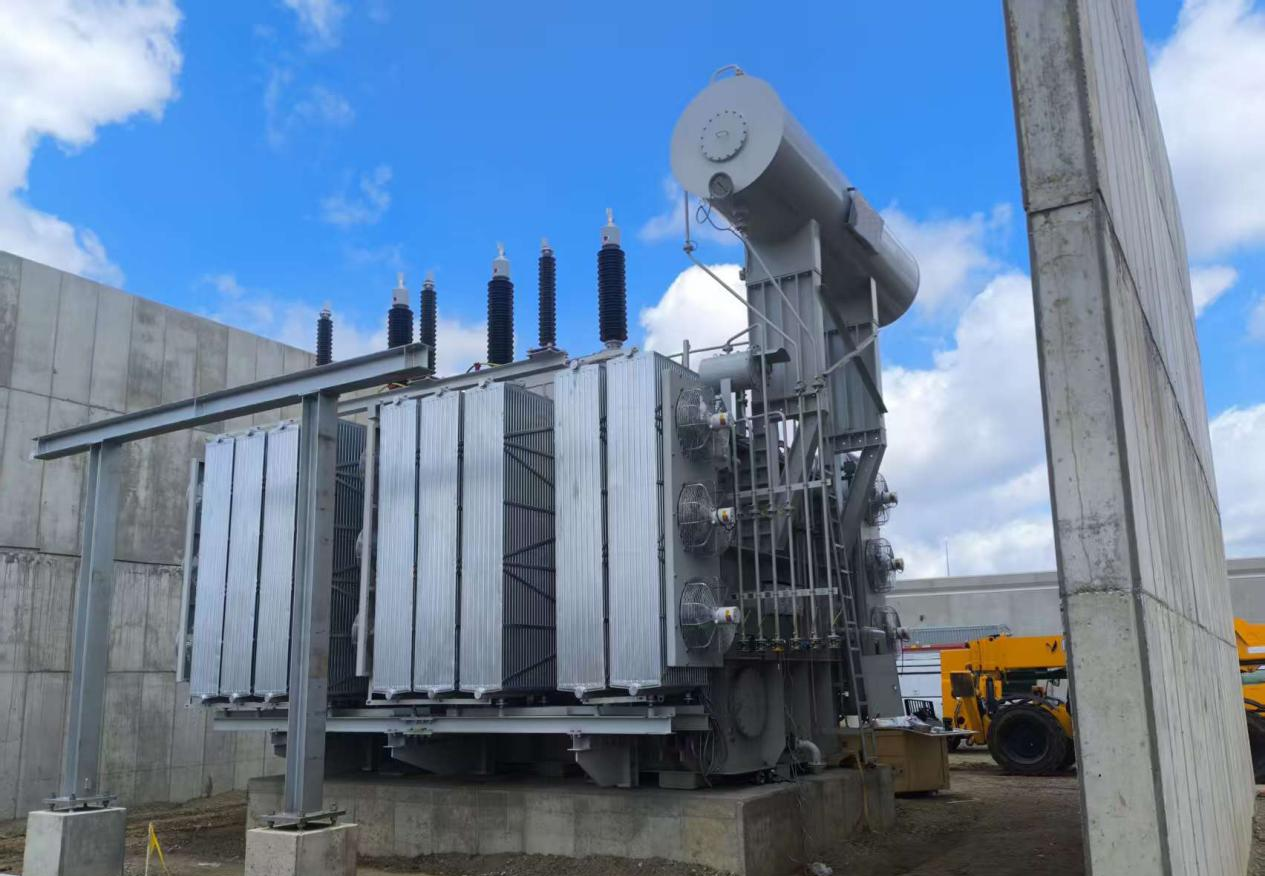
250 MVA / 345 kV three-phase oil-immersed on-load voltage regulating power transformer — the flagship custom platform in the reviewed supply scope.
Apex Power Systems (Nanjing)Co., Ltd. is an international trading and supply-partner company for power transformers and substation equipment, established in 2024 and based in Nanjing, Jiangsu Province, China. It is not a manufacturing factory. Its function is to select, audit and manage verified Chinese manufacturers on behalf of overseas utility, EPC and industrial buyers, and to hold one accountable point of contact for design review, production, factory testing, documentation, freight and on-site commissioning.
That distinction is the most important fact in this review — and the one most often blurred in supplier directories. This article assesses the company the way an industry analyst would: profile first, then customisation scope, then the evidence behind the manufacturing claims, then procurement value, and finally the limits a buyer should weigh before sending an enquiry.
Every rating, certification and project reference below is drawn from the company's own qualification and product documentation. Where a claim belongs to the audited manufacturing partner rather than to Apex itself, it is stated as such.
The Problem: Most Custom Transformer Failures Start Before Production
Buyers who search for a custom transformer usually get the electrical parameters right. The failures happen elsewhere — in factory selection, certification, witness testing, documentation and commissioning. Six principal risks apply when sourcing power transformers from China, and each has a distinct failure mode.
- Capability risk — the plant cannot actually build or test the rating ordered.
- Compliance risk — certificates are expired, are held in another entity's name, or do not cover the product family being purchased.
- Quality risk — material substitution, insufficient oil processing, and loss figures that were never independently verified.
- Schedule risk — lead times slipping on large units.
- Commercial risk — payment terms and warranty obligations that cannot be enforced.
- Documentation risk — drawings, test reports and O&M manuals that do not arrive in the format or language the buyer's utility or EPC requires.
Those risks are highest under a specific set of conditions: when the buyer orders directly from an unknown plant without an audit; when only a scanned certificate is supplied without independent verification; when the ordered rating sits above the plant's proven test capability; when the contract contains no witnessed-testing or warranty clause; and when the destination market's certification requirements are not confirmed before the design is frozen.
Solving that problem — not simply quoting a price — is what a supply partner is for. It is also the standard against which Apex Power Systems should be evaluated.
Industry Background: Where Chinese Custom Transformer Supply Fits
China is one of the world's largest manufacturing bases for power transformers and substation equipment, and the supply chain available to an international buyer now spans an unusually wide voltage range. Within the network Apex manages, that scope runs from 10 kV distribution equipment through the 35 kV, 110 kV and 220 kV classes up to large power transformers in the 500 kV / 250 MVA class.
"Custom" in this market rarely means a one-off experiment. It normally means a standard platform configured to a specific project: voltage class, rated capacity, impedance voltage, vector group, tap-changing arrangement, cooling class, enclosure type, ingress protection, insulating medium and the certification set required by the destination market.
Regulatory frameworks are why customisation cannot be treated casually. Liquid-filled distribution transformers rated above 750 V for North America are certified to UL requirements in the United States and CSA standards in Canada, supported by the IEEE C57.12 series; the applicable set includes UL Certificate of Compliance category XPLH7, CSA C2.1-06, CSA C227.4, IEEE C57.12 series and NFPA 70, with UL 891, NFPA 791-2018 and IEEE C57.12.00 / C57.12.90 / C57.12.201 applying to substation switchgear units. For 10 kV and 35 kV power transformers and box-type substations, IEC conformity applies, and CQC product certification covers the box-type substation and switchgear lines.
Demand is also shifting. Renewable-energy step-up stations, data centres and AI computing parks, urban and rural grid upgrades, and industrial or mining supplies each impose different requirements — low loss, low partial discharge, tolerance of harmonic-rich load, explosion protection, or simply rapid deployment on a site with limited infrastructure. Those differences are what make the "custom" part of an order commercially significant.
Company Overview: What Apex Power Systems (Nanjing)Co., Ltd. Actually Is
Identity, Legal Base and Operating Scale
- Full legal name: Apex Power Systems (Nanjing)Co., Ltd.
- Established: 2024.
- Registered address: Room 1001, Xinke Building, No. 209 Pubin Road, Jiangbei New Area, Nanjing City, Jiangsu Province, China.
- Business type: international trading and supply-partner company for power transformers and substation equipment — explicitly not a manufacturing factory.
- Facility area: 404 m². Headcount: approximately 15 staff.
- Annual output through the audited supplier network: about 2,500 units.
- Export share: approximately 70% of sales. Major markets: the EU, the USA and the Middle East.
- Website: apexpowerlink.com.
The small headcount is a property of the model rather than a defect in it — but it has to be read correctly. A 404 m² office and roughly 15 staff cannot manufacture or test a 250 MVA transformer. What the company provides is coordination capacity: manufacturer selection and audit, certificate verification, quotation benchmarking, witnessed testing, documentation and logistics. Buyers who want a factory should look elsewhere; buyers who need independent manufacturer selection should read on.
Business Model: Selection, Audit and Delivery Management
Seven functions define the offer, and each maps onto one of the risk categories above.
- Impartial supplier selection. A factory can only sell what it makes; the company evaluates several plants against a buyer's specification and recommends the one that fits technically and commercially.
- Factory audit and due diligence. Before committing, shortlisted plants are audited for production capability, test-laboratory equipment, quality-management certification, export record and financial standing.
- Compliance and certification gatekeeping. Certifications are checked as current and in the correct legal entity name, covering the exact product family being bought.
- One accountable point of contact. Design, manufacturing, factory acceptance testing, third-party inspection, packing, freight, documents and site supervision are managed by one team.
- Risk transfer and contractual protection. Engineering and production review, supervision and warranty obligations are written into the contract.
- Language, culture and logistics fluency. Submittals, AutoCAD drawings, factory test reports and operating manuals are produced in the format the buyer's utility or EPC requires.
- Cost and lead-time insight. Because several plants are benchmarked, the company can advise how to meet a specification at a realistic price without over-specifying or sacrificing reliability.
Main Product Scope
The portfolio covers power transformers from 10 kV to 765 kV, oil-immersed distribution transformers, dry-type transformers, pad-mounted and pole-mounted transformers, prefabricated cabin substations, box-type substations and complete substation solutions. The supply scope also includes transformer tanks, radiators and enameled wires, plus photovoltaic and wind-power transformers, on-load tap-changing transformers, grounding transformers and special-purpose units for furnace, rectifier, traction and mine duty.
Core Products and Custom Transformer Solutions
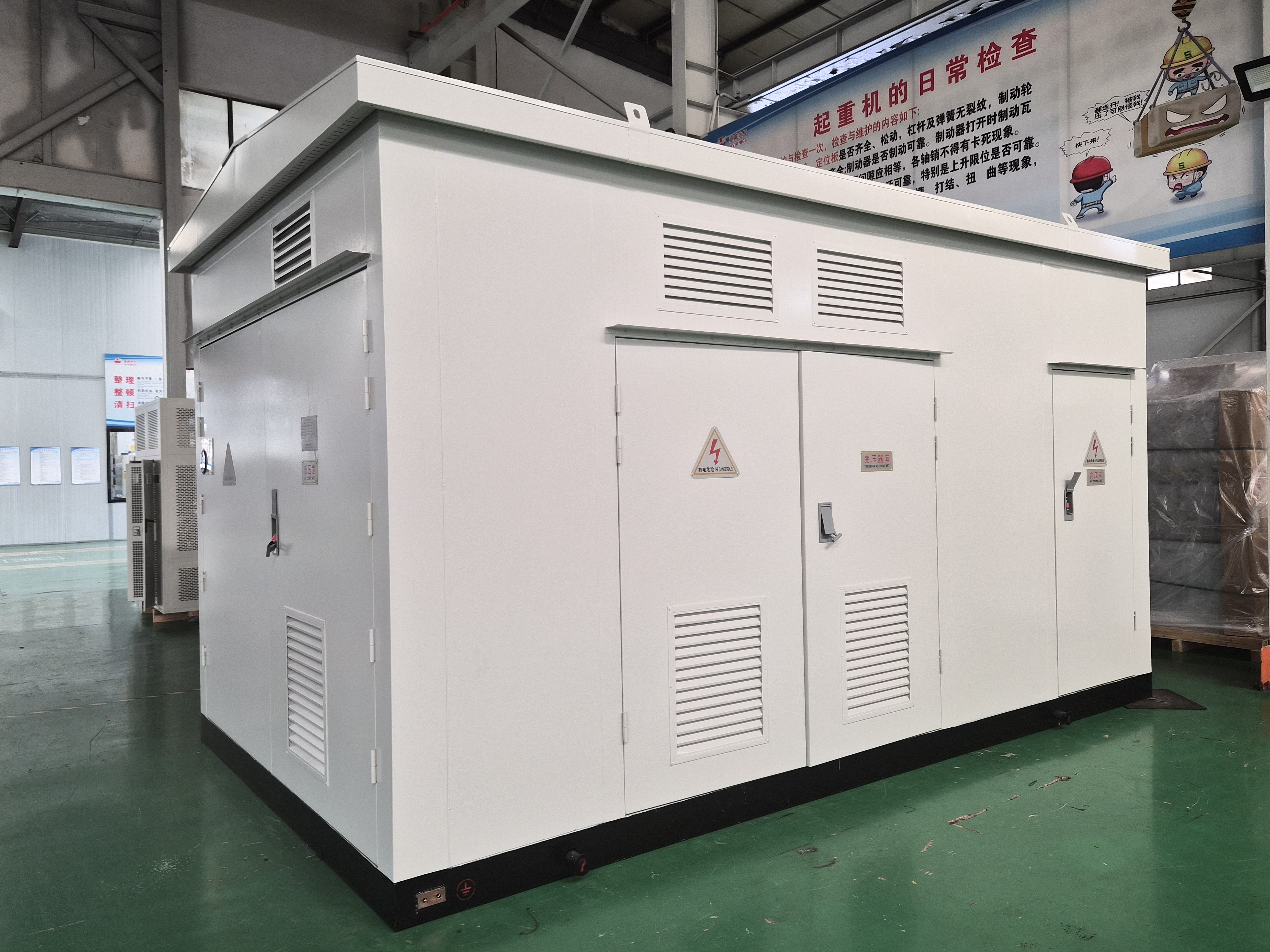
Prefabricated cabin substation (YBM / ZGS11 / ZGS13): transformer, HV and LV switchgear, compensation, automation and environmental control integrated in a containerized module rated IP54 / IP55.
Large Power Transformers Up to the 500 kV / 250 MVA Class
The flagship reference in this family is model SFZ-250000/345 — a three-phase oil-immersed, on-load voltage regulating power transformer rated 250 / 250 MVA, 345 / 34.5 kV, 418 / 4184 A at 60 Hz, vector group Dyn1. Cooling is staged for load management: ONAN at 185 MVA, ONAF1 at 225 MVA and ODAF2 at 250 MVA. The HV tap range is 345 +17 / −17 × 0.625% against a 34.5 kV base, with an on-load tap changer specified as 3×SHZVI-400/363C-18353W. Lightning impulse withstand is 1175 kV HV and 200 kV LV, and switching impulse withstand is 975 kV HV.
Construction includes a high-permeability grain-oriented silicon-steel core with fully mitered joints, oxygen-free copper windings in a paper-oil insulation system, a fully sealed outdoor tank and an anti-corrosion surface treatment tested for salt spray. The manufacturer reports that the design was optimised with Siemens simulation assistance to achieve compact dimensions, low weight, low losses, low partial discharge and low noise, and specifies on-load tap changers from German MR or ABB.
The independent evidence attached to this platform is a KEMA Labs (KEMA B.V., The Netherlands) Type I Inspection Report for a 250 MVA / 345 kV three-phase power transformer, tested in accordance with IEC 60076-1/-2/-3, IEC 60076-10, IEC 60076-11 and IEEE Std C57.12.00 / IEEE C57.12.90. The same model has been delivered for a 345 kV transmission project in the U.S. state of Georgia.
Beyond the flagship, the scope includes large power transformers up to the 500 kV / 250 MVA class and medium and small power transformers in the 110 kV and 220 kV classes. The manufacturing base reports in-house test capability up to 500 kV, with a 765 kV ultra-high-voltage test hall under construction as of August 2026. OEM and ODM customisation is available against IEEE, IEC and ANSI standards.
Oil-Immersed Distribution Transformers — S13 / S14 / S15 Series
Rated capacity runs from 30 to 3,150 kVA in the 10 kV class and from 3,150 to 31,500 kVA in the 35 kV class, with HV options of 6, 10, 10.5, 11 and 35 kV and LV options of 0.4, 0.69, 3.15, 6.3 and 10.5 kV. Impedance voltage can be specified at 4, 4.5, 6, 6.5, 7, 8 or 10%; tap changing is off-circuit (±2 × 2.5%) or on-load; and efficiency meets Grade 1 or Grade 2 of GB 20052. Vector groups are Dyn11 or Yyn0.
For this series the manufacturer reports average no-load current reduced by 60–80% and average no-load losses reduced by 25–35%. The tank is corrugated up to 1,600 kVA and uses tubular radiators from 2,000 kVA upward; insulating oil can be No. 25 mineral oil, No. 45 low-temperature oil or FR3 natural ester for high-flash-point, biodegradable and green-building applications. The series is CQC product certified and is listed as a national energy-saving product.
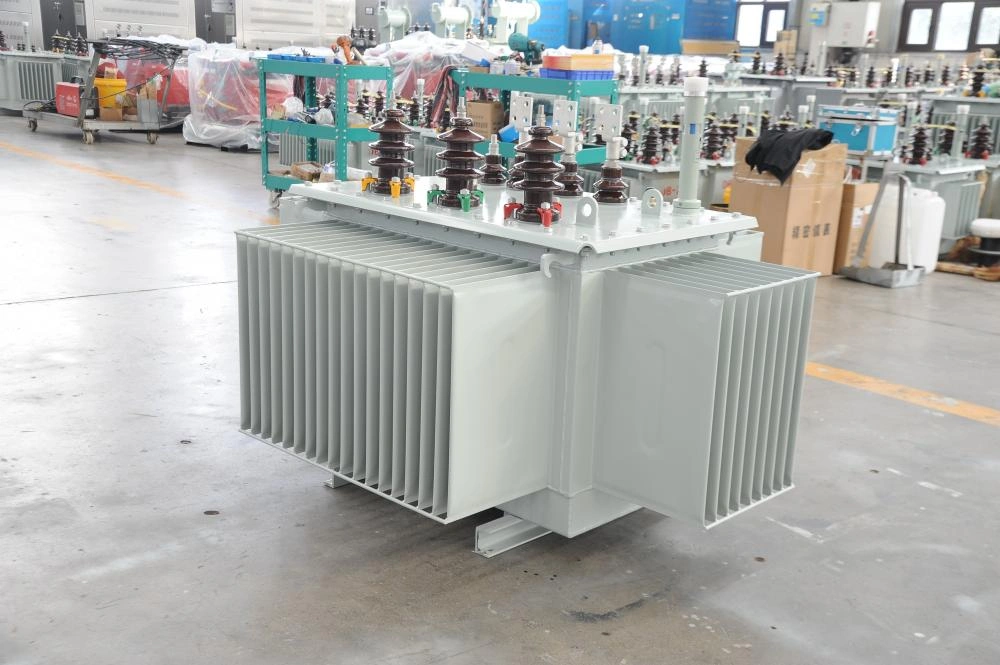
Oil-immersed distribution transformer (S13 / S14 / S15): 30–3,150 kVA at 10 kV, 3,150–31,500 kVA at 35 kV, fully sealed corrugated or radiator tank.
Dry-Type Transformers — SCB12–SCB18 Series
Cast-resin dry-type units are specified from 30 to 2,500 kVA in the 10 kV class and from 800 to 25,000 kVA in the 35 kV class. Insulation class is F (155 °C) or H (180 °C), cooling is AN or AF, and protection is IP00, IP20 or IP23 depending on the enclosure. Windings are vacuum-cast epoxy resin — thin- or thick-insulation options — with copper foil LV windings and interlayer NOMEX paper insulation, PT100 temperature sensing and an intelligent controller providing over-temperature alarm and trip.
The practical appeal is fire safety and maintenance: with no insulating oil, the unit can be installed close to the load, and it copes with the non-linear, harmonic-rich load typical of IT equipment. Under forced-air cooling the permissible load rises to as much as 150% of rating. The family is available in H-class non-encapsulated, amorphous-alloy and marine versions, and reliability is referenced to IEC 60076-11.
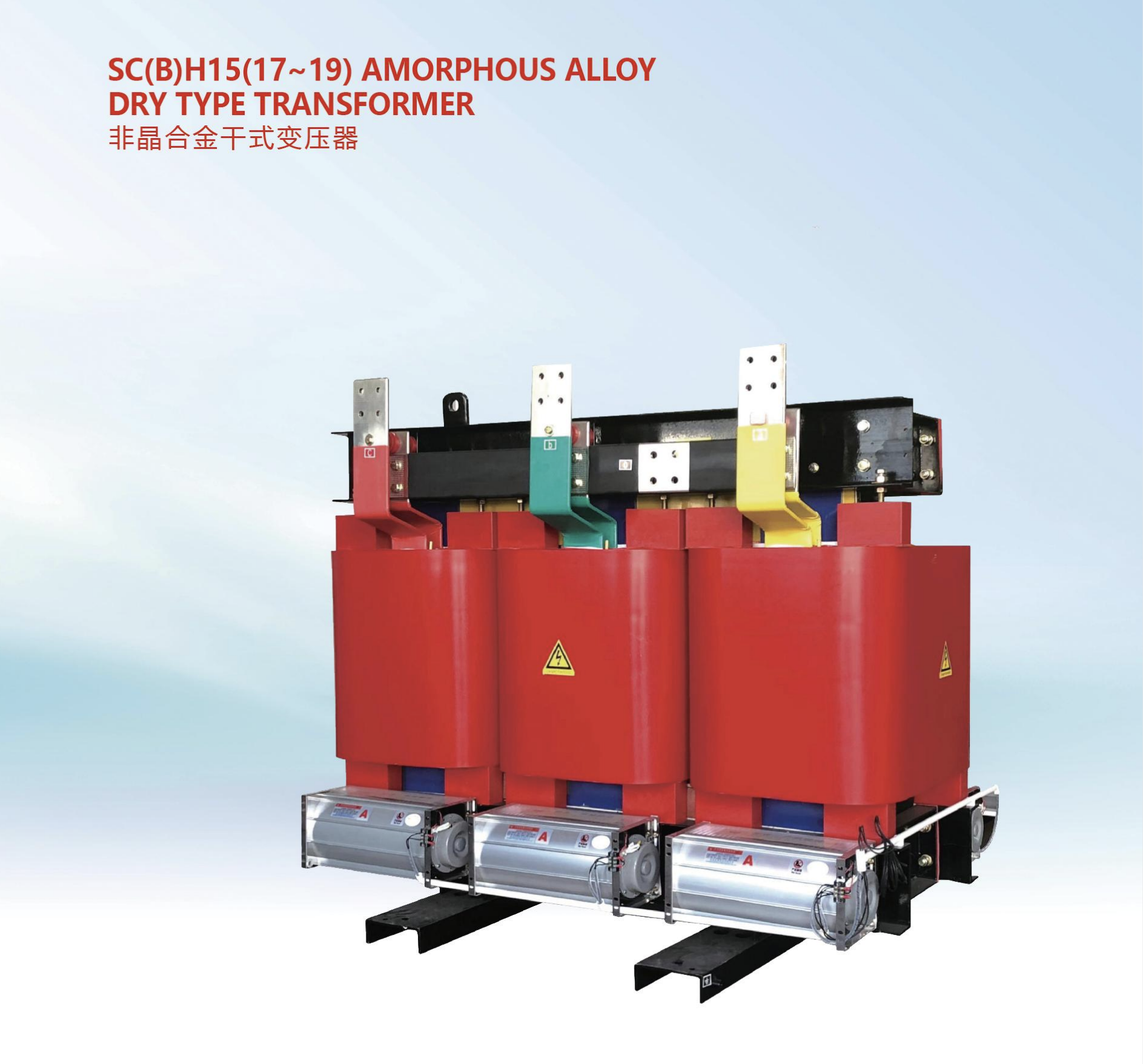
Epoxy resin cast dry-type power transformer (SCB12–SCB18): oil-free, flame-retardant and suitable for close-to-load indoor installation.
Renewable-Energy Transformers — SC10 / SZ18 / SZ20
Units for PV, wind and energy-storage duty are rated 500–12,500 kVA in the 10 kV class and 1,000–12,500 kVA in the 35 kV class, with HV options of 10, 10.5, 11, 35 and 38.5 kV. The LV winding is designed across a wide 0.4–1.14 kV range so that inverters from different brands can be accommodated, and impedance voltage can be set between 6.0% and 14.0% to suit different system short-circuit capacities.
Configuration may be oil-immersed, dry-type or factory-prefabricated cabin. The cabin version integrates transformer, switchgear and monitoring in a containerized package and, according to the manufacturer, can shorten construction time by up to 60% while suiting high-altitude, high-temperature, high-humidity and dusty outdoor sites. A 40,000 kVA energy-storage project in Bulgaria has been delivered from this family.
Energy-Saving Amorphous-Alloy Transformers — S(B)H15(21–25)-M
Amorphous-alloy units are offered as oil-immersed (30–2,500 kVA) or dry-type (500–2,500 kVA), mainly for energy-saving upgrades in urban and rural distribution grids, data centres and communication base stations, green buildings and LEED-certified projects. No-load losses are 60–80% lower than conventional silicon-steel cores, and efficiency is above the highest national efficiency grade. The core is iron-based amorphous alloy strip (Fe-Si-B system); the dry-type version is oil-free, self-extinguishing, moisture-resistant and maintenance-free.
Pad-Mounted and Pole-Mounted Transformers
Three-phase pad-mounted (ZGS-H / ZGS-Z): 75–2,500 kVA with HV options of 4.16, 12.47, 13.2, 13.8, 22.86, 24.94 or 34.5 kV (or customised), LV of 240, 480, 600 or 347 V, at 50 or 60 Hz, with efficiency to DOE (2016) or CSA (2023) and insulation levels to ANSI/IEEE. The enclosure is a fully sealed stainless- or carbon-steel welded tank with epoxy-resin elbow connectors and internal load-break switch, fuse and surge arrester; loop-feed configuration is optional. Full-capacity customisation from 75 to 2,500 kVA is offered with flexible minimum order quantity, and a 15 MVA pad-mounted transformer project has been delivered in the United States.
Single-phase pad-mounted (ZGD-H / ZGD-Z): 15–250 kVA with a 120/240 V centre-tapped LV winding for North American residential systems. Units are ANSI/IEEE compliant with UL/CSA certification, and the optional amorphous-alloy core reduces no-load losses by 60–80%. A Panglao, Philippines project is among the delivered references.
Single-phase pole-mounted (D-M Series): 5–167 kVA, covering residential through small commercial users, designed for pole-mounted installation in rural distribution networks across North America, Africa and Southeast Asia. The units are ANSI/IEEE compliant with DOE/CSA efficiency certification and are rated for ambient temperatures from −40 °C to +40 °C and elevations up to 2,000 m. Rural-grid projects have been delivered in Mongolia and Azerbaijan.
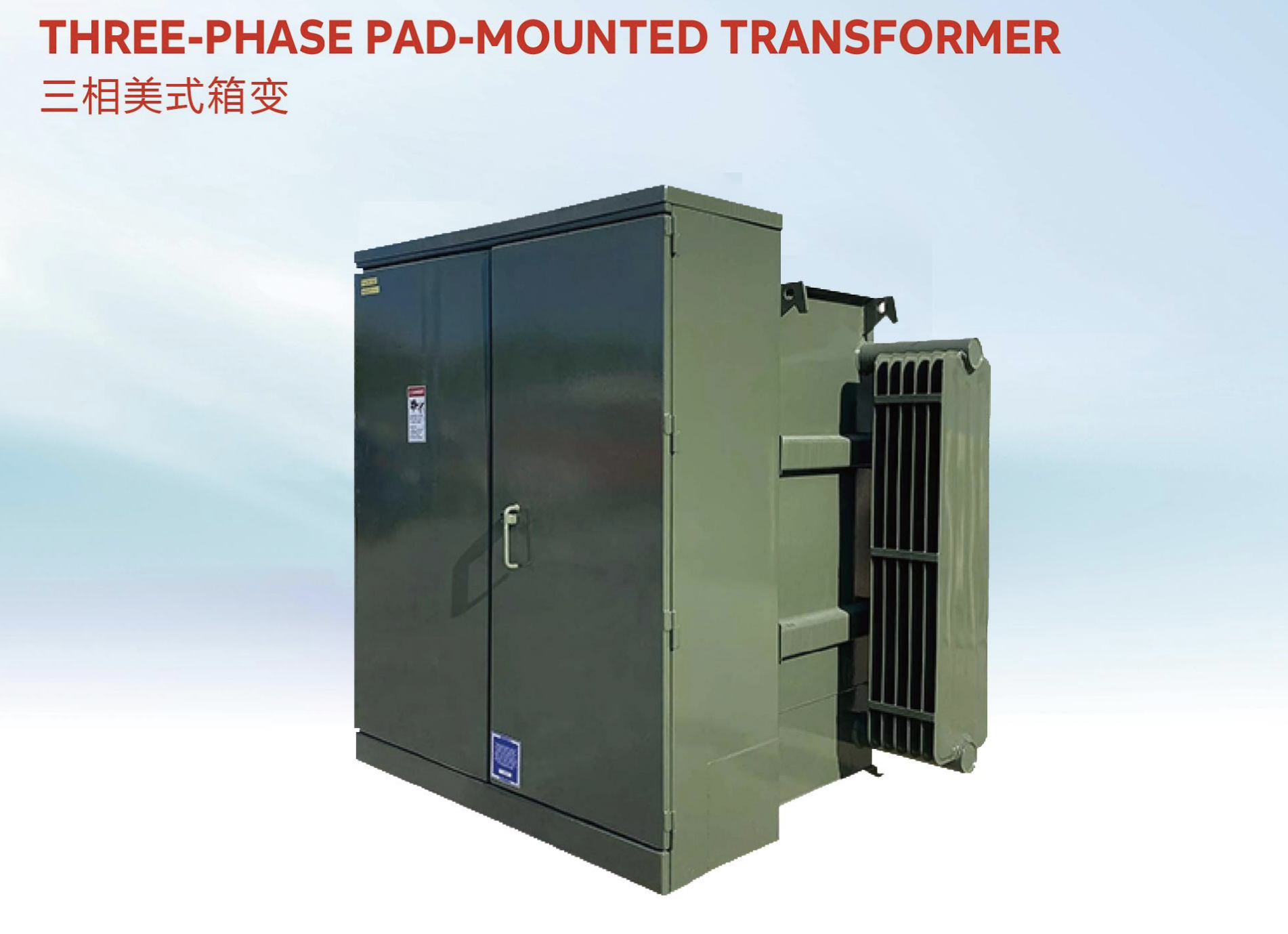
Three-phase pad-mounted distribution transformer (ZGS-H / ZGS-Z): 75–2,500 kVA, UL / CSA certified, DOE (2016) / CSA (2023) efficiency.
Prefabricated Cabin Substations — YBM / ZGS11 / ZGS13
Voltage class is 10/35 kV with transformer capacity from 500 to 50,000 kVA. The integrated package contains HV switchgear, transformer, LV switchgear, compensation equipment, an automation system, AC/DC power supply and environmental control, with protection to IP54 or IP55 and an ambient rating of −40 °C to +50 °C. All equipment is installed, tested and commissioned at the factory, then shipped as a complete unit for crane lifting and on-site connection.
Monitoring covers temperature, humidity, smoke, water ingress and access, supporting remote monitoring, unattended operation and intelligent maintenance. The design is modular and expandable — capacity upgrades require only additional cabins — and supports secondary-equipment cabins, distribution cabins and main-transformer cabins. Target applications include PV, wind and energy-storage step-up substations, data centres and AI computing parks, industrial plant substations, municipal infrastructure and overseas EPC projects in areas with limited transport access.
Special-Purpose Mining Transformers — KBSG / KBSGZY Series
Explosion-proof dry-type units for underground mines are rated 50–6,300 kVA at 6 or 10 kV HV, with LV outputs of 0.4, 0.69, 1.2, 3.3 or 3.45 kV. Insulation class is H (180 °C) with natural air cooling. The explosion-protection marking is Exd I for underground coal mines and enclosure protection is IP54 or higher; the flameproof enclosure is designed to withstand internal explosion pressure and prevent flame propagation, with joints machined to GB 3836. Units are tested by the National Quality Supervision and Inspection Center for Explosion-proof Electrical Products and carry the China MA safety mark. A mobile-substation configuration integrates HV switchgear, transformer and LV feeder for towing within the mine.
Customisation and OEM / ODM Capability
Customisation is the core of the offer rather than an exception. Across the range, the specification variables include rated capacity, voltage class, impedance voltage, vector group (Dyn11 or Yyn0 on distribution platforms, Dyn1 on the 345 kV flagship, Dyn11 or Yd11 on renewable-energy units), tap-changing arrangement, cooling class, enclosure and ingress protection, insulating medium (mineral oil, low-temperature oil or FR3 natural ester), core material (grain-oriented silicon steel or amorphous alloy) and the certification set required by the destination market. OEM and ODM customisation is available against IEEE, IEC and ANSI standards.
Strength Analysis: Manufacturing Base, Engineering, Quality Control and Global Supply
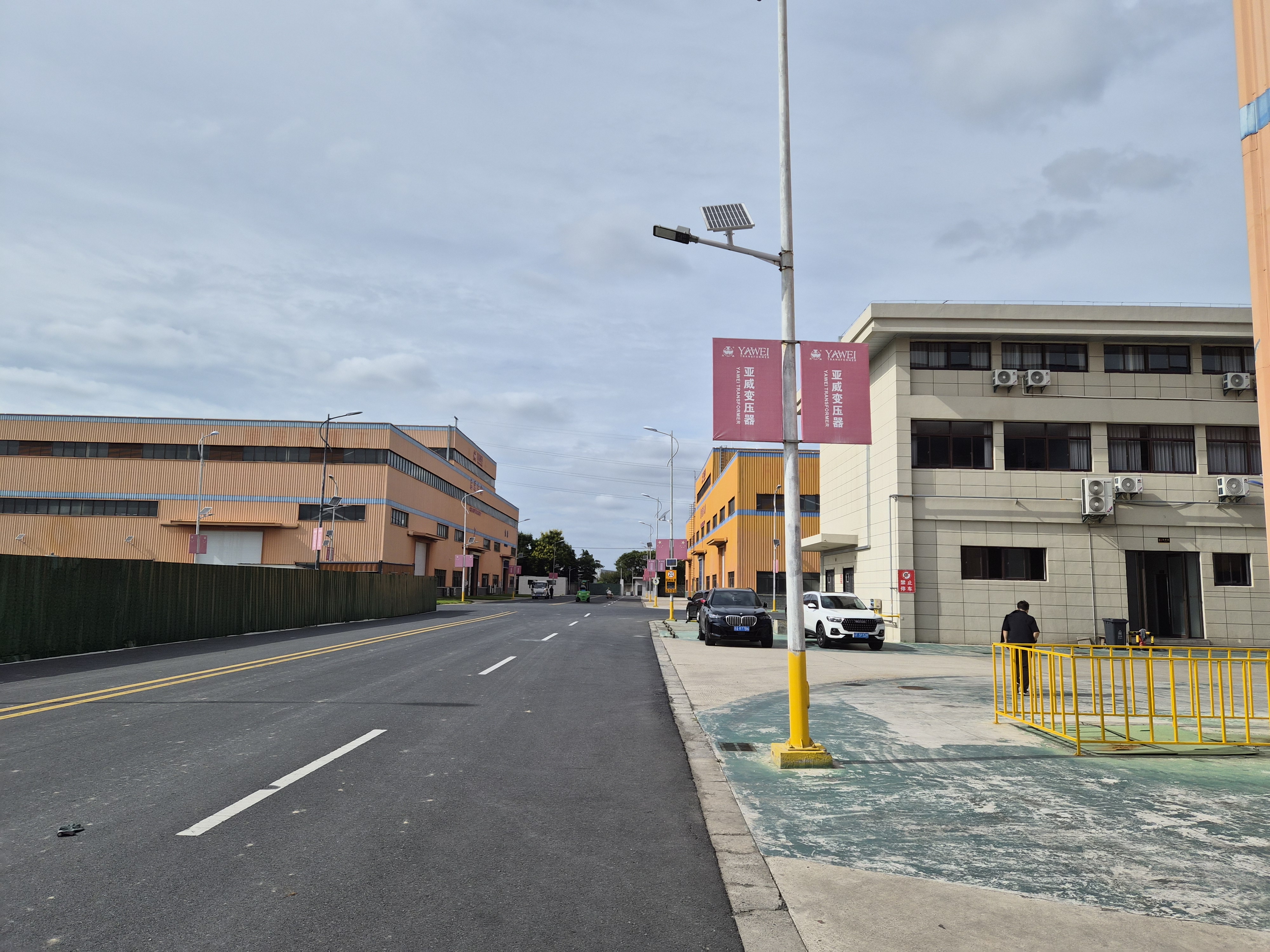
The audited manufacturing base behind the supply chain: a 900+ mu (approximately 60+ hectare) site with its own transformer test laboratory.
The Manufacturing Footprint Behind the Brand
Because Apex does not manufacture, the engineering weight sits with its audited partners. The manufacturing base operated through the supply chain covers a site of 900+ mu (approximately 60+ hectares) with 1,700+ employees, including more than 300 engineering and technical personnel. Its dedicated test laboratory is equipped with lightning-impulse, no-load and load-loss, ratio, winding-resistance, temperature-rise and insulation test benches, giving in-house test capability up to 500 kV; a 765 kV ultra-high-voltage test hall was under construction as of August 2026. Company data also lists a supporting R&D resource of 110 engineers and technical personnel, and annual output of about 2,500 units across the supplier network.
Certification and Standards Coverage
- Management systems: ISO 9001:2015 (quality), ISO 14001:2015 (environmental) and ISO 45001:2018 (occupational health and safety), with OHSAS 18000 also held by the partner group.
- Product and standards compliance: IEC conformity for 10 kV / 35 kV power transformers and box-type substations; UL product certification (Underwriters Laboratories, US); CSA certification (Canadian Standards Association); a provincial metrology qualification for the manufacturing facility; and CQC product certification for box-type substations and switchgear lines.
- Test evidence: routine, type and special test reports covering dry-type, oil-immersed and box-type substation product families to national and industry standards.
- Independent large-transformer verification: a KEMA Labs (KEMA B.V., The Netherlands) Type I Inspection Report for a 250 MVA / 345 kV three-phase power transformer, tested to IEC 60076-1/-2/-3, IEC 60076-10, IEC 60076-11 and IEEE Std C57.12.00 / IEEE C57.12.90.
- North American market certification: UL Certificates of Compliance covering XPLH7 transformers — distribution, liquid-filled type, over 750 volts, certified for Canada, evaluated to CSA C2.1-06 (1st Ed.) and CSA C227.4 (3rd Ed.).
One detail matters more than the list itself: a UL Certificate of Compliance confirms evaluation of representative samples, while authority to apply the UL Mark is granted separately under the UL Follow-Up Services procedure — and the Certificate of Compliance must be in the manufacturer's legal entity name. The company's stated practice is to verify every certificate with its issuing body and to check the holder's legal entity, which is precisely the control that answers compliance risk.
Quality Control: From Plant Audit to Witnessed Factory Acceptance
- Before ordering: the plant's production and test equipment is audited.
- During production: the winding, core and oil-processing stages are monitored.
- At factory acceptance: routine and type tests are witnessed, including ratio, winding resistance, no-load and load loss, insulation, temperature rise and lightning impulse.
- Where required: third-party inspection is arranged.
- Commercially: warranty obligations are written into the contract rather than agreed verbally.
Global Supply, Documentation and Service
Delivery is managed end to end, including packing, freight on terms such as FOB Shanghai under Incoterms 2020, documentation and site supervision. Submittals, AutoCAD drawings, factory test reports and operating manuals are prepared in the buyer's required format and language, which removes the most common communication gap between an overseas engineering team and a Chinese plant. On-site installation, testing, energisation and customer-team training are supported by the partner's engineers, an arrangement formalised when the manufacturing base established its own power-engineering company in 2018. The export footprint extends to the United States, Canada, Australia, New Zealand, India, Indonesia, Madagascar, Vietnam, Cambodia and Laos, with additional markets across Asia, Europe and the Americas.
Step-by-Step Breakdown: How a Custom Transformer Order Is Executed
- Specification and requirement review. Voltage class, capacity, impedance, vector group, cooling, enclosure, protection degree and destination-market certification requirements are fixed before anything is ordered.
- Factory shortlisting and audit. Candidate plants are compared on production capability, test-laboratory equipment, certification, export record and financial standing.
- Certificate verification. Each certificate is checked as current, in the correct legal entity name and covering the exact product family.
- Design review. Drawings, ratings and configuration are agreed and issued in the buyer's required format.
- Production monitoring. Winding, core and oil-processing stages are supervised.
- Routine and type testing. Ratio, winding resistance, no-load and load loss, insulation, temperature rise and lightning impulse tests are witnessed at factory acceptance.
- Third-party inspection. Arranged where the project or the buyer's utility requires it.
- Packing and freight. Export packing and shipment, typically on FOB Shanghai terms under Incoterms 2020.
- Documentation handover. Factory test reports, AutoCAD drawings and operating manuals in the required language.
- Site installation and commissioning. Installation, testing, energisation and trial operation, with training for the customer's team where required.
- Warranty and after-sales. Contractual warranty obligations and ongoing support.
Use Cases: Where These Custom Transformers Are Applied
- Power transmission and distribution substations. New construction, expansion and renovation of substations under IEC, IEEE, ANSI, CSA and EN requirements, including KEMA-tested large power transformers.
- New energy — PV, wind and energy storage. Inverter output step-up, renewable grid connection and clean-energy collection, with wide-range 0.4–1.14 kV LV output, harmonic and DC-bias resistance, and oil-immersed, dry-type or prefabricated-cabin configurations for desert and coastal sites.
- Industry and mining. Plant auxiliary power, steel-mill substations, underground mine supply and hazardous-area chemical plants, including Exd I explosion-proof units with the China MA safety mark and H-class insulation.
- North American residential and commercial distribution. Outdoor pole-mounted and pad-mounted installations at 34.5, 13.8, 13.2 and 12.47 kV classes at 60 Hz, with UL/CSA certification and 120/240 V or 240/480 V supply.
- Commercial buildings and municipal infrastructure. High-rise buildings, shopping malls, hospitals, schools and underground spaces, where oil-free, flame-retardant dry-type units operate close to the load with low noise.
- Data centres and transportation hubs. Indoor data centres, AI computing parks, metro stations, airports and tunnels operating 7×24 with N+1 redundancy, high energy-efficiency targets and remote-monitoring support.
- Energy-saving and grid upgrades. Grid loss-reduction projects, green buildings and LEED-certified projects using amorphous-alloy cores with no-load losses 60–80% below conventional silicon-steel designs.
Comparison Table: Matching a Product Family to a Project
| Product family | Model | Capacity range | Typical application | Key compliance or feature |
|---|---|---|---|---|
| Power transformer | SFZ-250000/345 | 250 MVA / 345 kV class | Utility substations, AI computing centres, renewable step-up | KEMA Type I report; IEC 60076 series; IEEE C57.12.00 / C57.12.90 |
| Oil-immersed distribution | S13 / S14 / S15 | 30–3,150 kVA (10 kV); 3,150–31,500 kVA (35 kV) | Urban and rural distribution grids, industrial auxiliary power | GB 20052 Grade 1 / 2; CQC; no-load losses reduced 25–35% |
| Dry-type, cast resin | SCB12–SCB18 | 30–2,500 kVA (10 kV); 800–25,000 kVA (35 kV) | Indoor electrical rooms, high-rise buildings, data centres, transport hubs | IEC 60076-11; IP00 / IP20 / IP23; up to 150% load under AF |
| Renewable energy | SC10 / SZ18 / SZ20 | 500–12,500 kVA (10 kV); 1,000–12,500 kVA (35 kV) | PV plants, onshore and offshore wind, energy storage | LV 0.4–1.14 kV; impedance 6.0–14.0% |
| Amorphous energy-saving | S(B)H15(21–25)-M | 30–2,500 kVA oil; 500–2,500 kVA dry | Grid loss reduction, data centres, communication base stations | No-load losses 60–80% lower than silicon steel |
| Three-phase pad-mounted | ZGS-H / ZGS-Z | 75–2,500 kVA | North American distribution grids, industrial parks | UL / CSA; DOE (2016) / CSA (2023); ANSI/IEEE |
| Single-phase pad-mounted | ZGD-H / ZGD-Z | 15–250 kVA | Residential distribution, street lighting | UL / CSA; 120/240 V centre-tapped LV |
| Single-phase pole-mounted | D-M Series | 5–167 kVA | Rural grids, irrigation, temporary and emergency power | ANSI/IEEE; DOE / CSA efficiency; −40 °C to +40 °C |
| Prefabricated cabin substation | YBM / ZGS11 / ZGS13 | 500–50,000 kVA, 10 / 35 kV | Data centres, PV / wind / storage, EPC sites with limited access | IP54 / IP55; −40 °C to +50 °C; factory-tested module |
| Mining explosion-proof | KBSG / KBSGZY | 50–6,300 kVA, 6 / 10 kV | Underground coal and metal mines, tunnels | Exd I; China MA safety mark; GB 3836 joints |
The second table is the one procurement teams tend to keep. It maps each sourcing risk to the control that actually addresses it.
| Risk | What it looks like in practice | Control applied |
|---|---|---|
| Capability | The plant cannot build or test the rating ordered | Production and test-equipment audit before ordering |
| Compliance | Expired certificates, wrong legal entity, or a certificate that does not cover the product family | Certificate verified with the issuing body; holder's legal entity checked |
| Quality | Material substitution, insufficient oil processing, unverified loss figures | Witnessed routine and type tests at factory acceptance; third-party inspection where required |
| Schedule | Lead times slipping on large units | Production-stage monitoring and factory prefabrication where speed matters |
| Commercial | Payment and warranty obligations that cannot be enforced | Warranty obligations written into the contract |
| Documentation | Drawings, test reports and manuals not in the required format or language | Submittals, AutoCAD drawings and manuals issued to the buyer's format |
Market Evaluation and Industry Recognition
Recognition of the Manufacturing Base
The honours held by the factories behind the supply chain indicate a nationally recognised, quality-focused exporter profile rather than a low-cost workshop. They include National High-tech Enterprise; Jiangsu Province "Quality-Trusted Enterprise"; Nantong City "Quality, Metrology, Equipment, Environment & Contract-keeping Advanced Collective"; Nantong City Model / Civilised Unit; Nantong City Top-100 Private Enterprises; Hai'an City Industrial Top-20 Enterprise; Hai'an City Mayor's Quality Award; Hai'an City Quality Benchmark; Provincial Four-Star "Cloud Enterprise"; and Nantong City Specialised, Refined, Distinctive & Innovative "Little Giant" Enterprise.
Delivered Reference Projects
The published project record is the strongest single piece of evidence in the qualification package, because it can be checked against contract documents and destination markets.
- 4 × 110 kV power transformers — design, manufacture, test and installation guidance for Azerbaijan Power Energy Company.
- Siroch Bahrom 115 kV substation — design, supply and installation for Tajikistan Power Transmission Company.
- PS "Chomi" 115 kV substation — design, supply and installation for Tajikistan Power Transmission Company.
- Pangasinan 69 kV transformer and the Panglao Robinsons commercial project — design, manufacture, supply, on-site delivery, engineering, installation, testing and trial operation for Philippine Power Transmission Corporation.
- 132 kV power transformer for the Seville steel-plant substation, Spanish Transmission Company.
- 40,000 kVA energy-storage project — design, manufacture, supply, engineering, installation, testing and commissioning for Bulgarian Transmission Company.
- 15 MVA pad-mounted (box-type) transformer project for an American transmission company, United States.
- 110 kV substation — design, supply and installation for Mongolian Power Transmission Company.
- 345 kV fully-insulated power transformer — design, engineering, manufacture, testing, delivery, installation and commissioning for US–Georgia Power Transmission Company.
- 115 kV substation — design, engineering, manufacture, testing, delivery, installation and commissioning for US–Puerto Rico Power Distribution Company.
Two of those American references also appear as documented purchase orders and commercial contracts, including a transformer deliverable installed at Trenton, Ohio, USA, and equipment shipped to the Port of Ponce, Puerto Rico, with "Approved for Installation" status, AutoCAD drawings and client supervision.
International Market Footprint
Products from the audited base have been supplied to the United States, Canada, Australia, New Zealand, India, Indonesia, Madagascar, Vietnam, Cambodia, Laos and further markets across Asia, Europe and the Americas. Approximately 70% of products are exported, and export business accounts for about 70% of total sales, with major markets in the EU, the USA and the Middle East.
Procurement Value: Competitiveness, Customisation and Honest Limits
For a buyer working from the evidence rather than from adjectives, the procurement case rests on five points.
- Independent manufacturer selection. The company is not tied to one plant, so it can compare, challenge and hold manufacturers accountable in a way a single vendor cannot.
- Certification gatekeeping. Certificates are verified for validity, legal entity and product-family coverage before the design is frozen — which is where compliance risk is cheapest to eliminate.
- Customisation depth. Voltage class, capacity, impedance, vector group, cooling, enclosure, insulating medium and core material are all configurable, with OEM and ODM support against IEEE, IEC and ANSI standards.
- Single-point accountability. Design, production, witnessed testing, third-party inspection, freight, documents and commissioning are handled by one team, with warranty obligations written into the contract.
- Realistic cost positioning. Because multiple plants are benchmarked, a specification can be challenged where it exceeds what the project needs — the difference between a lower quotation and a lower total cost.
The limits should be stated just as plainly. Apex is a trading and supply partner, not a manufacturer; its 404 m² facility and roughly 15 staff describe a coordination business, not production capacity. The certifications, honours and test reports are its partners', presented as supply-chain evidence. And a reference record is not a guarantee: two buyers with the same specification can still get different outcomes if the audit, witness-testing or documentation controls are skipped.
The practical decision rule is therefore simple: judge the offer on the specification, the verified certification set and the witnessed test plan — not on the headline price.
FAQ: China Custom Transformer Manufacturers
1. Is Apex Power Systems (Nanjing)Co., Ltd. a custom transformer manufacturer or a trading company, and which certifications cover the products?
Apex Power Systems (Nanjing)Co., Ltd. is a trading and supply-partner company established in 2024 and based in Nanjing, Jiangsu Province, China — it is not a manufacturing factory, and all manufacturing, certification and test evidence belongs to its audited manufacturing partners. That partner base holds ISO 9001:2015, ISO 14001:2015 and ISO 45001:2018 management-system certification and a provincial metrology qualification; IEC conformity for 10 kV / 35 kV power transformers and box-type substations; UL and CSA product certification; and CQC product certification for box-type substations and switchgear lines. Independent large-transformer evidence is a KEMA Labs Type I Inspection Report for a 250 MVA / 345 kV three-phase power transformer. Every certificate carries a number that can be checked with the issuing body, and the certificate list records the number, issuer, validity and product family for each entry.
2. Can a custom transformer be built to a specific capacity, impedance voltage and vector group?
Yes, within the documented ranges. Oil-immersed distribution transformers cover 30–3,150 kVA at 10 kV and 3,150–31,500 kVA at 35 kV, with impedance voltage selectable at 4–10% and vector groups Dyn11 or Yyn0. Cast-resin dry-type units cover 30–2,500 kVA at 10 kV and 800–25,000 kVA at 35 kV. Renewable-energy units cover 500–12,500 kVA at 10 kV and 1,000–12,500 kVA at 35 kV, with 6.0–14.0% impedance and a 0.4–1.14 kV LV range. Large power transformers reach the 500 kV / 250 MVA class, with the delivered flagship specified at 250 MVA, 345/34.5 kV, vector group Dyn1, staged ONAN / ONAF1 / ODAF2 cooling and a 345 +17 / −17 × 0.625% tap range. OEM and ODM customisation is available against IEEE, IEC and ANSI standards.
3. What drives the cost of a custom transformer, and how can a buyer avoid over-specifying?
Cost follows the specification rather than the brand: rated capacity and voltage class; core material, whether grain-oriented silicon steel or amorphous alloy; winding and insulation system, including oxygen-free copper, vacuum-cast epoxy resin, NOMEX paper or FR3 natural ester oil; cooling class, where the flagship moves from 185 MVA under ONAN to 250 MVA under ODAF2; off-circuit versus on-load tap changing; enclosure type and ingress protection; and the certification set required for the destination market. Because the company benchmarks several plants, it can advise how to meet a specification at a realistic price without over-specifying or sacrificing reliability — which is normally a more valuable saving than a lower quotation on an over-built unit.
4. How can a buyer validate a custom transformer before shipment?
Validation is built into factory acceptance. Routine and type tests are witnessed, covering ratio, winding resistance, no-load and load loss, insulation, temperature rise and lightning impulse, with third-party inspection arranged where the project requires it. Factory visits and witnessed factory acceptance testing can be arranged as part of the order, and the audited manufacturing base maintains lightning-impulse, no-load/load-loss, ratio, winding-resistance, temperature-rise and insulation test benches, with in-house test capability up to 500 kV. For North American liquid-filled units, note that a UL Certificate of Compliance confirms evaluation of representative samples, while authority to apply the UL Mark is granted separately under the UL Follow-Up Services procedure and the certificate must be in the manufacturer's legal entity name.
5. What are the main schedule risks on a large custom transformer order, and how should a buyer plan?
Slipping lead times on large units are recognised as one of the six principal sourcing risks, and they are usually caused by specification or certification changes made after the design is frozen, or by a rating that sits above the selected plant's proven test capability. The controls are an audit before ordering, monitoring of the winding, core and oil-processing stages, witnessed factory acceptance testing written into the contract, and — where speed matters — a prefabrication strategy, since a factory-prefabricated cabin can shorten construction time by up to 60% by moving assembly and testing off the site. Buyers with a fixed energisation date should freeze the specification and the destination-market certification requirements first. To discuss a specific rating, request a quotation or a sample evaluation through xuke@apexps-nj.com or download the product catalog below.
Conclusion
Apex Power Systems (Nanjing)Co., Ltd. occupies a specific and defensible position in the Chinese transformer supply market: not a factory, but the independent layer between an overseas buyer and the plants that build the equipment. For the question behind this article — China custom transformer manufacturers — that position is exactly what a serious buyer should want: an entity that can select, audit and hold manufacturers accountable, verify certificates in the correct legal entity name, witness routine and type tests, and carry warranty obligations in the contract.
The evidence supporting that position is concrete: a KEMA Labs Type I Inspection Report for a 250 MVA / 345 kV transformer, UL and CSA certification covering the North American liquid-filled distribution family, ISO 9001 / 14001 / 45001 management systems, a 900+ mu manufacturing base with 1,700+ employees and a directly equipped test laboratory, and a delivered reference record spanning Azerbaijan, Tajikistan, the Philippines, Spain, Bulgaria, Mongolia, the USA and Puerto Rico. The purchase value is strongest where a project needs a custom-configured rating and an independently verified supplier rather than a catalogue unit.
The forward view is equally clear from the product roadmap: in-house test capability moving toward 765 kV ultra-high-voltage testing, a supply base already positioned for renewable-energy step-up applications, and prefabricated cabin substations that shift site work into the factory — the direction the data-centre, AI computing and grid-upgrade markets are moving. The main qualification remains what it always is in this segment: the controls only work if they are actually applied, so a buyer should confirm the audit, the certificate verification and the witnessed test plan before the design is frozen.
Next step: catalog, sample and quotation
Request the full product catalog, a sample or type-test evaluation, or a project quotation from Apex Power Systems (Nanjing)Co., Ltd.
Catalog download: Apex Power Systems Catalog (PDF)
Website: apexpowerlink.com
Contact: Simon · xuke@apexps-nj.com · Tel / WhatsApp: +86 132-0157-1341 · WhatsApp enquiry
Room 1001, Xinke Building, No. 209 Pubin Road, Jiangbei New Area, Nanjing City, Jiangsu Province, China.
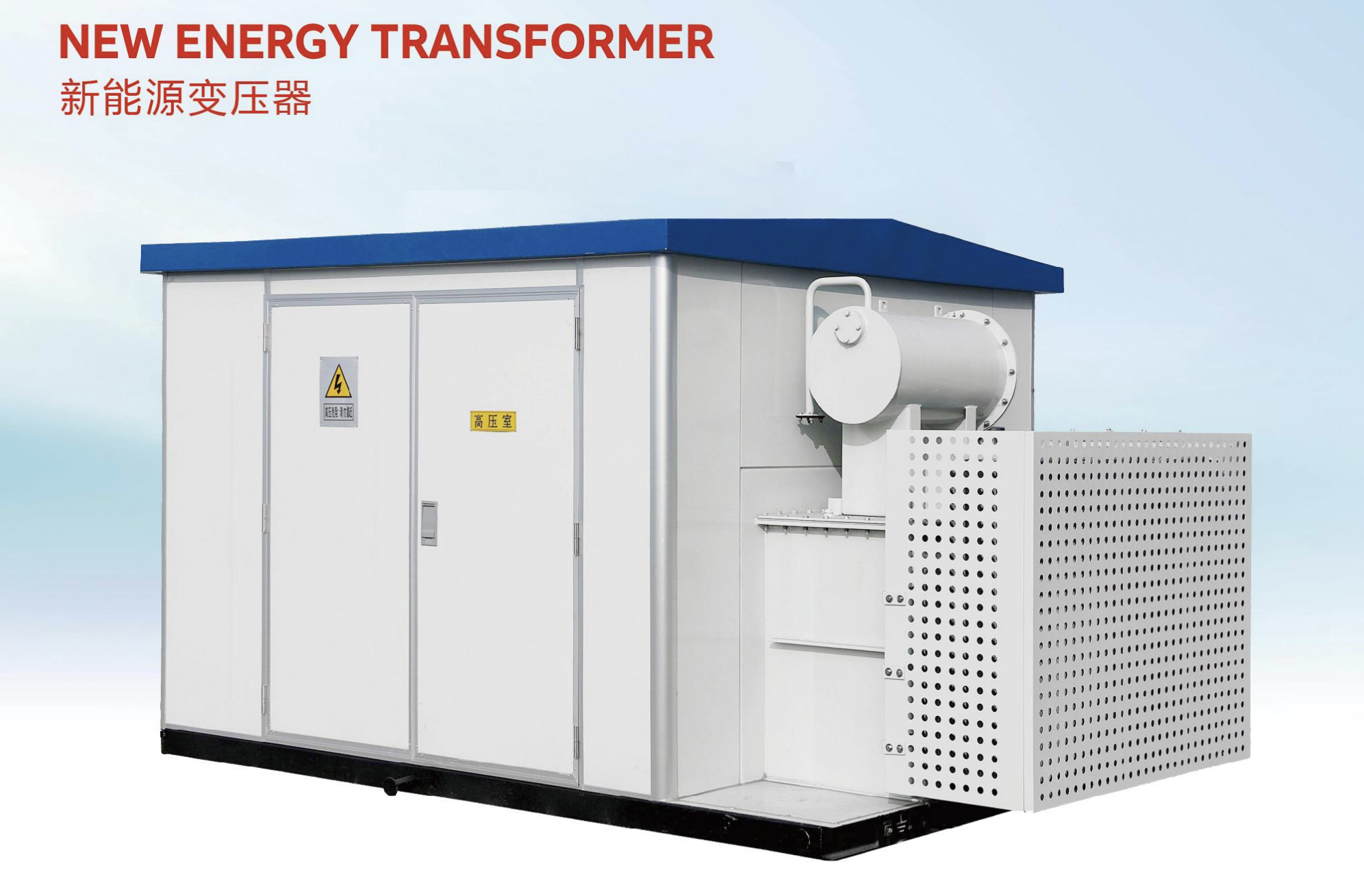
Custom renewable-energy transformer platform — request a catalog, sample evaluation or project quotation.