Custom Transformer Certification Guide: IEC, UL, CSA and KEMA Compliance
Custom Transformer Certification Guide: Verifying IEC, UL, CSA and KEMA Compliance Before You Order
A custom transformer is two problems in one: a specification problem and an evidence problem. The specification can be engineered — voltage ratio, impedance, tap range, cooling method, enclosure protection and footprint are all design variables. The evidence cannot be engineered after the fact. A certificate or type-test report either names the correct product family, the correct legal entity and a validity period that covers your delivery, or it does not.
This guide is written for utilities, EPC contractors and industrial buyers in the research and evaluation stage of a custom transformer purchase from China. It sets out the three ways compliance claims fail, what a verifiable certification set contains for a custom transformer, and how Apex Power Systems (Nanjing) Co., Ltd. manages that evidence on behalf of buyers. One boundary should be stated at the outset: Apex Power Systems is an international trading and supply-partner company for power transformers, box-type substations and complete substation solutions. It is not a manufacturer, and every manufacturing, certification and test reference in this article belongs to its audited manufacturing partners and is presented as evidence of the supply chain it manages.
Problem definition: the three ways “IEC-compliant” fails
Compliance problems on custom transformer orders rarely come from a supplier that holds no certificates at all. They come from a certificate that fails to match the transaction in one of three ways.
1. The certificate names the wrong legal entity
Certificates are issued to a legal entity, not to a brand or a product family. If the certificate is held by a parent company, an affiliated plant or a trading arm while the purchase order and shipping documents are issued by a different entity, the certificate does not automatically travel with the goods. The check is direct: compare the certificate holder’s name with the name on the offer, the contract, the factory acceptance test records and the commercial invoice. When the supplier is a trading or supply-partner company — as Apex Power Systems is — the same logic applies in reverse, and the buyer should be told plainly whose certificates are being presented and under which arrangement they are managed.
2. The certificate covers the wrong product family or rating
A dry-type transformer certificate does not cover an oil-immersed unit, and a certificate issued for a 10 kV product family does not automatically support a 35 kV offer. A useful discipline is to write the required certificate scope into the specification in exactly the same way as the technical parameters: product family, model series, voltage class, capacity range and destination market. For example, a tender for a data centre should specify an SCB12–SCB18 dry-type transformer with United States and Canadian certification, not “transformers” in general.
3. The certificate does not cover the delivery date — or the delivered design
Certificates carry validity periods, and a type test applies to the design that was tested. Two checks follow. First, compare each expiry date with the planned factory acceptance test, shipment and energisation dates; a certificate that expires before delivery is a project risk rather than an administrative detail, because renewal takes time. Second, when a custom design changes the winding, the core, the cooling arrangement or the tap changer, ask the supplier to state which type test covers the configuration being delivered and which changes would fall outside the tested design envelope. That single question separates a documented custom build from an unverified one.
Industry background: certification regimes that sit on top of IEC
Custom transformer projects sit at the intersection of two standard frameworks that do not fully overlap. The IEC 60076 series provides the international conventions for power-transformer rating, testing and insulation, and it is the baseline most Chinese manufacturers design to. Destination-market schemes sit on top of that baseline.
North American projects combine ANSI / IEEE design and insulation practice with UL certification and DOE efficiency requirements, while Canada adds CSA standards — CSA C2.1-06 and CSA C227.4 for liquid-immersed distribution transformers, and CSA C22.2 No.47 for dry-type units. The European market requires CE marking under the Electromagnetic Compatibility Directive. The Eurasian Economic Union requires an EAC declaration to ГОСТ Р 52719-2007. Marine and offshore installations require classification-society approval of both the facility and the product. KEMA Labs and TÜV Rheinland type-test reports are used internationally as independent evidence that a design meets the IEC 60076 series.
Renewable generation, grid upgrades, data centres and AI computing parks now generate much of the custom demand, because each has a site condition a catalogue unit cannot meet: a wide low-voltage window for inverter compatibility on solar and storage projects, oil-free construction close to IT load, or a complete substation module that must be energised quickly where site labour is limited. In all of these cases certification, rather than price, decides whether the unit can legally be energised — which is why the compliance check belongs in the specification stage and not in the shipping documents.
Detailed solution: what a verifiable custom transformer supply documents
Independent selection, audit and certification gatekeeping
Apex Power Systems supplies through a curated network of verified Chinese manufacturers, and its role is factory selection, factory auditing and end-to-end delivery management rather than manufacturing. The audit covers production capability, test-laboratory equipment, quality-management certification, export record and financial standing. The certification check is deliberately narrow: certificates must be current, must be held in the correct entity name and must cover the exact product family being purchased. The categories checked include ISO 9001, ISO 14001 and ISO 45001 management systems, IEC conformity, UL and CSA product certification, and independent third-party type tests such as KEMA.
Management-system certification
The audited manufacturing base holds ISO 9001:2015 quality management system certification under certificate number 04325Q30129R0M, issued by Beijing United Intelligence Certification Co., Ltd. (UICC) on 16 January 2025 and valid to 15 January 2028. Its scope covers the design and production of oil-immersed transformers up to 220 kV, dry-type transformers up to 35 kV and box-type substations.
Product certification and independent type testing
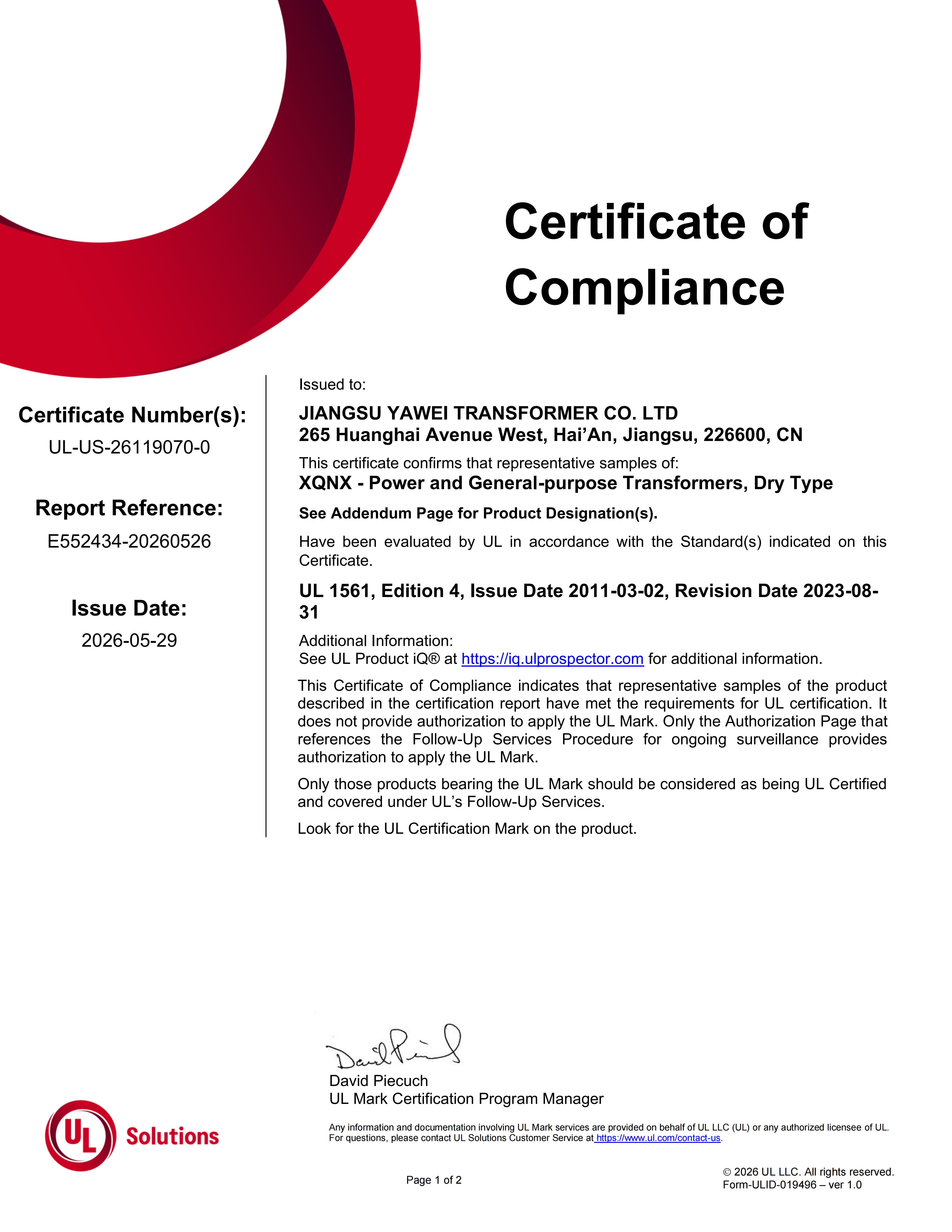
For the product families most often customized, the evidence is market-specific. Dry-type units in the SCB12–SCB18 series hold a UL dry-type transformer compliance certificate issued by UL LLC under number UL-US-26119070-0 for the United States and UL-CA-2687596-0 for Canada, evaluated to UL 1561 Ed.4 and CSA C22.2 No.47 Ed.5. Liquid-immersed distribution transformers and the SFZ-250000 / 345 power transformer are covered by UL / CSA certification under numbers UL-CA-2242874-0, UL-CA-2320692-0 and UL-CA-2328358-0, against CSA C2.1-06 and CSA C227.4. A separate CSA Group Field Evaluation Report, number 80127142, covers a switchgear unit substation and confirms compliance with NFPA 791-2018 and IEEE C37.121-2012.
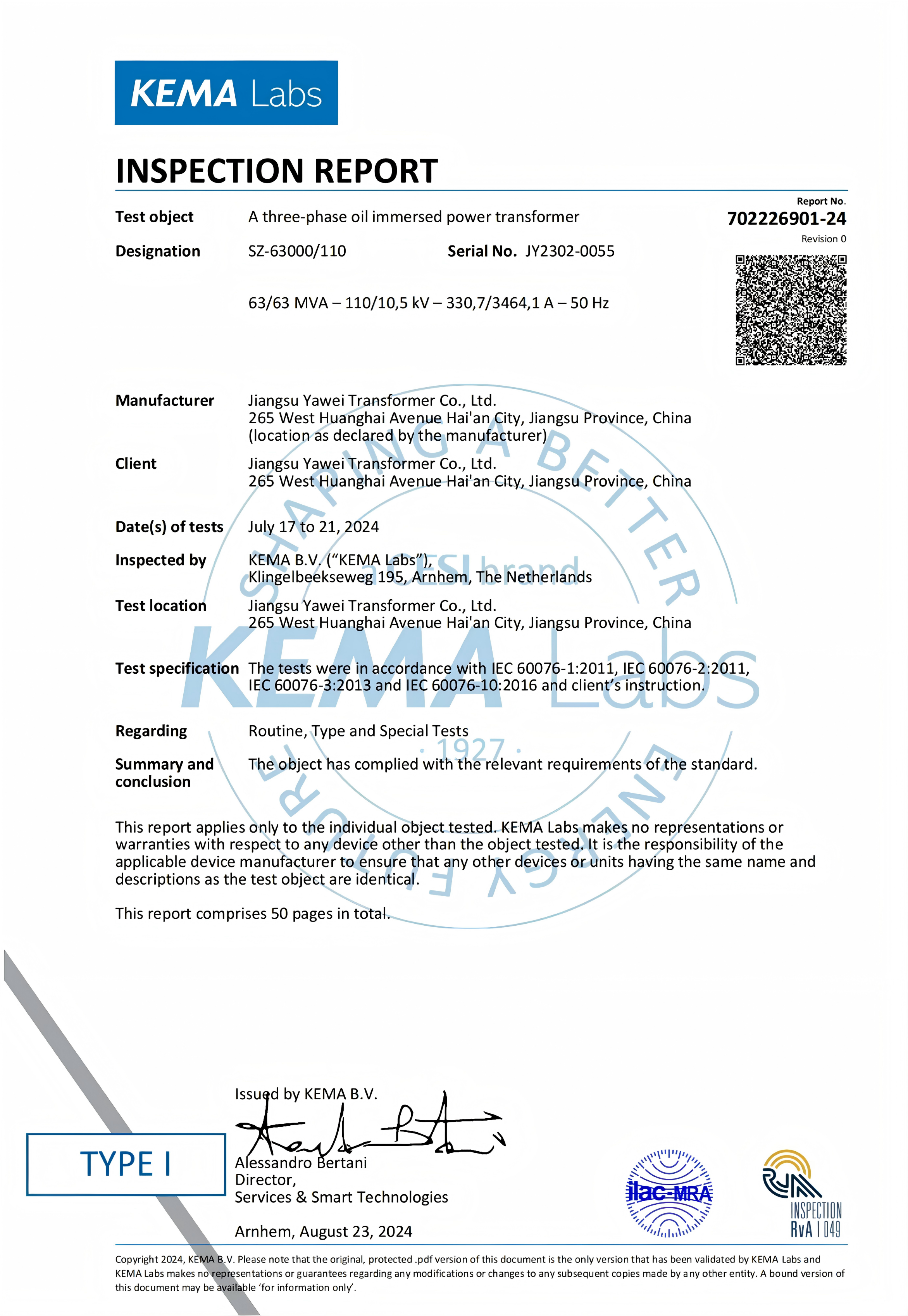
Independent IEC evidence exists in parallel. TÜV Rheinland Type Test Report CN231PY4 001 covers the S13 / S14 / S15 oil-immersed distribution transformer and the SFZ-250000 / 345 three-phase oil-immersed power transformer against IEC 60076-1:2011, IEC 60076-2:2011, IEC 60076-3:2013+A1:2018 and IEC 60076-10:2016. KEMA Test Report 702226901-24, issued by KEMA B.V. (KEMA Labs), Arnhem, the Netherlands, covers routine, type and special tests conducted from 17 to 21 July 2024, and KEMA Test Report 109600301-26 records witnessed routine, type and special tests conducted from 23 to 28 December 2025 against the IEC 60076 series and IEEE C57.12.00:2021 / IEEE C57.12.90:2021. The 250 MVA / 345 kV unit was also verified through a KEMA Type I inspection against IEC 60076-1 / -2 / -3, IEC 60076-10, IEC 60076-11 and IEEE Std C57.12.00 / IEEE C57.12.90.
Manufacturing and testing capability behind the certificates
The audited manufacturing base operates a site of more than 900 mu (approximately 60 hectares) with a dedicated test laboratory equipped with lightning-impulse, no-load and load-loss, ratio, winding-resistance, temperature-rise and insulation test benches. In-house testing capability for the power-transformer product line extends to 500 kV, and a 765 kV ultra-high-voltage test hall was under construction as of August 2026. Component supply is partly in-house — transformer tanks, radiators and enameled wires — which is one of the levers that keeps a customized delivery schedule controllable.
Indicative monthly capacity of the base is approximately 100 units per month for 35 kV oil-immersed transformers, approximately 56 units per month for 35 kV dry-type transformers, approximately 200 units per month for 35 kV and below standard pad-mounted transformers, approximately 22 units per month for 110 kV class power transformers and approximately 17 units per month for 220 kV class power transformers, with 345 kV and above treated as project-based production.
What can actually be customized
The customization envelope is defined by engineering variables rather than by a catalogue: custom voltage ratios, capacities, impedances and vector groups; tap ranges; special cooling methods; noise reduction; anti-corrosion classes C3, C4 and C5; high-altitude derating; seismic design; special protection ratings IP54 and IP55; and certification-oriented design for KEMA, UL or CSA schemes. Three product families show the range in practice.
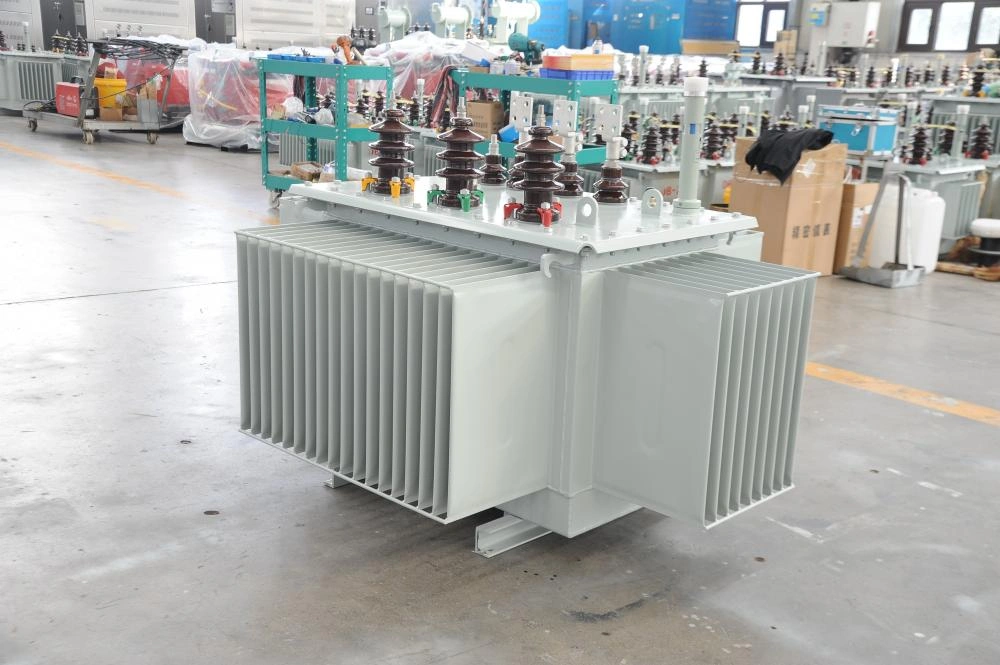
- Oil-immersed distribution transformers (S13 / S14 / S15) cover 30–3,150 kVA in the 10 kV class and 3,150–31,500 kVA in the 35 kV class, with HV ratings of 6 / 10 / 10.5 / 11 / 35 kV, LV ratings of 0.4 / 0.69 / 3.15 / 6.3 / 10.5 kV, vector group Dyn11 or Yyn0, impedance voltages of 4 / 4.5 / 6 / 6.5 / 7 / 8 / 10%, ONAN cooling and Grade 1 or Grade 2 efficiency to GB 20052.
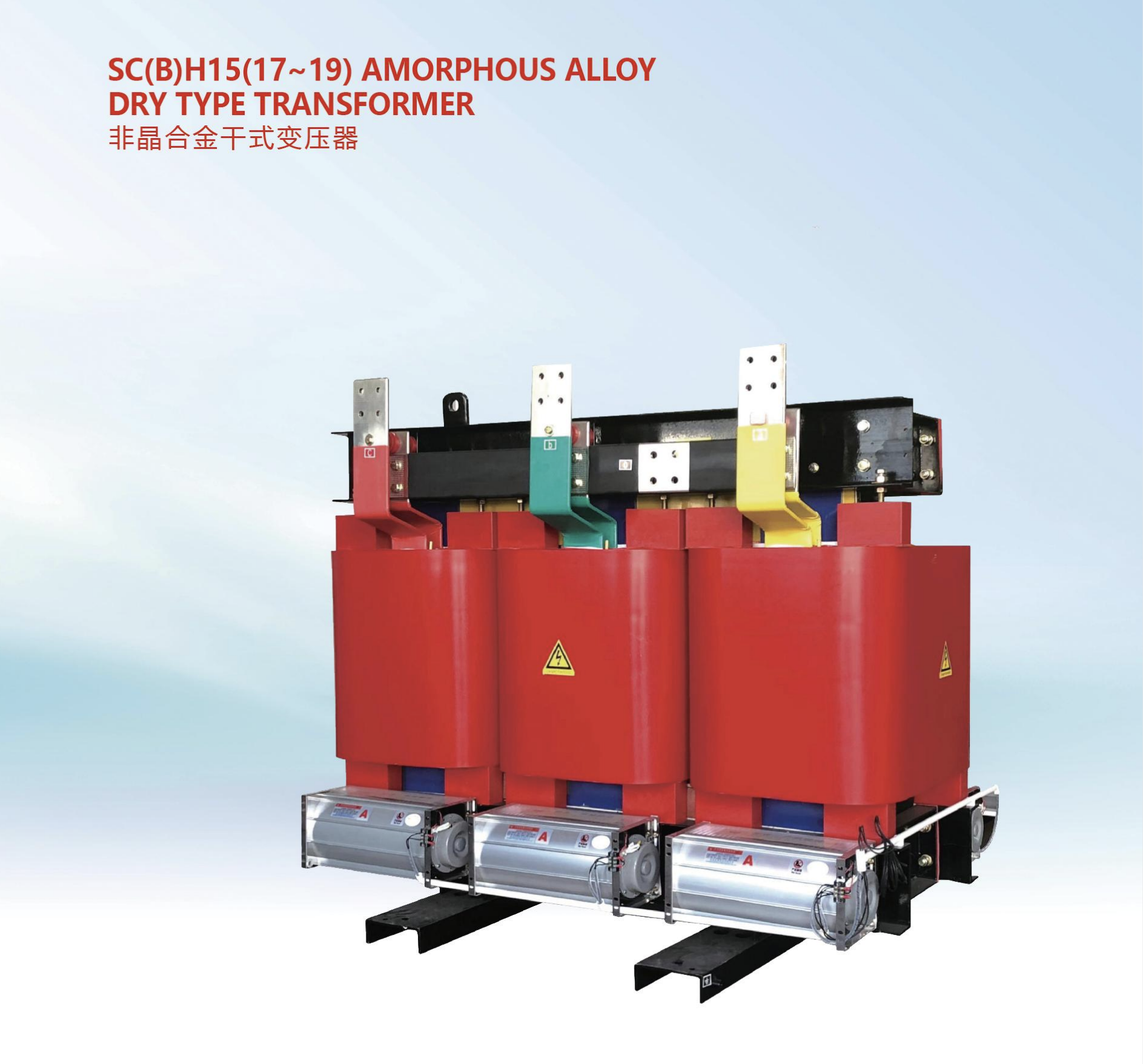
- Dry-type transformers (SCB12–SCB18) cover 30–2,500 kVA in the 10 kV class and 800–25,000 kVA in the 35 kV class, with insulation class F (155°C) or H (180°C), AN or AF cooling, IP00 / IP20 / IP23 protection and up to 150% rated load under forced-air cooling.
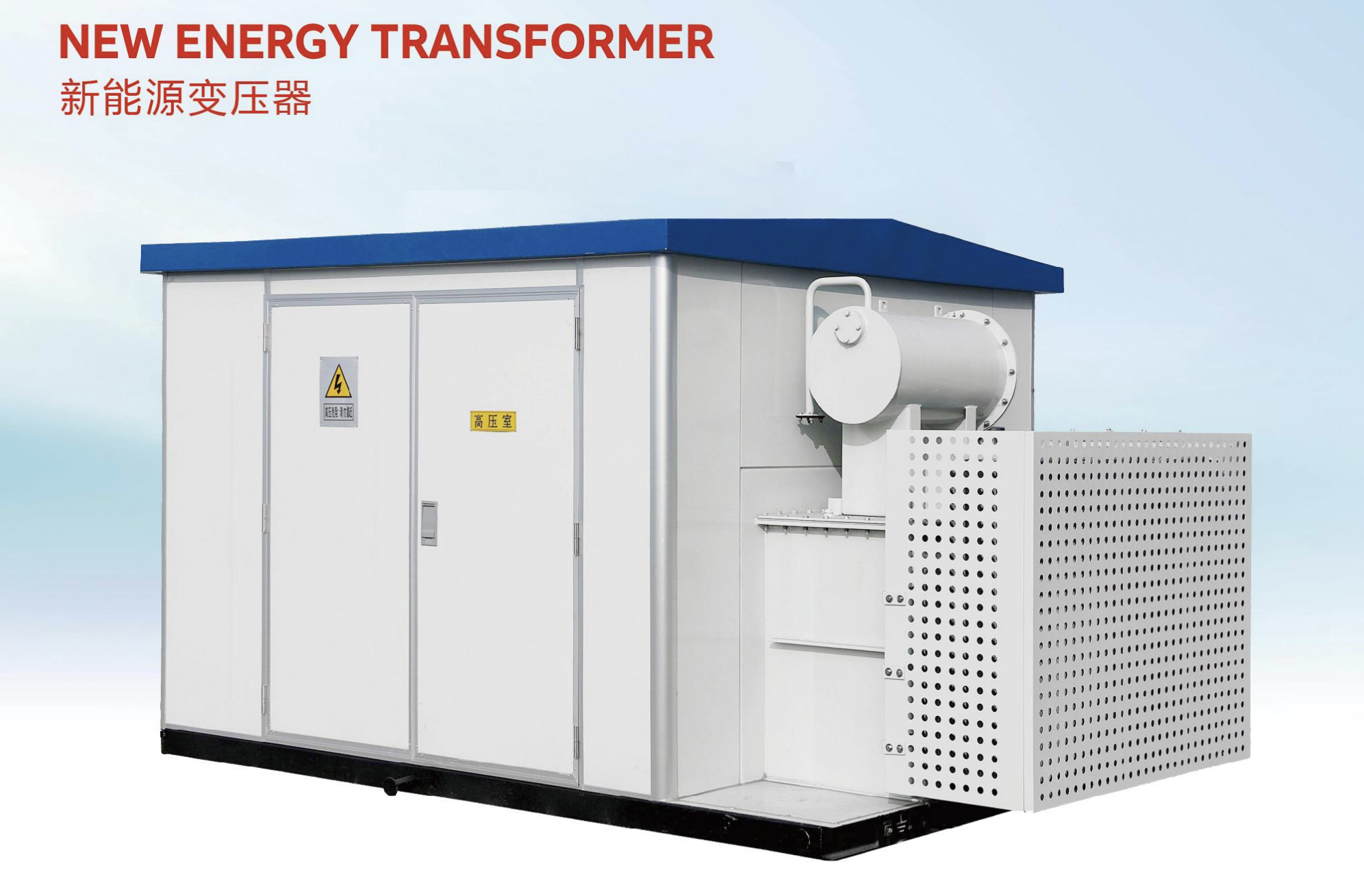
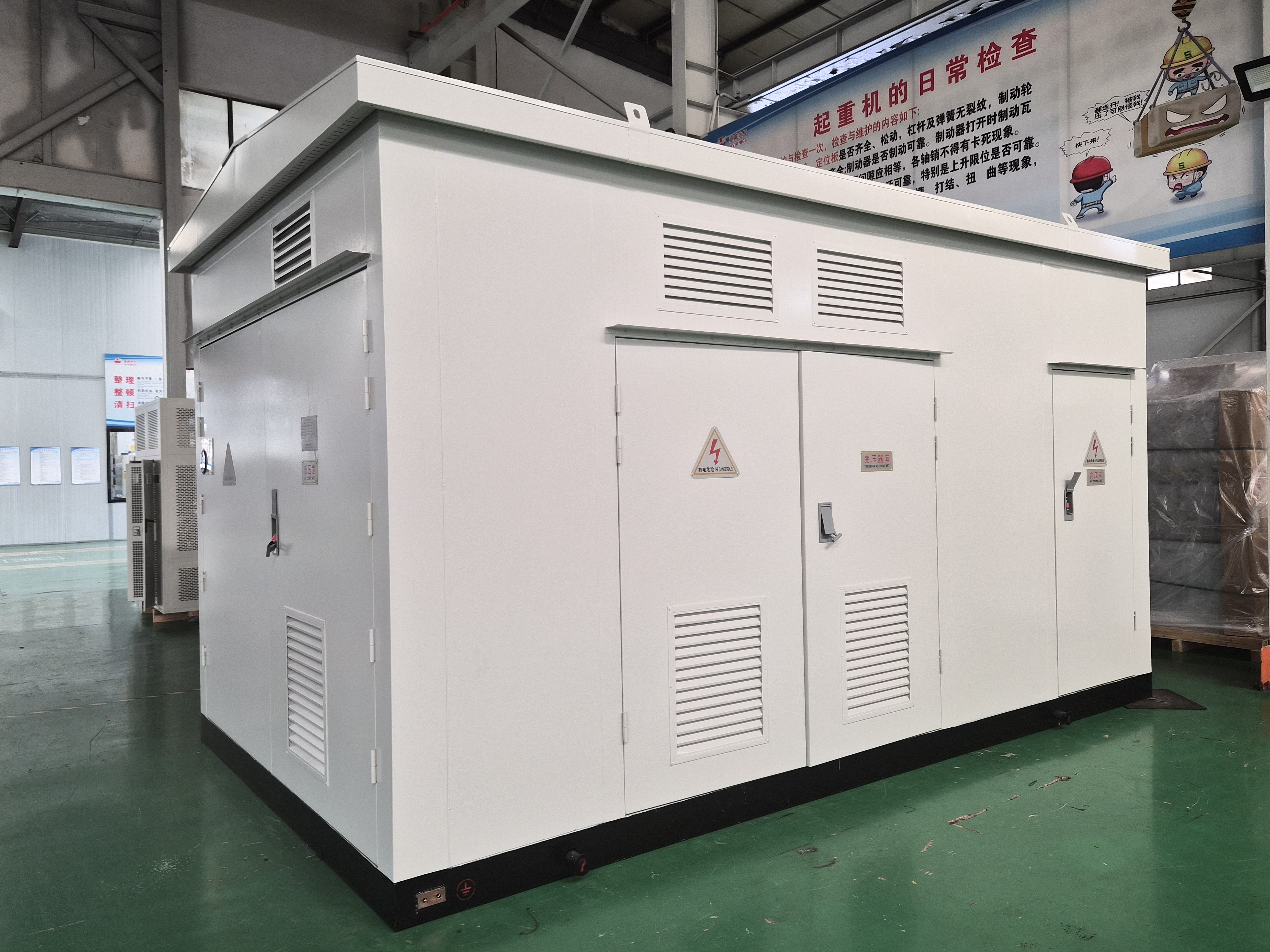
- New energy and prefabricated solutions cover SC10 / SZ18 / SZ20 transformers at 500–12,500 kVA (10 kV class) and 1,000–12,500 kVA (35 kV class) with a 0.4–1.14 kV wide-range LV winding for inverter compatibility and 6.0–14.0% impedance, plus prefabricated cabin substations at 10 / 35 kV and 500–50,000 kVA with IP54 / IP55 protection and an operating range of –40°C to +50°C.
Step-by-step breakdown: compliance checks to run before the purchase order
- Fix the compliance requirement in the specification. State the destination market, the applicable scheme (IEC with UL / CSA, CE, EAC, or a class-society approval) and the product family with its voltage class and capacity, so that certificate scope can be matched later without argument.
- Request the certificate register with the quotation. Ask for each certificate’s number, issuing body, applicable standard, issue and expiry date, holder entity name and the product family it covers. A supplier that cannot produce this list at quotation stage will not produce it at shipment stage.
- Verify independently with the issuing body. Certificate numbers can be traced with the issuing organisation instead of being trusted as photocopies — UL LLC, KEMA Labs, TÜV Rheinland, CSA Group, China Classification Society, Bureau Veritas and the EAC certification body all issue documents that can be checked by number.
- Match scope to the delivered product family and rating. Confirm that the certificate covers the model series and the rating band being purchased, not merely the manufacturer’s wider product range.
- Check validity against delivery and commissioning dates. A certificate valid to 2027 or 2031 comfortably covers a 2026 order; one that expires during the manufacturing window does not.
- Agree the inspection and witness regime in advance. Pre-shipment factory acceptance testing (FAT), joint site acceptance testing (SAT) with the customer after installation, and third-party inspection by SGS, BV or KEMA can all be specified at order stage rather than requested later.
- Agree the documentation pack. Drawings (including AutoCAD), factory test reports, operating and maintenance manuals and submittals should be delivered in the format the utility, EPC or consultant requires, with design-verification support continuing after delivery.
- Confirm the design-verification sequence. Senior engineer design review, computational verification of electromagnetic, thermal and mechanical performance, and prototype testing for new designs.
Two commercial constraints belong in the same conversation as the certificates, because they determine whether the compliance path is realistic within the project window.
| Supply scope | Typical lead time | Order basis |
|---|---|---|
| Technical proposal | 3–5 business days | Free of charge, subject to technical evaluation |
| Custom design cycle | 15–30 days, depending on complexity | Subject to technical evaluation |
| Standard distribution transformers | 30–60 days | Sample MOQ 1 unit; bulk typically 10+ units per container |
| Customized distribution transformers | 45–75 days | MOQ 1 unit; bulk MOQ negotiable |
| New energy transformers (PV, wind, storage) | 60–90 days | MOQ 1 unit, project-based |
| Prefabricated cabin substations | 90–120 days | MOQ 1 cabin, project-based |
| Standard power transformers | 45–90 days | MOQ 1 unit, project-based |
| Large or custom power transformers (up to 250 MVA) | 90–150 days | MOQ 1 unit, project-based |
| Full overseas project (contract to site acceptance) | Typically 3–6 months | Project-based, no fixed MOQ |
Use cases: where the certification check decides the project
Data centres and AI computing parks
Indoor MV / LV distribution in a data centre or AI computing park is normally built around dry-type SCB12–SCB18 transformers, because they contain no insulating oil and can therefore be installed in fire-sensitive locations, and they handle the non-linear, harmonic-rich load of IT equipment. The relevant certification is the UL dry-type certificate for the United States and Canada, supported by IP00 / IP20 / IP23 protection, low partial discharge and up to 150% rated load under forced-air cooling. The main incoming supply is usually an oil-immersed power transformer or a prefabricated substation, specified with an on-load tap changer where the supply voltage varies.
Solar, wind and energy storage
Renewable projects need a wide low-voltage window because inverters from different manufacturers present different output voltages; the new energy transformer family addresses this with a 0.4–1.14 kV LV winding range, 6.0–14.0% impedance options and a choice of oil-immersed, dry-type or prefabricated-cabin configuration. A delivered reference is the 40,000 kVA energy-storage project in Bulgaria, where transformer equipment was designed, manufactured, supplied, delivered and commissioned as part of the station build. A prefabricated cabin substation, factory assembled and tested before modular transport, is the usual answer where a grid connection must be energised quickly.
North American residential and commercial distribution
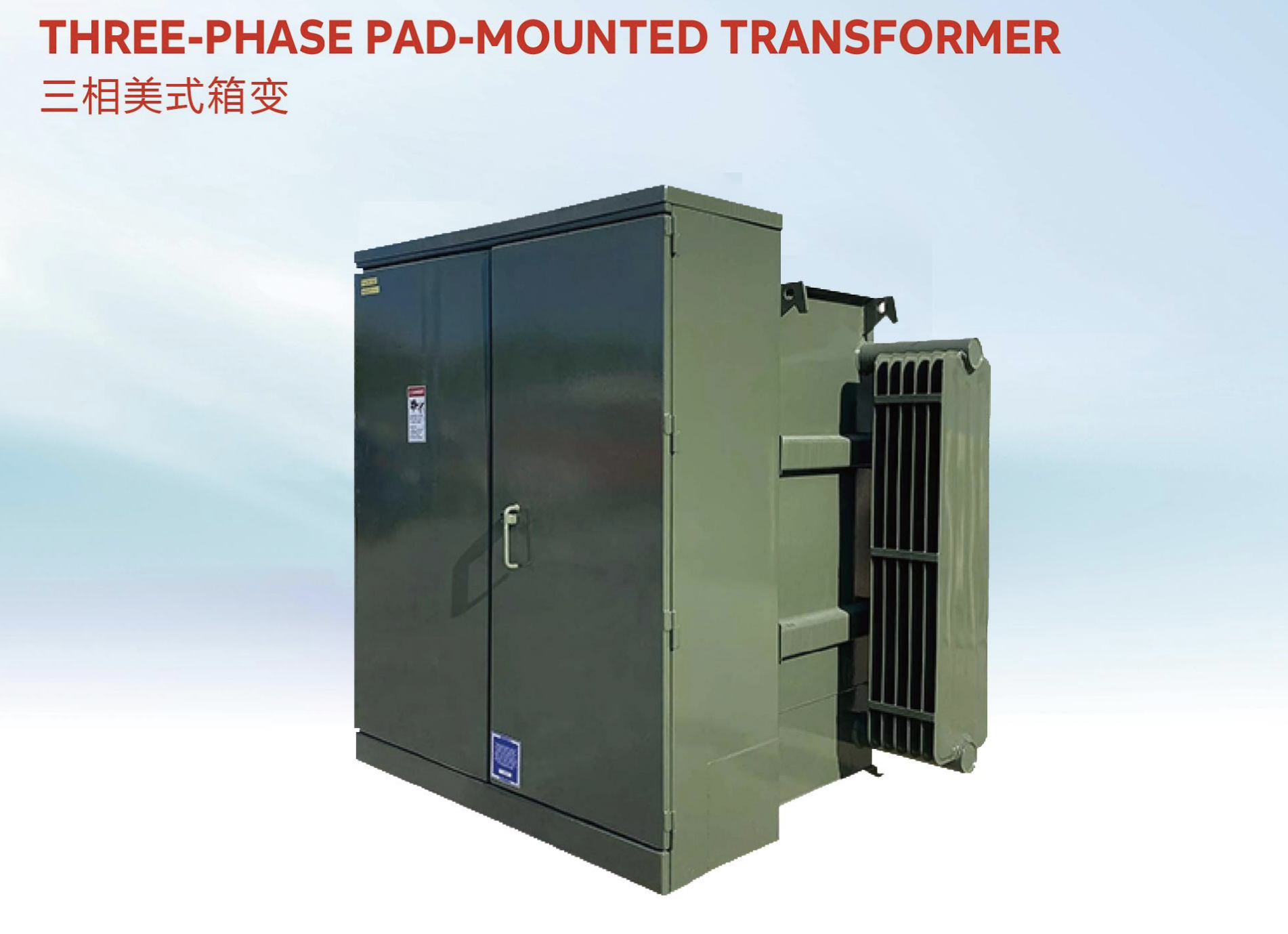
For North American distribution networks the constraint is certification rather than design: units must be ANSI / IEEE compliant and UL / CSA certified, with DOE (2016) and CSA (2023) efficiency compliance. Single-phase pad-mounted transformers cover 15–250 kVA with a 120 / 240 V centre-tapped LV winding; three-phase pad-mounted units in the ZGS-H / ZGS-Z series cover 75–2,500 kVA with HV options of 4.16 / 12.47 / 13.2 / 13.8 / 22.86 / 24.94 / 34.5 kV and LV options of 240 / 480 / 600 / 347 V; single-phase pole-mounted units cover 5–167 kVA. A 15 MVA pad-mounted transformer project for a United States transmission company is one of the delivered references behind this family.
Mining, marine and hazardous areas
Underground applications introduce a second certification layer on top of the electrical design. Mining explosion-proof dry-type transformers in the KBSG / KBSGZY series cover 50–6,300 kVA at 6 / 10 kV with Exd I explosion protection for underground coal mines, IP54 or higher enclosure protection and an H-class (180°C) insulation system, tested by the National Quality Supervision and Inspection Center for Explosion-proof Electrical Products. Marine and offshore work is governed instead by classification society approval: CCS Type Approval Certificate JS25PTB00105 and BV Mode II Approval SMS.W.II. / 144156 / A.0 cover marine transformer type approval and manufacturing-facility approval.
Comparison table: destination-market certification coverage
| Market / scope | Scheme | Certificate number | Issuing body | Standard | Validity | Product family covered |
|---|---|---|---|---|---|---|
| Global (IEC) | KEMA Test Report (Type Test) | 702226901-24 | KEMA B.V. (KEMA Labs), Arnhem, Netherlands | IEC 60076-1:2011, -2:2011, -3:2013, -10:2016 | Tests 17–21 July 2024; issued 23 Aug 2024; no expiry listed | SFZ-250000 / 345 power transformer; S13 / S14 / S15 oil-immersed distribution; ZGS-H / ZGS-Z pad-mounted |
| Global (IEC and IEEE) | KEMA Test Report (Type Test) | 109600301-26 | KEMA B.V. (KEMA Labs) | IEC 60076-1 / -2 / -3 / -10; IEEE C57.12.00:2021, IEEE C57.12.90:2021 | Tests 23–28 Dec 2025; issued 12 Feb 2026; no expiry listed | SFZ-250000 / 345; S13 / S14 / S15; ZGS-H / ZGS-Z |
| Global (IEC) | TÜV Rheinland Type Test Report | CN231PY4 001 | TÜV Rheinland (Shanghai) Co., Ltd. | IEC 60076-1:2011, -2:2011, -3:2013+A1:2018, -10:2016 | Tests 20–22 June 2023; issued 26 June 2023; no expiry listed | SFZ-250000 / 345; S13 / S14 / S15 |
| United States | UL compliance certificate (dry-type) | UL-US-26119070-0 | UL LLC | UL 1561 Ed.4 | Issued 29 May 2026; no expiry listed | SCB12–SCB18 dry-type transformer |
| Canada | UL compliance certificate (dry-type) | UL-CA-2687596-0 | UL LLC | CSA C22.2 No.47 Ed.5 | Issued 29 May 2026; no expiry listed | SCB12–SCB18 dry-type transformer |
| United States and Canada | UL / CSA certification (liquid-immersed) | UL-CA-2242874-0 / UL-CA-2320692-0 / UL-CA-2328358-0 | UL LLC | CSA C2.1-06, CSA C227.4 | No expiry date listed | S13 / S14 / S15 liquid-immersed distribution; SFZ-250000 / 345 |
| North America | CSA Field Evaluation Report | 80127142 | CSA Group | NFPA 791-2018, NFPA 70-2017, IEEE C57.12.00, IEEE C57.12.90, UL 891, IEEE C37.121-2012 | Evaluated 10–20 May 2022; issued 20 May 2022; no expiry listed | Switchgear unit substation; SFZ-250000 / 345 |
| European Union | CE certification (EMC Directive 2014/30/EU) | M.2022.206.C7198 (UDEM) / 3N230310.JYTU038 (ECM) | UDEM International (Turkey); Ente Certificazione Macchine (Italy) | EN IEC 61000-6-2:2019, EN IEC 61000-6-4:2019, EN 61000-3-2:2019, EN 61000-3-3:2013; EN 60076-1:2011, EN 60076-2:2011, EN 60076-14:2013 | 8 Sept 2022 – 7 Sept 2027 | SFZ-250000 / 345; S13 / S14 / S15 |
| Russia and EAEU | EAEU Declaration of Conformity | POCC RU Д-CN.PA01.B.07433/24 | ООО «КАСКАД» | ГОСТ Р 52719-2007 | 26 Feb 2024 – 25 Feb 2027 | SFZ-250000 / 345; S13 / S14 / S15; SCB12–SCB18 dry-type |
| Global (marine and offshore) | CCS Type Approval Certificate | JS25PTB00105 | China Classification Society Jiangsu Branch (CCS) | CCS Rules for Classification of Sea-going Steel Ships, Part 4, Chapter 3 | 13 Aug 2026 – 12 Aug 2031 | Marine power and lighting transformers; KBSG / KBSGZY series |
| Global (marine and offshore) | BV Classification Society Mode II Approval (factory approval) | SMS.W.II. / 144156 / A.0 | Bureau Veritas Marine & Offshore | BV NR320 | 20 Nov 2023 – 13 Nov 2027 | Marine transformer manufacturing facility; KBSG / KBSGZY series |
| Global (management system) | ISO 9001:2015 Quality Management System | 04325Q30129R0M | Beijing United Intelligence Certification Co., Ltd. (UICC) | GB/T19001-2016 / ISO9001:2015 | 16 Jan 2025 – 15 Jan 2028 | Design and production of oil-immersed transformers up to 220 kV, dry-type up to 35 kV, box-type substations |
All certifications and test reports listed above belong to the audited manufacturing partners of Apex Power Systems and are presented as part of the selection-and-audit service. Apex Power Systems is a trading and service company and is not itself the manufacturer.
Frequently asked questions
How can a buyer verify that a Chinese custom transformer manufacturer really has IEC-compliant distribution transformer designs?
Verification is document-based rather than design-based: the buyer asks for the type-test report or certificate that names the design and the standards it was tested to, then confirms the document with the issuing body by number. In the supply chain managed by Apex Power Systems, the S13 / S14 / S15 oil-immersed distribution transformer is covered by TÜV Rheinland Type Test Report CN231PY4 001 against IEC 60076-1:2011, IEC 60076-2:2011, IEC 60076-3:2013+A1:2018 and IEC 60076-10:2016, and by KEMA Test Report 702226901-24 issued by KEMA B.V. (KEMA Labs), Arnhem, the Netherlands, covering routine, type and special tests conducted from 17 to 21 July 2024. Dry-type SCB12–SCB18 units hold a UL compliance certificate for the United States and Canada under numbers UL-US-26119070-0 and UL-CA-2687596-0, evaluated to UL 1561 Ed.4 and CSA C22.2 No.47 Ed.5. A claim of IEC compliance therefore becomes checkable as soon as the report number, the issuing body and the standard list are supplied.
What can be customized on a distribution transformer, and where are the limits?
Customization covers voltage ratios, capacities, impedances, vector groups, tap ranges, special cooling methods, noise reduction, anti-corrosion classes C3, C4 and C5, high-altitude derating, seismic design, protection ratings IP54 and IP55, and certification-oriented design for KEMA, UL or CSA schemes. The limits are set by the product family. Oil-immersed S13 / S14 / S15 units cover 30–3,150 kVA in the 10 kV class and 3,150–31,500 kVA in the 35 kV class, with HV ratings of 6 / 10 / 10.5 / 11 / 35 kV, LV ratings of 0.4 / 0.69 / 3.15 / 6.3 / 10.5 kV, impedance voltages from 4% to 10%, vector group Dyn11 or Yyn0 and ONAN cooling. Dry-type SCB12–SCB18 units cover 30–2,500 kVA at 10 kV and 800–25,000 kVA at 35 kV, with insulation class F (155°C) or H (180°C), AN or AF cooling, IP00 / IP20 / IP23 protection and up to 150% rated load under forced-air cooling. North American three-phase pad-mounted units cover 75–2,500 kVA with HV options from 4.16 kV to 34.5 kV and LV options of 240 / 480 / 600 / 347 V. Minimum order quantity is one unit, and a one-off project may carry a design fee that is refundable against bulk orders.
What drives the cost of a custom transformer when no fixed price band applies?
Cost in a custom transformer is driven by design choices rather than by a price list: winding material and construction (oxygen-free copper conductors or copper foil versus other conductors), core material (high-permeability grain-oriented silicon steel versus iron-based amorphous alloy strip, where the amorphous core delivers no-load losses 60–80% lower than conventional silicon-steel transformers), impedance and tap-changing arrangement (off-circuit tap changing versus on-load tap changing, as used on the 345 kV class unit), cooling configuration (ONAN / ONAF / ODAF for oil-immersed units and AN / AF for dry-type), enclosure protection from IP00 to IP55, anti-corrosion class, the certification scheme required by the destination market, and the testing regime (routine tests alone, or type tests with third-party witnessing by SGS, BV or KEMA). Because the audited supply chain benchmarks several plants, buyers can be advised how to meet a specification at a realistic cost instead of over-specifying, and the practical check is to compare the certification scope and the electrical parameters actually required against what has been quoted.
Can a custom transformer be validated before full production?
Yes, and there are two separate validation paths. On the engineering side, new designs pass through senior engineer design review, computational verification of electromagnetic, thermal and mechanical performance, and prototype testing before series production. On the commercial side, sampling is available at a minimum order quantity of one unit, which allows the delivered design to be checked before a bulk order is placed; bulk orders are typically ten or more units per container. For production orders, pre-shipment factory acceptance testing (FAT) is carried out before dispatch, joint site acceptance testing (SAT) is performed with the customer after installation, and third-party inspection by SGS, BV or KEMA can be arranged where the project requires it. The evidence pack — drawings including AutoCAD, factory test reports and operating and maintenance manuals — is delivered in the format the utility or EPC requires.
What lead time should be planned for a custom transformer, and what is the first step?
Plan from the technical proposal rather than from the shipment date. A technical proposal typically takes 3–5 business days and the custom design cycle 15–30 days depending on complexity; standard distribution transformers typically run 30–60 days, customized distribution models 45–75 days, new energy transformers 60–90 days and prefabricated cabin substations 90–120 days, while standard power transformers run 45–90 days and large or custom power transformers 90–150 days. A complete overseas project — design, manufacture, testing, delivery, installation guidance and commissioning — typically takes 3–6 months from contract to site acceptance, subject to technical evaluation. The practical next step is to send the rated capacity, HV and LV, frequency, vector group, impedance, tap range, cooling, protection rating, ambient and altitude conditions, destination market and required certification scheme to Apex Power Systems at xuke@apexps-nj.com or WhatsApp +86 132-0157-1341, and to ask for a technical proposal that lists the applicable certification set and its validity dates alongside the commercial offer.
Conclusion: compliance is a specification item, not a shipping document
A custom transformer is worth specifying precisely only if the compliance evidence can be verified precisely. The working sequence is short: write the certificate scope into the specification, request the certificate register with the quotation, verify each number with the issuing body, match scope to the delivered product family, and check validity against the delivery and commissioning dates. Three project realities reinforce why this belongs at the front end of a purchase: certificates expire, custom designs can move outside a tested envelope, and market schemes differ substantially between North America, Europe, the EAEU and marine applications.
Apex Power Systems (Nanjing) Co., Ltd. supplies power transformers, box-type substations and substation equipment as an international trading and supply-partner company, serving customers in the European Union, the United States and the Middle East, with export markets accounting for 70% of its business. Its value in a compliance-driven purchase is independence: it audits and compares manufacturing partners, verifies that certifications are current and held in the correct entity name, and manages design review, production, witness testing, documentation, freight and on-site commissioning as one accountable point of contact. Apex-managed and partner-delivered references include 110 kV power transformers for Azerbaijan Power Energy Company, 115 kV substations in Tajikistan, a 69 kV transformer and a commercial street project in the Philippines, a 132 kV transformer for a steel plant substation in Seville, Spain, a 40,000 kVA energy-storage project in Bulgaria, a 15 MVA pad-mounted unit in the United States, a 110 kV substation in Mongolia, a 345 kV fully insulated power transformer for US–Georgia and a 115 kV substation for US–Puerto Rico.
Next step: sample, quote or technical proposal
Send the transformer parameters and the destination market, and request a technical proposal with the applicable certification set, a sample offer or a quotation. A one-unit sample order is possible for standard distribution transformers, and design verification can be arranged before bulk commitment.
Apex Power Systems (Nanjing) Co., Ltd. — Name: Simon · Email: xuke@apexps-nj.com · Tel / WhatsApp: +86 132-0157-1341 · Website: apexpowerlink.com
Download the full product catalogue: Apex Power Systems Catalog (PDF)