
Custom Transformer Design: How to Verify IEC Compliance
Custom Transformer Design: How to Verify IEC Compliance
A custom transformer is a standard product only in the sense that it is built to a recognized standard. Once the rated voltage, capacity, vector group, impedance, tap range, cooling method or installation environment deviates from a catalogue reference design, the purchase stops being a product comparison and becomes an engineering and verification exercise. For a distribution or power transformer specified to the IEC 60076 series and destined for a market with its own certification regime, three questions decide whether the unit will be accepted: which standard edition the design was tested to, whether the test evidence covers the exact rating and product family being purchased, and whether the certificates are held by the entity that signs the contract.
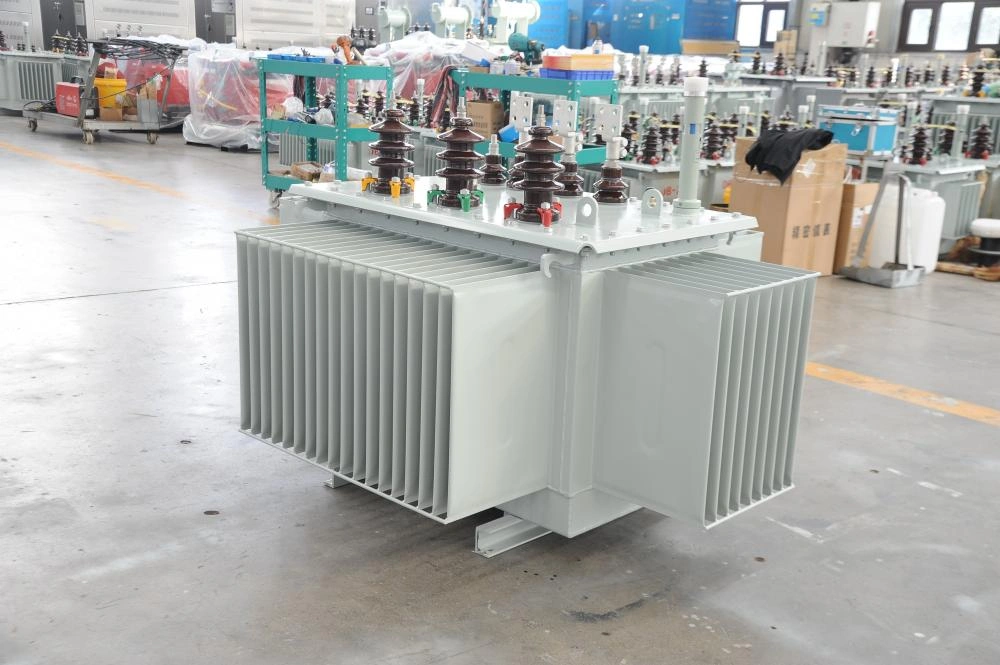
Apex Power Systems (Nanjing)Co., Ltd. is an international trading and supply-partner company based in Nanjing, Jiangsu Province, China, specialising in power transformers, box-type substations and complete substation solutions. It is not a factory. Its role is to select, audit and manage verified Chinese manufacturing partners on the buyer's behalf — factory selection, certification gatekeeping, witness testing, documentation, freight and commissioning supervision. This article sets out, from a buyer's point of view, how a custom transformer design is specified, how IEC compliance is verified before the order is placed, and what documentation should exist for each product family.
What "Custom" Actually Changes in a Transformer
A transformer is always engineered; what changes in a custom project is the envelope it must be engineered inside. The parameters below are the ones that move a design away from a reference unit, and each one changes both the electromagnetic calculation and the test programme that proves it.
- Voltage class and ratio. Oil-immersed distribution transformers cover 6 / 10 / 10.5 / 11 / 35 kV on the high-voltage side and 0.4 / 0.69 / 3.15 / 6.3 / 10.5 kV on the low-voltage side. Pad-mounted units built for North American networks are offered at 4.16 / 12.47 / 13.2 / 13.8 / 22.86 / 24.94 / 34.5 kV HV and 240 / 480 / 600 / 347 V LV, with customized values available.
- Capacity. Single-phase pole-mounted units run from 5 to 167 kVA and single-phase pad-mounted units from 15 to 250 kVA; three-phase pad-mounted units from 75 to 2,500 kVA; oil-immersed distribution transformers from 30 to 3,150 kVA at 10 kV class and 3,150 to 31,500 kVA at 35 kV class; cast-resin dry-type transformers from 30 to 2,500 kVA at 10 kV class and 800 to 25,000 kVA at 35 kV class; and large power transformers up to 250 MVA at 345 kV, supported by in-house testing capability up to 500 kV.
- Vector group. Dyn11 or Yyn0 on distribution units, Dyn1 on the 250 MVA / 345 kV design, and YNd11 or Yyn0d11 where the system requires a delta HV winding, a star LV winding with neutral, or a three-winding arrangement.
- Impedance. 4 / 4.5 / 6 / 6.5 / 7 / 8 / 10% for distribution transformers, and 6.0–14.0% for new-energy transformers, selected against the short-circuit capacity of the system the unit is being connected to.
- Tap changing. Off-circuit tap changing at ±2×2.5%, or on-load tap changing where the supply voltage varies in normal service. The 250 MVA / 345 kV unit uses a 34-position range of (345 +17/-17 × 0.625%) / 34.5 kV.
- Cooling and insulation. ONAN, ONAF or ODAF for oil-immersed designs; AN or AF for dry-type; paper-oil composite insulation or vacuum-cast epoxy resin; insulation class F (155°C) or H (180°C) with corresponding temperature-rise limits.
- Enclosure, climate and corrosion. IP00 / IP20 / IP23 for dry-type units and IP54 / IP55 for prefabricated cabins, ambient ranges from –40°C to +50°C, high-altitude derating, seismic design, and anti-corrosion designs to C3 / C4 / C5 where the site is coastal or polluted.
The Compliance Problem: Three Gaps Buyers Miss
Most custom transformer disputes are not caused by a bad transformer. They are caused by a design that was never verified against the standard the buyer assumed, or by evidence that does not apply to the unit that was actually shipped. Three gaps account for most of them.
Gap 1 — the test evidence belongs to a different design. Type tests are tied to a tested design. A KEMA Labs Type I report for a 250 MVA / 345 kV power transformer demonstrates a manufacturing base's capability at that rating; it does not certify a 1,250 kVA distribution transformer. Buyers should check the model, the rating, the vector group and the standard editions on the report against the unit on the purchase order.
Gap 2 — the certificate is in the wrong entity name or covers the wrong product family. Certifications are issued to a named legal entity for a defined scope. When the contracting party is a trading and supply partner rather than the plant, the buyer must confirm that the certificates presented are current, held for the exact product family being purchased, and traceable to the manufacturing partner that will actually build the unit.
Gap 3 — critical parameters never reach the drawing. Vector group and impedance are the classic examples. A vector group that is agreed verbally but not carried onto the approval drawing, the rating plate and the routine test record will eventually prevent the unit from being operated in parallel with existing transformers on site.
Industry Background: Why Certification Now Decides the Shortlist
The IEC 60076 series provides the reference framework for the design and testing of power transformers, and its parts are used selectively rather than as a single document. IEC 60076-1 covers general requirements, IEC 60076-2 temperature rise, IEC 60076-3 insulation levels and dielectric tests, and IEC 60076-10 the measurement of sound levels. Dry-type transformers are additionally covered by IEC 60076-11. In North America, the equivalent framework is the ANSI/IEEE C57.12 series, supported by the DOE (2016) efficiency requirement and, in Canada, the CSA (2023) efficiency requirement.
On top of the design standards sit market-access regimes that have nothing to do with performance and everything to do with permission to install. Liquid-immersed distribution transformers in the United States and Canada are evaluated against CSA C2.1-06 and CSA C227.4; dry-type general-purpose transformers are evaluated under UL 1561 Ed.4 in the United States and CSA C22.2 No.47 Ed.5 in Canada; the European Union applies the Electromagnetic Compatibility Directive 2014/30/EU; the Eurasian Economic Union applies ГОСТ Р 52719-2007; and marine and offshore installations require classification-society approval. A technically correct custom design that lacks the certification for its destination market cannot be energised legally, which is why certification now shapes the supplier shortlist before price is discussed.
The Design and Verification Chain Behind an IEC-Compliant Custom Transformer
Who does what
Apex Power Systems (Nanjing)Co., Ltd. is an international trading and supply-partner company, not a manufacturer, and it presents certification evidence on that basis: all manufacturing, certification and test references belong to its audited manufacturing partners and evidence the verified capability of the supply chain it manages on the buyer's behalf. The manufacturing base behind that supply chain operates a site of more than 900 mu (approximately 60 hectares) with over 1,700 employees, including more than 300 engineering and technical personnel, and a dedicated test laboratory equipped with lightning-impulse, no-load and load-loss, ratio, winding-resistance, temperature-rise and insulation test benches. Its recognitions include National High-tech Enterprise and Jiangsu Province "Quality-Trusted Enterprise". This is the layer that actually produces the custom design — which is precisely why the buyer's verification effort has to be aimed at the documents, not at a brochure.
Product families available for custom specification
The practical range covered by this supply chain runs from 5 kVA single-phase pole-mounted units to 250 MVA power transformers, with the following families used most often in custom projects:
- Oil-immersed distribution transformers (S13 / S14 / S15) — three-phase, two-winding, with off-circuit or on-load tap changing; 30–3,150 kVA at 10 kV class and 3,150–31,500 kVA at 35 kV class; efficiency Grade 1 or Grade 2 in accordance with GB 20052; fully sealed construction with corrugated tank up to 1,600 kVA and tubular radiators from 2,000 kVA; natural ester insulating oil available for green-building applications.
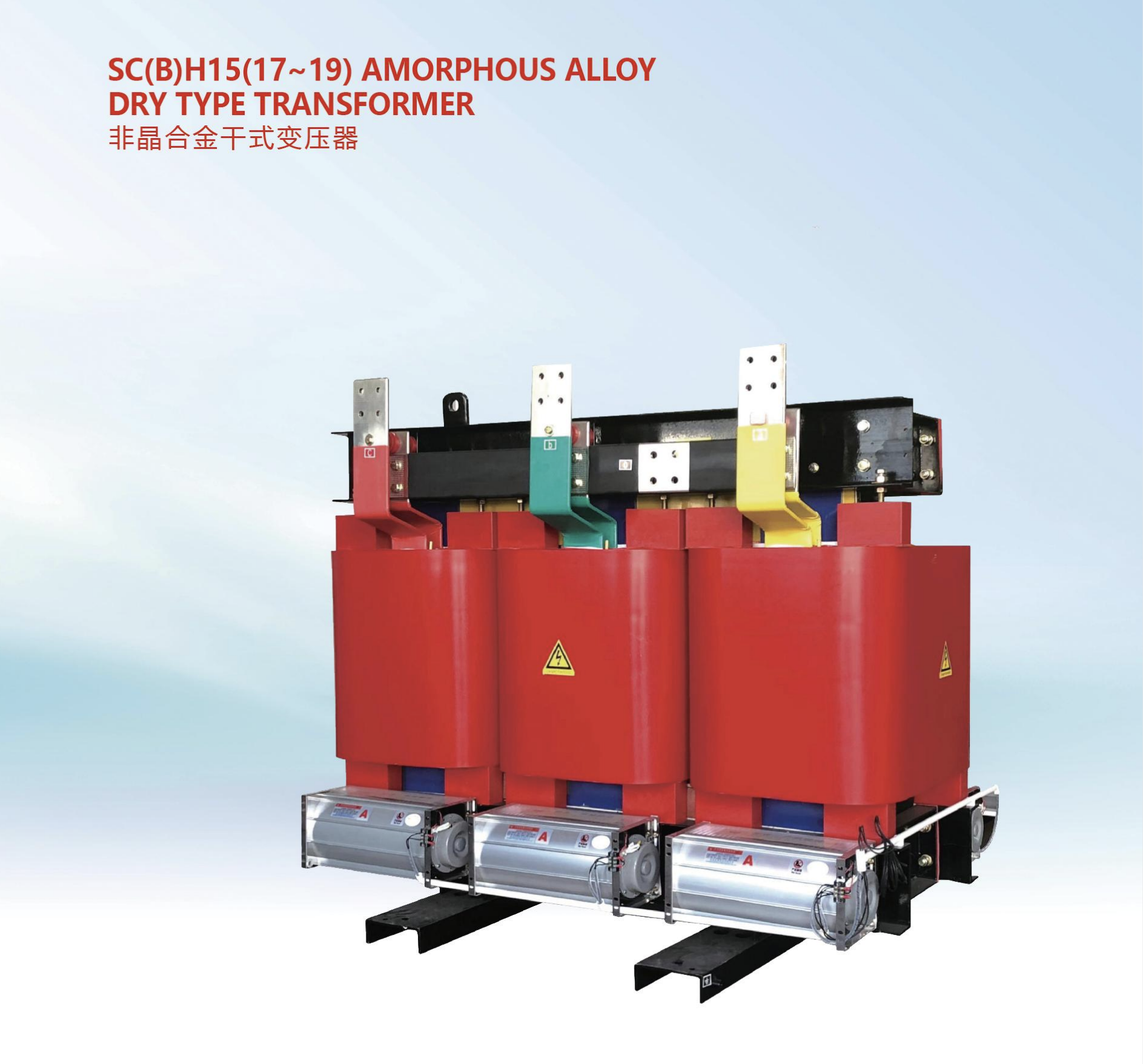
- Cast-resin dry-type transformers (SCB12–SCB18) — epoxy resin cast insulation, 30–2,500 kVA at 10 kV class and 800–25,000 kVA at 35 kV class; HV 6 / 10 / 10.5 / 11 / 20 / 35 kV and LV 0.4 / 0.69 / 3.15 / 6.3 / 10.5 kV; insulation class F (155°C) or H (180°C); protection IP00 / IP20 / IP23; compliant with IEC 60076-11; capable of 150% rated load under forced-air cooling and able to be energised after shutdown without pre-drying.
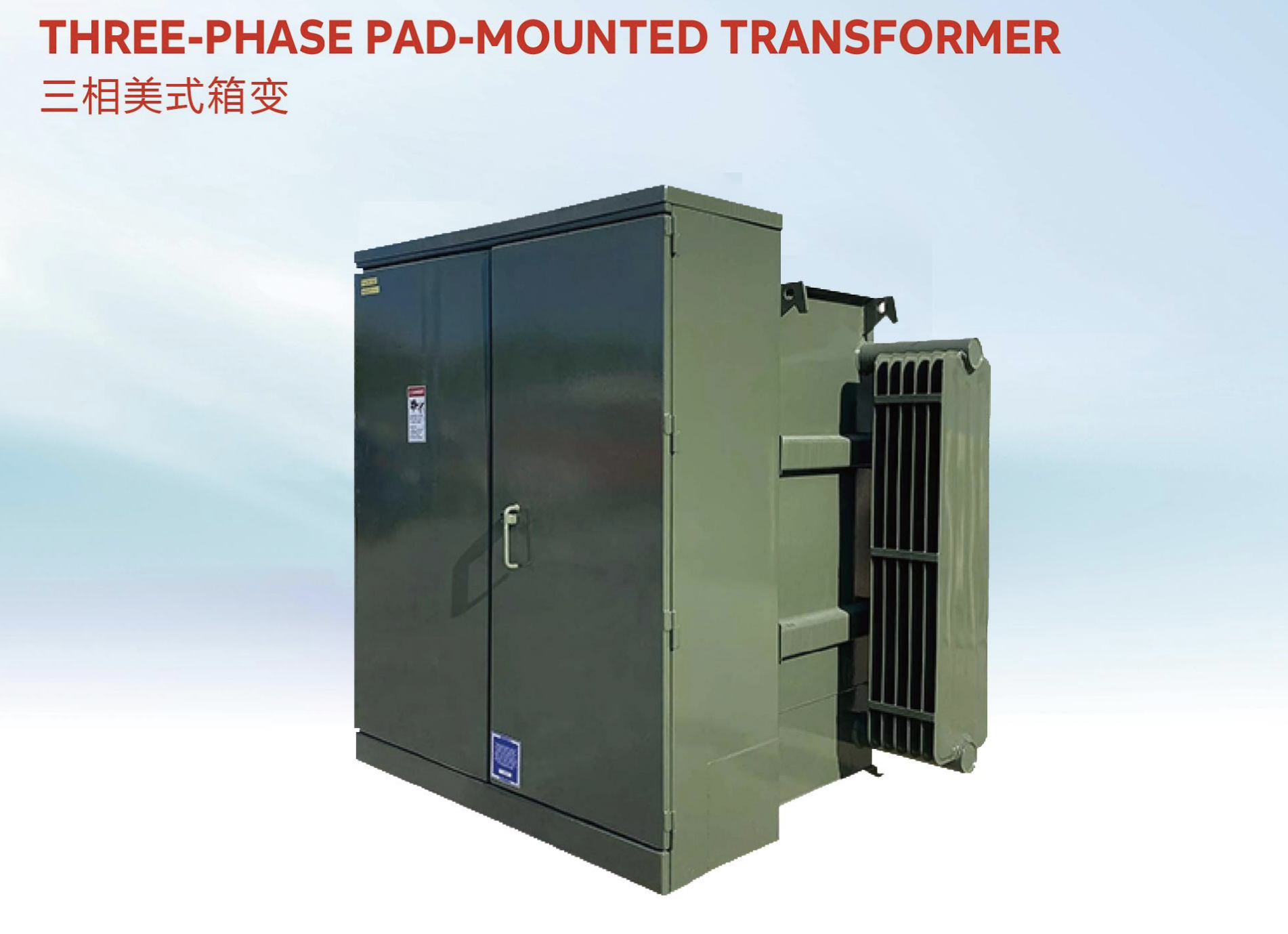
- Pad-mounted and pole-mounted distribution transformers — single-phase 15–250 kVA and three-phase 75–2,500 kVA pad-mounted, plus single-phase pole-mounted 5–167 kVA, built to ANSI / IEEE with UL / CSA certification and DOE (2016) / CSA (2023) efficiency.
- New-energy transformers (SC10 / SZ18 / SZ20) — 500–12,500 kVA at 10 kV class and 1,000–12,500 kVA at 35 kV class, with wide-range 0.4–1.14 kV LV windings that accept inverter outputs from different brands and impedance options of 6.0–14.0%.
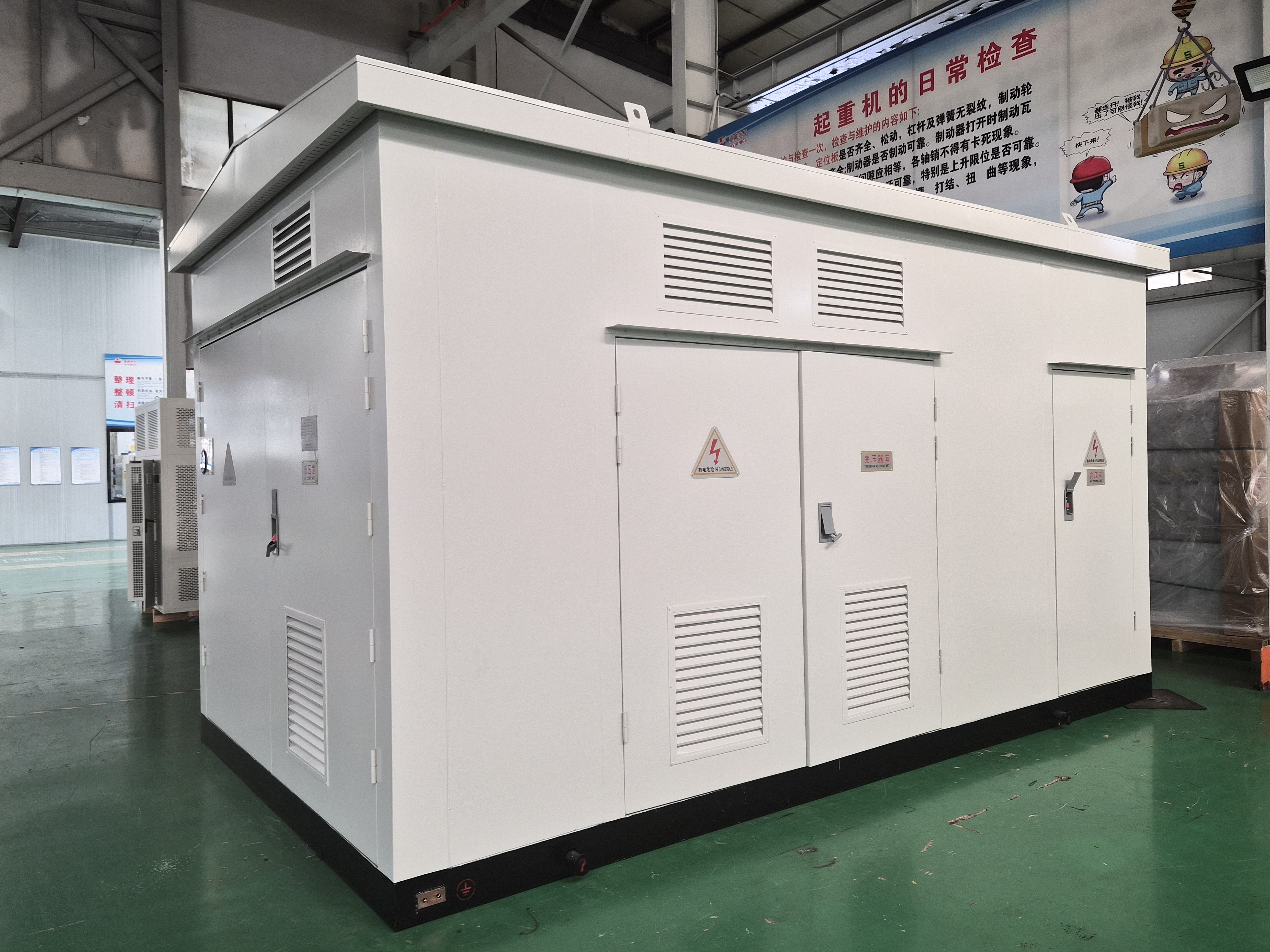
- Prefabricated cabin substations (YBM / ZGS11 / ZGS13) — 10 / 35 kV, 500–50,000 kVA, integrating HV switchgear, transformer, LV switchgear, compensation, automation, AC/DC supply and environmental control in a containerized enclosure rated IP54 / IP55 and –40°C to +50°C.
- Large power transformers — up to 250 MVA and 345 kV, with ONAN / ONAF / ODAF cooling, on-load tap changing, and IEC, IEEE or ANSI design bases.
Certifications: what exists, in whose name, and for which market
Certification evidence is only useful if it can be matched to a product family, a market and a validity period. The table below lists the principal documents held for the product families described above, with the issuing body and certificate number so that each can be verified independently with the issuer.
| Certificate / report | Issuing body | Number and status | Applies to |
|---|---|---|---|
| ISO 9001:2015 quality management system | Beijing United Intelligence Certification Co., Ltd. (UICC) | 04325Q30129R0M — issued 2025-01-16, valid to 2028-01-15 | Design and production of oil-immersed transformers up to 220 kV, dry-type transformers up to 35 kV, and box-type substations |
| KEMA Test Report (Type Test) | KEMA B.V. (KEMA Labs), Arnhem, Netherlands | 702226901-24 — issued 2024-08-23; tests 17–21 July 2024 | S13 / S14 / S15, ZGS-H / ZGS-Z, SFZ-250000/345 — IEC 60076-1:2011, -2:2011, -3:2013, -10:2016 |
| KEMA Test Report (Type Test) | KEMA B.V. (KEMA Labs), Arnhem, Netherlands | 109600301-26 — issued 2026-02-12; tests witnessed 23–28 December 2025 | Oil-immersed distribution, three-phase pad-mounted and SFZ-250000/345 — IEC 60076-1/-2/-3/-10 plus IEEE C57.12.00:2021 and C57.12.90:2021 |
| TÜV Rheinland Type Test Report | TÜV Rheinland (Shanghai) Co., Ltd. | CN231PY4 001 — issued 2023-06-26; tests 20–22 June 2023 | S13 / S14 / S15 and SFZ-250000/345 — IEC 60076-1:2011, -2:2011, -3:2013+A1:2018, -10:2016 |
| UL dry-type compliance certificate (US + Canada) | UL LLC | UL-US-26119070-0 (US) / UL-CA-2687596-0 (Canada) — issued 2026-05-29 | Open ventilated dry-type air-cooled general-purpose transformers — UL 1561 Ed.4 / CSA C22.2 No.47 Ed.5 |
| UL / CSA certification, liquid-immersed distribution transformer | UL LLC | UL-CA-2242874-0 / UL-CA-2320692-0 / UL-CA-2328358-0 | Liquid-immersed distribution transformers — CSA C2.1-06 and CSA C227.4 |
| CSA Field Evaluation Report | CSA Group | 80127142 — issued 2022-05-20; evaluation 10–20 May 2022 | Switchgear unit substation with the SFZ-250000/345 — NFPA 791-2018, NFPA 70-2017, IEEE C57.12.00, IEEE C57.12.90, UL 891, IEEE C37.121-2012 |
| CE certification (EMC Directive) | UDEM International / Ente Certificazione Macchine | M.2022.206.C7198 / 3N230310.JYTU038 — valid to 2027-09-07 | Power and distribution transformers — EN IEC 61000-6-2:2019, EN IEC 61000-6-4:2019, EN 61000-3-2:2019, EN 61000-3-3:2013; EN 60076-1:2011, -2:2011, -14:2013 |
| EAEU Declaration of Conformity (EAC) | ООО «КАСКАД», Russian certification body | POCC RU Д-CN.PA01.B.07433/24 — valid 2024-02-26 to 2027-02-25 | Dry-type SCB12–SCB18, oil-immersed S13 / S14 / S15 and SFZ-250000/345 — ГОСТ Р 52719-2007 |
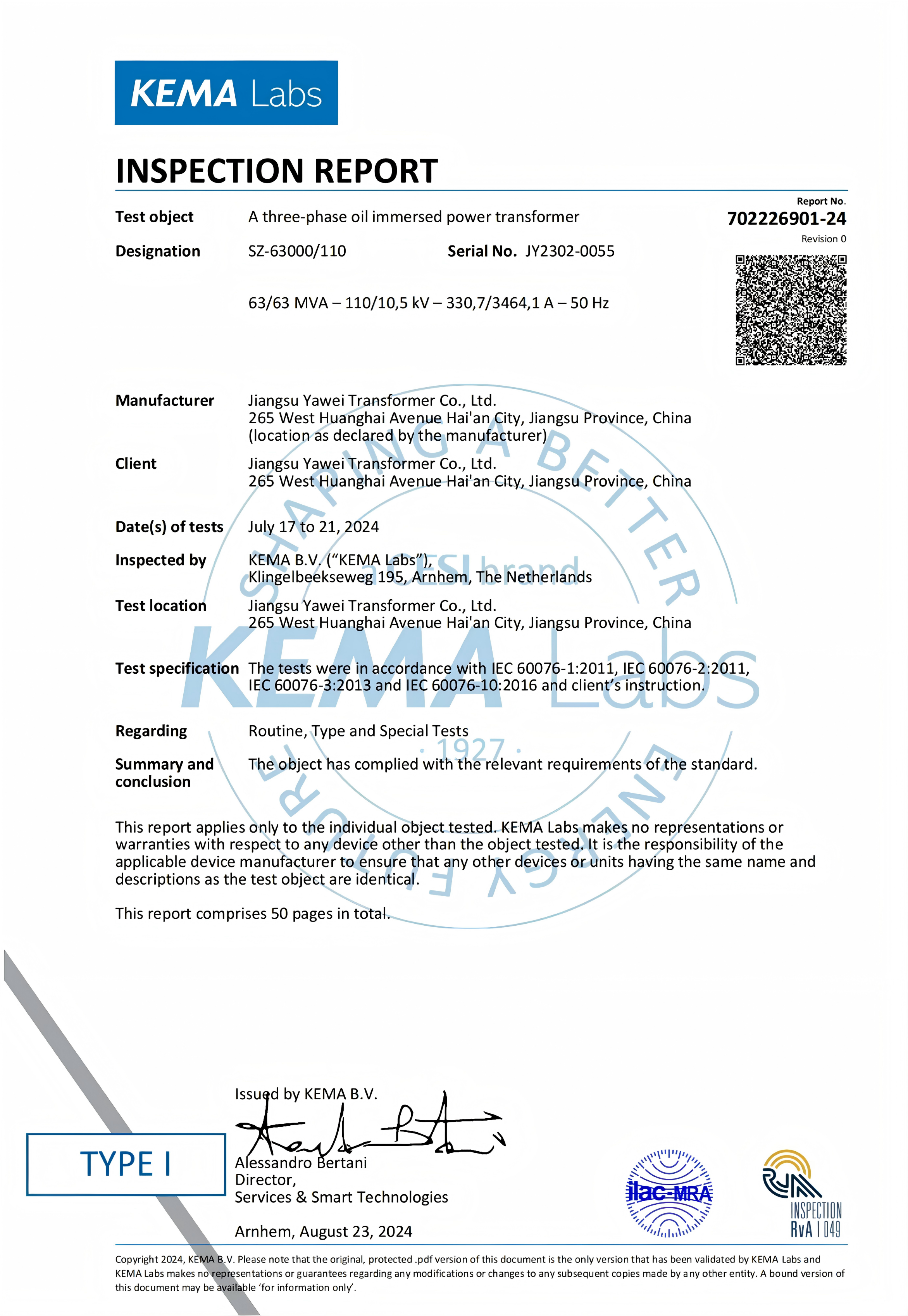
Two points are worth noting for buyers. First, management-system certification and product certification do different jobs: ISO 9001 covers the design and production system, while KEMA, TÜV, UL, CSA, CE and EAC documents cover a specific product family in a specific market. Second, a certificate number is only useful because it can be checked — the issuing body can confirm the entity, the scope and whether the document is still current, which is exactly the step that separates a verified supplier from a described one.
Step-by-Step: A Five-Stage Verification Workflow for a Custom Order
- Fix the electrical and site envelope in writing. Record the capacity, HV and LV ratings, frequency (50 or 60 Hz), vector group, impedance, tap range, cooling class, insulation class, protection rating, ambient temperature, altitude and corrosion class. For reference, the 250 MVA / 345 kV design carries a rated capacity of 250/250 MVA, a rated voltage of 345/34.5 kV, a rated current of 418/4184 A at 60 Hz, a Dyn1 vector group, a lightning impulse withstand of 1175 kV HV / 200 kV LV and a switching impulse withstand of 975 kV. A distribution unit is far simpler, but every one of these fields still has to be stated.
- Map the envelope to the correct standard and test programme. Confirm that the design will be verified under IEC 60076-1, -2, -3 and -10, or IEC 60076-11 for a dry-type unit, or the ANSI / IEEE C57.12 series for North America — and that the destination market's certification (UL, CSA, CE, EAC) is included in the scope rather than assumed.
- Verify the certification chain. For each certificate presented, check the number, the issuing body, the legal entity named, the product family covered and the validity period. Ask directly whether the document belongs to the contracting party or to the manufacturing partner, and how the audit trail links the two.
- Witness testing before shipment. Routine tests on a distribution transformer typically cover turns ratio, winding resistance, no-load and load losses, impedance, insulation and oil quality. Confirm the factory acceptance test in advance, and where the project requires it, arrange third-party inspection with SGS, BV or KEMA.
- Close the loop on documentation, delivery and commissioning. Submittals, AutoCAD drawings, factory test reports, O&M manuals, packing, freight terms and on-site installation guidance should all be named in the contract, with joint site acceptance testing after installation and a defined warranty period.
Design-cycle reference points. A technical proposal typically takes 3–5 business days and a full design cycle 15–30 days, depending on complexity. Standard distribution transformers are quoted at 30–60 days and customized models at 45–75 days; cast-resin dry-type transformers follow the same distribution-transformer schedule; large power transformers run 45–90 days for standard models and 90–150 days for large or customized designs; new-energy transformers 60–90 days; prefabricated cabin substations 90–120 days. Project-based delivery from contract to site acceptance is commonly 3–6 months. Minimum order quantity is 1 unit, with bulk orders typically 10 or more units per container.
Use Cases: Where Custom Designs Are Actually Applied
Cement and heavy industry. An S13-1250/10/0.4 oil-immersed distribution transformer was delivered and installed for a cement plant in Myanmar, where continuous process loads and high ambient temperatures make loss performance and thermal margin part of the specification rather than an afterthought.
Indoor industrial distribution. For an industrial customer in Central America, an SCB10-1000 kVA dry-type transformer at 13.2 / 0.4 kV was supplied together with an SG-400 kVA isolation transformer at 0.38 / 0.22 kV, operating since 2023. This is a typical custom combination: the dry-type unit removes oil from the building, and the isolation transformer separates a sensitive load from the upstream distribution.
Grid substations and transmission. Delivered references include four 110 kV power transformers for Azerbaijan Power Energy Company, 115 kV substations in Tajikistan, a 110 kV substation in Mongolia, a 115 kV substation for the Puerto Rico power distribution company and a 345 kV fully insulated power transformer for the US–Georgia transmission company. A 75,000 kVA, 230 kV transformer (S-75000 kVA, 230±2×2.5% / 13.8 kV, YNd11) was delivered and installed in an Ecuadorian substation.
Renewable generation and storage. A 40,000 kVA energy-storage project in Bulgaria was designed, manufactured, supplied, delivered, installed, tested and commissioned, and multiple 40 MVA transformers (SFSZ-40000, 115 / 158 kV class with 38.5 / 6.6 / 11 kV LV) plus a 25 MVA unit (SFFZ-25000) were supplied for PV grid connection.
North American distribution. A 15 MVA pad-mounted transformer project was delivered for a US transmission company, and a series of substation and distribution projects in Uzbekistan included transformers from 63 kVA up to 40 MVA at 110 / 115 kV, showing how far a single verified supply chain can be stretched without changing the certification basis.
Comparison: Custom Transformer Types at a Glance
| Type | Capacity and voltage | Insulation and cooling | Standards and certification available | Typical lead time |
|---|---|---|---|---|
| Oil-immersed distribution transformer (S13 / S14 / S15) | 30–3,150 kVA at 10 kV class; 3,150–31,500 kVA at 35 kV class; HV 6–35 kV | Paper-oil, ONAN, fully sealed; corrugated tank up to 1,600 kVA, tubular radiators from 2,000 kVA | IEC 60076-1/-2/-3/-10; KEMA 702226901-24; TÜV CN231PY4 001; UL / CSA to CSA C2.1-06 and CSA C227.4; EAC; CE | 30–60 days standard; 45–75 days customized |
| Cast-resin dry-type transformer (SCB12–SCB18) | 30–2,500 kVA at 10 kV class; 800–25,000 kVA at 35 kV class; HV 6–35 kV | Vacuum-cast epoxy resin, copper foil windings, AN or AF cooling, IP00 / IP20 / IP23 | IEC 60076-11; UL 1561 Ed.4 (UL-US-26119070-0) and CSA C22.2 No.47 Ed.5 (UL-CA-2687596-0); EAC | 30–60 days standard; 45–75 days customized |
| Three-phase pad-mounted transformer (ZGS-H / ZGS-Z) | 75–2,500 kVA; HV 4.16–34.5 kV; LV 240 / 480 / 600 / 347 V | Mineral oil, natural circulation, fully sealed tamper-resistant enclosure | ANSI / IEEE; DOE (2016) and CSA (2023) efficiency; UL / CSA; KEMA 109600301-26 | 30–60 days standard |
| Large power transformer (SFZ-250000/345 class) | Up to 250 MVA at 345 kV; in-house testing capability to 500 kV | Paper-oil composite insulation, ONAN / ONAF1 / ODAF2, on-load tap changing | IEC 60076-1/-2/-3/-10 plus IEEE C57.12.00 and C57.12.90; KEMA Type I; TÜV Rheinland; CSA field evaluation 80127142; UL / CSA; EAC; CE | 45–90 days standard; 90–150 days customized |
| Prefabricated cabin substation (YBM / ZGS11 / ZGS13) | 10 / 35 kV; 500–50,000 kVA | HV switchgear + transformer + LV switchgear + compensation + automation; IP54 / IP55; –40°C to +50°C | IEC conformity for 10 kV / 35 kV transformers and box-type substations; CQC product certification for box-type substations and switchgear | 90–120 days |
Read the table as a screening tool rather than a specification. The right column matters as much as the middle ones, because a unit that meets every electrical requirement but is certified for the wrong market, or whose type test covers a different rating, will still fail at the point of energisation. Where a buyer needs a KEMA-verified, UL-certified or EAC-declared design, that requirement should be written into the enquiry so it shapes the design from the start rather than being retrofitted afterwards.
Frequently Asked Questions
1. Which IEC standards apply to a custom distribution transformer, and how is a test report verified?
IEC 60076 is the reference framework, and it is applied in parts: IEC 60076-1 for general requirements, IEC 60076-2 for temperature rise, IEC 60076-3 for insulation levels and dielectric tests, and IEC 60076-10 for the measurement of sound levels, with IEC 60076-11 additionally covering dry-type transformers. Verification means checking that the document is a third-party type test rather than a routine test, that the model, rating, vector group and standard editions match the unit being purchased, and that the laboratory and report number can be identified and queried. Evidence available for this supply chain includes KEMA B.V. Type Test Report 109600301-26, issued 2026-02-12 for routine, type and special tests witnessed from 23 to 28 December 2025 to IEC 60076-1:2011, -2:2011, -3:2013 and -10:2016 together with IEEE C57.12.00:2021 and C57.12.90:2021, and TÜV Rheinland report CN231PY4 001 for the S13 / S14 / S15 series and the SFZ-250000/345 transformer.
2. What market-specific certification should a Chinese custom transformer supplier be able to show?
It depends on the destination market. For the United States and Canada, dry-type general-purpose transformers should carry UL compliance under UL 1561 Ed.4 in the US and CSA C22.2 No.47 Ed.5 in Canada — for example certificates UL-US-26119070-0 and UL-CA-2687596-0, issued by UL LLC on 2026-05-29 — while liquid-immersed distribution transformers are certified to CSA C2.1-06 and CSA C227.4, as covered by UL-CA-2242874-0, UL-CA-2320692-0 and UL-CA-2328358-0. For the European Union, CE certification under the Electromagnetic Compatibility Directive 2014/30/EU is held under numbers M.2022.206.C7198 and 3N230310.JYTU038, valid to 2027-09-07. For Russia and the Eurasian Economic Union, an EAEU Declaration of Conformity (POCC RU Д-CN.PA01.B.07433/24, valid 2024-02-26 to 2027-02-25) covers dry-type and oil-immersed transformers to ГОСТ Р 52719-2007.
3. How much of a transformer can actually be customized?
More than most buyers assume, provided the change stays inside the verified design and certification envelope. Custom engineering covers voltage ratios, capacities, impedances (4–14% depending on type and system short-circuit capacity), vector groups such as Dyn11, Yyn0, YNd11 and Dyn1, tap ranges including off-circuit ±2×2.5% and on-load tap changing over 34 positions, special cooling arrangements, noise reduction, anti-corrosion finishes to C3 / C4 / C5, high-altitude derating, seismic design, protection ratings up to IP54 / IP55, and design work specifically aimed at KEMA, UL or CSA certification. What cannot be customized is the standard itself: whatever is changed must still be verified under the applicable IEC, IEEE or ANSI test programme.
4. What drives the price and the lead time of a custom transformer?
The main cost drivers are the material and construction choices — copper or aluminium windings, silicon-steel or amorphous-alloy core, insulation class, tank type and cooling stage — followed by non-standard impedance or ratio combinations, certification-specific design and any third-party testing required by the project. Lead time is driven by how far the unit departs from a reference design and by the type of product: 30–60 days for standard distribution transformers and 45–75 days for customized ones, 45–90 days for standard large power transformers and 90–150 days for customized large units, 60–90 days for new-energy transformers, and 90–120 days for prefabricated cabin substations, with the technical proposal stage taking 3–5 business days and design 15–30 days. Over-specifying a parameter that does not affect service performance adds cost without adding reliability.
5. How can a buyer validate a custom design before mass production begins?
Validation runs on three levels. First, drawing and design approval before production starts, which is where vector group, impedance and tap range must be fixed in writing. Second, factory acceptance testing before shipment: routine tests on a distribution transformer cover turns ratio, winding resistance, no-load and load losses, impedance, insulation and oil quality, and third-party inspection can be arranged with SGS, BV or KEMA where the project requires it. Third, joint site acceptance testing after installation, supported by installation guidance, commissioning and trial operation, with a 12-month warranty on distribution transformers and 12–24 months on power transformers per contract. Minimum order quantity for a custom design is 1 unit. Apex Power Systems (Nanjing)Co., Ltd. can supply the certificate list, the design proposal and the testing plan for a specific project on request — contact xuke@apexps-nj.com or +86 132-0157-1341, or download the product catalogue below.
Conclusion: Verify the Design, Then Buy the Transformer
Custom transformer sourcing is a documentation exercise as much as an engineering one. The electrical envelope — voltage, capacity, vector group, impedance, tap range, cooling, protection and climate class — determines what the unit must do. The standard and the certification determine whether it will be accepted in the destination market. The verification workflow described above closes the gap between the two: fix the envelope in writing, map it to IEC 60076 or the ANSI / IEEE equivalent, check every certificate number against its issuer, witness the factory acceptance test, and confirm the documentation, delivery and commissioning scope before the contract is signed.
Next step
If you are evaluating a custom transformer for a distribution, substation, data-centre, mining or renewable-energy project, Apex Power Systems (Nanjing)Co., Ltd. can prepare a technical proposal within 3–5 business days and issue the matching certification evidence for the product family and destination market you need.
Email: xuke@apexps-nj.com | Tel / WhatsApp: +86 132-0157-1341 | Web: apexpowerlink.com