
Pole-Mounted vs Pad-Mounted Custom Transformers: A North American Distribution Comparison
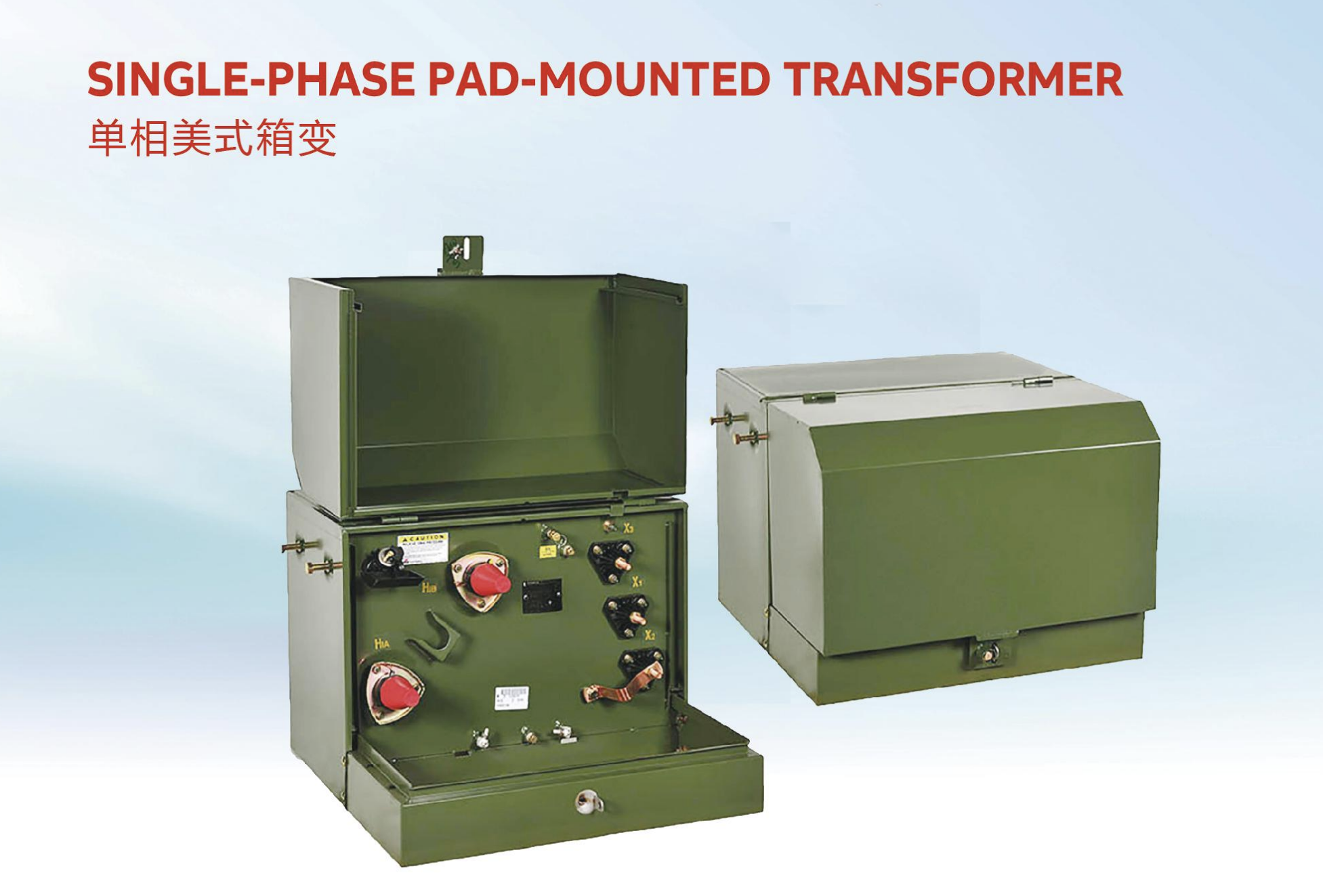
Single-phase pad-mounted configuration: high-voltage and low-voltage switching, fusing and protection are enclosed together with the transformer in a tamper-resistant steel enclosure standing on a concrete pad.
A distribution transformer enquiry for a North American project usually opens with capacity and voltage — and that is exactly where three different configurations begin to look interchangeable. A single-phase pole-mounted unit, a single-phase pad-mounted unit and a three-phase pad-mounted unit can share the same 60 Hz basis, the same ANSI/IEEE framework and overlapping kVA ranges, yet they are not interchangeable at the level that decides whether a project is accepted: the enclosure, the location of switching, fusing and protection, and the scope of the certification document that has to be handed to the utility.
This comparison sets out the documented differences between the D-M Series single-phase pole-mounted transformer, the ZGD-H / ZGD-Z Series single-phase pad-mounted transformer and the ZGS-H / ZGS-Z Series three-phase pad-mounted transformer, and then translates those differences into selection criteria a buyer can check on paper before a purchase order is raised. It treats the UL Certificate of Compliance for liquid-filled distribution transformers as a hard gate rather than a formality, because a unit that is correct technically but not certified for the destination market will not be accepted.
Problem Definition: The Enclosure, Not the Core, Decides the Layout
The buyer's difficulty is that all three configurations perform the same basic function — stepping a distribution voltage down to a user supply — while distributing the surrounding equipment very differently. For pad-mounted equipment the answer is fixed by the product definition. A pad-mounted transformer is a distribution transformer whose high-voltage and low-voltage switching, fusing and protection are enclosed together with the transformer in a tamper-resistant steel enclosure, installed at ground level on a concrete pad. Compartmental and dead-front construction, radial or loop feed, and tamper-resistant design are the defining features of the style, which is why it can stand in publicly accessible areas without a fenced substation.
For pole-mounted equipment the transformer is elevated on the pole and carried on side mounting brackets, with top lifting eyes for handling. The published data for the D-M Series lists its bushings — porcelain or composite on the high-voltage side, porcelain on the low-voltage side — together with a drain valve, an oil-level gauge, a grounding terminal and a nameplate as the fittings supplied on the unit. That is a different installation logic: the pole structure, the overhead line and the site carry the working space around the transformer.
Two constraints therefore sit underneath every comparison. The first is site layout and protection access: where the switching, fusing and surge protection physically sit determines the footprint, the civil work, the way a crew isolates a circuit, and whether the unit can be placed in a front yard, an alley or a parking island. The second is market certification: liquid-filled distribution transformers destined for the United States and Canada must carry a UL Certificate of Compliance for units rated over 750 V, and for Canada certification to CSA C2.1-06 and CSA C227.4. A specification that ignores either constraint produces a unit that either does not fit the site or cannot be energised.
Industry Background: How North American Distribution Sets the Specification
North American distribution practice fixes a number of parameters before a buyer reaches the question of style. Systems operate at 60 Hz and are specified against ANSI/IEEE insulation and loss conventions rather than IEC alone. Distribution high-voltage classes in service include 12.47 kV, 13.2 kV, 13.8 kV and 34.5 kV, and the three-phase pad-mounted product data also lists 4.16 kV, 22.86 kV and 24.94 kV. On the low-voltage side the two patterns that dominate are the 120/240 V centre-tapped secondary used for single-phase residential service and the 240 V, 480 V, 600 V or 347 V patterns used for three-phase commercial and light-industrial supply.
The layout choice follows the network. Overhead pole lines serve scattered and rural loads, where a transformer mounted on the pole is the conventional arrangement and where the published D-M Series range of 5 kVA to 167 kVA covers everything from a single home to a small commercial user. Underground residential and commercial distribution uses ground-level equipment, which is why pad-mounted units exist in the 15–250 kVA single-phase range and the 75–2,500 kVA three-phase range. Industry guidance for this market is consistent on typical sizes: single-phase units of roughly 25–100 kVA for residential and small commercial service, with 50 kVA and 75 kVA units at 7200/2400 V and a 120/240 V secondary common in service, and three-phase pad-mounted units wherever commercial or light-industrial loads need a three-phase supply.
Efficiency is now part of the specification rather than an afterthought. The three-phase pad-mounted data specifies efficiency to DOE (2016) and CSA (2023), and the pole-mounted data states ANSI/IEEE compliance with DOE/CSA efficiency certification. Buyers with a loss-evaluation component in their tender also have an amorphous-core option on both the pole-mounted and the single-phase pad-mounted designs, which the product data states reduces no-load losses by 60–80%.
Detailed Solution: The Three Documented Configurations
1. Single-phase pole-mounted — D-M Series, 5–167 kVA
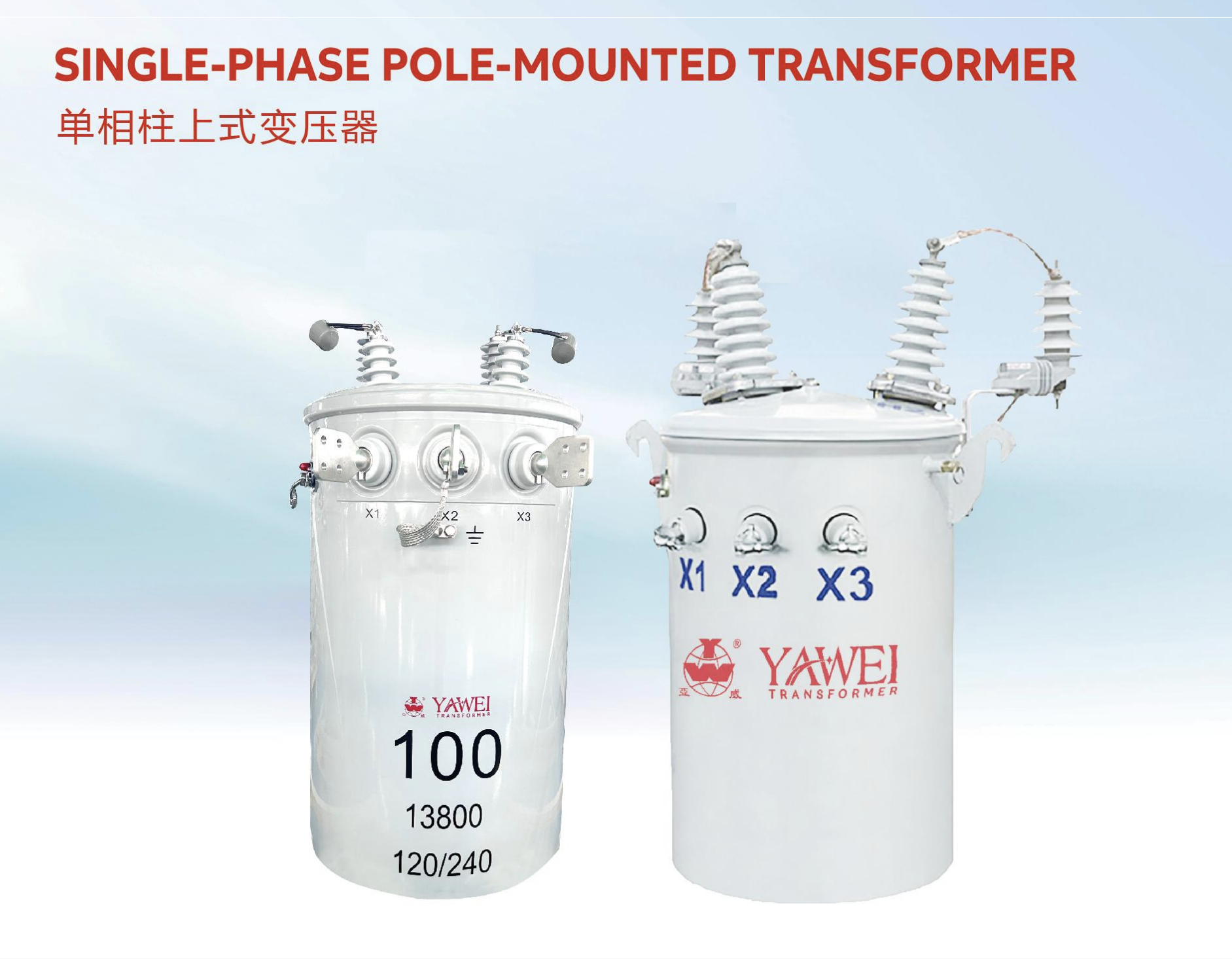
Single-phase pole-mounted configuration: cylindrical or elliptical fully sealed tank, side mounting brackets and top lifting eyes, sized from 5 kVA to 167 kVA.
The D-M Series is built as a cylindrical or elliptical carbon-steel tank, fully sealed, with copper windings insulated with NOMEX paper or cable paper and natural oil circulation (ONAN) for cooling. High-voltage bushings are porcelain or composite and low-voltage bushings porcelain. The unit is designed for temperatures from –40 °C to +40 °C and elevations up to 2,000 m, which is the range that matters for rural and remote overhead networks. The product data states that pole mounting eliminates the need for a distribution room and reduces civil cost and low-voltage line losses by more than 60%. Documented applications are rural grids in North America, Africa and Southeast Asia, remote mountainous and scattered-village supply, agricultural production and irrigation, railway and urban grid upgrades, and temporary or emergency power. Units have been delivered for rural-grid projects in Mongolia and Azerbaijan.
2. Single-phase pad-mounted — ZGD-H / ZGD-Z Series, 15–250 kVA
The single-phase pad-mounted design is where enclosure integration becomes visible. It uses epoxy-resin elbow bushings for the high-voltage connection and a 120/240 V centre-tapped low-voltage winding, which is the standard North American residential secondary pattern. The core is amorphous alloy or silicon steel, windings are copper with paper insulation, and the tank is a welded carbon-steel fully sealed construction with an anti-corrosion powder coating. Cooling is by natural mineral-oil circulation. The product data states ANSI/IEEE compliance with UL/CSA certification for direct access to the North American market, a fully sealed maintenance-free design with low operating noise for residential areas, and a compact arrangement that reduces civil and foundation costs. Documented applications include residential distribution in North America and Southeast Asia, rural grids and remote-area electrification, retail and small industrial distribution, street lighting and community distribution with predominantly single-phase loads; the series has been delivered to overseas projects including Panglao in the Philippines.
3. Three-phase pad-mounted — ZGS-H / ZGS-Z Series, 75–2,500 kVA
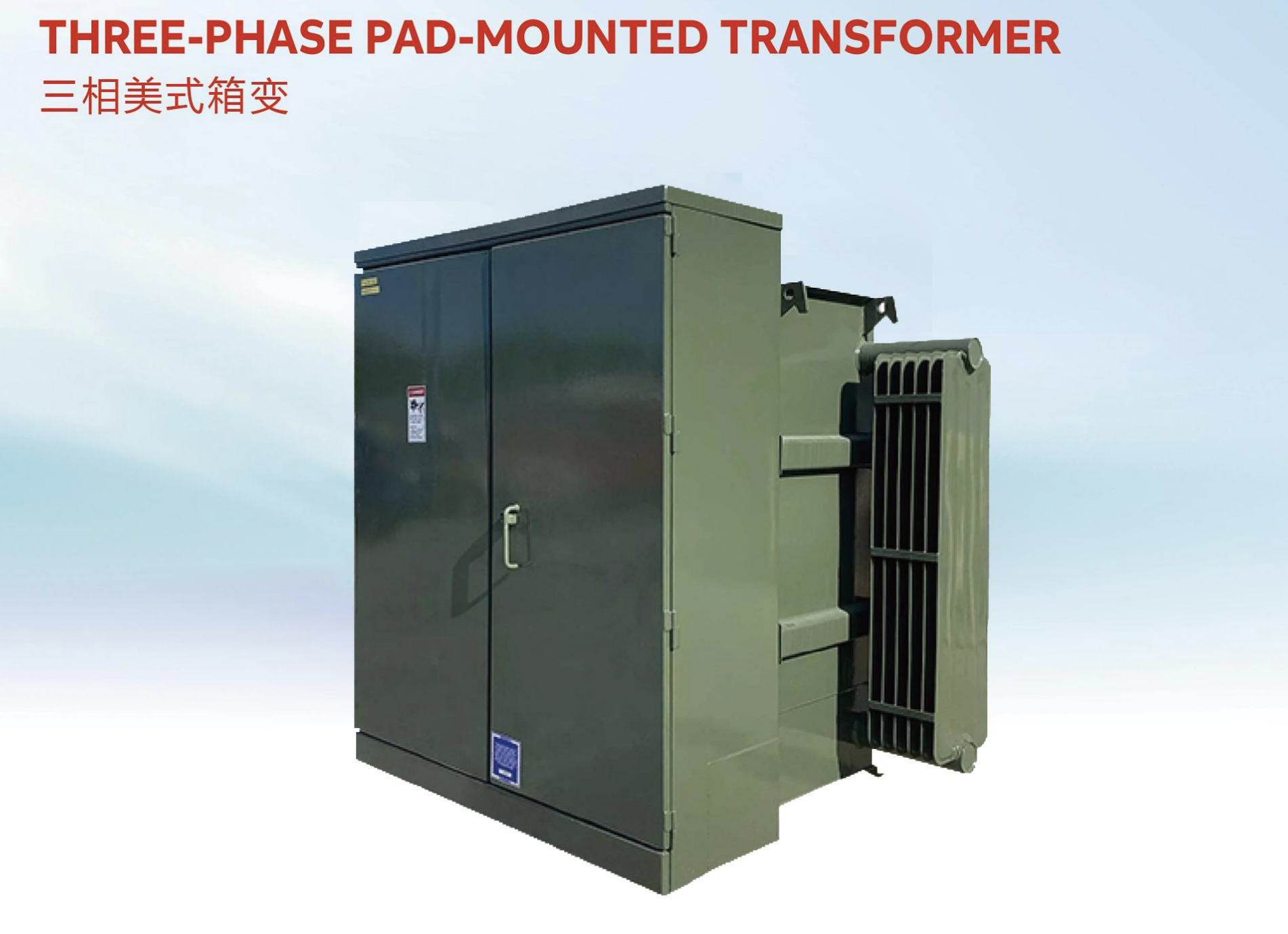
Three-phase pad-mounted configuration: internal load-break switch, fuse and surge arrester, epoxy-resin moulded HV bushings with elbow connectors and copper busbar LV terminals.
The three-phase pad-mounted unit is the configuration in which the enclosure carries the most equipment. The published data lists a load-break switch, a fuse and a surge arrester as internal components, with a loop-feed configuration available as an option alongside radial feed. High-voltage connections use epoxy-resin moulded bushings with elbow connectors; the low-voltage side terminates in copper busbars. The core is low-loss grain-oriented silicon steel with step-lap joints, windings are copper foil or copper conductors with interlayer insulation, and the tank is a stainless-steel or carbon-steel welded, fully sealed construction with a military green or grey anti-corrosion powder coating, specified for coastal, humid and high-temperature climates. Ratings run from 75 kVA to 2,500 kVA, with high voltage at 4.16, 12.47, 13.2, 13.8, 22.86, 24.94 or 34.5 kV, or customized, and low voltage at 240, 480, 600 or 347 V, or customized. The design is stated as compliant with ANSI/IEEE/DOE/CSA and UL/CSA certified, with the fully insulated and sealed elbow connectors described as providing safe operation and protection against accidental contact.
What Enclosure Integration Changes on Site
Three practical consequences follow from putting switching, fusing and protection inside a locked enclosure.
Footprint and civil work. A pad-mounted unit requires a concrete pad, and the three-phase design is described as having a small footprint with a sealed construction listed for indoor or outdoor installation. A pole-mounted unit requires the pole and its mounting brackets, and the product data states that the arrangement removes the distribution room altogether. In both cases the civil cost is lower than a built enclosure, but the two layouts consume site area in completely different ways: one at ground level in a defined footprint, the other vertically on the line.
Access to the protective devices. On the three-phase pad-mounted design the components a crew operates — load-break switch, fuse and surge arrester — are named items inside the enclosure, reached from the dead-front face through elbow connectors that are fully insulated and sealed. On the pole-mounted design the documented touchpoints are the bushings, the drain valve, the oil-level gauge, the grounding terminal and the nameplate, and the working position is at height on the pole. That is the real difference for a utility: not the transformer itself, but where the person stands when the circuit has to be isolated.
Placement in public space. The pad-mounted definition includes tamper-resistant construction precisely so that the unit can sit in a publicly accessible area without a fenced substation. This is what makes underground residential distribution possible. The pole-mounted configuration instead uses the elevation of the line as its separation from the public, which is why it dominates scattered rural supply.
Cooling is common to all three configurations. Every unit described here relies on natural oil circulation — ONAN on the pole-mounted design and natural mineral-oil circulation on both pad-mounted designs — so a comparison built on cooling class will not separate them.
Certification as a Selection Criterion
For this market, compliance is a document question before it is an engineering question. The relevant record is a UL Certificate of Compliance for liquid-filled distribution transformers rated over 750 V, and for Canada certification to CSA C2.1-06 and CSA C227.4. The UL/CSA certification referenced here was issued by UL LLC for the United States and Canadian markets under certificate numbers UL-CA-2242874-0, UL-CA-2320692-0 and UL-CA-2328358-0, with the scope described as North American market liquid-immersed distribution transformer safety certification to CSA C2.1-06 and CSA C227.4.
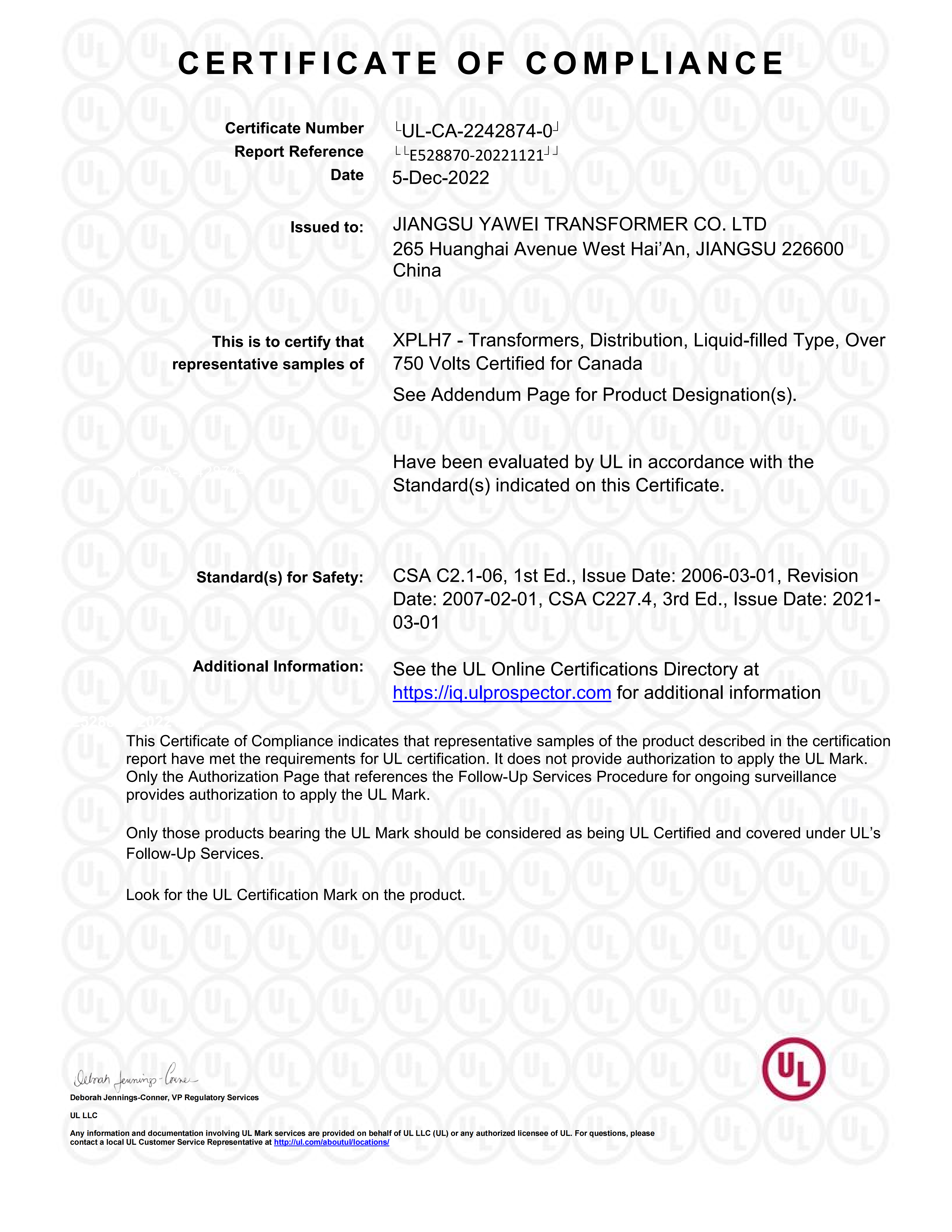
Certification record for liquid-immersed distribution transformers: UL-CA-2242874-0 / UL-CA-2320692-0 / UL-CA-2328358-0, issued by UL LLC, United States and Canada.
Two further layers of evidence are worth requesting. The first is type-test evidence: KEMA test reports 702226901-24 and 109600301-26 are recorded against the three-phase pad-mounted product family among others, tested to IEC 60076-1:2011, IEC 60076-2:2011, IEC 60076-3:2013 and IEC 60076-10:2016, with the later report also covering IEEE C57.12.00:2021 and IEEE C57.12.90:2021. The second is the manufacturing quality system: ISO 9001:2015 certificate 04325Q30129R0M, issued by Beijing United Intelligence Certification Co., Ltd. (UICC), covers the design and production of oil-immersed transformers up to 220 kV, dry-type transformers up to 35 kV and box-type substations, and is valid from 16 January 2025 to 15 January 2028.
Comparison Table: Three Configurations on the Same Basis
| Selection factor | Single-phase pole-mounted (D-M Series) | Single-phase pad-mounted (ZGD-H / ZGD-Z) | Three-phase pad-mounted (ZGS-H / ZGS-Z) |
|---|---|---|---|
| Phase / duty | Single-phase | Single-phase | Three-phase |
| Documented capacity | 5–167 kVA | 15–250 kVA | 75–2,500 kVA |
| Published voltage data | Capacity and construction data only | LV 120/240 V, centre-tapped | HV 4.16 / 12.47 / 13.2 / 13.8 / 22.86 / 24.94 / 34.5 kV or customized; LV 240 / 480 / 600 / 347 V or customized |
| Where switching, fusing and protection sit | Not described as enclosed in the published product data | Enclosed with the transformer in a tamper-resistant steel enclosure, per the pad-mounted definition | Internal load-break switch, fuse and surge arrester; loop-feed configuration optional |
| Connection hardware | Porcelain or composite HV bushings; porcelain LV bushings | Epoxy-resin elbow bushings; centre-tapped LV winding | Epoxy-resin moulded HV bushings with elbow connectors; LV copper busbar terminals |
| Tank and finish | Cylindrical or elliptical carbon-steel tank, fully sealed | Welded carbon-steel tank, fully sealed; anti-corrosion powder coating | Stainless-steel or carbon-steel welded tank, fully sealed; military green or grey anti-corrosion powder coating |
| Cooling | ONAN, natural oil circulation | Natural mineral-oil cooling | Natural mineral-oil circulation |
| Stated standards and certification | ANSI/IEEE compliant; DOE/CSA efficiency certification | ANSI/IEEE compliant; UL/CSA certification | ANSI/IEEE insulation level; DOE (2016) / CSA (2023) efficiency; UL/CSA certified |
| Site and installation factor | Pole-mounted; no distribution room; stated to cut civil cost and LV line losses by more than 60% | Compact arrangement that reduces civil and foundation costs | Small footprint; sealed design listed for indoor or outdoor installation |
| Documented application | Rural grids, remote and agricultural supply, railway and urban grid upgrades, temporary and emergency power | Residential distribution, rural electrification, retail and small industrial, street lighting | Commercial complexes and industrial parks, municipal utilities, residential developments, distribution-side renewables |
Step-by-Step Breakdown: A Buyer's Comparison Sequence
Step 1 — Fix the load and the phase. Decide whether the load is single-phase or three-phase before comparing anything else. Single-phase residential and small commercial service sits naturally in the 15–250 kVA pad-mounted or 5–167 kVA pole-mounted range; commercial and light-industrial three-phase load moves the enquiry to the 75–2,500 kVA three-phase pad-mounted range.
Step 2 — Choose the network layout. Overhead lines point to pole mounting; underground residential and commercial distribution points to a pad. This decision is made by the network planner, not the transformer supplier, and it usually removes one configuration from the comparison immediately.
Step 3 — Set the voltages and frequency. Confirm the high-voltage class against the system (12.47, 13.2, 13.8 or 34.5 kV, among others) and the low-voltage pattern against the service (120/240 V centre-tapped for single-phase residential; 240, 480, 600 or 347 V for three-phase). Frequency is 60 Hz for this market; the three-phase pad-mounted data covers 50/60 Hz.
Step 4 — Decide where switching, fusing and protection must sit. If the site requires the switching, fusing and protection to be inside a tamper-resistant enclosure at ground level — the usual case for publicly accessible residential and commercial locations — the pad-mounted configuration is the one that satisfies it by definition, and the three-phase design names the load-break switch, fuse and surge arrester as internal components. Record this decision in the specification, because it is the single item that cannot be retrofitted on site.
Step 5 — Verify the certificate against the family and the rating. Request the UL Certificate of Compliance for liquid-filled distribution transformers rated over 750 V, plus the Canadian certification to CSA C2.1-06 and CSA C227.4 where applicable, and check that the numbers match the unit being quoted.
Step 6 — Check the efficiency basis. Three-phase pad-mounted units are specified to DOE (2016) / CSA (2023) efficiency; pole-mounted units carry DOE/CSA efficiency certification. Where loss capitalisation is part of the evaluation, ask for the amorphous-core option, which the data states cuts no-load losses by 60–80%.
Step 7 — Check the site conditions against the design data. For pole-mounted units confirm the ambient and altitude envelope of –40 °C to +40 °C and 2,000 m. For three-phase pad-mounted units confirm the corrosion resistance of the enclosure where the site is coastal or humid, and confirm the loop-feed or radial-feed arrangement the network needs.
Step 8 — Agree quantity, lead time and the test plan. Sample orders from one unit are accepted, with a design fee applicable to one-off projects that is refundable for bulk orders, subject to technical evaluation. Standard distribution transformers run 30–60 days and customized models 45–75 days, subject to technical evaluation and per technical agreement. Routine tests are performed to IEC 60076 / ANSI/IEEE C57.12 — turns ratio, resistance, no-load and load losses, impedance, insulation and oil quality — with type and special tests available, and pre-shipment FAT plus post-installation SAT can be witnessed, with third-party inspection by SGS, BV or KEMA arranged where required.
Use Cases: Where Each Configuration Fits
Residential subdivision with underground service. Single-phase pad-mounted units in the 15–250 kVA range, with a 120/240 V centre-tapped secondary and epoxy-resin elbow bushings, are the configuration that matches underground residential distribution. Units of 50 kVA and 75 kVA at 7200/2400 V with a 120/240 V secondary are typical in service, and 25–100 kVA is the working band for residential and small commercial service.
Rural and agricultural overhead supply. Pole-mounted units cover 5–167 kVA from a single dwelling to a small commercial user, and the –40 °C to +40 °C, 2,000 m envelope suits remote networks. The same configuration is used for street lighting circuits, railway and urban grid upgrades, and temporary or emergency power where a distribution room cannot be built.
Commercial and light-industrial developments. Three-phase pad-mounted units from 75 kVA to 2,500 kVA serve commercial complexes, industrial parks, municipal utilities and residential developments, including distribution-side renewable plants. Loop-feed configuration suits networks where continuity of supply along a run matters, and the corrosion-resistant enclosure suits coastal and high-temperature sites. A 15 MVA pad-mounted transformer project for a North American transmission company is part of the delivery record, alongside the earlier single-phase pad-mounted deliveries to Panglao in the Philippines and pole-mounted rural-grid deliveries in Mongolia and Azerbaijan.
Municipal street lighting and small commercial single-phase loads. These sit in the single-phase ranges on either configuration; the choice between pole and pad is again decided by whether the service is overhead or underground, not by the transformer.
FAQ
Which certification must a liquid-filled distribution transformer hold for the United States and Canada?
A UL Certificate of Compliance for liquid-filled distribution transformers rated over 750 V is required for the United States, and for Canada certification to CSA C2.1-06 and CSA C227.4. In the record referenced in this comparison, UL LLC issued certification for the United States and Canadian markets under numbers UL-CA-2242874-0, UL-CA-2320692-0 and UL-CA-2328358-0, with the scope described as North American market liquid-immersed distribution transformer safety certification. The certificate must name the product family and the rating being purchased, and the number can be verified with UL. Third-party type-test evidence is a useful companion: KEMA reports 702226901-24 and 109600301-26 cover IEC 60076-1/-2/-3/-10, with the later report also referencing IEEE C57.12.00:2021 and IEEE C57.12.90:2021.
Can one supplier cover pole-mounted, single-phase pad-mounted and three-phase pad-mounted custom transformers?
The three families are documented as a single production scope: 5–167 kVA single-phase pole-mounted, 15–250 kVA single-phase pad-mounted and 75–2,500 kVA three-phase pad-mounted, with customized voltage ratios, capacities, impedances, vector groups and tap ranges available, plus anti-corrosion classes C3/C4/C5, high-altitude derating, seismic design and IP54/IP55 protection where required. Standard pad-mounted production at 35 kV and below is stated at approximately 200 units per month. Apex Power Systems (Nanjing) Co., Ltd. is a trading and supply-partner company rather than a manufacturer: it selects and audits the manufacturing partner, verifies that certifications are current and in the correct entity name, and manages design review, production, witness testing, documentation and logistics as one accountable point of contact. Its export ratio is stated at 70%, with main markets in the EU, USA and Middle East.
What actually changes the cost between a pole-mounted and a pad-mounted unit?
The published content units do not state price bands, so the honest answer is a list of the documented variables that change the bill of materials rather than a percentage. Those variables are: single-phase versus three-phase duty; capacity within the documented ranges; whether the enclosure must integrate a load-break switch, fuse and surge arrester and whether a loop-feed configuration is required; the efficiency basis (DOE 2016 / CSA 2023 for three-phase pad-mounted, DOE/CSA efficiency certification for pole-mounted) and whether an amorphous core is specified; the corrosion class of the finish for coastal or humid sites; and the mounting hardware. On commercial terms, a sample order of one unit is accepted, and a design fee may apply to one-off projects, refundable against bulk orders and subject to technical evaluation. Because a supply partner benchmarks several plants, it can also advise how to meet a specification without over-specifying it.
Can we order a single unit to validate before committing to a bulk order?
Yes. The stated minimum order quantity for a sample is one unit, with bulk quantities negotiable and subject to technical evaluation. A technical proposal is typically issued in 3–5 business days and the design cycle for a customized unit runs 15–30 days, subject to technical evaluation depending on complexity. Before shipment the unit can be routine-tested to IEC 60076 / ANSI/IEEE C57.12 — turns ratio, winding resistance, no-load and load losses, impedance, insulation and oil quality — with type and special tests available, and the factory acceptance test can be witnessed by the buyer or by a third party such as SGS, BV or KEMA.
What lead time should we plan for each configuration?
Standard distribution transformers are quoted at 30–60 days and customized models at 45–75 days, subject to technical evaluation and confirmed per technical agreement. Where the order is handled as a full overseas project — design, manufacture, testing, delivery, installation guidance and commissioning — the typical cycle is 3–6 months from contract to site acceptance. A 12-month warranty applies, with spare parts, remote technical support and optional on-site commissioning available. To establish which of the three configurations fits a specific project, send the load, the high-voltage and low-voltage requirements and the site layout to Apex Power Systems for a configuration comparison and quotation.
Conclusion: Choose by Enclosure Logic, Then Verify by Certificate
The comparison resolves into a short set of decision rules. Where the service is overhead, the load is single-phase and the site is rural, remote or temporary, the pole-mounted configuration in the 5–167 kVA range does the work, with no distribution room and a documented –40 °C to +40 °C, 2,000 m envelope. Where the service is underground and the load is single-phase residential or small commercial, the single-phase pad-mounted unit in 15–250 kVA delivers the 120/240 V centre-tapped secondary and the tamper-resistant enclosure that lets the unit stand in public space. Where the load is three-phase and the site needs switching, fusing and surge protection inside the enclosure, the three-phase pad-mounted unit in 75–2,500 kVA provides the load-break switch, fuse and arrester internally, with loop-feed or radial feed and a corrosion-resistant enclosure for coastal climates.
Across all three, the same gate applies: the UL Certificate of Compliance for liquid-filled distribution transformers rated over 750 V, and certification to CSA C2.1-06 and CSA C227.4 for Canada, checked against the exact family and rating on the quotation. Cooling class will not separate these units, and neither will the core material. The enclosure, the access to protective devices and the certificate scope will.
Comparing configurations for a live project?
Send the load, the high-voltage and low-voltage requirements and the site layout, and Apex Power Systems will return a configuration comparison, a sample or quotation path and the certification documents that apply to the unit quoted.
Email: simon@apexps-nj.com | Tel / WhatsApp: +86 132-0157-1341
Apex Power Systems (Nanjing) Co., Ltd. — Room 1001, Xinke Building, No. 209 Pubin Road, Jiangbei New Area, Nanjing City, Jiangsu Province, China
Website: apexpowerlink.com
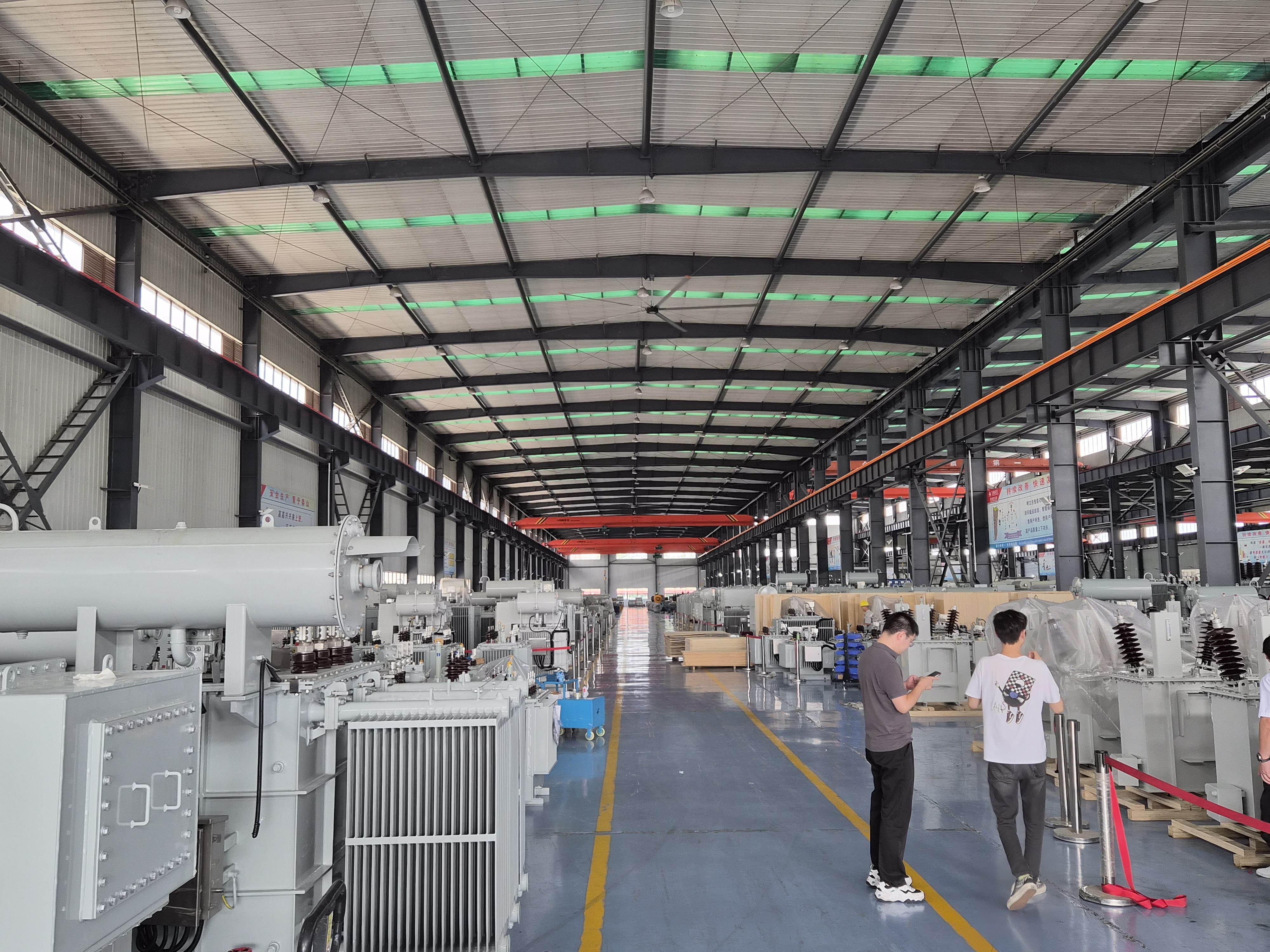
Manufacturing base behind the supply: standard pad-mounted production at 35 kV and below is stated at approximately 200 units per month, with routine testing to IEC 60076 / ANSI/IEEE C57.12 before shipment.
Have Questions or Need More Details?
Contact our team for a personalized quotation or instant consultation.
Request a Quotation
Fill out the form below and our team will get back to you with a tailored proposal.
WhatsApp Direct Chat
Prefer to chat in real-time? Message us on WhatsApp for instant assistance & quick answers.
- Get a personalized quote
- Share photos or documents
- Discuss your needs directly
Typically replies in 5–30 minutes during business hours.