
Prefabricated Cabin Substation vs Civil-Built Substation for Custom Transformer Projects
The selection question, defined
A custom transformer project rarely involves only a transformer. A working substation also needs high-voltage and low-voltage switchgear, protection, an auxiliary AC/DC supply, ventilation or cooling, and an enclosure or building to hold them. There are two ways to deliver all of it, and the choice changes the risk profile of the project far more than a small difference in transformer price does.
In the first model, a prefabricated (also called packaged, containerized or prefabricated cabin) substation is supplied as a factory-assembled unit — typically a steel or containerized enclosure containing the transformer, HV and LV switchgear, protection and auxiliary systems — and is delivered to site ready for connection. In the second model, a conventional substation is erected on site from separate components, and each item is installed and integrated by the site contractor.
The decision is often taken too late. The transformer specification is frozen first, and only afterwards are the enclosure, switchgear, protection and auxiliary supply discussed. That sequence creates interfaces — between the transformer supplier, the switchgear supplier and the civil contractor — and every interface is a place where responsibility can fall between parties. Deciding the delivery model early, at the same time as the transformer rating, removes most of that exposure.
Why the two models exist: industry background
Packaged substations emerged because grid stations are frequently needed faster than conventional civil construction allows. Where a distribution or medium-power grid station has to be energised quickly, or where a site has limited skilled site labour, assembling and factory-testing the whole unit before shipment converts site work into factory work that is easier to control. It also means the completed module can be relocated if the network changes — something a civil-built station cannot offer.
The same logic now applies well beyond classic utility distribution. Renewable-energy step-up stations, industrial plant substations, municipal power for temporary or permanent infrastructure, and projects in areas with limited transport access all tend to favour prefabrication, because the alternative is a long programme of site civil works in a location where that work is difficult to resource and supervise.
The civil-built model has not disappeared, and it is not a legacy approach. Transmission-level and complex multi-bay stations are still built on site, and the scale involved is significant: through Apex's audited manufacturing partners, custom power transformer designs are supported up to 250 MVA, verified by KEMA on a 345 kV class unit. Equipment at that scale is not shipped as a single packaged module.
What each option actually delivers
Prefabricated cabin substation
Within the range supplied through Apex, the prefabricated cabin substation is designated YBM/ZGS11/ZGS13 and is built around standard container dimensions, which can be customised to the project. Its verified configuration and ratings are as follows:
- Voltage class: 10 / 35 kV
- Transformer capacity: 500–50,000 kVA
- Integrated equipment: HV switchgear + transformer + LV switchgear + compensation equipment + automation system + AC/DC power supply + environmental control
- Cabin: containerized steel structure with rock-wool sandwich-panel insulation and anti-corrosion coating; standard container dimensions, customisable
- Transformer type: oil-immersed or dry-type, optional
- Switchgear: metal-clad withdrawable or fixed type with vacuum circuit breakers
- Busbar: copper busbar with heat-shrink insulation
- Monitoring: integrated automation system covering temperature, humidity, smoke, water-ingress and access monitoring
- HVAC and fire protection: industrial air conditioner, forced ventilation and heater; gas extinguishing or ultra-fine dry powder fire protection available as an option
- Protection and environment: IP54 / IP55; ambient temperature −40°C to +50°C
- Installation: transported as a complete unit and positioned by crane lifting with on-site connection
The practical consequence is that the transformer, the switchgear and the auxiliary systems are assembled and tested together in one place, then moved as one asset. The site work that remains is essentially foundation preparation, positioning and connection.
Conventional civil-built substation
In the civil-built route the substation is erected on site from separate components. Foundations, structures, the transformer plinth, switchgear and control accommodation, cable routes, earthing and the auxiliary supply are constructed on site, and the transformer, switchgear and protection panels arrive as separate deliveries to be installed, wired, tested and commissioned by the site contractor and the individual equipment suppliers.
This route remains the appropriate choice where capacity is very large, where a complex multi-bay layout is required, or where local civil and utility standards demand a bespoke arrangement. Its advantage is freedom of layout; its cost is that the integration, testing and responsibility for the finished system are distributed across several parties on site.
How the two routes differ on the factors that decide a project
Speed and sequence
Packaged substations cut on-site civil works and installation time, because assembly and factory testing are completed before shipment. The published lead time for prefabricated cabin substations is 90–120 days, subject to technical evaluation and the technical agreement, while the typical project delivery cycle from contract to site acceptance is 3–6 months. On the civil-built route the transformer programme is still on the critical path — 90–150 days for large or custom power transformers — but the overall programme is additionally governed by civil construction and on-site integration.
Where quality is controlled
One of the clearest differences is where verification happens. A prefabricated cabin substation benefits from factory pre-assembly and full-load testing, IEC routine and type tests, and integrated system commissioning tests before the unit leaves the works. On the civil-built route each equipment package is individually tested at its own factory, and the behaviour of the assembled system is verified on site.
Environment and protection
Packaged units are specified with defined environmental performance: IP54 / IP55 protection and an ambient temperature range of −40°C to +50°C, with integrated heating and ventilation and optional fire suppression. That makes them suitable for cold-climate and hot-climate projects alike, and for sites where a permanent manned building would be impractical. In a civil-built station, environmental provision is designed and built to the local specification, which gives more freedom but also more site-dependent variables.
Flexibility and relocation
A packaged substation can be relocated if the network changes, which is valuable for temporary capacity, expanding industrial sites and construction power. A civil-built substation is a fixed installation, and capacity growth is normally handled by adding bays or a new station.
Certification and market acceptance
Both routes depend on documents, not on impressions. Management-system certification held by the audited manufacturing partners covers the box-type substation product family, and IEC conformity applies to 10 kV / 35 kV power transformers and box-type substations, with CQC product certification for box-type substations and switchgear product lines. Destination-market certification — UL or CSA for North America, EAC declarations for Russia and the EAEU, CE marking under the Electromagnetic Compatibility Directive for the EU / EEA — must be confirmed before the design is frozen, whichever delivery model is chosen.
Step-by-step: how to choose and deliver the right model
The following sequence works for both routes and forces the delivery-model decision to be taken while it can still be changed.
- Fix the load and the voltage class. Establish the required capacity with a growth margin, the HV and LV voltage levels, the connection symbol (vector group), the cooling class, and whether an on-load or off-circuit tap changer is needed. Distribution-level projects typically fall within the 10 / 35 kV, 500–50,000 kVA range of a prefabricated cabin; transmission-level projects move to large power transformers in the 10 kV to 765 kV range.
- Describe the site. Indoor or outdoor, ambient temperature, altitude, seismic zone, pollution level, transport access and whether skilled site labour is available. High-altitude derating, seismic design, anti-corrosion class C3 / C4 / C5 and special protection ratings IP54 / IP55 are all customisation items that should be stated now.
- State the programme. If energisation is required within a compressed window, or the site is remote, prefabrication moves work off the critical path. If the programme is governed by a long civil works package, the packaged route may not be the constraint at all.
- Confirm the destination market's requirements. Identify the certification the utility or the regulator will ask for, and verify that the certificate is current, issued in the correct legal entity name and covering the exact product family ordered.
- Select the delivery model. Prefabricated cabin for distribution and medium-power grid stations, urgent deployments, remote sites, renewable step-up stations and transport-constrained projects; civil-built for very large capacity, complex multi-bay layouts and locally mandated bespoke arrangements.
- Approve the technical proposal and freeze the design. The verified engineering cycle is a technical proposal within 3–5 business days and a design cycle of 15–30 days, subject to technical evaluation and complexity. Design review is carried out by senior engineers, supported by electromagnetic, thermal and mechanical computational verification, with prototype testing for new designs.
- Build and pre-test. Prefabricated cabins follow a modular assembly line with project-based scheduling. Quality control covers incoming material inspection, dimensional checks, weld inspection and tank pressure / leak testing, followed by factory pre-assembly and full-load testing.
- Carry out factory acceptance testing. Pre-shipment FAT is performed for the project, and routine tests follow IEC 60076 / IEEE C57.12 — winding resistance, turns ratio, load loss and impedance, no-load loss and current, insulation tests, induced withstand and partial discharge measurement, lightning impulse and oil test. Type and special tests are available on request, and third-party inspection is available through SGS, BV and KEMA.
- Transport and connect. The completed unit is transported as a single module and positioned by crane, with on-site connection and connection works completed by the site team. Local agent coordination and multi-unit project scheduling are part of the delivery service.
- Commission and hand over. A joint Site Acceptance Test (SAT) is conducted with the customer after installation, followed by commissioning, trial operation and technical training for customer personnel, with warranty coverage and remote support afterwards.
Use cases: which projects choose which model
Renewable-energy step-up stations
PV, wind and energy-storage projects are among the strongest candidates for the packaged route, because grid connection points are often remote, the programme is driven by the generation asset, and the station is comparatively compact. Prefabricated cabin substations are supplied for PV, wind and storage applications with integrated HV switchgear, transformer, LV switchgear, automation and monitoring. The record behind this route includes a 40,000 kVA energy-storage project delivered for a Bulgarian transmission company and multiple 40 MVA class PV transformers delivered and commissioned for European PV projects.
Data centres and AI computing parks
Where a campus must be energised quickly and the distribution is indoors, a common arrangement is dry-type transformers for the indoor MV/LV distribution and an oil-immersed transformer or a prefabricated substation for the incoming supply. Prefabricated cabins are listed for data centres and AI computing parks, industrial plant substations, and temporary or permanent municipal infrastructure power.
Industrial, mining and remote sites
Industrial plant substations and remote power supply for mines and oil and gas fields favour the packaged route because the alternative is extensive site construction in a difficult location. Projects in cold-climate markets such as Mongolia, where a 110 kV substation was designed, supplied and installed, illustrate the same point about delivering complete stations rather than loose equipment.
Overseas EPC projects with limited transport access
Prefabricated cabins are specified for overseas EPC power projects in areas with limited transport access, where a single transportable module is easier to move and install than a sequence of separate deliveries requiring specialist site trades. Box-type substations have been delivered to projects including a 15 MVA pad-mounted (box-type) transformer project for a United States transmission company.
Transmission and complex multi-bay stations
For very large capacity and complex multi-bay layouts, the civil-built route remains appropriate. The reference record at this scale includes 4 × 110 kV power transformers for Azerbaijan Power Energy Company, 115 kV substations in Tajikistan, a 132 kV transformer for a Spanish steel-plant substation, a 69 kV transformer in the Philippines, a 345 kV fully insulated power transformer for a US–Georgia transmission company and a 115 kV substation for a Puerto Rico power distribution company.
Side-by-side comparison
| Decision factor | Prefabricated cabin substation | Conventional civil-built substation |
|---|---|---|
| What is delivered | Factory-assembled unit — steel or containerized enclosure containing the transformer, HV and LV switchgear, protection and auxiliary systems, delivered ready for connection | Erected on site from separate components: civil structures, transformer, switchgear, protection and auxiliary supply integrated by the site contractor |
| Voltage class and capacity | 10 / 35 kV; transformer capacity 500–50,000 kVA | Set by the transmission equipment rather than by an enclosure: power transformers across the 10 kV to 765 kV range, with custom designs supported up to 250 MVA, verified by KEMA |
| On-site work | Reduced — foundation preparation, crane positioning and on-site connection | Higher — foundations, structures, cable routes, earthing and separate installation of each equipment package |
| Where quality is verified | Factory pre-assembly and full-load testing, IEC routine and type tests, and integrated system commissioning tests before shipment | Individual factory tests on each equipment package; integration of the assembled system verified on site |
| Acceptance process | Pre-shipment FAT and post-installation joint SAT with the customer; third-party inspection available through SGS, BV and KEMA | Pre-shipment FAT per equipment package and site acceptance of the integrated installation |
| Environmental performance | IP54 / IP55; ambient temperature −40°C to +50°C; integrated HVAC, forced ventilation and heater; optional gas extinguishing or ultra-fine dry powder fire protection | Designed and built to the local specification; more layout freedom, more site-dependent variables |
| Relocation | Can be relocated if the network changes | Fixed installation; not designed for relocation |
| Indicative lead time | 90–120 days for prefabricated cabin substations, subject to technical evaluation; typical project delivery 3–6 months from contract to site acceptance | 90–150 days for large or custom power transformers, subject to technical evaluation; overall programme additionally governed by civil works and site integration |
| Best fit | Distribution and medium-power grid stations, urgent grid stations, remote sites with limited skilled site labour, PV / wind / storage step-up, data centres, industrial plant substations, temporary or permanent municipal power, projects with limited transport access | Very large capacity, complex multi-bay layouts, and projects where local civil and utility standards require a bespoke arrangement |
| Minimum order | MOQ 1 cabin, project-based orders; a minimum order quantity of 1 unit supports prototype and pilot orders | Project-based; equipment quantities set by the station layout |
Both routes are supplied through the same audited manufacturing partners, so the comparison is a delivery-model comparison rather than a supplier comparison. On the packaged route a single contract covers the enclosure, the transformer, the switchgear, the automation and the auxiliary systems; on the civil-built route those scopes are split across several packages and the site programme.
Quality control, testing and certification across both routes
Whichever model is chosen, the documents that make a substation acceptable to a utility are the same kind of documents, and they can be checked before the order is placed rather than after delivery.
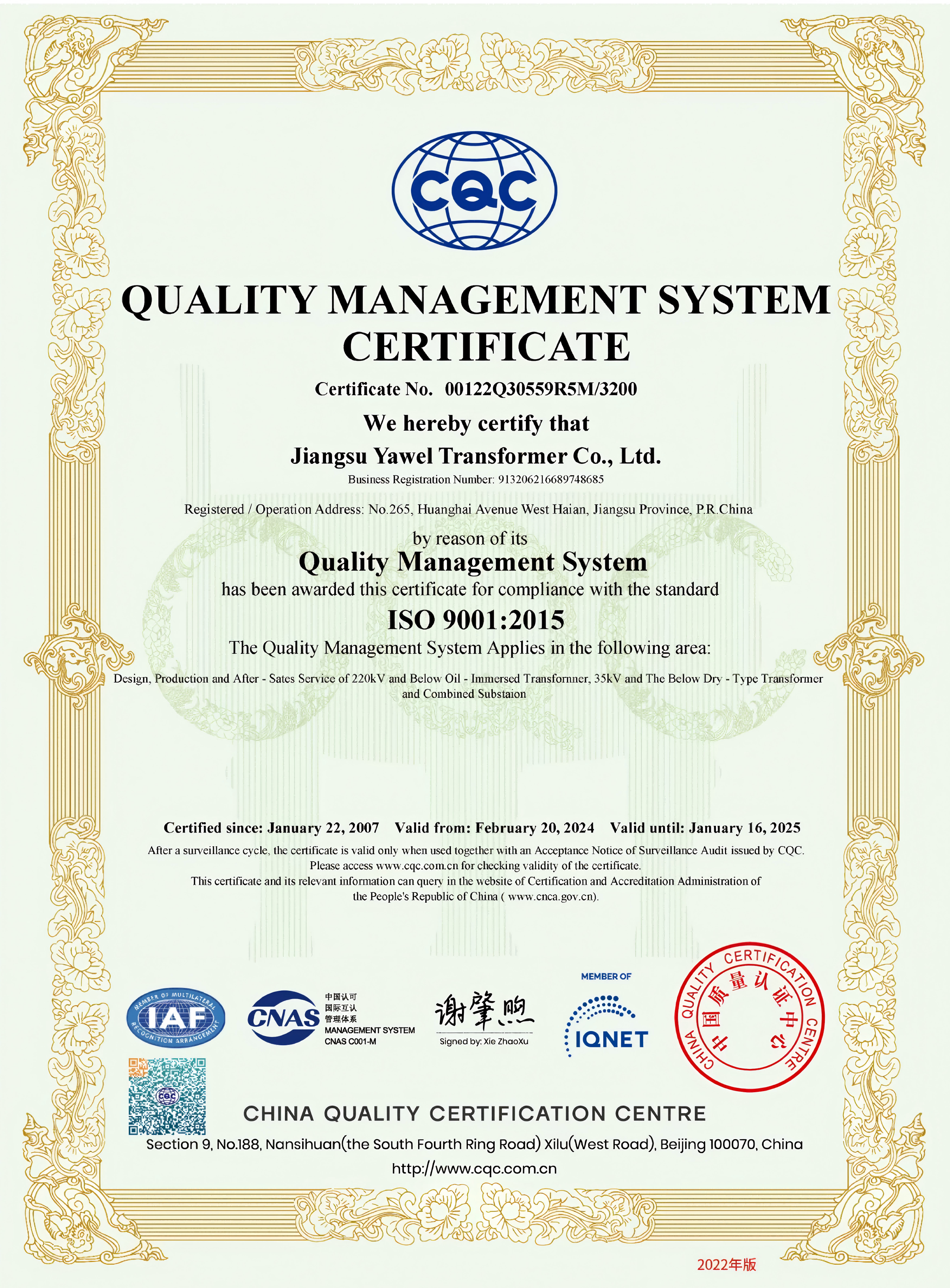
- Management systems: ISO 9001, ISO 14001 and ISO 45001 certification held by the audited manufacturing partners, with the ISO 9001 scope covering the design and production of oil-immersed transformers up to 220 kV, dry-type transformers up to 35 kV and box-type substations.
- Product conformity: IEC conformity for 10 kV / 35 kV power transformers and box-type substations, and CQC product certification for box-type substations and switchgear product lines.
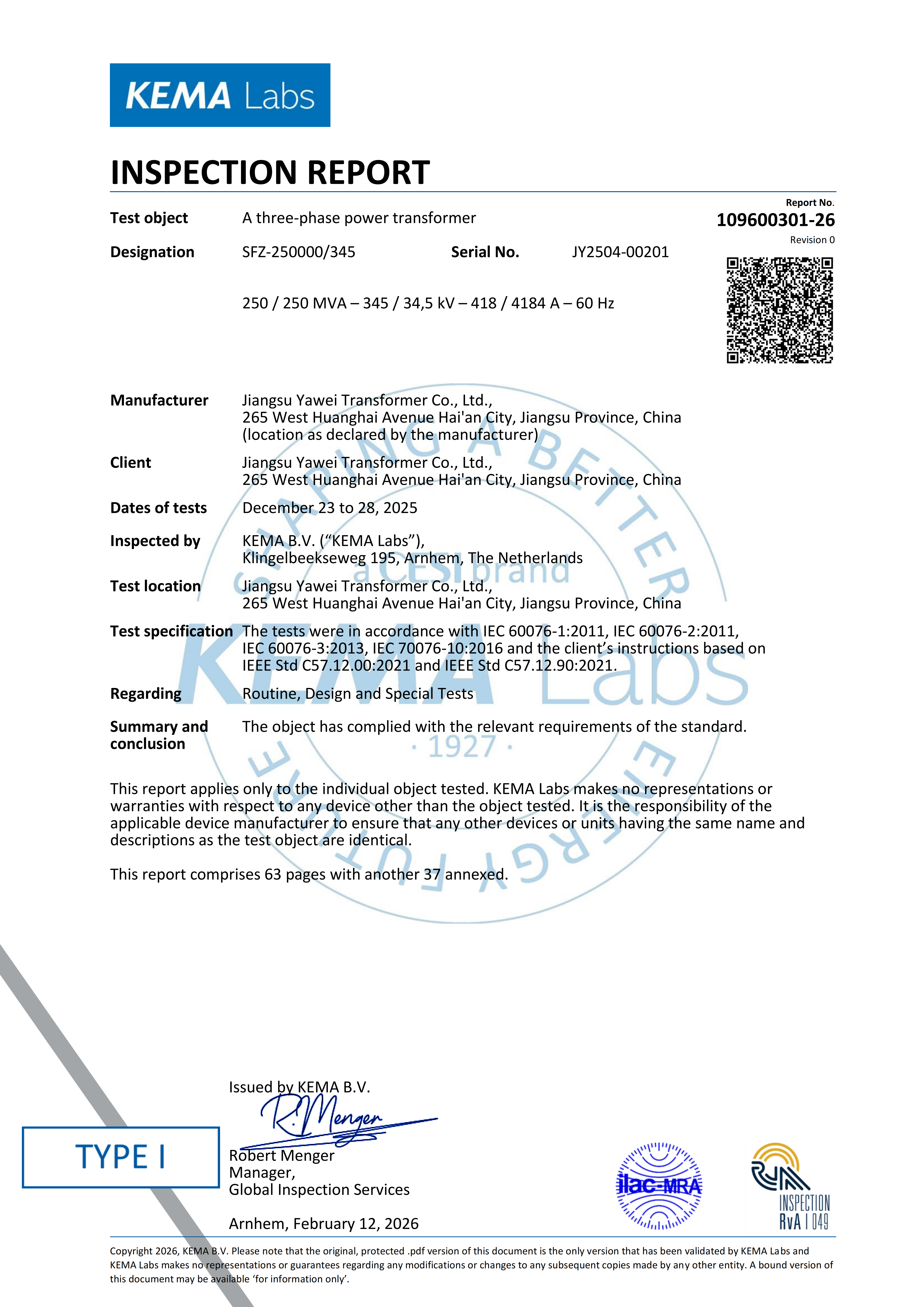
- Independent verification: a KEMA Labs (KEMA B.V., The Netherlands) Type I Inspection Report for a 250 MVA / 345 kV three-phase power transformer, tested in accordance with IEC 60076-1 / -2 / -3, IEC 60076-10, IEC 60076-11 and IEEE Std C57.12.00 / IEEE C57.12.90 (report 702226901-24), and a further KEMA witnessed routine, type and special test programme issued as report 109600301-26.
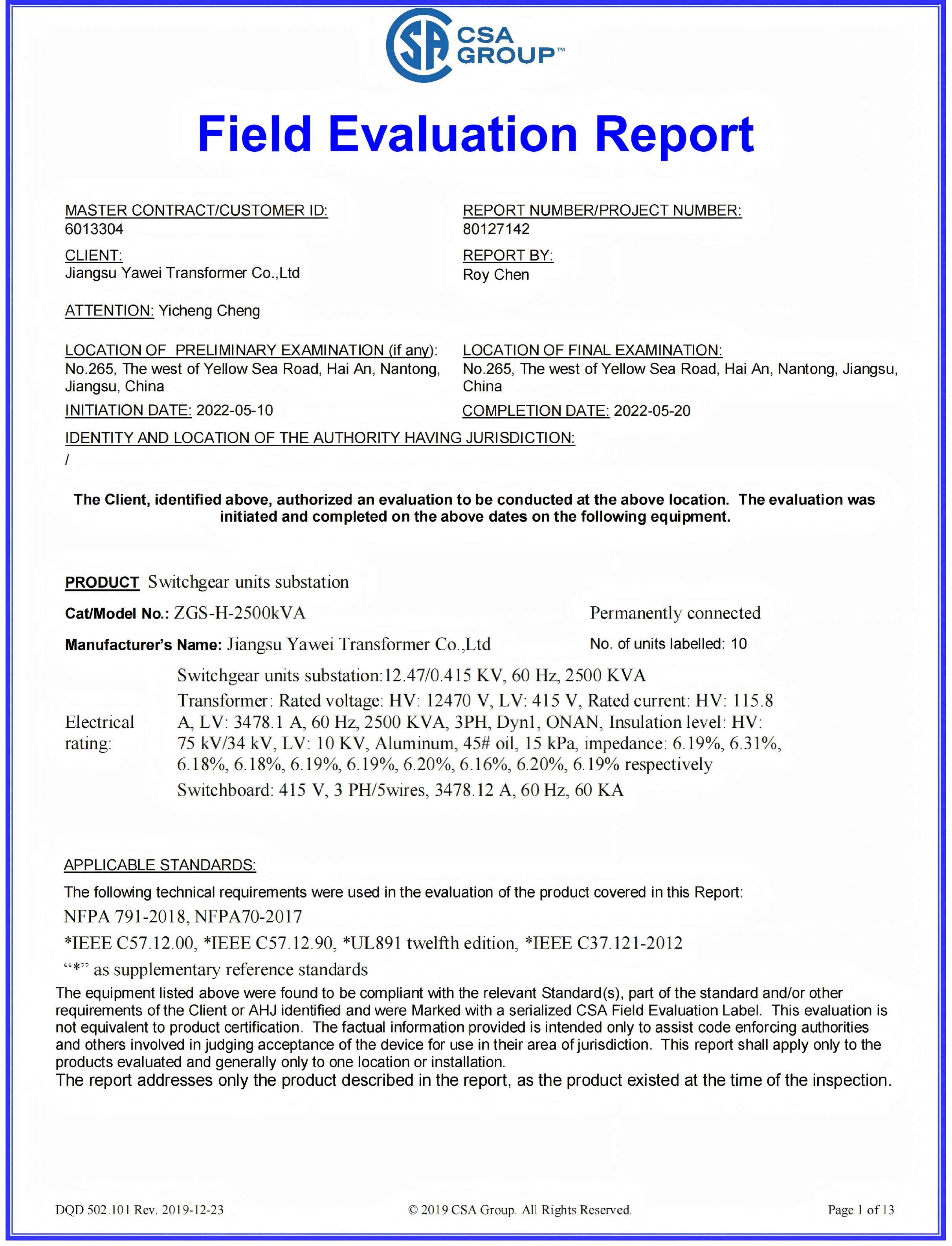
- Market-specific certification: UL and CSA certification for North American requirements, including a CSA Group field evaluation report for a switchgear unit substation (report 80127142, evaluated against NFPA 791-2018, NFPA 70-2017, IEEE C57.12.00, IEEE C57.12.90, UL 891 and IEEE C37.121-2012), and EAC declarations of conformity for Russia and the EAEU.
- Verification discipline: a certificate number should always be checked with the issuing body, the expiry date confirmed, the certificate holder's legal entity name matched to the contracting party, and the listed model range confirmed to cover the ordered unit.
Frequently asked questions
Which certifications should a prefabricated cabin substation carry for an overseas project?
A packaged substation should be supported by three layers of documentation. The first is a management system: ISO 9001, ISO 14001 and ISO 45001 certification held by the manufacturing partner, with the ISO 9001 scope explicitly covering box-type substations as well as transformers. The second is product conformity: IEC conformity for 10 kV / 35 kV power transformers and box-type substations, and CQC product certification for box-type substations and switchgear product lines. The third is market-specific certification for the destination — UL or CSA for North America, EAC declarations of conformity for Russia and the EAEU, or CE marking under the Electromagnetic Compatibility Directive for the EU / EEA. Each document should be checked for three things before the order is placed: that the certificate number can be verified with the issuing body, that it has not expired, and that the certificate holder's legal entity name matches the company that will sign the contract.
Can a custom transformer manufacturer handle in-house design and testing of a packaged substation, or is it only final assembly?
Design and testing are the parts that decide whether a packaged substation works, so they should be verified rather than assumed. On the engineering side, custom work covers voltage ratios, capacities, impedances, vector groups and tap ranges, together with special cooling methods, noise reduction, anti-corrosion classes C3 / C4 / C5, high-altitude derating, seismic design and special protection ratings such as IP54 / IP55, with KEMA, UL and CSA certification design supported where the destination market requires it. Design review is carried out by senior engineers and supported by electromagnetic, thermal and mechanical computational verification, with prototype testing for new designs; a technical proposal is typically issued within 3–5 business days and the design cycle runs 15–30 days, subject to technical evaluation and complexity. On the testing side, the process covers incoming material inspection, dimensional checks, weld inspection, tank pressure and leak testing, factory pre-assembly and full-load testing, followed by IEC routine and type tests and integrated system commissioning tests. The dedicated test laboratory includes lightning-impulse, no-load and load-loss, ratio, winding-resistance, temperature-rise and insulation test benches, and independent third-party inspection is available through SGS, BV and KEMA.
What drives the cost of a prefabricated cabin substation compared with a civil-built one?
The cost comparison is a comparison of scope, not of a single price. A prefabricated cabin substation integrates the HV switchgear, transformer, LV switchgear, compensation equipment, automation system, AC/DC power supply and environmental control into one factory-assembled package, so those items are contracted, assembled and tested together rather than bought and installed separately. Because assembly and factory testing are completed before shipment, on-site civil works and installation time are reduced, which is where much of the difference arises — but the total installed cost still depends on site conditions, transport access, and whether local civil and utility standards require a bespoke arrangement. Commercial terms support a staged approach: the minimum order quantity is one unit or one cabin, and while one-off projects may incur design fees, those fees are refundable for bulk orders, subject to technical evaluation.
Can we order a single unit or a pilot before committing to a full project?
Yes. The minimum order quantity of one unit is specifically intended to support prototype and pilot orders for custom transformer projects, and prefabricated cabin substations are also offered at a project-based minimum order quantity of one cabin. A pilot unit is a reasonable way to validate a new design, because quality control for new designs includes senior engineer design review, computational verification and prototype testing before series production. If the design is validated and the project proceeds to multiple cabins or multiple transformer units, the engineering effort already invested carries forward into the production batch.
How long does a prefabricated cabin substation take to deliver, and how is it accepted?
Prefabricated cabin substations are quoted at 90–120 days, subject to technical evaluation and the technical agreement, and the typical project delivery cycle from contract to site acceptance is 3–6 months. Acceptance is a two-stage process. Before shipment, a Factory Acceptance Test (FAT) is performed; routine tests follow IEC 60076 / IEEE C57.12 and include winding resistance, turns ratio, load loss and impedance, no-load loss and current, insulation tests, induced withstand and partial discharge measurement, lightning impulse and oil test, with type and special tests available on request and third-party inspection available through SGS, BV and KEMA. After installation, a joint Site Acceptance Test (SAT) is conducted with the customer, followed by commissioning, trial operation, technical training for customer personnel, a 12–24 month warranty per contract, spare parts and 7×24 remote support. To start a technical proposal and quotation for a specific project, send your load data, voltage levels, vector group, site conditions and target schedule to Apex Power Systems or request a sample and quotation through the company website.
Next step
Choosing between a prefabricated cabin substation and a civil-built substation is a decision about where you want the risk to sit: in a factory with a defined test regime and a defined delivery date, or on a site with a layout built to your own civil standard. Both are legitimate answers, and the answer changes with capacity, voltage class, location, schedule and the certification the receiving utility will demand.
The practical way to settle it is to provide the load and voltage data, the site description and the target energisation date, and to ask for a technical proposal covering both routes with the scope, testing and acceptance terms stated for each. That comparison takes a few business days to prepare and prevents the more expensive mistake of discovering the delivery model was wrong after the transformer specification has been frozen.
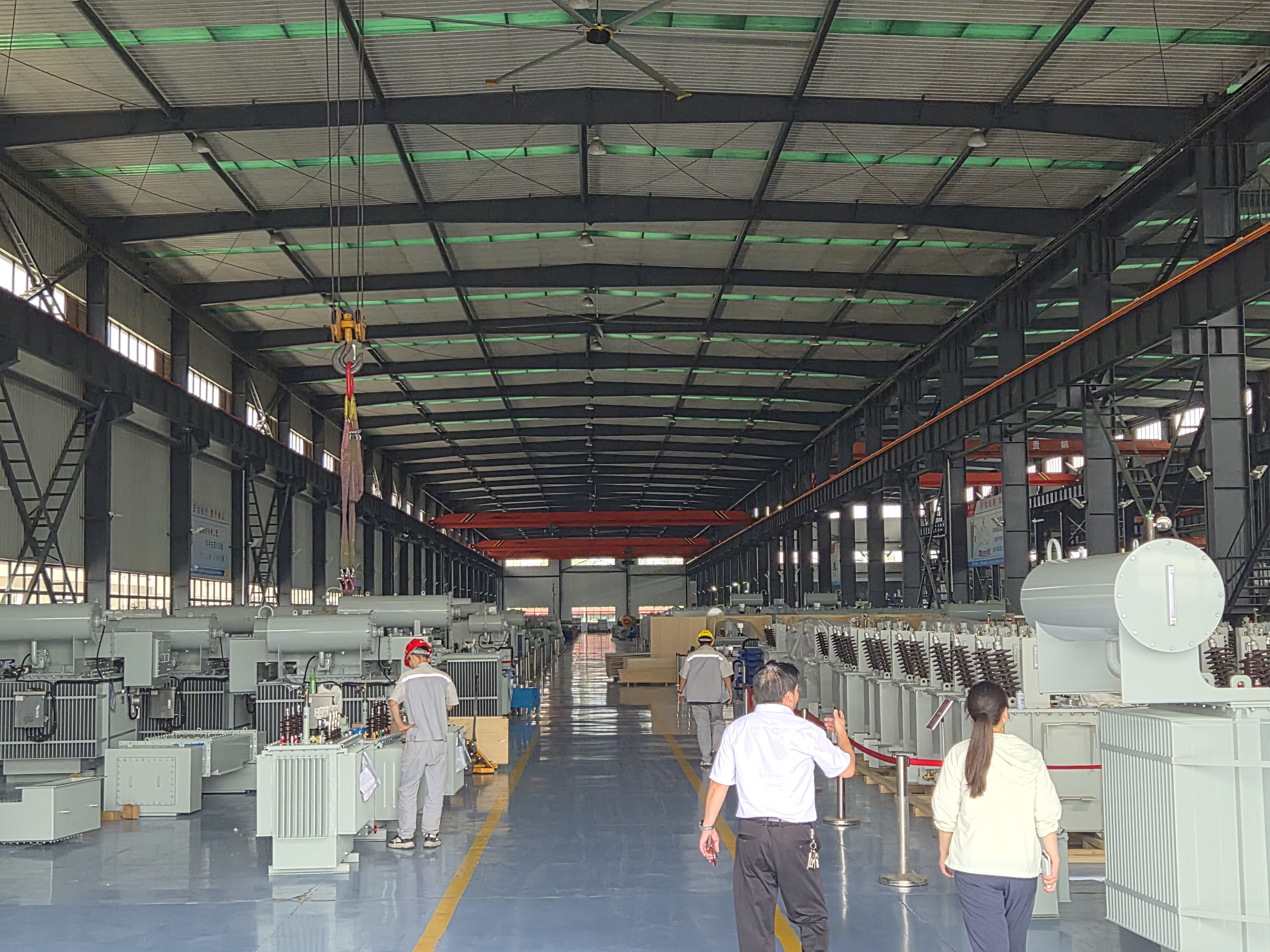
Request a technical proposal for your substation project
Send your load data, voltage levels, site conditions and target schedule to Apex Power Systems (Nanjing)Co., Ltd. You will receive a comparison of the prefabricated cabin route and the civil-built route, with the applicable certification, testing and delivery terms for each.
Email: xuke@apexps-nj.com | Tel / WhatsApp: +86 132-0157-1341 | Website: apexpowerlink.com
Download the full product and capability catalogue: Apex Power Systems Catalog (PDF)
Have Questions or Need More Details?
Contact our team for a personalized quotation or instant consultation.
Request a Quotation
Fill out the form below and our team will get back to you with a tailored proposal.
WhatsApp Direct Chat
Prefer to chat in real-time? Message us on WhatsApp for instant assistance & quick answers.
- Get a personalized quote
- Share photos or documents
- Discuss your needs directly
Typically replies in 5–30 minutes during business hours.