Ranked: Custom Transformers for North American Residential and Commercial Distribution
Short answer: For North American residential and commercial distribution, the correct custom transformer is decided by the type of load and by where the unit has to stand — not by kVA alone. Ranked by fit for that duty, five configurations cover almost every project: three-phase pad-mounted units (75–2500 kVA) for commercial and light-industrial services; single-phase pad-mounted units (15–250 kVA) for underground residential distribution; single-phase pole-mounted units (5–167 kVA) for overhead and rural residential lines; dry-type units (30–2500 kVA at 10 kV class) for indoor installation close to the load; and oil-immersed distribution transformers (30–3150 kVA at 10 kV class) for larger loads where an outdoor location is available. Every liquid-filled unit applied above 750 V must also hold a UL Certificate of Compliance for the destination market — that certificate is a selection criterion, not paperwork to be settled after the order.
The ranked list at a glance
- Three-phase pad-mounted transformer — commercial and light-industrial distribution (75–2500 kVA)
- Single-phase pad-mounted transformer — underground residential distribution (15–250 kVA)
- Single-phase pole-mounted transformer — overhead and rural residential lines (5–167 kVA)
- Dry-type transformer — indoor commercial distribution close to the load (30–2500 kVA, 10 kV class)
- Oil-immersed distribution transformer — larger outdoor commercial and industrial distribution (30–3150 kVA, 10 kV class)
Ranking criteria used throughout: rated capacity range, voltage class and frequency, installation type, protection and switching package, and certification for the destination market.
Apex Power Systems (Nanjing) Co., Ltd. is an international trading and supply-partner company for power transformers and substation equipment; it is not itself a factory, and instead selects, audits and manages manufacturers on the buyer's behalf, coordinating design, production, testing, shipment and commissioning. All manufacturing, certification and test references in this article relate to the audited manufacturing partners whose products Apex supplies.
1. Problem Definition: Why Custom Transformer Selection Goes Wrong in North America
A North American distribution project rarely fails because the transformer was too small. It fails because a technically correct unit was specified for the wrong place, or because the purchasing utility could not accept it. Four failure modes account for most of the rework.
Failure mode 1 — certification for the destination market
A liquid-filled distribution transformer rated over 750 V needs a UL Certificate of Compliance for the destination market, and for Canada certification to CSA C2.1-06 and CSA C227.4. A unit that is electrically correct but not certified for the market where it will be installed will not be accepted, no matter how good the losses or the enclosure are. This is why certification is treated in this article as a ranking and selection criterion rather than a compliance afterthought.
Failure mode 2 — the "box" misconception
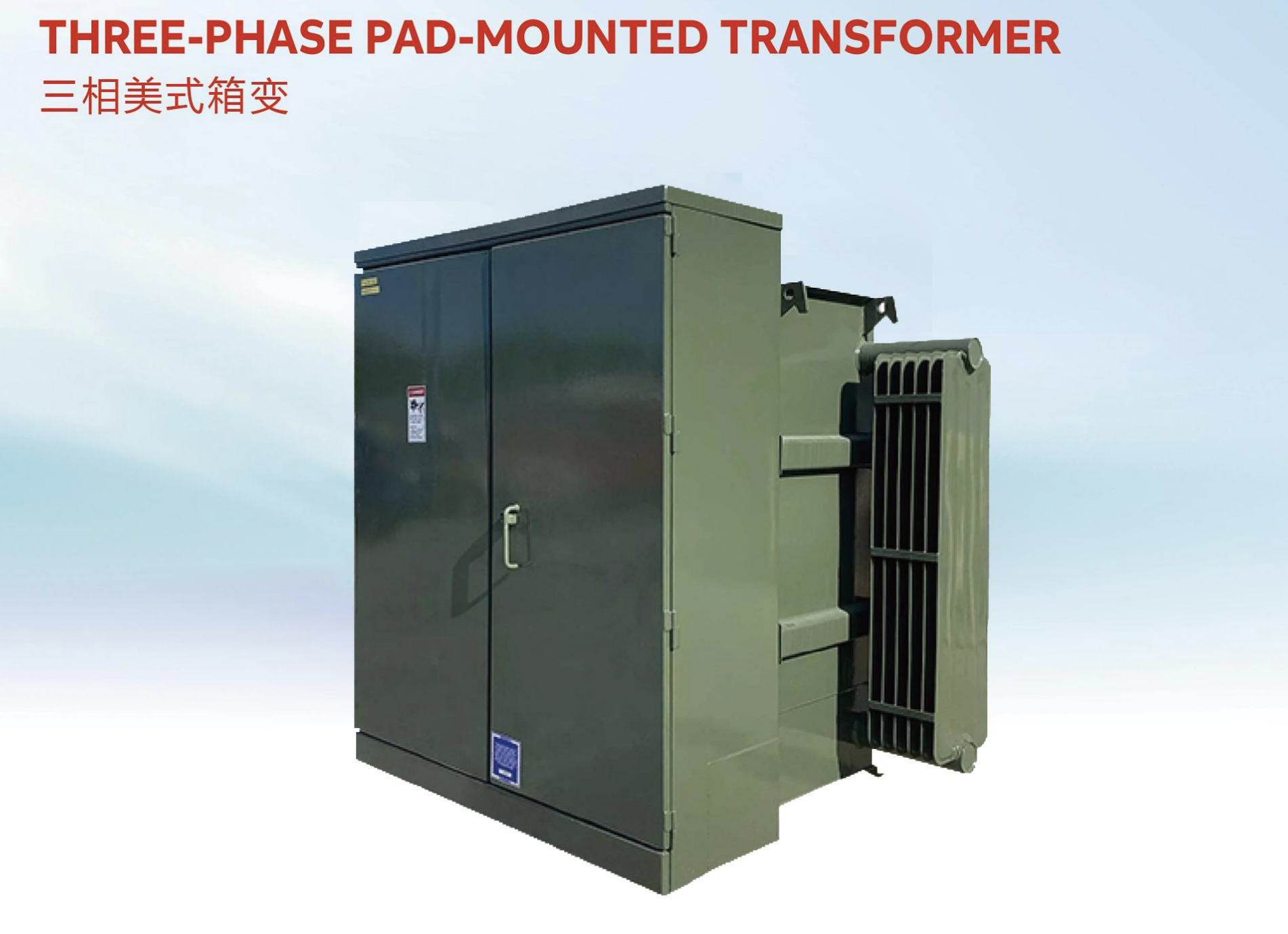
A pad-mounted transformer is not a standard distribution transformer placed inside a metal box. It is a distribution transformer whose high-voltage and low-voltage switching, fusing and protection are enclosed together with the transformer in a tamper-resistant steel enclosure, installed at ground level on a concrete pad. That construction is what allows the unit to stand in a publicly accessible area without a fenced substation — and it is why the enclosure, the switching and the fusing belong to the customization scope rather than being accessories added later.
Failure mode 3 — treating single-phase and three-phase pad-mounted units as interchangeable
They are different products serving different services. Single-phase pad-mounted units use a 120/240 V centre-tapped low-voltage winding for residential service, while three-phase pad-mounted units step down to 240/480 V for commercial and light-industrial service. Specifying the wrong one is not a small error, because the low-voltage winding defines what the service can be connected to.
Failure mode 4 — placing a liquid-filled unit indoors
Where the transformer must sit inside a building, close to the load, a dry-type transformer removes the insulating oil from the building entirely. Oil-immersed units then remain the right answer for outdoor or dedicated-enclosure locations.
2. Industry Background
The distribution transformer segment is growing faster than the transformer market as a whole, and two regulatory shifts are changing what buyers now write into a specification.
- The global distribution transformer market is projected to grow from USD 26.0 billion in 2026 to USD 47.7 billion by 2033, a CAGR of 9.1% (Grand View Research).
- The total global transformer market is estimated to reach USD 80.8 billion in 2026 (Fortune Business Insights); the distribution transformer segment is therefore roughly one third of the total.
- Global trade of electrical transformers with a power capacity above 500 kVA (HS 850434) reached USD 2.5 billion in 2024, a 12.7% increase year on year (OEC).
- The U.S. Department of Energy 2024 rule under 10 CFR Part 431 requires distribution transformers to transition towards amorphous electrical steel starting in 2029.
- In China, GB 20052-2024, the standard for minimum allowable values of energy efficiency and energy efficiency grades for power transformers, took effect on 1 February 2025 — relevant to buyers because a large share of custom distribution units for export is engineered and manufactured in China.
The practical consequence is that core material, loss performance and destination-market certification now sit in the same specification conversation. A specification written only around kVA and voltage class leaves all three open, which is exactly where projects lose time.
3. The Ranked Configurations
The ranking below is ordered by breadth of fit across North American residential and commercial distribution duty. It is a ranking of configurations, not of brands: individual projects can and do reverse the order once the scope is narrowed to one building or one network section.
Rank 1 Three-phase pad-mounted transformer — ZGS-H / ZGS-Z Series
What it is. A three-phase, outdoor pad-mounted distribution transformer with a fully sealed tank, rated 75–2500 kVA. High voltage covers 4.16 / 12.47 / 13.2 / 13.8 / 22.86 / 24.94 / 34.5 kV or customized values; low voltage covers 240 / 480 / 600 / 347 V or customized values at 50/60 Hz. Efficiency is specified to DOE (2016) / CSA (2023), and the insulation level follows ANSI/IEEE standards. The internal package includes a load-break switch, fuse and surge arrester, with a loop-feed configuration available; the core is low-loss grain-oriented silicon steel with step-lap joints, the windings are copper foil or copper conductors with interlayer insulation, the high-voltage bushings are epoxy-resin moulded with elbow connectors, and the low-voltage terminals are copper busbar. The enclosure is stainless steel or carbon steel with a military green or grey anti-corrosion powder coating.
Why it ranks first. It covers the widest band of commercial and light-industrial distribution duty in North America, and it is the configuration most often customized, because the utility or consulting engineer fixes the voltage class, the feed arrangement (loop or radial) and the protection package. Apex-coordinated reference work includes a 15 MVA pad-mounted transformer project delivered for a U.S. transmission company, and the catalogue range runs to 2500 kVA with flexible MOQ.
Limits. It is not the right unit for a single-phase residential service. Where the service is single-phase, Rank 2 or Rank 3 applies.
Rank 2 Single-phase pad-mounted transformer — ZGD-H / ZGD-Z Series
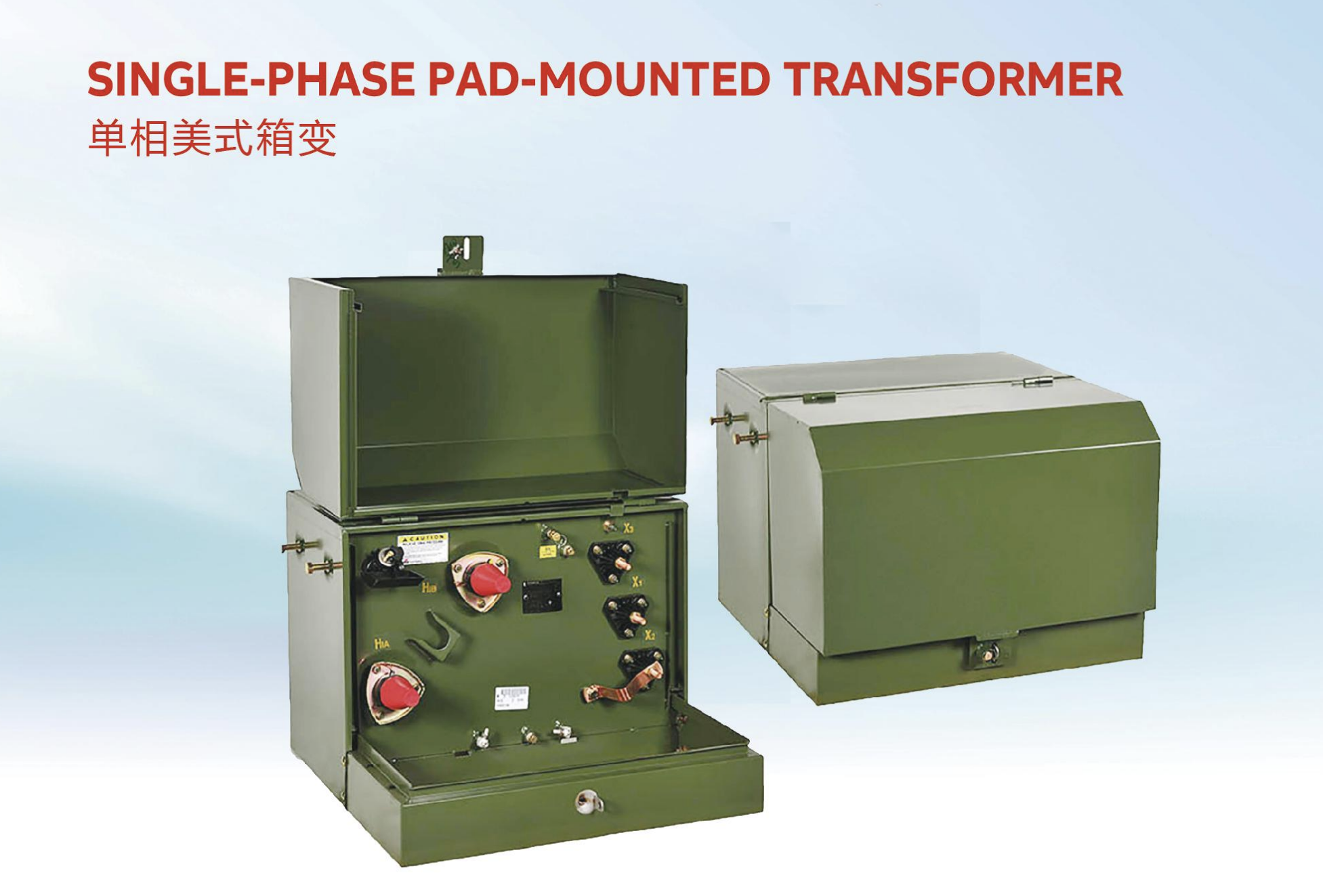
What it is. A single-phase pad-mounted unit rated 15–250 kVA, with an amorphous-alloy or silicon-steel core, copper windings with paper insulation, a carbon-steel welded fully sealed tank, epoxy-resin elbow high-voltage bushings and a 120/240 V centre-tapped low-voltage winding; cooling is natural mineral-oil circulation and the surface is anti-corrosion powder coated. It is ANSI/IEEE compliant with UL/CSA certification.
Why it ranks second. Residential loads in North America are predominantly single-phase, and the pad-mounted format is the standard answer for underground residential distribution, where the 15–250 kVA range covers homes through small commercial users. The 120/240 V centre-tapped winding matches the North American residential system directly, and the fully sealed, maintenance-free design keeps operating noise low for residential areas. An optional amorphous-alloy core reduces no-load losses by 60–80% compared with conventional cores, which is directly relevant to the DOE 2029 direction. The configuration has been delivered to overseas projects including Panglao in the Philippines.
Limits. The 250 kVA ceiling and single-phase construction mean any three-phase commercial or light-industrial load moves to Rank 1.
Rank 3 Single-phase pole-mounted transformer — D-M Series
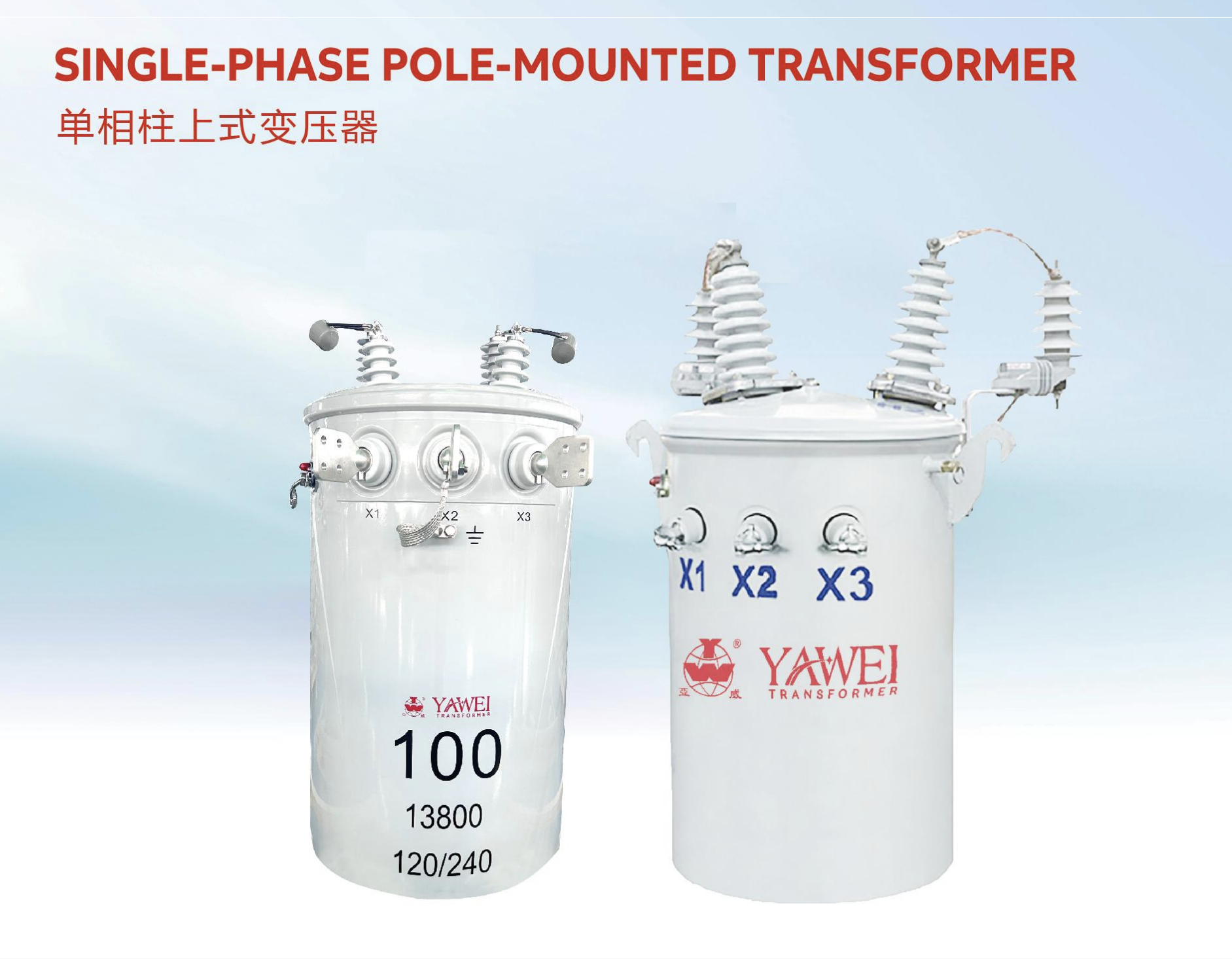
What it is. A single-phase pole-mounted unit rated 5–167 kVA, using a high-permeability silicon-steel or amorphous-alloy core, copper windings with NOMEX paper or cable-paper insulation, a cylindrical or elliptical carbon-steel fully sealed tank, porcelain or composite high-voltage bushings, porcelain low-voltage bushings and ONAN natural oil circulation. Accessories include a drain valve, oil-level gauge, grounding terminal and nameplate, with top lifting eyes and side mounting brackets. It is ANSI/IEEE compliant with DOE/CSA efficiency certification, and is designed for ambient temperatures from –40°C to +40°C and elevations up to 2,000 m.
Why it ranks third. Where the distribution line is overhead, pole mounting removes the need for a distribution room, which reduces civil works and low-voltage line losses. The range is applied to rural grids, remote areas and scattered settlements, agricultural production and irrigation, and municipal street lighting. Reference deliveries include rural-grid projects in Mongolia and Azerbaijan.
Limits. It tops out at 167 kVA and is not applicable to an underground residential network, which needs a pad-mounted unit.
Rank 4 Dry-type transformer — SCB12–SCB18 Series
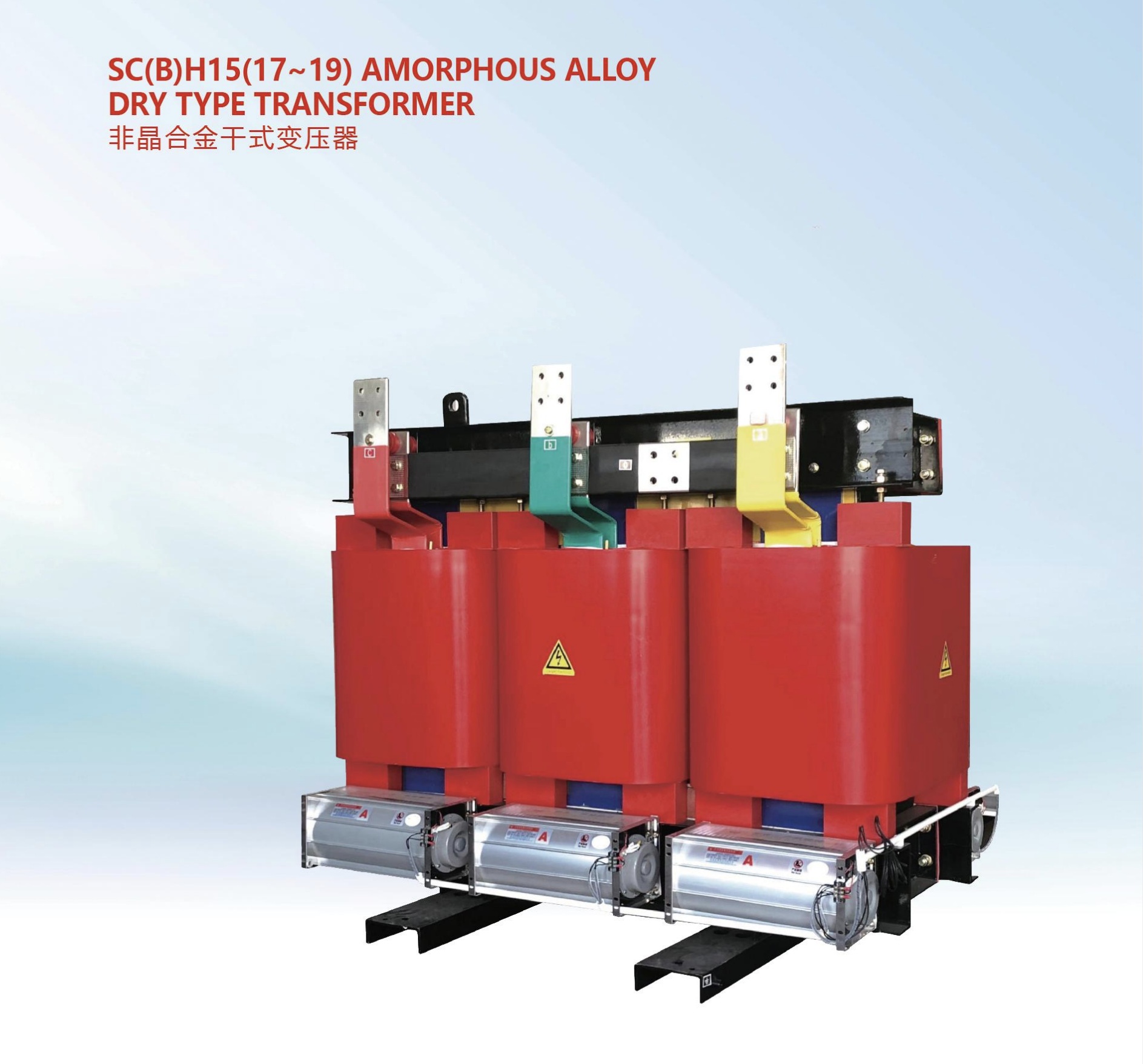
What it is. An epoxy resin cast dry-type power transformer rated 30–2500 kVA at 10 kV class and 800–25,000 kVA at 35 kV class, with high voltage at 6 / 10 / 10.5 / 11 / 20 / 35 kV and low voltage at 0.4 / 0.69 / 3.15 / 6.3 / 10.5 kV, 50/60 Hz, vector groups Dyn11 or Yyn0. Insulation class is F (155°C) or H (180°C), with AN natural air or AF forced air cooling, temperature-rise limits of 100 K (F) and 125 K (H), and protection ratings of IP00 / IP20 / IP23. High-voltage windings are vacuum-cast epoxy resin over copper foil or copper conductors, low-voltage windings are copper foil with interlayer NOMEX paper insulation, and the temperature control uses PT100 resistance sensors with an intelligent controller providing over-temperature alarm and trip.
Why it ranks fourth. For commercial distribution it becomes decisive the moment the unit has to sit inside the building: it contains no insulating oil, is flame-retardant and explosion-resistant, and can therefore be installed close to the load, with low lifecycle cost and operation at 100% humidity without pre-drying after a shutdown. It is applied in high-rise buildings and commercial centres, transport hubs, data centres and communication base stations, hospitals and schools, and it is compliant with IEC 60076-11. The 35 kV class reaches 25,000 kVA for large industrial and renewable-energy applications.
Limits. Outdoor residential pad duty is normally served by a liquid-filled pad-mounted unit, so dry-type ranks below the pad-mounted configurations for that specific scope.
Rank 5 Oil-immersed distribution transformer — S13 / S14 / S15 Series
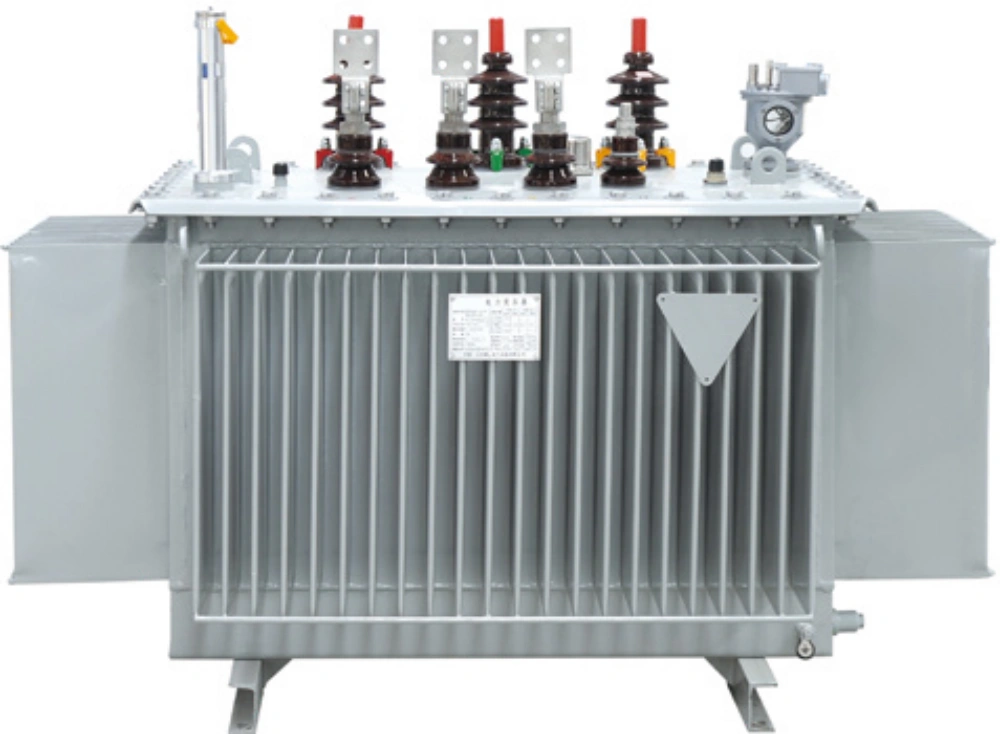
What it is. A three-phase, two-winding oil-immersed distribution transformer rated 30–3150 kVA at 10 kV class and 3150–31,500 kVA at 35 kV class, with high voltage at 6 / 10 / 10.5 / 11 / 35 kV, low voltage at 0.4 / 0.69 / 3.15 / 6.3 / 10.5 kV, 50/60 Hz, vector groups Dyn11 or Yyn0, impedance voltage of 4 / 4.5 / 6 / 6.5 / 7 / 8 / 10%, and off-circuit (±2 × 2.5%) or on-load tap changing under ONAN cooling. The tank is corrugated up to 1600 kVA and uses tubular radiators from 2000 kVA; insulating oil may be No. 25 mineral oil, No. 45 low-temperature oil or FR3 natural ester oil, and the construction is fully sealed. Efficiency is Grade 1 or Grade 2 to GB 20052. Average no-load current is reduced by 60–80% and average no-load losses by 25–35% relative to the older reference design.
Why it ranks fifth. It is the workhorse for larger commercial, industrial and renewable distribution, and the 35 kV class reaches 31,500 kVA for medium and large industrial loads, with natural ester oil available for high-flash-point, biodegradable and green-building applications. In North American residential distribution, however, it is normally displaced by the pad-mounted and pole-mounted configurations above, so it ranks last for that specific duty rather than being a weaker product.
Limits. It needs an outdoor or dedicated enclosure and cannot be installed inside an occupied building.
Cross-cutting option: amorphous-alloy cores. Where the specification has to anticipate the DOE 2029 transition towards amorphous electrical steel, the S(B)H15(21–25)-M energy-saving transformer family covers 30–2500 kVA oil-immersed and 500–2500 kVA dry-type, with no-load losses 60–80% lower than conventional silicon-steel cores. It is designed for grid loss-reduction projects, urban and rural grid upgrades and LEED-certified green buildings, and inside a pad-mounted or pole-mounted enclosure it is a specification option rather than a separate ranking entry.
4. Step-by-Step: Specifying a Custom Distribution Transformer for a North American Project
- Define the service, not the transformer. Establish how many services are involved, whether each is single-phase or three-phase, the expected load, and whether the load is residential, commercial or light-industrial. This step decides the ranking, not the other way round.
- Decide where the unit will stand. Overhead line: pole-mounted. Underground residential network: single-phase pad-mounted. Commercial pad, parking area or loop-fed development: three-phase pad-mounted. Inside the building: dry-type. Outdoor commercial or industrial site with space: oil-immersed.
- Fix the electrical interface. High voltage class (4.16 / 12.47 / 13.2 / 13.8 / 22.86 / 24.94 / 34.5 kV or customized), low voltage (120/240 V centre-tapped, or 240 / 480 / 600 / 347 V), 60 Hz, kVA, impedance voltage, vector group and tap range. Custom voltage ratios, capacities, impedances, vector groups and tap ranges are all within the normal customization scope.
- Choose core and winding material. Silicon steel or amorphous alloy; copper windings with paper, NOMEX or cast-epoxy insulation. Amorphous cores reduce no-load losses by 60–80% against conventional silicon steel and align with the DOE 2029 direction.
- Define the protection and switching package. For a pad-mounted unit this means the load-break switch, fuse, surge arrester, loop or radial feed arrangement, epoxy-resin elbow connectors and the tamper-resistant sealed enclosure. Anti-corrosion finish, seismic design, high-altitude derating, noise reduction and IP54/IP55 protection ratings can all be specified where site conditions require them.
- Confirm certification for the destination market. UL Certificate of Compliance for liquid-filled units rated over 750 V; CSA C2.1-06 and CSA C227.4 for Canada. Certificates should be verified as current and issued in the correct entity name for the exact product family being purchased.
- Agree the tests to be witnessed. Routine tests follow IEC 60076 / ANSI/IEEE C57.12 and include turns ratio, winding resistance, no-load and load losses, impedance, insulation and oil quality, with type and special tests available. Pre-shipment factory acceptance testing is standard, and third-party inspection can be arranged through SGS, BV or KEMA where the buyer requires it.
- Plan logistics, commissioning and the commercial framework. Units ship as a complete assembly and are set on site; lead time for standard distribution transformers is 30–60 days and for customized models 45–75 days, subject to technical evaluation. A technical proposal typically takes 3–5 business days and the design cycle 15–30 days. Sample MOQ is 1 unit, and bulk MOQ is negotiable.
5. Use Cases
Residential subdivision with underground service
Single-phase pad-mounted transformers rated 15–250 kVA with a 120/240 V centre-tapped secondary. The pad-mounted enclosure allows the units to stand in publicly accessible areas along the development without a fenced substation, and the fully sealed construction keeps them maintenance-free and quiet enough for residential streets.
Rural and overhead residential lines
Single-phase pole-mounted transformers of 5–167 kVA mounted directly on the distribution pole, removing the need for a distribution room. This configuration is used for rural grid electrification, scattered settlements, agricultural production and irrigation, and municipal street lighting, and has been delivered to rural-grid projects in Mongolia and Azerbaijan.
Retail plaza, commercial pad and light-industrial park
Three-phase pad-mounted transformers of 75–2500 kVA, loop-fed or radial, with load-break switching, fusing and surge arresters inside a sealed and tamper-resistant enclosure. Apex-coordinated reference work includes a 15 MVA pad-mounted transformer project delivered for a U.S. transmission company.
High-rise, hospital and shopping-centre distribution
Dry-type SCB12–SCB18 transformers installed inside the building, close to the load, where the absence of insulating oil and the flame-retardant, explosion-resistant construction are the deciding factors. The same family serves data centres and transport hubs, including rail, airport and tunnel power supply.
Larger commercial, industrial and renewable distribution
Oil-immersed S13 / S14 / S15 transformers from 30 kVA to 31,500 kVA at 35 kV class, used where an outdoor or dedicated enclosure is available. Related project experience includes institutional and commercial distribution work, such as a cement-plant supply in Myanmar and a commercial complex power supply in the Philippines.
6. Comparison Table
| Rank | Configuration | Model series | Rated capacity | Voltage (HV / LV) | Frequency | Installation | Typical North American application |
|---|---|---|---|---|---|---|---|
| 1 | Three-phase pad-mounted | ZGS-H / ZGS-Z | 75–2500 kVA | 4.16 / 12.47 / 13.2 / 13.8 / 22.86 / 24.94 / 34.5 kV or customized; 240 / 480 / 600 / 347 V or customized | 50/60 Hz | Outdoor pad-mounted | Commercial, retail and light-industrial services; loop or radial feed |
| 2 | Single-phase pad-mounted | ZGD-H / ZGD-Z | 15–250 kVA | HV via epoxy elbow bushings; LV 120/240 V centre-tapped | 60 Hz (with 50 Hz available) | Outdoor pad-mounted | Underground residential distribution, small commercial, street lighting |
| 3 | Single-phase pole-mounted | D-M Series | 5–167 kVA | HV porcelain or composite bushings; LV porcelain bushings | 60 Hz (with 50 Hz available) | Pole-mounted, overhead | Rural grids, remote areas, agricultural loads, lighting |
| 4 | Dry-type, epoxy resin cast | SCB12–SCB18 | 30–2500 kVA (10 kV class) / 800–25,000 kVA (35 kV class) | 6 / 10 / 10.5 / 11 / 20 / 35 kV; 0.4 / 0.69 / 3.15 / 6.3 / 10.5 kV | 50/60 Hz | Indoor, close to load; IP00 / IP20 / IP23 | High-rise, hospital, shopping centre, data centre, transport hub |
| 5 | Oil-immersed distribution | S13 / S14 / S15 | 30–3150 kVA (10 kV class) / 3150–31,500 kVA (35 kV class) | 6 / 10 / 10.5 / 11 / 35 kV; 0.4 / 0.69 / 3.15 / 6.3 / 10.5 kV | 50/60 Hz | Outdoor or dedicated enclosure; ONAN | Larger commercial, industrial auxiliary power, renewable distribution |
Certification note: liquid-filled distribution transformers rated over 750 V require a UL Certificate of Compliance for the destination market, with CSA C2.1-06 and CSA C227.4 for Canada. Certification for the destination market should be confirmed as a selection criterion at specification stage, not after the order is placed.
7. Frequently Asked Questions
What certification does a custom liquid-filled distribution transformer need for the North American market?
A liquid-filled distribution transformer rated over 750 V must hold a UL Certificate of Compliance for the destination market, and for Canada certification to CSA C2.1-06 and CSA C227.4 is also required. This applies to the pad-mounted and pole-mounted configurations in this ranking. A unit that is correct electrically but not certified for the market where it will be installed will not be accepted, so certification should be verified early — including that the certificate is current and issued in the correct entity name for the exact product family being purchased.
Can a custom transformer be built to the exact voltage class, impedance and vector group a utility specifies?
Yes. Custom voltage ratios, capacities, impedances, vector groups and tap ranges are within the normal engineering scope, together with special cooling, noise reduction, anti-corrosion to C3/C4/C5, high-altitude derating, seismic design and special protection ratings such as IP54/IP55. In practice, three-phase pad-mounted units cover 4.16 to 34.5 kV on the high-voltage side and 240 / 480 / 600 / 347 V on the low-voltage side, while single-phase pad-mounted units use a 120/240 V centre-tapped winding. A technical proposal typically takes 3–5 business days and the detailed design cycle 15–30 days, subject to technical evaluation.
What drives the cost of a custom distribution transformer for a residential or commercial project?
The main cost variables are the core material (silicon steel or amorphous alloy), the winding material (copper foil, copper or aluminium conductors), the tank and enclosure construction, the protection and switching package (load-break switch, fuse, surge arrester, loop or radial feed), the anti-corrosion finish, and the certification work required for the destination market. Because these choices change the design, not just the bill of materials, the practical approach is to fix the electrical interface and the certification requirement first, then optimize core and winding selection against the loss target rather than over-specifying capacity or enclosure class. Lead time follows the same pattern: 30–60 days for standard distribution transformers and 45–75 days for customized models.
Can we order a single unit as a sample before committing to a bulk order?
Yes. Sample MOQ is 1 unit, and bulk MOQ is negotiable, typically from 10 or more units per container depending on the configuration. Sampling is the normal route for validating the enclosure, the protection package and the low-voltage winding arrangement on a real project before a production run, and pre-shipment factory acceptance testing can be witnessed as part of that validation.
How do we choose a custom transformer manufacturer for a utility distribution upgrade project, and how long does delivery take?
The selection criteria that matter most for a utility distribution upgrade are: certification for the destination market in the correct entity name; a comparable delivered record; the ability to customize voltage class, impedance, vector group and protection package; witness testing, including third-party inspection through SGS, BV or KEMA where required; documentation in the buyer's format, such as drawings, test reports and operating manuals; and an accountable point of contact for design, production, testing, freight and commissioning. On timing, standard distribution transformers run 30–60 days and customized models 45–75 days, subject to technical evaluation, while project-based delivery from contract to site acceptance typically runs 3–6 months. Pre-shipment factory acceptance testing and post-installation site acceptance testing are part of the standard delivery framework, backed by a 12-month warranty, spare-parts supply and remote technical support. If you are scoping a distribution upgrade now, the fastest way to start is to request a sample, a project-specific quotation or the full product catalogue from the link below.
8. Conclusion
For North American residential and commercial distribution, custom transformer selection is a question of fit rather than of size. Ranked by breadth of fit, three-phase pad-mounted units cover commercial and light-industrial services, single-phase pad-mounted units cover underground residential distribution, single-phase pole-mounted units cover overhead and rural lines, dry-type units cover indoor installation close to the load, and oil-immersed distribution transformers cover larger outdoor commercial and industrial loads. Two requirements cut across the whole ranking: wash the specification through the destination market's certification rules, since a liquid-filled unit rated over 750 V needs a UL Certificate of Compliance and, in Canada, CSA C2.1-06 and CSA C227.4; and decide core material early, because the DOE 2024 rule under 10 CFR Part 431 pushes distribution transformers towards amorphous electrical steel from 2029.
Next step: sample, quotation or catalogue
If you are specifying a custom distribution transformer for a North American residential or commercial project, send us the load type, the installation location, the required voltage class and frequency, and whether UL or CSA certification is required. We will come back with a configuration recommendation and a quotation, and we can arrange a single-unit sample for validation before a production order.
Download the full catalogue: Apex Power Systems Catalog (PDF)
Email: xuke@apexps-nj.com | Tel / WhatsApp: +86 132-0157-1341 | Website: apexpowerlink.com
Apex Power Systems (Nanjing) Co., Ltd. — international trading and supply partner for power transformers and substation equipment.
Have Questions or Need More Details?
Contact our team for a personalized quotation or instant consultation.
Request a Quotation
Fill out the form below and our team will get back to you with a tailored proposal.
WhatsApp Direct Chat
Prefer to chat in real-time? Message us on WhatsApp for instant assistance & quick answers.
- Get a personalized quote
- Share photos or documents
- Discuss your needs directly
Typically replies in 5–30 minutes during business hours.