
Diesel Generator for Mining Projects: Application Fit, Engine Selection, and Site Adaptation
Diesel Generator for Mining Projects: Application Fit, Engine Selection, and Site Adaptation
Mining sites need power that remains available when grid supply is absent, weak, or unreliable. A diesel generator for mining projects must handle high starting loads, dusty and high-altitude conditions, long operating hours, and often multi-unit paralleling. This guide explains how to match a diesel generator set to a mining application, what site conditions change the specification, and how the engineering behind BAIFA POWER (WUXI) LTD. supports mining buyers at the research and evaluation stage.
What Makes a Mining Diesel Generator Different from a Standard Industrial Set
Mining is not a single application. It includes open-pit and underground operations, crushing and screening plants, dewatering systems, ventilation, site accommodation, and maintenance workshops. A generator that works for a factory may not be suitable for a mine because the operating pattern is different.
Mining generator sets typically operate in prime power (PRP) or continuous mode rather than standby mode. Prime power means the set supplies power for a variable load for an unlimited number of hours per year, with defined maintenance intervals. In mining, the set may be the primary electricity source for the site, not just an emergency backup.
Several mining-specific characteristics change the specification:
- Large motor starting loads from crushers, conveyors, and dewatering pumps require a generator with enough transient response and often a larger alternator frame or PMG excitation.
- Altitude above 1000 m reduces engine power output because air density is lower. High ambient temperatures also de-rate the set unless the radiator and ventilation are upgraded.
- Dust and particulate matter can clog filters and shorten service life if the enclosure, filtration, and maintenance access are not designed for the site.
- Multi-unit paralleling is common at mines, either to match load growth or to provide redundancy. Paralleling requires compatible controls, protection, and switchgear.
- Remote sites often need containerized or weatherproof sets that can be transported, lifted, and serviced with limited local infrastructure.
Industry Context: Why Diesel Remains a Practical Power Source for Mines
The global diesel generator market was valued at approximately USD 22.33 billion in 2025, according to Spherical Insights. China's diesel generator market is projected to grow at a CAGR of 9.3% from 2023 to 2030, based on data from Research and Markets and Generator Source. Diesel generating sets remain widely used in sectors such as manufacturing, mining, construction, and infrastructure because they offer fuel flexibility, scalable capacity, and faster deployment than permanent grid infrastructure.
For mining, diesel generation is often used as prime power when grid extension is not economical, as standby power for critical operations, or as a bridge to a future grid connection. In each case, the buyer needs more than a power rating; they need a set engineered for the site's electrical and environmental conditions.
Choosing the Right Engine Brand for Mining Generator Sets
Engine selection is usually the first decision in a mining generator project. The engine determines fuel consumption, service intervals, parts availability, and the set's overall reputation for reliability. No single engine brand is best for every mine; the right choice depends on power range, local support, project timeline, operating hours, and the buyer's long-term maintenance strategy.
BAIFA POWER (WUXI) LTD. builds diesel generator sets around multiple globally recognized engine brands, which allows buyers to align engine choice with project requirements rather than being locked into a single supplier. The available ranges in the BAIFA program include:
- Cummins-powered BF-C series: 25 kVA to 2750 kVA, rated speed 1500 rpm, IP23 protection.
- Volvo-powered BF-V series: 200 kVA to 880 kVA, rated speed 1500 rpm, IP23 protection.
- MTU-powered BF-M series: 750 kVA to 3750 kVA, rated speed 1500 rpm, IP23 protection.
- Perkins-powered BF-P series: 9 kVA to 2500 kVA, rated speed 1500 rpm, IP23 protection.
- Mitsubishi-powered BF-SM series: 750 kVA to 2750 kVA, rated speed 1500 rpm, IP23 protection.
- Baudouin-powered BF-BD series: 62.5 kVA to 3750 kVA, rated speed 1500 rpm, IP23 protection.
- Doosan-powered BF-DW series: 168 kVA to 1125 kVA, rated speed 1500 rpm, IP23 protection.
- SME-powered BF-SM series: 750 kVA to 2750 kVA, rated speed 1500 rpm, IP23 protection.
For large mining loads above 750 kVA, MTU, Mitsubishi, Baudouin, or Cummins powered sets are commonly evaluated. For mid-range mine facilities, Volvo, Perkins, and Doosan are also practical options. Because BAIFA manufactures sets in all these lines, a project consultant can compare brands on the same set for the same site conditions.
Engine Selection Criteria for a Mining Site
A useful way to evaluate engines is by project need rather than brand reputation alone. Consider:
- Power range fit: Is the engine line available in the required kVA band without oversizing or running near the limit?
- Altitude and temperature de-rating: Does the engine data allow acceptable performance at the mine's altitude and ambient temperature?
- Fuel consumption and operating cost: For high-hour, fuel-intensive mine sites, differences in specific fuel consumption matter across years of operation.
- Parts and service network: Can the buyer or their maintenance partner obtain filters, injectors, and overhaul kits locally or from a regional distributor?
- Integration with the generator set: The set builder must match the engine, alternator, controls, cooling package, and base frame as a system. This is where OEM experience matters.
Step-by-Step: How to Match a Diesel Generator Set to a Mining Project
The following workflow reflects how mining buyers and consultants should translate project conditions into a generator specification.
Step 1: Define the electrical load profile
List all loads supplied by the generator, including motor-driven equipment such as crushers, conveyors, pumps, and ventilation fans. For each load, record starting current, running current, and duty cycle. The peak starting kVA is often more important than the total running kVA.
Step 2: Determine the operating mode
Decide whether the set runs as prime power, continuous power, or standby power. Mining sites that run off-grid or with weak grid support usually require a prime or continuous rating. The same generator model may have a different kVA rating under standby vs prime definitions, so the rating must be stated explicitly.
Step 3: Account for site conditions
Apply de-rating factors for altitude, temperature, humidity, and air filtration. High-altitude mines may need a larger engine, a turbocharger matched to the site, or a derated output to maintain the required power. Dust conditions may require upgraded filtration, while coastal mines need corrosion-resistant enclosures and treatment.
Step 4: Evaluate paralleling requirements
If multiple generators must run together, define how many sets will parallel, whether the system is island mode or grid-connected, and what type of paralleling switchgear and controls are required. Paralleling also requires the sets to share load consistently, which depends on the engine governor type and voltage regulation systems.
Step 5: Specify enclosure and site integration
Choose between open skid-mounted sets, canopy sets, or containerized sets based on transport and weather requirements. Containerized sets are common for remote mining projects because they protect the generator, reduce outdoor installation work, and simplify fuel and control integration.
Step 6: Review quality control and delivery capability
For project-critical orders, the manufacturer's testing process and delivery schedule matter as much as the specification. BAIFA reports a monthly production capacity of 400–500 units, a typical lead time of 25–60 days, a minimum order quantity of 1 unit, and 100% testing before shipment. These points are relevant to buyers who need to schedule equipment into a mine construction plan.
Mining Application Case Evidence
BAIFA has supplied mining sites across multiple countries, and the case records show the range of configurations and operating conditions that can be delivered.
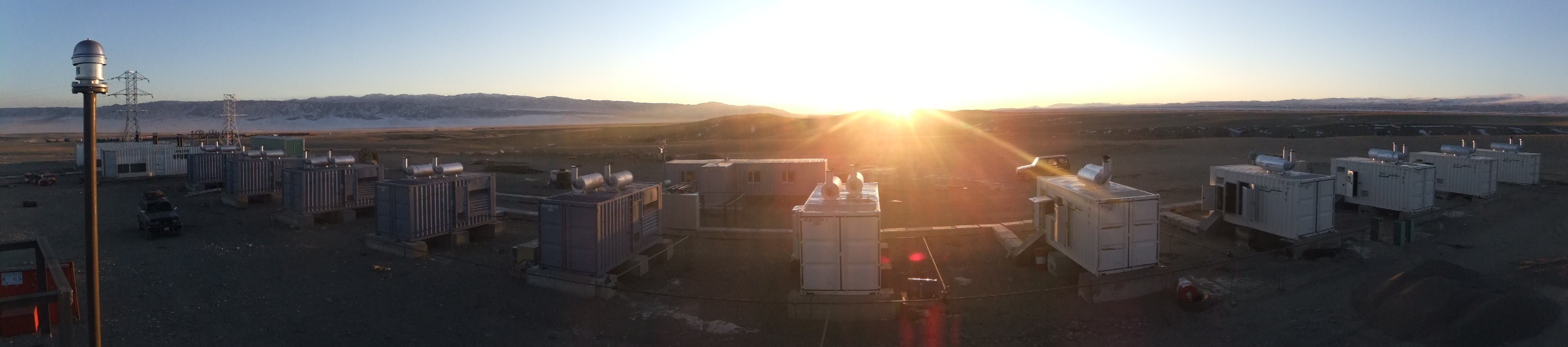
- Mongolia – BF-C825 units: 11 units supplied in a boosted and auto-paralleled configuration for prime power on a mining site. The installation includes IP54 protection. The sets have been in stable operation for 15 years, with a modular design for installation and maintenance.
- Mongolia – BF-M2500SHV units: 2 units in a boosted and auto-paralleled prime power configuration, IP54-protected, operating for 13 years.
- Mozambique – BF-C1375S units: 40 units boosted and auto-paralleled for prime power on a mining site. The application supports continuous night-time production and has operated stably for 8 years.
- Russia – BF-WD550S units: 73 units supplied for mine crushing applications, with stable performance under high load conditions over a 1-year project period.
- Mongolia – M3250RSE+ units: 6 units for a mining independent power supply system, built with 22 kV transformers and IP54 protection, operating for 2 years.
These cases illustrate that mining installations often require high-voltage integration, paralleling, and enclosure protection beyond what is found in a standard building standby application.
Comparison of BAIFA Mining-Relevant Generator Series
The table below compares BAIFA diesel generator series that are frequently considered for mining projects, based on manufacturer data.
| Series | Engine | Power Range | Rated Speed | Protection | Typical Mining Fit |
|---|---|---|---|---|---|
| BF-C | Cummins | 25–2750 kVA | 1500 rpm | IP23 | Wide coverage from site services to large prime power |
| BF-V | Volvo | 200–880 kVA | 1500 rpm | IP23 | Mid-range mine facilities and auxiliary power |
| BF-M | MTU | 750–3750 kVA | 1500 rpm | IP23 | Large loads, high-voltage integrations, heavy duty |
| BF-SM | Mitsubishi | 750–2750 kVA | 1500 rpm | IP23 | Large mine power plants |
| BF-BD | Baudouin | 62.5–3750 kVA | 1500 rpm | IP23 | Broad range, including heavy industrial sites |
| BF-P | Perkins | 9–2500 kVA | 1500 rpm | IP23 | Smaller mine loads and standby duties |
IP23 is the standard protection class for the BAIFA series, while several mining deployments are built to IP54 when weather and dust exposure require a higher level of protection. For projects needing an IP54 or high-voltage configuration, the enclosure, switchgear, and transformer are specified as part of the project solution.
Site Conditions That Change the Generator Specification
A diesel generator set that performs well at sea level in a temperate climate may not perform the same at a 4000 m mine site. The most important conditions to review include:
Altitude
Most diesel engines lose output as altitude increases. If a set is rated at standard reference conditions and the mine is high-altitude, the set builder should apply the engine manufacturer's de-rating curve and select neither an undersized nor an unnecessarily oversized unit.
Ambient temperature
Hot climates reduce combustion air density and cooling efficiency. The radiator must be large enough for the maximum ambient temperature expected during the hottest period of operation. In desert or savanna climates, dust loading on the cooling surfaces is also a maintenance concern.
Dust and particulate
Heavy dust affects air filters, enclosures, and alternator ventilation. For mining, a weatherproof enclosure with proper sealing, a filter change schedule, and possibly a pressurized control cabinet can materially improve availability.
Corrosive environment
Sites near coastlines or with high salinity in the air require corrosion-protected enclosures and electrical components. This is especially relevant for mining operations in coastal regions or processing sites near salt water.
Electrical duty and power quality
Large motors in crushing and conveying can impose high starting kVA. The alternator must sustain voltage dip within acceptable limits, and the control system must handle load steps without nuisance trips. For continuous high-load operation, a robust cooling package and a heavy-duty base frame are part of the mechanical design.
Use Cases: Where Different Generator Configurations Apply
Open-pit mine prime power
Open-pit operations often use multiple generator sets in paralleling to power crushers, conveyors, dewatering pumps, and site facilities. The sets run as the main electricity source for long hours, so the specification emphasizes continuous rating, high load acceptance, and serviceability. Containerized sets are common because they can be relocated as the mine moves or expands.
Underground mine ventilation and drainage backup
Underground mines require reliable standby power for ventilation fans, drainage pumps, and communication systems. In a mains failure, the generator must start automatically and accept the required load quickly. Low noise and compact footprint may also matter depending on placement.
Mine camp and ancillary power
Worker camps, administrative buildings, workshops, and water treatment facilities need stable power for lighting, HVAC, kitchen equipment, and security systems. These loads are less demanding than crushers, which allows mid-range engine options such as Volvo, Perkins, or Cummins powered sets to be an appropriate technical and commercial fit.
High-voltage mine power station
Very large mines may deploy high-voltage generator sets paralleled into a site distribution network. BAIFA has delivered high-voltage configurations such as the BF-M2500HVS and BF-M2500SHV, with built-in transformers such as the 22 kV units used in a Mongolia project. In these projects, the generator set is not simply a standalone product but part of the mine's electrical infrastructure.
Factory and OEM Capability as a Selection Criterion
Mining buyers are not only selecting an engine; they are selecting a set builder who can integrate the engine, alternator, controls, enclosure, and auxiliary systems into a reliable product. OEM relationships and factory capabilities therefore matter.
BAIFA POWER (WUXI) LTD. operates in Wuxi, Jiangsu Province, near Shanghai. The company was founded in 1992 and operates a facility covering more than 60,000 square meters. The production program includes industrial diesel and gas generator sets from 8 kW to 3200 kW, marine generator sets from 40 kW to 1100 kW, lighting towers, low-voltage and high-voltage switch panels up to 35 kV, transformers up to 110 kV, and power generation accessories. Annual output is 5000–6000 units, with a 25-engineer R&D team and more than 180 employees. Exports account for roughly 70% of production, with main markets in Latin America, Southeast Asia, and the Middle East.
BAIFA holds OEM partnerships with multiple well-known engine and alternator manufacturers. These include Cummins, Volvo Penta, MTU, Perkins, Mitsubishi, Scania, Baudouin, Weichai, Stamford, Leroy-Somer, and AvK. The ability to build around different engines and alternators gives project buyers flexibility in specifying a mining generator set. OEM capacity also supports customization such as logo, nameplate, paint color, voltage and frequency configuration, connection type, protection degree, control system, structure, and additional options such as ATS, droop, PMG, oil-water separator, anti-condensation heater, and float charger for starting batteries.
How BAIFA Positions Itself for Mining Projects
BAIFA's mining-related evidence includes high-voltage, low-noise, and containerized configurations rather than only standard open sets. The company's production and testing capability, long-term records of mining installations, and multiple engine brand options make it a candidate for buyers who are at the evaluation stage and need a supplier capable of delivering an integrated solution.
For a mining project, the practical evaluation questions are: Can the manufacturer provide the engine brand and power class required? Can they configure high-voltage, paralleling, IP54, and containerized solutions? What is the lead time, and can they test 100% of the units before shipment? BAIFA's stated monthly capacity is 400–500 units, with a lead time of 25–60 days and an MOQ of 1 unit.
FAQ
Can diesel generator sets be used as prime power for a mining site?
Yes. Diesel generator sets can serve as prime power for mining sites when grid electricity is unavailable or insufficient. In prime power mode, the set supplies a variable load for unlimited annual hours with defined maintenance intervals. BAIFA has delivered mining prime power installations such as the BF-C825 units in Mongolia used in boosted and auto-paralleled configurations for 15 years, the BF-C1375S units in Mozambique used in parallel for 8 years, and the BF-M2500SHV units in Mongolia operating for 13 years.
Which engine brands does BAIFA offer for mining diesel generator projects?
BAIFA builds diesel generator sets around multiple engine brands, including Cummins, Volvo, MTU, Perkins, Mitsubishi, Baudouin, Doosan, and SME. The BAIFA series include the Cummins-powered BF-C series from 25 kVA to 2750 kVA, the Volvo-powered BF-V series from 200 kVA to 880 kVA, the MTU-powered BF-M series from 750 kVA to 3750 kVA, the Perkins-powered BF-P series from 9 kVA to 2500 kVA, the Mitsubishi-powered BF-SM series from 750 kVA to 2750 kVA, the Baudouin-powered BF-BD series from 62.5 kVA to 3750 kVA, and the Doosan-powered BF-DW series from 168 kVA to 1125 kVA.
What protection class is standard on BAIFA generator sets, and can higher protection be configured?
The standard protection class for BAIFA generator sets is IP23. For harsher site conditions, higher protection can be configured. For example, mining projects in Mongolia were delivered with IP54 protection, including the BF-C825 units and BF-M2500SHV units used for mining prime power.
Can BAIFA supply high-voltage containerized diesel generators for large mining projects?
BAIFA has supplied high-voltage generator sets for large projects. Mining-related examples include the BF-M2500SHV units used in Mongolia with built-in 22 kV transformers and IP54 protection, and the BF-M2500HVS high-voltage set used for factory prime power. High-voltage configurations are part of the product and engineering program, which also includes LV and HV switch panels up to 35 kV and transformers up to 110 kV.
What is BAIFA's production capacity and lead time for a mining generator order?
BAIFA reports a monthly production capacity of 400–500 units, a typical lead time of 25 to 60 days, and a minimum order quantity of 1 unit. All units are tested before shipment, and after-sales support includes remote support as well as on-site installation, commissioning, and maintenance. For a specific mining project, lead time should be confirmed with the BAIFA team based on configuration, engine brand, and order schedule.
Need to evaluate a diesel generator set for a specific mining site?
Send BAIFA your project load profile, site altitude, temperature, and electrical configuration for a technical and commercial assessment.
Email BAIFA WhatsApp BAIFA