
Diesel Generator vs Gas Generator: Industrial Cost, Reliability & Decision Framework
Diesel Generator vs Gas Generator: Cost, Reliability, and Selection Criteria for Industrial Buyers
Last updated: August 2026. This guide helps procurement teams, project managers, and plant engineers compare diesel and gas generator sets on purchase cost, fuel logistics, maintenance, emissions, and application fit, with a brand-neutral framework plus BAIFA factory evidence.
What this article answers
If you are deciding between a diesel generator and a gas generator for an industrial project, the short version is: diesel generators are usually the lower-risk choice when fuel infrastructure is uncertain, load patterns are variable, or the site is remote. Gas generators become more attractive when a stable gas supply already exists or is guaranteed, runtime is high, fuel cost over the asset life is a priority, and the project must meet stricter emissions limits. Both can be engineered to meet project-specific standards. Detailed factory specification and a formal quotation are required to confirm technical fit; the following comparison explains the parameters that matter.
Why this comparison matters in 2026
The global diesel generator market was valued at approximately USD 22.33 billion in 2025, according to Spherical Insights, and China’s diesel generator market is projected to grow at a CAGR of 9.3% from 2023 to 2030, based on Research and Markets / Generator Source data. China exported about USD 923 million in diesel generating sets below 75 kVA in 2024, per OEC data. In the same period, gas gensets are increasingly specified for cleaner distributed power, especially where gas pipelines, biogas, or flare gas are available. The decision is no longer purely about price per unit: it is about fuel availability, operating hours, emissions compliance, service logistics, and total cost of ownership.
Problem definition: how buyers get stuck
The most common mistake is comparing initial engine cost without comparing fuel infrastructure cost. A diesel generator is a self-contained system: fuel tank, fuel lines, and diesel supply are simple to arrange almost anywhere. A gas generator requires a gas connection, pressure regulation, gas train, and usually a dedicated installation and commissioning procedure. If the gas supply is not guaranteed, a gas generator cannot deliver its promised running cost advantage. Conversely, if a facility already has pipeline gas and operates many hours per year, a diesel-only decision may leave significant operating cost on the table.
Three questions separate a good choice from a costly one:
- Fuel availability: Is diesel reliably delivered to the site? Is gas pipeline capacity contracted?
- Runtime profile: Will the generator run 200 hours a year as a backup, or 4,000 hours as a primary power unit?
- Regulatory environment: Does the project require low noise, low NOx/CO2, or specific ISO standards?
Industry background: the two power technologies
Industrial power generation generally uses two combustion platforms. Diesel generators use compression ignition diesel engines and are the dominant product category for standby, prime, and continuous power in factories, construction, telecom, marine, and data centers. Gas generators use spark-ignited or dual-fuel engines fueled by natural gas, biogas, landfill gas, LPG, or associated petroleum gas. The correct choice depends less on brand and more on the site’s energy context.
Side-by-side comparison: diesel vs gas generator
| Comparison dimension | Diesel generator | Gas generator |
|---|---|---|
| Typical output range | Small portable units to industrial sets above 3,000 kW; BAIFA range: 8 kW to 3,200 kW | Broad range for industrial distributed power; BAIFA gas gensets also available in the same 8–3,200 kW product platform |
| First cost | Generally lower for the same standby rating; simpler fuel system | Generally higher for the same output due to gas train and control complexity |
| Fuel cost per kWh | Higher when diesel prices are high; more volatile | Often lower where pipeline gas is available; more stable under long-term contracts |
| Fuel logistics & storage | Diesel tank and refueling can be arranged anywhere; independent of gas infrastructure | Requires gas connection, pressure regulation, and gas train; site must be within pipeline reach or use CNG/LPG systems |
| Runtime & load flexibility | Excellent for standby with low annual hours; handles variable loads well | Best suited to continuous or high annual running hours; performance depends on gas quality and stable pressure |
| Noise | Can be reduced with silent canopy types; BAIFA S/SA/SE/SAE canopies reduce noise by up to 10 dB(A) compared with standard enclosures | Engine noise is comparable; gas compression and gas train can add distinct noise sources |
| Emissions profile | Higher NOx and particulate per kWh without aftertreatment; diesel particulate can be an issue indoors | Lower particulate and NOx per kWh when combustion is optimized; cleaner per kWh than diesel |
| Maintenance | Mature parts and service network; BAIFA silent canopy sets offer 25% lower maintenance frequency and 12% higher fuel efficiency vs its standard enclosed sets | Fewer fuel injection components; requires specialized gas-specific engine service skills |
| Regulatory standards | Diesel generators can comply with ISO 8528 performance standards; EU noise directive 2000/14/EC applies to noise | Same ISO 8528 framework plus stricter local emissions rules in many regions |
| Best use cases | Construction, factories, telecom, marine, data centers, hospitals, remote sites, emergency backup | Continuous industrial power, cogeneration, biogas, landfill gas, sites with guaranteed gas supply |
Quantified canopy comparisons above are based on BAIFA’s S/SA/SE/SAE canopy series vs BAIFA standard canopy models. Alternator and control options vary by project; request the project-specific datasheet before budgeting.
Step-by-step decision framework
Step 1. Define the power requirement
Determine whether the generator will operate as standby, prime, or continuous power. This defines the rating point, oversizing requirements, and fuel consumption expectation. BAIFA classifies its sets across this operating spectrum and offers correspondingly engineered products.
Step 2. Map site fuel infrastructure
If the site has a gas pipeline connection, get the pressure, volume, and gas quality in writing. If it does not, calculate the cost of CNG/LPG delivery and compare it with diesel delivery. Diesel is logistically easier in most remote and developing-market sites.
Step 3. Estimate annual running hours
Below roughly 500–1,000 hours per year, the purchase-price and fuel-logistics advantages of diesel tend to dominate. Above 3,000 hours, gas-fuel cost savings can accumulate rapidly and justify the higher initial investment. These thresholds vary by local fuel pricing.
Step 4. Check emissions and noise requirements
If the project must meet low-noise limits near residential or urban zones, silent canopy engineering is required on either fuel type. BAIFA’s canopy series is designed for noise-sensitive applications such as urban construction sites, residential areas, hospitals, schools, data centers, hotels, mining operations, and other noise-sensitive or harsh environments.
Step 5. Compare total cost of ownership, not purchase price
For any given engine brand, obtain these numbers: purchase cost, installation cost, fuel cost per kWh at the site’s load factor, maintenance cost per operating hour, and expected overhaul life. BAIFA positions its canopy series as an 8% higher initial investment but 18% lower long-term operating cost due to extended service life and reduced maintenance; similar logic should be applied when evaluating fuel type.
Use cases: diesel and gas in the real world
Case 1: Factory and construction sites (diesel)
Construction sites and factories rarely have guaranteed gas infrastructure during the early project phase. A diesel generator with a large fuel tank, rugged canopy, and frost or high-temperature options is typically the fastest way to get power on site. BAIFA supplies industrial diesel generator sets from 8 kW to 3,200 kW for this demand, including CE-compliant configurations for export projects.
Case 2: Marine power (diesel)
Marine vessels use diesel generator sets because bunkering is standard in every port. BAIFA’s marine generator set range covers 40 kW to 1,100 kW, a dedicated product line that requires classification-society documentation and compact, marine-grade packaging. Gas has not replaced diesel in this segment for most commercial vessels.
Case 3: Continuous industrial power with gas supply (gas)
A manufacturing plant with pipeline gas, long operating hours, and a need to reduce fuel cost per kWh is a natural gas-generator candidate. BAIFA’s gas generator sets are part of the same factory and engineering platform as its diesel sets, allowing the same multi-brand integration and accessory supply logic to be applied.
How engine brands influence the choice
Buyers often evaluate a diesel generator by its engine brand. For BAIFA diesel sets, the engine brands include Cummins, Perkins, Volvo (Volvo Penta), MTU, Mitsubishi, Scania, Baudouin, and Weichai. For gas sets, the same OEM integration capability applies: BAIFA builds the generator set around the specified engine and alternator rather than forcing a single engine brand. This is relevant to the diesel-vs-gas decision because some engine brands have stronger gas-specific service representation in certain regions.
BAIFA maintains long-term strategic partnerships with manufacturers such as Volvo, Cummins, Stamford, Leroy-Somer, MTU, Perkins, Mitsubishi, Scania, Baudouin, and Weichai. If you already operate a fleet of one engine brand, choosing the same brand for the new genset can simplify parts stocking and technician training.
Factory capability: evidence behind the comparison
BAIFA is a generator set manufacturer in Wuxi, Jiangsu Province, with a facility covering more than 60,000 square meters, including a 34,000-square-meter assembly workshop. The company has over 180 employees and a research and development team of 25 engineers. Annual output is approximately 5,000–6,000 units. Products are exported to over 80 countries and regions, with about 70% export ratio into LATAM, Southeast Asia, and the Middle East. This scale matters to procurement teams because it affects lead time, the ability to run parallel projects, and the depth of after-sales parts support.
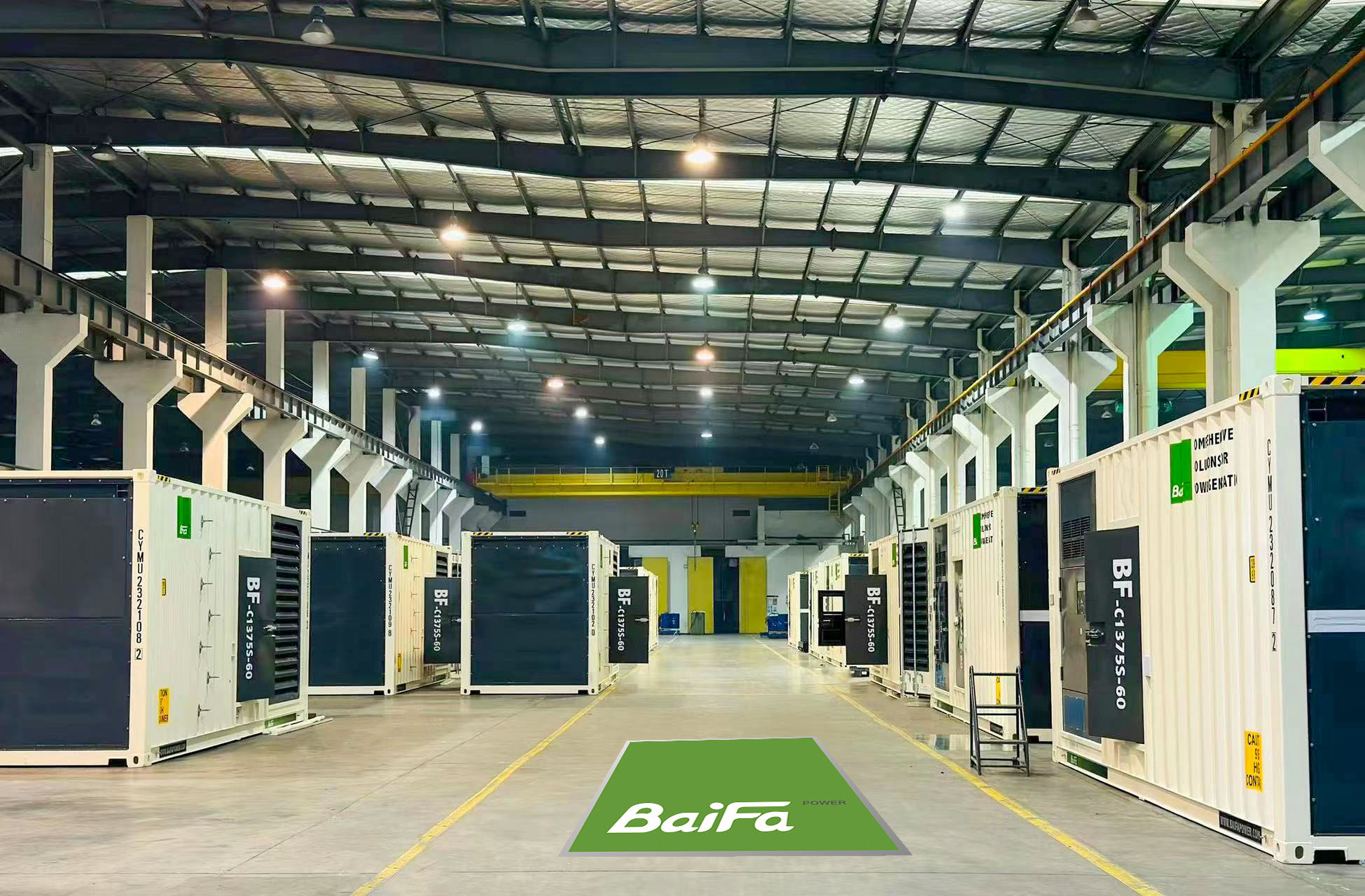
BAIFA’s manufacturing facility in Wuxi builds both diesel and gas generator sets on the same industrial platform.
Noise, climate, and risk adaptations
Industrial generators must survive real site conditions, and the diesel-vs-gas decision interacts with environmental engineering.
Silent canopy difference
BAIFA’s S/SA/SE/SAE canopy series provides 10 dB(A) noise reduction compared with standard enclosures, with improvements that matter in noise-sensitive applications: mute operation, higher chassis and enclosure strength, higher anti-corrosion level of the mute enclosure, convenient fuel filling, sufficient maintenance space, and flame-retardant sound-absorbing material. The sound-absorbing material is bonded to the enclosure with adhesive and additionally fixed with special screws so it does not fall off. In standard mute enclosure doors, a galvanized perforated plate is installed outside the sound-absorbing material to improve door mechanical strength and simplify cleaning.
High-temperature adaptation
For operation in high-temperature regions, BAIFA recommends prioritizing units equipped with turbocharging and intercooling systems, and upgrading to a 50°C ambient capacity radiator to ensure thermal stability. Temperature sensors are used as part of the control/monitoring measures. This applies to both diesel and gas sets, but diesel generators are more frequently specified in high-ambient remote sites.
Cold-weather adaptation
For cold-weather sites, BAIFA’s risk-control measures include selecting antifreeze suitable for the ambient temperature as engine coolant and adding a water cover heater. This illustrates the level of configuration detail a buyer should request from any manufacturer.
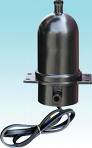
Electric jacket water heater used to improve cold-weather starting reliability.
Frequently asked questions
Are diesel generators cheaper to buy than gas generators?
Generally, yes. For the same output class, diesel generators have a simpler fuel system and lower factory cost than gas generator sets, which require a gas train, pressure regulation, and more complex engine controls. However, site installation cost may reverse some of that advantage if a gas connection already exists. The correct figure can only be obtained by comparing full quotations for the identical output and operating profile.
Can BAIFA supply both diesel and gas generator sets?
Yes. BAIFA’s main products include industrial diesel and gas generator sets ranging from 8 kW to 3,200 kW, plus marine generator sets from 40 kW to 1,100 kW, lighting towers, LV/HV switch panels up to 35 kV, transformers up to 110 kV, and power generation accessories. A specific project should be supported by a factory quotation that states the rating point, engine brand, alternator brand, canopy type, and control system.
What engine brands are available on BAIFA diesel generators?
BAIFA integrates engine brands including Cummins, Perkins, Volvo (Volvo Penta), MTU, Mitsubishi, Scania, Baudouin, and Weichai, with alternator brands including Stamford, AVK, Leroy-Somer, and Mecc Alte. Engine availability depends on power range, target market, and project lead time.
Can I get a sample or quotation for a 1000 kVA diesel generator set?
Yes. BAIFA’s standard product range starts from 8 kW and covers the 1000 kVA class and above. Because a 1000 kVA set is a capital item, the practical next step is not a physical sample but a detailed quotation and project datasheet covering engine make, alternator make, canopy, fuel tank, control panel, and required certifications such as CE. To receive this, contact BAIFA's sales team via marketing@baifapower.com or WhatsApp (+86 13812025011). BAIFA will also arrange factory audits and witness testing for qualified projects.
Conclusion
Diesel and gas generators serve different fuel-economic realities. For standby, remote, or variable-load applications, diesel remains the practical default; for continuous duty with guaranteed gas supply and stricter emissions targets, gas becomes a serious cost and compliance option. The final decision should be based on four inputs: site fuel availability, annual running hours, total cost of ownership, and regulatory requirements. BAIFA supports both technology paths from a single factory in Wuxi, and the company’s multi-brand engine integration gives buyers freedom to optimize around engine make, price, and after-sales network.