
Industry-Specific Diesel Generator Selection Guide: Meeting Critical Power Demands in Mining, Construction, and Healthcare
Industry-Specific Diesel Generator Selection Guide: Meeting Critical Power Demands in Mining, Construction, and Healthcare
For procurement professionals in heavy industries, selecting a diesel generator (DG) supplier is not a one-size-fits-all decision. Each sector—mining, construction, or healthcare—imposes unique operational constraints that demand tailored power solutions. This guide outlines the core requirements of three key verticals, defines the essential capabilities of a qualified supplier, and provides practical cooperation strategies to ensure reliable, compliant, and cost-effective power generation.
1. Industry-Specific Power Requirements
Mining Sector
Mining operations often occur in remote, high-altitude areas with extreme dust, temperature variations, and unstable grid access. Critical demands include:
- High dust and weather resistance: Equipment must operate reliably in environments with airborne particulates and corrosive agents.
- High-altitude derating compensation: Engines and alternators must be derated correctly per ISO 3046 to maintain output at elevations above 1000m.
- Continuous heavy load capacity: Prime power (PRP) operation for 24/7 mining, crushing, and dewatering systems.
- Robust fuel systems: Large on-site fuel storage and automated refueling for prolonged runtime.
Construction Sector
Construction sites demand portability, low noise, and rapid deployment. Typical specifications include:
- Low noise operation: Strict urban noise regulations require sound-attenuated enclosures (e.g., ≤ 75 dB(A) at 7m).
- Compact and mobile design: Skid-mounted or trailer-mounted units for easy relocation across job sites.
- Parallel capability: Multiple units paralleled to scale up power as the project evolves.
- Weatherproof canopy: IP23 minimum protection for outdoor installation.
Healthcare Sector
Hospitals and medical facilities require ultra-reliable standby power to protect life-support systems. Key demands:
- Instant start and transfer: Automatic mains failure (AMF) start within 10 seconds; automatic transfer switch (ATS) integration.
- Low noise and clean exhaust: Enclosed units that comply with hospital environmental standards.
- Redundancy and load sharing: N+1 configuration to ensure uninterrupted power to ICUs, operating rooms, and data servers.
- Compliance with medical safety codes: IEC 60364, local electrical codes, and fire safety integration.
2. Supplier Selection Criteria: Three Essential Capabilities
When evaluating a diesel generator supplier for these demanding sectors, procurement teams should verify the following core capabilities:
A. Industry-Specific Customization Experience
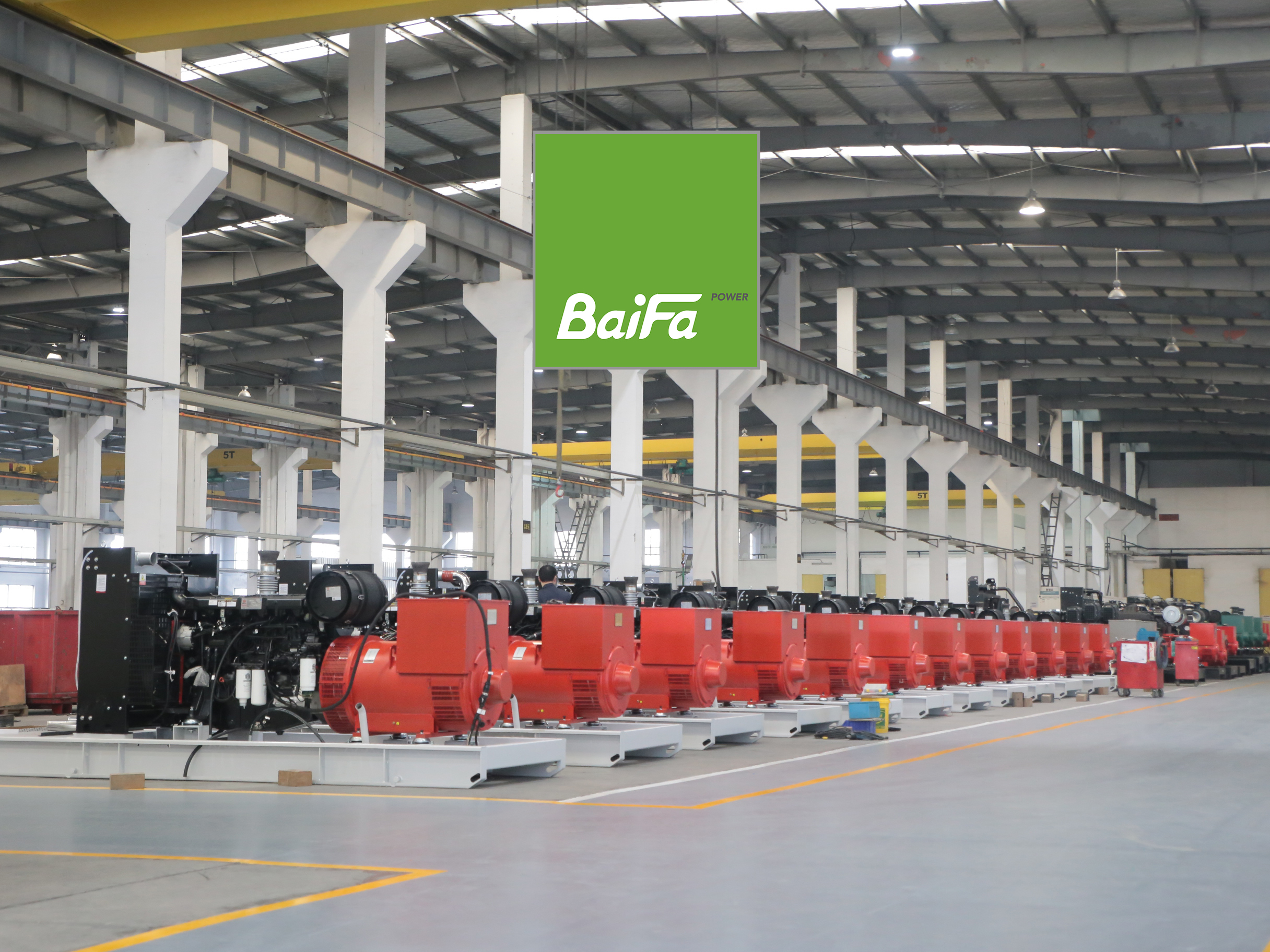
A qualified manufacturer must demonstrate a track record of customizing generator sets for specific verticals—modifying radiators for 50°C ambient operation, adding IP54 enclosures for dust, or integrating high-voltage switchgear for mining. Suppliers like BAIFA POWER (WUXI) LTD., founded in 1992 and operating a 60,000 m² production base, have delivered over 5,000 sets annually with a dedicated 25-engineer R&D team that tailors solutions for mining, construction, and healthcare clients.
B. Compliance and Certifications
All generator sets supplied to regulated industries must carry recognized certifications. For European and global projects, CE certification (certificate no. 3427/IST/23, issued by SGS, valid until 2028) is mandatory, confirming conformity with EN ISO 12100, EN 60204-1, and EN ISO 8528-13. Additionally, ISO 9001 (quality management), ISO 14001 (environmental), and ISO 45001 (occupational health) certifications (all valid through 2026) demonstrate a systematic approach to manufacturing and safety.
C. Rugged Design for Harsh Environments
The ability to operate reliably under extreme conditions is non-negotiable. Suppliers should offer:
- Cold-weather packages: Electric jacket water heaters, anti-condensation heaters, and correct coolant selection for temperatures below 0°C.
- High-ambient-temperature radiators: Upgraded cooling systems for operation at 50°C ambient without derating.
- Corrosion-resistant materials: Galvanized steel, stainless steel fasteners, and marine-grade enclosures for coastal or salt-spray environments.
3. Successful Implementation: Case Studies Demonstrating Vertical Expertise
Healthcare: 10-Year Stable Emergency Backup for a Chinese Hospital
In China, BAIFA diesel generator sets provided emergency backup power to operating rooms, ICUs, and life-support systems during grid failures, achieving stable operation over 10 years. The solution integrated an automatic transfer switch (ATS) and a low-noise canopy to meet hospital environmental standards. This case demonstrates the critical importance of reliability and long-term after-sales support in the medical sector.
Mining: 11 Units of BF-C825 for a Mongolia Mine (15-Year Record)
For a large-scale mining operation in Mongolia, 11 units of BAIFA BF-C825 (powered by Cummins) were configured in parallel to supply prime power for excavation, crushing, and dewatering systems. The sets were fitted with IP54 enclosures and high-altitude derating kits. After 15 years of continuous operation, the customer reported stable performance under heavy load, minimal downtime, and low maintenance cost—validating the design for extreme mining environments.
Construction: 66 Units for Hyundai Construction (Saudi Arabia)
In Saudi Arabia, 66 BAIFA generator sets (including BF‑V series powered by Volvo, 200–880 kVA) were deployed to power construction camps and machinery for Hyundai Construction. The project required low noise (due to proximity to residential areas) and rapid deployment. All units passed a 100% factory acceptance test (FAT) before shipment and have operated reliably for 8 years.
4. Cooperation Recommendations for Procurement Professionals
To ensure a successful partnership with any diesel generator supplier, buyers should follow these four key steps:
- Define industry standards upfront: Specify applicable certifications (e.g., CE, ISO, local electrical codes) and performance criteria (ISO 8528 for power rating, ISO 3046 for altitude derating) in the request for quotation (RFQ).
- Conduct a site survey: Have the supplier’s engineers visit the installation site to assess ambient conditions, fuel logistics, exhaust routing, and grid characteristics. This step eliminates 80% of post-installation issues.
- Insist on 100% factory testing: Every set should undergo a full-load factory acceptance test (FAT) witnessed by the buyer or a third-party inspector. BAIFA, for example, implements a 100% test standard for all units.
- Secure a comprehensive after-sales plan: Ensure the supplier offers remote diagnostics, on-site commissioning, and a spare parts inventory. For critical applications, a 24/7 service response commitment is essential.
This guide is based on verified industry data and real-world case studies. For detailed specifications or to discuss your specific project requirements, contact the manufacturer directly.