
Choosing the Right Pole Height and Wattage for Custom LED Street Lights
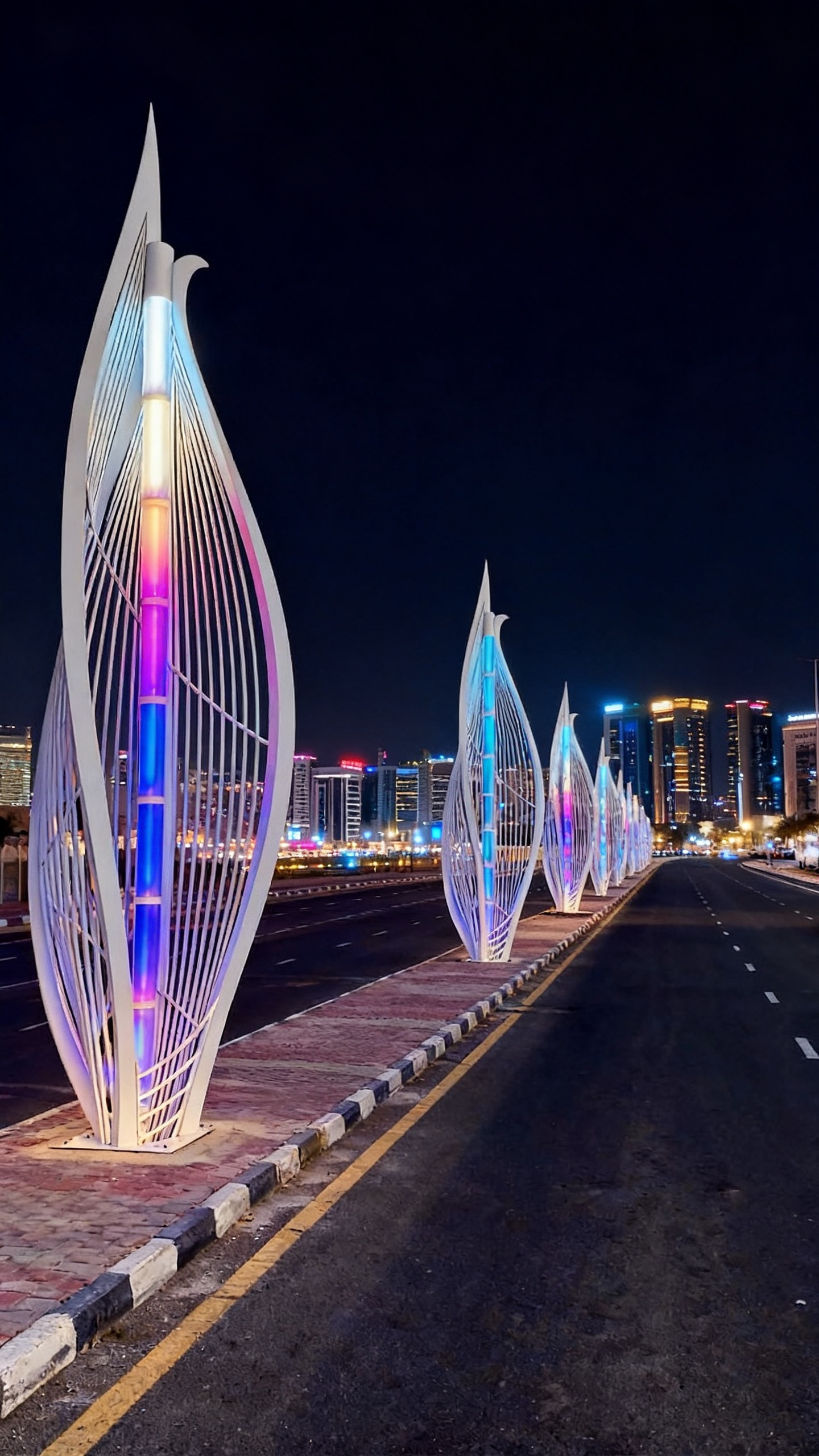
Pole height and LED wattage decide whether a custom street light meets its lighting target or misses it. On the BF-LSL-4000-120W custom LED landscape street light, mounting height can be specified at 6 m, 8 m, 10 m or 12 m, and LED power at 60 W, 80 W, 100 W, 120 W, 150 W, 180 W or 200 W — and both values can be customized further to match project requirements.
Height and wattage appear in the same specification line, but they solve different problems. Height sets how far the luminaire sits from the surface it must light, and how the beam spreads across a carriageway or walkway. Wattage sets how much light is available to distribute in the first place. Treating them as one “bigger is better” decision is one of the most common reasons a delivered installation looks nothing like the rendering.
This guide explains how to read the two parameters together, how project scenario — an urban road versus a park, plaza or commercial street — shifts the selection, and which environmental ratings and control decisions should be confirmed before a single pole is ordered.
Why Height and Wattage Are the Two Decisions That Define a Custom Street Light
Answer first: the correct combination is the one that delivers the illuminance and uniformity the project’s lighting class requires, across the pole spacing the site allows, without pushing glare above the limit — and without paying for output the site cannot use.
Two failure modes account for most rework on outdoor lighting projects. The first is a pole that is too tall for the luminaire mounted on it: light is spread across a wide area at low intensity, the road surface reads as dim and patchy, and pole spacing has to be tightened to compensate. The second is a luminaire with more output than the pole height and surrounding environment can absorb: the result is glare for drivers and residents, hot spots directly beneath the fixture and dark gaps between poles.
The two parameters also carry very different change costs. Wattage lives inside the luminaire, and on a modular LED platform output can be finalised at the ordering stage or managed later through dimming profiles. Pole height lives in the pole, the flange base, the embedded anchor bolts and the foundation. A height error discovered after installation is not a specification change; it is a civil works change.
Industry Background: What Sets the Design Frame Today
Street lighting is a mature but still expanding category. The global street lighting market was valued at USD 9.1 billion in 2023 and is projected to reach USD 11.6 billion by 2030, a CAGR of 3.6%, according to Grand View Research. Forecasts diverge by source — the same 2030 horizon is estimated at USD 16.5 billion by StrategyR — so market figures are best treated as directional context rather than as a budget input.
LED is now the default technology. LED lighting accounted for 79.7% of global street lighting revenue in 2023, according to Grand View Research, which is why height and wattage decisions today are almost always decisions about LED luminaire photometry rather than about legacy lamp types.
Smart control is the fastest-moving layer. The installed base of smart street lights reached 32.9 million units globally at the end of 2024, with a 20.9% CAGR projected through 2029, per Berg Insight. Other forecasts place a lower figure — 63.8 million units — on a shorter 2027 horizon, so the direction of growth is clearer than the exact number.
Two standard families usually define how a height-and-wattage combination is judged. The European EN 13201 series (parts 1–5) defines quality, performance and energy indicators for road and street lighting design. ANSI/IES RP-8 is the primary American national standard for lighting roadway and parking facilities, focused on luminance and safety criteria. Both operate the same way in practice: the project states a lighting class or performance target, and pole geometry and luminaire output are then calculated to meet it.
On the control side, the D4i and Zhaga standards are increasingly adopted in smart street lighting for interoperability between sensors and luminaires. This affects the specification earlier than many buyers expect. If a project plans photovoltaic control, dimming or sensor-based operation, the control interface must be confirmed before the luminaire is ordered, because a dimming profile changes how much output the installation actually consumes across the night.
The supply side also matters to the decision. The top 10 companies in the global lighting fixtures market, including Signify and Osram, account for just over 20% of total market share, according to CSIL. That fragmentation is one reason non-standard pole and luminaire configurations are frequently sourced from specialised manufacturers rather than from a top-tier catalogue.
The Specification Reference: BF-LSL-4000-120W
BAIFU LIGHTING (Zhongshan Baifu Street Lamp Co., Ltd.) is a custom outdoor lighting manufacturer based in Guzhen Town, Zhongshan City, Guangdong, China, established in 2013 and operating an 11,158 m² production facility. The BF-LSL-4000-120W is a non-standard custom decorative landscape street light that carries the full height and power range in a single platform — which makes it a practical reference example for this selection process.
Supported specification points for the BF-LSL-4000-120W include:
- Mounting height: 6 m, 8 m, 10 m or 12 m, customizable as per project requirements
- LED power: 60 W, 80 W, 100 W, 120 W, 150 W, 180 W or 200 W
- Input voltage: AC 85–265 V, 50/60 Hz
- Light source: high-efficiency modular LED light source
- Luminaire efficacy: ≥130 lm/W
- Colour temperature: 2700 K, 3000 K, 4000 K, 5000 K or 6000 K
- Colour rendering index: Ra≥70, with Ra≥80 optional
- Power factor: PF≥0.95
- IP rating: IP65 or IP66
- Electric shock protection class: Class I
- Service life: ≥50,000 hours
- Operating temperature: −30 °C to +60 °C
- Pole structure: conical poles, square poles, special-shaped poles or artistic structures
- Bracket style: single arm, double arms, multi-arms and combined high-low lamp heads
- Light distribution: road lighting, plaza lighting or decorative landscape distribution
- Surface treatment: full hot-dip galvanizing followed by outdoor electrostatic powder coating
- Standard colours: dark grey, black, silver grey, bronze, customizable to RAL colour card
- Materials: Q235 hot-dip galvanized steel, 304 stainless steel, die-cast aluminium lamp housings, high-transmittance tempered glass, stainless steel fasteners
- Control: standard on-off control; photocell, timer, 0–10V dimming, DALI and smart lighting control optional
- Installation: flange base fixed with embedded anchor bolts
One clarification matters for specification work: the “120W” in the model number identifies the configuration used as the reference point here, not a fixed output. The same platform is offered from 60 W to 200 W, and height, bracket structure, colour, decorative patterns, light source configuration and control system can all be re-specified per project.
Step-by-Step: How to Select Height and Wattage for a Project
Step 1 — Define the lighting task and the design class
Before any number is chosen, the project needs a stated objective: a lighting class or performance target under EN 13201 or ANSI/IES RP-8 for roadway applications, or a defined ambience and safety target for parks, plazas and promenades. The same mounting height can be correct for one class and wrong for another, because the required illuminance and uniformity differ between them. This is the step that converts an aesthetic concept into a specification.
Step 2 — Set the mounting height from the surface to be lit
Mounting height is selected first because it is built into civil works: the pole, the flange base, the embedded anchor bolts and the foundation are all dimensioned around it. As a planning orientation for projects using this platform:
- 6 m — pedestrian-scale settings such as park footpaths, plaza edges, residential internal roads and commercial walkways
- 8 m — secondary roads, park perimeter roads, industrial park internal roads and parking areas
- 10 m — collector roads, commercial streets, landscaped boulevards and mixed vehicle/pedestrian corridors
- 12 m — arterial roads, wide carriageways, large plazas and open public spaces
These levels are a planning orientation, not a substitute for a lighting design calculation. Final values are confirmed through the project lighting design rather than adopted from a generic matrix.
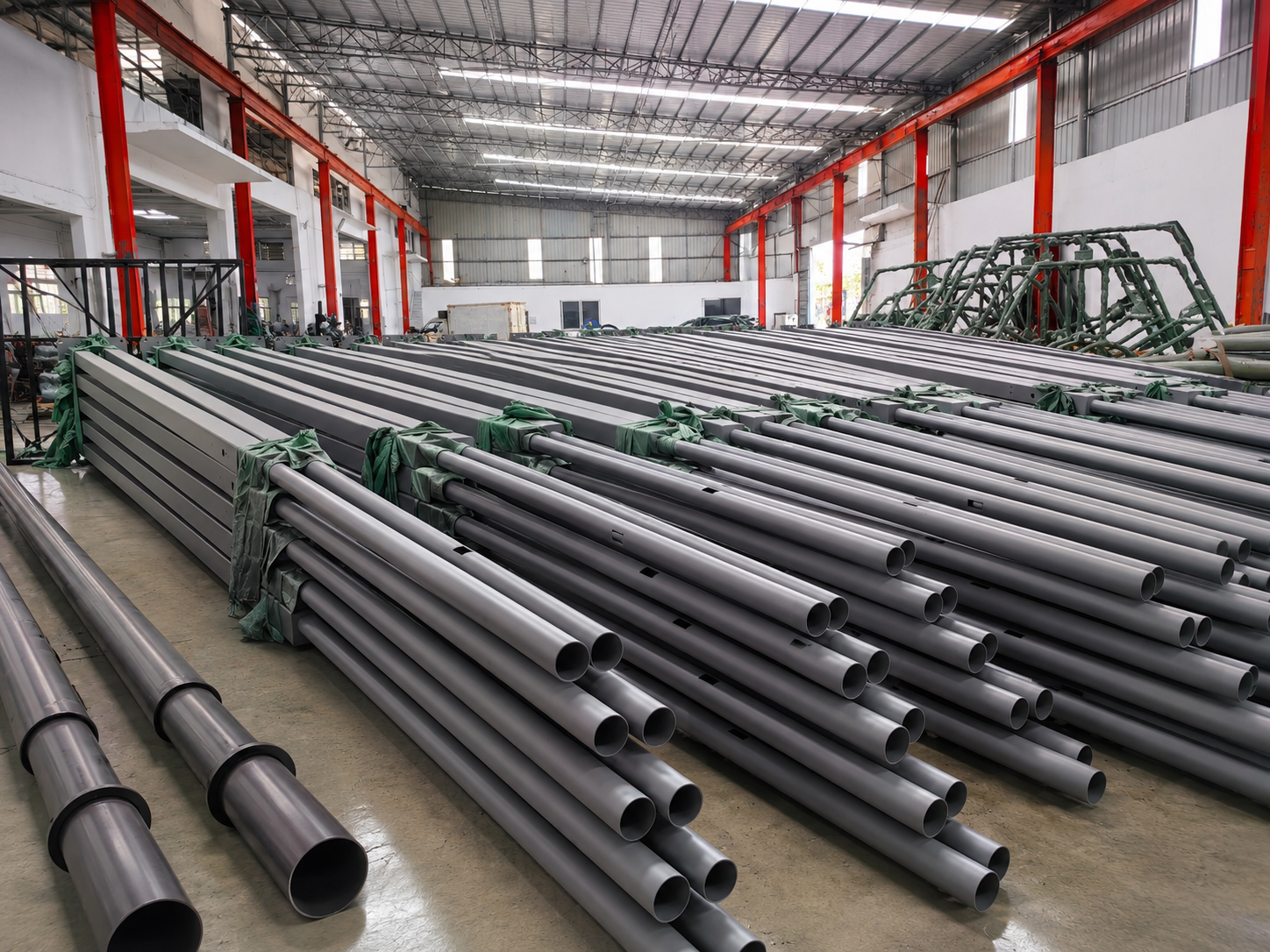
Height also has a structural consequence. Wind resistance on this platform is a structural design tailored to pole height and the local wind speed of the project site, so a change in height changes the pole structure, the base and the anchor bolt design — not just the luminaire position.
Step 3 — Match LED power to the height and the task
Wattage is the input side of the equation; delivered luminaire output scales with the platform’s efficacy rating of ≥130 lm/W. There is no universal height-to-wattage pairing, because the correct wattage depends on the width of the surface to be lit, the pole spacing and overhang, the required uniformity, and the maintenance assumptions used in the design.
The practical logic is consistent: the greater the mounting distance and the wider the area, the more output is needed to hold the same illuminance on the ground. Sites with dense pedestrian activity, signage or visually complex backgrounds generally benefit more from higher uniformity than from simply higher output.
The 60–200 W range on the BF-LSL platform allows the same decorative luminaire family to serve a park path and an arterial road without breaking the visual language of the streetscape — a real advantage in municipal programmes where lighting identity is part of the design brief.
Step 4 — Set colour temperature and colour rendering for the environment
Ra≥70 is the standard colour rendering option; Ra≥80 is optional. Ra≥70 supports traffic visibility and general outdoor perception. Ra≥80 is commonly specified where colour appearance matters — landscaped promenades, heritage and tourist districts, commercial frontages, hotel and resort surroundings, and mixed-use plazas — because stronger colour rendering keeps planting, facades and materials reading as intended after dark.
Colour temperature follows the same scenario logic. The platform offers 2700 K, 3000 K, 4000 K, 5000 K and 6000 K. Warmer options of 2700–3000 K are typical in residential, heritage and decorative settings; 4000 K is a frequently chosen neutral point where visibility and scene harmony need to be balanced; 5000–6000 K suits open infrastructure and large areas. The lamp itself uses a high-efficiency modular LED light source, so the colour decision does not change the fixture architecture.
Step 5 — Confirm protection, temperature range and service life
The BF-LSL-4000-120W is rated IP65 or IP66, operates from −30 °C to +60 °C and has a service life of at least 50,000 hours, with a power factor of PF≥0.95 and electric shock protection Class I.
Two of these points deserve attention during specification. Class I protection means the luminaire relies on a protective earth connection, so the electrical design must be coordinated with the installation’s earthing arrangement. Temperature rating, meanwhile, should always be compared against the site’s recorded range rather than against a regional average. For contrast, the separate solar street lamp BF-SL-8M-100W is rated −20 °C to +60 °C — a narrower low-temperature window than the mains-powered platform. In cold inland or high-altitude projects where solar and mains-powered options are combined in one scheme, that difference should be checked explicitly.
Step 6 — Confirm pole structure, wind resistance and the control interface
The pole itself is a specification, not an accessory. Available structures include conical, square, special-shaped and artistic poles, and bracket options cover single arm, double arms, multi-arms and combined high-low lamp heads. Light distribution can be specified as road lighting distribution, plaza lighting distribution or decorative landscape distribution. Surface treatment is full hot-dip galvanizing followed by outdoor electrostatic powder coating, with dark grey, black, silver grey and bronze as standard colours and RAL colour matching available.
Control should be decided at this stage as well. Standard on-off control is the base configuration, with photocell, timer, 0–10V dimming, DALI and smart lighting control available as options. For projects planned as smart city lighting schemes, the D4i and Zhaga interoperability trend is worth factoring in early, because the control interface must be defined before the pole and luminaire are ordered.
Use Cases: How Urban Roads and Parks Pull the Same Platform in Different Directions
Scenario is the strongest single driver of the height-and-wattage pairing, and the two dominant scenario families pull in opposite directions.
Urban roads: performance leads
Road scenarios are generally driven by carriageway width and traffic characteristics. Wider, faster roads push toward the upper end of the mounting height range, because the luminaire must span the carriageway and hold uniformity across lanes, and toward higher wattage so that uniformity is maintained at realistic pole spacing. Decorative elements still matter — in many municipal streetscape programmes the pole is part of the city’s visual identity — but functional performance leads the specification.
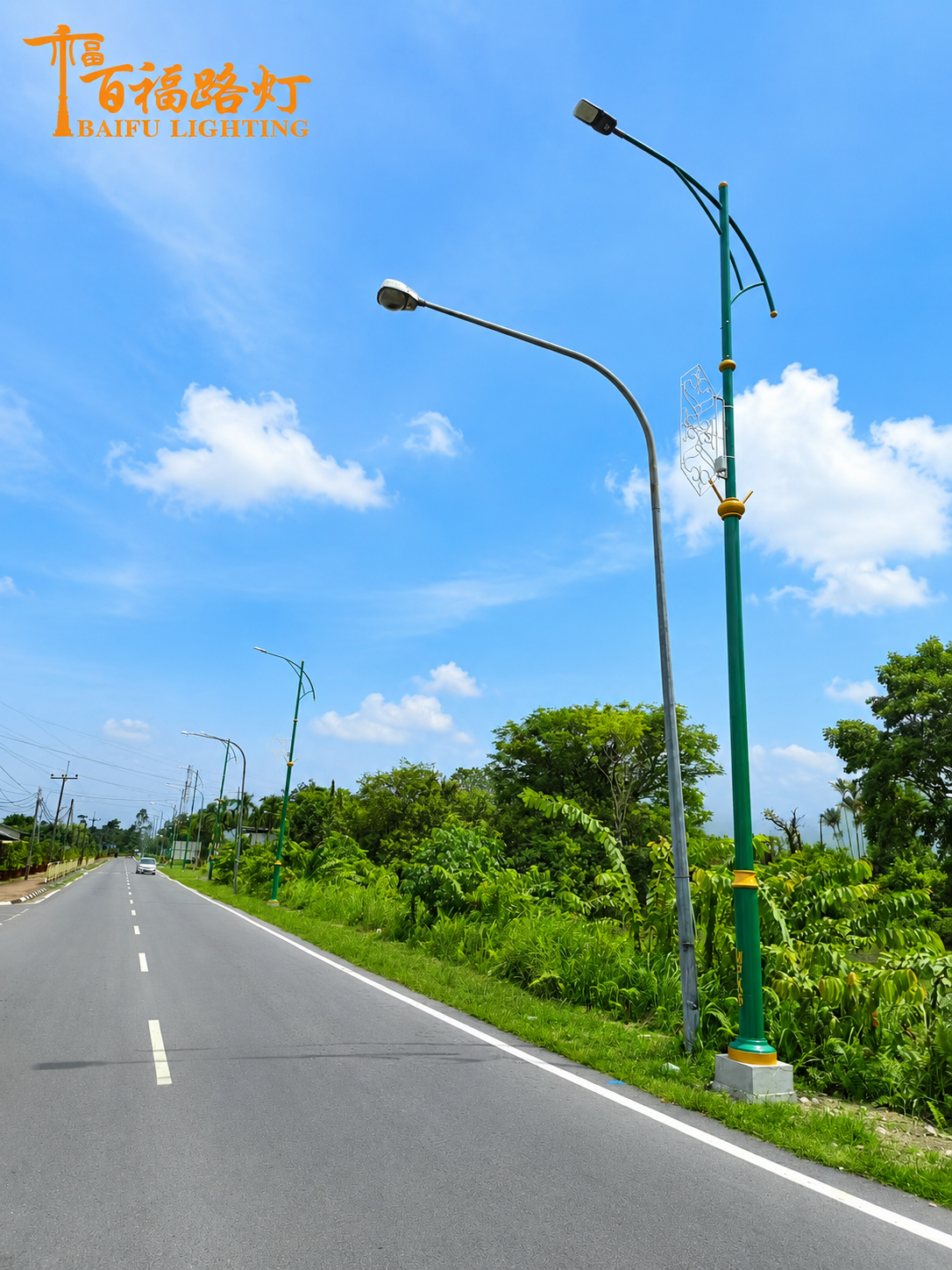
A Malaysian municipal project shows the pattern in practice. Sixty-eight units of customized landscape street lamps were installed along urban roads, characteristic streets and road landscape areas, with pole design matched to the local road greening and urban environment. After installation the lamps operated stably, night-time road brightness was uniform, and the illumination range met vehicle and pedestrian passage needs, with the project balancing lighting brightness, road safety, weather resistance and landscape effect.
Parks, plazas and pedestrian areas: ambience and colour lead
Park and plaza scenarios invert the logic. Lighting tasks are pedestrian-scale, so lower mounting heights are usual, with output selected for even, comfortable coverage rather than reach. Here the decorative dimension of the pole and luminaire carries more specification weight, and colour rendering and colour temperature become decision lines in their own right — which is where Ra≥80 requests most often appear.
The same manufacturer’s range illustrates how the height decision scales across a site. The BF-AGL-4000-60W ancient-style courtyard lamp addresses the smallest end of the range at an installation height of 3–4 m with 30 W, 40 W, 50 W, 60 W and 80 W options, for residential communities, villa courtyards, urban parks, commercial plazas, hotels and resorts. At the other end of the same logic, the BF-SL-8M-100W separate-type solar street lamp is built on an 8 m single-arm conical pole with a 100 W LED, a 200 W monocrystalline silicon panel and a 12 V 80 Ah maintenance-free battery, targeting rural road projects, urban side roads, industrial parks, residential communities, park roads, schools, hospitals, parking lots, commercial plazas, government projects and overseas infrastructure lighting projects.
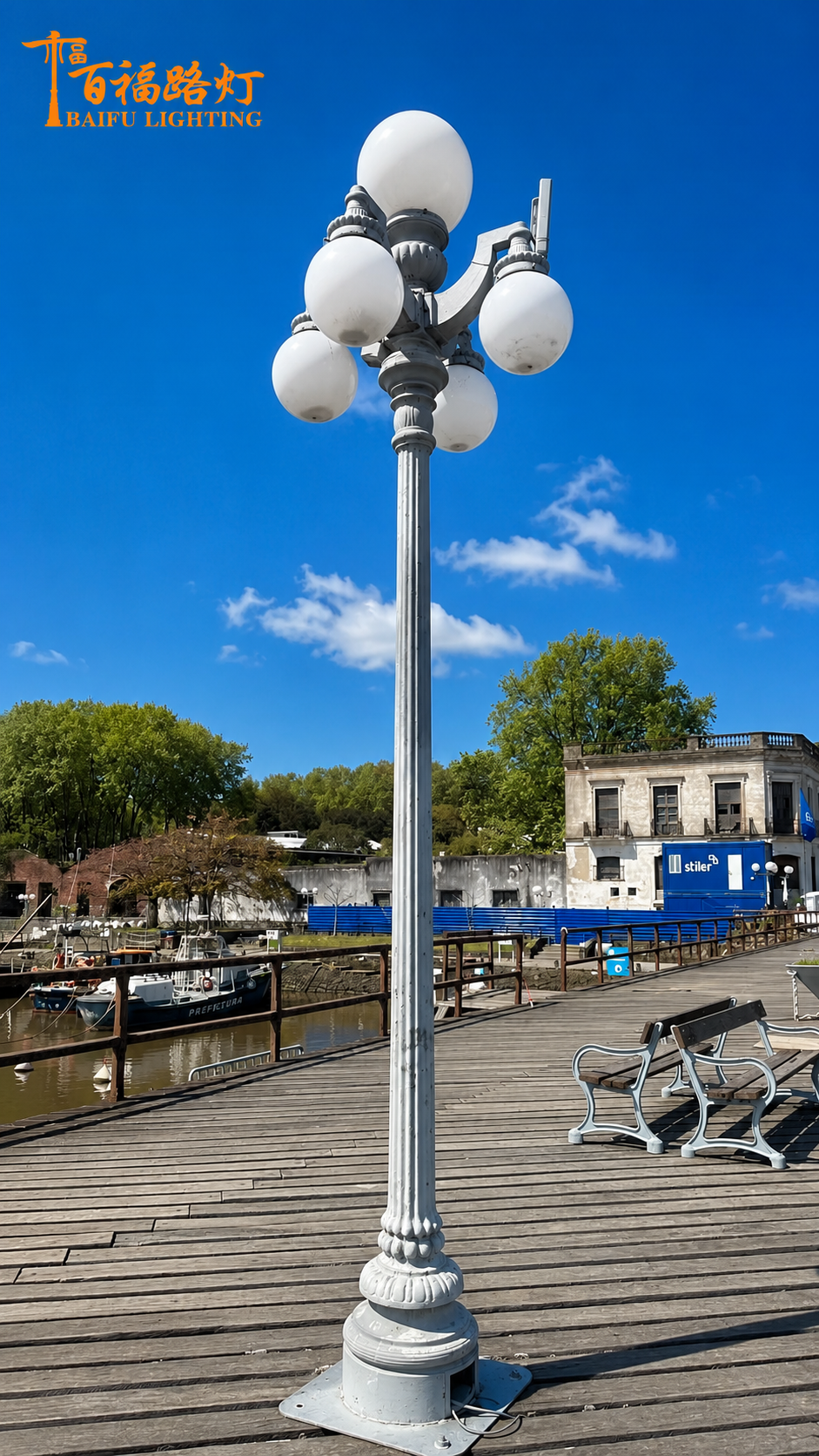
A second municipal reference — a coastal waterfront programme of 35 custom units delivered over two years for coastal roads, port surroundings, city squares and public recreation areas — shows the same platform used where corrosion resistance and visual harmony with surrounding architecture matter as much as output. Those fixtures were custom-designed around the local coastal environment and architectural style, with waterproof, anti-corrosion and weather-resistant construction intended for long-term coastal use.
Comparison Table: Height, Power and Platform Options
The first table is a planning orientation for how scenario shifts the height and wattage direction on the BF-LSL-4000-120W platform; the second compares three BAIFU LIGHTING outdoor models across the parameters that most often decide a project specification.
| Project scenario | Mounting height commonly considered | Wattage direction | Engineering reason |
|---|---|---|---|
| Urban arterial / wide carriageway | 12 m | Upper part of the 60–200 W range | Greater mounting distance and wider surface require more output to hold illuminance and uniformity |
| Collector road / commercial street | 10 m | Mid to upper range | Mixed vehicle and pedestrian tasks; decorative identity often specified alongside performance |
| Secondary road / industrial park road | 8 m | Mid range | Moderate mounting distance; uniformity across a narrower surface is the priority |
| Park path / plaza edge / residential internal road | 6 m | Lower part of the range | Pedestrian-scale task; comfort, glare control and colour appearance lead the specification |
This matrix is orientation only. Final values are confirmed through the project lighting design — for example against EN 13201 or ANSI/IES RP-8 — and against the site’s wind speed, temperature range and installation conditions.
| Parameter | BF-LSL-4000-120W | BF-AGL-4000-60W | BF-SL-8M-100W |
|---|---|---|---|
| Type | Custom decorative landscape street light | Aluminium / steel cast outdoor lamp (ancient-style courtyard) | Separate-type solar street lamp |
| Mounting / installation height | 6 m, 8 m, 10 m, 12 m (customizable) | 3–4 m (customizable) | 8 m pole, single-arm conical |
| LED power options | 60 W, 80 W, 100 W, 120 W, 150 W, 180 W, 200 W | 30 W, 40 W, 50 W, 60 W, 80 W | 100 W |
| Luminaire efficacy | ≥130 lm/W | ≥130 lm/W | ≥150 lm/W |
| Colour temperature | 2700 K, 3000 K, 4000 K, 5000 K, 6000 K | 3000 K, 4000 K, 5000 K, 6000 K | 3000 K, 4000 K, 5000 K, 6000 K |
| Colour rendering index | Ra≥70; Ra≥80 optional | Ra≥70 | Ra≥70 |
| Power factor | PF≥0.95 | PF≥0.95 | Not stated in the available specification |
| IP rating | IP65 / IP66 | IP65 / IP66 | IP65 / IP66 |
| Electric shock protection class | Class I | Class I | Not stated in the available specification |
| Operating temperature | −30 °C to +60 °C | −30 °C to +60 °C | −20 °C to +60 °C |
| Service life | ≥50,000 hours | ≥50,000 hours | Not stated in the available specification |
| Control | On-off standard; photocell, timer, 0–10V dimming, DALI, smart control optional | Switch control standard; light control, time control, intelligent control optional | Light control + time control; intelligent dimming supported |
| Typical applications | Urban roads, parks, plazas, commercial streets, large-scale landscape projects | Residential communities, villa courtyards, urban parks, commercial plazas, hotels and resorts | Rural roads, urban side roads, industrial parks, park roads, parking lots, infrastructure projects |
Frequently Asked Questions
What standards should guide pole height and wattage selection on a municipal project?
Two standard families cover most projects. The EN 13201 series (parts 1–5) defines quality, performance and energy indicators for road and street lighting design in Europe, while ANSI/IES RP-8 is the primary American national standard for lighting roadway and parking facilities, focused on luminance and safety criteria. In practice, the project first confirms which lighting class or performance target applies, and the mounting height and luminaire output are then calculated to satisfy it. On custom projects, this design basis should be shared with the manufacturer before quotation, because engineering support such as product selection, CAD drawing development and lighting configuration recommendations depends on those inputs.
Can BAIFU LIGHTING customise pole height and LED wattage outside the standard options?
Yes. On the BF-LSL-4000-120W platform, mounting height is offered at 6 m, 8 m, 10 m and 12 m with further customisation per project requirements, and LED power covers 60 W, 80 W, 100 W, 120 W, 150 W, 180 W and 200 W. Customisation also extends to appearance design, bracket structure, colour per RAL card, decorative patterns, light source configuration and intelligent control systems. BAIFU LIGHTING is Zhongshan Baifu Street Lamp Co., Ltd., a custom outdoor lighting manufacturer in Guzhen Town, Zhongshan City, Guangdong, China, established in 2013 with an 11,158 m² facility, a 5-engineer R&D team and OEM/ODM plus project-based manufacturing.
What are the minimum order quantity and lead time for a custom street light project?
For BAIFU LIGHTING, standard styles require a minimum order of 20 sets, while custom styles require a minimum order of 5 sets. Production lead time is 15 to 18 days, and monthly production capacity is 3,000 to 5,000 units for regular orders. Because custom pole heights, artistic structures and RAL colour matching are project-specific, buyers should confirm whether their configuration is classified as standard or custom before comparing MOQ terms across suppliers.
How is quality and after-sales support handled on a custom configuration?
Products generally need to pass appearance inspection, electrical performance test and protection level test. Engineering support can include CAD drawing development, lighting configuration recommendations, appearance design evaluation, sample development and project quotation. After delivery, BAIFU LIGHTING provides installation instructions, remote technical support, fault diagnosis and accessory supply; for quality issues, repair, replacement or supplementary service is provided as stipulated in the contract. Buyers ordering a non-standard pole height should confirm the inspection documentation accompanying the shipment, since protection level and electrical performance are the parameters most affected by customisation.
Chinese custom street light manufacturers for smart city municipal projects — what should buyers verify?
For smart city municipal projects, buyers should verify four things: an integrated manufacturing base that covers metal fabrication, welding, surface treatment, electrical assembly, inspection and export packing; documented customisation capability for pole height, LED power, bracket structure and control system; smart-control options such as photocell, timer, 0–10V dimming, DALI and smart lighting control; and project references in comparable markets. BAIFU LIGHTING manufactures and customises LED street lights, solar street lights, decorative street lights, landscape lights, garden lights, lawn lights, smart street lights, high mast lighting and custom lighting poles, with products supplied to more than 71 countries and markets including the Middle East, Central Asia, North America, Southeast Asia and Africa. The company serves municipal contractors, engineering companies, developers, lighting distributors, landscape designers, architects and project procurement companies, and provides English product specifications, quotations, CAD drawing support, packaging information, export documentation and shipment coordination for international projects. Buyers working on a smart city or municipal programme can send their pole height, wattage target and site conditions for a configuration review and quotation.
Conclusion: Lock the Height, Then Size the Wattage
The selection process reduces to a clear sequence. Define the lighting task and the applicable design class. Fix the mounting height from the surface to be lit, because it is embedded in the pole, base, anchor bolts and foundation and is expensive to revise later. Size the LED power to serve that height and task, using the platform’s ≥130 lm/W efficacy to understand how output scales. Then confirm colour rendering and colour temperature against the environment, verify IP rating, operating temperature range, service life, protection class and power factor against site conditions, and settle the pole structure, wind resistance and control interface before production starts.
Applied to a real platform such as the BF-LSL-4000-120W, that sequence turns an open choice of 6 m, 8 m, 10 m or 12 m and 60 W to 200 W into a defensible specification — one that holds up against EN 13201 or ANSI/IES RP-8 design targets, matches whether the site is an urban road, a park path or a plaza, and survives the local temperature range and weather exposure over a service life of at least 50,000 hours.
Next Step: Review Your Project Configuration
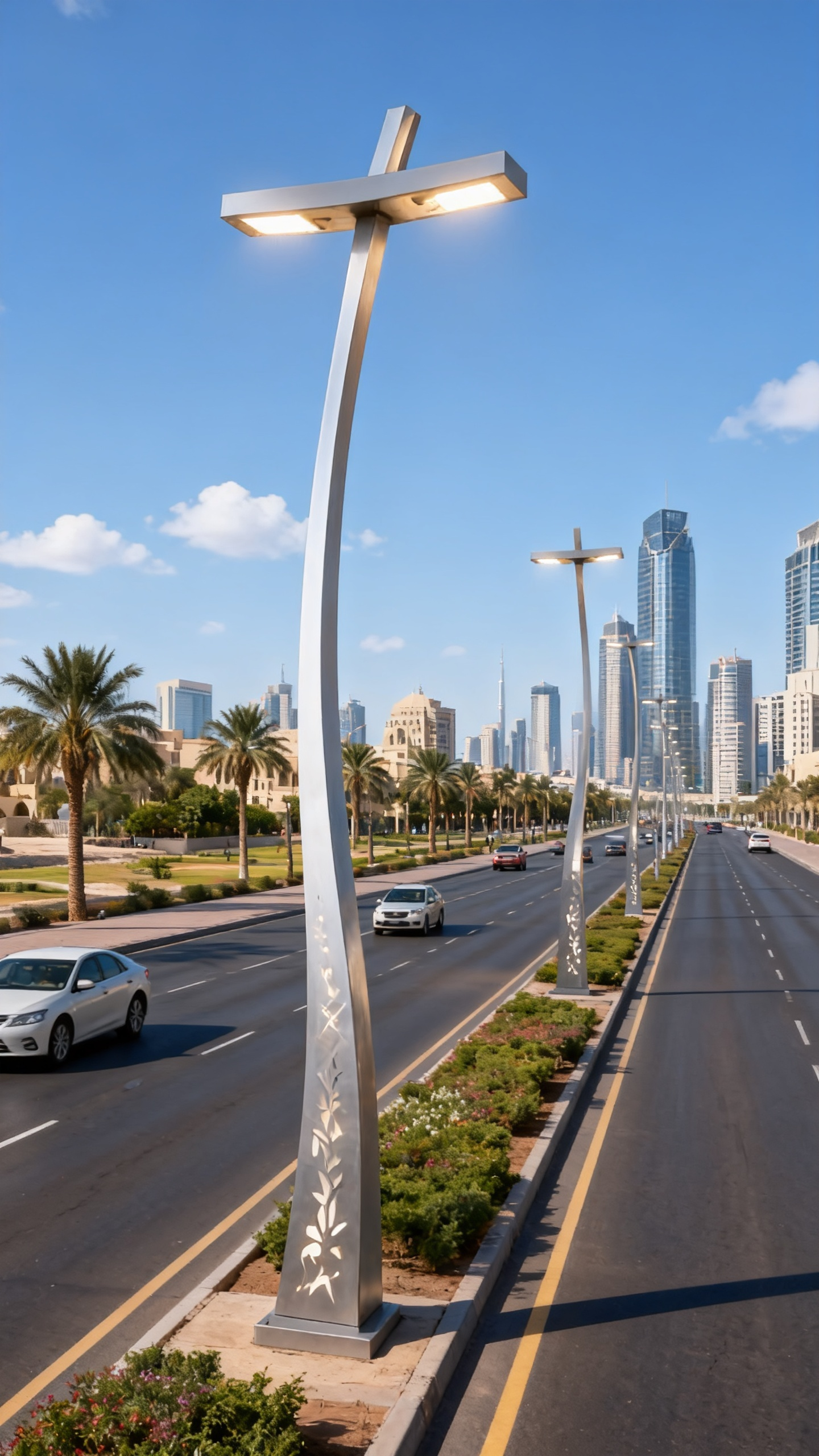
If you are specifying a municipal road, park, plaza or smart city lighting project, BAIFU LIGHTING can review your mounting height, LED wattage target, control requirements and site conditions, then return a configuration recommendation, CAD drawing support and quotation.
- Request a quotation or sample evaluation: Jack Chen — WhatsApp +86 195 8242 2595, Tel +86 186 8015 2652, Email chenyingjie@baifulamp.com
- Download the product album: BAIFU LIGHTING Customized Album (PDF)
- Company information: www.baifulamp.com — No. 102 Xinxing Avenue, Guzhen Town, Zhongshan City, Guangdong Province, P.R. China