
Custom Street Light Compliance Guide: Regional Requirements to Verifiable Specs
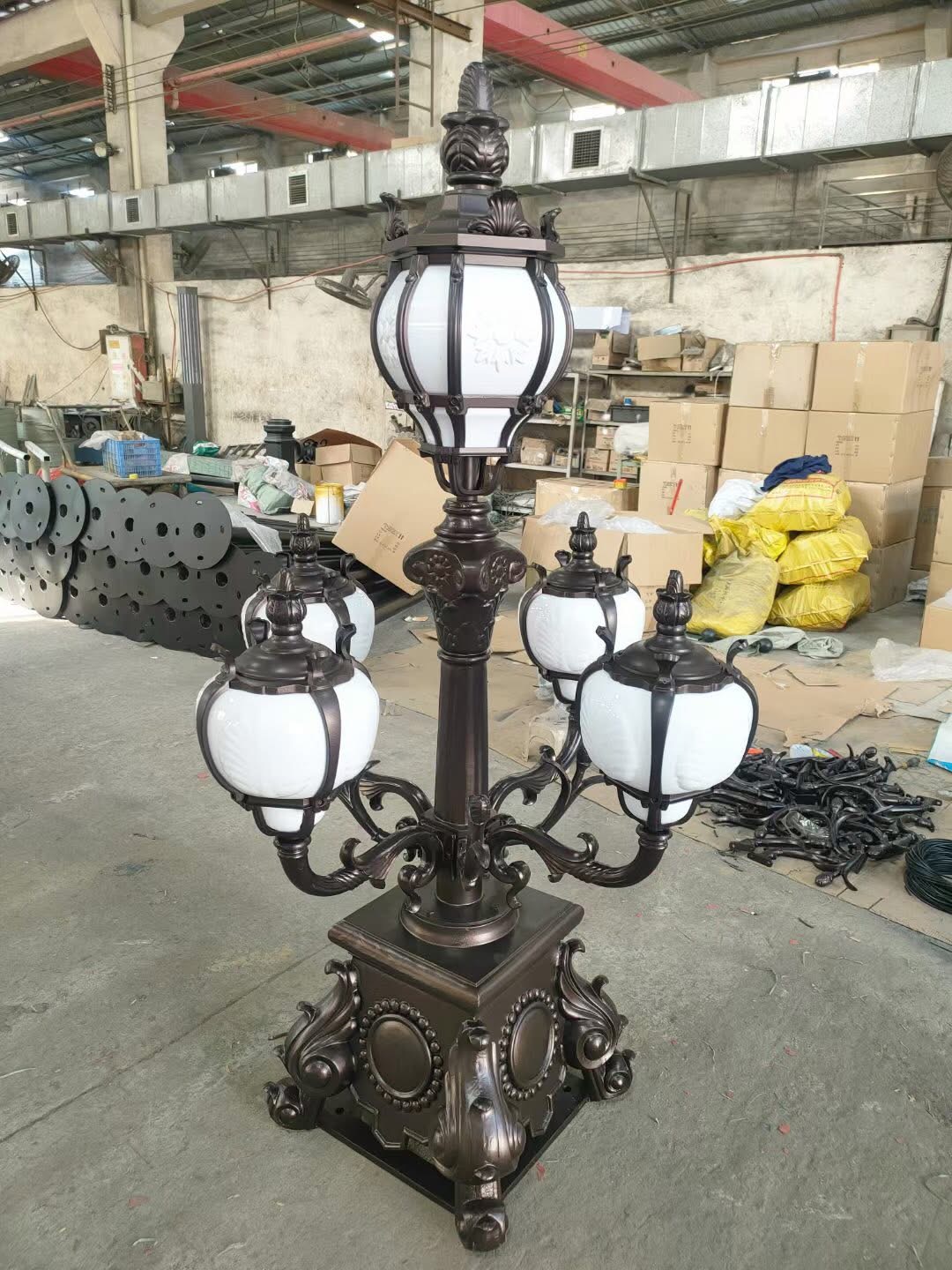
A custom street light only becomes compliant when each regional requirement has been written down as a value a supplier can be held to.
A regional lighting requirement becomes enforceable only when it has been converted into a specification that a supplier can be measured against. For custom street lights, that conversion happens across five fields: ingress protection, electric shock protection class, input voltage, operating temperature, and wind load. This guide explains how project buyers move each field from a verbal assurance to a documented line item, and it uses three BAIFU LIGHTING models — BF-LSL-4000-120W, BF-AGL-4000-60W and BF-SL-8M-100W — as worked examples of what a verifiable specification actually looks like.
This is written for the research and evaluation stage of a project, where drawings are still open and the supplier has not yet been locked. At that stage, a specification error is cheap to fix. Once tooling, pole fabrication and coating have started, the same error becomes a rework, a delayed shipment, or a luminaire that fails on site. The purpose of this page is to make the earlier, cheaper correction possible.
Problem Definition: Why “Compliant” Is Not the Same as “Verifiable”
Regional requirements reach a buyer in several different forms: a design criterion from a lighting consultant, a clause inside a tender document, a reference to a national standard, or an informal instruction that the product must be “suitable for coastal conditions.” None of these forms is directly orderable. A tender clause has no units. A standard reference describes a design outcome, not a product value. A verbal requirement has no test behind it.
The result is a predictable set of failures in custom outdoor lighting procurement:
- Requirements expressed as performance, answered as hardware. A requirement may reference road lighting quality indicators, while the supplier's datasheet lists wattage and luminous flux. The two documents are not talking about the same thing.
- Waterproofing described in words instead of ratings. “Waterproof” and “weather resistant” are not specifications. A declared IP rating is. IP65 and IP66 are separate declarations and should be stated as such on the model datasheet.
- Electrical safety class left blank. Electric shock protection class is frequently omitted from quotations for decorative or landscape luminaires, even though it is one of the values a reviewing engineer will look for first.
- Voltage assumptions taken from the home market. A luminaire rated for a narrow voltage band may behave differently from one rated for a wide range, and the difference only appears when the project is energised.
- Temperature range not checked against the installation site. Published operating ranges differ between models — and a two-model family from the same manufacturer can differ by ten degrees at the cold end.
- Wind load handled as a promise rather than a design input. Wind resistance is a structural design decision tied to pole height and local wind speed, not a fixed product feature.
The common thread is that none of these gaps are caused by a bad product. They are caused by a requirement that was never translated into a value, a class, or a range that could be verified before dispatch.
Industry Background: Why Compliance Evidence Became a Procurement Gate
Street lighting is a mature but steadily growing category. Grand View Research valued the global street lighting market at USD 9.1 billion in 2023 and projected it to reach USD 11.6 billion by 2030, a CAGR of 3.6%. Within that market, LED lighting dominated in 2023 with 79.7% of total revenue, so LED street lighting is now the default specification rather than the premium option.
The installed base is also becoming more instrumented. Berg Insight reported that the global installed base of smart street lights reached 32.9 million units at the end of 2024, with a 20.9% CAGR projected through 2029. That growth matters for compliance work because connected luminaires carry additional interoperability expectations: the D4i and Zhaga standards are increasingly adopted so that sensors and luminaires from different suppliers can work together. A project that specifies smart control therefore has more specification fields to verify, not fewer.
On the supply side, the market is fragmented. The top ten companies in the global lighting fixtures market, including Signify and Osram, together account for just over 20% of total market share, according to CSIL. That means the majority of project supply is delivered by manufacturers outside that group — including specialist custom and project-based factories. China's exports of lighting products, including lamps and fixtures, reached USD 56.3 billion in 2023, reflecting a 7% year-on-year decrease, but the absolute volume confirms the role Chinese manufacturers play in international project supply. Regionally, Africa is recognised as the fastest-growing lighting market, with over 4% average annual growth since 2018, driven largely by public infrastructure projects.
The regulatory layer sits on top of this. In Europe, the EN 13201 series (parts 1 to 5) defines quality, performance and energy indicators for road and street lighting design. In the United States, ANSI/IES RP-8 is the primary American national standard for lighting roadway and parking facilities, focusing on luminance and safety criteria. These documents govern design outcomes. They do not, by themselves, tell a factory what to put on a packing list. The translation between the two is where projects succeed or stall.
The Five Specification Fields Where Regional Requirements Usually Break Down
Most regional compliance questions in custom street lighting resolve into five product fields. Each one can be written as a verifiable value.
1. Ingress Protection
Ingress protection is the field buyers ask about most and verify least. The relevant question is not whether a luminaire is “waterproof” but which IP rating is declared for the exact model being quoted, and whether the declaration is backed by the supplier's own protection level testing rather than a generic catalogue claim.
The BF-LSL-4000-120W custom LED landscape street light carries an IP rating of IP65 or IP66, and the BF-AGL-4000-60W ancient-style courtyard lamp carries the same IP65/IP66 protection grade. Both statements are model-specific declarations, which is what a reviewer needs. A project in a high-rainfall or coastal environment should require the declared rating in writing, per model, and should treat a range such as “IP65/IP66” as something to be fixed at order stage — not left to the factory's discretion at dispatch.
2. Electric Shock Protection Class
Electric shock protection class is the field most often missing from a quotation and most often requested by a reviewing electrical engineer. It is a classification, not a performance score, so there is nothing to negotiate: the value is either declared for the model or it is not.
Within the BAIFU LIGHTING range, the BF-LSL-4000-120W custom LED landscape street light has an electric shock protection class of Class I, and the BF-AGL-4000-60W ancient-style courtyard lamp is also Class I. A buyer comparing quotes should record the class for every luminaire in the package. If a model in the proposed bill of materials does not state a class, that is a documentation gap to close before award, not a detail to settle after installation.
3. Input Voltage and Frequency
Grid conditions vary by region, and luminaires that accept a narrow voltage band may be unsuitable for sites where supply fluctuates. The practical specification is a declared input voltage range and frequency, checked against the project's actual supply — and, for projects that combine grid and solar supply, an explicit statement of which luminaires run on which source.
The BF-LSL-4000-120W operates at a rated voltage of AC 85–265V, 50/60Hz, and the BF-AGL-4000-60W lists the same input voltage and frequency. The BF-SL-8M-100W is a different case entirely: it is a split-type solar street lamp with a 200W high-efficiency monocrystalline silicon solar panel and a 12V 80Ah maintenance-free lead-acid battery. That model does not draw from the grid in the same way, so its “voltage” specification is really a system configuration question covering panel, battery and controller. Making that distinction explicit early prevents a mixed bill of materials from being quoted as if all luminaires were mains-powered.
4. Operating Temperature Range
Operating temperature is where assumptions about a “product family” cause real errors. Temperature ranges are declared per model, and they do not always match across a range.
The BF-LSL-4000-120W operates in a temperature range of −30°C to +60°C and has a service life of at least 50,000 hours. The BF-AGL-4000-60W lists the same −30°C to +60°C range and the same minimum 50,000-hour service life. The BF-SL-8M-100W solar street lamp, by contrast, is specified at −20°C to +60°C. For a project in a hot inland region the difference is immaterial; for a project at the cold end of the range, it is the difference between a compliant and a non-compliant luminaire. The specification fix is straightforward: state the site's minimum and maximum design temperature, then require each proposed model to declare its operating range against that figure.
5. Wind Load and Pole Structure
Wind load is the field least likely to appear as a number on a datasheet, because it is not a fixed product property. It is a structural design output that depends on the pole, the arm, the luminaire and the local wind speed at the project site.
BAIFU LIGHTING handles this consistently across the three models in different ways that all point back to the same design input. The BF-LSL-4000-120W uses wind resistance based on a structural design tailored to pole height and the local wind speed of the project site. The BF-AGL-4000-60W is structurally designed based on lamp height and local wind speed. The BF-SL-8M-100W uses a structural design based on the wind speed at the project location. In each case, the verifiable specification is not a single number but a documented design input: the wind speed the structure was designed for, the pole height and form, the material, and the surface treatment system.
Structure and surface treatment are part of the same verification. The BF-LSL-4000-120W is constructed with Q235 hot-dip galvanized steel, 304 stainless steel, die-cast aluminum lamp housings, high-transmittance tempered glass, stainless steel fasteners and outdoor electrostatic powder coating. The BF-AGL-4000-60W uses a high-pressure cast aluminum lamp body, a Q235 hot-dip galvanized steel pole, tempered glass or UV-resistant PC cover, and stainless steel fasteners. The BF-SL-8M-100W uses a Q235 steel pole with hot-dip galvanizing anti-corrosion coating and an outdoor electrostatic powder coating layer. For a coastal or high-humidity site, that material and coating stack is exactly the paragraph a reviewer needs to see.
Step-by-Step: Converting a Regional Requirement into a Verifiable Specification
The following six steps turn a regional requirement into something a supplier can be measured against. The order matters, because skipping to step four is what produces the mismatches described above.
- Write the requirement in its original form. Quote the clause, standard reference or design criterion exactly as received — for example an EN 13201 reference in a European project or an ANSI/IES RP-8 reference in a US project. Do not paraphrase it into product language yet.
- Identify which physical field it governs. Decide whether the requirement is actually about ingress protection, electrical safety class, voltage and frequency, operating temperature, wind and structural design, or light distribution type. One requirement usually governs one field.
- Fix a value, class or range for that field. Replace adjectives with declared values. “Must be weather resistant” becomes a declared IP rating. “Must meet local electrical safety” becomes a declared electric shock protection class. “Must suit the climate” becomes a numeric operating temperature range.
- Check the value against the site condition. Compare the declared value with the site's actual wind speed, minimum and maximum design temperature, grid supply, and exposure. This is where a −20°C model and a −30°C model stop being interchangeable.
- Request documented evidence, not a restated claim. The supplier's quality process should cover appearance inspection, electrical performance testing and protection level testing. Ask for the declared specification per model, and for the test scope that supports it. A statement repeated in a quotation is not evidence; a declared value plus a defined test is.
- Lock the value into the order and the inspection scope. Push the agreed figures into the purchase specification and the pre-shipment inspection checklist, so the same values are checked at the end of production as were agreed at the beginning.
One verification rhythm that works: before the order, confirm the declared value for each of the five fields; before shipment, confirm that the same values appear in the protection level and electrical performance test records. Two checks, one document trail.
The table below shows how common regional requirement categories map onto the specification fields that must be fixed, and the evidence a buyer should ask to see.
| Requirement category | Specification field to fix | Evidence to request before award |
|---|---|---|
| Moisture, dust and rain exposure | Declared IP rating per model (IP65 / IP66) | Model datasheet value plus protection level test coverage |
| Electrical safety review | Electric shock protection class (for example Class I) | Declared class per model plus electrical performance test coverage |
| Grid and supply conditions | Rated input voltage and frequency | Declared range, and confirmation of which luminaires are mains- or solar-powered |
| Climate and seasonal extremes | Operating temperature range per model | Declared range and service life figure |
| Wind, storm and structural loading | Design wind speed, pole structure, material and surface treatment | Structural design basis plus pole drawing and coating specification |
| Road lighting design quality | Light distribution type and luminaire performance | Design reference used in the project region (for example EN 13201 or ANSI/IES RP-8) and matching luminaire data |
Worked Examples: Three Custom Street Light Models Against Project Conditions
These three models belong to the BAIFU LIGHTING range and illustrate how the same five fields resolve differently depending on the project type.
Coastal and Public Realm Conditions — BF-AGL-4000-60W
The BF-AGL-4000-60W ancient-style courtyard lamp is designed for residential and commercial landscape lighting, with typical applications including residential communities, villa courtyards, urban parks, commercial plazas, hotels and resorts. It is installed at 3–4 metres — customisable according to project requirements — and offers LED power options of 30W, 40W, 50W, 60W and 80W, with luminaire efficacy of at least 130 lm/W, colour rendering index Ra≥70 and power factor PF≥0.95.
A municipal engineering project delivered by the company illustrates why the corrosion and weather-resistance fields matter more than the photometric ones in coastal conditions. That project installed 35 units along coastal roads, around ports, in city squares and in public recreational areas, combining night-time road lighting, pedestrian guidance and coastal landscape decoration. The two-year engagement required luminaires custom-designed around the local coastal environment and architectural style, with an outdoor structure built for waterproof, anti-corrosion and weather-resistant performance over long-term coastal use. For a buyer preparing a similar specification, the compliance lesson is that material and coating fields — Q235 hot-dip galvanized steel pole, high-pressure cast aluminum lamp body, stainless steel fasteners and outdoor electrostatic powder coating — belong in the written specification, not in a verbal assurance about quality.
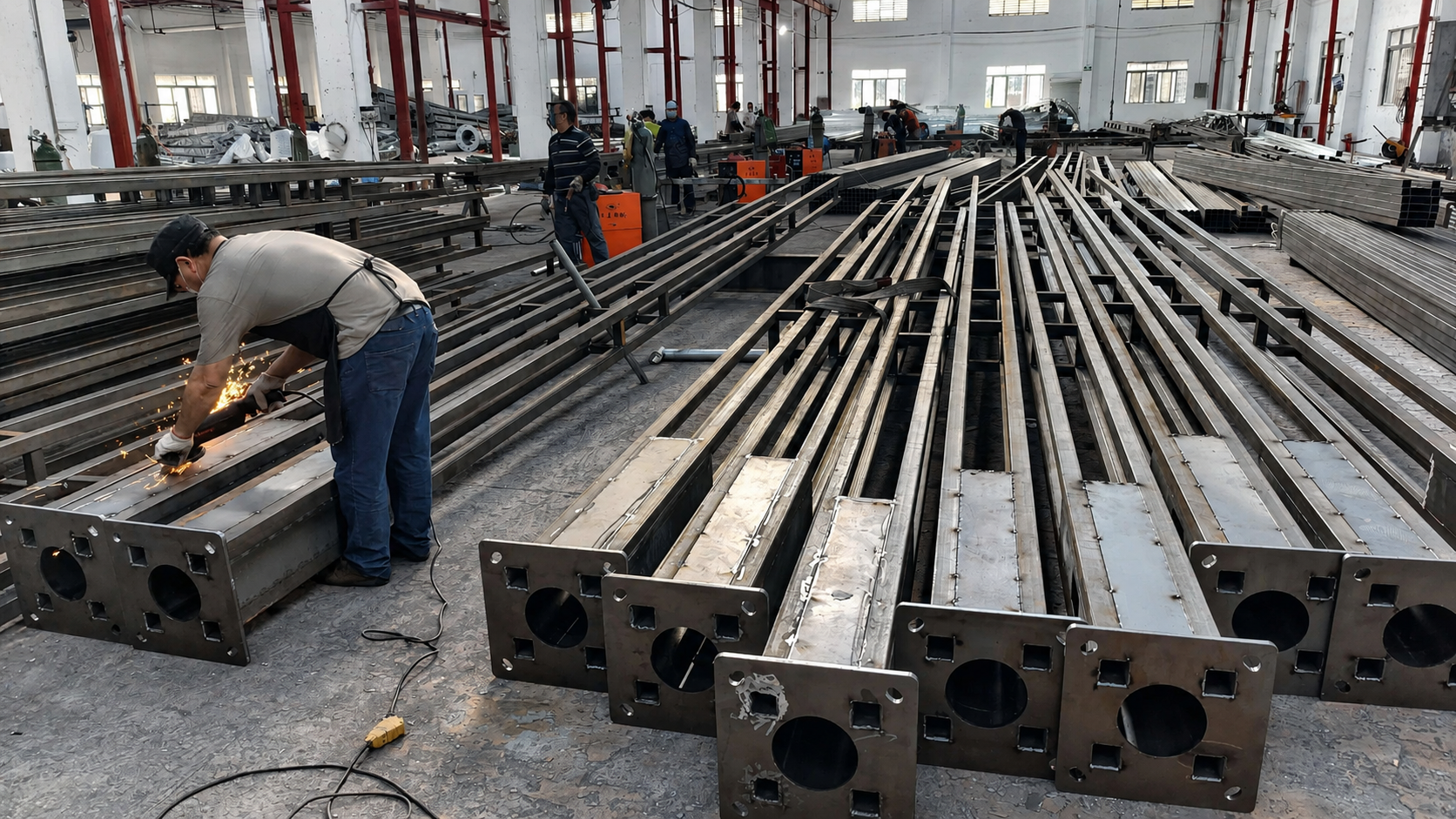
Structural fabrication is where the wind load and material specifications for a custom pole are actually realised.
Municipal Road and Streetscape Conditions — BF-LSL-4000-120W
The BF-LSL-4000-120W custom LED landscape street light is a non-standard customised luminaire with mounting heights of 6m, 8m, 10m and 12m, LED power options from 60W to 200W, luminaire efficacy of at least 130 lm/W, colour rendering index Ra≥70 with Ra≥80 optional, and power factor PF≥0.95. It is available with a high-efficiency modular LED light source in colour temperatures of 2700K, 3000K, 4000K, 5000K and 6000K, with an IP rating of IP65 or IP66, electric shock protection Class I, a service life of at least 50,000 hours and an operating range of −30°C to +60°C.
The control field is where this model offers the widest specification choice, and therefore the widest scope for ambiguity. Control methods include standard on-off control with optional photocell, timer, 0–10V dimming, DALI and smart lighting control. A project that specifies smart control should name the exact control method in the specification, because “smart ready” and “DALI controlled” are different line items.
A municipal urban road project delivered in Malaysia shows how this model is used in practice. Sixty-eight units were installed for municipal urban roads, characteristic streets and road landscape lighting, with lamp post designs blended into the local road greening and urban environment. The project took into account lighting brightness, road safety, weather resistance and landscape effect. In specification terms, that combination means the light distribution type, the surface treatment and the wind resistance design basis all had to be fixed before production rather than after delivery.
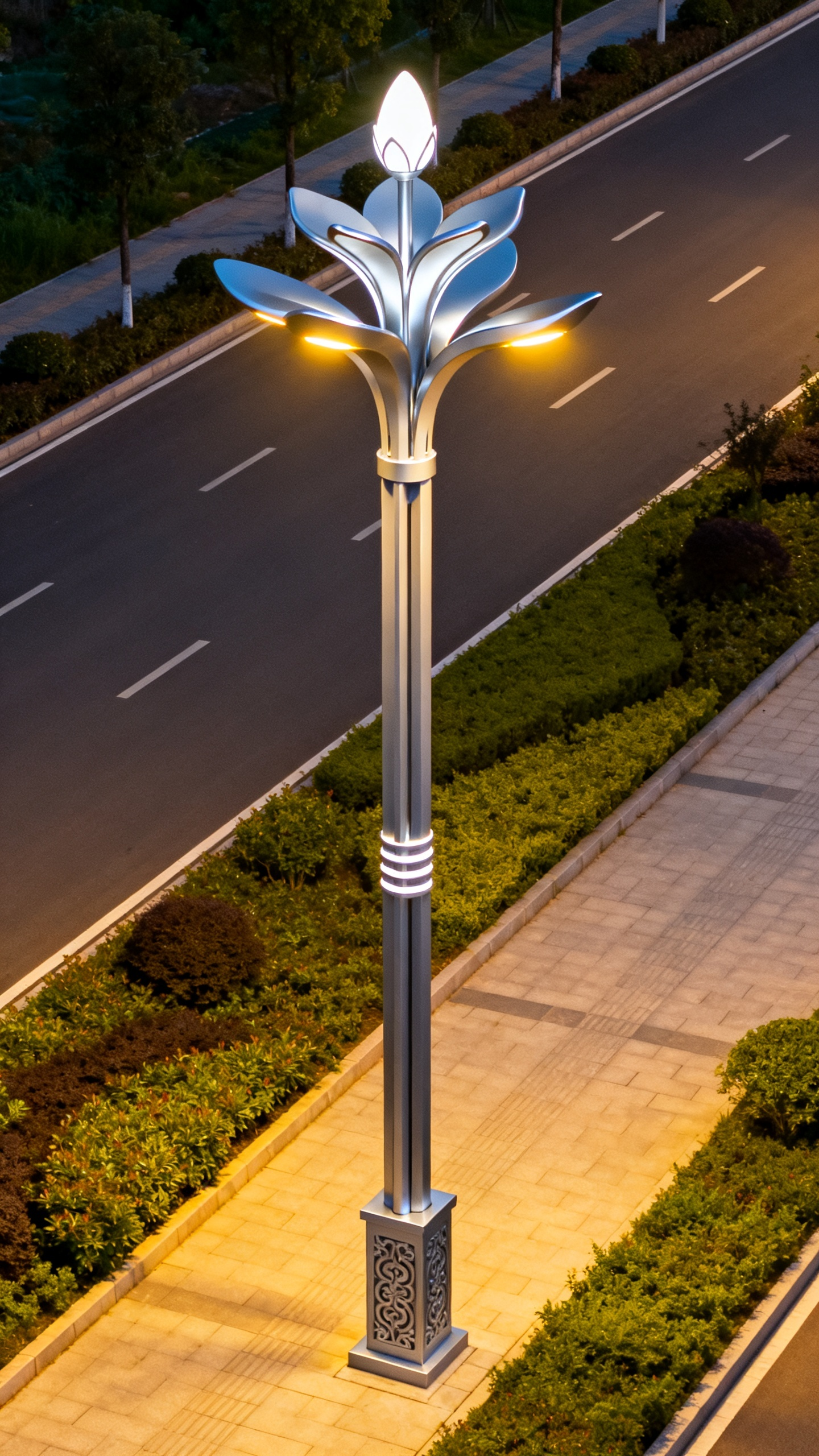
Non-standard optical and appearance design decisions must be fixed as values before the order, not left open at dispatch.
Off-Grid and Side Road Conditions — BF-SL-8M-100W
The BF-SL-8M-100W is an 8-metre split-type solar LED street lamp with a 100W LED lamp, a 200W high-efficiency monocrystalline silicon solar panel, a 12V 80Ah maintenance-free lead-acid battery, luminaire efficacy of at least 150 lm/W, colour rendering index Ra≥70, and IP65/IP66 protection. It uses a single-arm conical light pole with the lamp arm installed at 90 degrees, and the pole is finished with overall hot-dip galvanizing followed by electrostatic spraying. Its working temperature range is −20°C to +60°C.
Because there is no grid connection to fall back on, the solar model's compliance fields are different from the mains-powered models. Lighting time is 10–12 hours per day, and battery autonomy in rainy days is 2–3 days, configurable according to project requirements. Control is by light control plus time control, with intelligent dimming supported. Typical applications include rural road projects, urban side roads, municipal road lighting, industrial parks, residential communities, park roads, schools, hospitals, parking lots, commercial plazas, government projects and overseas infrastructure lighting projects. For a buyer, the verifiable specification here includes the panel and battery configuration and the autonomy figure — both of which should be stated in the order, because they determine whether the lamp performs through a cloudy week.
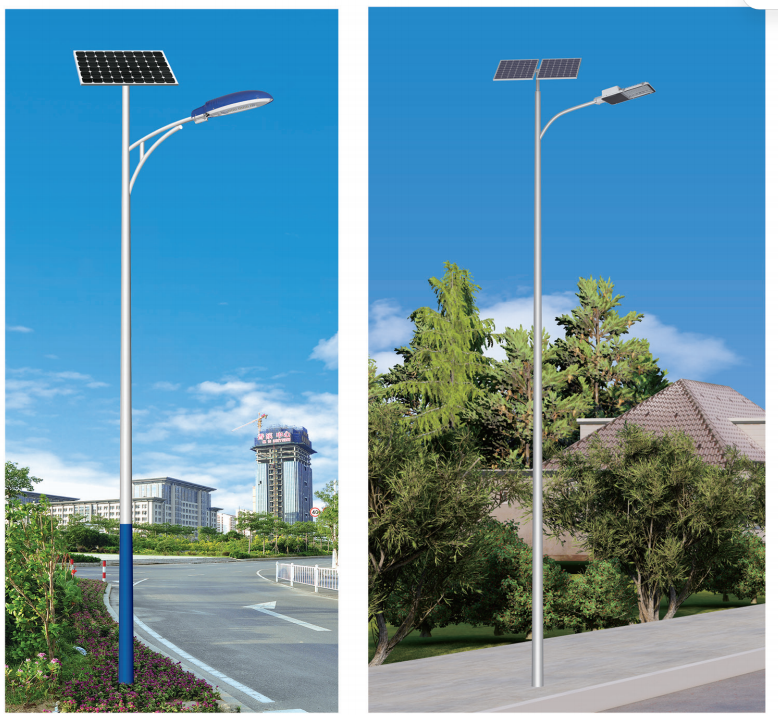
For solar models, the verifiable specification is a system configuration: panel, battery, controller and autonomy, not just a volt rating.
Specification Comparison: Three Custom Street Light Models
| Specification field | BF-LSL-4000-120W | BF-AGL-4000-60W | BF-SL-8M-100W |
|---|---|---|---|
| Product type | Custom decorative landscape street light | Ancient-style courtyard lamp (aluminum/steel cast outdoor lamp) | 8 m split-type solar LED street lamp |
| IP rating | IP65 / IP66 | IP65 / IP66 | IP65 / IP66 |
| Electric shock protection class | Class I | Class I | Not stated in the published model parameters — confirm at specification stage |
| Input / power source | AC 85–265V, 50/60Hz | AC 85–265V, 50/60Hz | Solar: 200W monocrystalline panel, 12V 80Ah maintenance-free lead-acid battery |
| Operating temperature | −30°C to +60°C | −30°C to +60°C | −20°C to +60°C |
| Wind resistance basis | Structural design tailored to pole height and local wind speed of the project site | Structural design based on lamp height and local wind speed | Structural design based on wind speed at the project location |
| Mounting height | 6 m, 8 m, 10 m, 12 m (customisable) | 3–4 m (customisable) | 8 m |
| LED power options | 60W, 80W, 100W, 120W, 150W, 180W, 200W | 30W, 40W, 50W, 60W, 80W | 100W |
| Luminaire efficacy | ≥130 lm/W | ≥130 lm/W | ≥150 lm/W |
Reading the table as a buyer: the two mains-powered models share the same voltage, protection and temperature declarations, so a project that mixes them does not need two separate electrical safety specifications. The solar model differs on temperature and on power-source architecture, so it should be specified separately even when it appears in the same bill of materials. That single observation prevents one of the most common compliance errors in mixed municipal packages.
Frequently Asked Questions
1. What documents should a buyer request to verify IP rating and electrical safety class for a custom street light?
Ask for the declared specification per model, not per product family, and ask what the supplier's quality process covers. At BAIFU LIGHTING, products generally pass appearance inspection, electrical performance testing and protection level testing. In practice this means two things for a buyer: the IP rating and electric shock protection class should be stated for each model being quoted, and the request should extend to the test coverage behind those declarations. A model such as the BF-LSL-4000-120W states IP65/IP66 and Class I directly, which makes verification straightforward. If a quoted model has no stated protection class, treat that as an open item to resolve before award rather than after installation.
2. How should buyers evaluate Chinese custom street light manufacturers for smart city municipal projects?
Start with whether the manufacturer works on non-standard, project-based outdoor lighting rather than catalogue-only supply, because municipal and smart city packages rarely match a standard product. BAIFU LIGHTING, formally Zhongshan Baifu Street Lamp Co., Ltd., is a custom outdoor lighting manufacturer based in Guzhen Town, Zhongshan City, Guangdong, China, founded in 2013, with an 11,158 m² production facility, a five-engineer technical team and an export ratio of 45%. The company exports to 71 countries across the Middle East, Central Asia, North America, Southeast Asia and Africa. Four checks are worth running: whether the manufacturer supports CAD drawing development and lighting configuration recommendations; whether it offers sample development and project quotation; whether its inspection process covers appearance, electrical performance and protection level testing; and whether the control options needed for a smart project — such as photocell, timer, 0–10V dimming, DALI or smart lighting control — are genuinely available on the quoted models rather than offered generically.
3. What drives the cost of a compliance-aligned custom street light specification?
Cost follows configuration rather than a fixed product tier. The variables that move a custom outdoor lighting quotation are the ones a project controls: lamp power and optical ratio, appearance design, surface treatment, lamp pole height and accessories, solar energy configuration, and control system. On the BF-LSL-4000-120W, for example, the height can be 6m, 8m, 10m or 12m and the power can run from 60W to 200W, so a compliance decision at either end of those ranges produces a different structure and a different bill of materials. Material and coating choices also sit inside the specification: Q235 hot-dip galvanized steel, 304 stainless steel, die-cast aluminum housings, tempered glass and outdoor electrostatic powder coating all appear in the specified build. The practical approach is to fix the five compliance fields first, then price the configuration that satisfies them, so cost is compared against a defined scope instead of an assumed one.
4. Can a custom street light be validated against project specifications before full production?
Yes, and it should be. BAIFU LIGHTING's engineering support includes product selection, CAD drawing development, lighting configuration recommendations, appearance design evaluation, sample development and project quotation. The custom-style minimum order quantity is 5 sets, with 20 sets for standard styles, which means a small validation batch is practical for a custom design. Validation should be tied to the specification rather than to appearance alone: confirm the declared IP rating, protection class, voltage and frequency, operating temperature range and the structural design basis for the intended pole height and site wind speed before releasing the full order.
5. What lead time should a buyer expect for a custom street light order, and where does it start?
BAIFU LIGHTING states a lead time of 15 to 18 days, with monthly production capacity of 3,000–5,000 units for regular orders. Two clarifications are worth putting in writing before the order is placed. First, whether the quoted lead time starts from order confirmation or from drawing approval, since custom designs require drawing and appearance confirmation before fabrication. Second, whether the pre-shipment inspection scope covers the compliance fields agreed at specification stage, so protection level and electrical performance checks confirm the same values that were fixed at the start. Confirming both points early removes most of the schedule risk from a custom order.
Next Step: Turn Your Regional Requirement into a Fixed Specification
If you are at the specification stage of a municipal, landscape or infrastructure lighting project, send the requirement as you received it — clause, standard reference or design criterion — and BAIFU LIGHTING can help translate it into declared values for ingress protection, protection class, voltage, operating temperature and structural design, supported by CAD drawing development, sample development and project quotation.
Download the BAIFU LIGHTING customized lighting catalogue (PDF) | www.baifulamp.com
WhatsApp: +86 195 8242 2595 | Email: chenyingjie@baifulamp.com
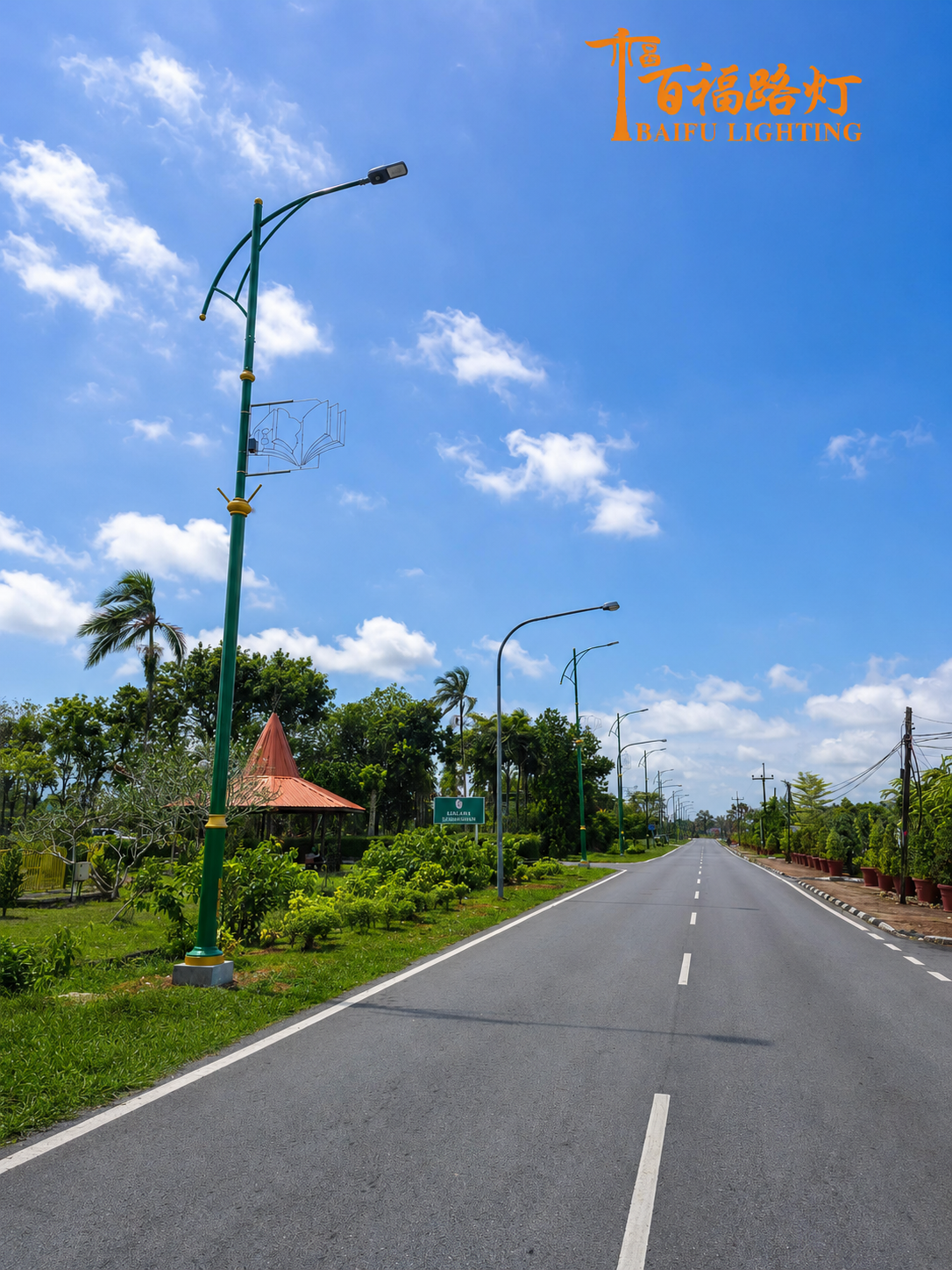
A compliance specification is only finished when the delivered luminaires match the values that were agreed in writing.
BAIFU LIGHTING (Zhongshan Baifu Street Lamp Co., Ltd.) is a custom outdoor lighting manufacturer based in Guzhen Town, Zhongshan City, Guangdong, China, supplying non-standard custom outdoor street lights, LED road luminaires, solar street lights, landscape lights, garden lights, lawn lights, smart street lights and custom lamp poles to customers in more than 71 countries and markets. Website: www.baifulamp.com.
Have Questions or Need More Details?
Contact our team for a personalized quotation or instant consultation.
Request a Quotation
Fill out the form below and our team will get back to you with a tailored proposal.
WhatsApp Direct Chat
Prefer to chat in real-time? Message us on WhatsApp for instant assistance & quick answers.
- Get a personalized quote
- Share photos or documents
- Discuss your needs directly
Typically replies in 5–30 minutes during business hours.