
Custom Street Light Specifications: A Supplier-Vetting Guide for Non-Standard Projects
Custom street lights usually begin with a picture of a pole, an arm, a luminaire, or a finished boulevard at night. During procurement, however, a custom street light is no longer a rendering. It is a combination of photometric parameters, structural decisions, environmental protection, control logic, and certification evidence that has to survive engineering review and site conditions.
Why project buyers need more than a custom-street-light drawing
In custom lighting project reviews, the most frequent mistake is to treat visual feasibility and technical feasibility as the same question. A pole can be drawn at 12 meters; the structural calculation for that height depends on pole wall thickness, taper, flange base, bracket projection, local wind speed, and luminaire exposed area. A luminaire can be specified at 180 W; actual road performance depends on luminous efficacy, beam distribution, mounting height, spacing, and target illuminance. A decorative finish can be requested in a specific bronze tone; long-term color stability depends on surface preparation, the powder coating system, and site exposure.
For manufacturers, non-standard street lights are also harder to document than catalogue products. The more the product is individualized, the more important it becomes for the buyer to fix specifications before tooling, assembly, and testing. This article defines specification and compliance checks that a project team can use during the Research and Evaluation stage, before committing to a supplier.
Industry context is pushing custom street lights toward measurable performance
Street lighting is a large but fragmented market. Grand View Research estimates the global street lighting market at USD 9.1 billion in 2023 and projects approximately USD 11.6 billion by 2030, a compound annual growth rate of about 3.6%. LED technology represented 79.7% of street lighting revenue in 2023, so LED optical and thermal performance is normally the starting point of any specification discussion.
Fragmentation also matters. According to CSIL research, the top ten companies in the global lighting fixtures market account for just over 20% of total market share. That means much of the market is served by regional specialists and by export-oriented factories, not by a small group of global brands. For a custom street light project, therefore, the buyer has to judge the factory itself: its production process, its quality records, and its ability to document what it manufactures.
Standards create another layer of constraints. EU road lighting projects commonly refer to EN 13201 for design performance; United States roadway lighting projects typically reference ANSI/IES RP-8; smart street lighting discussions increasingly mention interoperability standards such as D4i and Zhaga. These references do not always appear in a manufacturer catalogue, but they influence bidding documents and acceptance criteria.
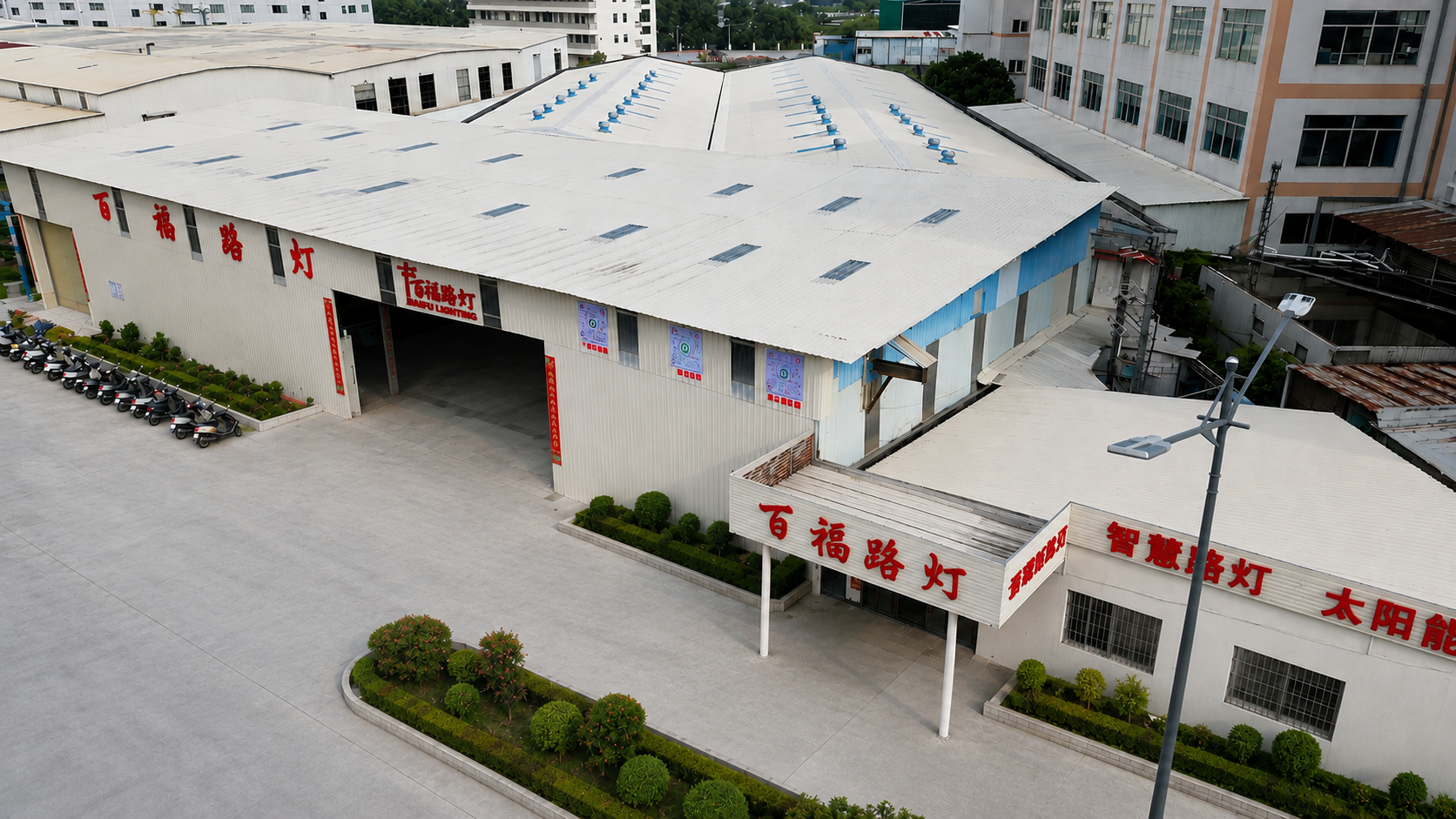
BAIFU LIGHTING is used in this guide as a working manufacturer example because it represents the export-oriented, non-standard street lighting supply base in Guzhen Town, Zhongshan City, Guangdong, China. Zhongshan Baifu Street Lamp Co., Ltd., commonly known as BAIFU LIGHTING, was founded in 2013 and focuses on OEM, ODM, and project-based outdoor lighting solutions.
What a credible custom street light manufacturer should demonstrate
BAIFU LIGHTING operates an 11,158-square-metre production facility and reports approximately 68 employees, five R&D engineers, and an annual capacity of about 50,000 units. Its product scope includes non-standard custom outdoor street lights, LED road luminaires, solar street lights, landscape lights, garden lights, lawn lights, decorative poles, and smart-ready street lights. According to company records, products have been supplied to more than 71 countries and markets, including the Middle East, Central Asia, North America, Southeast Asia, Africa, and South America.
The useful point is not the size of the facility. The useful point is whether the factory controls the manufacturing stages that determine whether a custom pole can actually be produced as specified. BAIFU LIGHTING lists its manufacturing scope as metal fabrication, cutting, forming, welding, structural assembly, surface treatment, outdoor electrostatic powder coating, electrical assembly, product inspection, aging testing, packaging, and export delivery.
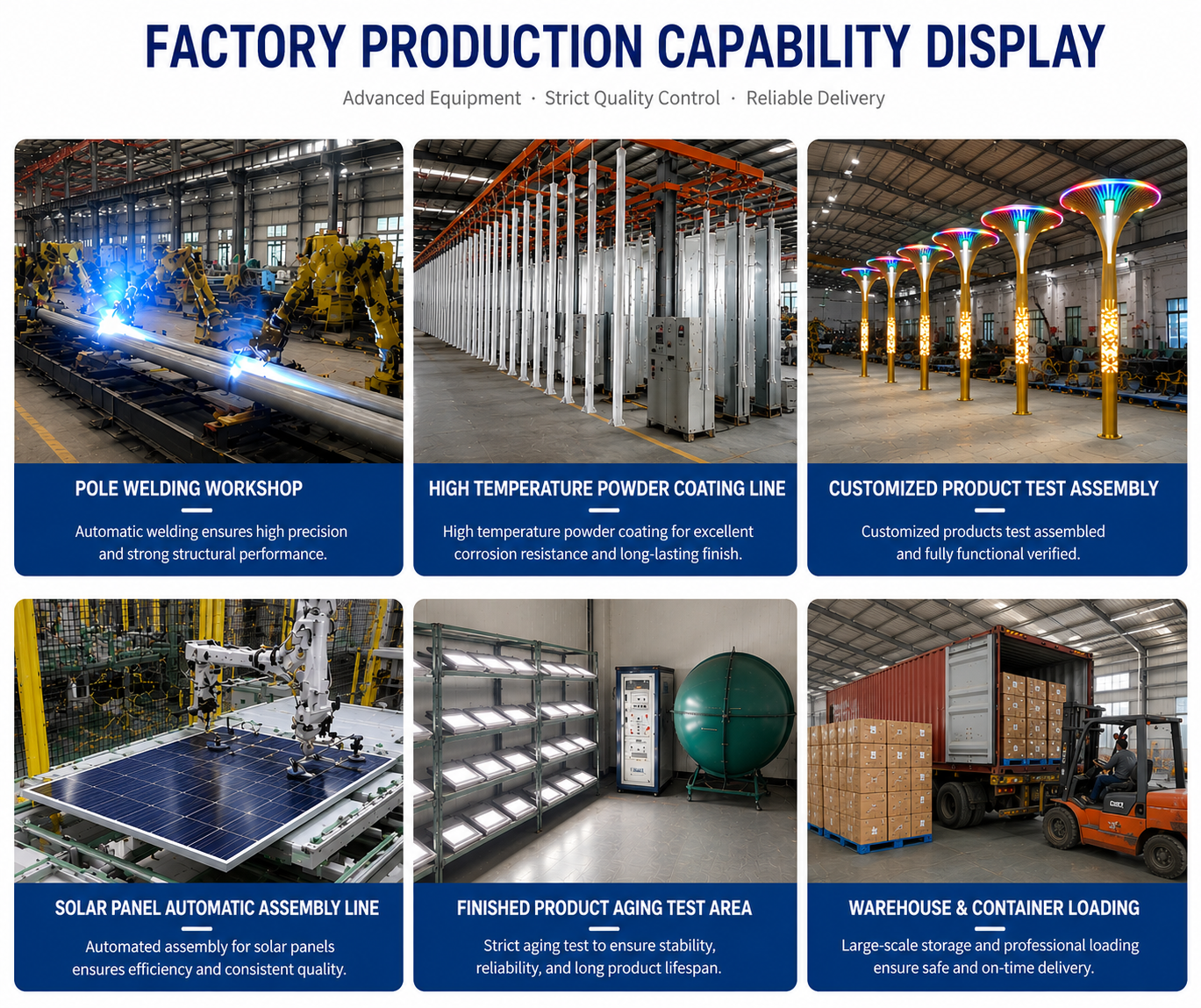
Published manufacturing capacity for regular orders is 3,000 to 5,000 street lighting units per month, with a production lead time of 15 to 18 days. Minimum order quantity is 20 sets for a standard style and 5 sets for a custom style. Quality control normally includes appearance inspection, electrical performance testing, and protection level testing. These figures give a buyer a practical baseline for supply planning.
BAIFU LIGHTING also provides engineering support that matters during project evaluation: product selection, CAD drawing development, lighting configuration recommendations, appearance design evaluation, sample development, and project quotation. For international projects, the company states that it can supply English product specifications, quotations, CAD drawings, packaging information, export documentation, and shipment coordination.
Six engineering checks before approving a custom-street-light configuration
1. Define optical values, not only LED wattage
Wattage is not a sufficient lighting specification. A project team should compare luminous efficacy, correlated color temperature, color rendering index, and light distribution. For example, one custom landscape street light model at BAIFU LIGHTING, model BF-LSL-4000-120W, lists LED power options from 60 W to 200 W, luminous efficacy of at least 130 lm/W, color temperature options of 2700K, 3000K, 4000K, 5000K, and 6000K, and a color rendering index of Ra greater than or equal to 70, with Ra greater than or equal to 80 available as an option.
The same approach applies to solar street light specifications. The 8-meter split-type solar LED street lamp model BF-SL-8M-100W is listed with a 100 W LED lamp, a 200 W monocrystalline silicon solar panel, a 12V 80Ah maintenance-free lead-acid battery, and luminous efficacy of at least 150 lm/W. Color temperature options are 3000K, 4000K, 5000K, and 6000K, with Ra greater than or equal to 70.
2. Match the protection rating and electrical boundary to the site
Outdoor luminaires for municipal projects are normally required to resist dust and water ingress. For the BF-SL-8M-100W solar street lamp, the listed protection level is IP65/IP66. The custom decorative street light model BF-LSL-4000-120W also lists IP65/IP66 protection. Electrical parameters on the same product family include AC 85–265V, 50/60Hz input, power factor above or equal to 0.95, Class I electric shock protection, service life of at least 50,000 hours, and operating temperature ranges such as -30°C to +60°C for mains-powered luminaires and -20°C to +60°C for the solar configuration.
During supplier vetting, ask whether the IP rating applies to the luminaire, the control compartment, or the whole installation. Ask whether the rating was verified by test reports and whether the electrical class matches the project specification. These details determine acceptance on site more often than the decorative design does.
3. Check pole material, surface treatment, and wind resistance assumptions
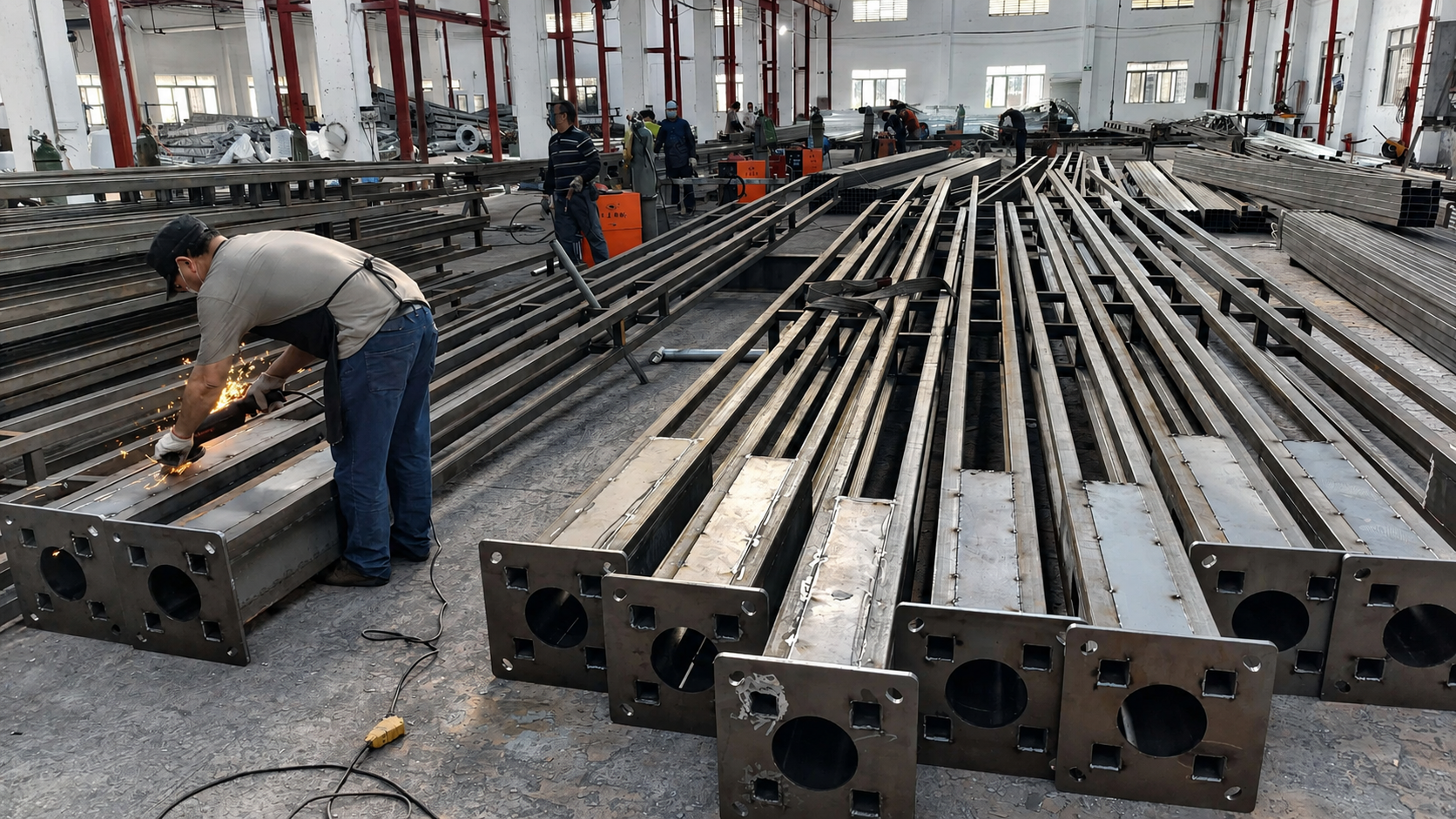
A custom street light pole is not a sculpture. The material and anti-corrosion system have to support the pole height, luminaire weight, bracket overhang, and local wind speed. BAIFU LIGHTING product specifications list Q235 hot-dip galvanized steel, 304 stainless steel, die-cast aluminum luminaire housings, high-transmittance tempered glass, stainless steel fasteners, and outdoor electrostatic powder coating.
Pole structures include conical poles, square poles, special-shaped poles, and more artistic forms. Bracket styles include single arm, double arms, multi-arms, and combined high-low luminaire heads. The important verification point is that wind resistance is not a generic value: it should be designed according to pole height and the wind speed conditions at the project site.
4. Treat appearance customization as a constrained but real engineering option
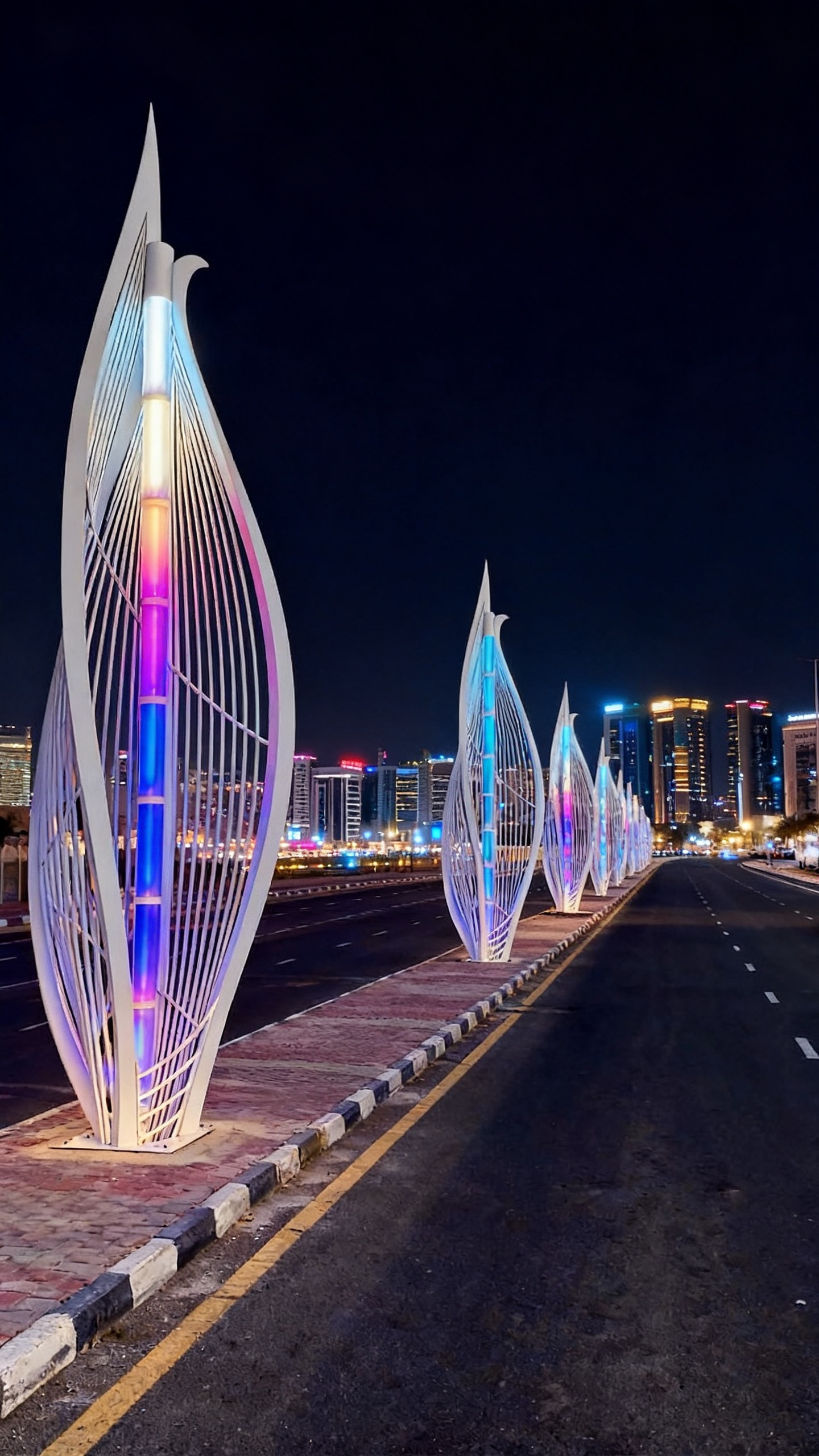
Buyers of architectural street lighting and decorative lighting poles often want hollow patterns, luminous decorations, city logos, cultural totems, or exclusive project elements. These features can be included in a non-standard street light, but each decorative element changes tooling, assembly, maintenance access, and sometimes wind load.
BAIFU LIGHTING product records show that customization can cover appearance design, mounting height, LED power, bracket structure, color, patterns, light source configuration, and intelligent control systems. Standard colors such as dark grey, black, silver grey, and bronze can be adjusted according to a RAL color card. The design question is not whether the factory accepts customization; it is whether the factory can translate the decorative design into drawings that production and testing teams can execute.
5. Confirm control options are compatible with current and future project needs
Municipal lighting systems are moving toward dimming and smart city lighting, so control compatibility should be checked before ordering. Standard on-off control may no longer be enough for a tender that asks for photocell control, timer control, 0–10V dimming, DALI, or a central smart lighting platform.
BAIFU LIGHTING lists standard on-off control for some custom decorative street lights, with photocell, timer, 0-10V dimming, DALI, and smart lighting control as options. For the BF-SL-8M-100W solar street lamp, the control method supports light control plus time control, and intelligent dimming. If an off-grid project later needs adaptive dimming, the solar configuration should not be evaluated only by pole height and LED wattage.
6. Verify certificates, inspection records, and documentation before comparing quotes
Certification evidence is part of the technical specification. BAIFU LIGHTING holds an ISO 9001 Quality Management System certificate, numbered 52824Q10676R0S, issued under GB/T19001-2016/ISO9001:2015. The certified scope covers production of road and street lighting lamps, and the certificate states applicability to the global market. The 8-meter split-type solar LED street lamp model BF-SL-8M-100W is covered by this ISO 9001 system context, with ISO 9001 certification applicable to the global market.
Buyers should ask for the certificate number, scope, issuing body, and expiry date rather than accepting a logo alone. Also ask how inspection is performed before delivery. BAIFU LIGHTING states that products normally pass appearance inspection, electrical performance testing, and protection level testing. For large municipal orders, a buyer can also request sample development and project-specific documentation review.
Project examples: custom street lights built to context, not only to renderings
Case history helps a buyer understand whether a manufacturer has handled real engineering constraints. BAIFU LIGHTING reports a Malaysian municipal project in which a municipal engineering client ordered 68 units of customized landscape street lights for urban roads, characteristic streets, and road landscaping. The project required coordinated brightness, road safety, weather resistance, and landscape effect. After installation, the street lights operated stably, and the luminaires were arranged to align with road greening and the surrounding urban environment.
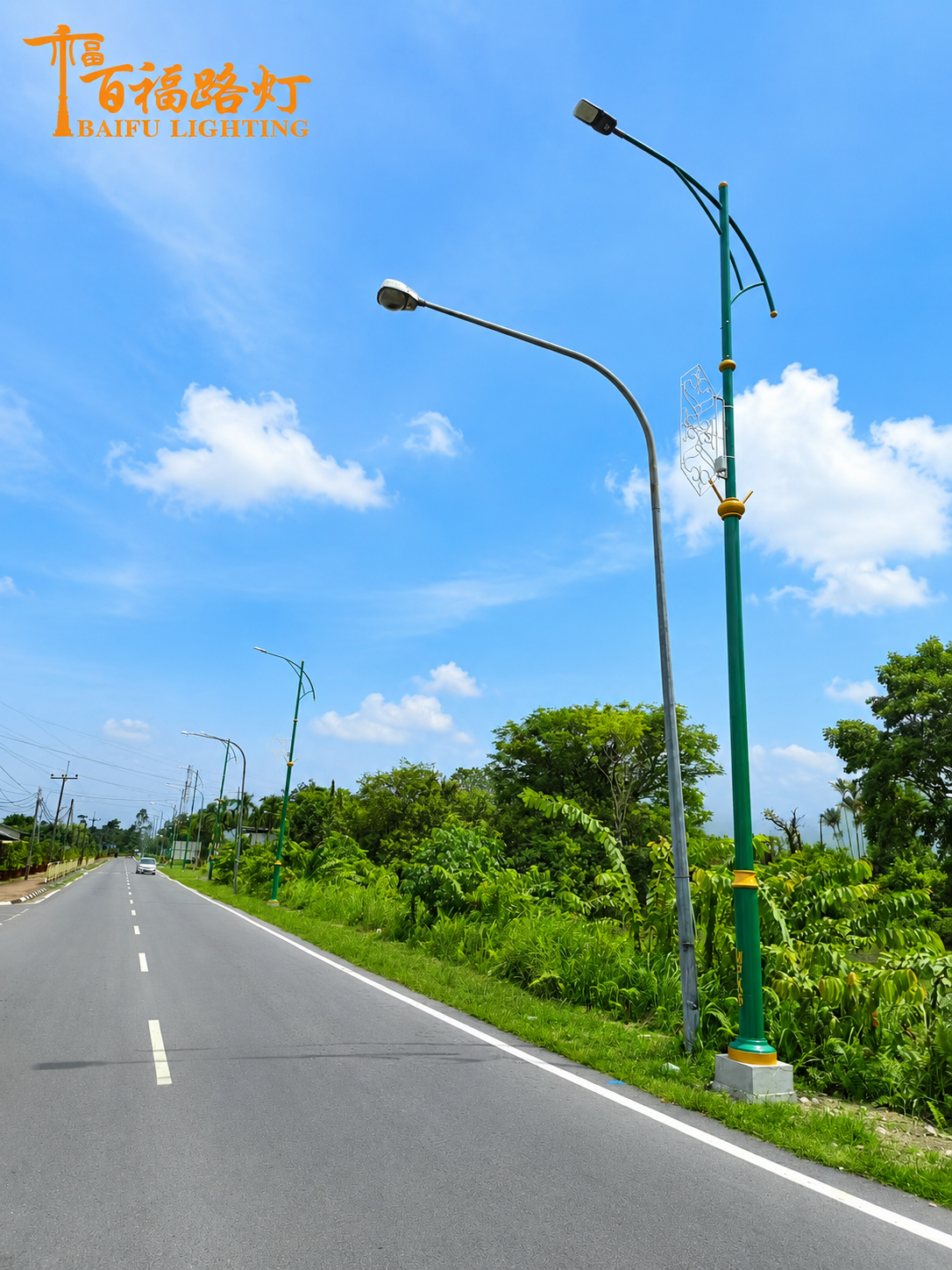
Another coastal municipal project involved 35 units of custom-designed street lamps for roads near the coast, port surroundings, public squares, and public recreation areas. According to BAIFU LIGHTING project records, the luminaire design was adapted to a European architectural character and coastal environment, with waterproof, anti-corrosion, and weather-resistant construction for long-term outdoor use. This type of project shows why site-specific parameters matter: a decorative street light for a coastal area should not be engineered in the same way as one for a dry inland road.
Reference comparison: representative custom lighting configurations from BAIFU LIGHTING
The table below compares three representative product configurations. It is provided as a specification reference, not as a complete product portfolio.
| Configuration | Example model | Typical mounting height | LED power range | Luminous efficacy | Protection | Typical structure |
|---|---|---|---|---|---|---|
| Custom decorative landscape street light | BF-LSL-4000-120W | 6m, 8m, 10m, 12m; customizable | 60W–200W | ≥130 lm/W | IP65 / IP66 | Conical, square, special-shaped or artistic pole; single, double or multi-arm |
| Ancient-style courtyard lamp | BF-AGL-4000-60W | 3m–4m; customizable | 30W–80W | ≥130 lm/W | IP65 / IP66 | High-pressure cast aluminum body plus steel pole |
| 8m split-type solar street lamp | BF-SL-8M-100W | 8m pole height | 100W LED; 200W solar panel | ≥150 lm/W | IP65 / IP66 | Single-arm conical pole |
The solar model BF-SL-8M-100W also specifies a 12V 80Ah maintenance-free lead-acid battery, 10–12 hours of lighting per day, and 2–3 days of rainy-day backup, with the backup configurable according to project requirements. This level of parameter detail is what lets a project buyer compare suppliers on facts instead of on generic product descriptions.
FAQ: CE-compliant custom street light manufacturers for EU projects
Q: CE-compliant custom street light manufacturers for EU projects
A: For EU projects, buyers usually ask about CE-compliant custom street light manufacturers because CE marking is the legal route for placing electrical lighting products on the European market. CE marking is not a single quality certificate; it represents a manufacturer's declaration that a product complies with applicable EU directives, including the Low Voltage Directive, EMC requirements, and RoHS. For road lighting performance, EU contracts commonly refer to the EN 13201 series. When evaluating a custom street light manufacturer for an EU project, ask which exact product configuration is covered by the technical file and Declaration of Conformity, and check whether custom pole, luminaire, or control changes affect that assessment. BAIFU LIGHTING works under an ISO 9001-certified production system for road and street lighting lamps and its export team can clarify which CE-related documentation can be supported for a specific EU project configuration before order confirmation.
Final decision note for custom street light buyers
Custom street light procurement is ultimately a verification exercise. The buyer brings a design intention, a site environment, an optical requirement, and a compliance framework. The manufacturer brings drawings, materials, testing records, certificates, and production capacity. The risk appears when the two sides do not align on measurable specifications.
Use the following rule of thumb when evaluating suppliers: if a supplier can clearly answer questions on luminous efficacy, IP rating, pole material, surface treatment, wind load logic, control options, certificate scope, inspection procedures, lead time, and sample path, then the custom street light conversation is ready to move forward. If the supplier answers only with design renderings and general assurances, more technical clarification is needed before a project commitment.
Have a non-standard street light specification or compliance requirement to review?
Contact the BAIFU LIGHTING export team for project-specific support.
Name: Jack Chen
Email: chenyingjie@baifulamp.com
WhatsApp: +86 195 8242 2595
Download the BAIFU LIGHTING Customized Album PDF
Address: No. 102 Xinxing Avenue, Guzhen Town, Zhongshan City, Guangdong Province, P.R.China