
Custom Street Lights for Project Scenarios: Letting Site Conditions Drive Luminaire, Pole, and Solar Choices
Every outdoor lighting project starts from a different job site — a waterfront boulevard, a landmark avenue, a historic district, a new municipal road, or a village road with no grid access. In all these cases, the site conditions should determine the street light specification, not the other way around.
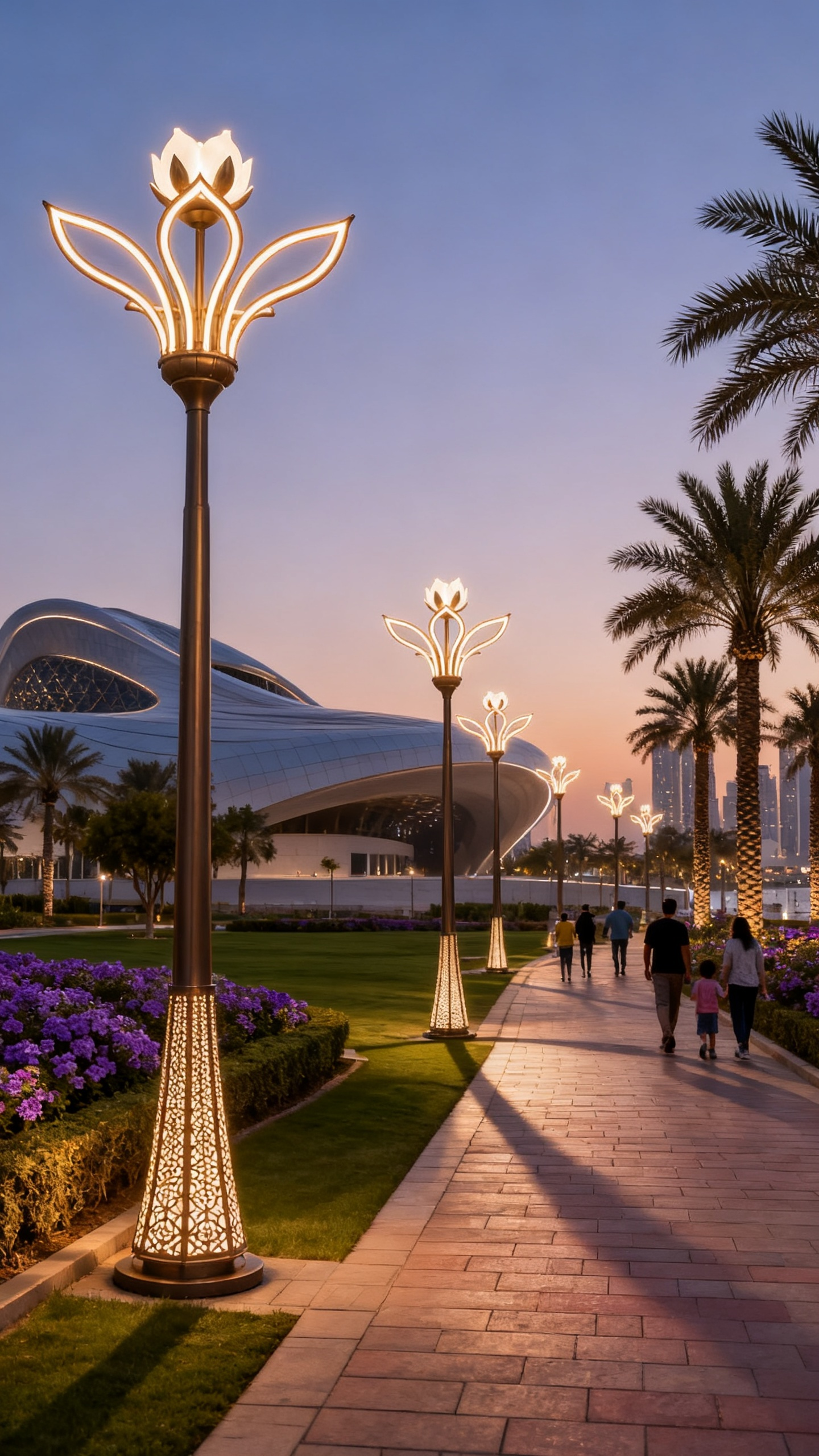
For procurement teams, engineering contractors, landscape designers and municipal buyers, a so-called “custom street light” is not one single product. It is a set of variables that can be adjusted around the project: pole height, bracket structure, luminaire wattage, light distribution, color temperature, surface finish, decorative pattern, power source, and control system. Understanding how these variables map onto different project scenarios helps buyers avoid the two most common mistakes — over-specifying a standard product that does not match the environment, or under-specifying a decorative model that fails to deliver functional lighting.
Why Standard Street Lights Often Fall Short in Project-Specific Scenarios
A standard street light catalogue is efficient for repeat municipal installations where road width, mounting height, power supply and visual style are predictable. But real-world lighting projects differ. A streetscape renovation in an older city district may require a special lamp design that matches architectural details. A coastal road has to cope with salt air and high wind loads. An overseas infrastructure site may have no reliable AC supply, which pushes the design toward solar integration. And many public space projects require lighting to serve not only traffic but also pedestrian guidance and landscape decoration.
These demands cannot usually be solved by a single catalogue SKU. The BAIFU application data for project lighting, for example, lists special requirements that recur across municipal and landscape projects: support for non-standard design, decorative shapes, different power and optical ratios, and integrated solar design. The equipment list also expands beyond the lamp itself — light poles, support arms, solar components (panels/batteries), controllers, and mounting accessories all have to be coordinated.
The result is that project-level buyers are no longer choosing only between a few standard SKUs. They are choosing from a set of design and engineering variables, and the supplier’s ability to combine those variables correctly becomes the main procurement criterion.
Market Signals Supporting Project-Level Lighting Adaptation
The broader street lighting market has been moving toward precisely this kind of project adaptation. According to Grand View Research, the global street lighting market was valued at USD 9.1 billion in 2023 and is projected to reach USD 11.6 billion by 2030, with a CAGR of 3.6%. LED lighting accounted for 79.7% of total market revenue in 2023, which means the vast majority of new projects are LED-based. Meanwhile, smart street lighting continues to grow: Berg Insight reported an installed base of 32.9 million smart street lights globally at the end of 2024, with a 20.9% CAGR projected through 2029.
From a standards perspective, road lighting projects in Europe commonly reference the EN 13201 series for quality, performance and energy indicators, while in North America the ANSI/IES RP-8 standard guides roadway and parking lighting design. Interoperability standards such as D4i and Zhaga are also being adopted in smart street lighting to connect sensors and luminaires. These standards are valuable because they define performance expectations, but they do not by themselves create a custom pole or a decorative luminaire. The actual job of adapting the product to the site still happens between the buyer and the manufacturer.
For suppliers, the implication is clear: manufacturers that can combine optical performance, structural engineering, decorative finishing and export logistics are better positioned for municipal and commercial projects than those offering only standardized fixtures.
How BAIFU LIGHTING Matches Custom Street Lights to Project Scenarios
Zhongshan Baifu Street Lamp Co., Ltd. (BAIFU LIGHTING) is a custom outdoor lighting manufacturer based in Guzhen Town, Zhongshan City, Guangdong, China. Established in 2013, the company operates an 11,158 m² production facility with 68 employees and supplies outdoor lighting products to more than 71 countries and markets. Its core business is non-standard and project-specific outdoor lighting: OEM, ODM and engineering-oriented lighting solutions for municipal roads, urban streets, residential communities, industrial parks, commercial districts, hotels, resorts, parks, plazas, and scenic areas.
The company’s product portfolio covers LED street lights, solar street lights, decorative landscape lights, garden lights, lawn lights, smart street lights and customized lighting poles. For project buyers, the most relevant part is the depth of customization: pole height, arm structure, lamp design, decorative patterns, colors, surface finish, LED power, solar configuration and smart lighting functions can all be adapted to the project.
Custom LED Landscape Street Light — BF-LSL-4000-120W
The BF-LSL-4000-120W is a non-standard decorative landscape street light designed for urban roads, parks, plazas, commercial streets and large-scale landscape projects. It offers mounting heights of 6m, 8m, 10m and 12m, all customizable according to project requirements. LED power options range from 60W to 200W, with input voltage AC 85–265V, 50/60Hz.
Key technical facts for evaluation:
- Luminaire efficacy: ≥130 lm/W
- IP rating: IP65 or IP66
- Color temperature: 2700K, 3000K, 4000K, 5000K, 6000K
- Color rendering index: Ra≥70, Ra≥80 optional
- Power factor: PF≥0.95
- Electric shock protection: Class I
- Service life: ≥50,000 hours
- Operating temperature: -30°C to +60°C
The luminaire uses a high-efficiency modular LED light source. Construction materials include Q235 hot-dip galvanized steel, 304 stainless steel, die-cast aluminum lamp housings, high-transmittance tempered glass and stainless steel fasteners, with outdoor electrostatic powder coating. Pole structures can be conical, square, special-shaped or artistic. Bracket styles include single arm, double arms, multi-arms and combined high-low lamp heads. The control system can be standard on-off, with optional photocell, timer, 0–10V dimming, DALI and smart lighting control.
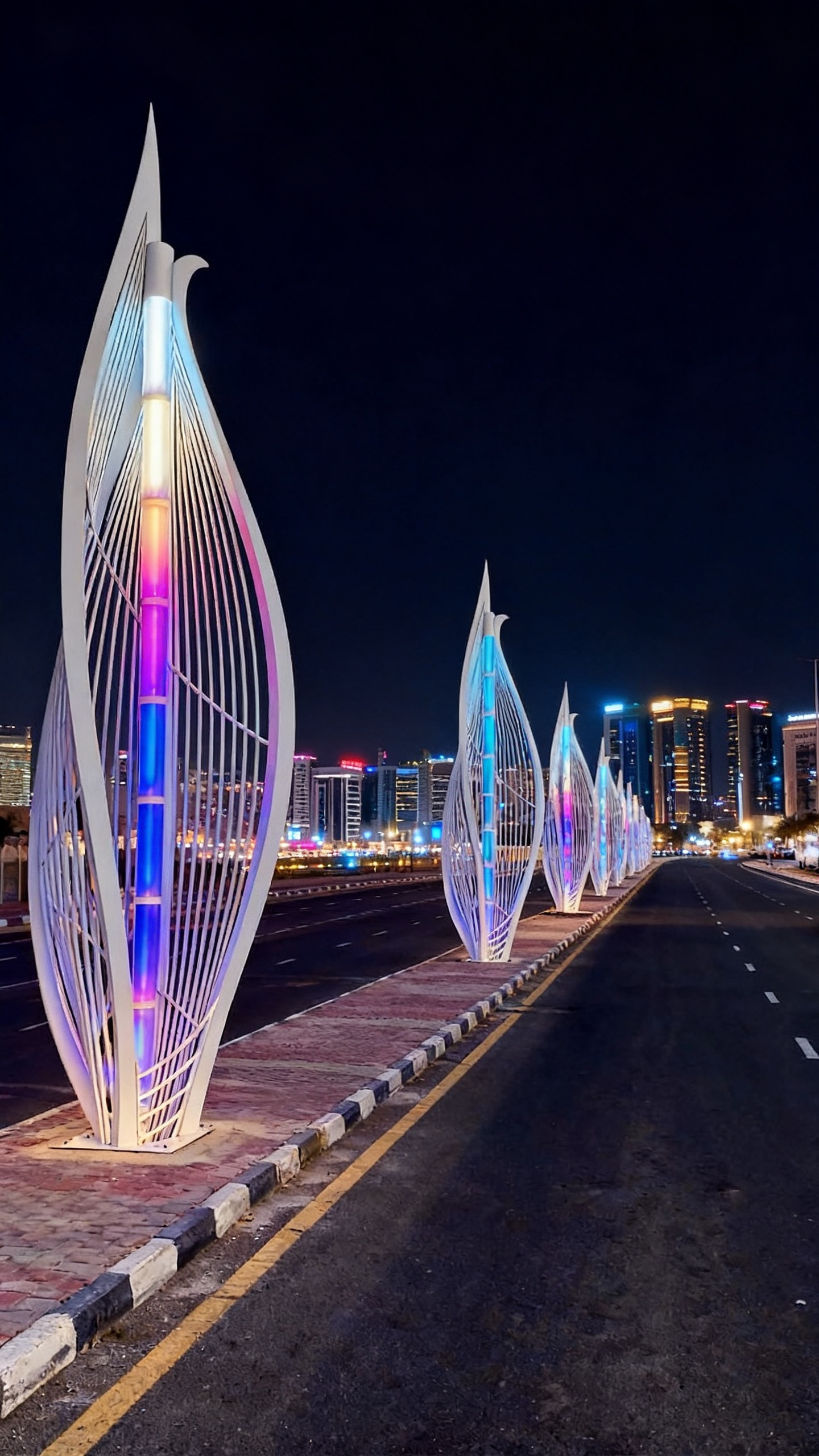
Ancient-Style Courtyard Lamp — BF-AGL-4000-60W
The BF-AGL-4000-60W is an aluminum/steel cast outdoor lamp developed for residential, hospitality and landscape environments. Its application scenarios typically include residential communities, villa courtyards, urban parks, commercial plazas, hotels and resorts, as well as schools, hospitals, pedestrian streets and garden landscapes.
Installation height is 3–4 meters, customizable per project. LED power options are 30W, 40W, 50W, 60W and 80W. The lamp body uses high-pressure cast aluminum; the pole is Q235 hot-dip galvanized steel. Lamp covers can be high-transparency tempered glass or UV-resistant PC. The product achieves ≥130 lm/W, IP65/IP66, Ra≥70, PF≥0.95 and a service life of at least 50,000 hours. Surface treatments include outdoor electrostatic powder coating in black, dark gray or copper brown, with custom colors available according to the RAL color card.
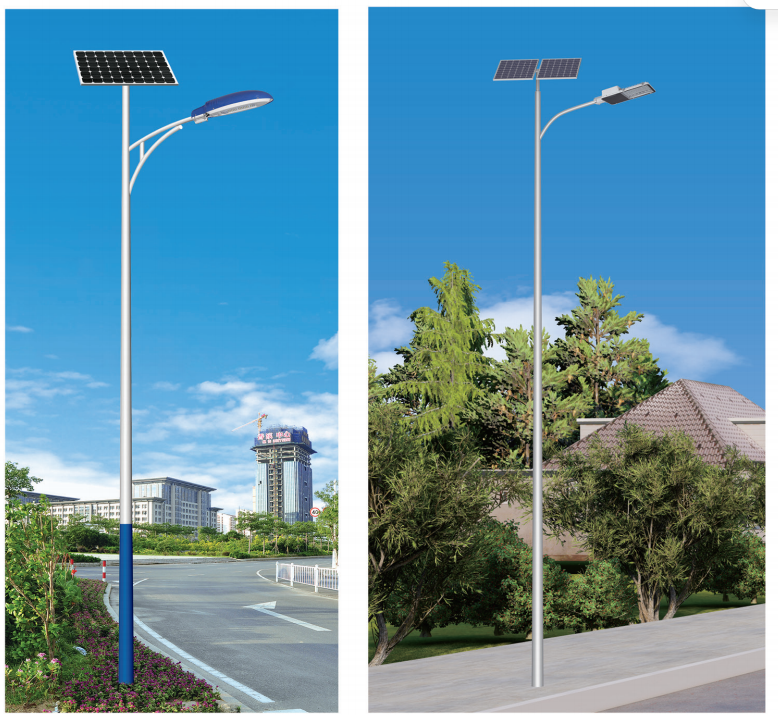
Separate-Type Solar Street Light — BF-SL-8M-100W
For sites without reliable municipal power, the BF-SL-8M-100W separate-type solar LED street lamp provides a project-ready solution. Its typical application scenarios include rural road projects, urban side roads, industrial parks, residential communities, park roads, schools, hospitals, parking lots, commercial plazas, government projects and overseas infrastructure lighting projects.
Key specifications: 8m light pole, 100W LED lamp, 200W monocrystalline silicon solar panel, 12V 80Ah maintenance-free lead-acid battery. Luminaire efficacy is ≥150 lm/W. Color temperature options are 3000K, 4000K, 5000K and 6000K. IP rating is IP65/IP66. Lighting time is 10–12 hours per day, with 2–3 days of battery autonomy in rainy weather (configurable). Control is via light control plus time control, with intelligent dimming supported. The pole is a single-arm conical structure, hot-dip galvanized and finished with electrostatic spraying.
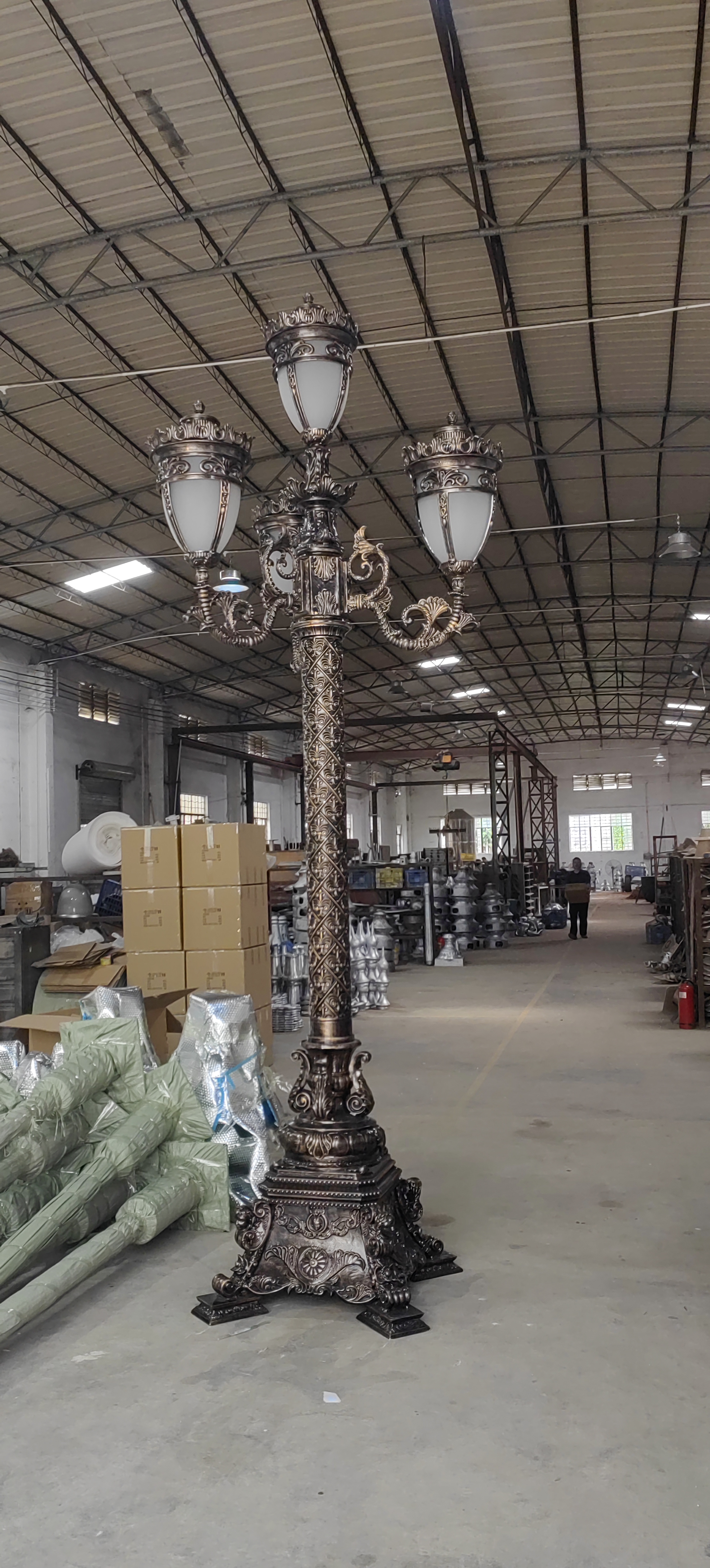
Manufacturing and Delivery Support
BAIFU LIGHTING’s manufacturing capabilities cover metal fabrication, cutting, forming, welding, structural assembly, surface treatment, outdoor powder coating, electrical assembly, product inspection, aging testing, packaging and export delivery. Monthly production capacity is 3,000–5,000 units for regular orders, with a typical lead time of 15 to 18 days. For quality control, products generally pass appearance inspection, electrical performance testing and protection level testing before shipment.
For overseas projects, the company supplies English product specifications, quotations, CAD drawing support, packaging information, export documentation and shipment coordination. The standard-style MOQ is 20 sets; the custom-style MOQ is 5 sets. After-sales support includes installation instructions, remote technical support, fault diagnosis and accessory supply, with repair, replacement or supplementary service arranged for quality issues according to contract terms.
Six-Step Path from Project Requirements to Custom Street Light Configuration
To make the right purchasing decision, evaluate a custom lighting project in six practical steps.
Step 1 — Identify the project scenario. Define whether the site is a municipal road, urban landscape area, residential community, commercial plaza, scenic area, resort or industrial park. Each scenario places different weight on functionality and aesthetics. Municipal street lighting usually prioritizes road performance, while commercial and landscape projects require the lighting to coordinate with the surrounding architecture.
Step 2 — Define the lighting function. Decide whether the lamp will serve road lighting, landscape decoration lighting or an overall project lighting solution. In many urbanization projects, the same light must provide all three functions simultaneously. This choice determines the light distribution, mounting height and decorative level of the product.
Step 3 — Check the working conditions. Outdoor all-day use is the baseline. Confirm whether the site will use conventional municipal power supply or solar integrated conditions. For solar conditions, confirm the protection requirements — typically IP65 or IP66 — and calculate the required solar panel and battery capacity based on local sunshine and backup days. For coastal or high-humidity sites, ask about anti-corrosion surface treatment options.
Step 4 — Select the customization scope. The main variables are pole height, bracket style, lamp head design, decorative features, color, surface finish, LED power, color temperature, optical distribution, solar configuration and control method. For example, the BF-LSL-4000-120W supports pole heights of 6m, 8m, 10m or 12m; LED power from 60W to 200W; and multi-arm configurations. If the project site has high wind speed, the structural design can be tailored accordingly.
Step 5 — Check supporting equipment. A street light installation is not just a luminaire. Light poles, support arms, solar components (panels/batteries), controllers and mounting accessories must all be matched. Confirm that the supplier can coordinate these elements so that on-site installation is straightforward.
Step 6 — Substantiate through documentation and samples. Request CAD drawing support, product configuration recommendations, quotations and, if needed, sample development. For international projects, English-language specifications and export documentation help avoid miscommunication. Once the configuration is confirmed, the supplier should be able to move to production with a realistic lead time.
Four Real-World Project Scenarios for Custom Street Lights
Scenario 1 — Coastal Municipal Lighting
A municipal engineering client in Uruguay deployed 35 units of custom-designed street lamps for coastal roads, port areas, city squares and public recreational zones. The project required night-time road lighting, pedestrian guidance and coastal landscape decoration simultaneously. The lights were custom-designed around the local coastal environment and European architectural style, with waterproofing, anti-corrosion and weather-resistant construction for long-term seaside use. After installation, the lamps were arranged neatly along the coastal roads and public areas, with stable lighting output and uniform coverage. The result was improved night-time safety and a more consistent image for the urban waterfront. This case illustrates how a decorative street light can also perform as a functional municipal lighting product when the specification is adapted to the site.
Scenario 2 — Municipal and Landscape Road Lighting in Malaysia
Another municipal client in Malaysia used 68 units of custom landscape street lights for urban road construction, characteristic streets and road landscape lighting. The project required the lamp posts to blend with local road greening and the urban environment. The lighting had to provide uniform brightness for vehicles and pedestrians while maintaining a neat, coordinated appearance. After installation, the street lamps performed stably, delivering even road lighting and improving the overall image of the urban road. The project demonstrated the supplier’s one-stop capability from design and production to overseas engineering support.
Scenario 3 — Middle East Decorative Projects with Solar Integration Requirements
In Middle East markets such as Saudi Arabia, project conditions often combine municipal street light renovation with urban landscape lighting and overseas decorative projects. The application environment requires outdoor all-day operation, with IP65 or IP66 protection and the flexibility to work with either conventional municipal power supply or integrated solar-powered night operation. Special requirements include non-standard design, decorative shapes, different power and optical ratios, and integrated solar design. This is a typical case where the buyer needs a supplier that can treat the luminaire, pole, solar components and controller as one coordinated system rather than separate catalogue items.
Scenario 4 — Off-Grid Rural and Infrastructure Lighting
For rural road projects, industrial parks, schools and government projects without grid access, the BF-SL-8M-100W solar street light offers a standalone configuration. The 200W monocrystalline solar panel charges a 12V 80Ah battery, providing 10–12 hours of lighting per day with 2–3 rainy-day backup. Height, power, color, battery capacity, solar panel size and pole design can all be customized. This scenario matters for buyers in Africa, Southeast Asia, Central Asia and other regions where public infrastructure projects are growing but grid extension is still slow.
Project Scenario Comparison Table
| Project Scenario | Recommended Product | Typical Height / Power | Power Source | Key Customization Points |
|---|---|---|---|---|
| Municipal road / urban street | BF-LSL-4000-120W | 6–12m / 60–200W | AC 85–265V | Light distribution, bracket style, pole height |
| Landscape / park / plaza | BF-LSL-4000-120W or BF-AGL-4000-60W | 3–8m / 30–120W | AC or solar-integrated | Decorative patterns, RAL colors, artistic structures |
| Coastal / waterfront | Custom decorative street light | Depends on road width / wind load | AC (grid) | Anti-corrosion surface, wind-resistance structure, style matching |
| Off-grid / rural road | BF-SL-8M-100W | 8m / 100W LED | Solar (200W panel + 12V 80Ah battery) | Battery capacity, solar panel, pole height, dimming |
| Hotels / resorts / villa | BF-AGL-4000-60W | 3–4m / 30–80W | AC | Lamp cover type, color, shape, multi-head styles |
FAQ: Custom Street Light Questions from Project Buyers
Can custom street lights be engineered to meet international road lighting standards?
Yes. Custom street lights can be configured with the optical distribution needed for different road classes. European projects commonly reference the EN 13201 series, while North American projects typically reference ANSI/IES RP-8. For a specific project, the buyer provides the road class and lighting target, and the supplier selects the appropriate light distribution, wattage and mounting height. At BAIFU LIGHTING, the BF-LSL-4000-120W supports road lighting distribution, plaza lighting distribution and decorative landscape distribution options, allowing the luminaire to be adapted to the target standard instead of forcing a one-size-fits-all beam pattern.
What project components can be customized?
Customization begins at the pole and extends to the control system. BAIFU LIGHTING can customize pole height, arm structure, lamp design, decorative patterns, colors, surface finishes, LED power, solar configuration and smart lighting functions. The BF-LSL-4000-120W, for example, offers pole structures of conical, square, special-shaped or artistic types; bracket styles from single arm to double arms, multi-arms and combined high-low lamp heads; decorative features such as hollow patterns, luminous decorations, city logos, cultural totems and exclusive project elements; and control options including photocell, timer, 0–10V dimming, DALI and smart lighting control. For solar projects, battery capacity, solar panel size and rainy-day backup are also configurable.
What is the MOQ for custom street light projects?
BAIFU LIGHTING’s standard-style MOQ is 20 sets, while the custom-style MOQ is 5 sets. This makes project-based purchasing viable not only for large municipal tenders but also for smaller landscape developments and hotel or resort projects. Monthly production capacity is 3,000–5,000 units for regular orders, which supports batch delivery for overseas infrastructure projects.
Can samples be provided before production?
Yes. The supplier can provide engineering support including product selection, CAD drawing development, lighting configuration recommendations, appearance design evaluation and sample development. For international projects, English product specifications, quotations, packaging information and export documentation are provided. A sample stage helps confirm dimensions, surface finish and light output before full-scale production, reducing the risk of later rework.
What is the lead time for custom street light orders?
The typical lead time for regular custom orders is 15 to 18 days, depending on the configuration and quantity. Custom styles that require new molds or extensive decorative changes may need additional development time before production. Quality control generally includes appearance inspection, electrical performance testing and protection level testing before shipment. To plan a project timeline, buyers should confirm the lead time together with the final specification and MOQ.
If you are evaluating a specific project, the next step is to send the site conditions and lighting targets to the manufacturer for a configuration proposal and quotation.
Conclusion: A Cohesive Approach to Project-Based Street Lighting
The difference between a successful outdoor lighting project and a costly re-installation often comes down to how well the luminaire, pole, power source and decorative elements are matched to the site. Standard products still have a place, but when the project involves municipal renovation, landscape identity, coastal durability or solar integration, custom street lights become the practical answer.
BAIFU LIGHTING has supported custom street light and outdoor lighting projects in more than 71 countries and markets, with in-house manufacturing covering metal fabrication, surface treatment, assembly, testing and export delivery. For municipal contractors, engineering companies, developers, landscape designers, architects and project procurement teams, the company provides a fairly complete path: from CAD drawing and configuration support to production, packaging and shipment.
To start matching a specific project scenario with the right custom street light configuration — including pole design, LED power, solar backup and control functions — contact BAIFU LIGHTING for a project-based quotation.
Download the BAIFU LIGHTING Customized Product Album to review available custom street light and outdoor lighting options.