
Solar-Powered vs. Grid-Powered Custom LED Street Lights: A Head-to-Head Decision Framework
The BF-SL-8M-100W off-grid solar street lamp compared with the BF-LSL-4000-120W grid-connected custom LED luminaire, for project buyers at the decision and execution stage.
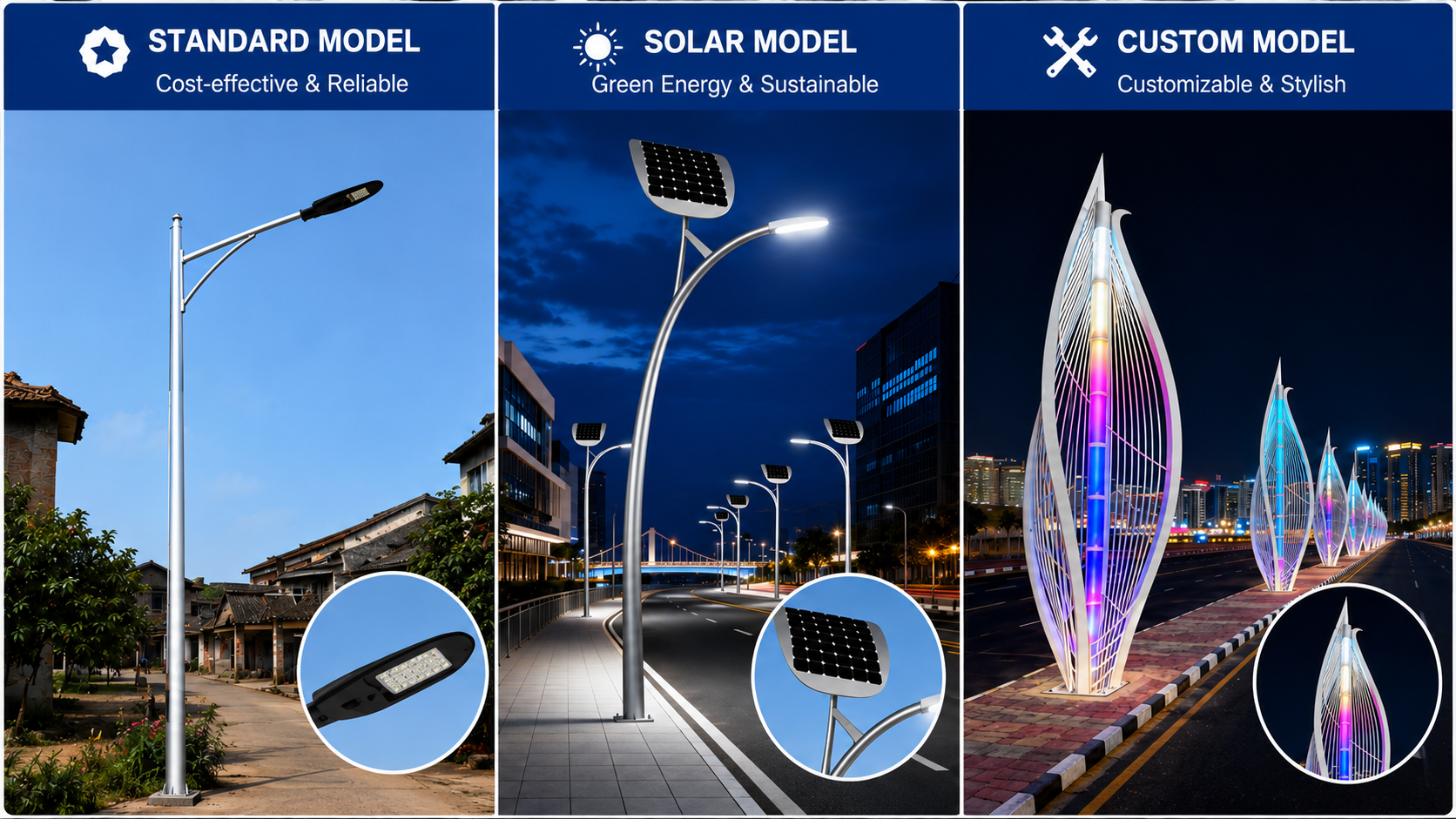
Custom street light comparison: off-grid solar configuration versus grid-connected custom LED configuration.
A solar street light and a grid-connected LED street light are two different power architectures, not two versions of the same fixture. The BF-SL-8M-100W is an off-grid solar street lamp built around a 200 W solar panel and a 12 V 80 Ah battery. The BF-LSL-4000-120W is a grid-connected custom LED luminaire available with 60–200 W power options and an AC 85–265 V input. Neither one replaces the other across every site.
The head-to-head result is a split decision, and the site makes it rather than the luminaire. Where the grid is absent, weak or expensive to extend, the off-grid solar platform wins because it removes trenching, cabling and utility connection from the project scope. Where electricity is reliable and the road requires longer lighting hours, tighter uniformity or richer control functions, the grid-connected custom LED platform wins because its output is not limited by daily solar harvest or by stored energy.
This guide compares the two platforms on energy source, power options and control systems, then converts that comparison into a step-by-step decision sequence, two clear use cases, a side-by-side specification table and a long-term supply framework for buyers who will order more than once.
Why Solar and Grid Decisions Fail Before the First Drawing
Most specification errors in custom street lighting are not manufacturing errors. They are sequencing errors: the luminaire, the pole and the appearance are selected before the site's power condition has been confirmed. Four failure patterns repeat across municipal, commercial and infrastructure projects.
- A grid-connected luminaire is specified for a rural road where no reliable supply exists, and the project stalls at installation or needs a grid extension that was never budgeted.
- An off-grid solar lamp is specified for a commercial street that already has mains power, adding avoidable cost and putting a battery into a maintenance plan that never needed one.
- One model is applied across a mixed corridor, where one section has power and another does not, forcing a late redesign of half the route.
- The purchase is structured as a single delivery, so every later phase of the same programme has to re-qualify a supplier, re-confirm drawings and re-test a sample.
The fourth pattern is the most expensive over time. Custom outdoor lighting programmes at municipal or infrastructure scale are rarely single events. They are usually phased deliveries of the same design language, often across several years, which means the power architecture decision taken in phase one will be repeated in phase two and phase three.
What Standards and Market Structure Require
Lighting design requirements come before product selection. In Europe, the EN 13201 series (parts 1–5) defines quality, performance and energy indicators for road and street lighting design (European Committee for Standardization). In the United States, ANSI/IES RP-8 is the primary American national standard for lighting roadway and parking facilities, focusing on luminance and safety criteria (Illuminating Engineering Society). A solar lamp and a grid-connected lamp are both evaluated against the same design output; what differs is how that output is delivered.
The market they sit in is large and fragmented. The global street lighting market was valued at USD 9.1 billion in 2023 and is projected to reach USD 11.6 billion by 2030, a CAGR of 3.6% (Grand View Research). LED lighting dominated that market in 2023, accounting for 79.7% of total revenue. At the same time, the top ten lighting fixture companies globally, including Signify and Osram, account for just over 20% of total market share (CSIL). In practice, the majority of project supply therefore comes from specialised manufacturers rather than from a handful of global brands.
Smart control has shifted from upgrade to expectation. The installed base of smart street lights reached 32.9 million units globally at the end of 2024, with a 20.9% CAGR projected through 2029 (Berg Insight). The D4i and Zhaga standards are increasingly adopted in smart street lighting to support interoperability between sensors and luminaires, which matters when a specification allows controls or sensors from more than one vendor.
Off-grid demand is geographically concentrated. Africa is recognised as the fastest-growing regional lighting market, with over 4% average annual growth since 2018, driven by public infrastructure projects (CSIL). Regions where grid extension is slow or costly are exactly where solar-powered street lighting is evaluated first.
Taken together, these points define the head-to-head: grid-connected lighting is being asked to deliver more control and more interoperability, while solar lighting is being asked to carry more of the infrastructure burden.
The Two Platforms, Component by Component
BF-SL-8M-100W: the off-grid solar platform
The BF-SL-8M-100W is a solar street lamp intended for sites where the grid cannot be relied on. Its configuration centres on a 200 W solar panel and a 12 V 80 Ah battery, and those two components define how the lamp is sized and where it can reasonably be installed. The lamp is applicable to municipal road lighting, rural road projects, urban side roads, industrial parks, residential communities, park roads, schools, hospitals, parking lots, commercial plazas, government projects and overseas infrastructure lighting projects.
For buyers, the practical characteristic is that the solar configuration sits inside the customisation scope rather than beside it. Pole height, arm structure, lamp design, decorative pattern, colour, surface finish, light distribution and the control system can all be adapted to the project, and the solar configuration is specified in the same drawing package as the luminaire and the pole.
The trade-off is structural rather than cosmetic. An off-grid system carries its own energy supply, so its long-term performance is tied to the solar resource at the site and to the working life of the battery. That does not disqualify the platform. It means an off-grid project should be planned with service access, spare-part availability and component replacement in mind from the beginning, because those items enter the lifecycle of the installation on day one.
BF-LSL-4000-120W: the grid-connected custom LED platform
The BF-LSL-4000-120W is a grid-connected custom LED street light. It offers 60–200 W power options and an AC 85–265 V input, which places the luminaire in a different design space: light output can be selected for the road rather than for the energy budget.
The wide AC input range is relevant on networks where supply voltage is not perfectly stable, and on projects where the designer does not want the driver specification to become a site-specific risk. Because the luminaire does not carry a storage component, the control strategy can be built around the project instead of around stored energy: switching schedules, dimming profiles and smart lighting functions can all be configured, and the luminaire can be specified as part of a broader smart lighting system rather than as a standalone fixture.
Grid connection carries its own obligations. Cable routing, connection points and coordination between the luminaire and the distribution design must be in the bill of quantities. For a commercial street or an urban road that already has a distribution network, these obligations are normally cheaper and simpler than extending power to a remote location.
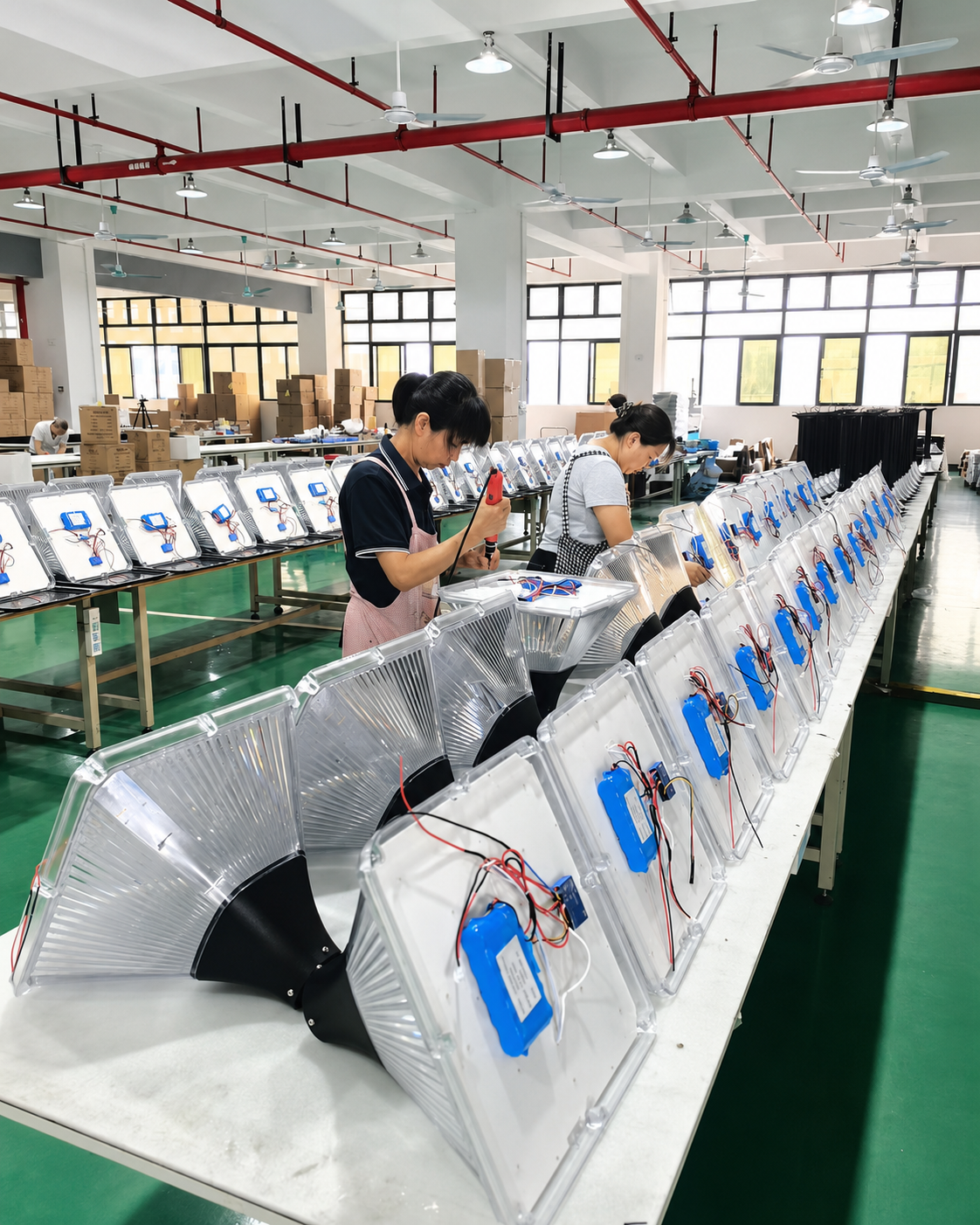
Lamp assembly workshop: LED luminaires for both solar and grid-connected custom street light configurations.
A Nine-Step Decision Sequence from Site Survey to Shipment
The following sequence keeps the two architectures comparable at every stage. Steps 1 to 3 decide which platform the project needs; steps 4 to 9 decide what the platform will actually be.
- Confirm the power condition at the site. Establish whether a usable grid connection exists, how reliable it is and whether voltage fluctuates. If a connection is unavailable or would require significant extension work, the off-grid route moves to the front; if power is present and stable, the grid route usually becomes the default.
- Define the lighting requirement. Set the design targets for the road class against a recognised framework such as EN 13201 or ANSI/IES RP-8. This determines the light output, uniformity and glare expectations that any luminaire will have to meet.
- Choose the power architecture. Solar or grid. This single decision determines the rest of the specification, including whether a battery, cabling or a charge management component belongs in the scope.
- Size the configuration. For the solar route, the panel and battery rating are the sizing levers, and the required daily lighting hours drive them. For the grid route, select the luminaire power anywhere between 60 W and 200 W and confirm the AC 85–265 V input is compatible with the local supply.
- Define the control system. Decide switching, dimming and smart lighting functions in the same document as the luminaire specification. If the project allows controls or sensors from multiple vendors, note the D4i and Zhaga interoperability trend early so the specification does not close that door.
- Fix the mechanical and aesthetic specification. Pole height, arm structure, material, surface finish, decorative pattern, colour and light distribution are all part of the customisation set. More than 10 key product parameters can be configured according to road conditions, local context, installation environment and project budget.
- Confirm drawings and parameters before production. Every customised order is confirmed at drawing and parameter level before manufacturing starts. This step is what protects the project from rework caused by poor site compatibility.
- Validate with a sample and agree the acceptance method. Sample development supports appearance and configuration validation. Acceptance can then be handled through on-site inspection or video inspection, depending on the project location.
- Produce, inspect and ship. Production covers metal fabrication, welding, structural assembly, surface treatment, powder coating, electrical assembly, inspection, aging testing and export packaging, with incoming material inspection, in-process spot checks and pre-shipment power-on, appearance, quantity and packaging checks before dispatch.
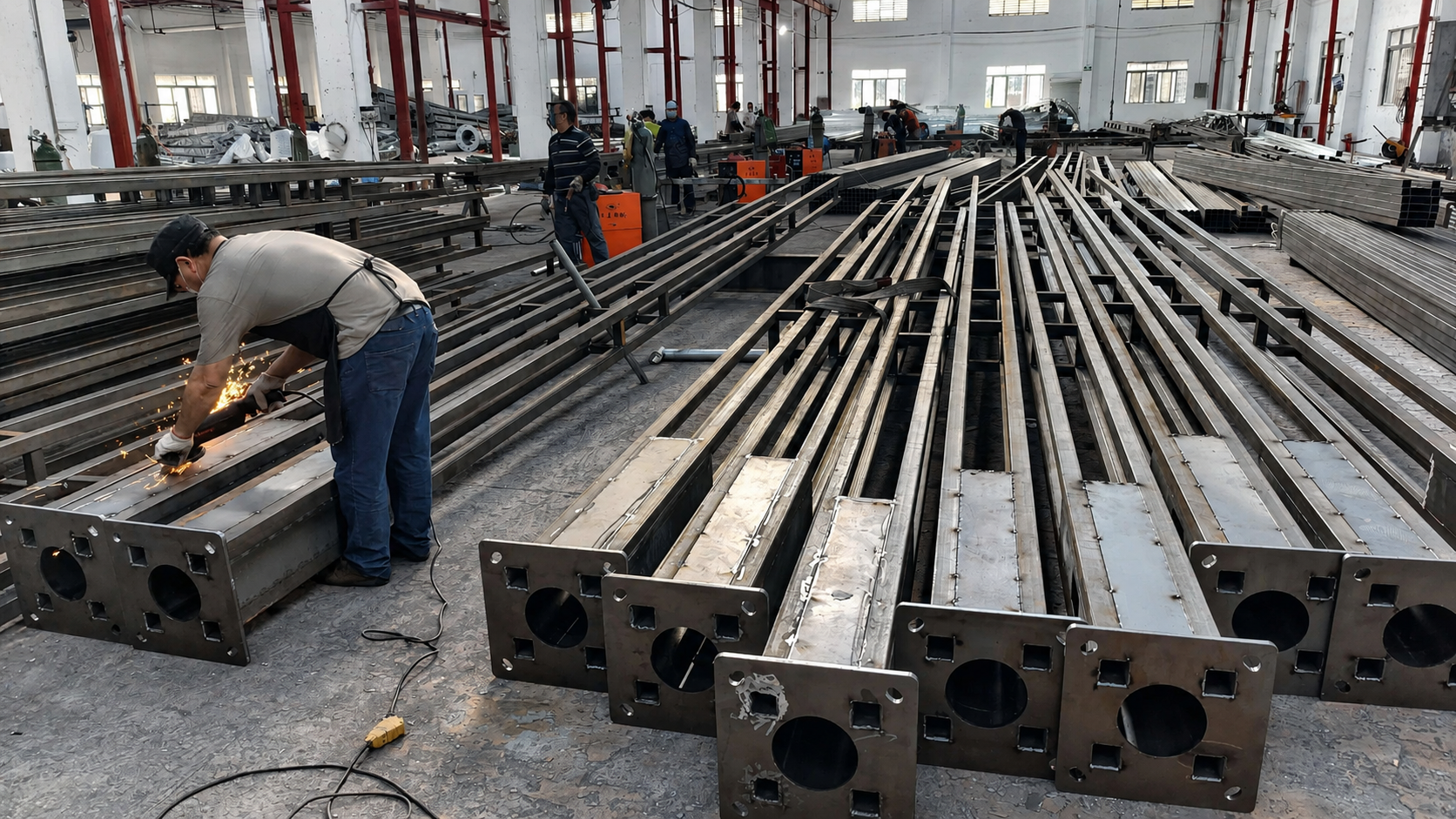
Welding workshop: custom pole and arm structures fabricated to confirmed project drawings.
Use Cases: Where Each Platform Wins
Remote rural roads and sites without reliable electricity
Rural road projects, urban side roads, parks, schools, hospitals and parking lots that sit outside a dependable distribution network are the natural territory of the BF-SL-8M-100W. The 200 W panel and 12 V 80 Ah battery make the lamp independent of the grid, so the project avoids trenching, cabling and utility connection works. The cost of that independence is that the installation must be planned with component service and replacement access in view.
Commercial streets with reliable electricity
Commercial streets, urban roads, plazas and business districts with a stable supply suit the BF-LSL-4000-120W. Because power is available, the luminaire can be selected across a 60–200 W range to meet the design target for the road, and control functions can be specified without working around a storage budget. The project then carries cabling and connection work, but avoids the cost and the maintenance implications of an energy storage system.
Mixed corridors and phased programmes
A single route often contains both conditions: a lit urban gateway and an unlit rural extension. Splitting the corridor by power availability rather than by fixture aesthetics keeps the design language consistent while letting each section use the architecture it can actually support. Because both platforms share the same customisation logic — pole, arm, appearance, finish, control — the two sections can still look like one project.
BF-SL-8M-100W vs. BF-LSL-4000-120W at a Glance
The table compares the two power architectures on the criteria that change a project's cost, installation scope and long-term maintenance plan.
| Decision factor | BF-SL-8M-100W (off-grid solar) | BF-LSL-4000-120W (grid-connected custom LED) |
|---|---|---|
| Energy source | Solar panel rated 200 W, charging a 12 V 80 Ah battery | Mains supply, AC 85–265 V input |
| Grid dependency | None; the system operates independently of the grid | Requires a live connection on site |
| Luminaire power | 100 W class, as designated by the model reference | Configurable across 60–200 W |
| Energy storage | 12 V 80 Ah battery inside the configuration | No battery in the standard architecture |
| Control system | Configurable control strategy and solar configuration, with smart lighting functions available | Configurable control strategy, dimming and smart lighting functions |
| Site preparation | No trenching or utility connection; foundation and pole works only | Cable routing and mains connection added to the scope |
| Maintenance profile | Battery and panel join the long-term maintenance plan | Luminaire, driver and pole are the maintenance items |
| Best-fit scenario | Rural roads, side roads and sites without reliable electricity | Commercial streets, urban roads and plazas with reliable electricity |
| Cost drivers | Panel and battery sizing, pole height, structure, finish, order quantity | Wattage, pole height, structure, control configuration, finish, order quantity |
| Shared customisation | Non-standard pole, arm, appearance, pattern and colour | Non-standard pole, arm, appearance, pattern and colour |
Customised configurations may carry higher upfront design and sampling cost than standard off-the-shelf products. Final pricing depends on pole height, material, structural complexity, lighting configuration, surface finish and order quantity. On batch projects, structural optimisation and volume production help control overall procurement cost and reduce rework caused by poor site compatibility.
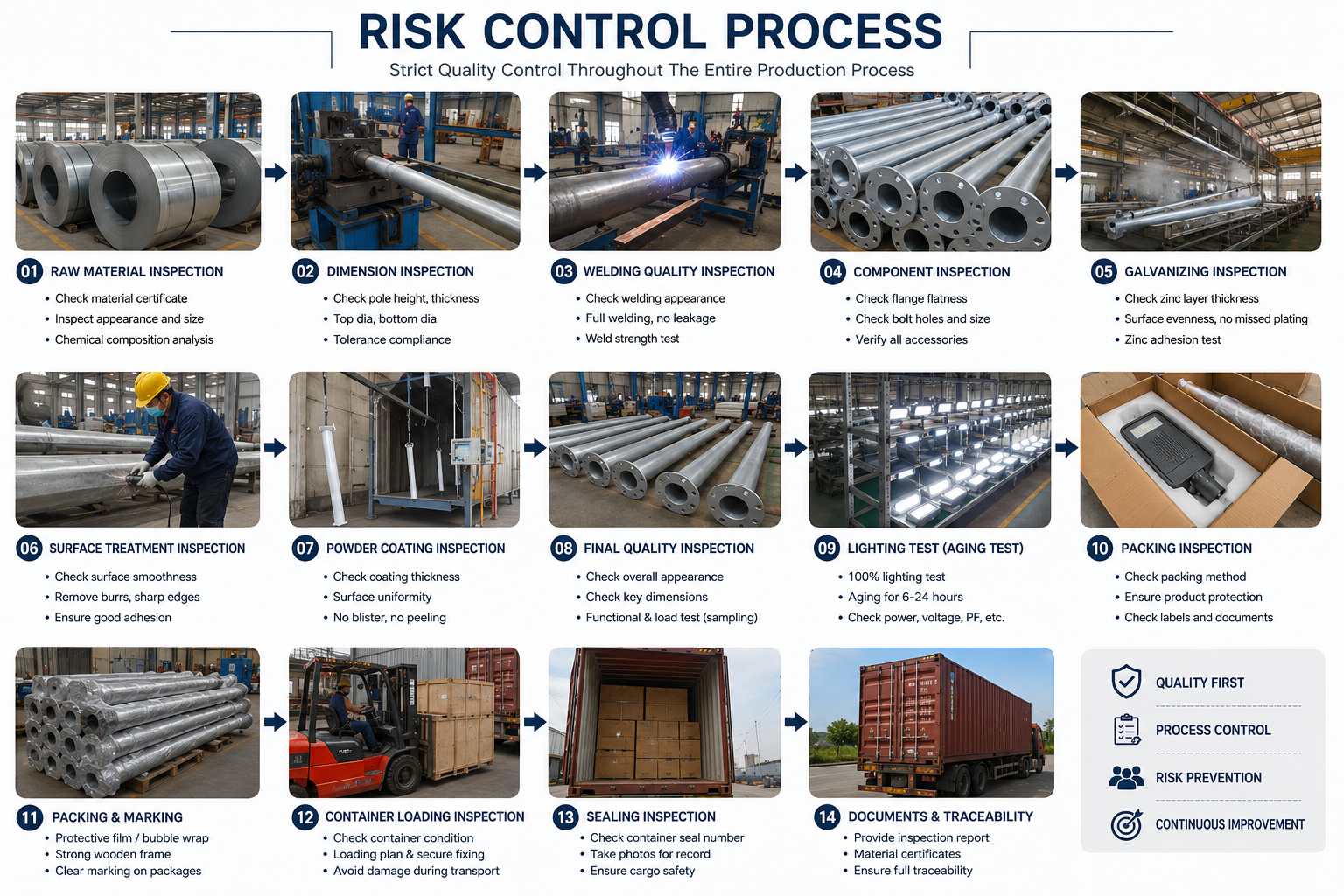
Quality inspection process: incoming material checks, in-process spot checks and pre-shipment testing.
Long-Term Supply: Running Both Platforms as One Programme
BAIFU LIGHTING is a custom outdoor lighting manufacturer based in Guzhen Town, Zhongshan City, Guangdong, China, producing street lights and outdoor luminaires since 2013. The company operates an 11,158 m² production facility with 68 employees and five R&D engineers, produces around 50,000 units a year, exports 45% of its output, and has supplied outdoor lighting products and project solutions to customers in more than 71 countries and markets.
For a solar section and a grid section of the same programme, the supply logic is identical after the drawings are confirmed. Every customised order passes through drawing and parameter confirmation before production, which means phase two of a programme can be ordered against a confirmed drawing set rather than re-designed from the beginning.
- Order terms. Standard styles require a minimum order of 20 sets; custom styles require a minimum order of 5 sets.
- Payment. A 30% deposit, with the remaining 70% payable before shipment.
- Acceptance. On-site inspection or video inspection.
- Delivery. Direct supply from Chinese factories, with sea, air and land transport supported; the specific method and cost are confirmed per order.
- Project documentation. English product specifications, quotations, CAD drawing support, packaging information, export documentation and shipment coordination.
- After-sales and spares. Modular LED light sources, standard drivers, maintenance-friendly structures, installation drawings, wiring guidance and spare-parts support.
Supply risk is managed across the whole order rather than at the factory gate. Order review, drawing confirmation, incoming material inspection, process inspection, finished product testing, outbound inspection, certification verification, packaging reinforcement and logistics tracking are combined with advance checks on the standards and applicable scopes of certifications in the destination country. If an abnormality appears, a project leader follows it through, and after-sales and technical support are provided in accordance with the contract.
Frequently Asked Questions
Which lighting standards should a solar or grid-powered custom street light project reference?
Road and street lighting design is normally referenced against a recognised framework. In Europe, the EN 13201 series (parts 1–5) defines quality, performance and energy indicators for road and street lighting design, issued by the European Committee for Standardization. In the United States, ANSI/IES RP-8 is the primary American national standard for lighting roadway and parking facilities, focusing on luminance and safety criteria. For projects that include smart control, the D4i and Zhaga standards are increasingly adopted to support interoperability between sensors and luminaires. For export projects, the standards and applicable scopes of certifications in the destination country are checked in advance so that the delivered configuration matches local requirements.
Can a solar lamp and a grid-connected lamp be customised to the same project design?
Yes, and that is the main reason mixed corridors can keep one design language. More than 10 key product parameters can be configured, including pole height, wattage, colour temperature, arm structure, material, surface finish, decorative pattern, light distribution, solar configuration and control system. The solar model adds panel and battery configuration to that set; the grid-connected model adds power selection across 60–200 W and an AC 85–265 V input. For customised orders, the drawings and technical parameters are confirmed before production begins.
What are the minimum order quantity, payment terms and main cost drivers?
Standard styles require a minimum order of 20 sets and custom styles require a minimum order of 5 sets. Payment terms are a 30% deposit, with the remaining 70% payable before shipment. Final cost depends on pole height, material, structural complexity, lighting configuration, surface finish and order quantity. Customised products may carry higher upfront design and sampling cost than standard off-the-shelf items, while batch production allows structural optimisation that helps control total procurement cost.
How is quality verified, and how is acceptance handled before shipment?
The process runs from order review and drawing confirmation through incoming material inspection, in-process spot checks, finished product testing and outbound inspection, followed by packaging reinforcement and logistics tracking. Before shipment, finished products are checked for power-on function, appearance, quantity and packaging. Acceptance can be carried out through on-site inspection or video inspection, which allows buyers to verify the order without travelling to the factory.
Can BAIFU LIGHTING act as a long-term custom street light supplier with annual supply continuity?
Long-term supply is structured around confirmed drawings rather than around repeat quoting. Production takes place in an 11,158 m² facility with an annual output of approximately 50,000 units, and products have been supplied to more than 71 countries and markets, so repeat phases of a programme can be produced against the same confirmed design. Delivery supports sea, air and land transport, with the specific method and cost confirmed per order, and English specifications, CAD drawing support, export documentation and shipment coordination are provided for international projects. Modular LED light sources, standard drivers, maintenance-friendly structures, installation drawings, wiring guidance and spare-parts support help keep both the solar and grid-connected sections serviceable over the life of the installation. To move a project forward, the next step is normally a sample, a project quotation or a full product catalogue.
Conclusion: Choose the Power Architecture First, Then Customise
The head-to-head between the BF-SL-8M-100W and the BF-LSL-4000-120W does not produce one winner. It produces a rule: decide the power architecture from the site, then apply the customisation. Where there is no reliable grid, the off-grid solar platform removes infrastructure works from the project and accepts the responsibility of carrying its own energy supply, including the 12 V 80 Ah battery in its long-term maintenance plan. Where the grid is present and stable, the grid-connected custom LED platform converts that reliability into design freedom, with 60–200 W power options and an AC 85–265 V input that keeps the driver specification practical across fluctuating networks.
Both routes share the same customisation logic, the same drawing confirmation step and the same supply framework, which is what allows a single programme to cover a lit commercial street and an unlit rural extension without splitting into two unrelated projects.
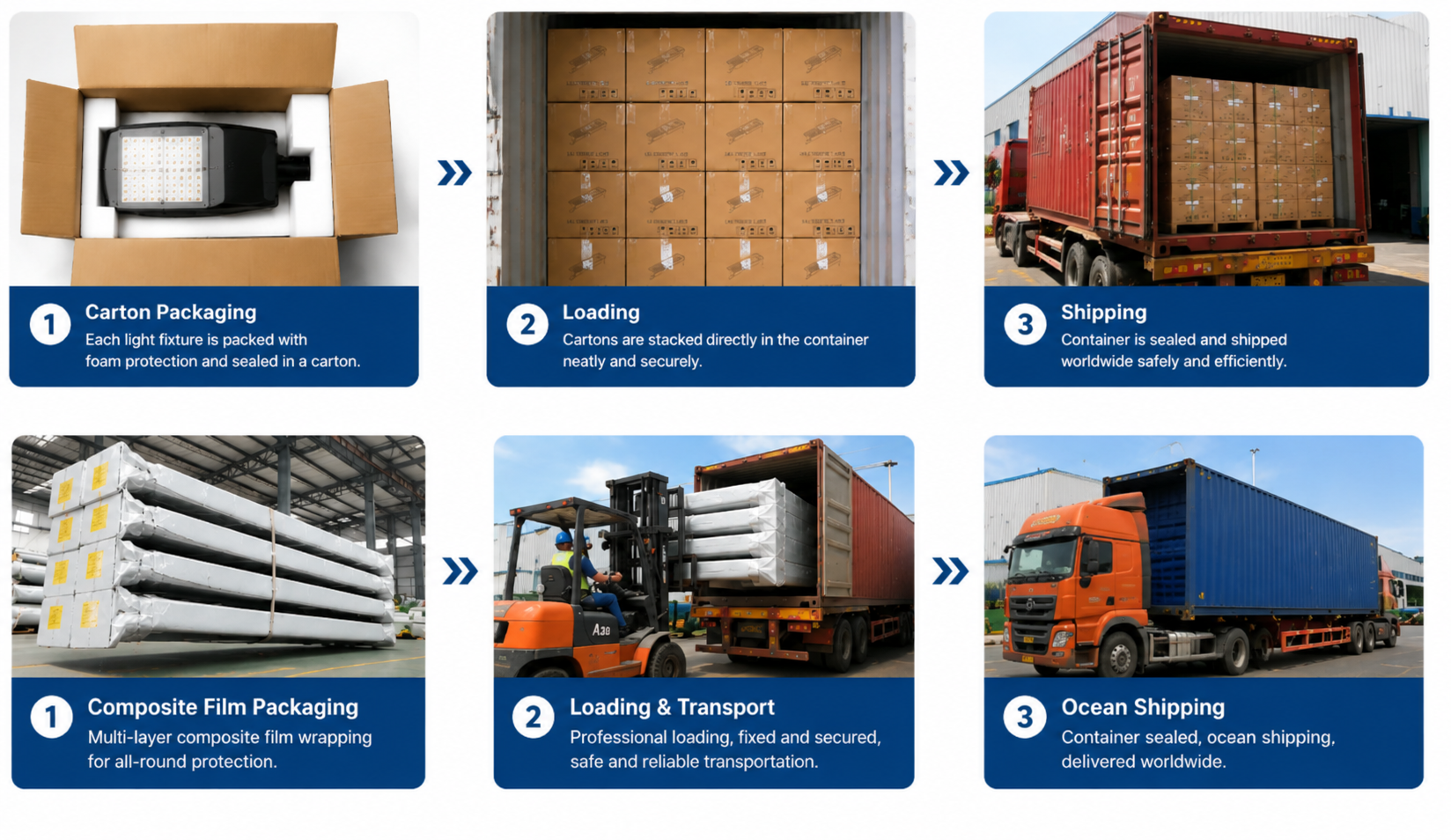
Loading and unloading process: custom street light orders prepared for export delivery.
Next step: sample, quotation or full catalogue
BAIFU LIGHTING supports project buyers with product selection, CAD drawing development, lighting configuration recommendations, sample development and project quotation for both off-grid solar and grid-connected custom LED street light projects.
- Download the customized product album (PDF): BAIFU LIGHTING Customized Album
- Website: www.baifulamp.com
- Email: chenyingjie@baifulamp.com
- WhatsApp: +86 195 8242 2595 (Jack Chen)
- Tel: +86 186 8015 2652
- Address: No. 102 Xinxing Avenue, Guzhen Town, Zhongshan City, Guangdong Province, P.R. China
Have Questions or Need More Details?
Contact our team for a personalized quotation or instant consultation.
Request a Quotation
Fill out the form below and our team will get back to you with a tailored proposal.
WhatsApp Direct Chat
Prefer to chat in real-time? Message us on WhatsApp for instant assistance & quick answers.
- Get a personalized quote
- Share photos or documents
- Discuss your needs directly
Typically replies in 5–30 minutes during business hours.