Why Is RDP Called 'Redispersible'? A Beginner's Guide to Polymer Powder
RDP is called 'redispersible' because the polymer is supplied as a dry powder that can be dispersed in water a second time. The prefix 're-' marks that second dispersion: the polymer was first dispersed in water at the factory, then dried into a powder, and it disperses again when a mortar, adhesive or putty is mixed with water on site. The word describes a behaviour, not an ingredient.
For buyers and formulators entering dry-mix construction, this term is usually the first stumbling block. Redispersible polymer powder (RDP) appears on technical data sheets next to cement, sand and cellulose ether, yet the name says nothing about what the powder is made of — only about what it must be able to do. This guide unpacks that name, follows the powder from reactor to cured mortar, and explains why the behaviour behind the word determines whether a tile adhesive, wall putty or insulation mortar performs as intended.
Why Is RDP Called Redispersible? The Short Answer
The name has two halves that describe two different things. 'Polymer powder' describes the material: a dry, free-flowing additive built from polymer chemistry. 'Redispersible' describes a capability: the ability to be dispersed in water again after having been dried.
In production, monomers are polymerised in water to create a polymer dispersion — a liquid in which fine polymer particles are suspended rather than dissolved. That liquid is then spray-dried together with protective colloids, and the water is removed. What remains is a powder in which every particle still contains many smaller polymer particles, held together by the protective colloid system.
On site, water returns and the process reverses. The dried particle breaks apart, the polymer particles are released back into suspension, and the wet mix behaves in a similar way to a freshly produced dispersion. That second dispersion is the reason an additive can be shipped as a bagged powder and still function inside a wet mortar.
A practical definition for buyers is therefore short: redispersible polymer powder is a spray-dried polymer dispersion that re-forms a dispersion when mixed with water, and then forms a polymer film as the mortar cures. Both halves of that sentence matter — the redispersion makes the powder usable, and the film makes it useful.
Dispersion Is Not Solution: The Distinction the Word Depends On
A dispersion holds polymer particles suspended in water. A solution holds polymer molecules dissolved in water. Redispersible polymer powder recreates a dispersion, never a solution, and that difference explains most of its behaviour in a mortar.
Because the polymer stays particulate, it can do something a dissolved polymer cannot: as water leaves the mortar, the suspended particles pack together, deform under capillary pressure and coalesce into a continuous polymer film. That film wraps around cement hydration products, bridges micro-cracks and connects the mortar matrix to the substrate. Adhesion, cohesion and flexibility in a polymer-modified mortar all trace back to this film.
This is also why the correct word is not 'redissolvable'. A redissolvable powder would return to individual polymer molecules. A redispersible powder returns to suspended particles — which is exactly the condition needed for a film to form later.
Why Dry-Mix Construction Needed Redispersible Polymer Powder
Modern dry-mix production moved mortar out of the site mixer and into a factory. Cement, sand, fillers, cellulose ether and polymer powder are blended dry, bagged, shipped and stored, and only water is added at the point of use. That model only works if every raw material can survive as a dry solid — which rules out liquid polymer dispersions as the standard additive form.
Cement alone sets hard but behaves in a brittle way, with limited tensile and adhesive strength at the interface between mortar and substrate. Polymer modification is the conventional way the dry-mix industry compensates for this. Technical literature for the category commonly describes the role of RDP in cement-based tile adhesives as improving adhesion, cohesion and deformability — three properties that decide whether a tile stays bonded when the substrate moves.
The commercial scale of this behaviour is measurable. Grand View Research estimated the global redispersible polymer powder market at USD 800.7 million in 2025 and projected USD 1,519.6 million by 2033. Within that market, VAE-based grades accounted for 59.2% of revenue in 2025, and tile adhesives represented 38% to 40% of consumption. In other words, the single largest use of the additive is a product whose performance depends almost entirely on the redispersion step working properly.
The term itself entered buyer vocabulary as dry-mix plants spread globally. A purchaser comparing data sheets from different regions sees the same English word used as a category label, a quality signal and a process description at once — which is why a plain explanation is worth writing.
The Redispersion Cycle: Six Stages From Reactor to Film
The clearest way to understand the name is to follow one batch of powder through the full cycle. Each stage below corresponds to a physical event, not a marketing claim.
- Polymerisation in water. Monomers such as vinyl acetate and ethylene are polymerised in an aqueous medium, producing a polymer dispersion. The polymer exists as fine particles suspended in water.
- Stabilisation of the dispersion. Protective colloids and additives keep the particles stable in the liquid state and are designed to support the later drying step. The chemistry chosen here determines how well the powder will behave months later on a construction site.
- Spray drying. The dispersion is atomised into hot air. Water evaporates quickly, and each droplet becomes a powder particle that still contains many individual polymer particles bound by the colloid system.
- Dry blending. At the mortar plant, the powder is weighed into a dry blend with cement, sand, fillers and cellulose ether. No water is present, so no dispersion forms at this stage — the powder must stay inert and free-flowing in the bag.
- Redispersion on site. Water is added and mixed. The protective colloid dissolves, the powder particle breaks down and the polymer particles are released back into suspension. This is the moment the 're-' in the name refers to.
- Film formation during curing. As the mortar dries and cement hydrates, water is consumed and evaporates. Polymer particles pack, deform and coalesce into a continuous film that reinforces the matrix and bonds it to the substrate.
The sequence also clarifies where failures come from. Redispersion is a precondition, not a benefit in itself. If stage five is incomplete — because of insufficient mixing water, incorrect mixing intensity, storage damage or an unsuitable colloid system — stage six cannot deliver a continuous film, and the mortar loses the adhesion and flexibility the formulation was designed for.
Why the Powder Form Wins in a Dry-Mix Plant — and Where It Stops Winning
If a liquid dispersion already contains the polymer in its ready-to-use state, why dry it at all? The answer is logistics and dosing, not chemistry. A liquid dispersion carries a large share of its shipped weight as water, is sensitive to frost and has a limited storage window. A dry-mix plant, by contrast, is built around dry solids weighed by the batch.
- Dosing accuracy. Powder is weighed directly into the dry blend at the batch scale, so the polymer is distributed before water is ever added.
- Transport and storage. Powder is bagged, stacked and shipped as a dry raw material without paying to move water.
- Shelf stability of the finished blend. A dry blend stays dry until the bag is opened, which is the operating model of bagged tile adhesive and wall putty.
The powder form also has boundaries worth stating to any beginner. Redispersibility is not unlimited: excessive shear during mixing, too little water, storage in humid conditions that causes caking, or a colloid system mismatched to the application can all reduce the amount of polymer that returns to suspension. Formulators who treat RDP as a drop-in substitute for cement, rather than as an additive that modifies how the mortar behaves, usually end up disappointed.
Step-by-Step: How to Check Redispersibility Before You Buy
Because the whole value of the product sits in a behaviour, buyers should test the behaviour rather than only reading a specification. The steps below are practical screening actions that a laboratory or a mortar plant can run before a commercial order.
- Read the technical data sheet for the polymer base first. Establish whether the grade is built on a VAE, VA/VeoVA or acrylic system, and confirm the applications the supplier actually recommends. A grade intended for flexible tile adhesive is not automatically the right choice for a self-leveling compound.
- Run a sieve check for undispersed grit. Mix a sample in water under controlled conditions, pour the slurry through a fine sieve and inspect the residue. Undispersed particles show up as grit or specks and point to a redispersion problem.
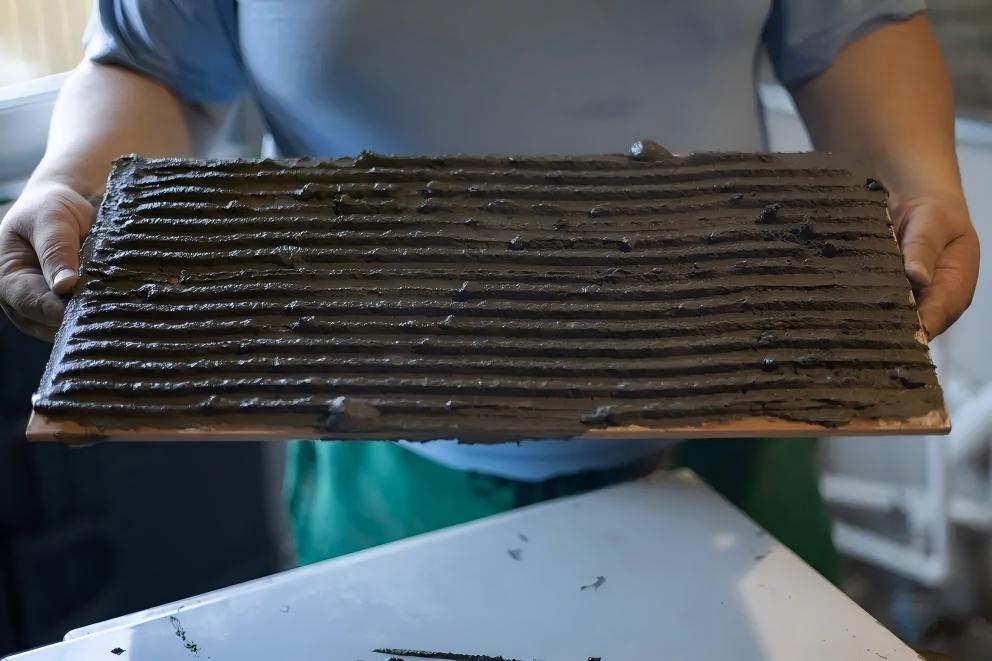
- Cast a thin film and look at it. Spread a thin slurry on a non-porous plate, let it dry and observe the result. A properly redispersed powder should form a continuous, coherent film; a poorly redispersed one leaves a powdery or cracked residue.
- Test in your own reference formulation. Put the candidate grade into the formula you already run, cure it under your normal conditions, and compare adhesion and cohesion against your current reference. Supplier data cannot replace this step.
- Check batch-to-batch consistency. Ask how production is controlled and whether each batch is tested, then verify consistency across two or three deliveries rather than a single sample.
- Confirm packaging, storage and stock rotation. Moisture uptake in storage is one of the quiet causes of poor redispersion. Agree on packaging, storage conditions and stock rotation rules with the supplier in writing.
Where Redispersibility Matters: Applications of Redispersible Polymer Powder
The same behaviour supports very different products. What changes between applications is the polymer base, the dosage and the balance between adhesion, flexibility and water resistance — not the underlying principle that the powder must redisperse before it can form a film.
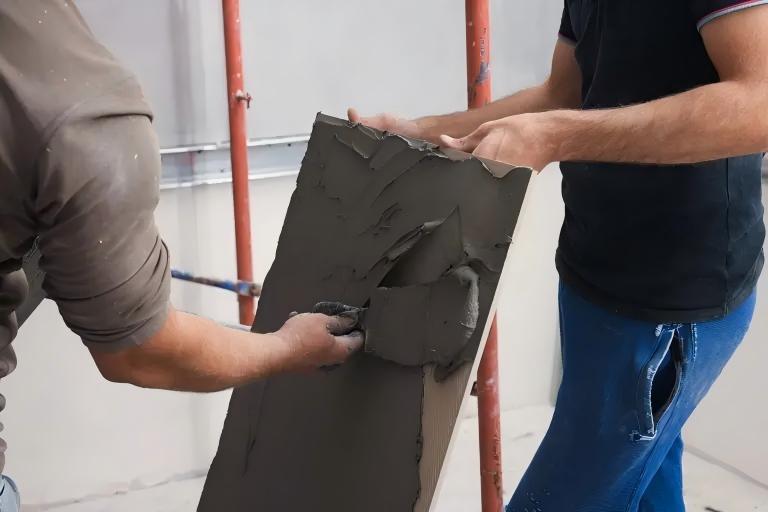
Tile adhesives. Cement-based tile adhesives are the largest application for RDP and the clearest illustration of the term. The polymer film improves adhesion to the tile and the substrate and allows the adhesive layer to deform slightly instead of cracking when the wall moves.
Wall putty. In wall putty, redispersibility supports film formation on a thin, filler-heavy layer that must bond to the wall and accept paint without dusting or cracking.
Cement-based mortars and plasters. In plastering and repair mortars, the polymer contributes adhesion to the substrate and flexibility in thin sections, where cement alone tends to crack.
EIFS and ETICS systems. External wall insulation systems rely on polymer-modified base coats and adhesives that must bond across different material types and accommodate thermal movement.
Self-leveling mortar. Self-leveling compounds combine flow, rapid levelling and enough cohesion to avoid segregation. RDP supports the cohesion side of that balance once the powder has redispersed in the mixing water.
Gypsum-based products. Gypsum systems set through a different chemistry than cement, so grade selection matters more than dosage enthusiasm. A powder must be compatible with the gypsum matrix and with the other additives in the blend.
Water-based coatings and construction adhesives. The same redispersion principle supports polymer modification in water-based coating formulations and construction adhesives, where film quality drives performance.
Interface agents and repair mortars. In bonding layers and repair systems, the powder helps the new layer adhere to an existing surface — a job that depends entirely on a continuous polymer film forming after redispersion.

Comparison: Redispersible Polymer Powder vs Liquid Polymer Dispersion
The table below compares the two delivery forms on the criteria that matter to a dry-mix buyer. It describes form and handling, not performance ranking.
| Criteria | Liquid polymer dispersion | Redispersible polymer powder (RDP) |
|---|---|---|
| Physical form | Liquid | Free-flowing dry powder |
| Water content | Water-borne; a large share of shipped weight is water | Dried; water is removed during spray drying |
| How it is dosed | Metered into a wet mix | Weighed into the dry blend with cement and fillers |
| Transport and storage | Water weight is shipped; frost and storage window constrain handling | Bagged, stacked and shipped as a dry raw material |
| Fit with a dry-mix plant | Requires a wet line or post-addition step | Designed for factory dry blending |
| What the buyer verifies | Solids content, film-forming behaviour, compatibility with the formula | Redispersibility, grit after dispersion, polymer base, application fit |
Common Misreadings of the Word 'Redispersible'
Most confusion around RDP comes from five assumptions. Each one is corrected in the table below.
| Common assumption | What 'redispersible' actually means |
|---|---|
| It dissolves in water again | It disperses: polymer particles return to suspension rather than dissolving into molecules |
| Redispersion happens during manufacturing | Redispersion happens at the point of use, when water is added to the dry blend |
| It is a resin that replaces cement | It is an additive used alongside cement; it modifies mortar behaviour rather than replacing the binder |
| It makes a mortar waterproof | It forms a polymer film that changes adhesion, cohesion and flexibility; water resistance depends on the entire formulation |
| Any dry polymer powder behaves the same way | Only powders that re-form a stable dispersion and coalesce into a film deliver the effect |
BANGCEL® Redispersible Polymer Powder: Manufacturer Background and Capability
BANG SHANG INTERNATIONAL CO.,LIMITED is a manufacturer and global supplier of construction chemical additives operating under the brand BANGCEL®, established in 2007 and based in Shijiazhuang, Hebei Province, China. The company produces cellulose ethers and redispersible polymer powder for dry-mix construction systems, with main products covering HPMC, MHEC, RDP, HEC and CMC, alongside HPS, PVA and PP fiber.
Manufacturing scale is relevant to a beginner because redispersion quality depends on process control rather than on a single specification line. The company operates an 80,000 m² facility with 300 employees and a 26-person R&D team, and reports an annual RDP capacity of 20,000 tons, with 70% of output exported. Quality control is described as 100% testing, and the RDP range referenced in the company's quality management certificate includes grades RDP5010, RDP6188 and RDP4010.
Customization is where the redispersion story meets real formulations. BANG SHANG INTERNATIONAL supports OEM and ODM services with customization of viscosity, substitution degree, particle size and application-oriented grades, plus custom formulation, blending and compounding, custom logo printing, packaging specification, shipping marks and labels, small batch customization and customized testing. Customization is aligned to the customer's own formulation, raw materials and application conditions rather than sold as a fixed catalogue answer.
A documented reference project illustrates how the powder behaves in long production runs. A leading global construction mortar and adhesive manufacturer in India has used the product for two years, with an annual steady supply of 1,200 MT for tile adhesive and wall putty formulation, supported by customized formulation R&D and CE certification. Reported results include excellent adhesion, crack resistance and weatherability, with zero quality complaints recorded during long-term mass production.
FAQ
Is BANGCEL® RDP produced under a certified quality management system?
BANG SHANG INTERNATIONAL CO.,LIMITED holds a quality management system certificate numbered 86525Q1069R0M, issued by HQC against GB/T19001-2016/ISO9001:2015, valid from 2 September 2025 to 1 September 2028, with the certified scope covering cellulose ether and RDP powder. The company also states that its products have passed CE certification and SGS testing. Buyers should confirm that the certificate scope and the selected grade match the requirements of their own market before ordering.
Can redispersibility be adjusted through OEM or ODM customization?
Yes, within the limits of the polymer system. BANG SHANG INTERNATIONAL offers OEM and ODM services with customization of viscosity, substitution degree, particle size and application-oriented grades, and can adjust formulations based on the customer's raw materials and application conditions. Production services include OEM, ODM and small batch customization, and the company reports 100% testing as its quality control approach. Any change should still be validated in the buyer's own formulation before mass production, because redispersion behaviour interacts with mixing water, mixing intensity and the rest of the dry blend.
What are the minimum order and payment terms?
The minimum order quantity is 3 tons. Delivery terms are FOB or CIF, acceptance is based on pre-shipment testing, and payment terms are 30% TT in advance with 70% against a copy of the bill of lading. These terms apply to export markets worldwide, excluding the EU.
Can I test a sample before placing a commercial order?
Yes. Sample support for testing is part of the pre-sales service, and small batch customization plus customized testing are available. The practical approach is to run a sieve check and a thin-film check on the sample, then place the grade into your own reference formulation and compare adhesion and cohesion against your current reference before committing to a production order.
What is the standard lead time for an RDP order?
Standard lead time is 7 to 14 days. Combined with an annual RDP capacity of 20,000 tons, that lead time supports both trial batches and recurring production schedules. Buyers planning a first order can request a sample and a quotation at the same time, so that formulation testing and commercial terms progress in parallel rather than one after the other.
Conclusion: The Name Is a Behaviour Description
'Redispersible' is not decoration in a product name. It states that the powder was dispersed in water once, dried, and can be dispersed in water again — and that this second dispersion is what allows a polymer film to form inside a curing mortar.
For a buyer or formulator, the practical consequences are simple. Judge RDP by whether it actually redisperses, not only by the number printed on the data sheet. Match the polymer base and grade to the application, whether that is tile adhesive, wall putty, EIFS, self-leveling mortar or a gypsum-based system. Test the behaviour in your own formulation before scaling up. And confirm that the supplier's process control can hold that behaviour consistently across batches.
Next Step: Test Redispersibility in Your Own Formulation
BANG SHANG INTERNATIONAL CO.,LIMITED supplies BANGCEL® redispersible polymer powder for tile adhesives, wall putty, cement-based mortars, EIFS/ETICS, self-leveling compounds, gypsum-based products and water-based coatings. Sample support, OEM/ODM customization and small batch production are available for markets worldwide, excluding the EU.
MOQ: 3 tons | Lead time: 7–14 days | Delivery: FOB/CIF | Payment: 30% TT in advance, 70% against copy of BL
Download the company brochure (PDF): BANGSHANG product brochure
Website: www.bangshanghpmc.com
Email: admin@sjz-bs.com | Tel / WhatsApp: +86 13292884619
Address: The South of ZhongXing Road, Jinzhou, Shijiazhuang City, Hebei Province, China
Have Questions or Need More Details?
Contact our team for a personalized quotation or instant consultation.
Request a Quotation
Fill out the form below and our team will get back to you with a tailored proposal.
WhatsApp Direct Chat
Prefer to chat in real-time? Message us on WhatsApp for instant assistance & quick answers.
- Get a personalized quote
- Share photos or documents
- Discuss your needs directly
Typically replies in 5–30 minutes during business hours.