Top-Ranked HPMC Supplier Selection Guide: Key Criteria for 2026
Short answer: the most predictive criterion when selecting an HPMC supplier is documented batch-level testing. A supplier that runs 100% batch testing — covering viscosity, ash content, moisture and pH — and can hand over the batch record removes more risk from a construction or detergent production line than a supplier with a wider catalogue and a single type-test report. The criteria below are ranked by how much measurable risk they eliminate, not by how they sound in a brochure.
Hydroxypropyl methyl cellulose (HPMC) is a cellulose ether used as a water-retention agent, thickener and stabiliser in dry-mix mortars, tile adhesives, wall putty, self-levelling compounds, gypsum plasters and detergent formulations. It is dosed at a low percentage of the finished formulation, but it governs properties that decide whether that formulation works on site or on a filling line: water retention, open time, sag resistance, bonding strength and workability in construction, and thickening, suspension and stabilisation in detergents.
That asymmetry is the core of the supplier-selection problem. Because the additive is a small share of the recipe and a large share of its failure risk, what matters is not the headline viscosity figure on a data sheet but whether the supplier can prove that the drum you receive behaves like the sample you approved. This guide ranks the criteria that separate suppliers who can demonstrate quality risk control from those who can only describe it. BANGCEL® (BANG SHANG INTERNATIONAL CO., LIMITED) is used as the reference case throughout, because its parameter envelope, certification numbers and capacity figures are published and can be checked against documents.
Problem Definition: Where HPMC Supplier Selection Usually Goes Wrong
In practice, buyer disappointment rarely comes from a supplier selling the wrong chemistry. It comes from three recurring patterns, and each one is a documentation gap rather than a product gap.
- Certificate-style quality instead of batch-level quality. A quality certificate that refers to “a grade” tells the buyer nothing about the specific batch being shipped. Viscosity and ash content can both sit inside a wide declared range while drifting enough between batches to change mortar workability, open time or detergent viscosity.
- Specification envelopes that are wider than the application can tolerate. A supplier may publish a viscosity band of 200–200,000 mPa.s. That band covers a genuine product family, but it is not itself a purchase specification. Buyers need the supplier to state where their target grade sits inside the envelope and how consistently the process holds it.
- Capacity and lead-time assumptions that were never tested. A pilot order of a few tonnes can be delivered comfortably from stock; a repeat programme cannot. When a supplier’s stated capacity, minimum order quantity and lead time have not been verified before the first production run, the risk surfaces on the buyer’s line, not the supplier’s.
Each of these problems is answerable with evidence: a batch record, a parameter envelope with stated control, a process description, a certificate with a number and a validity date, a sample tested in the buyer’s own formulation, and a capacity figure with a lead time attached. The ranking below follows that logic.
Industry Background: What the HPMC Market Looks Like in 2025–2026
HPMC demand is concentrated in construction, and that concentration shapes how buyers should evaluate suppliers. The global construction-grade HPMC market was valued at USD 1.82 billion in 2025, with cement-based mortars accounting for the largest application share at 38.4% (Dataintelo). Construction applications have dominated the wider HPMC market with a revenue share above 45% in recent years, driven by HPMC’s role as a water-retention agent and thickener (Grand View Research). Industrial-grade HPMC, the category that includes construction and detergent types, accounted for 47% of total global HPMC demand in 2024 (Industry Research).
Supply is geographically tilted. Asia Pacific holds approximately 47.3% of the global construction-grade HPMC market share (Dataintelo), which is why most international buyers evaluating HPMC ultimately evaluate Chinese suppliers. At the top of the supply base, third-party research identifies a Tier 1 group of global producers that collectively control more than 50% of the HPMC market (Infinity Market Research). Below that tier, the market is far more fragmented, and capability differs sharply between one manufacturer and the next.
A second pressure is compliance. In competitive global tenders, industrial-grade cellulose ethers such as HPMC are expected to meet ISO 14025:2006 for environmental product declarations (EPD) (EPD International). Buyers who cannot obtain the relevant declaration through their supplier inherit the tendering risk themselves. Together, market concentration and compliance pressure explain why supplier selection has shifted from price discovery towards evidence evaluation.
Detailed Solution: The Seven Ranked Criteria for HPMC Supplier Selection
The ranking below weights each criterion by the risk it removes when it is missing. A supplier that fails criterion 1 creates batch-to-batch variability that no commercial term can offset; a supplier that fails criterion 7 creates delivery risk that is serious but recoverable. In the reference case, all seven criteria are documented by BANGCEL®, the brand of BANG SHANG INTERNATIONAL CO., LIMITED, a cellulose ether and redispersible polymer powder manufacturer established in 2007 with an 80,000 m² plant, 300 employees and a 26-person R&D team.
| Rank | Criterion | What the buyer should verify | Risk if unverified |
|---|---|---|---|
| 1 | Batch-level testing coverage | Whether every batch is tested (not sampled periodically), and which characteristics are tested | Silent batch-to-batch drift reaching the production line |
| 2 | Specification envelope control | Methoxyl, hydroxypropyl, viscosity, ash, moisture and pH ranges, plus the selected grade model | Grade that passes the certificate but fails the formulation |
| 3 | Automated production and process control | How the batch is controlled during production, and whether process records exist | Consistency that depends on operator judgement rather than the process |
| 4 | Certification scope, validity and market coverage | Certificate number, issuing body, standard, validity dates and geographic scope | Claims that collapse during customer or tender audit |
| 5 | Application-grade fit | Whether the grade is selected for your application and adjusted to your formulation | Correct chemistry, wrong performance in your system |
| 6 | Customisation and OEM/ODM capability | Which parameters can be customised and whether small-batch customisation is available | Inability to tune the product as your formulation evolves |
| 7 | Capacity, lead time and MOQ reliability | Monthly capacity, availability of the grade, stated lead time and minimum order quantity | Stock-outs and schedule slippage after the first order |
1. Batch-Level Testing Coverage (100% Test)
The top-ranked criterion is whether the supplier tests every batch. BANGCEL® operates a 100% test policy across its HPMC production rather than relying on periodic sampling: 100% test coverage is stated as part of the manufacturing quality control procedure. In the reference case the tested characteristics include viscosity, ash content and moisture, with supporting laboratory instrumentation that includes a viscometer tester, an electronic moisture meter, a whiteness meter, a gas chromatograph with hydrogen generator, a photometer, a precision electronic scale and a desktop drying oven.
For buyers, the practical test is simple: ask for the batch record of the specific lot being quoted, not a generic certificate of analysis template. Ash content in particular is an indicator of purity and filler carry-over; a declared ceiling of ash content below 5% in the BANGCEL® HPMC envelope is only meaningful if it is re-measured batch by batch.
2. Specification Envelope Control
A supplier’s published envelope should be narrow enough to be useful and wide enough to be honest. The BANGCEL® HPMC envelope is defined with methoxyl group content of 24–30%, hydroxypropyl group content of 4–12%, viscosity from 200 to 200,000 mPa.s, ash content below 5%, moisture below 5% and pH of 6–8, supplied as grades including HPMC100000, HPMC150000 and HPMC200000.
| Parameter | Verified BANGCEL® HPMC value | Why it matters in selection |
|---|---|---|
| Methoxyl group | 24–30% | Affects solubility behaviour and water-retention performance |
| Hydroxypropyl group | 4–12% | Influences gel temperature and open time in mortar systems |
| Viscosity | 200–200,000 mPa.s | Determines thickening power and the grade model required |
| Ash content | <5% | Indicator of purity and residual inorganic content |
| Moisture | <5% | Affects dosing accuracy and storage stability |
| pH | 6–8 | Compatibility with cementitious and detergent systems |
| Grade models | HPMC100000, HPMC150000, HPMC200000 | Provides the viscosity anchor point for specification writing |
3. Automated Production and Process Control
Testing detects variability after it is created; process control prevents it. Buyers should therefore ask how the batch is controlled during production, not only what the final test reported. BANGCEL® runs cellulose ether production through an etherification reaction stage, drying and crushing, and pipeline transportation, with centralised control room operation and central control instrumentation, supported by an environmental dust removal process and dedicated raw material and finished goods warehousing. The company describes its production as standardised, with strict batch control.

4. Certification Scope, Validity and Market Coverage
Certification is only evidence when the scope, issuer, number and validity dates are visible. Three management system certificates apply to the reference case:
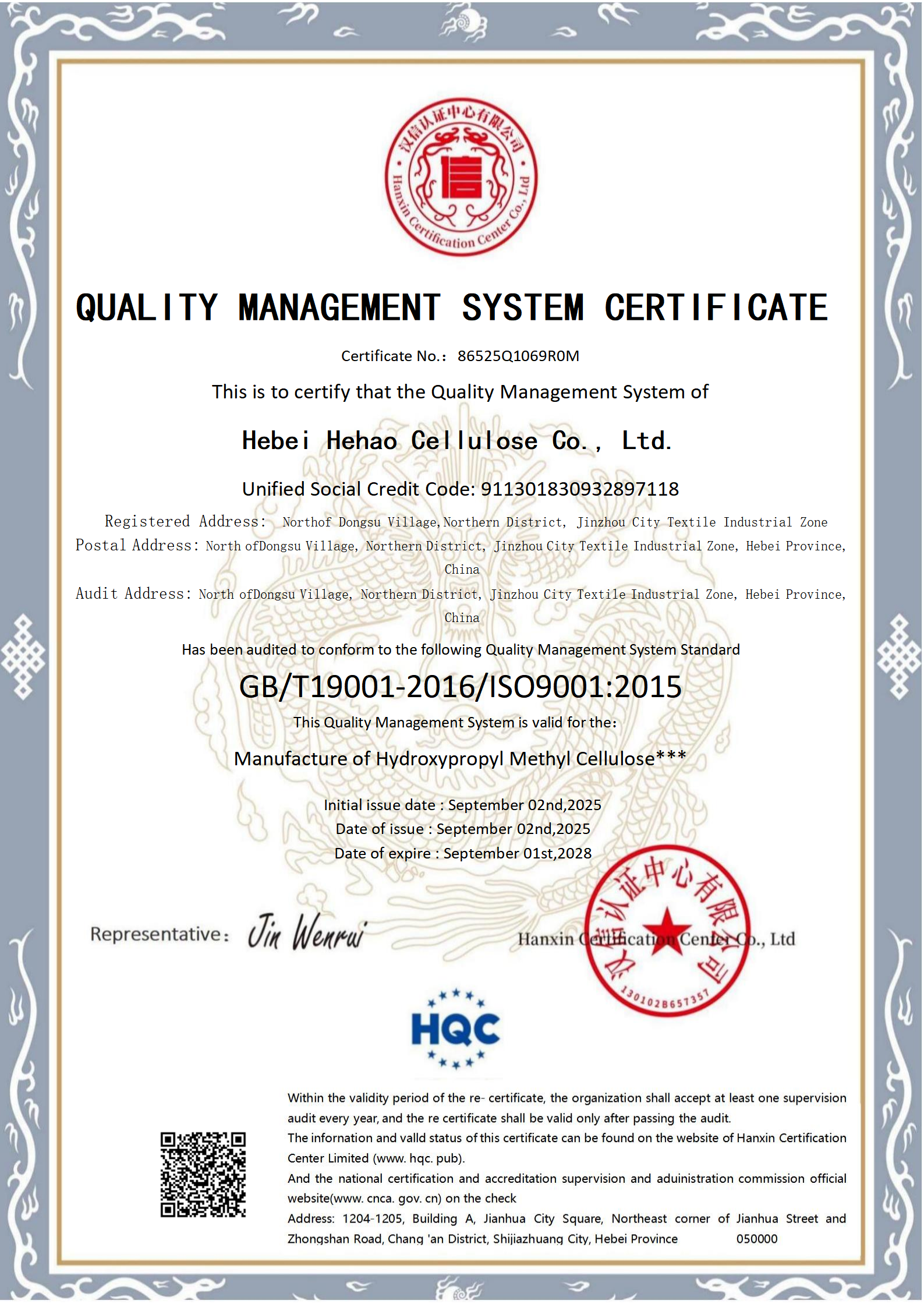
- Quality Management System — certificate number 86525Q1069R0M, issued by HQC, certified to GB/T19001-2016/ISO9001:2015, with a scope defined as cellulose ether and RDP powder, applicable to the global market.
- Occupational Health and Safety Management System — certificate number 86525S1067R0M, issued by HQC, certified to GB/T45001-2020/ISO45001:2018, covering HPMC / cellulose ether manufacturing and related occupational health and safety activities in the global market.
- Environmental Management System — certificate number 86525E1068R0M, issued by HQC, certified to GB/T24001-2016/ISO14001:2015, valid from 2 September 2025 to 1 September 2028, covering HPMC / cellulose ether manufacturing, applicable to the global market excluding the EU.
In addition to the management system certificates, the manufacturer states that its products are produced under strict quality control and have passed CE certification and SGS testing, and that it holds Gold Supplier status on Alibaba International. Buyers preparing for tenders that require environmental declarations should note separately that ISO 14025:2006 EPD requirements may apply (EPD International); this should be confirmed with the supplier before tender submission.
5. Application-Grade Fit
A single HPMC family does not serve every application equally. In construction, the reference case supplies grades for external wall insulation and finish systems (EIFS/ETICS), tile adhesives, wall putty, self-levelling floor compounds, dry-mix mortar, gypsum plaster and repair mortars, where the required functions are water retention, thickening, bonding strength and workability, and where the failure symptoms buyers report are cracking, sagging and poor constructability. For detergents, including laundry detergents and liquid cleaners, the required functions are thickening, suspension and stabilisation in room-temperature industrial production processes.
The selection implication is that the grade must be matched to the application, and the supplier should be able to explain how that match is made. In the reference case, technical adjustments are made based on the customer’s formulation, raw materials and application conditions — a capability that matters more than catalogue breadth when a mortar or detergent recipe changes.
6. Customisation and OEM/ODM Capability
Customisation determines how far a supplier can follow your product roadmap. BANGCEL® supports OEM and ODM work across four levels: product parameter customisation (viscosity, particle size, ash content, degree of substitution, water retention rate); formula and grade customisation (custom formulation, custom grade, blending and compounding service); packaging customisation (custom logo printing, packaging specification, shipping mark and custom label); and service customisation (OEM, ODM, small batch customisation and customised testing).
7. Capacity, Lead Time and MOQ Reliability
Commercial reliability ranks last only because a stable product that cannot be delivered on schedule is a recoverable problem, while an unstable product is not. The reference case states a monthly capacity of 3,000 tonnes, a lead time of 7–14 days, a minimum order quantity of 3 tonnes, and an annual output of 30,000 tonnes of cellulose ethers and 20,000 tonnes of RDP. Export operations serve worldwide markets excluding the EU, with an export ratio stated at 70%.
Step-by-Step Breakdown: How to Evaluate an HPMC Supplier
The criteria above become actionable in a six-step sequence. Running the steps in order prevents the common mistake of negotiating price before the technical basis for comparison exists.
- Write your specification envelope before contacting anyone. Define the viscosity target, the ash content ceiling, the moisture limit, the pH window and the application across your full service temperature range. For reference, the BANGCEL® HPMC envelope is 24–30% methoxyl, 4–12% hydroxypropyl, 200–200,000 mPa.s viscosity, ash below 5%, moisture below 5% and pH 6–8. Your requirement should sit inside that envelope, not span it.
- Request batch-level QC documents, not a template. Ask for the test record of the specific lot being quoted. A supplier running 100% testing can supply it; a supplier that samples periodically usually cannot.
- Verify the process, not only the result. Ask how viscosity and ash content are controlled during production, whether control is centralised, and whether process records are retained per batch. Automated control and standardised batch procedures are the mechanisms behind consistent output.
- Check certifications line by line. Record the certificate number, issuer, standard, validity dates and geographic scope. The reference case certificates are 86525Q1069R0M (ISO 9001:2015), 86525S1067R0M (ISO 45001:2018) and 86525E1068R0M (ISO 14001:2015, valid 2 September 2025 to 1 September 2028, global market excluding the EU).
- Test the sample in your own formulation. Evaluate water retention, open time and sag resistance in your mortar, or thickening and stability in your detergent, using your production equipment rather than a bench approximation.
- Lock the commercial and support terms. Confirm minimum order quantity (3 tonnes in the reference case), lead time (7–14 days), customisation scope, packaging configuration and the after-sales arrangement, including technical support and formula adjustment over time.
Use Cases: Where These Criteria Decide the Outcome
Construction: Tile Adhesives, Putty and Dry-Mix Mortar
In tile adhesives, wall putty, EIFS/ETICS systems, self-levelling compounds, gypsum plasters and repair mortars, HPMC supplies water retention, thickening, bonding strength and workability, and is selected to reduce cracking, sagging and poor constructability. A grade that holds water retention consistently across batches is what keeps open time and slip resistance repeatable on site, particularly in the wide-area, all-weather conditions covered by the reference case, which includes low temperature, high humidity and dry climates.
Detergents and Cleaning Products
In laundry detergents, liquid cleaners and industrial detergent formulations, HPMC functions as a thickener, suspending agent and stabiliser, and is used in room-temperature industrial production processes rather than high-temperature spray systems. Here the selection risk is viscosity stability: a thickening grade that drifts between batches forces the formulator to re-balance the recipe, which is a slower and more expensive correction than choosing a slightly different grade in the first place.
Reference Case: A Two-Year Supply Relationship in India
One documented case involves a construction chemicals manufacturer in India producing dry-mix mortar and water-based paint. The relationship covers 20 MT with a two-year duration, with published results citing excellent water retention and highlights of high purity and stable viscosity. The case illustrates the practical payoff of criteria 1 and 2: when batch testing and the parameter envelope hold, the buyer measures the benefit in formulation stability rather than in specification negotiations.
Comparison Table: Supplier Profile versus Verification Priority
Buyers can shortcut the evaluation by matching the type of supplier they are dealing with to the criterion that needs the most attention. The table below uses only verifiable category facts and general market structure; it does not name individual competitors.
| Supplier profile | Position in the supply chain | Priority to verify | Principal buyer risk |
|---|---|---|---|
| Tier 1 multinational producers (unnamed) | Collectively control more than 50% of the global HPMC market (Infinity Market Research) | Commercial terms, MOQ flexibility and customisation responsiveness | Limited flexibility for small-batch or application-specific grades |
| Domestic / regional manufacturers with in-house etherification | Manufacture cellulose ether directly from raw material | Batch testing coverage, process control and certification scope | Wide capability variation between individual plants |
| Trading intermediaries and resellers | Distribute material produced elsewhere | Origin traceability and the identity of the actual producer | Limited accountability when a batch underperforms |
| Manufacturers that publish documented quality control (reference case: BANGCEL®) | Cellulose ether producer established 2007, 80,000 m² plant, 30,000 t annual cellulose ether capacity, 3,000 t monthly capacity | Batch records, parameter envelope, certificate numbers and lead time | Continuity of supply and grade drift if criteria are not re-audited |
FAQ: HPMC Supplier Selection Questions Buyers Ask
What certifications should an HPMC supplier be able to document for construction projects?
The reference case documents three management system certificates issued by HQC: a Quality Management System certificate, number 86525Q1069R0M, certified to GB/T19001-2016/ISO9001:2015 with a scope covering cellulose ether and RDP powder; an Occupational Health and Safety Management System certificate, number 86525S1067R0M, certified to GB/T45001-2020/ISO45001:2018 for HPMC / cellulose ether manufacturing and related activities in the global market; and an Environmental Management System certificate, number 86525E1068R0M, certified to GB/T24001-2016/ISO14001:2015, valid from 2 September 2025 to 1 September 2028 for the global market excluding the EU. The manufacturer also states CE certification and SGS testing. Buyers should record each certificate number, standard and validity date, and should confirm separately whether a tender requires an ISO 14025:2006 environmental product declaration (EPD International).
How can a buyer verify that an HPMC supplier actually tests every batch?
Ask for the test record of the specific lot being quoted rather than a generic certificate template, and ask for the batch identification that links the record to the shipment. The reference case states a 100% test policy supported by in-house laboratory equipment including a viscometer tester, electronic moisture meter, whiteness meter, gas chromatograph with hydrogen generator, photometer, precision electronic scale and desktop drying oven. Cross-check the tested characteristics against your purchase specification: viscosity, ash content, moisture and pH are the parameters that most directly affect mortar water retention and detergent thickening.
Does stricter quality control always mean a higher HPMC price?
Not automatically, but it changes where the cost sits. Batch-level testing, automated process control and certification maintenance are real operating costs, and they are reflected in the price of the material. The comparison buyers should make is not price per tonne against price per tonne, but price against the cost of formulation instability, rejected production and re-work. The reference case illustrates the commercial trade-off in concrete terms: a minimum order quantity of 3 tonnes with a lead time of 7–14 days allows buyers to validate a grade before committing to larger volumes, which reduces the financial exposure of switching suppliers.
What sample support should a buyer expect before placing a first order?
Sample support for testing is part of the stated pre-sales service in the reference case, alongside product recommendation, grade selection and technical consultation on formulation. Customisation options include customised testing and small batch customisation, which is useful when a buyer wants to validate viscosity, particle size, ash content, degree of substitution or water retention rate against a specific recipe before scaling. The practical rule is to test the sample in your own production equipment, not only on a laboratory bench.
What capacity, MOQ and lead time are realistic for an HPMC order?
In the reference case, the stated figures are a monthly capacity of 3,000 tonnes, a lead time of 7–14 days and a minimum order quantity of 3 tonnes, supported by an annual output of 30,000 tonnes of cellulose ethers and 20,000 tonnes of RDP. Standardised production with strict batch control, transparent order and production status, and continuous after-sales technical support including formula adjustment are part of the stated service model. Buyers preparing a first order can request a sample and a quotation against their specification envelope; the product brochure is available for download at BANGCEL® product brochure, and technical enquiries can be directed to the manufacturer through www.bangshanghpmc.com.
Conclusion: Rank the Evidence, Then Rank the Suppliers
HPMC supplier selection in 2026 is an evidence exercise. The ranked criteria in this guide — batch-level testing, specification envelope control, automated process control, certification scope, application-grade fit, customisation capability and capacity reliability — are ordered by the risk each one removes. A supplier that can produce a batch record for the lot being shipped, state where your target grade sits inside a defined envelope, show the process that holds it there, and support the claim with certificate numbers and validity dates is a supplier whose performance can be predicted before the first production run.
BANGCEL®, the brand of BANG SHANG INTERNATIONAL CO., LIMITED, publishes the corresponding evidence: 100% batch testing, an HPMC envelope of 24–30% methoxyl, 4–12% hydroxypropyl, 200–200,000 mPa.s viscosity, ash content below 5%, moisture below 5% and pH 6–8, ISO 9001:2015, ISO 45001:2018 and ISO 14001:2015 certificates issued by HQC, OEM and ODM customisation across parameters, formulation and packaging, and a stated capacity of 3,000 tonnes per month with a 7–14 day lead time and a 3 tonne minimum order quantity.
Next Step: Validate the Criteria Against Your Own Formulation
Specifications are only comparable when they are tested in your own system. BANGCEL® provides sample support for testing, grade selection assistance and technical consultation on formulation, with customised testing and small batch customisation available for buyers validating a new mortar, putty or detergent recipe.
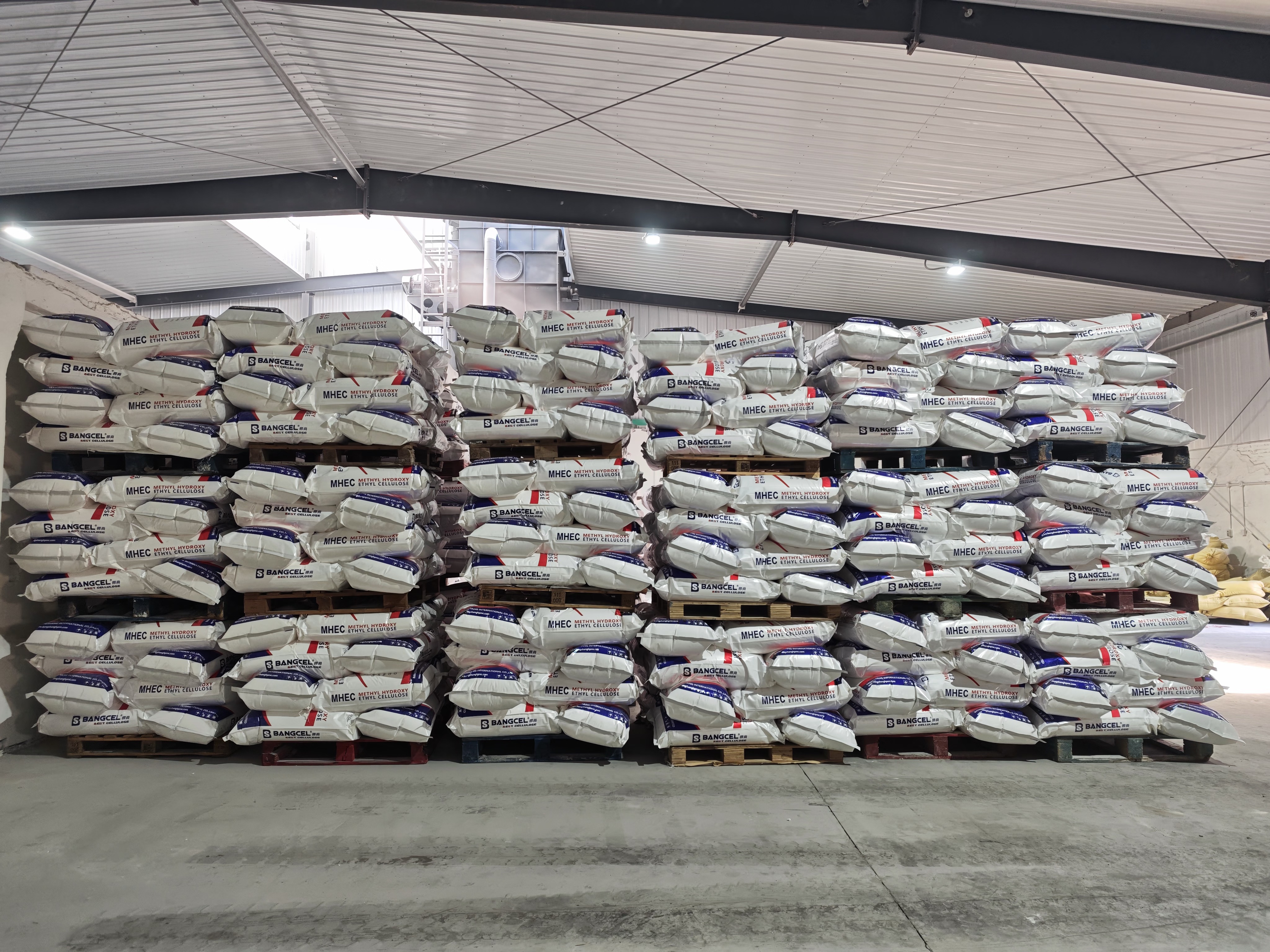
Request a sample or a quotation through www.bangshanghpmc.com, download the BANGCEL® product brochure, or contact the team directly at admin@sjz-bs.com / WhatsApp +86 13292884619.
Have Questions or Need More Details?
Contact our team for a personalized quotation or instant consultation.
Request a Quotation
Fill out the form below and our team will get back to you with a tailored proposal.
WhatsApp Direct Chat
Prefer to chat in real-time? Message us on WhatsApp for instant assistance & quick answers.
- Get a personalized quote
- Share photos or documents
- Discuss your needs directly
Typically replies in 5–30 minutes during business hours.