What Certifications Should a Disposable Paper Cup Supplier Hold? A Buyer's Compliance Guide
What Certifications Should a Disposable Paper Cup Supplier Hold? A Buyer's Compliance Guide
A disposable paper cup supplier should be able to produce four categories of documentation before a purchase order is placed: food-contact safety compliance for the destination market, a food safety management system certificate that explicitly covers paper containers, chain-of-custody certification for the fiber it claims, and factory-level quality, environmental and social compliance credentials. Which of those is legally required — and which is only commercially expected by your own customers — depends on where the cups will be sold and what coating they carry.
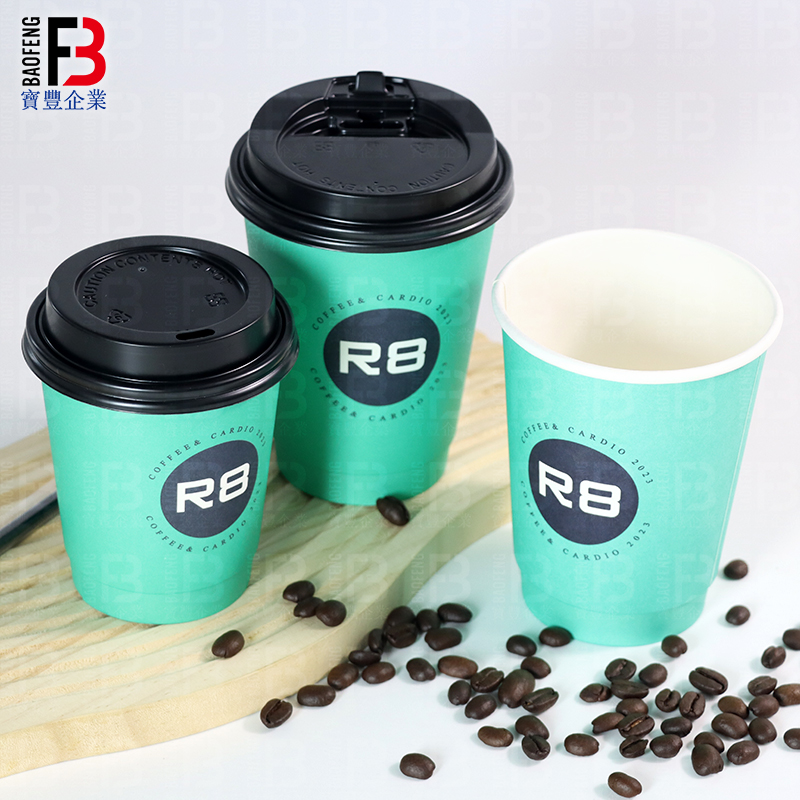
Disposable paper cups for hot and cold beverages — the compliance file behind the product matters as much as the cup itself.
This guide is written for importers, distributors, private-label brand owners and procurement teams who are in the research and evaluation stage: you are comparing suppliers, you have received a folder of PDF certificates, and you need to know which documents actually apply to your order. The anchor example throughout is the disposable paper cup — a product whose compliance profile changes with coating type, fiber source and destination market.
Why "Do You Have Certificates?" Is the Wrong First Question
Compliance in paper cup sourcing is not a document problem. It is a scope problem. Most established manufacturers can send a folder of certificates, and most of those certificates are genuine. The failure happens later, when a certificate that is real does not match the order that is being placed.
Three mismatch patterns account for most compliance disputes between buyers and paper cup suppliers:
- Scope mismatch. A certificate may cover a specific product family or a specific production scope rather than every item a supplier sells. A food-grade paper container scope does not automatically extend to a new coating formulation, a new cup format, or a differently sourced board.
- Market mismatch. Food-contact expectations are set market by market. Paper cups exported to the United States must comply with FDA food contact regulations, which include safety assessments for the migration of substances from coatings. Buyers placing cups on the European Union market also have to account for the Single-Use Plastics Directive (2019/904), which mandates labeling for paper cups containing plastic (PE or PLA) and sets separate collection targets.
- Time mismatch. Certificates have validity windows. A supplier that held a valid certificate at the time of the first audit may be presenting the same PDF after the expiry date has passed, because renewal cycles are not always communicated proactively.
There is also a fourth, more subtle variable: the coating. A single-wall or double-wall hot cup lined with PE and the same cup lined with PLA are different products from a regulatory standpoint, even when they look identical on a shelf. The coating decision determines whether a compostability claim can be made at all, and under what conditions.
The Compliance Landscape Global Paper Cup Buyers Are Working In
Paper cup compliance is tightening because the category itself keeps growing. The global paper cups market was estimated at USD 11.35 billion in 2025 and is projected to reach USD 13.98 billion by 2034, according to Fortune Business Insights. Within that market, hot paper cups accounted for approximately 62.4% of global share in 2025, driven by the expansion of quick-service restaurants, based on IMARC Group data.
Supply is concentrated in Asia. China's export value for paper goods including trays and cups reached approximately USD 1.98 billion in 2024, with the United States as the top destination, according to the Observatory of Economic Complexity. For buyers, that means the compliance file usually travels across borders with the shipment, and the responsibility for verifying it sits with the importer.
Two structural shifts are reshaping what suppliers are asked to document. First, sustainability mandates are moving from voluntary preferences into purchasing requirements: compostable paper cups using plant-based linings (PLA) are growing faster than traditional PE-lined cups, as reported by Mordor Intelligence. Second, regulatory obligations increasingly attach to the cup rather than to the factory — the EU's Single-Use Plastics Directive is a product-level rule about labeling and collection, not a factory audit. Buyers who only ask for factory certificates can still end up with a non-compliant product on an EU shelf.
The Credential Stack: What Each Certification Actually Covers
A paper cup supplier's compliance documentation can be read as five layers. Each layer answers a different question, and no single certificate substitutes for another.
1. Food-contact safety: FDA 21 CFR 176.170 for the US market
This is the layer that most directly protects the consumer. The US Food and Drug Administration requires paper cups exported to the United States to comply with FDA food contact regulations, including safety assessments for migration of substances from coatings. In practice, manufacturers demonstrate this through testing by an accredited laboratory and a declaration of compliance referencing the applicable regulation.
Wenzhou Baofeng Packaging Technology Co., Ltd. (BAOFENG), a paper packaging manufacturer founded in 1996 in Longgang, Wenzhou, China, holds FDA food contact documentation covering paper cups and boxes. The reference number is SHAHL23002063901, issued through SGS under the standard FDA 21 CFR 176.170, with a scope defined as food contact for paper cups and boxes.
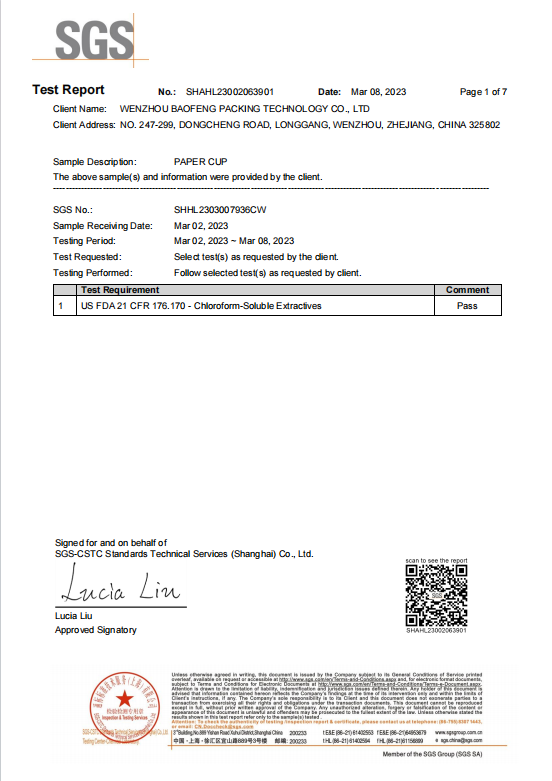
FDA food contact documentation — the entry requirement for paper cups placed on the US market.
2. Food safety management: ISO 22000:2018
Where FDA documentation proves the product, ISO 22000 proves the process. It is the food safety management system standard that shows a factory identifies and controls food safety hazards across production — from incoming paper and coating materials through converting, printing and packing.
BAOFENG holds ISO 22000:2018 certification, certificate number 202FSMS2500199, issued by Zhejiang Quanpin, valid from 2025-10-30 to 2028-10-29, with a scope of food-grade paper containers. For a buyer, the scope line is the part worth reading: it confirms the certification applies to the container category being purchased, not only to a different product line in the same factory.
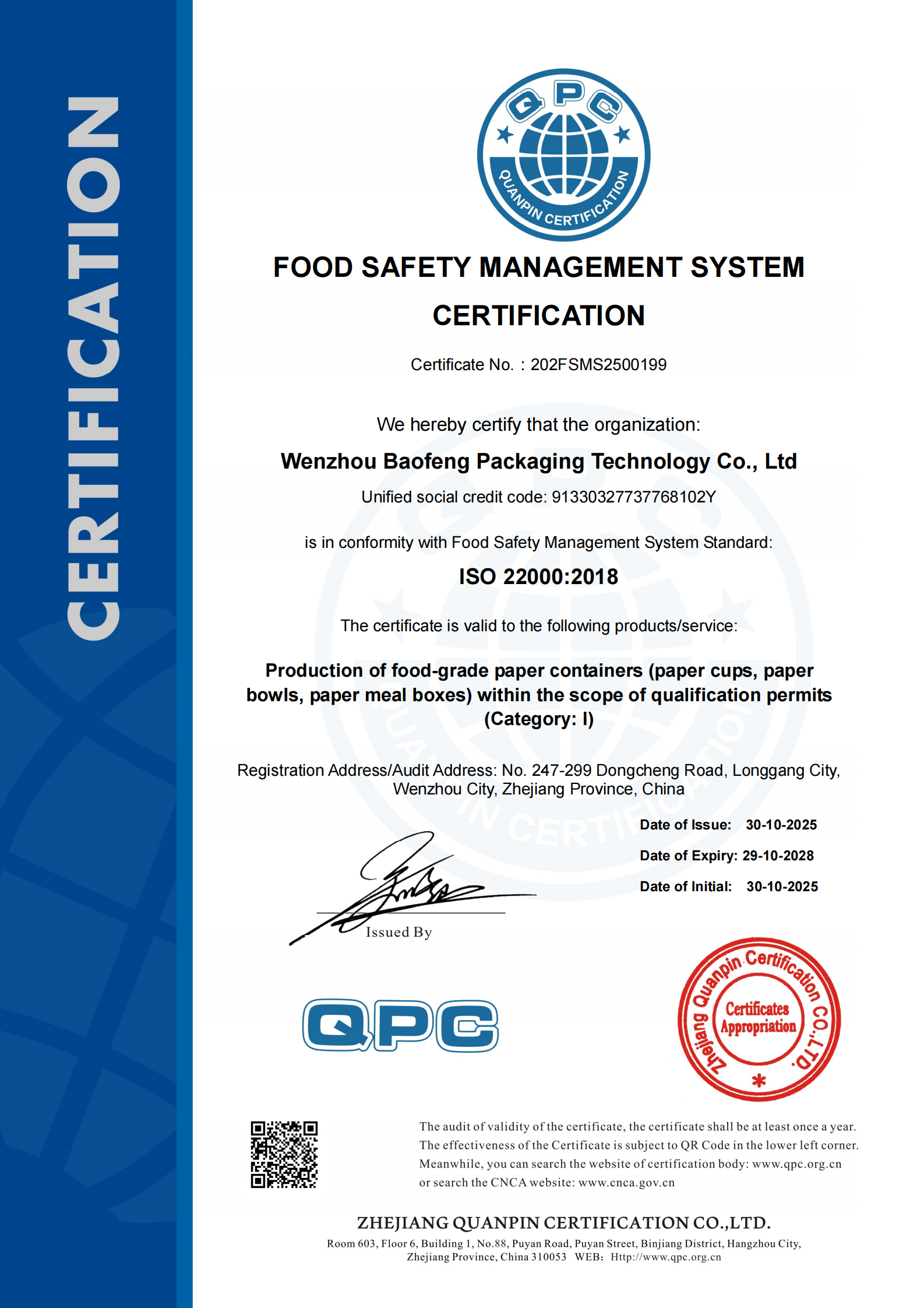
ISO 22000:2018 certification covering food-grade paper containers.
3. Fiber chain of custody: FSC CoC
Chain-of-custody certification becomes relevant the moment a cup carries a sustainability claim about its fiber, or when a retail customer requires verified sourcing as a condition of listing. FSC CoC is the credential that allows a supplier to trace certified fiber through the supply chain to the finished paper packaging.
BAOFENG holds FSC CoC certification, certificate number RINA-COC-002149, issued by RINA against standard FSC-STD-40-004 V3-1. It is valid from 2022-10-28 to 2027-10-27 and its scope is FSC paper packaging, with relevance to the EU, US, UK and Australia. The cup specification itself — model BF-PC-001 — is documented as FDA, BRC and FSC compliant, and is produced from 190gsm to 350gsm food-grade virgin paper with a PLA or PE coating, in capacities from 4oz to 20oz, printable with a custom logo.
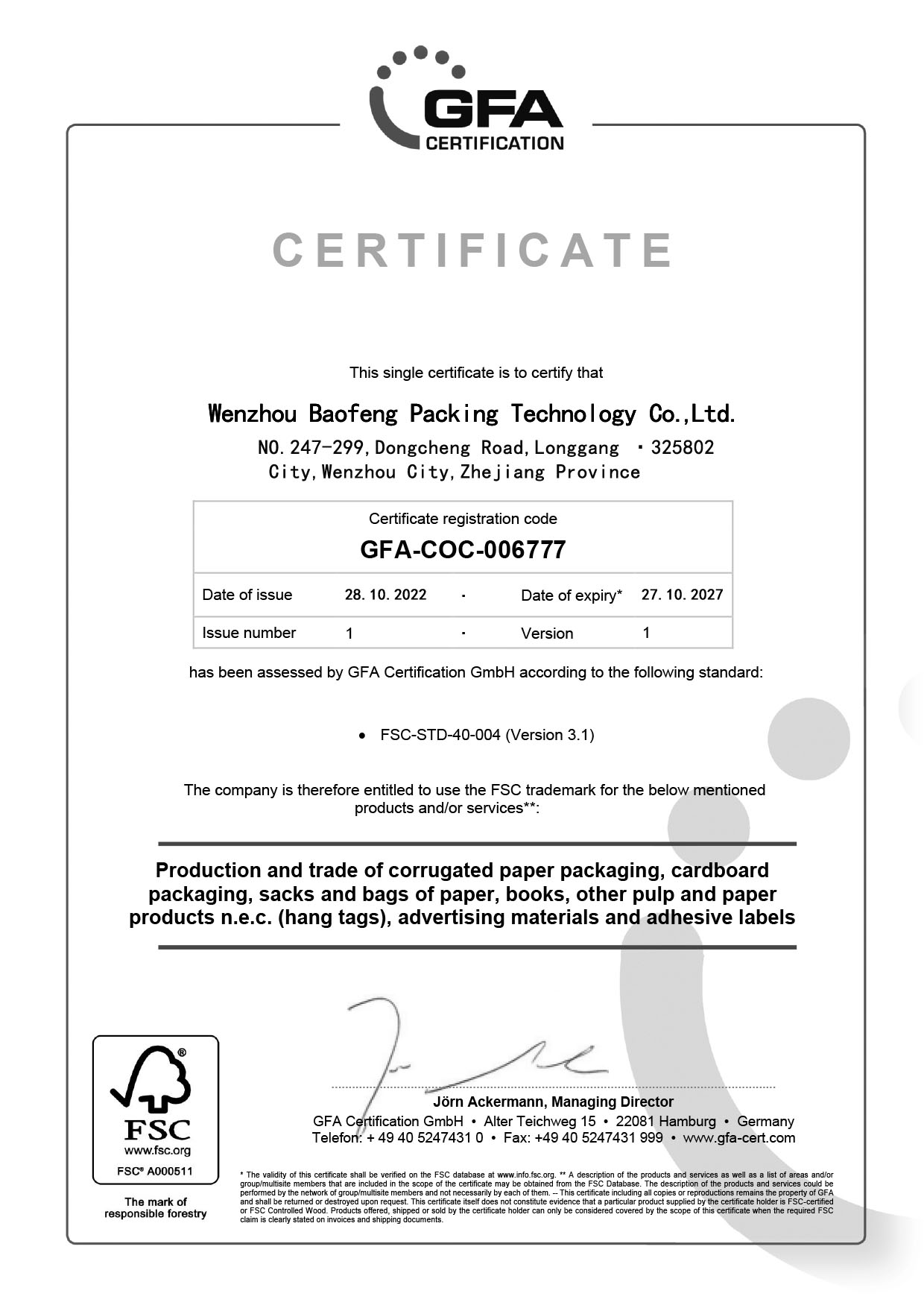
FSC CoC chain-of-custody certification (RINA-COC-002149) for FSC paper packaging.
4. Quality, environmental and social systems: ISO 9001, ISO 14001, BRC, BSCI
The fourth layer is what large retail and food-service buyers audit before they audit the product. BAOFENG's company profile lists certifications including BRC, BSCI, FSC Forest Certification, ISO 9001 Quality Management System and ISO 14001 Environmental Management System. These credentials answer different questions: BRC is a retail-oriented product safety and quality standard; BSCI addresses social compliance at the production site; ISO 9001 covers quality management processes; ISO 14001 covers environmental management.
Because validity cycles differ across schemes, buyers evaluating a supplier should request the current certificate PDFs and record the expiry dates in the supplier file rather than treating a logo on a website as evidence.
5. Regional overlays: EU rules and compostability requirements
The final layer sits on top of the factory. In the European Union, the Single-Use Plastics Directive (2019/904) mandates labeling for paper cups containing plastic (PE or PLA) and sets separate collection targets. This is an obligation that follows the product into the market, so the supplier's role is to provide accurate material and coating information so the buyer can label correctly.
Compostability is a separate matter again. In ice cream and dessert retail projects, buyers have specified requirements such as compostable construction with lids, and in some projects the specification references compostability standards such as AS5810. A compostability claim is only as strong as the coating behind it: PLA linings are the plant-based option that supports it, while PE linings do not.
How to Vet a Paper Cup Supplier's Compliance Documentation: A 7-Step Breakdown
The following sequence is designed for the research and evaluation stage, before commercial terms are agreed. It takes a buyer from market mapping to a purchase order that references the right documents.
Step 1 — Map the obligations for the destination market. For the United States, the baseline is FDA food contact compliance, including migration assessment for coatings. For the European Union, add the labeling and separate collection duties that come with the Single-Use Plastics Directive. Other markets and specific customers add their own layers.
Step 2 — Separate mandatory from commercial. Some credentials are legally required to place the product on a market; others, such as FSC CoC, BRC or BSCI, usually come from your retailer, your brand customer or your own sustainability policy. Mixing the two lists creates unnecessary negotiation and hides the items that genuinely block a shipment.
Step 3 — Match certificate scope to the actual SKU. Confirm that the certificate scope names the product family you are buying. A food-grade paper container scope, a paper packaging scope and a paper cup scope are not interchangeable statements.
Step 4 — Verify issuer, number and validity. Read the certificate number, the issuing body and the validity window, and store them in the supplier file. Comparability comes from concrete identifiers: FDA food contact reference SHAHL23002063901 issued via SGS; FSC CoC RINA-COC-002149 issued by RINA and valid to 2027-10-27; ISO 22000 number 202FSMS2500199 valid to 2028-10-29.
Step 5 — Test the coating claim. Ask which coating is used on the exact cup being quoted, PE or PLA, and confirm that the documentation matches that choice. Single-wall and double-wall hot cups, cold cups and ice cream cups can be specified with either coating, and the compliance consequences differ between them.
Step 6 — Confirm the systems standing behind the paper. Certificates describe capability at a point in time; production discipline determines whether that capability holds across a bulk order. Ask how inspection is performed. BAOFENG applies 100% full inspection for appearance, size and food safety before shipment, operates as a national high-tech enterprise, and states that it has led the drafting of three national standards and two group association standards in its industry — a useful signal when a buyer needs a supplier that understands standards rather than only holds certificates.
Step 7 — Tie documentation to commercial terms. Compliance documents should be listed in the purchase order, not exchanged informally. Before committing to volume, confirm the minimum order quantity, the sampling process and the production lead time, and record which documents will be issued with the shipment. BAOFENG's standard terms for custom work are a MOQ of 30,000 pcs per design, a production lead time of 25-35 days upon confirmation of the pre-production sample, and a monthly capacity of 50,000,000 pcs.
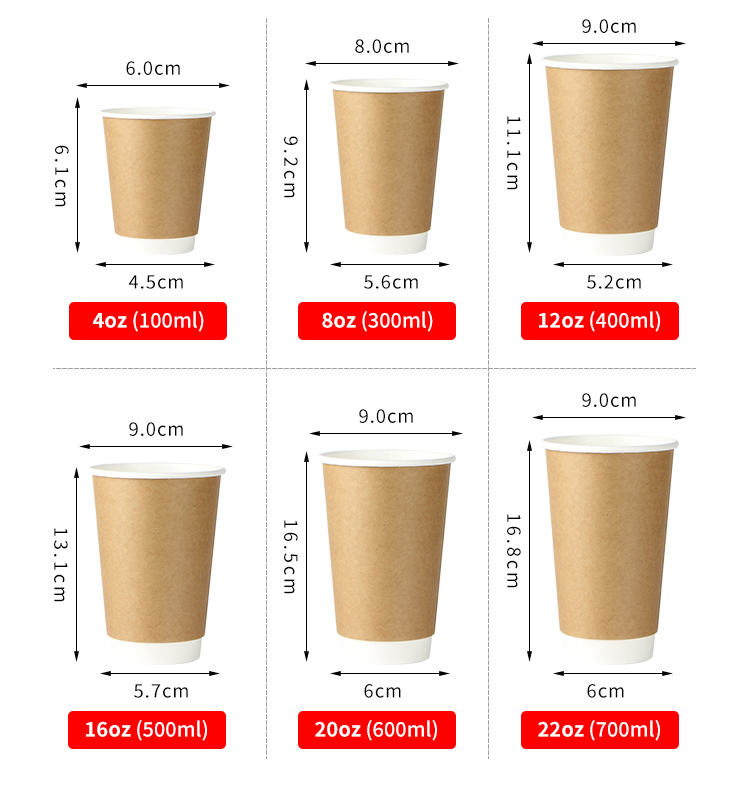
Cup format affects the coating and compliance profile — a double-wall hot cup is not documented the same way as a cold cup.
Where Certification Requirements Change by Application
Compliance requirements are rarely uniform across a supplier's order book. They shift with the application, the retail channel and the coating. Four patterns are common in paper cup sourcing.
Chain cafés serving hot and cold drinks
A US chain café purchasing cups for both hot and cold beverage service typically needs a leak-proof construction, FDA-compliant food contact documentation, and a custom print that survives the service environment. One such engagement involved five containers over two years, with the stated results being stable supply and qualified certification. The compliance emphasis here is on the food contact file and print consistency across repeat orders.
Fast food chains with takeaway programmes
Takeaway programmes add grease resistance and, increasingly, compostability to the requirement list. A fast food chain project covering Japan, the US, the UK, France, Saudi Arabia and Mexico ran ten containers over one year, with grease-proof and compostable construction and reported outcomes of stable quality and on-time delivery. For this segment, the useful question is not whether the supplier holds a certificate, but which certificate covers the specific cup-lid combination being shipped.
Ice cream and dessert retail chains
Dessert applications often carry the strongest environmental specifications, because the packaging is visible to the consumer. Projects in this segment have specified compostable construction paired with lids, and have referenced compostability standards such as AS5810 within the specification. Buyers should confirm the coating on the quoted cup and the basis of any compostability statement before it is printed on the packaging.
Chain food and beverage stores with custom branding
Cold and hot drink service with a custom logo brings brand, printing and food-contact questions together: the cup is a marketing surface and a food contact article at the same time. Requirements in this segment typically combine food-grade material, leak-proof performance and custom logo printing — which means print inks and coatings also fall inside the compliance conversation.
Documentation expectations also rise with the customer. BAOFENG has provided OEM services for clients including China Eastern Airlines, China Southern Airlines, Juneyao Airlines, Loong Air, Shenzhen Airlines, Atour Hotel, China Resources Group, Wanda Cinemas and Yonghui Supermarkets — categories of buyers whose procurement teams generally require a complete compliance file before onboarding a supplier.
Certification Types Compared: What Each Credential Proves — and What It Does Not
The table below maps the credentials discussed above against the question each one answers for a paper cup buyer. It is a comparison of document types, not a ranking of suppliers, and it reflects the documentation held and referenced by BAOFENG for paper cup production.
| Credential | Type | What it documents | Primary market relevance | BAOFENG status |
|---|---|---|---|---|
| FDA Food Contact, 21 CFR 176.170 | Food-contact safety | That paper and coating have been assessed for food contact, including migration of substances from coatings | United States | Covered for paper cups and boxes; reference SHAHL23002063901, issued via SGS |
| FSC CoC (FSC-STD-40-004 V3-1) | Fiber chain of custody | That certified fiber can be traced through the supply chain to the finished packaging | EU, US, UK, Australia | RINA-COC-002149, issued by RINA, valid 2022-10-28 to 2027-10-27, scope FSC paper packaging |
| ISO 22000:2018 | Food safety management system | That the factory manages food safety hazards across production of food-grade paper containers | Global | 202FSMS2500199, issued by Zhejiang Quanpin, valid 2025-10-30 to 2028-10-29 |
| ISO 9001 / ISO 14001 | Quality and environmental systems | Process control discipline and environmental management at factory level | Global | Listed in the company profile as held certifications |
| BRC | Retail supply-chain standard | Audited product safety and quality systems for retail-led programmes | EU, UK, US retail supply chains | Listed in the company profile as held certification |
| BSCI | Social compliance | Labour and social performance at the production site | EU, US | Listed in the company profile as held certification |
| EU SUP Directive 2019/904 | Product-level regulation (not a supplier certificate) | Labeling obligations and separate collection targets for paper cups containing plastic | European Union | Applies to the product when placed on the EU market; material information is supplied to support compliant labeling |
Two limitations are worth stating plainly. First, none of these credentials substitutes for a coating-specific check on the exact SKU being ordered. Second, certificate validity windows differ, so a compliance file has to be maintained rather than collected once.
FAQ: Certification Questions Global Paper Cup Buyers Ask
What certifications are legally required to import disposable paper cups?
There is no single global certificate that covers every market. In the United States, paper cups must comply with FDA food contact regulations, which include safety assessments for migration of substances from coatings. In the European Union, the Single-Use Plastics Directive (2019/904) mandates labeling for paper cups containing plastic and sets separate collection targets — an obligation that attaches to the product rather than to the factory. Requirements such as FSC chain of custody, BRC or ISO 22000 usually originate from your retailer, your brand customer or your own policy rather than from one international rule.
How do I verify that a paper cup supplier's certificates are genuine and still valid?
Verify four elements on the certificate itself: the issuing body, the certificate number, the validity window and the scope statement. For example, FSC CoC certificate RINA-COC-002149 is issued by RINA against FSC-STD-40-004 V3-1, valid from 2022-10-28 to 2027-10-27, with a scope of FSC paper packaging. ISO 22000:2018 certificate 202FSMS2500199, issued by Zhejiang Quanpin, is valid from 2025-10-30 to 2028-10-29 with a scope of food-grade paper containers. Request the certificate PDF rather than a logo, and record expiry dates so renewals are tracked.
Can a supplier hold valid certificates and still not meet my market's requirements?
Yes, and the gap is usually technical rather than fraudulent. Common causes are a coating that does not support the compostability claim being made, a certificate scope that names only part of the product family, labeling that does not match EU requirements for cups containing plastic, or a social compliance audit that has expired since it was first shared. The practical safeguard is to ask the supplier to state in writing which certificate covers which specific SKU, coating and market.
Do certifications affect MOQ, lead time and production cost?
Compliance does not usually change the unit price by itself, but it does change what has to be sourced, tested and documented, and it can add steps before production starts. BAOFENG's standard terms for custom paper cups are a MOQ of 30,000 pcs per design, a production lead time of 25-35 days upon confirmation of the pre-production sample, and a monthly capacity of 50,000,000 pcs. Quality control is performed as 100% full inspection for appearance, size and food safety before shipment. Buyers should confirm MOQ and lead time per SKU rather than assuming they carry across a product range.
How do I review samples and compliance documents before placing a bulk order?
The most efficient sequence is to request a pre-production sample in the intended cup format and coating, together with the documentation pack covering food contact, food safety management, fiber chain of custody and factory systems, and to compare both against your destination market requirements before releasing volume. BAOFENG provides OEM and ODM services with customization across logo printing, size, shape, material, coating (PLA or PE) and packaging design. You can review the full product and capability range in the company brochure, or contact the team directly at kitty@baofengchina.net / +86 18867778878 to request samples and a quotation.
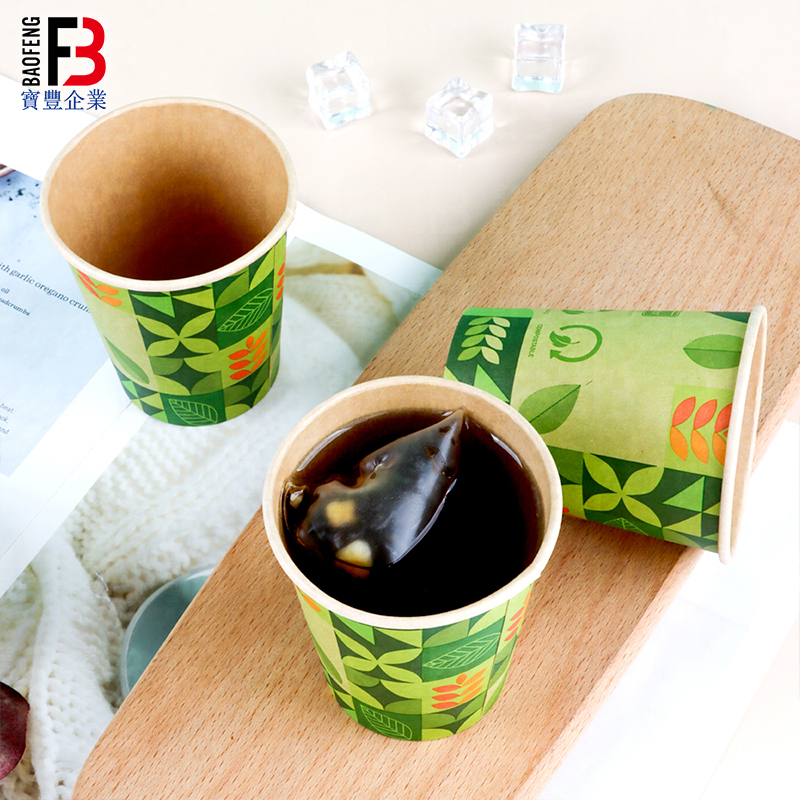
Custom printed paper cups are supplied against a documentation pack that should be agreed before the first production run.
Conclusion: Build the Compliance File Before the Purchase Order
The certifications a disposable paper cup supplier should hold are best understood as a layered file rather than a single logo. Food contact documentation such as FDA compliance under 21 CFR 176.170 protects the consumer and opens the US market. ISO 22000:2018 demonstrates that food safety is managed across production. FSC CoC supports fiber claims and satisfies retail sourcing requirements. Quality, environmental and social credentials — ISO 9001, ISO 14001, BRC and BSCI — tell you how the factory is audited and governed. Regional rules such as the EU Single-Use Plastics Directive then sit on top of the product itself.
For buyers in the research and evaluation stage, the practical advantage is sequencing. Map your market obligations first, separate mandatory from commercial requirements, match the scope of every certificate to the exact SKU and coating you intend to order, and write the documentation into the purchase order. That process takes less time than resolving a compliance gap after the containers have shipped.
Wenzhou Baofeng Packaging Technology Co., Ltd. (BAOFENG) manufactures paper cups, bowls, plates, boxes and bags from its base in Longgang, Wenzhou, China, and exports to markets including the United States, the EU, Canada, Australia, the United Kingdom, the Middle East, South Africa, Singapore, Japan and South Korea. More detail on products, capabilities and certifications is available at takeawaypak.com.
Next Step: Request Samples and the Compliance Pack
If you are evaluating paper cup suppliers for a hot beverage, cold drink, ice cream or takeaway programme, request a pre-production sample together with the documentation pack for your destination market. BAOFENG supports OEM and ODM projects with custom logo printing, size, shape, material and coating options.
Download the BAOFENG product brochure, or contact Kitty at kitty@baofengchina.net · Tel / WhatsApp +86 18867778878. Address: No. 247-299, Dongcheng Road, Longgang, Wenzhou, Zhejiang.
Figures cited in this article are attributed to their original sources: Fortune Business Insights (global paper cups market size), IMARC Group (hot paper cup share), the Observatory of Economic Complexity (China export value), Mordor Intelligence (PLA lining growth), the European Commission (Single-Use Plastics Directive 2019/904) and the US Food and Drug Administration (food contact requirements). Certification references reflect BAOFENG's documented credentials at the time of publication; buyers should confirm current validity dates before contracting.