From Trial Run to 1 Million Units: Fixing the Eco-Packaging Scale-Up Gap
Answer first: the bottleneck is rarely the sample. The scale-up gap appears when a supplier can produce a beautiful trial run but cannot move that approved pack into repeatable mass production without changing equipment, quality systems or accountability. For eco-friendly custom packaging, the fix is to verify three things before committing to volume: trial-to-mass-production capacity, sampling and production timelines, and whether the work stays in-house on owned equipment.
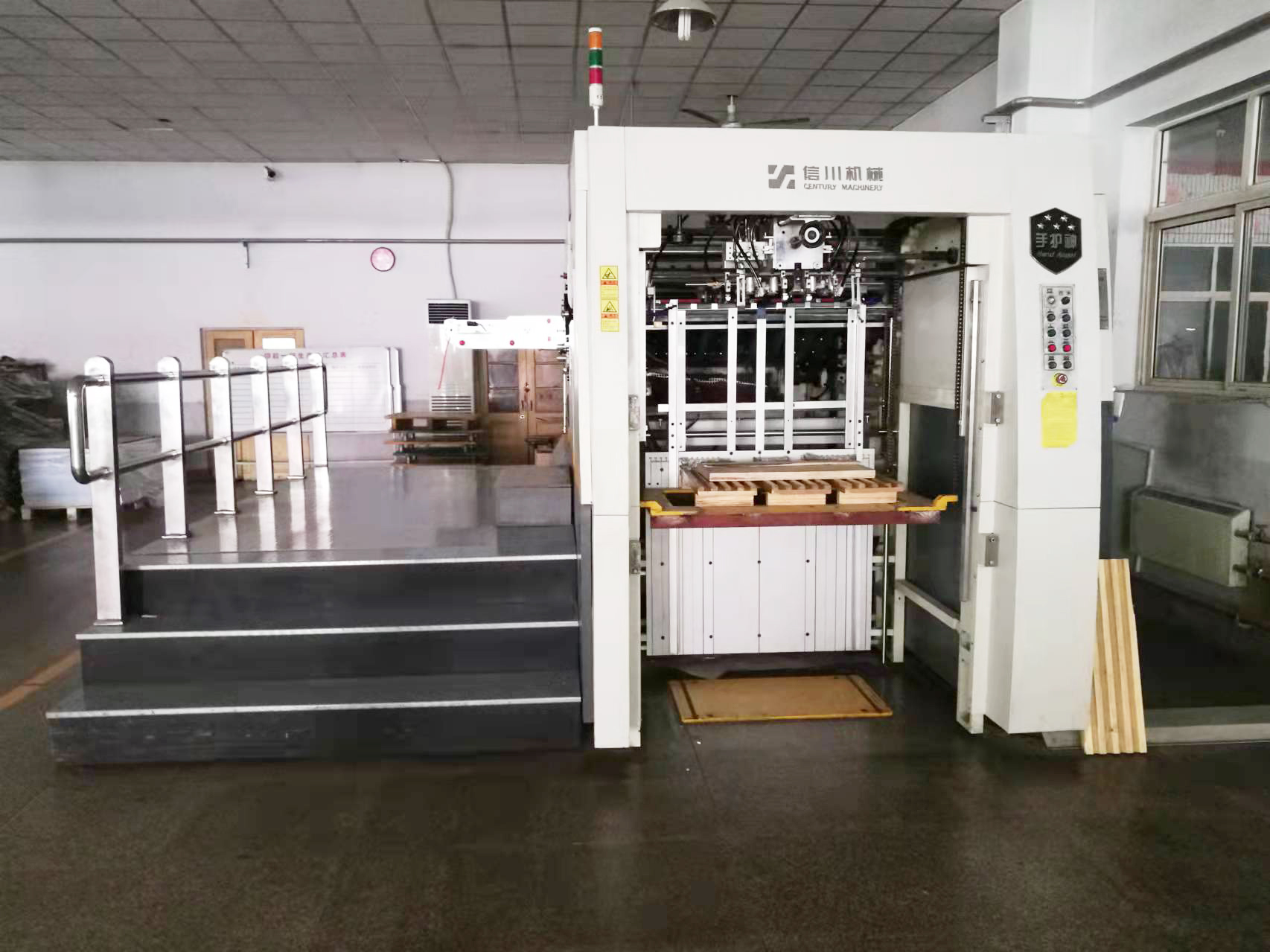
Automatic die-cutting equipment supports repeatable conversion from approved sample to volume production.
Problem Definition: The Sample Is Not the Bottleneck
A retail launch can be derailed after the sample stage. A brand approves an eco-friendly custom packaging sample, plans a fixed retail window, and then discovers that the supplier cannot schedule the order at volume. The artwork is approved, the material looks right, and the prototype works. The failure sits upstream of the box: capacity, timing and production control.
This is the trial-to-volume gap. It is not a design problem. It is an execution problem. When the retail window is fixed, a supplier that cannot move from a small trial run to mass production creates three risks: missed shelf dates, emergency re-sourcing, and a last-minute compromise on certification or material specification.
The scale-up gap in one sentence: a supplier proves it can make the sample, but not that it can repeat the sample at volume, on schedule, with the same material, print and quality system.
For buyers in research and evaluation stages, the practical question is not “Can you make this box?” It is “Can you make this box at 1 million units without changing the production logic that made the sample work?” That question belongs in supplier qualification, not after the purchase order.
Industry Background: Why Trial-to-Volume Failures Now Cost Retail Windows
Sustainable packaging is no longer a niche test. Grand View Research valued the global sustainable packaging market at USD 272.9 billion in 2023, with Europe holding a 36.2% revenue share. Research and Markets / Golden Arrow reported that paper and paperboard materials held a 38.2% share of the sustainable packaging market in 2024. Precedence Research placed the boxes and cartons segment at 33.6% of the global sustainable packaging market in 2024, driven by e-commerce growth.
Those numbers matter for scale-up planning because paper-based packaging is often bought through multi-stage approval: brand team approves the structure, procurement approves the cost, compliance reviews the material, and operations expects the carton to run on existing packing lines. A sample that passes the brand review but cannot pass the volume review creates a costly disconnect.
Regulation adds another constraint. The EU Packaging and Packaging Waste Regulation requires all packaging to be recyclable by 2030; it was adopted on 19 December 2024 and entered into force on 11 February 2025, with major application beginning in August 2026. Extended Producer Responsibility regulations for packaging now span 63 countries as of 2025, according to Mordor Intelligence. Eco-friendly custom packaging therefore has to be not only visually approved, but also documentable, repeatable and available in volume.
Detailed Solution: Three Diagnostic Checks Before You Commit to Volume
The fix is a pre-volume review. It should happen after sample approval and before the purchase order is released. The three checks below turn a subjective supplier conversation into an evidence-based decision.
Check 1 — Trial-to-Mass-Production Capacity
Capacity is not a single annual figure. Buyers should ask how the supplier converts annual capacity into a scheduled production slot for the specific product family. BEJAN GIANT NEW PACKAGING, a Qingdao-based direct packaging manufacturer, publishes a 10,000 m² facility, 200+ staff and 100,000,000 units of annual capacity. Its capability data lists monthly capacity at 30,000,000 units. A 1 million-unit program is therefore within the published capacity envelope, but the buyer still needs to confirm the production window.
Product-level output matters because folding cartons, corrugated mailers and rigid gift boxes do not run at the same speed. The published daily output is at least 60,000 pieces for the Folding Paper Carton Box, at least 40,000 pieces for the Corrugated E-commerce Mailer Box, and at least 25,000 pieces for the Rigid Gift Box. These figures help a buyer test whether the requested volume is realistic for the selected structure, not just for the factory as a whole.
Minimum order quantity is the other side of the same check. BEJAN lists a MOQ of 500 units. That low MOQ supports trial runs, market tests and sample validation before a brand commits to a larger program. The scale-up question is whether the same supplier can then move from that 500-unit trial to a multi-SKU retail order without re-qualifying the entire project.
Check 2 — Sampling and Production Timelines
Timelines should be checked as a chain, not as isolated promises. BEJAN publishes 3-day custom design, 7-day sampling and 14-day mass production delivery as its fast-turnaround service. Its capability record also lists a 7–15 day lead time, which should be read as project-dependent. The buyer should map the supplier’s stated timeline against the retail window, the artwork approval date, the material lead time and the inland or ocean freight schedule.
A 7-day sampling window is useful only if the sample is made with the same material and conversion route as the planned mass production. If the sample is hand-finished but the volume order will run on automated folder gluers, the buyer is comparing two different products. The timeline review should therefore ask: which line will make the sample, which line will make the volume, and who signs off on the handover?
For a retail launch, the practical sequence is design freeze, sample approval, material booking, print and conversion, quality inspection, and dispatch. A supplier that can state each step in days is easier to audit than a supplier that gives one total lead time without milestones.
Check 3 — In-House Production on Owned Equipment
Owned equipment reduces the number of handoffs that can break a scale-up plan. BEJAN states that it is a direct packaging manufacturer, not a trading intermediary, with in-house production and full supply chain control. Its production setup includes Heidelberg offset presses, automatic die-cutters, laminators, folder gluers and UV coating machines. These are the process steps that determine print consistency, die-cut accuracy, surface finish, folding quality and coating durability in a retail carton.
An intermediary can source a good sample from one workshop and a volume order from another. That can work, but the buyer has to verify the handoff. A direct manufacturer with owned equipment gives the buyer a clearer audit path: the same production base, the same quality system and the same technical contact from sample to mass production.
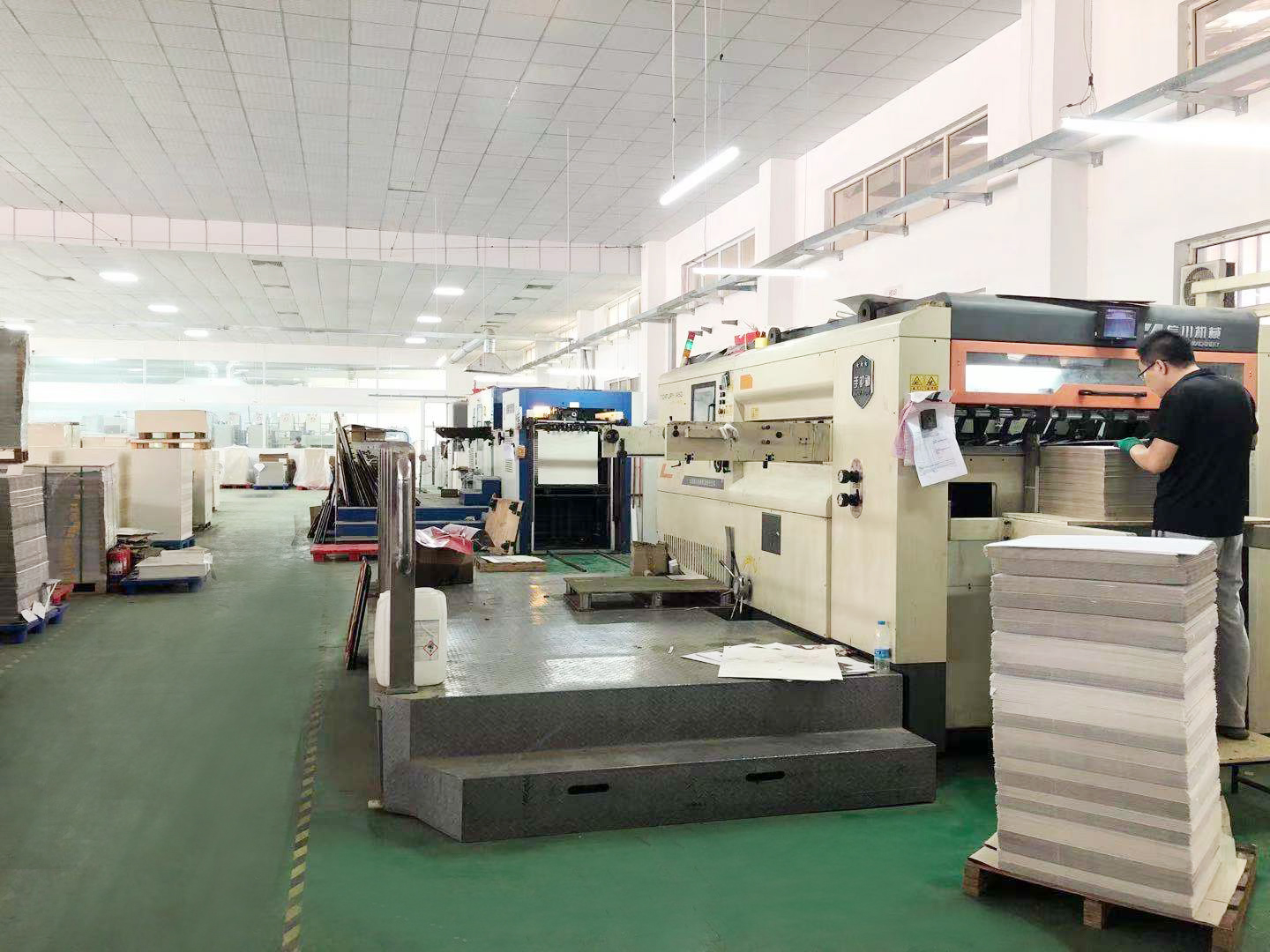
Automatic die-cutting equipment in the production workshop.
BEJAN has specialized in custom packaging for 12 years and reports serving 200+ global brands. The company’s quality control description includes full inspection before shipment together with compression resistance testing, and on-site third-party inspection by SGS is available. Those controls matter at the trial-to-volume stage because the buyer needs evidence that the approved sample standard will be repeated, not reinterpreted.
Step-by-Step Breakdown: How to Close the Gap
The following sequence can be used as a pre-volume review for an eco-friendly custom packaging program. It is written for a brand that has already approved a sample and now needs a reliable path to mass production.
- Convert the retail window into a production calendar. Start from the in-store date and work backwards through freight, inspection, mass production, sampling and design freeze. Compare the result with the supplier’s stated 3-day custom design, 7-day sampling and 14-day mass production delivery. If the calendar has no buffer, the project is already exposed.
- Ask for capacity by product family, not only annual capacity. Confirm the daily output for the selected structure: at least 60,000 pieces for the Folding Paper Carton Box, at least 40,000 pieces for the Corrugated E-commerce Mailer Box, and at least 25,000 pieces for the Rigid Gift Box. Check whether the requested 1 million-unit program can be scheduled across the relevant line.
- Confirm the sample-to-production handoff. Ask which equipment will produce the sample and which equipment will produce the volume order. Verify that the material, print method, surface finish and inserts remain the same. For BEJAN, the relevant in-house equipment includes Heidelberg offset presses, automatic die-cutters, laminators, folder gluers and UV coating machines.
- Validate compliance before the purchase order. Request the FSC Chain of Custody certificate and the ISO 9001:2015 certificate for the product family. Confirm that the certificate scope covers the actual work, not only a related product category.
- Stage the volume. Use the 500-unit MOQ for trial or market test, then scale in planned batches. A staged program gives the buyer a chance to inspect print consistency, die-cut accuracy and packing performance before the full volume is released.
- Keep the quality gate visible. Require full inspection before shipment and compression resistance testing where relevant. If the buyer needs third-party verification, confirm whether on-site inspection by SGS can be arranged.
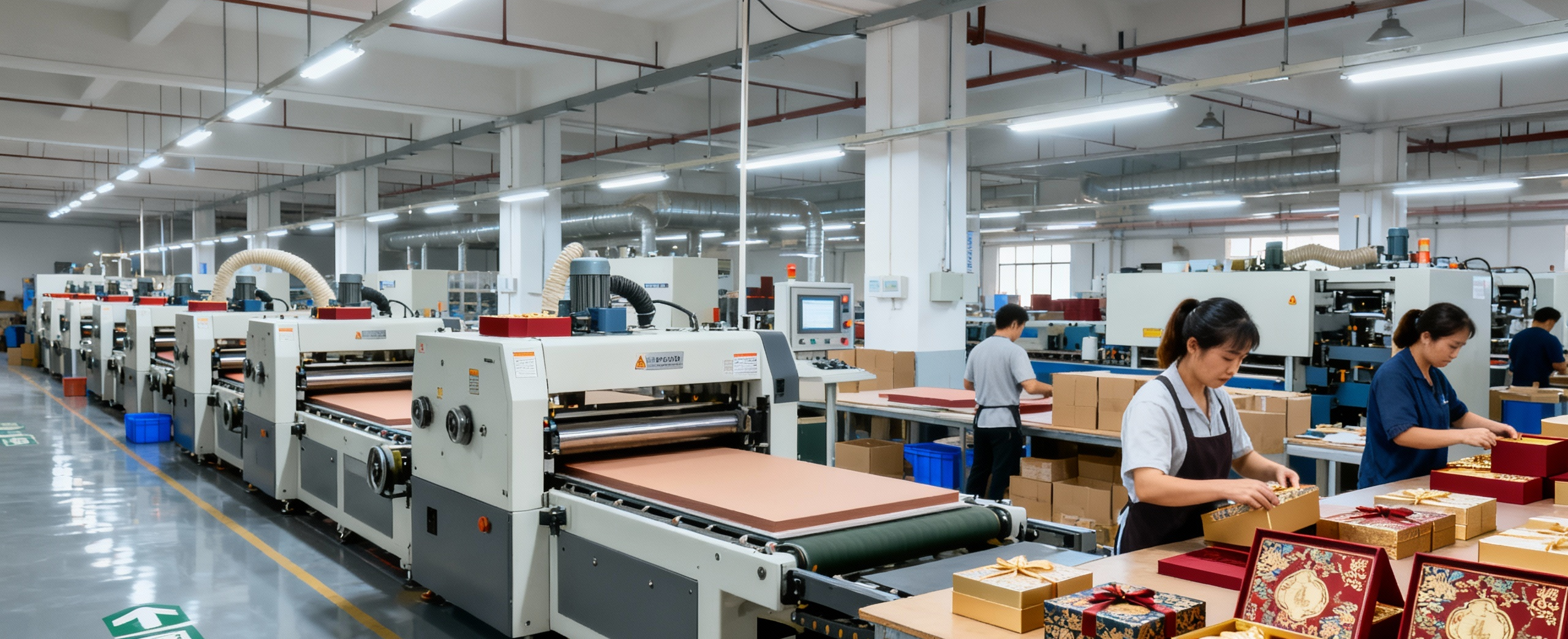
Rigid box workshop for premium eco-friendly packaging programs.
A published case record from BEJAN covers cross-border DTC brands and foreign trade wholesalers in KR, IL and US markets, with 5,000–50,000 pieces per batch for cosmetic, wine and food outer packaging. The same record describes long-term repeat orders over 3–5 years, stable packaging quality, smooth customs clearance, full FSC certification, complete pre-shipment inspection support, a stable delivery cycle and transparent cost accounting. This is the kind of repeat-order evidence that supports a scale-up conversation, because it shows the supplier has managed recurring batches rather than only one-off samples.
Use Cases: Mapping the Fix Across Three Packaging Families
The same scale-up logic applies differently to folding cartons, corrugated mailers and rigid gift boxes. The product family determines the material, the daily output, the packing line and the certification review.
Folding Paper Carton Box — Retail Shelf and Lightweight E-commerce
The Folding Paper Carton Box, model BP-FBB-CARTON03, is an eco-friendly folding carton made from FSC-certified FBB/SBS white cardboard and recycled paperboard. It is positioned for beauty and skincare, fragrance, food and jewelry packaging, as well as retail and cross-border e-commerce scenarios. Published structures include top and bottom lid, auto-lock bottom and window patch box. Printing supports full CMYK and Pantone spot color, with hot stamping, embossing and debossing, and spot UV. Surface finishing includes matte or gloss lamination and water-based soft touch varnish.
For scale-up, the relevant output is at least 60,000 pieces per day. The product is described as plastic-free and fully recyclable, with food contact safety, drop and compression testing referenced in the product data. The Folding Paper Carton Box is covered by FSC Chain of Custody certification and produced under an ISO 9001:2015 quality management system.
Corrugated E-commerce Mailer Box — DTC and Subscription Shipping
The Corrugated E-commerce Mailer Box, model BP-MAIL-EB01, uses FSC-certified E/B flute corrugated board. It is intended for cross-border e-commerce retail and the apparel, shoes and beauty industry, with additional applications across fragrance and candles, chocolate and baked goods, snacks, small 3C accessories, light luxury jewelry, premium tea and coffee, pet food, sports nutrition, designer toy blind boxes, ceramic tableware, craft beer, wine and spirits, corporate business gifts, spa and aromatherapy, handmade soap, wedding favors and other consumer categories.
The mailer uses an automatic self-locking design without adhesive tape and supports full-color printing on both inner and outer surfaces. Custom molded pulp inserts are available. Published daily output is at least 40,000 pieces. The Corrugated E-commerce Mailer Box is FSC Chain of Custody certified and covered by an ISO 9001:2015 quality management system.
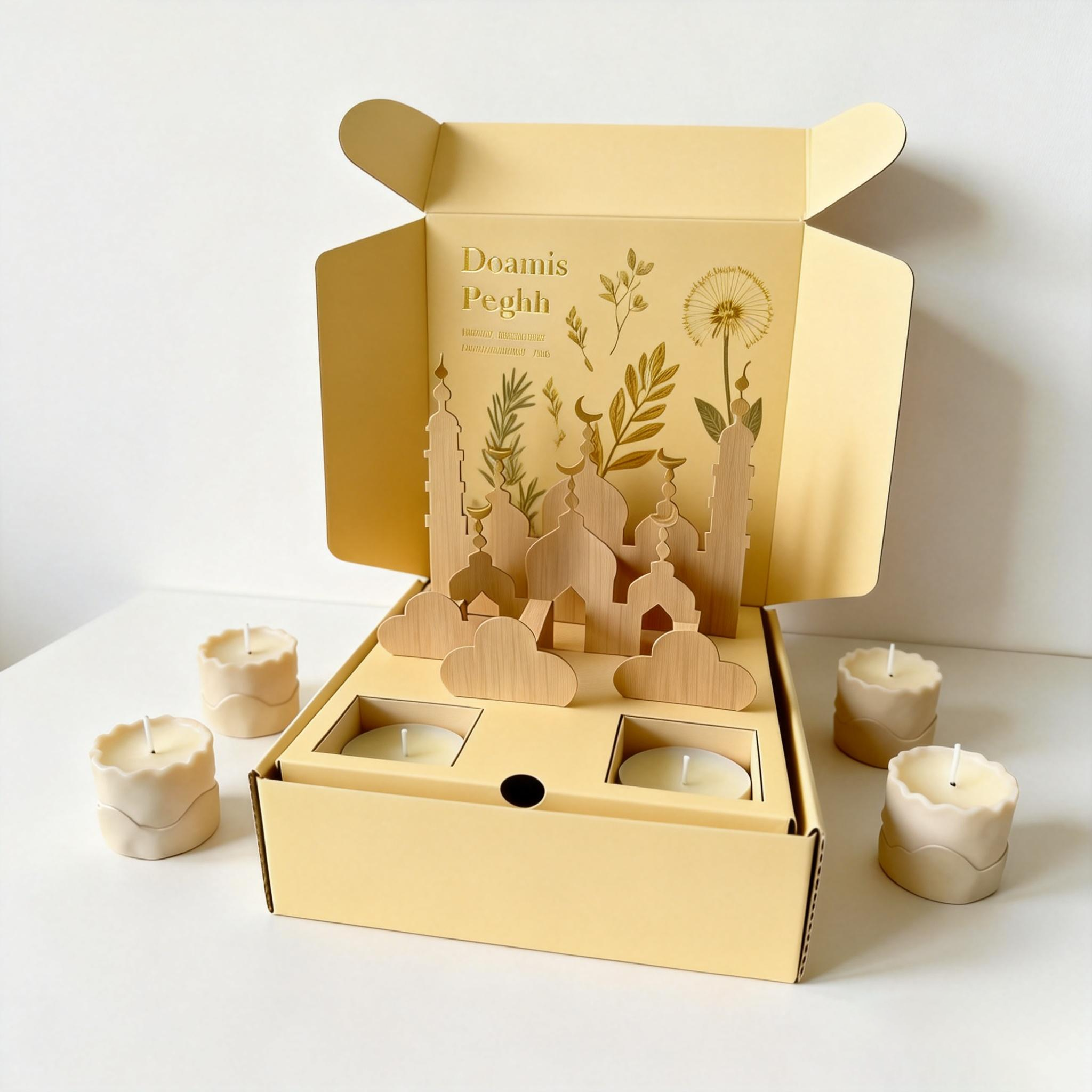
Corrugated e-commerce mailer box example for eco-friendly shipping programs.
Rigid Gift Box — Premium Retail and Gift Programs
The Rigid Gift Box, model BP-RIGID-GIFT02, is a luxury rigid gift box made with FSC high-density grey board and FSC eco outer wrapping paper. It is intended for jewelry, cosmetics, luxury candles, wine, wedding favors, corporate subscription gift boxes, skincare, watches, designer toys, premium tea, bridal proposals and holiday gift programs. The structure can be customized, including a foldable flat style. Magnetic closure options include a standard 5N force, with 7.5N or 10N strong magnets available. Inserts can include foam, EVA tray, molded pulp, velvet-lined paper tray or layered divider cards.
Published daily output is at least 25,000 pieces. The Rigid Gift Box is FSC Chain of Custody certified and manufactured under an ISO 9001:2015 certified quality management system. For a premium gift program, the scale-up review should focus on the hand-finishing steps, insert fit and surface finish consistency, because those are the details that can slow a volume order.
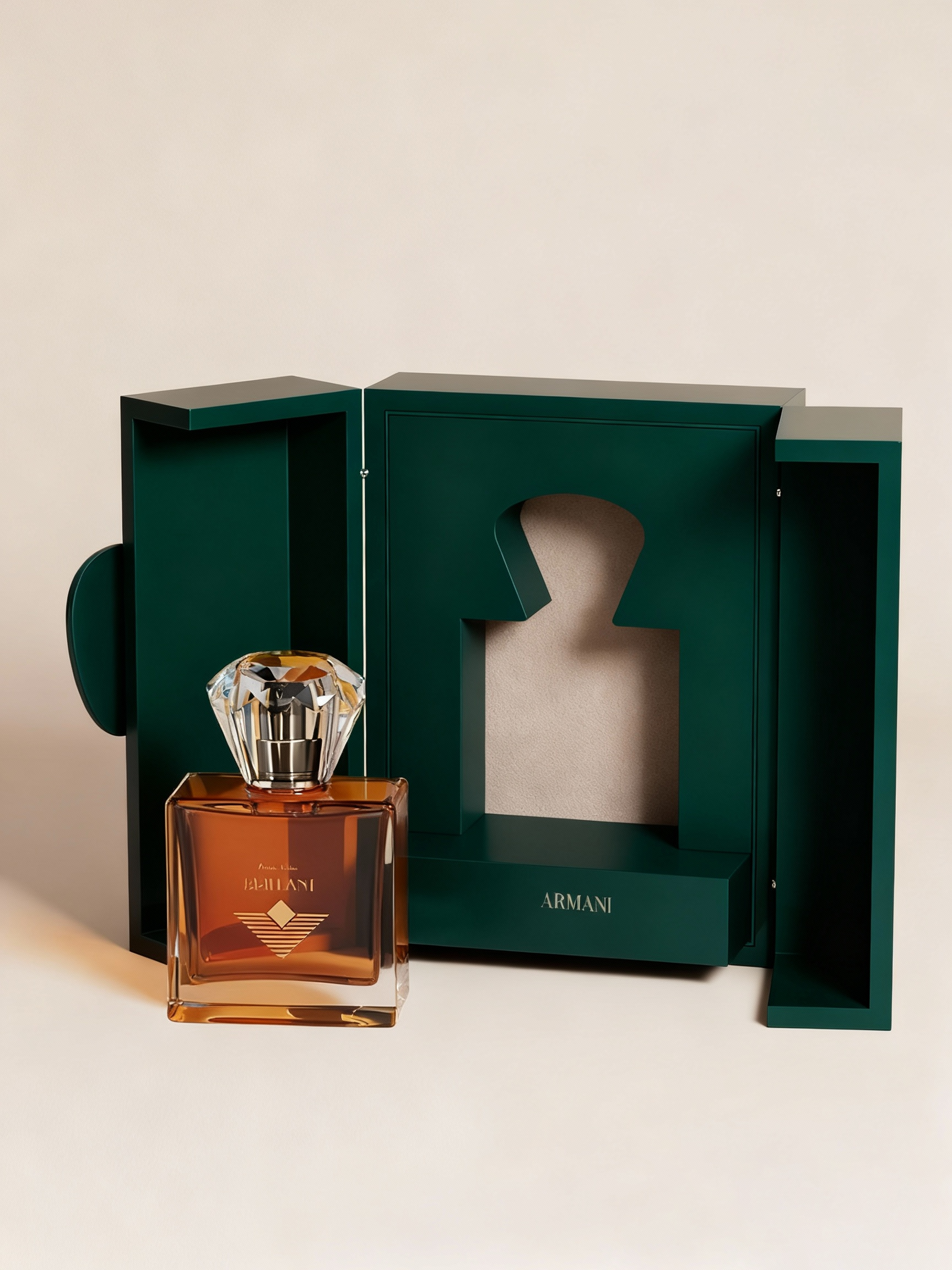
Rigid gift box example with a double-opening structure.
Comparison Table: Scale-Up Fit by Product Family
The table below uses published product facts only. It is a product-family comparison, not a ranking of suppliers.
| Product | Model | Typical fit | Core material | Daily output | FSC CoC | ISO 9001:2015 | Starting unit price |
|---|---|---|---|---|---|---|---|
| Folding Paper Carton Box | BP-FBB-CARTON03 | Beauty and skincare, fragrance, food and jewelry retail packaging | FSC-certified FBB/SBS white cardboard; recycled paperboard | ≥60,000 pieces | Covered | Covered | From USD 0.3 |
| Corrugated E-commerce Mailer Box | BP-MAIL-EB01 | Cross-border e-commerce, apparel, shoes and beauty shipping | FSC-certified E/B flute corrugated board | ≥40,000 pieces | Covered | Covered | From USD 0.5 |
| Rigid Gift Box | BP-RIGID-GIFT02 | Jewelry, cosmetics, candles, wine, wedding and corporate gifts | FSC high-density grey board; FSC eco outer wrapping paper | ≥25,000 pieces | Covered | Covered | From USD 1.5 |
The comparison shows why the scale-up review should be product-specific. A folding carton program may be constrained by print and die-cut scheduling, a corrugated mailer program by board supply and packing-line speed, and a rigid gift box program by hand-finishing and insert fit. The certification review is consistent across all three: FSC Chain of Custody certificate RR-COC-001255, issued by Russian Register and valid from 21 June 2023 to 20 June 2028 under FSC-STD-40-004 v.3-0, covers purchasing of paper materials, production and sales of paper products under FSC 100%, FSC Mix and FSC Recycled. ISO 9001:2015 certificate 452QMS2100010, issued by QINGDAO GFS CERTIFICATION CO.,LTD., is valid from 18 October 2021 to 17 October 2027 for production and sales of paper products.
FAQ: Eco-Friendly Custom Packaging Scale-Up Questions
1. Are the Folding Paper Carton Box, Corrugated E-commerce Mailer Box and Rigid Gift Box FSC and ISO 9001 certified?
Yes. All three product families are covered by FSC Chain of Custody certification RR-COC-001255, issued by Russian Register and valid from 21 June 2023 to 20 June 2028 under FSC-STD-40-004 v.3-0. The scope covers purchasing of paper materials, production and sales of paper products under FSC 100%, FSC Mix and FSC Recycled. All three are also produced under ISO 9001:2015 certificate 452QMS2100010, issued by QINGDAO GFS CERTIFICATION CO.,LTD. and valid from 18 October 2021 to 17 October 2027 for production and sales of paper products.
2. Can BEJAN support a move from a small trial run to 1 million units?
BEJAN GIANT NEW PACKAGING publishes a 10,000 m² facility, 200+ staff, 100,000,000 units of annual capacity and 30,000,000 units of monthly capacity. Product-level daily output is at least 60,000 pieces for the Folding Paper Carton Box, at least 40,000 pieces for the Corrugated E-commerce Mailer Box and at least 25,000 pieces for the Rigid Gift Box. The MOQ is 500 units. A 1 million-unit program therefore sits within the published capacity envelope, but the production window still needs to be booked against the retail calendar.
3. What MOQ and starting price should a buyer expect?
The published MOQ is 500 units. Starting unit prices are from USD 0.3 for the Folding Paper Carton Box, from USD 0.5 for the Corrugated E-commerce Mailer Box and from USD 1.5 for the Rigid Gift Box. Final pricing depends on size, material, printing, surface finishing, inserts and order quantity, so the starting price should be used for budget screening rather than as a final quotation.
4. How fast can a custom eco-friendly packaging sample be produced?
BEJAN publishes a 3-day custom design service and a 7-day sampling service. The company also lists free blank sample delivery and packaging structure optimization support. For a printed custom sample, the buyer should confirm the material, print method and finishing route at the same time, because the sample should represent the planned mass-production configuration rather than a separate hand-made prototype.
5. How should a buyer plan mass production lead time for a retail launch?
The fast-turnaround service states 3-day custom design, 7-day sampling and 14-day mass production delivery. The capability record also lists a 7–15 day lead time, which is project-dependent. Buyers should map those windows against artwork approval, material booking, inspection and freight, then reserve buffer before the retail date. For a project-specific scale-up review, contact BEJAN GIANT NEW PACKAGING at bupack@qingdaobaina.com or +86 150 6426 0757 with the product family, quantity and target launch date.
Conclusion: Fix the Scale-Up Gap Before the Retail Window Closes
The trial run proves design intent. Mass production proves supply reliability. The gap between the two is where retail windows are lost. A buyer can reduce that risk by checking capacity by product family, validating the sample-to-production timeline, and confirming that the work stays on owned equipment under a documented quality system.
For eco-friendly custom packaging, BEJAN GIANT NEW PACKAGING supports that review with a 10,000 m² facility, 200+ staff, 100,000,000 units of annual capacity, 500-unit MOQ, 3-day custom design, 7-day sampling and 14-day mass production delivery. The Folding Paper Carton Box, Corrugated E-commerce Mailer Box and Rigid Gift Box are each covered by FSC Chain of Custody certification and produced under an ISO 9001:2015 quality management system. The next step is to test the supplier against the actual retail calendar, not only against the sample.
Request a scale-up review or sample discussion.
BEJAN GIANT NEW PACKAGING | Qingdao Bejan Giant New Packaging Technology Co., Ltd.
Contact: Rock | Email: bupack@qingdaobaina.com | hello@qingdaobaina.com
Phone / WhatsApp: +86 150 6426 0757
Address: No. 96, Tianfeng North Road Chengyang, Qingdao, China
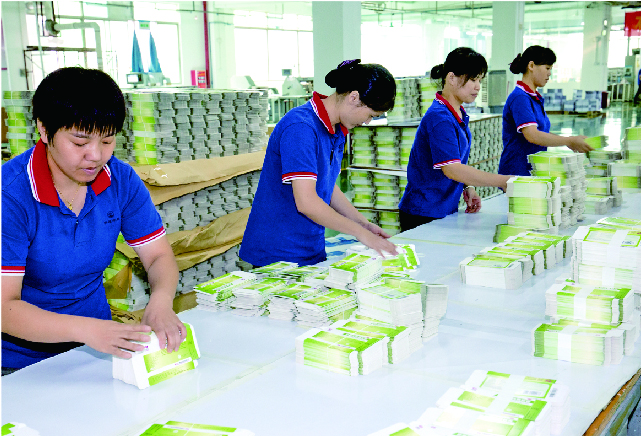
Manual packaging workshop supporting custom eco-friendly packaging orders.
Have Questions or Need More Details?
Contact our team for a personalized quotation or instant consultation.
Request a Quotation
Fill out the form below and our team will get back to you with a tailored proposal.
WhatsApp Direct Chat
Prefer to chat in real-time? Message us on WhatsApp for instant assistance & quick answers.
- Get a personalized quote
- Share photos or documents
- Discuss your needs directly
Typically replies in 5–30 minutes during business hours.