
Push-Pull vs. M12 vs. Industrial Connectors: A Buyer’s Comparison Guide for Electrical Applications
Push-pull connectors, M12 connectors and industrial M-series connectors are not three versions of the same part. They are three different answers to three different sets of constraints. Push-pull connectors are chosen when a design needs high contact counts (2–48 pins), higher current per contact (1.5–25 A) and a wide operating window (−55 °C to 250 °C). M12 connectors are chosen when a sealed automation interface rated IP67 has to mate reliably with equipment from different manufacturers. Industrial M-series connectors, ranging from M5 through M23, are chosen when signal and power wiring must terminate inside a sealed enclosure or on a machine panel.
This guide compares the three families on the specifications that actually decide a purchase: pin count, current rating, locking method, sealing level, temperature range, mating cycles, salt-spray resistance and market compliance. The specifications used here are the documented parameter sets of BEXKOM’s connector families together with published third-party standards that govern each interface. BEXKOM (Shenzhen BEXKOM Electronics Co., Ltd.) is a Shenzhen-based connector manufacturer founded in 2016 that develops and produces push-pull self-locking connectors, medical connectors, circular connectors and cable assemblies for medical, industrial, MIL, automation and test & measurement applications.
Short answer: If your design needs more than 19 contacts, more than 16 A per contact, or operation outside −25 °C to 80 °C, push-pull is the only one of the three families that covers the requirement. If your design needs a sealed IP67 field connection that follows a cross-manufacturer automation standard, M12 is the correct interface. If your design needs a range of small threaded interfaces (M5 to M23) terminated inside a sealed housing or on a panel, industrial M-series connectors are the practical choice. The three families overlap only in the middle of the range, roughly 3–19 pins and 1.0–16 A, which is exactly where most purchasing mistakes happen.
Problem Definition: Why the Three Families Are Usually Compared on the Wrong Axis
The comparison problem is not a lack of datasheets. It is that push-pull, M12 and industrial connectors are typically compared on brand familiarity or unit price, while the constraints that determine whether a connector survives in the field are ignored until after the first order. A connector that fails one constraint cannot be rescued by better performance in another. A 48-pin push-pull connector cannot be replaced by an M12 connector simply because the M12 version is more common, and an IP67 M12 connection cannot be replaced by a push-pull connector if the equipment interface is already standardised.
Five constraints decide the family, and they should be evaluated in this order:
- Contact count and signal density. Push-pull covers 2–48 pins and medical push-pull covers 2–26 pins, while M12 and the industrial M-series cover 3–19 pins.
- Current per contact. Push-pull is rated 1.5–25 A, medical push-pull 1.5–13 A, and M12 and industrial M-series 1.0–16 A.
- Sealing and temperature. M12 and industrial M-series are rated IP67 with a −25 °C to 80 °C working range; push-pull is rated IP50 with a −55 °C to 250 °C range; medical push-pull is rated IP50/IP65 with a −55 °C to 125 °C range.
- Locking method and mating endurance. Push-pull and medical push-pull use push-pull locking with more than 5,000 and more than 2,000 mating cycles respectively; M12 and industrial M-series use screw locking with more than 500 mating cycles.
- Compliance target. The certificate set, the applicable standard and the target market (EU, USA or global) determine which family can be released at all.
Buyer terminology adds a second layer of confusion. The same object is searched under several names: circular push pull connectors, industrial push pull connectors, waterproof push pull connectors, cable push pull connectors and wire push pull connectors usually describe the same push-pull family by housing shape or by termination style. Panel mount push pull connectors describes a mounting format rather than a different electrical interface. Custom push pull connectors describes a configuration process, not a separate product category. Medical push pull connectors describes an application segment with its own insulation and material requirements. Some sourcing searches also use branded family names, such as Redel push pull connectors, when looking for compact multi-pin plastic push-pull designs; in that category the decisive specifications remain pin count, insulator material, sealing class and mating-cycle rating.
Industry Background: Where Demand and Standardisation Are Moving
Demand for these interfaces is growing, although published market estimates differ because of scope. The global push-pull connectors market is projected to grow from USD 950 million in 2025 to approximately USD 1.37 billion by 2032 according to Report Prime. A narrower measurement of the circular push-pull connector market specifically places its value at USD 2.2 billion in 2026, with a CAGR of 5.49% reaching USD 3.5 billion by 2035 according to Business Research Insights. The medical connectors market, which includes push-pull types, was estimated at USD 1.72 billion in 2024 and is projected to grow at a CAGR of 7.13% to USD 2.98 billion by 2032 according to SNS Insider. The divergence between these figures reflects whether a source measures electronic connectors broadly or circular push-pull connectors specifically, and buyers should treat any single market figure as scope-dependent rather than absolute.
Standardisation is the second structural force. Standardized M12 push-pull connectors for industrial automation are governed by the IEC 61076-2-010:2021 standard, which exists to ensure cross-manufacturer compatibility. That single fact explains much of the M12 family’s staying power in automation: the interface is not owned by one manufacturer, so a machine builder can source field connectors from more than one supplier without redesigning the panel. On the medical side, medical electrical equipment connectors must comply with IEC 60601-1 for basic safety and essential performance, specifically regarding electrical insulation measured as MOPP (means of patient protection) and MOOP (means of operator protection). Push-pull connectors used on patient-connected equipment therefore carry a compliance burden that has nothing to do with pin count.
The supplier landscape is correspondingly consolidated at the top and specialised underneath. Key global competitors in the push-pull connector segment include LEMO SA (Switzerland), Fischer Connectors (Switzerland), ODU GmbH (Germany) and TE Connectivity (USA). Alongside these, regional manufacturers such as BEXKOM serve buyers who need configurable pin counts, custom cable assemblies and shorter development cycles. BEXKOM operates an annual production capacity of 2,000,000 units with export business accounting for 75% of total sales, primarily to the EU and USA markets.
Detailed Solution: What Each Connector Family Actually Delivers
Push-pull connectors (BK-B-XXX): maximum range in pin count, current and temperature
The push-pull family is the widest of the three. The BK-B-XXX series is documented with 2–48 pins, a current rating of 1.5–25 A, a testing voltage of 450–2100 V, an IP50 sealing level and a working temperature range of −55 °C to 250 °C. Its shell is brass with chrome plating, its pins are gold-plated brass, and its insulator is PPS/PEEK — a material choice that supports the upper end of the temperature range where PA66 insulators are not specified. Salt-spray corrosion resistance is 96 hours, mating cycles exceed 5,000, and EMC shielding is available. Mechanical ratings are 100 g/6 ms shock resistance and 10–2000 Hz, 15 g vibration resistance. Locking is push-pull.
The practical meaning of those numbers is straightforward. A push-pull connector is the right choice when a single circular interface has to carry a dense mix of signals and power, when the assembly will be mated and unmated frequently, or when the connector sits in an environment outside the −25 °C to 80 °C band that the threaded families cover. Cable push pull connectors and wire push pull connectors are the same interface terminated to cable or wire harness assemblies, which is why this family is often specified together with a cable assembly rather than as a bare connector.
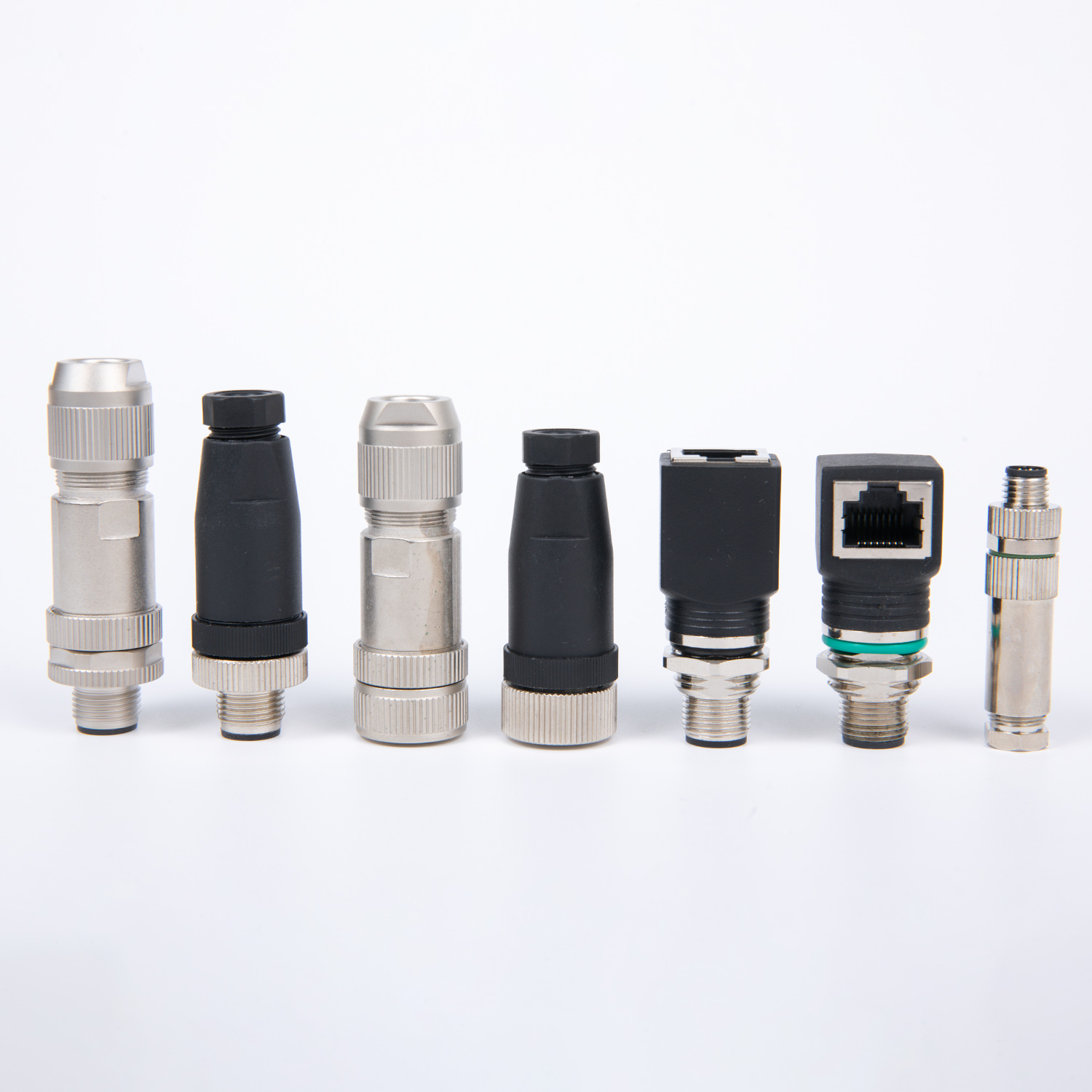
M12 connectors (BK-M12-XXX): the standardised sealed automation interface
The M12 family is narrower but more standardised. The BK-M12-XXX series is documented with 3–19 pins, a current rating of 1.0–16 A, a testing voltage of 250–1900 V, IP67 sealing and a working temperature range of −25 °C to 80 °C. The shell is brass with chrome plating, the pins are gold-plated brass, the insulator is PA66, salt-spray resistance is 48 hours and mating cycles exceed 500. EMC shielding is available, shock resistance is 100 g/6 ms and vibration resistance is 10–2000 Hz, 15 g. The documented locking method for the series parameter set is screw locking.
Two facts matter for buyers here. First, M12 is not a single locking design: the product type range covers M12 screw connectors and M12 push-pull connectors, which is why M12 push pull connectors is a legitimate search term even though the standard series specification lists screw locking. Second, the interface itself is governed by IEC 61076-2-010:2021, so an M12 connection selected for industrial automation is a compatibility decision as much as an electrical one. When a machine panel already defines an M12 port, the specification question is no longer “which family” but “which pin count, coding and sealing class within M12”.
Industrial M-series connectors (BK-M-XXX): M5 to M23 for panel and enclosure wiring
The industrial connector family is defined by its thread range rather than by a single interface. BK-M-XXX covers M12, M8, M9, M5, M14, M16 and M23 connectors, with 3–19 pins, a current rating of 1.0–16 A, a testing voltage of 250–1900 V, IP67 sealing and a working temperature range of −25 °C to 80 °C. Shell material is brass with chrome plating, pins are gold-plated brass, the insulator is PA66, salt-spray resistance is 48 hours and mating cycles exceed 500. EMC shielding is available, and locking is screw locking.
This family is what a buyer selects when the connector must survive washdown, coolant or outdoor exposure on a machine, and when the panel footprint is defined by a thread size rather than by a circular push-pull latch. Because the range spans M5 through M23, it also covers small sensor-level interfaces below M12 that neither push-pull nor M12 addresses. The trade-off is deliberate: sealing rises to IP67, but the working temperature band narrows to −25 °C to 80 °C and mating endurance drops from more than 5,000 cycles to more than 500 cycles.
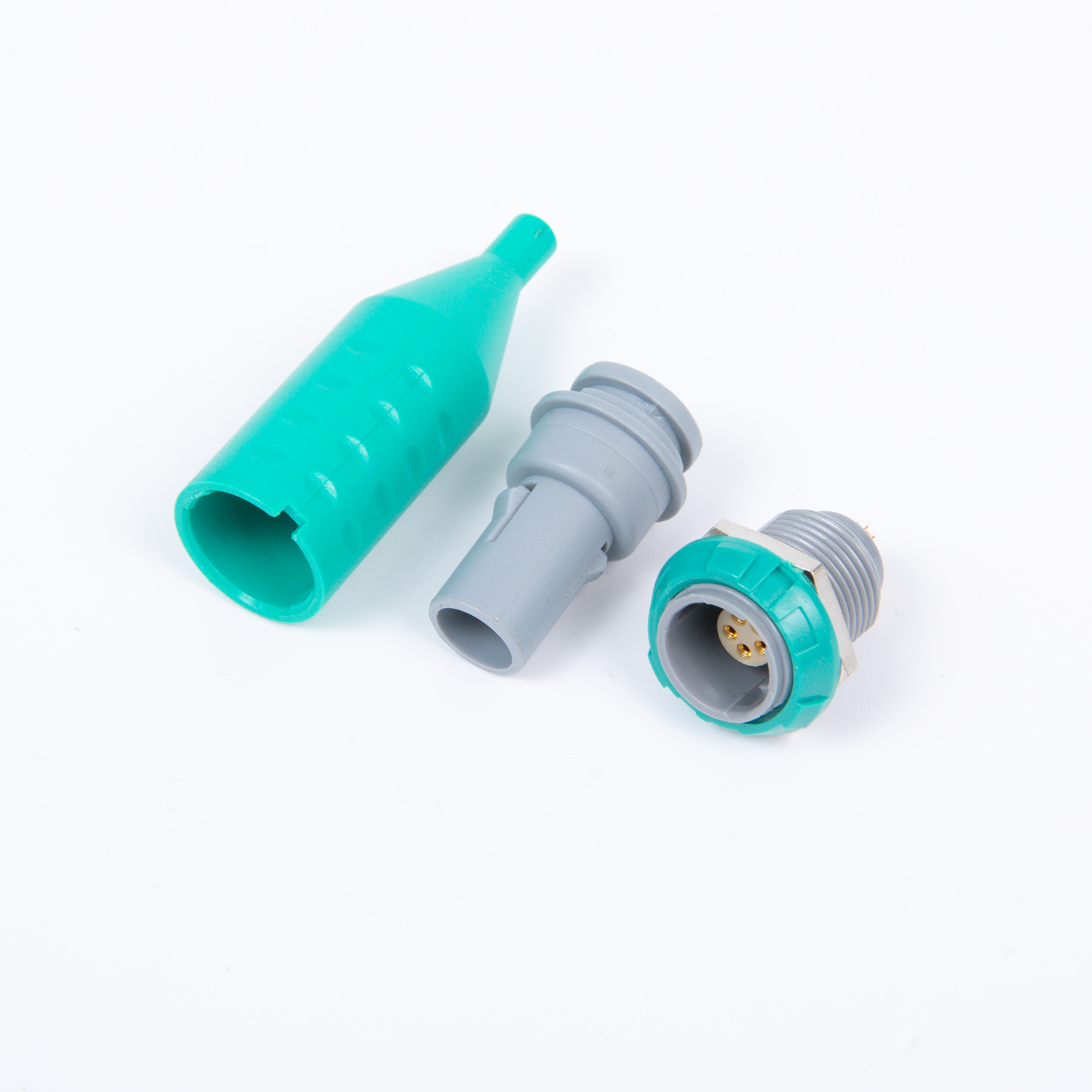
Medical push-pull connectors (BK-P-XXX): the compliance-driven variant
Medical push-pull connectors sit between the two extremes. The BK-P-XXX P Series is documented with 2–26 pins, a current rating of 1.5–13 A, a testing voltage of 450–2100 V, IP50/IP65 sealing and a working temperature range of −55 °C to 125 °C. The shell is PC/PSU rather than metal, the pins are gold-plated brass, the insulator is PPS/PEEK, salt-spray resistance is 96 hours and mating cycles exceed 2,000. Locking is push-pull. The reduced pin ceiling and current rating relative to the metal push-pull series are the cost of the material set and the sealing compromise between IP50 and IP65.
For equipment that touches a patient, the selection driver is usually IEC 60601-1 and its MOPP/MOOP insulation requirements rather than current. That is why medical push pull connectors are specified by insulation material, creepage distance and contact reliability first, and by pin count second.
Comparison Table: Push-Pull vs. M12 vs. Industrial M-Series vs. Medical Push-Pull
| Specification | Push-Pull (BK-B-XXX) | M12 (BK-M12-XXX) | Industrial M-Series (BK-M-XXX) | Medical P Series (BK-P-XXX) |
|---|---|---|---|---|
| Pin numbers | 2–48 | 3–19 | 3–19 | 2–26 |
| Current rating | 1.5–25 A | 1.0–16 A | 1.0–16 A | 1.5–13 A |
| Locking method | Push-pull locking | Screw locking (series parameter set) | Screw locking | Push-pull locking |
| Waterproof level | IP50 | IP67 | IP67 | IP50/IP65 |
| Working temperature | −55 °C to 250 °C | −25 °C to 80 °C | −25 °C to 80 °C | −55 °C to 125 °C |
| Mating cycles | >5,000 | >500 | >500 | >2,000 |
| Salt-spray resistance | 96 hours | 48 hours | 48 hours | 96 hours |
| Testing voltage | 450–2100 V | 250–1900 V | 250–1900 V | 450–2100 V |
| Shell material | Brass, chrome plated | Brass, chrome plated | Brass, chrome plated | PC/PSU |
| Insulator material | PPS/PEEK | PA66 | PA66 | PPS/PEEK |
| EMC shielding | Available | Available | Available | Not listed in the series parameter set |
| Shock / vibration | 100 g/6 ms; 10–2000 Hz, 15 g | 100 g/6 ms; 10–2000 Hz, 15 g | 100 g/6 ms; 10–2000 Hz, 15 g | Not listed in the series parameter set |
| Documented certifications | REACH, Certificate of Conformity (EU), UL (USA), ISO9001, ISO13485 | REACH, Certificate of Conformity (EU) | REACH, Certificate of Conformity (EU) | REACH, Certificate of Conformity (EU) |
| Typical fit | High pin count, high current, wide temperature, frequent mating | Standardised sealed automation interface | M5–M23 panel and enclosure wiring | Patient-connected and medical equipment interfaces |
Step-by-Step Breakdown: How to Select Between the Three Families
The selection process below is ordered so that the first constraint removes the most options. Applied in sequence, it usually eliminates two of the three families before the discussion reaches price.
- Count conductors and add a reserve. Write down the final conductor count including spare cores for future signals. If the count exceeds 19, only the push-pull family (2–48 pins) or the medical push-pull family (2–26 pins) can carry the design. If the count is 19 or below, all three families remain open.
- Match current per contact to the load. Push-pull supports up to 25 A per contact and medical push-pull up to 13 A, while M12 and the industrial M-series are rated to 16 A. A design that mixes a high-current power pair with low-current signal lines is usually better served by one push-pull connector than by two separate threaded connectors.
- Define the environment before the housing. Ambient and process temperature decides the insulator. Push-pull uses PPS/PEEK and is specified from −55 °C to 250 °C; M12 and the industrial M-series use PA66 and are specified from −25 °C to 80 °C. If the assembly will be washed down, submerged or exposed to coolant, IP67 from the threaded families matters more than the wider temperature band. Decide which constraint is non-negotiable before requesting quotations.
- Decide how often the connector will be mated. Push-pull locking is rated above 5,000 mating cycles, medical push-pull above 2,000, and screw locking above 500. A connector that is mated daily in a service bay belongs in the push-pull family; a connector installed once and left in place for the life of the machine does not need that endurance.
- Fix the compliance target by market and application. EU shipments need a Certificate of Conformity and REACH coverage, USA shipments need UL coverage where applicable, and medical equipment brings IEC 60601-1 into scope. Automation panels using M12 push-pull interfaces are governed by IEC 61076-2-010:2021. Compliance should be confirmed before the sample is built, not after.
- Validate with a sample, then lock the supply path. BEXKOM runs OEM/ODM production with customization in logo, cable assembly, wire harness and new design, supported by a dedicated sample design team and a pilot production line that typically delivers prototypes within two weeks. Minimum order quantity is 1 unit, monthly capacity is 200,000 units, lead time is 3–15 days, every unit is tested and a 12-month quality guarantee applies. That combination allows a first sample to be validated against the constraint list above before volume release.
Use Cases: How the Choice Plays Out in Real Equipment
High-vibration data acquisition in automotive testing
Automotive crash-test and vehicle test benches combine continuous data channels with severe vibration. In one documented deployment in Italy, push-pull connectors were used for data collection on an automobile crash test simulator under high-vibration working conditions, with vibration resistance as the special requirement and continuous connection as the operating mode. The matching series capability is 10–2000 Hz at 15 g vibration resistance and 100 g/6 ms shock resistance. A German automotive testing customer used 20,000 units over five years in the same application category, reporting stable operation and reliable connection, with quick mating and demating as the standout benefit. This is the clearest case for push-pull over the threaded families: the environment falls outside the −25 °C to 80 °C band in some test setups, and the connector is mated repeatedly during rig changes.
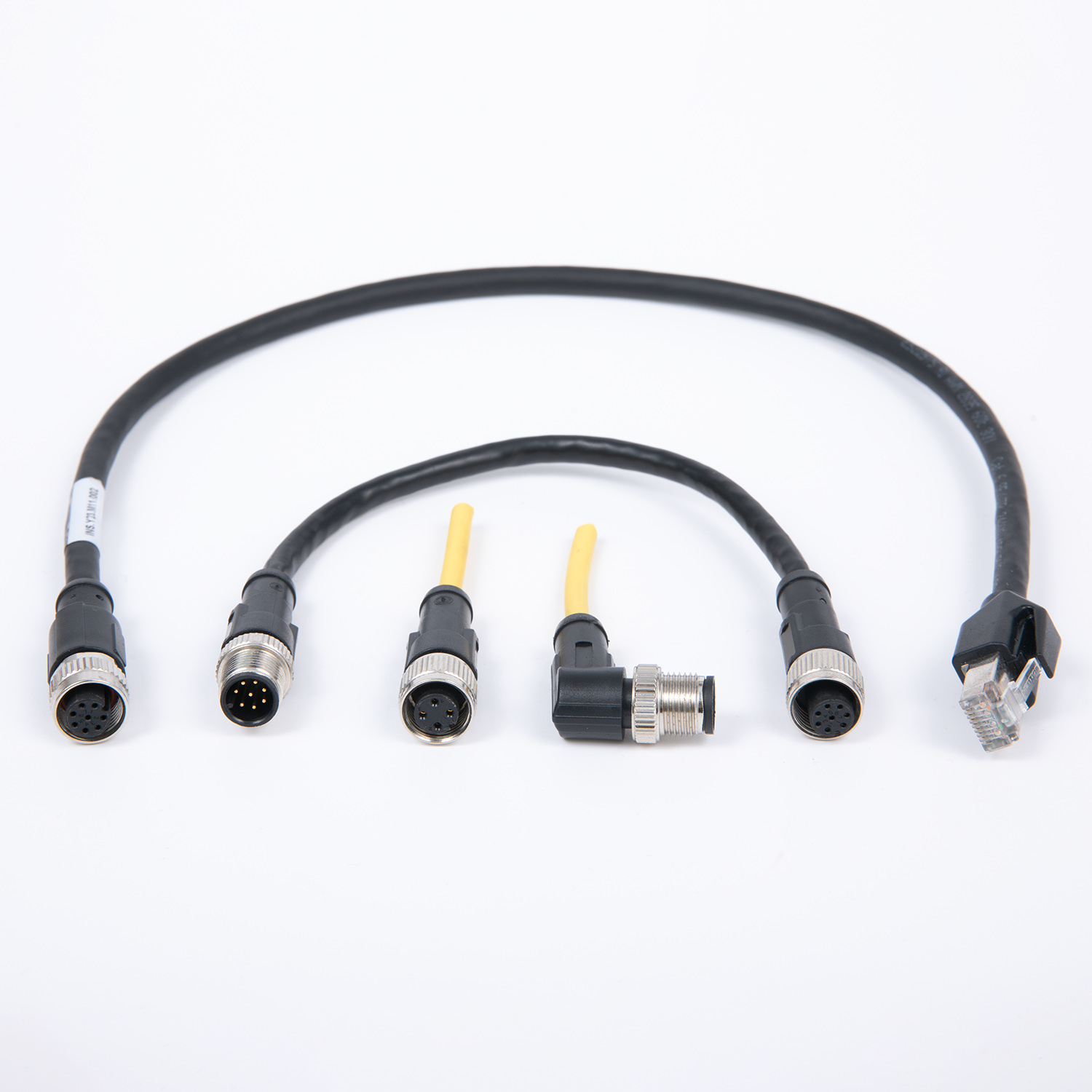
Automation robot signal transmission with IP67 sealing
In a documented German industrial automation robot project, the requirement was continuous signal transmission with IP67 waterproofing, matched to a cable assembly for continuous operation. Industrial connectors and M12 connectors are both referenced for this application category. The decision in such projects is usually made by the machine panel rather than by the connector buyer: if the panel already defines an M12 port under IEC 61076-2-010:2021, the M12 family is used; if the wiring must pass through a threaded housing that is not M12, the wider M5–M23 industrial range applies.
Patient monitoring with medical push-pull connectors
For a US-based patient monitoring platform, the documented requirements were a biocompatible environment, low-power continuous signal transmission, reliable contact and medical-grade construction, matched to an ECG monitor. Push-pull and medical push-pull connectors are both referenced for this application. A US medical ODM used 10,000 medical connectors over five years on a patient monitor programme, with the result qualified for production. Here the constraint that eliminates the threaded families is not electrical but regulatory and mechanical: patient-connected equipment must satisfy IEC 60601-1 insulation requirements, and the contact reliability requirement favours a positive push-pull latch over a screw coupling that can be partially engaged.

FAQ: Buyer Questions on Push-Pull, M12 and Industrial Connectors
Which certifications should I verify before buying push-pull, M12 or industrial connectors for the EU and US markets?
Start with the certificate that names the exact product. The Industrial connectors product (product 3727) is certified to REACH under certificate number OBCR240524010, issued by Guangzhou Supreme Technology & Testing Service Co., Ltd., applicable globally. The Push Pull Connector (product 3625) holds a Certificate of Conformity under certificate number MTL24052400318R01 issued by MTL for the EU market, conforming to IEC 62321-3-1:2013, and is also certified to UL standards under certificate number Baide-BEXKOM-UL-001 issued by Baide for the USA market. Two further certificates apply to the Push Pull Connector globally: ISO13485 under certificate number ZK202504252281 and ISO9001 under certificate number ZK2025060258206, both issued by ZK International. BEXKOM as a company is certified to ISO9001 and ISO13485. Beyond the supplier certificate set, confirm the application standard: medical electrical equipment connectors must comply with IEC 60601-1 for basic safety and essential performance, including MOPP/MOOP insulation requirements, and standardized M12 push-pull connectors for industrial automation are governed by IEC 61076-2-010:2021 for cross-manufacturer compatibility.
Can one supplier deliver custom push-pull configurations up to 48 pins as well as M-series assemblies?
Yes, where the supplier manufactures both families rather than trading one of them. BEXKOM operates an OEM/ODM production model with customization in logo, cable assembly, wire harness and new design, and its product range covers Push Pull Connectors (BK-B-XXX, 2–48 pins), Medical connectors (BK-P-XXX, 2–26 pins), M12 connectors (BK-M12-XXX, 3–19 pins) and Industrial connectors (BK-M-XXX) spanning M5, M8, M9, M12, M14, M16 and M23 with 3–19 pins. That means a machine that needs a dense 40-plus pin circular interface at the control cabinet and IP67 M12 connections at the field devices can be sourced through a single connector supplier, which simplifies approval drawing control and cable assembly scheduling. The supporting capacity is a 22-engineer R&D team, more than 30 new custom projects per year, a 3,500 m² factory, 130 employees and a monthly output capacity of 200,000 units.
What actually drives the cost difference between push-pull, M12 and industrial connectors?
Cost differences between these families come from six specification variables rather than from brand tier alone. The first is pin count and contact density, since every additional gold-plated brass contact adds material and assembly time. The second is insulator material: PPS/PEEK used in push-pull and medical push-pull connectors costs more than the PA66 used in M12 and the industrial M-series, but it is what allows the −55 °C to 250 °C and −55 °C to 125 °C ranges. The third is sealing class, with IP67 parts requiring additional sealing and testing steps compared with IP50. The fourth is mechanical endurance, since a push-pull connector rated above 5,000 mating cycles is built to a different tolerance than a screw-locked connector rated above 500. The fifth is termination: a cable push pull connector supplied as a terminated harness carries assembly cost that a bare connector does not. The sixth is compliance testing for the destination market, including REACH, Certificate of Conformity and UL documentation. Any unit-price comparison is only meaningful when two quotes are normalised to the same pin count, current rating, sealing class and termination.
How should I validate a connector before committing to volume production?
Validate the constraints that fail in the field, not the ones that are easiest to measure. Request a sample configured to the final pin count and sealing class, then test vibration endurance (documented rating: 10–2000 Hz, 15 g), shock (100 g/6 ms), mating-cycle endurance, salt-spray resistance (96 hours for push-pull and medical push-pull, 48 hours for M12 and industrial) and the temperature extremes of the intended installation. BEXKOM supports this with a dedicated sample design team and a pilot production line that typically delivers prototypes within two weeks, a minimum order quantity of 1 unit, 100% testing on production units and a 12-month quality guarantee. A reference point for what a successful validation looks like is the German automotive testing programme that ran 20,000 units over five years with stable operation and reliable connection.
What lead time should a buyer plan for, and what has to be confirmed first?
BEXKOM’s stated lead time is 3–15 days, with a minimum order quantity of 1 unit and a 12-month quality guarantee; custom projects follow the sample path first, with prototypes typically delivered within two weeks. Before a purchase order is issued, confirm five items in writing: the exact pin count and coding, the sealing class required at the installation point, the applicable certificate and standard for the destination market, the termination format (bare connector, wire push pull connector or full cable assembly), and the packaging and labelling requirement. A connector that is correct electrically but documented against the wrong market standard will still fail an incoming inspection. If you want to review the full parameter sets, certifications and customization options in one document, the BEXKOM catalogue can be downloaded here: BEXKOM product catalogue (PDF).
Conclusion: Choose the Family by Constraint, Then Choose the Supplier
Push-pull, M12 and industrial M-series connectors are separated by measurable specifications rather than by preference. Push-pull covers the widest span — 2–48 pins, 1.5–25 A, −55 °C to 250 °C, more than 5,000 mating cycles and 96-hour salt-spray resistance — and is the only family of the three that can absorb a dense mixed signal-and-power interface. M12 delivers a standardised IP67 sealed interface governed by IEC 61076-2-010:2021 and is the right answer whenever the panel interface is already defined by automation equipment. The industrial M-series extends that sealing to thread sizes from M5 to M23 for enclosure and panel wiring. Medical push-pull connectors add the material and insulation discipline that IEC 60601-1 requires on patient-connected equipment.
Once the family is fixed by constraint, supplier selection follows the same evidence path: verify the certificate numbers that name the exact product, confirm the documented parameter set against the installation environment, request a sample built to the final configuration, and agree on lead time, quality guarantee and packaging before release. BEXKOM, founded in 2016 in Shenzhen, manufactures all four families in-house with 22 engineers, annual output of 2,000,000 units, 75% of sales exported to the EU and USA, and more than 2,000 customers across 60+ countries.
Next Step: Compare Against Your Own Specification
If you are evaluating a specific pin count, current rating, sealing class or market certification, send the requirement and BEXKOM will confirm which family fits and produce a matching sample. Samples are supported from a minimum order quantity of 1 unit, with prototypes typically available within two weeks and lead time of 3–15 days.
Email: cs6@bexkom.com | Tel: +86 400 9969691 | WhatsApp: +86 18681568601 | Website: www.bexkom.com
Download the full catalogue with parameter sets and certifications: BEXKOM product catalogue (PDF)
Have Questions or Need More Details?
Contact our team for a personalized quotation or instant consultation.
Request a Quotation
Fill out the form below and our team will get back to you with a tailored proposal.
WhatsApp Direct Chat
Prefer to chat in real-time? Message us on WhatsApp for instant assistance & quick answers.
- Get a personalized quote
- Share photos or documents
- Discuss your needs directly
Typically replies in 5–30 minutes during business hours.