
BGT Steel Plate (Jiangyin Baoguantao): A Deep Analysis of a Chinese Wear Resistant Steel Plate Supplier
BGT Steel Plate (Jiangyin Baoguantao): A Deep Analysis of a Chinese Wear Resistant Steel Plate Supplier
BGT Steel Plate is the trading identity of Jiangyin Baoguantao Import & Export Co., Ltd., a Chinese wear resistant steel stockholder, processor and distributor founded in 2013 and based in Jiangyin, Wuxi City, Jiangsu Province. The company supplies quenched and tempered wear resistant steel plate (NM400, NM450, NM500, NM550, NM600 and XCHD450), high manganese steel plate Mn13, and high strength steel plate (Q550D, Q690D, Q690E, Q890D and Q960E), backed by a standing inventory of more than 30,000 metric tons held across 12 warehouses in Jiangsu, Shandong and Hunan provinces, with export activity accounting for 40% of sales.
For an importer, project buyer or equipment manufacturer at the discovery stage, the practical question is rarely about headline price. It is whether a supplier can place the correct grade, at the correct thickness, with the documentation the application demands, into a consolidated shipment on schedule. This analysis examines BGT Steel Plate against that question: what it actually stocks, how its supply model is structured, where its capability is strongest, and which points a buyer should verify rather than assume.
The Discovery Problem: Why “Wear Resistant Steel Plate” Is Not a Single Product
The search term is far simpler than the product behind it. A single query for wear resistant steel plate covers quenched and tempered abrasion resistant plate, work-hardening manganese plate and high strength structural plate — three metallurgically different families with different fabrication behaviour and different failure modes. Buyers who treat them as interchangeable typically discover the mismatch at the cutting and welding stage, or later in the field.
A second complication is shorthand. Procurement documents frequently use imported brand names as a proxy for a hardness class, so phrases such as “Hardox equivalent wear resistant steel plate” or “abrasion resistant steel plate 500 HBW” circulate without defining thickness tolerance, flatness, through-thickness hardness consistency or documentation. Two plates can be quoted against the same shorthand and still behave differently in service. The only dependable comparison points are an original mill test certificate and a verified hardness reading taken under a defined procedure.
A third issue is the gap between stated capability and physical stock. A mill can roll a grade; a stockholder can ship it next week. Those are different promises. At the research stage, the most useful supplier question is not “can you produce it” but “is it in your inventory, where is it held, and what paperwork travels with it.”
Industry Background: The Three Steel Families Behind Wear Protection
Wear protection in heavy industry is usually engineered around the dominant wear mechanism at the contact surface — sliding abrasion, impact, or a combination of both. That mechanism, more than the equipment name, determines which steel family belongs in the application.
Quenched and tempered wear plate: NM and AR grades
The NM series (NM400, NM450, NM500, NM550, NM600) is produced through controlled alloying and through-thickness quenching and tempering. The result is a martensitic microstructure with high baseline hardness, typically 400–500 HBW and above, that stays consistent from surface to core rather than only at the skin. Because hardness is uniform through the thickness, wear resistance does not collapse once the top layer is consumed. Lower grades in the series remain easy to cold form, weld and cut; higher grades trade formability for abrasion resistance.
Work-hardening high manganese steel: Mn13
Mn13 has an austenitic microstructure rather than a martensitic one. Its surface hardness begins around 200 HBW and rises above 500 HBW when it is subjected to heavy impact or compressive loading, while the substrate stays tough and ductile. This makes it the appropriate choice where repeated shock loading dominates, such as railway turnout frogs, jaw crusher plates and shot blast liners. It is not the economical answer for pure sliding abrasion with little impact.
High strength structural plate: the Q series
High strength plate is a load-carrying material rather than a wear material. Q550D, Q690D and Q690E deliver minimum yield strengths of 550 MPa and 690 MPa respectively; the D suffix denotes impact toughness at −20°C and the E suffix at −40°C. The Q890D and Q960E grades push yield strength to the 890 MPa and 960 MPa class for extreme heavy-duty equipment, where weight reduction and structural safety matter more than surface abrasion resistance. These grades are common in crane booms, mining haul truck structures and cold-climate equipment.
Understanding this split matters during supplier discovery, because a supplier that stocks only one family will still be asked for the other two — and the answer reveals whether the request is being served from inventory or from an assumption.
Company Overview: What BGT Steel Plate Is and What It Supplies
Jiangyin Baoguantao Import & Export Co., Ltd. was established in 2013 and has since concentrated on the wear resistant steel segment. The company operates as a stockholder, processor and distributor rather than as a steel mill, which shapes both its strengths and its boundaries as a supply partner.
- Founded: 2013, with more than a decade focused on wear resistant steel.
- Facility and team: a 5,000 m² operation with 40 employees, including a 3-engineer technical team.
- Annual output: 200,000 tons.
- Core products: wear resistant steel plates and high strength steel plates.
- Inventory: a standing stock of over 30,000 metric tons of wear resistant steel plate, distributed across 12 modern warehouses in Jiangsu, Shandong and Hunan provinces.
- Export profile: a 40% export ratio, with sales into the Middle East, Southeast Asia, South America, Africa, Central Asia and Russia.
- Service model: a one-stop combination of product inventory, custom cutting and processing, and professional sales distribution.
The company positions itself as China’s largest wear-resistant steel stockholder, citing the widest range of grades, specifications and custom sizes in the segment. Buyers should treat that as the company’s stated market position and evaluate it against the concrete indicators that can be checked: inventory depth, warehouse count and location, grade range, and the traceability documentation attached to each order.
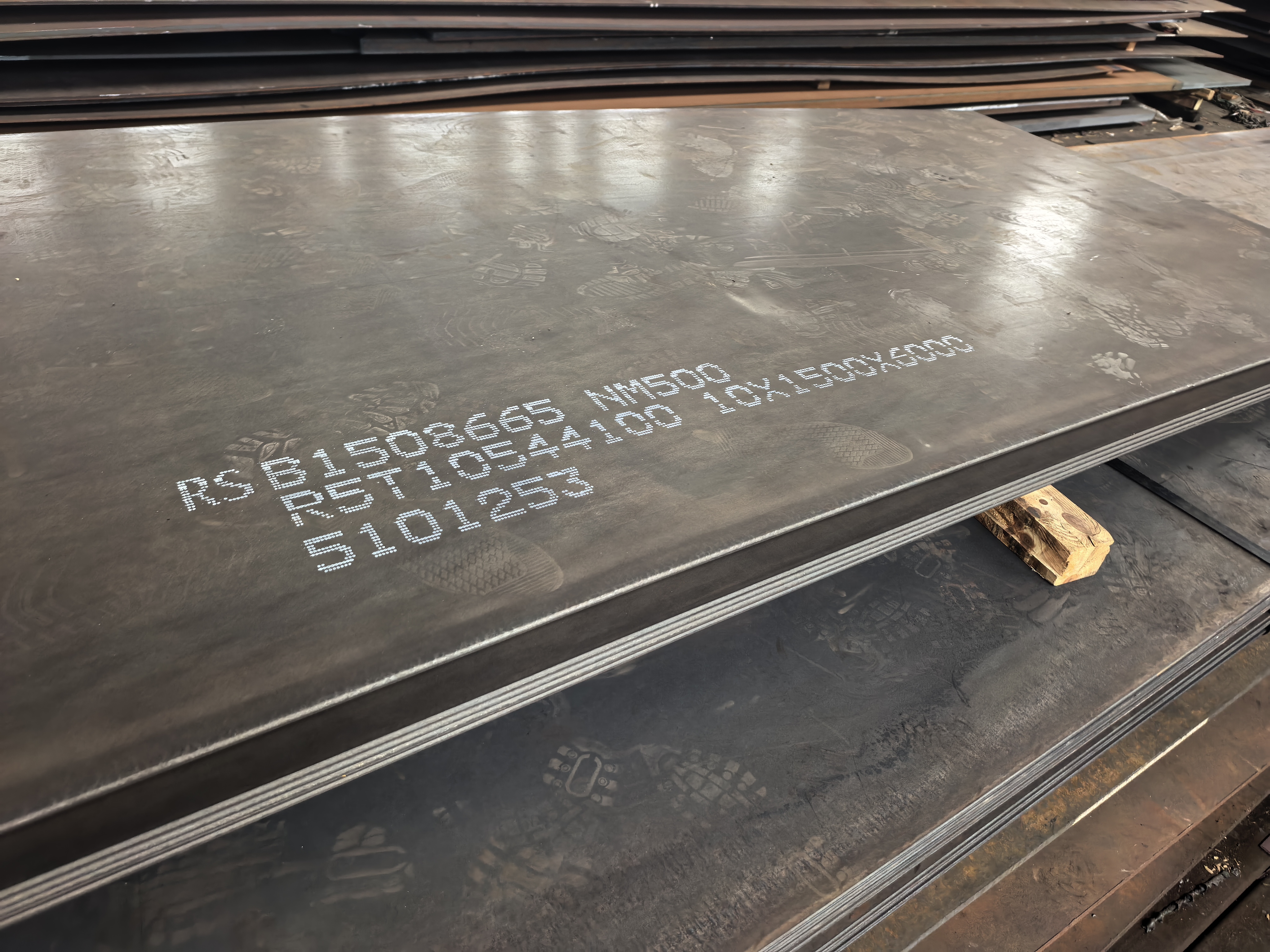
Core Product Portfolio and Technical Positioning
The portfolio is organised around three application logics: abrasion resistance, impact resistance through work hardening, and load-bearing strength. Each grade carries a specific hardness or strength target, and the company supplies an original mill test certificate with orders.
| Grade | Family | Key property | Where it is typically used |
|---|---|---|---|
| NM400 | Wear resistant plate | 400 HBW; balanced hardness and toughness, easy to cold form, weld and cut | Construction and mining equipment, cement plant components, excavator buckets, dump truck beds, crusher liners |
| NM450 | Wear resistant plate | Approx. 15–20% longer wear life than NM400 while retaining cold-formability and weldability | Mining machinery, garbage compactors, chutes, loader cutting edges |
| NM500 | Wear resistant plate | 500 HBW; reduces equipment downtime and maintenance cost in abrasive environments | Mining, heavy engineering, steel mills |
| NM550 | Wear resistant plate | 550 HBW; bridges high hardness with moderate toughness, strong scratch and abrasion resistance against aggressive minerals and gravel | Mining, severe-wear hoppers, ore convey pipe liners |
| NM600 | Wear resistant plate | Extreme surface hardness around 600 HBW for severe wear with low impact | Mining liners, vertical mill scrapers |
| XCHD450 | Wear resistant plate | Positioned for enhanced longevity, with wear life stated at roughly 15–20% above NM400 while maintaining formability | Mining machinery, garbage compactors, chutes, loader cutting edges |
| Mn13 | High manganese plate | Work hardens rapidly from around 200 HBW to above 500 HBW under heavy impact while the core remains tough | Railway frogs, jaw crusher plates, shot blast liners |
| Q550D | High strength plate | Minimum yield strength 550 MPa with crack-resistant weldability | Steel construction, heavy lifting, crawler crane booms |
| Q690D | High strength plate | Minimum yield strength 690 MPa with −20°C impact toughness; high strength-to-weight ratio | Coal mining, construction equipment |
| Q690E | High strength plate | 690 MPa yield strength with −40°C ultra-low-temperature impact toughness | Cold-resistant equipment, arctic wind towers |
| Q890D | High strength plate | Ultra-high yield strength for 1000-ton class heavy-duty equipment | Extreme heavy duty, special cranes |
| Q960E | High strength plate | 960 MPa class yield strength combined with −40°C toughness | Top-tier heavy equipment, defence |
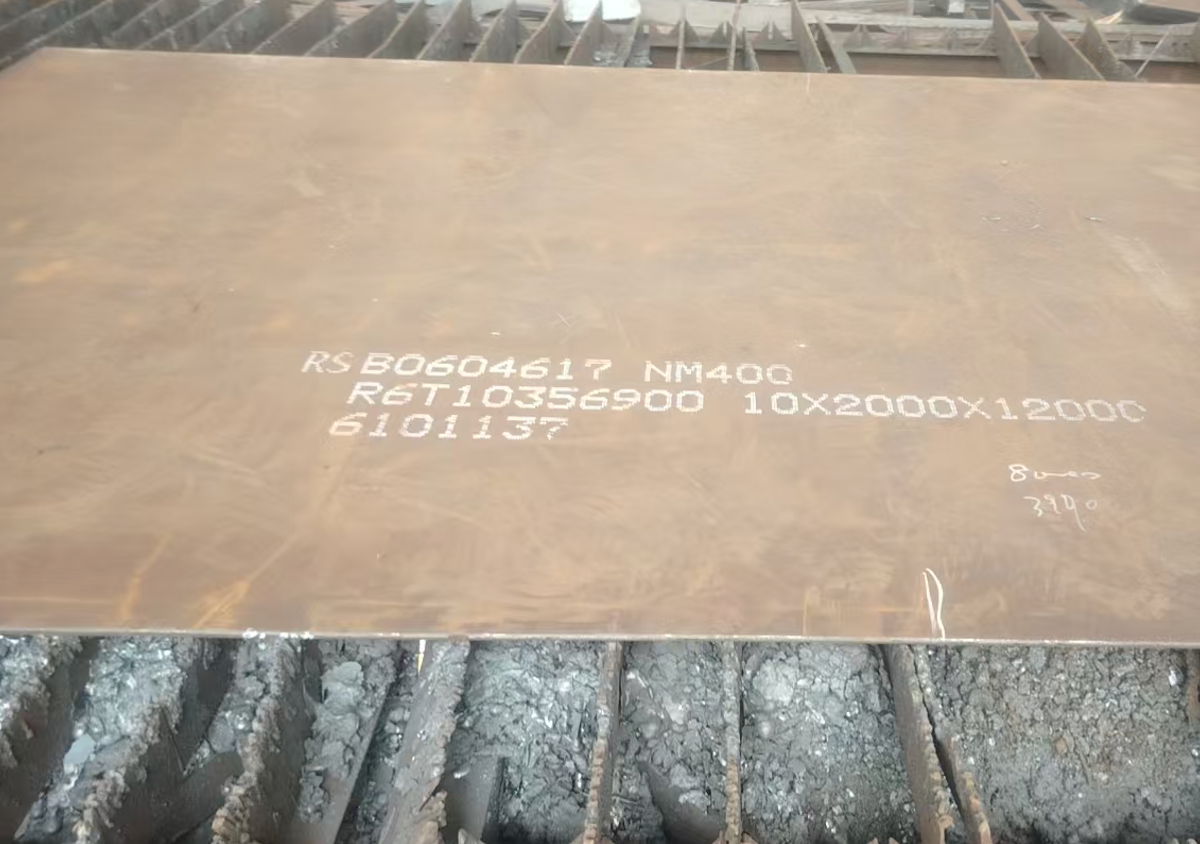
Specifications, Custom Cutting and Processing Flexibility
Across the plate range, the company operates a common size envelope rather than a narrow catalogue. That consistency simplifies multi-grade orders, because different grades can be specified within the same dimensional logic.
- Thickness range: 3–150 mm.
- Width range: 600–3950 mm, with customised sizes accepted.
- Length options: 2438, 5800, 6000, 6096, 12000 and 12200 mm, with customised sizes accepted.
- Mills of origin: Xingcheng, Nisco, Shandong Steel, Shougang, Xisc, Lianyuan, Puyang, Rongshen and Yongfeng.
- Documentation: original Mill Test Certificate (MTC) with each order.
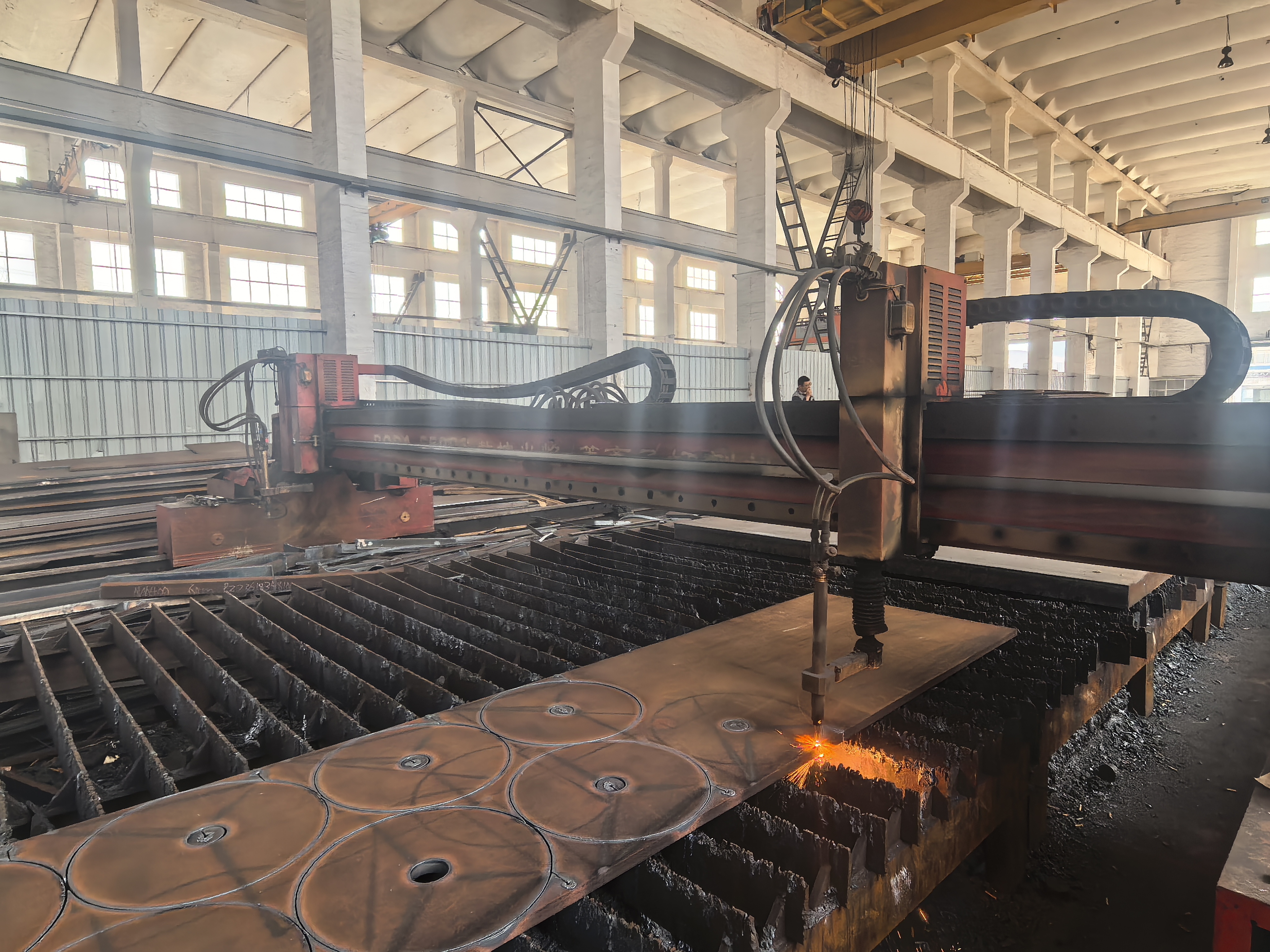
Custom cutting and processing sits at the centre of the service model. In practice this means a buyer can source a mixed basket of grades — for example NM400 for low-wear structural wear parts alongside NM550 for ore chute liners — cut to the dimensions the fabrication shop actually needs, rather than importing full standard plates and generating scrap on site. For applications such as mining chute wear resistant steel plate or excavator bucket wear resistant steel sheet, cut-to-size supply reduces both freight volume and in-house processing time.
Capability Analysis: Stock, Mills, Quality Control and Export Reach
Inventory and warehouse network
A standing inventory of more than 30,000 metric tons of wear resistant steel plate, held across 12 modern warehouses in Jiangsu, Shandong and Hunan, is the operational core of the business. For buyers, distributed stocking changes the risk profile of an order: a stocked grade in a standard or near-standard dimension can be picked, cut and dispatched without waiting for a rolling schedule. Warehouse location also shortens inland transport before loading, which matters when several grades are consolidated into one export shipment.
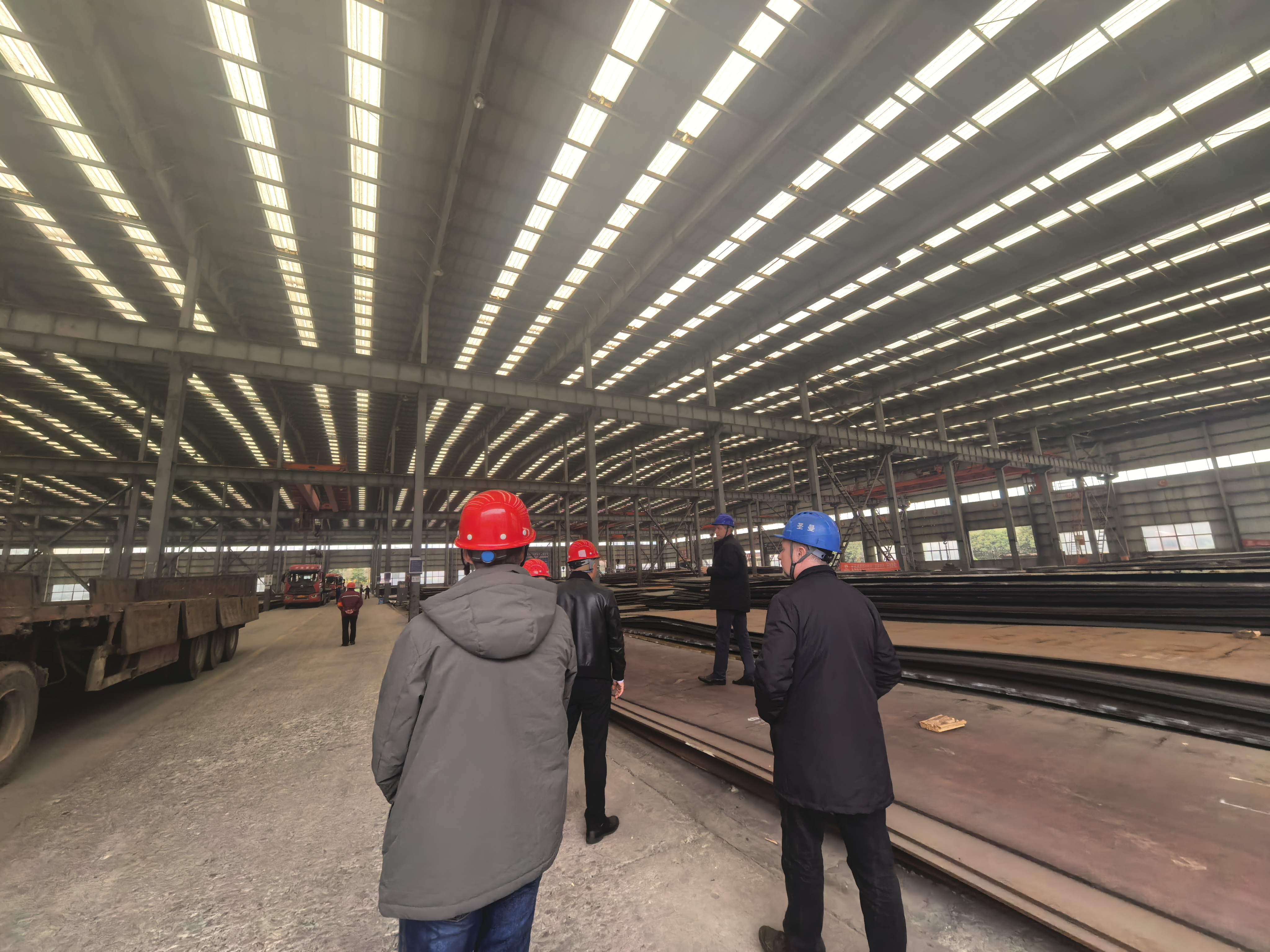
Mill supply network
The company states long-term strategic partnerships with domestic steel mills and acts as one of the primary distributors for producers including Xingcheng, Nisco, Shougang, Xisc, Shandong Steel, Hanye, Tangsteel, Rongshen, Tisco, Baosteel, Lianyuan and Puyang. Direct mill relationships are the mechanism behind traceability: the plate in the warehouse can be tied back to a named producer and a specific heat, which is exactly what an original MTC documents.
Quality control and documentation
Documentation is the most verifiable part of any wear plate purchase, and it is worth being specific about what “verification” means. Hardness testing on wear plate should not be performed on the raw surface or near a cut edge. The standard procedure is to take a test point at least 50 mm away from any flame or plasma cut edge, grind away 1.5–2.0 mm to remove the decarburised layer, and use an HBW 10/3000 indenter for plates in the 6–80 mm range, the same method used for mill test certificates and third-party inspection. Three consecutive readings are averaged, and the result is checked against the grade tolerance — for NM400, a typical acceptance band is 360–440 HBW. Ultrasonic testing is also available for applications in metallurgy and port handling where internal soundness is specified.
Export and service capability
With 40% of sales going to export markets including the Middle East, Southeast Asia, South America, Africa, Central Asia and Russia, the company operates on export documentation and multi-market logistics as a routine part of the business rather than as an exception. Enquiries are handled through a single commercial contact point, which keeps grade, dimension and documentation questions with one party instead of being split across mills.
Step-by-Step: How Sourcing Through BGT Steel Plate Works
A practical sourcing sequence, based on how the supply model is structured:
- Define the wear mechanism and the base metal. Establish whether the failure mode is sliding abrasion, impact, or mixed, and whether the component is load-bearing. This decides whether the answer is NM400–NM600, Mn13, or a Q-series structural grade.
- Fix dimensions against the fabrication drawing. Confirm thickness, width and length, or release a cut-to-size list if on-site processing capacity is limited.
- Confirm stock position and grade origin. Ask which warehouse holds the grade and which mill produced it, so the MTC can be matched before the order is placed.
- Agree the inspection plan. Specify hardness verification method and, where required, ultrasonic testing, including who performs the test and at what stage.
- Validate on a sample or trial quantity. Order a test piece or a small trial lot for the grades or thicknesses that are new to the fabrication team, particularly for high-hardness and high-strength material.
- Release the production and cutting sequence. Standard stock plus cutting and processing is prepared to the agreed drawing set, with the mill test certificate attached.
- Consolidate and ship. Multi-grade orders can be grouped into one shipment from the warehouse network rather than shipped grade by grade from different sources.
Application Scenarios: Where the Plate Is Consumed
Cement plants
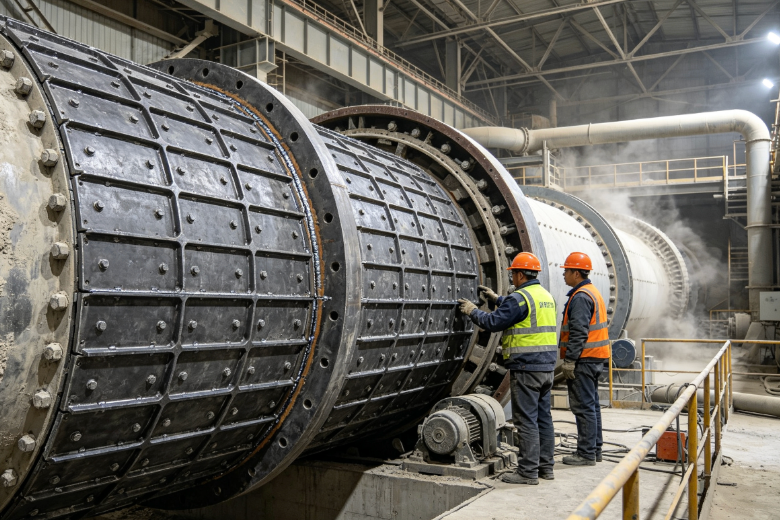
Cement production combines heavy abrasion, impact wear and continuous operation. Crushers, ball mills, vertical roller mills, chutes, hoppers, conveyors, bucket elevators, screens, separators, silos and clinker handling equipment all rely on wear liners that must hold their hardness through long running hours. The relevant grades in this environment span NM400, NM450, NM500, NM550, NM600 and Mn13, matched to the impact level of each position.
Mining machinery and excavator buckets
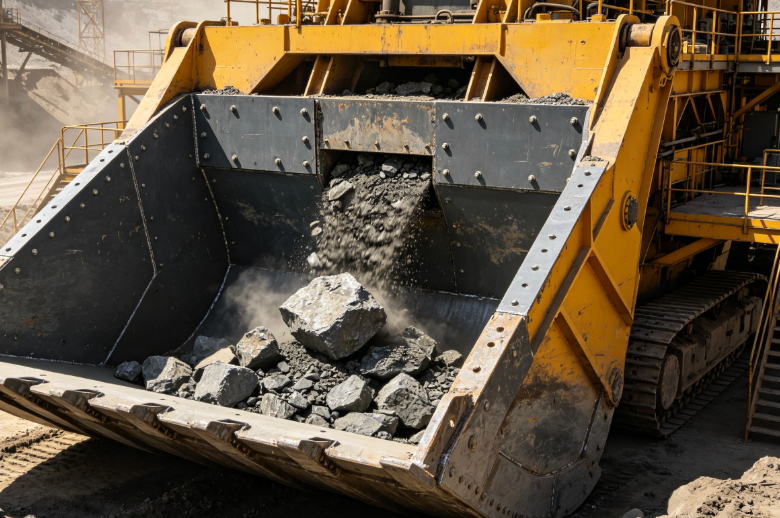
Mine hoppers, ore chutes and digging buckets experience abrasive wear with medium impact under near-continuous loading. NM400 through NM600 are used depending on how aggressive the ore is and how costly replacement downtime becomes. Excavator bucket wear resistant steel sheet is typically specified in the lower-to-mid thickness range, while chute and hopper liners move toward higher hardness where material flow is fast and abrasive.
Metallurgy
Ore chutes, hoppers, ball mill and crusher liners and mining trucks operate under abrasive wear with medium impact and heavy abrasive wear in 24/7 duty. This is a segment where ultrasonic inspection is frequently requested alongside hardness verification, so documentation quality carries as much weight as the grade itself.
Power and coal chemical
Coal mill chutes, pipe bends and coal bunker linings wear through continuous abrasive flow. NM400, NM450 and NM500 are the usual selections for lining plates in these positions, where the requirement is predictable wear life under uninterrupted operation rather than extreme impact resistance.
Port handling
Port equipment such as crane structures and crawler crane components is a structural rather than an abrasion application. Heavy loads combined with low ambient temperatures call for Q960E, Q690E and Q690D, where low-temperature impact toughness, ultrasonic inspection and weldability are the defining requirements.
Railway
Railway turnout frogs face severe impact with intermittent shock loading. This is the classic Mn13 application: the surface work hardens under repeated impact while the core retains the toughness needed to avoid brittle failure.
Grade Comparison and Selection by Working Condition
The table below maps operating conditions to suitable grades, using the material behaviour documented for each family.
| Working condition | Dominant wear type | Indicated grade | Why |
|---|---|---|---|
| Dump truck beds, excavator buckets, general hoppers | Mild sliding abrasion | NM400 | Best cost-performance balance; easy to cold form, weld and cut |
| Chutes, loader cutting edges, garbage compactors | Moderate to severe abrasion | NM450 / XCHD450 | Roughly 15–20% longer wear life than NM400 with manageable fabrication |
| Mining chutes, mixers, scrapers where downtime is costly | High abrasion | NM500 | 500 HBW surface hardness reduces replacement frequency |
| Ore convey pipe liners, severe-wear hoppers | Heavy sliding abrasion | NM550 | 550 HBW with moderate toughness for aggressive minerals and gravel |
| Mining liners, vertical mill scrapers | Extreme abrasion, low impact | NM600 | Around 600 HBW for maximum service life; cold forming and welding are difficult and require strict procedures |
| Railway frogs, jaw crusher plates, shot blast liners | Heavy impact with abrasion | Mn13 | Work hardens above 500 HBW under impact while the core stays ductile |
| Heavy-load structures at −20°C and above | Structural loading | Q550D / Q690D | 550 MPa and 690 MPa minimum yield strength with appropriate impact toughness |
| Heavy lifting equipment in extreme cold | Structural loading, low temperature | Q690E | −40°C impact toughness prevents brittle fracture in arctic conditions |
| Extreme heavy duty, special cranes | Structural loading at maximum load | Q890D / Q960E | 890 MPa and 960 MPa class yield strength; preheating and low-hydrogen consumables are mandatory |
Market Evaluation and Industry Recognition
Evaluating a stockholder is different from evaluating a mill. The relevant evidence is not rolling capacity but inventory depth, mill authorisation, geographic coverage and documentation discipline — and on those measures BGT Steel Plate presents a specific and checkable profile.
The inventory position is the clearest differentiator. A standing stock exceeding 30,000 metric tons across 12 warehouses, combined with an annual output of 200,000 tons, indicates a business built around availability rather than order-by-order procurement. Its distribution role with mills such as Xingcheng, Nisco, Shougang, Xisc, Shandong Steel, Hanye, Tangsteel, Rongshen, Tisco, Baosteel, Lianyuan and Puyang supports the traceability chain that export buyers depend on, since multiple mill origins can be documented and matched to specific grades and heats.
Internationally, a 40% export ratio across the Middle East, Southeast Asia, South America, Africa, Central Asia and Russia indicates familiarity with cross-border documentation and multi-destination logistics. Experience in cement, mining machinery, metallurgy, power and coal chemical, port handling and railway applications also means the technical conversation tends to start from working conditions rather than from a grade number — which is the more useful starting point for a first enquiry.
Buying Recommendation: Where the Model Fits, and What to Verify
Where the model fits well
- Mixed-grade orders. Buyers who need several grades in one shipment — for example NM400 for buckets and NM550 for chute liners — can consolidate instead of dealing with separate sources.
- Cut-to-size requirement. Projects with limited in-house cutting capacity benefit from receiving plates already processed to drawing dimensions.
- Availability-led timelines. Orders that cannot wait for a rolling schedule are better served by a stocked position than by a production commitment.
- Distributors and importers building local stock. A multi-grade inventory model is convenient for channel partners that need a broad range rather than deep volume in a single grade.
What to verify before ordering
- Confirm the specific grade, thickness and quantity are in stock, and at which warehouse, before finalising the price.
- Request the original mill test certificate and check the mill of origin against the mill list agreed at quotation stage.
- For high-hardness grades such as NM600, and for Q890D and Q960E, confirm that the fabricator has the required procedures in place — hardness is not the only variable that determines service life.
- For OEM and private-label requirements, obtain written confirmation of scope before placing an order.
Commercial value in practice
The procurement logic of wear plate is rarely decided by the price per ton alone. A higher grade that replaces a component less often, or a cut-to-size delivery that removes on-site processing and scrap, usually dominates the calculation over a single order cycle. Because the range spans NM400 to NM600, Mn13 and Q550D to Q960E, buyers can right-size the grade to the actual wear mechanism instead of over-specifying across the whole bill of materials — a decision that protects both budget and fabrication timelines.
Frequently Asked Questions
1. What documentation should I expect from a Chinese wear resistant steel plate manufacturer?
Orders from BGT Steel Plate are supplied with an original Mill Test Certificate (MTC) identifying the producing mill, which is essential for traceability and for customs or project approval. Certificates should be read together with the agreed grade tolerance: for a 400 HBW grade such as NM400, a typical acceptance band is 360–440 HBW. Where hardness is verified independently, the test should be taken at least 50 mm from any flame or plasma cut edge, with 1.5–2.0 mm ground off to remove the decarburised layer, using an HBW 10/3000 indenter for plates between 6 mm and 80 mm. Ultrasonic testing is available for applications that specify internal soundness, such as metallurgy and port handling equipment.
2. Which wear resistant steel plate grades and sizes can BGT Steel Plate supply?
The range covers quenched and tempered wear plate in NM400, NM450, NM500, NM550, NM600 and XCHD450; high manganese plate in Mn13; and high strength structural plate in Q550D, Q690D, Q690E, Q890D and Q960E. Across the range, thickness spans 3–150 mm and width spans 600–3950 mm, with lengths of 2438, 5800, 6000, 6096, 12000 and 12200 mm; customised sizes are accepted. Plate originates from mills including Xingcheng, Nisco, Shandong Steel, Shougang, Xisc, Lianyuan, Puyang, Rongshen and Yongfeng, and custom cutting and processing is part of the service scope.
3. How do I avoid over-specifying and paying more than the application requires?
Grade selection should follow the wear mechanism, not the equipment name. NM400 offers strong cost-performance for general abrasion, such as dump truck beds and excavator buckets. NM450 is the intermediate step when NM400 wears too quickly, delivering approximately 15–20% longer wear life while remaining easy to fabricate. NM500 is justified where abrasion is heavy and replacement downtime is expensive. NM550 should be selected for moderate-to-heavy sliding abrasion, and NM600 reserved for extreme abrasive wear with low impact, since it carries a higher material cost and stricter processing requirements. Where impact dominates rather than sliding abrasion, Mn13 is the more appropriate choice. Over-specifying a grade the working condition does not require adds cost without adding service life.
4. Can I validate a grade before committing to a bulk order?
Yes, and it is the recommended approach for any grade that is new to the fabrication team. Validation should focus on the two variables that determine in-service behaviour: the documentation and the actual hardness. Request the mill test certificate for the specific grade and heat, and confirm the hardness reading using the standard procedure described above, on a test piece taken at least 50 mm from the cut edge. For high-hardness grades such as NM600 and ultra-high-strength grades such as Q890D and Q960E, a trial cut, form and weld on sample material is also worth doing before production quantities are released. Sample and trial-order requirements can be raised directly with the BGT Steel Plate sales team so that grade, thickness and test documentation are confirmed against the specific application.
5. What affects lead time when ordering wear resistant steel plate from China?
Three factors dominate: whether the grade and thickness are held in stock, whether the order needs custom cutting and processing, and the destination port. BGT Steel Plate maintains a standing inventory of more than 30,000 metric tons of wear resistant steel plate across 12 warehouses in Jiangsu, Shandong and Hunan, which is designed to allow swift delivery for stocked grades and standard dimensions rather than waiting on a rolling schedule. Custom sizes and cut-to-length processing are produced to order and add processing time before dispatch. Because the company exports to the Middle East, Southeast Asia, South America, Africa, Central Asia and Russia, buyers should confirm grade, thickness, processing scope and destination port together at the enquiry stage, so that stock confirmation and cutting capacity are checked against the same timeline. The fastest way to get a definitive answer on availability is to send the grade and dimension list directly to the sales contact.
Conclusion: BGT Steel Plate’s Position in the Wear Resistant Steel Supply Chain
BGT Steel Plate, the trading identity of Jiangyin Baoguantao Import & Export Co., Ltd., occupies a specific position in the supply chain: not a steel mill, but a stockholding, processing and distribution partner built around availability. Founded in 2013, the company operates from Jiangyin in Wuxi City, Jiangsu Province, with a 5,000 m² facility, 40 employees, annual output of 200,000 tons, a 40% export ratio, and a standing inventory of more than 30,000 metric tons of wear resistant steel plate spread across 12 warehouses in Jiangsu, Shandong and Hunan.
Its product scope covers what most heavy-industry wear and structural applications require: NM400 to NM600 and XCHD450 for abrasion resistance, Mn13 for impact-dominated work hardening, and Q550D through Q960E for load-bearing structures in normal and extremely cold climates, all within a 3–150 mm thickness and 600–3950 mm width envelope with custom sizes, cutting and processing available, and an original mill test certificate with every order. For buyers at the discovery and research stage, the productive next step is not a broad request for pricing but a specific one: a grade and dimension list matched to the actual wear mechanism, sent for stock confirmation and documentation review.
Next Step: Confirm Grade, Stock and Documentation
Send your grade, thickness and quantity list to the BGT Steel Plate team for stock confirmation, or download the full product catalogue for detailed specifications across the wear resistant and high strength plate range.
Catalogue download: BGT Steel Plate Product Catalogue (PDF)
Contact: Zhen.Li · Email: sales@bgtsteel.com · Tel / WhatsApp: +86 189-1230-2159
Warehouse: Jiangyin, Wuxi City, Jiangsu Province, China · Website: www.bgtsteel.com
